
lovethailand home >Northeastern Travel Attractions >Roi Et Travel Attractions >Nong Phok >Pha Nam Yoi > Pha Nam Yoi (Isan Buddhist Park)
TL;DR: Pha Nam Yoi (Isan Buddhist Park) is located at Ban Khok Klang, Pha Nam Yoi Subdistrict, Nong Phok District, Roi Et Province, open Daily, hours 06.00 – 17.00.
Pha Nam Yoi (Isan Buddhist Park)
Open Days: Daily
Opening Hours: 06.00 – 17.00
Pha Nam Yoi (Isan Buddhist Park) in Roi Et Province is an important natural, religious, and cultural destination in Nong Phok District. Located at Ban Khok Klang, Pha Nam Yoi Subdistrict, the site sits on Khao Khiao, a forested mountain area known for a large rock cliff where water seeps throughout the year. Pha Nam Yoi combines a natural cliff landscape, forest, wildlife habitat, Buddhist architecture, and local devotion in one place. It is also home to Wat Pha Nam Thip Thep Prasit Wanaram and Phra Maha Chedi Chai Mongkhon, one of Roi Et’s most prominent Buddhist landmarks.
Pha Nam Yoi covers approximately 20,000 rai and is an important mountain landscape for Nong Phok District. The cliff rises about 200 meters above the surrounding ground and about 380 – 500 meters above sea level. This elevation gives the area cooler air, wider views, and a strong sense of separation from the lowland landscape around it. Visitors come here not only to admire the cliff and forest, but also to worship, study Buddhist art, and experience Roi Et’s mountain environment.
The site is located on Khao Khiao, a mountain area where natural rock formations, moisture, forest, and religious development come together. The name Pha Nam Yoi is directly connected with the cliff and the water that seeps down the rock face. The word pha means cliff, while nam yoi refers to water that drips or seeps. This makes the name a direct expression of the landscape rather than an artificial tourism name. The continuously seeping water gives the cliff its distinctive identity and contributes to the cool, green atmosphere of the area.
The natural environment around Pha Nam Yoi includes hardwood forest and wildlife habitat. Animals reported in the area include wild boar, barking deer, deer, jungle fowl, and smaller wildlife species. The forest plays an important role in conserving moisture, soil, water, and habitat for animals. Visitors should therefore see Pha Nam Yoi not only as a viewpoint or temple destination, but also as part of a living mountain ecosystem that deserves care and respectful travel behavior.
Within the Pha Nam Yoi mountain area is Wat Pha Nam Thip Thep Prasit Wanaram, covering around 2,500 rai. The temple is closely associated with Phra Maha Chedi Chai Mongkhon, a large and highly respected Buddhist stupa. The construction was led by Phra Ajarn Sri Mahaviro, a disciple of Phra Ajarn Mun Bhuridatto, one of the most influential meditation masters in the Thai forest tradition. This connection gives the site deep significance within Isan Buddhist practice, especially the forest meditation lineage.
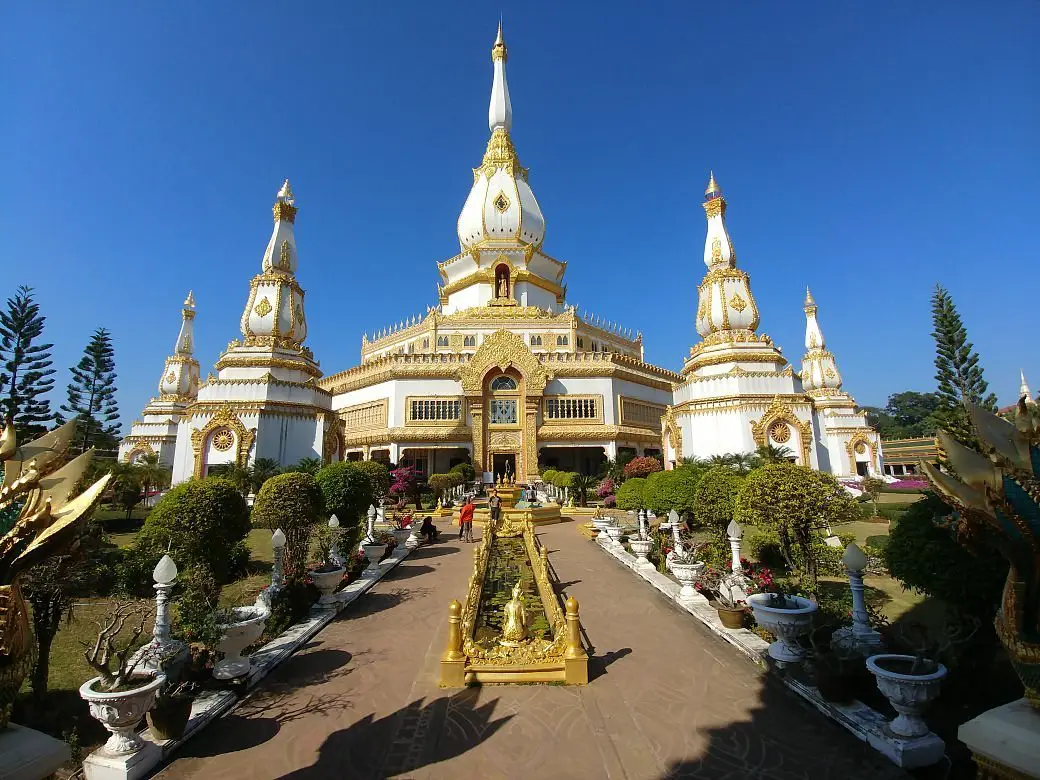
Phra Maha Chedi Chai Mongkhon is the most iconic feature of the site. The stupa blends Central Thai and Isan Buddhist architecture, with design inspiration from Phra Pathom Chedi and Phra That Phanom. Its white structure is decorated with elegant golden ornamentation and surrounded by eight smaller stupas. The main stupa is 101 meters wide, 101 meters long, and 101 meters high. Including the golden spire, it reaches 109 meters. The spire uses approximately 4,750 baht-weight of gold, or about 60 kilograms. These proportions and details make it one of the most outstanding religious monuments in Roi Et.
The interior of Phra Maha Chedi Chai Mongkhon is arranged for worship, learning, and Buddhist reflection. Lower levels include large halls for religious activities and merit-making. Other levels display scenes from the life of the Buddha, Thai decorative art, statues and images of revered monks, and 101 representations of respected Buddhist masters. The stupa also contains a museum related to meditation practice and the spiritual path of Luang Pu Sri Mahaviro. The highest level enshrines sacred Buddhist relics, making the monument a major pilgrimage point for Buddhist visitors.
A visit to Pha Nam Yoi gives travelers several layers of experience. First, visitors enter the forested mountain landscape of Nong Phok. Then they encounter the cliff, the natural moisture of the rock, and the surrounding greenery. Finally, they reach Wat Pha Nam Thip Thep Prasit Wanaram and Phra Maha Chedi Chai Mongkhon, where the natural landscape becomes the setting for large-scale Buddhist devotion. This makes the site suitable for general travelers, families, students, photographers, pilgrims, and international visitors interested in Thai Buddhist culture.
Pha Nam Yoi is best visited slowly. A rushed visit may show only the size of the stupa, but a slower visit reveals the relationship between cliff, forest, temple, art, and faith. The mountain setting strengthens the spiritual atmosphere of the temple. The white-and-gold stupa rises above the green forest and rock landscape, creating a powerful visual and symbolic contrast between nature and sacred architecture.
Visitors should allow at least two to three hours for Pha Nam Yoi and Wat Pha Nam Thip Thep Prasit Wanaram. Those who want to explore the interior of Phra Maha Chedi Chai Mongkhon carefully should allow more time because each level has a different function and atmosphere. Movement inside the stupa should be calm and respectful, especially near sacred relics and images of revered teachers. This is not only a sightseeing building but an active place of worship.
Morning is the most suitable time to visit. The air is cooler, the light is softer, and visitors have enough time to worship and explore before closing time. The rainy season into the cool season gives the forest a fresh green character and a more pleasant atmosphere. During the hot season, visitors should bring water, sun protection, and plan their visit to avoid the strongest midday heat.
Visitor etiquette is important because the site is both a natural area and a Buddhist temple. Dress modestly, speak quietly, remove shoes where required, avoid touching sacred objects, do not climb railings or risky areas for photographs, and keep the forest and temple area clean. Respectful behavior helps preserve the dignity of the temple and the natural environment for local worshippers and future visitors.
For nature-oriented travelers, Pha Nam Yoi shows that Roi Et is not only a province of plains, rice fields, and city landmarks. It also has cliffs, forested mountains, wildlife habitats, and elevated viewpoints. This helps complete the picture of Roi Et as a province with cultural, religious, urban, rural, and natural dimensions. Pha Nam Yoi is therefore one of the best places to understand the mountain side of Roi Et.
From a religious perspective, Pha Nam Yoi is significant because it connects mountain solitude with Buddhist practice. Phra Ajarn Sri Mahaviro’s role in developing the temple and stupa links the site with the Thai forest meditation tradition associated with Phra Ajarn Mun Bhuridatto. The temple is not only a place of grand architecture but also a place connected with meditation, spiritual discipline, and devotion in the Isan Buddhist world.
Phra Maha Chedi Chai Mongkhon is also an important study site for contemporary Thai Buddhist art. Its use of white and gold, its eight surrounding stupas, its interior organization, and its blending of Phra Pathom Chedi and Phra That Phanom influences show how traditional Thai Buddhist forms can be reinterpreted in a modern monumental context. Visitors interested in architecture should take time to observe the details rather than only the scale of the structure.
Photography at Pha Nam Yoi should be done respectfully. Good subjects include the front view of Phra Maha Chedi Chai Mongkhon, the surrounding smaller stupas, the gold decorations, views toward Khao Khiao, the temple approach, and the cliff landscape. Avoid disturbing worshippers, using equipment without permission, or entering restricted or risky areas. Since the site is both a sacred place and a natural landscape, photography should always respect both aspects.
Getting There from Roi Et city is convenient by private car, rental car, or local hired transport. Take the Roi Et – Phon Thong – Nong Phok route via Highways 2044 and 2136. The distance from Roi Et city to Nong Phok District is about 62 km. From there, continue toward Ban Tha Sa-at and Pha Nam Yoi Subdistrict, then drive up Khao Khiao for about 5 km to reach Wat Pha Nam Thip Thep Prasit Wanaram.
Public transport users can travel first to Nong Phok District and then hire local transport to Ban Tha Sa-at and Pha Nam Yoi. From Bangkok, buses on the Bangkok – Mukdahan route pass through Nong Phok, while buses on the Bangkok – Roi Et route end in Roi Et city, where visitors must continue to Nong Phok by local transport. Travelers without private vehicles should arrange return transport clearly, especially for same-day visits.
Pha Nam Yoi can be planned as a half-day or full-day route. A half-day visit can focus on the cliff, Wat Pha Nam Thip Thep Prasit Wanaram, and Phra Maha Chedi Chai Mongkhon. A full-day route can include Pha Mok Mi Wai, Pha Phu Thai, Tham Pha Nam Thip Non-Hunting Area, Nong Phok town, and local restaurants. This route combines worship, forested mountain views, and local food in Nong Phok District.
For families, Pha Nam Yoi offers both beauty and learning. Children and young visitors can learn about rock cliffs, forest ecology, wildlife, Buddhist architecture, sacred relics, and contemporary Thai art in one place. The site is suitable for educational travel because it combines nature, religion, history, and art in a real landscape rather than in a classroom setting.
For international travelers, Pha Nam Yoi is a strong example of the diversity of Thai travel. It brings together a natural cliff, forest, mountain temple, large Buddhist stupa, sacred relics, and the Isan forest-meditation tradition. The site can be understood as a Buddhist park on a forested mountain cliff, where nature and devotion coexist. This makes it more meaningful than a simple viewpoint or temple stop.
Pha Nam Yoi can also be connected with Tham Pha Nam Thip Non-Hunting Area, Pha Mok Mi Wai, and Pha Phu Thai. Nature lovers can visit Phra Maha Chedi Chai Mongkhon in the morning and continue to Pha Mok Mi Wai in the afternoon for forest and cliff scenery. Proper timing is important because the temple closes at 17.00 and mountain roads require careful driving, especially in rainy weather or near evening.
Nearby food options are mostly found along the road to the stupa and in Nong Phok town. Visitors can find local restaurants, grilled fish restaurants, cafes, and simple food shops. It is practical to eat before going up the mountain or prepare drinking water, especially when traveling with elderly visitors or children. The upper temple area is mainly for worship and sightseeing, not for extended food exploration.
Accommodation near Pha Nam Yoi includes hotels, resorts, homestays, and local guesthouses in Nong Phok District and Pha Nam Yoi Subdistrict. Travelers who want to visit Phra Maha Chedi Chai Mongkhon, Pha Mok Mi Wai, and Tham Pha Nam Thip Non-Hunting Area without rushing may stay overnight in Nong Phok. Those who prefer more city services can stay in Roi Et city and travel as a long day trip.
Visitors should prepare for both temple and mountain conditions. Modest clothing, comfortable walking shoes, drinking water, a camera, power bank, and small cash for merit-making are useful. During the rainy season, check road and weather conditions before traveling. During festivals or long weekends, allow more time because the temple and stupa attract many worshippers and visitors.
Pha Nam Yoi and Wat Pha Nam Thip Thep Prasit Wanaram have no admission fee. Visitors can enter, worship, and view the area free of charge during opening hours. Donations are voluntary. Any local transport, parking, or shuttle arrangements within the area should follow the rules of the site on the day of travel. Respecting site management helps keep the visit orderly and safe.
In summary, Pha Nam Yoi (Isan Buddhist Park) in Roi Et Province is a valuable destination combining nature, religion, art, and cultural travel. Located on Khao Khiao at Ban Khok Klang, Pha Nam Yoi Subdistrict, it features a large cliff with year-round water seepage, extensive forest, wildlife habitat, Wat Pha Nam Thip Thep Prasit Wanaram, and the magnificent Phra Maha Chedi Chai Mongkhon. Travelers who want to experience Roi Et beyond the city should visit this site for its forested mountain landscape, Buddhist devotion, and contemporary Thai sacred architecture.
| Name | Pha Nam Yoi (Isan Buddhist Park) |
| Related Name / Type | Pha Nam Yoi / Isan Buddhist Park / Wat Pha Nam Thip Thep Prasit Wanaram / Phra Maha Chedi Chai Mongkhon / Mountain Cliff And Buddhist Destination |
| Location | Ban Khok Klang, Pha Nam Yoi Subdistrict, Nong Phok District, Roi Et Province |
| Address | Ban Khok Klang, Pha Nam Yoi Subdistrict, Nong Phok District, Roi Et Province 45210, Thailand |
| Highlights | A large rock cliff on Khao Khiao with year-round water seepage, rich hardwood forest, Wat Pha Nam Thip Thep Prasit Wanaram, and Phra Maha Chedi Chai Mongkhon, one of Roi Et’s major Buddhist landmarks |
| Approximate Area | Pha Nam Yoi covers about 20,000 rai, while Wat Pha Nam Thip Thep Prasit Wanaram covers about 2,500 rai |
| Elevation | About 200 meters above the surrounding ground and about 380 – 500 meters above sea level |
| Natural Features | Large rock cliff, year-round water seepage, Khao Khiao mountain setting, hardwood forest, and wildlife habitat |
| Wildlife | Wild Boar, Barking Deer, Deer, Jungle Fowl, And Small Wildlife Species In The Mountain Ecosystem |
| Important Features Inside The Area | Wat Pha Nam Thip Thep Prasit Wanaram, Phra Maha Chedi Chai Mongkhon, Buddhist Relics, Meditation Museum, 101 Images Of Revered Buddhist Masters, And Natural Cliff Area |
| Important Monk / Founder | Phra Ajarn Sri Mahaviro, a disciple of Phra Ajarn Mun Bhuridatto, led the construction of Wat Pha Nam Thip Thep Prasit Wanaram and Phra Maha Chedi Chai Mongkhon |
| Phra Maha Chedi Chai Mongkhon Features | A contemporary Central Thai and Isan Buddhist stupa inspired by Phra Pathom Chedi and Phra That Phanom, white with gold ornamentation, surrounded by 8 smaller stupas, 101 meters wide, 101 meters long, 101 meters high, and 109 meters high including the golden spire |
| Recommended Activities | Worshipping Phra Maha Chedi Chai Mongkhon, Visiting Pha Nam Yoi Cliff, Viewing Khao Khiao Landscape, Learning Buddhist Art, Visiting The Meditation Museum, Merit-Making, Nature Photography, And Exploring Nong Phok Travel Routes |
| Travel Information | From Roi Et city, take the Roi Et – Phon Thong – Nong Phok route via Highways 2044 and 2136 for about 62 km to Nong Phok District, then continue to Ban Tha Sa-at, Pha Nam Yoi Subdistrict, and drive up Khao Khiao for about 5 km |
| Current Status | Open for nature visits, worship, and visits to Wat Pha Nam Thip Thep Prasit Wanaram during operating hours |
| Open Days | Daily |
| Opening Hours | 06.00 – 17.00 |
| Fees | No Admission Fee; Donations Are Voluntary |
| Facilities | Worship Area, Viewpoint, Parking Area, Visitor Service Points, Local Shops Along The Access Route, Toilets, Rest Areas, And Route Connection To Tham Pha Nam Thip Non-Hunting Area |
| Main Areas / Zones | 1. Pha Nam Yoi Natural Cliff Zone 2. Wat Pha Nam Thip Thep Prasit Wanaram Zone 3. Phra Maha Chedi Chai Mongkhon Zone 4. Buddhist Relics Worship Zone 5. Meditation Museum And 101 Revered Buddhist Masters Zone 6. Khao Khiao Viewpoint Zone 7. Mountain Access Road And Parking Zone 8. Route Connection To Pha Mok Mi Wai And Tham Pha Nam Thip Non-Hunting Area |
| Responsible / Related Organizations | Wat Pha Nam Thip Thep Prasit Wanaram, Pha Nam Yoi Community, Pha Nam Yoi Subdistrict Municipality, And Local Authorities In Nong Phok District |
| Local Contact Number | Pha Nam Yoi Subdistrict Municipality, Tel. 043-625555 |
| Best Visiting Time | Morning is best for worship and views; the rainy-to-cool season gives the forested mountain landscape a fresh and pleasant atmosphere |
| Visitor Etiquette | Dress Modestly, Speak Quietly, Remove Shoes Where Required, Do Not Touch Sacred Objects, Do Not Climb Risky Areas, Do Not Litter, And Follow Site Staff Instructions |
| Nearby Tourist Attractions | 1. Phra Maha Chedi Chai Mongkhon, About 0 km 2. Wat Pha Nam Thip Thep Prasit Wanaram, About 0 km 3. Tham Pha Nam Thip Non-Hunting Area / Pha Mok Mi Wai, About 4 km 4. Pha Phu Thai, About 6 km 5. Nong Phok Market And Nong Phok Town Area, About 14 km 6. Wat Pa Kung / Wat Prachakhom Wanaram, About 75 km 7. Bueng Phalan Chai, Mueang Roi Et, About 80 km 8. Roi Et Tower 101, About 81 km |
| Nearby Restaurants | 1. VR Pla Phao Restaurant, About 6 km, Tel. 081-209-7330, 089-617-8830 2. 29 Café Nong Phok, About 14 km, Tel. 088-324-3517 3. Big Seafood, About 14 km, Tel. 061-040-6854 4. Wali Land Garden Cafe, About 15 km, Tel. 087-221-1909 5. Today Coffee, About 15 km, Tel. 087-221-1909 6. Pai Nom Sod 168 Milk At Home, About 16 km, Tel. 094-991-2212 |
| Nearby Accommodations | 1. Meethip Hotel, About 14 km, Tel. 089-942-0701, 087-949-9119 2. Baan Fahsai Dao Suay Resort, About 18 km, Tel. 089-009-6439 3. Hanchana’s Sweet Home, About 18 km, Tel. 087-224-2867 4. Phu Dao Homestay, About 20 km, Tel. 065-293-5353 5. Por Palm Si Rung, About 20 km, Tel. 091-054-9815 |
Frequently Asked Questions (FAQ)
Q: Where is Pha Nam Yoi (Isan Buddhist Park) located?
A: Pha Nam Yoi is located at Ban Khok Klang, Pha Nam Yoi Subdistrict, Nong Phok District, Roi Et Province. It is a large rock cliff on Khao Khiao and the location of Wat Pha Nam Thip Thep Prasit Wanaram and Phra Maha Chedi Chai Mongkhon.
Q: What are the opening days and opening hours of Pha Nam Yoi?
A: Pha Nam Yoi is open daily from 06.00 to 17.00.
Q: Is there an admission fee to visit Pha Nam Yoi?
A: No. Visitors can enter the area, worship, and visit the temple without an admission fee. Donations are voluntary.
Q: What is the main highlight of Pha Nam Yoi?
A: The main highlight is the large rock cliff with year-round water seepage, the forested Khao Khiao landscape, Wat Pha Nam Thip Thep Prasit Wanaram, and Phra Maha Chedi Chai Mongkhon.
Q: Why is Phra Maha Chedi Chai Mongkhon important?
A: It is a large Buddhist stupa enshrining sacred Buddhist relics, designed with contemporary Central Thai and Isan Buddhist art, and respected as a major spiritual landmark of Roi Et and northeastern Thailand.
Q: How do visitors travel from Roi Et city to Pha Nam Yoi?
A: From Roi Et city, take the Roi Et – Phon Thong – Nong Phok route via Highways 2044 and 2136 for about 62 km to Nong Phok, then continue to Ban Tha Sa-at and drive up Khao Khiao for about 5 km.
Q: When is the best time to visit Pha Nam Yoi?
A: Morning is the best time because the air is cooler, the light is pleasant, and visitors have enough time to worship and explore before closing. The rainy-to-cool season gives the forest a fresher atmosphere.
Q: What nearby places can be visited with Pha Nam Yoi?
A: Nearby and connected places include Pha Mok Mi Wai, Pha Phu Thai, Tham Pha Nam Thip Non-Hunting Area, Nong Phok Market, Wat Pa Kung, Bueng Phalan Chai, and Roi Et Tower 101.
 Category: ●Nature and Wildlife
 Group: ●Mountain (Doi)
Last Update : 2 MonthAgo
 Last Update : 2 MonthAgo
 Click to Access the Navigation Map GPS
Pha Nam Yoi (Isan Buddhist Park) Map
Recommend

 Art, Culture and Heritage
 Historical Sites and Monuments(3)
 Landmarks and Memorials(5)
 Art, Craft Centres, Tradition(2)
 Museums(1)
 Educational Places
 Educational Gardens, Farm(3)
 Places of Worship
 Temple(35)
 Other Sacred Sites(6)
 Suburban Living
 Village, Community(1)
 Local Market(1)
 National Parks and Marine Reserves(1)
Mountain (Doi)(2)
National Parks and Marine Reserves(1)
Mountain (Doi)(2)
 Dam, Reservoir, Lake(8)
 Waterfalls(1)
 Flower Field(1)
 River, Canal(4)
 Entertainment and Agricultural
 Zoos and Aquariums(1)
 Stadium(1)
 Farms, Parks and Ecotourism(5)
 Shopping
 Shopping and Night Market(1)
 Travel Articles, Recipes
 Travel Review, Food Review(1)


