
lovethailand home >Northeastern Travel Attractions >Nong Bua Lamphu Travel Attractions >Si Bun Ruang >Nong Bua Tai > Nong Bua Sang Sian
TL;DR: Nong Bua Sang Sian is located at Wat Chantharaprasit, Ban Sang Sian, Nong Bua Tai Subdistrict, Si Bun Rueang District, Nong Bua Lamphu Province, open Daily, hours 08.30 – 16.30.
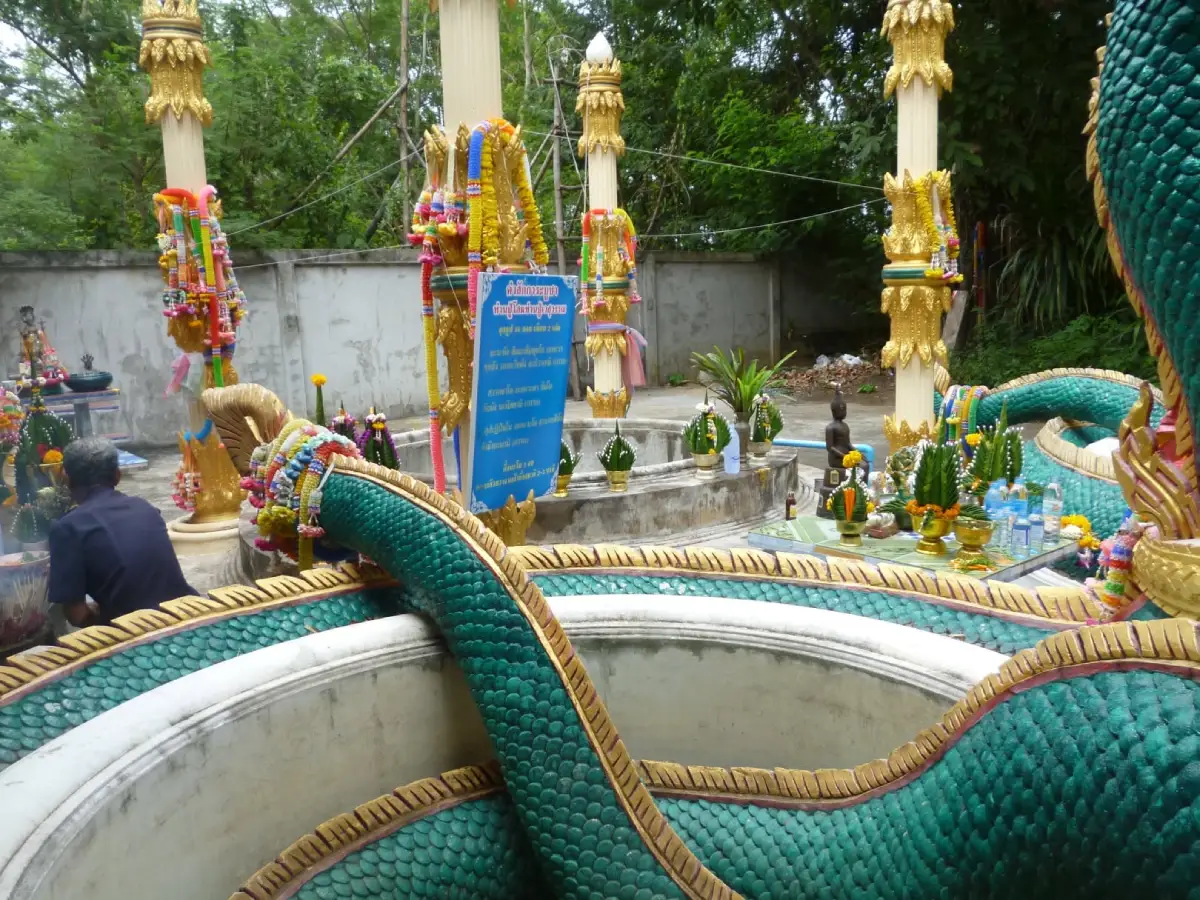
Nong Bua Sang Sian
Open Days: Daily
Opening Hours: 08.30 – 16.30
Nong Bua Sang Sian, also known as the Sacred Well of Bo Sang Sian, is an ancient well located inside Wat Chantharaprasit in Ban Sang Sian, Nong Bua Tai Subdistrict, Si Bun Rueang District, Nong Bua Lamphu Province. The well is deeply connected with local faith, temple history, and Isan community legends. Local people tell stories of mysterious light appearing from the well at night, especially around Buddhist holy days. This quiet cultural site is suitable for travelers interested in sacred wells, local Buddhist temples, oral traditions, and the spiritual heritage of northeastern Thailand.
Nong Bua Sang Sian is the local name of an ancient sacred well inside Wat Chantharaprasit in Ban Sang Sian, Nong Bua Tai Subdistrict, Si Bun Rueang District, Nong Bua Lamphu Province. Although it may appear modest at first sight, this old well carries strong cultural meaning for the local community. It is not merely a water source; it is a place of memory, belief, and respect. The well is known for a local legend that says light once appeared from it at night. Even today, people still speak of occasional light appearing from the well, particularly on Buddhist holy days.
Wat Chantharaprasit is a local Buddhist temple under the Dhammayut order. It is located in Ban Sang Sian, Moo 3, Nong Bua Tai Subdistrict. The temple has long served as a spiritual center for the community. Within its grounds are the ancient well, brass Buddha images, a statue of Luang Pu Khao Analayo, and Luang Por Than Jai, all of which form part of the temple’s religious identity. Visiting Nong Bua Sang Sian therefore means entering a living temple space where history, faith, and local belief still remain closely connected.
The name “Sang Sian” has an important local meaning. In this context, “sang” refers to a well, while “sian” conveys the idea of smoothness, beauty, evenness, and refined form. The name therefore suggests a well that is carefully shaped, neat, and beautiful. This meaning reflects both the physical character of the well and the respect that villagers have given to it for generations. In traditional rural Isan society, wells were central to community life because they provided water, supported settlement, and often became associated with spiritual protection.
The legend surrounding Nong Bua Sang Sian is one of the reasons the place continues to attract interest. Local stories describe the well as ancient and sacred. Some accounts connect the area with an old settlement, a local ruler, hidden treasures, and spiritual guardians. Stories also mention the sound of a gong being heard on full-moon Buddhist holy nights in the past. These narratives do not function merely as mysterious tales; they preserve the community’s relationship with the place and show how local people understand sacred space through memory, respect, and inherited belief.
The story of light appearing from the well is especially significant. Elders in the community have passed down accounts of light shining from the well at night. Today, the light is not described as a regular event, but people still speak of it as appearing on certain occasions, especially around Buddhist holy days. For visitors, this belief should be understood as part of the local spiritual landscape. It is a cultural story that reflects the connection between Buddhism, community faith, and the unseen world in traditional Isan thought.
From a cultural perspective, Nong Bua Sang Sian is an example of a sacred water source in northeastern Thailand. In Isan communities, water sources are often connected with guardians, ancestral memory, fertility, temple life, and local rituals. A well can become sacred not only because of its age, but also because of the stories, experiences, and collective memory attached to it. Nong Bua Sang Sian stands as a place where water, religion, and oral tradition meet in one quiet temple compound.
Wat Chantharaprasit was established in 1924. The temple was built by local villagers in an area associated with Luang Pu Khao Analayo, a highly respected forest-meditation monk who once stayed there for spiritual practice. The temple received its royal boundary for ordination ceremonies on 12 January 1979 under the name Wat Chantharaprasit, with a boundary measuring 40 meters by 50 meters. This history gives the temple a clear religious foundation and helps explain why the ancient well is preserved within a place of continuing Buddhist practice.
The association with Luang Pu Khao Analayo gives the temple additional meaning for those interested in Thai forest Buddhism. Luang Pu Khao is widely respected among Buddhist practitioners, particularly in northeastern Thailand. The fact that this area was connected with his meditation practice contributes to the spiritual value of the temple. Inside Wat Chantharaprasit, visitors can also pay respect to his statue, making the visit more meaningful for those who wish to understand the temple beyond the sacred well itself.
Nong Bua Sang Sian also helps visitors understand how local place names preserve history. In many Isan communities, the names of villages, temples, wells, ponds, and sacred trees often hold clues to older stories. Ban Sang Sian is more than a village name; it is connected to the well that gives the area cultural identity. Once visitors understand the meaning of the name, the experience of seeing the well becomes richer because the physical site and the local language begin to support each other.
The atmosphere of Wat Chantharaprasit is quiet and local. This is not a large commercial tourist attraction, and its charm lies in simplicity. Visitors should walk slowly, observe the temple environment, and approach the sacred well respectfully. The beauty of Nong Bua Sang Sian is not based on dramatic architecture or entertainment. It lies in stillness, local belief, oral history, and the quiet dignity of a sacred site that has remained meaningful to the community.
For travelers interested in local history, Nong Bua Sang Sian offers a different view of Nong Bua Lamphu Province. The province is often known for natural sites, temples, and rural landscapes, but small sacred places like this reveal the deeper cultural layers of the region. An ancient well inside a village temple can tell stories of settlement, water use, spiritual protection, and community identity. This makes the site valuable for cultural travelers, researchers, teachers, and visitors who enjoy meaningful local destinations.
The well’s main appeal is the way it connects water, nature, Buddhism, and legend. Physically, it is an old well. Culturally, it is a sacred space guarded by memory and belief. The story of light appearing at night adds a spiritual dimension, but visitors should approach it with respect rather than curiosity alone. For local people, the legend is part of their inherited relationship with the place, and this relationship should be treated with care.
Visitors should observe proper manners because the well is located inside an active Buddhist temple. Modest clothing is recommended. Visitors should avoid loud noise, throwing anything into the well, touching sacred objects unnecessarily, or behaving in a way that disturbs monks or local worshippers. If additional information is needed, it is best to ask monks, temple caretakers, or local officials politely. Respectful behavior helps preserve both the physical site and its spiritual atmosphere.
For cultural tourism, Nong Bua Sang Sian is best visited by travelers who are interested in slow, reflective experiences. It is not a place designed for quick entertainment. Instead, it offers insight into how local communities remember the past and preserve sacred stories. The well allows visitors to see how belief, landscape, and Buddhist practice are woven together in everyday village life in Isan.
Wat Chantharaprasit also features Luang Por Than Jai and Phra Phuttha Yanti Chanthara Prathip Sawali Than Jai, both associated with local devotion. Visitors can combine the visit to the sacred well with paying respect to these important Buddhist images within the temple. This makes the temple visit more complete, as travelers can experience both the ancient well and the active religious life that continues around it.
The temple has also played a role in Buddhist education. Records mention that the temple opened a Dhamma studies school in 1944 and a Sunday Buddhist studies center in 1990. This shows that Wat Chantharaprasit has served not only as a ritual site, but also as a place of learning for the community. The sacred well therefore belongs to a temple environment shaped by worship, education, meditation, and community life.
The historical list of abbots of Wat Chantharaprasit reflects the continuity of temple leadership over many generations. Known names include Luang Pho Luang Wijan, Luang Pho No Attano, Luang Pho Kham Kalyano, Luang Pho Li Attalo, Phra Khamdi Dhammadharo, Phra Khun Khunissaro, Phra Phimpha Panyaphalo, Phra Wilai Khemiyo, Phra Prasit Sitthiyano, Phra Khru Bandit Saraphan, Phra Thongpan Panyadharo, and Phra Phikun Aphakaro. These names represent the long-standing religious administration of the temple.
Current ecclesiastical information for Nong Bua Lamphu Province lists Chao Athikan Phaithun Yanawaro as being attached to Wat Chantharaprasit in Nong Bua Tai Subdistrict and serving as secretary to the Dhammayut district ecclesiastical chief of Si Bun Rueang. This information is useful for visitors or local agencies who need to coordinate with the temple or verify religious administration details.
Getting There is most convenient by private car or rental car. From Nong Bua Lamphu town, travel toward Si Bun Rueang District, then continue to Nong Bua Tai Subdistrict and Ban Sang Sian. The route passes through rural communities and agricultural landscapes, giving visitors a calm view of local Isan life. From Si Bun Rueang town, the temple can be reached more easily as a short cultural stop within the district.
The visit can be arranged as either a short stop or part of a full-day cultural route. If time is limited, visitors can pay respect at Wat Chantharaprasit, visit Nong Bua Sang Sian, and continue to nearby places in Si Bun Rueang town for food or rest. With more time, the route can be extended to other local cultural and natural sites such as Bueng Ngio, the historic wooden sim at Wat Charoen Songtham, Don Po community sites, and Pha Sam Yot.
The best time to visit is during the morning or afternoon. Daylight makes it easier to see the temple grounds and the sacred well clearly, and daytime visits are safer and more appropriate for general travelers. Although the legend of light is associated with nighttime and Buddhist holy days, visitors should treat this as a local spiritual tradition rather than a scheduled event. The site is best appreciated with calm attention and respect for the temple environment.
For photographers, Nong Bua Sang Sian is suitable for documentary-style cultural photography. Wide views of the temple grounds, the well area, walking paths, and Buddhist elements can help capture the context of the site. Visitors should avoid staged or intrusive photography, especially around sacred objects or people who are making merit. Photography should preserve the dignity of the place rather than turning it into a spectacle.
Nong Bua Sang Sian is also suitable for educational trips. Teachers, students, researchers, and cultural travelers can use the site to study the relationship between water sources, Buddhist temples, oral legends, and local identity. The well shows that history is not always preserved only in large monuments; it can also live in small sacred places, local names, community stories, and the continued respect of villagers.
In terms of preservation, the sacred well should be cared for as both a religious and cultural heritage site. Keeping the area clean, preventing inappropriate behavior, and communicating its history clearly can help future visitors understand its value. The legend of the light, the meaning of the name Sang Sian, the connection with Wat Chantharaprasit, and the role of Luang Pu Khao Analayo are all important parts of the site’s identity.
For foreign visitors, the simplest way to understand Nong Bua Sang Sian is as an ancient sacred well inside a local Buddhist temple. Its value comes from the combination of water, faith, Buddhist memory, and local legend. The story of light appearing on Buddhist holy days should be understood as a local spiritual narrative that reflects community belief. Visiting with respect allows travelers to appreciate the deeper cultural meaning of this quiet place in Nong Bua Lamphu.
Overall, Nong Bua Sang Sian is a small but meaningful cultural destination in Ban Sang Sian, Nong Bua Tai Subdistrict, Si Bun Rueang District, Nong Bua Lamphu Province. Its importance comes from the ancient well, the meaning of its name, the legend of mysterious light, the association with Buddhist holy days, the history of Wat Chantharaprasit, and the temple’s link with Luang Pu Khao Analayo. It is a place best visited with calmness, respect, and a willingness to listen to the memory of the local community.
| Name | Nong Bua Sang Sian / Sacred Well Of Bo Sang Sian |
| Location | Wat Chantharaprasit, Ban Sang Sian, Nong Bua Tai Subdistrict, Si Bun Rueang District, Nong Bua Lamphu Province |
| Address | Wat Chantharaprasit, Ban Sang Sian, Moo 3, Nong Bua Tai Subdistrict, Si Bun Rueang District, Nong Bua Lamphu 39180, Thailand |
| Highlights | Ancient sacred well inside Wat Chantharaprasit, known for local legends of mysterious light appearing at night and its role as a spiritual landmark of Ban Sang Sian |
| History | Wat Chantharaprasit was established in 1924 and received its royal boundary on 12 January 1979. The sacred well is an old religious and cultural site within the temple grounds |
| Name Origin | “Sang” means well, while “Sian” refers to smoothness, beauty, evenness, and refined form |
| Distinctive Features | Ancient well associated with legends of light, gong sounds on full-moon Buddhist holy days, and sacred guardianship within the local community |
| Travel Information | Best reached by private car or rental car. From Nong Bua Lamphu town, travel toward Si Bun Rueang District, then continue to Nong Bua Tai Subdistrict and Ban Sang Sian |
| Current Status | Open to visitors as a sacred cultural site and local attraction of Nong Bua Tai Subdistrict |
| Open Days | Daily |
| Opening Hours | 08.30 – 16.30 |
| Main Areas / Zones | Sacred Well Of Bo Sang Sian Luang Por Than Jai At Wat Chantharaprasit Phra Phuttha Yanti Chanthara Prathip Sawali Than Jai Statue Of Luang Pu Khao Analayo Ordination Hall And Temple Grounds Of Wat Chantharaprasit |
| Abbot / Caretaker | Chao Athikan Phaithun Yanawaro, attached to Wat Chantharaprasit and serving as secretary to the Dhammayut district ecclesiastical chief of Si Bun Rueang |
| Main Contact Number | Nong Bua Tai Subdistrict Administrative Organization, Tel. 0-4200-2252 / Chao Athikan Phaithun Yanawaro, Tel. 089-943-6704 |
| Official Website / Official Page | Nong Bua Tai Subdistrict Administrative Organization, nongboatai.go.th |
| Nearby Tourist Attractions | 1. Luang Por Than Jai At Wat Chantharaprasit, about 0 km 2. Phra Phuttha Yanti Chanthara Prathip Sawali Than Jai, about 0 km 3. Bueng Ngio, Nong Bua Tai Subdistrict, about 8 km 4. Historic Wooden Sim At Wat Charoen Songtham, Ban Don Po, about 10 km 5. Don Po Village Guardian Shrine, about 10 km 6. Wat Pa Pha Sam Yot / Pha Sam Yot, Si Bun Rueang District, about 35 km |
| Nearby Restaurants | 1. R&B Cafe, Si Bun Rueang District, about 14 km 2. PunThai Coffee, Road 228 Si Bun Rueang, about 15 km, Tel. 061-414-3547 3. Na Khun Yai Restaurant, about 15 km, Tel. 098-258-9838 4. Dab Samak Photchana Restaurant, about 15 km, Tel. 082-126-5960 5. Sawan Baan Na Restaurant, about 17 km, Tel. 084-787-4847, 064-748-0781 |
| Nearby Accommodations | 1. P2 Garden View Si Bun Rueang, about 13 km, Tel. 061-079-7136 2. TonLiw Hotel Si Bun Rueang, about 13 km 3. Namfon Resort 24-Hour Rooms, about 14 km, Tel. 085-683-4162 4. Hi Creek Resort & Campsite, about 14 km, Tel. 082-570-5925 5. BANSUAN HOTEL, about 15 km |
Frequently Asked Questions (FAQ)
Q: Where is Nong Bua Sang Sian located?
A: Nong Bua Sang Sian, or the Sacred Well of Bo Sang Sian, is located inside Wat Chantharaprasit in Ban Sang Sian, Moo 3, Nong Bua Tai Subdistrict, Si Bun Rueang District, Nong Bua Lamphu Province.
Q: Why is Nong Bua Sang Sian important?
A: It is an ancient sacred well respected by the local community and associated with legends of mysterious light, gong sounds on Buddhist holy nights, and the spiritual identity of Ban Sang Sian.
Q: What does the name Sang Sian mean?
A: “Sang” means well, while “Sian” refers to smoothness, beauty, evenness, and refined form. The name describes a well that is considered neat, beautiful, and culturally meaningful.
Q: Does the sacred well really produce light?
A: Local people tell stories of light appearing from the well at night. Today, the story is still associated with occasional appearances of light, especially around Buddhist holy days.
Q: How is Wat Chantharaprasit connected with Luang Pu Khao Analayo?
A: Wat Chantharaprasit was built in an area where Luang Pu Khao Analayo once stayed for meditation practice. A statue of Luang Pu Khao is also kept within the temple.
Q: What should visitors wear when visiting?
A: Visitors should dress modestly because the well is inside an active Buddhist temple. Quiet and respectful behavior is expected.
Q: Who should visit Nong Bua Sang Sian?
A: The site is suitable for travelers interested in old temples, sacred wells, local legends, Isan cultural heritage, and quiet spiritual destinations.
Q: What nearby places can be combined with the visit?
A: Nearby places include Luang Por Than Jai at Wat Chantharaprasit, Bueng Ngio, the historic wooden sim at Wat Charoen Songtham, Don Po Village Guardian Shrine, and Pha Sam Yot.
 Category: ●Places of Worship
 Group: ●Other Sacred Sites
Last Update : 2 MonthAgo
 Last Update : 2 MonthAgo
 Click to Access the Navigation Map GPS
 Art, Culture and Heritage
 Historical Sites and Monuments(4)
 Landmarks and Memorials(1)
 Art, Craft Centres, Tradition(1)
 Museums(3)
 Temple(10)
Other Sacred Sites(6)
Temple(10)
Other Sacred Sites(6)
 Suburban Living
 Village, Community(3)
 Nature and Wildlife
 National Parks and Marine Reserves(3)
 Mountain (Doi)(5)
 Dam, Reservoir, Lake(5)
 Waterfalls(1)
 Caves(6)
 River, Canal(2)
 Bays and Beaches(1)
 Other natural attractions(3)


