
lovethailand home >Northeastern Travel Attractions >Nakhon Ratchasima Travel Attractions >Khon Buri >Chaliang > Wua Dang Cave (Khao Tham Wua Dang Korat)
TL;DR: Wua Dang Cave (Khao Tham Wua Dang Korat) is located at Khao Luk Chang, Chaliang Subdistrict, Khon Buri District, Nakhon Ratchasima Province, Thailand, open Daily, hours 08.00 – 17.00.
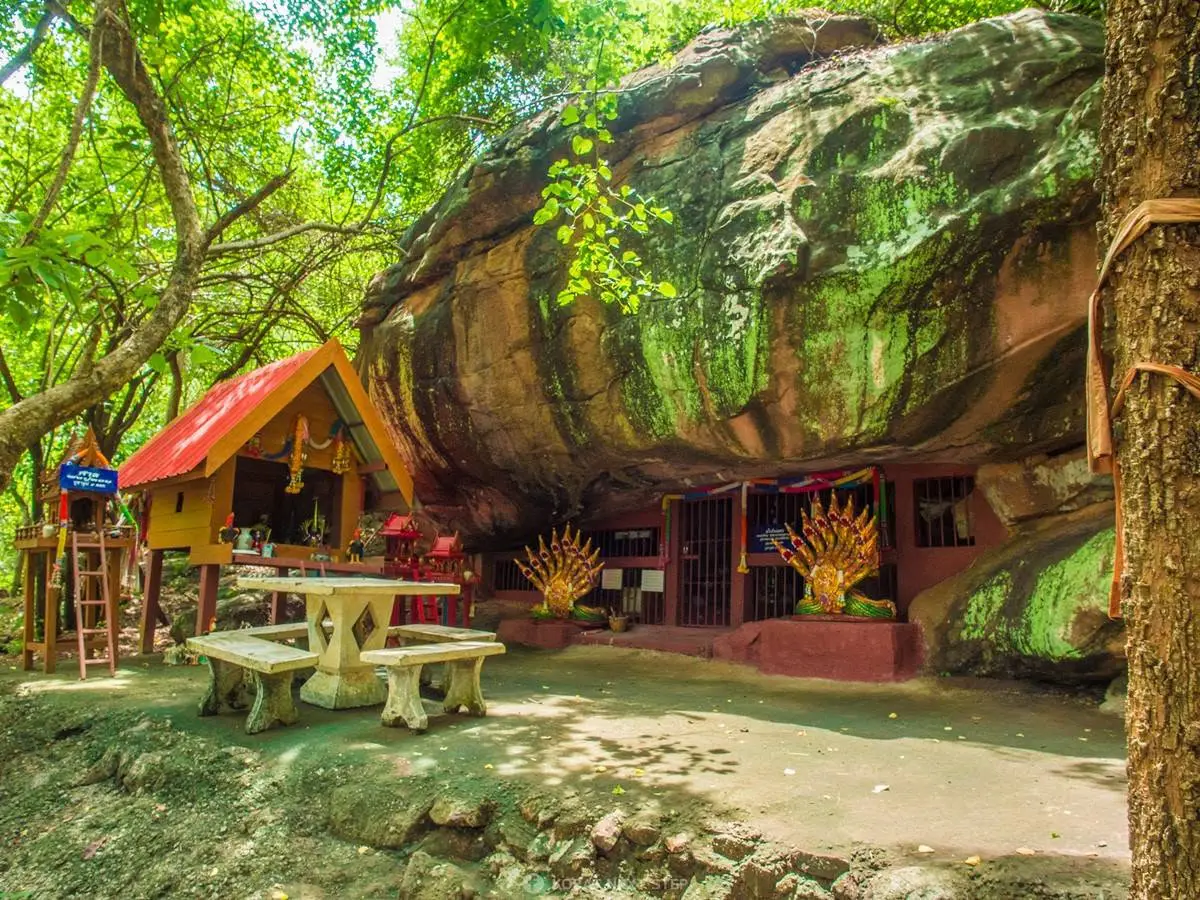
Wua Dang Cave (Khao Tham Wua Dang Korat)
Open Days: Daily
Opening Hours: 08.00 – 17.00
Tham Wua Daeng Archaeological Site in Nakhon Ratchasima is an important Khmer-style Hindu rock relief site located at Khao Luk Chang, Chaliang Subdistrict, Khon Buri District, about 13 km from Khon Buri town. The site is a shallow red sandstone rock shelter with a low-relief carving on the inner wall. The carving depicts Shiva holding a trident and Uma, or Parvati, seated on Nandi the sacred bull, accompanied by attendant deities holding ceremonial fans and figures of sages in reverence. The relief is dated to around the late 16th to early 17th Buddhist century, or approximately 950 years ago. Today, the carving is protected by an iron fence. The site is suitable for travelers interested in Khmer art, Hindu iconography, archaeology, local history, conservation, and scenic views of Khon Buri’s countryside.
Tham Wua Daeng Archaeological Site in Nakhon Ratchasima Province is one of the most meaningful historical attractions in Khon Buri District. Located at Khao Luk Chang in Chaliang Subdistrict, about 13 km from Khon Buri town, it is not a deep cave system but a shallow red sandstone rock shelter. Its importance comes from a rare low-relief carving on the inner wall of the shelter. This carving preserves a Hindu image associated with Khmer art and reflects the cultural connection between the upper Mun River basin and ancient Khmer religious traditions almost a thousand years ago.
The most important feature of Tham Wua Daeng is the low-relief image of Shiva holding a trident and Uma, also known as Parvati, seated together on Nandi, the sacred bull of Shiva. This iconographic theme is known as Uma-Mahesvara, a representation of Shiva and Uma as a divine couple. Unlike many Khmer monuments that survive as stone temples or freestanding sculptures, Tham Wua Daeng uses a natural red sandstone rock wall as the surface for sacred art. This makes the site especially distinctive: nature, religion, and sculpture exist in the same place.
The relief contains several important details. In front of Nandi are 2 kneeling divine figures showing reverence. Behind Nandi are attendant figures holding chamara fans and a ceremonial fan or parasol-like object with peacock-tail decoration. Additional standing figures, often interpreted as sages or attendants, appear in a gesture of worship. These figures do more than decorate the scene; they create a complete ritual setting around Shiva and Uma. The composition shows hierarchy, devotion, and sacred movement within a limited rock surface.
The historical value of the carving comes from its artistic style and dating. Specialists have connected details such as the clothing of Shiva and Uma with sculpture from other Khmer-period sites in the Mun River basin. The relief has been dated to around the late 16th to early 17th Buddhist century, or about the 11th century CE. This places it roughly 950 years ago, within a period associated with major Khmer artistic activity in the region, including the broader cultural world of Phimai and Angkor.
The location of Tham Wua Daeng is also significant. Khon Buri is a district of water sources, hills, agricultural communities, reservoirs, forests, and routes connected with the Mun River system. The presence of a Hindu rock relief in this landscape indicates that the area was not only a natural and agricultural zone but also a place with ancient ritual importance. The relief suggests that communities in or near this area participated in religious traditions linked to Shiva worship and Khmer cultural influence.
The cave itself is best understood as a sandstone rock shelter rather than a long underground cave. The red sandstone wall forms a natural sacred backdrop, and the relief was carved directly into this rock surface. The red tone of the stone helps define the character of the place and gives meaning to the name Wua Daeng. Visitors should approach the site as a small but highly important art-historical place. Its value is not in size, but in the rarity and meaning of the surviving carving.
The relief at Tham Wua Daeng is fragile. Parts of the carving have been damaged or stolen in the past, so an iron fence now protects the relief from direct contact. This protective barrier should be understood as an essential conservation measure. It prevents touching, scratching, chipping, and accidental damage. Visitors can still appreciate the carving from outside the barrier, but should never try to reach through, climb, or disturb the protective structure.
A visit to Tham Wua Daeng should not be rushed. Travelers should allow at least 45 minutes to 1 hour to walk up to the site, view the rock shelter, study the relief, and observe the surrounding landscape. Visitors who take more time can also enjoy the upper viewpoint, where the landscape of Chaliang Subdistrict and the southern part of Khon Buri can be seen. This combination of ancient art and local scenery makes the site more complete than a brief roadside stop.
Getting There is most convenient from Khon Buri town. Travel toward Chaliang Subdistrict and Ban Chaliang, then continue to the Khao Luk Chang area. The distance from Khon Buri town is about 13 km. Vehicles can reach the local access area, and visitors continue on foot toward the rock shelter. Because the site is on a hill and connected with a local religious area, daytime visits are recommended. Morning or early afternoon provides safer walking conditions and clearer light for viewing the relief.
The site may be referred to by several names, including Tham Wua Daeng Archaeological Site, Tham Wua Daeng, Wat Tham Wua Daeng, or Wat Khao Tham Wua Daeng. These names reflect the layered identity of the place as both an ancient art site and a local sacred area. For navigation and research, the most accurate keywords are “Tham Wua Daeng Chaliang Khon Buri” or “Tham Wua Daeng Archaeological Site Nakhon Ratchasima.”
From a religious perspective, the relief clearly reflects Shaivism, a Hindu tradition centered on Shiva. Shiva is represented with the trident, while Uma or Parvati appears as the divine consort. Nandi, the sacred bull, is both vehicle and devotee of Shiva. The presence of attendants and sages reinforces the sacred authority of the divine couple. The rock shelter was therefore not simply a decorative surface; it functioned as a meaningful religious space.
Tham Wua Daeng also helps visitors understand the diversity of Khmer art in Nakhon Ratchasima. Phimai is the best-known large Khmer sanctuary in the province, but Khmer cultural expression was not limited to grand temples. It also appeared in smaller religious places, rock shelters, caves, and natural settings. Tham Wua Daeng is an excellent example of a smaller but academically important site where a natural cliff became a sacred image surface.
Visitors should study the composition carefully. Shiva and Uma occupy the central position on Nandi, creating the main sacred focus. Kneeling figures in front express reverence, while attendant figures at the back complete the ritual scene. The arrangement creates a sense of procession and worship. Even though the carving is not large, its iconographic structure is rich and meaningful. The more carefully visitors look, the more clearly they can see how the relief communicates devotion and hierarchy.
The site is small in scale when compared with major monuments, but its cultural value is very high. A rock relief in its original position is difficult to protect, difficult to restore, and impossible to replace if damaged. For this reason, visitors should behave as conservation partners. Do not touch the relief, do not climb the rock surface, do not scratch or write on the stone, and do not create smoke, vibration, or physical pressure near the carving.
The hilltop area near Tham Wua Daeng also offers scenic value. From the upper area, visitors can see the countryside of Chaliang Subdistrict, rice fields, and the wider terrain of southern Khon Buri. During the rainy season and early cool season, the surrounding fields and trees become especially green. The viewpoint adds a natural dimension to the historical visit and helps travelers understand why this hill could have carried both practical and sacred meaning for local communities.
In addition to the ancient relief, the area contains local sacred features, including unusual rock formations, natural water holes, and a Buddha footprint worship area on the hill. These elements show how the site has accumulated layers of belief over time. The ancient Hindu relief represents one religious layer, while present-day Buddhist and local beliefs form another. This coexistence of traditions gives Tham Wua Daeng a special cultural depth.
Tham Wua Daeng is suitable for travelers interested in archaeology, Khmer art, Hindu iconography, local history, sacred landscapes, and quiet viewpoints. Families can use the visit as a learning experience about ancient religions, art conservation, and the difference between Hindu and Buddhist imagery. Students and cultural groups will find the site useful because it is compact, readable, and directly connected with broader Khmer-period history in the Mun River basin.
Visitors should dress modestly and prepare for a short hill walk. Shoes with good grip are recommended. A hat, drinking water, and sun protection are useful, especially in the hot season. During the rainy season, the path and rocks can be slippery, so visitors should walk carefully and avoid the area during heavy rain. The best visiting time is between 08.00 and 17.00, when there is enough daylight to walk safely and view the relief clearly.
The best season to visit is late rainy season to cool season, when the surrounding landscape is green and the weather is more comfortable. In the hot season, early morning is preferable. In the rainy season, the scenery is fresh, but the walking route can be slippery. Travelers should choose a time that balances visibility, safety, and comfort. Since the site is a cultural heritage area, visiting calmly and respectfully is more important than rushing through the itinerary.
Tham Wua Daeng can be combined with other attractions in Khon Buri. Nearby places include Pha Sam Kloe, Lam Chae Dam, Lam Mun Bon Dam, Chom Thong Beach, Phu King Fa, the 100-Year Wooden Bridge, and Prang Khon Buri. These sites show different sides of the district: ancient art, viewpoints, reservoirs, water landscapes, local communities, and forested terrain. A half-day trip can combine Tham Wua Daeng with Pha Sam Kloe, while a full-day trip can continue to the reservoirs.
Pha Sam Kloe is one of the most relevant nearby viewpoints. Travelers often visit it for views over Lam Chae Dam and the surrounding landscape. A practical route is to visit Tham Wua Daeng in the morning or early afternoon, then continue to Pha Sam Kloe later in the day. This creates a balanced journey between history and scenery. Lam Chae Dam is also a good place for riverside dining, rafting activities, and a wider view of Khon Buri’s water resources.
Lam Mun Bon Dam and Chom Thong Beach can also extend the trip. Lam Mun Bon is linked with the upper Mun River system, while Chom Thong Beach offers a freshwater-beach atmosphere where local visitors relax. Adding these places after Tham Wua Daeng gives travelers a fuller understanding of Khon Buri as a district shaped by water, forest, agriculture, and history.
For photography, the main subjects are the relief, the red sandstone shelter, and the hilltop view. Visitors should avoid using flash very close to the carving and should never push cameras or phones through the protective fence. Scenic photos should be taken from safe ground. Do not climb rock edges or stand in unstable positions for a better angle. The most valuable photographs are those taken without harming the place.
International travelers should understand Tham Wua Daeng as a Khmer-style Hindu low-relief carving on a natural red sandstone rock shelter. It is not a deep cave temple and not a large stone sanctuary. Its importance lies in the surviving image of Shiva, Uma, and Nandi in its original natural setting. This makes it a rare and meaningful heritage site for travelers who want to understand Nakhon Ratchasima beyond the better-known monuments.
Responsible behavior is essential. Do not touch the relief, scratch the wall, climb the fence, burn incense near the carving, leave trash, or make loud noise. The rock surface has survived for almost a millennium, but it can still be damaged by careless human action. Visiting quietly and keeping distance from the relief are simple ways to help preserve the site.
For Khon Buri District, Tham Wua Daeng is a local identity marker. It proves that the district is not only a place of reservoirs, forests, agriculture, and scenic landscapes, but also a place with deep historical roots. The relief connects present-day Chaliang Subdistrict with ancient religious culture and shows that the area formed part of a wider cultural landscape in the Mun River basin.
In conclusion, Tham Wua Daeng Archaeological Site is one of the most valuable cultural attractions in Khon Buri, Nakhon Ratchasima. Its key feature is the 950-year-old Khmer-style Hindu low relief of Shiva, Uma, and Nandi carved into a red sandstone rock shelter. The site combines archaeology, sacred art, local belief, hill scenery, and conservation significance. With respectful behavior, daytime travel, and careful attention to the relief, visitors can experience a compact but deeply meaningful heritage site that reveals an important layer of Nakhon Ratchasima’s ancient past.
| Name | Tham Wua Daeng Archaeological Site |
| Location | Khao Luk Chang, Chaliang Subdistrict, Khon Buri District, Nakhon Ratchasima Province, Thailand |
| Address | Chaliang Subdistrict, Khon Buri District, Nakhon Ratchasima 30250, Thailand |
| Coordinates | 14.4869176479, 102.280695816 |
| Highlights | Rare Khmer-style Hindu low relief carved on a red sandstone rock shelter, depicting Shiva holding a trident and Uma seated on Nandi, accompanied by attendants and sages |
| History / Importance | An important cultural heritage site of Khon Buri, dated to around the late 16th to early 17th Buddhist century, or approximately 950 years ago, reflecting Shaivite Hindu belief and Khmer art in the upper Mun River basin |
| Name Origin | The name is associated with the red sandstone shelter and the sacred bull Nandi in the carved relief |
| Distinctive Features | A shallow red sandstone rock shelter with a low-relief image of Shiva, Uma, Nandi, attendant figures holding ceremonial fans, and sages in worship |
| Travel Information | Travel from Khon Buri town to Chaliang Subdistrict and Ban Chaliang, about 13 km, then continue to the Khao Luk Chang / Tham Wua Daeng access area and walk up to the rock shelter |
| Current Status | Open as a local archaeological and sacred site. Visitors should go during daylight and follow conservation rules around the protected relief. |
| Open Days | Daily |
| Opening Hours | 08.00 – 17.00 / Chaliang Subdistrict Administrative Organization contact hours: Monday-Friday, 08.30 – 16.30 |
| Fees | No government-announced entrance fee. Visitors may make voluntary merit donations or support local site maintenance. |
| Best Time To Visit | Morning to early afternoon, especially from late rainy season to cool season when the surrounding countryside is green and the weather is more comfortable |
| Facilities | Local parking area near the access point, walking route to the rock shelter, worship area, viewpoint area, and iron fence protecting the ancient relief |
| Main Areas / Zones | Khao Luk Chang Access Zone Red Sandstone Rock Shelter Zone Shiva And Uma Low Relief Zone Iron Fence Protection Zone Unusual Rock And Natural Water-Hole Zone Buddha Footprint And Worship Zone Chaliang Countryside Viewpoint Zone |
| Caretaker | Fine Arts Department through Phimai National Museum / Chaliang Subdistrict Administrative Organization / Nakhon Ratchasima Local Natural And Cultural Environment Conservation Unit / local community and sacred-site caretakers |
| Main Contact Number | Chaliang Subdistrict Administrative Organization Tel. 044-346-252 / Phimai National Museum Tel. 044-471-167 / Nakhon Ratchasima Local Natural And Cultural Environment Conservation Unit Tel. 044-009-009 ext. 1010 |
| Official Website / Official Page | Fine Arts Department / Phimai National Museum / Chaliang Subdistrict Administrative Organization / Conserved Cultural Environment Database |
| Nearby Tourist Attractions | 1. Khao Luk Chang Viewpoint And Tham Wua Daeng Area, about 0 km 2. Pha Sam Kloe / Pha Mae Plot, about 15 km 3. Prang Khon Buri, about 13 km 4. Lam Chae Dam, about 22 km 5. Lam Mun Bon Dam / Chom Thong Beach, about 28 km, Tel. 098-140-6197 6. Phu King Fa, about 25 km 7. 100-Year Wooden Bridge, Khon Buri, about 18 km |
| Nearby Restaurants | 1. Jungle Cafe Khon Buri Branch, about 10 km, Tel. 098-097-1015 2. Krua Rim Khlong Khon Buri, about 12 km, Tel. 086-339-4999 3. Chae Chae Kitchen, about 10 km, Tel. 088-574-7127 4. Krua Phae Nong Kan, Lam Chae Dam, about 22 km, Tel. 085-491-9005 5. Holiday Raft Lam Chae Dam, about 23 km, Tel. 082-158-6955 6. Restaurants And Raft Services Around Lam Mun Bon Dam / Chom Thong Beach, about 28 km, Tel. 098-140-6197 |
| Nearby Accommodations | 1. Yu Sabai Rooms & Resort Khon Buri, about 15 km, Tel. 092-941-1556 2. Ton Mai Yai Resort Khon Buri, about 18 km, Tel. 063-634-5678 3. Krua Phae Nong Kan / Lam Chae Dam Riverside Stay, about 22 km, Tel. 085-491-9005 4. Piano Resort Lam Chae Dam, about 23 km, Tel. 081-383-0309 5. Ban Rai Rim Than Lam Chae, about 26 km 6. Accommodation And Camping Around Lam Mun Bon Dam / Chom Thong Beach, about 28 km, Tel. 098-140-6197 |
Frequently Asked Questions (FAQ)
Q: Where is Tham Wua Daeng Archaeological Site located?
A: It is located at Khao Luk Chang, Chaliang Subdistrict, Khon Buri District, Nakhon Ratchasima Province, about 13 km from Khon Buri town.
Q: Is Tham Wua Daeng open to visitors?
A: Yes. It is open as a local archaeological and sacred site. Visitors should go during daylight, ideally between 08.00 and 17.00, and follow conservation rules around the protected relief.
Q: Is there an entrance fee for Tham Wua Daeng?
A: There is no government-announced entrance fee. Visitors may make voluntary merit donations or support local site maintenance.
Q: What is the main highlight of Tham Wua Daeng?
A: The main highlight is a Khmer-style Hindu low relief carved into a red sandstone rock shelter, depicting Shiva holding a trident and Uma seated on Nandi, accompanied by attendants and sages.
Q: How old is the Tham Wua Daeng relief?
A: The relief is dated to around the late 16th to early 17th Buddhist century, or approximately 950 years ago.
Q: Why is the relief protected by an iron fence?
A: The fence protects the ancient carving from touching, scratching, chipping, and further damage because parts of the relief were damaged or stolen in the past.
Q: Who should visit Tham Wua Daeng?
A: It is ideal for travelers interested in archaeology, Khmer art, Hindu iconography, local history, sacred landscapes, conservation, and quiet viewpoints.
Q: What nearby places can be included in the same trip?
A: Nearby places include Pha Sam Kloe, Prang Khon Buri, Lam Chae Dam, Lam Mun Bon Dam, Chom Thong Beach, Phu King Fa, and the 100-Year Wooden Bridge in Khon Buri.
 Category: ●Nature and Wildlife
 Group: ●Caves
Last Update : 4 WeekAgo
 Last Update : 4 WeekAgo
 Click to Access the Navigation Map GPS
Wua Dang Cave (Khao Tham Wua Dang Korat) Map
Recommend

 Art, Culture and Heritage
 Historical Sites and Monuments(20)
 Landmarks and Memorials(5)
 Art, Craft Centres, Tradition(7)
 Museums(6)
 Art Gallery(1)
 Educational Places
 Educational Gardens, Farm(4)
 Places of Worship
 Temple(29)
 Mosque(1)
 Other Sacred Sites(6)
 Research and Development
 Royal Project(3)
 Suburban Living
 Village, Community(6)
 Local Market(4)
 Floating Market(1)
 National Parks and Marine Reserves(3)
 Mountain (Doi)(5)
 Dam, Reservoir, Lake(8)
 Waterfalls(9)
 Hot Springs(1)
Caves(2)
Hot Springs(1)
Caves(2)
 Flower Field(1)
 River, Canal(8)
 Bays and Beaches(2)
 Other natural attractions(3)
 Entertainment and Agricultural
 Zoos and Aquariums(1)
 Animal camps and shows(1)
 Farms, Parks and Ecotourism(21)
 Waterpark(2)
 Outdoor and Adventure Activities(6)
 Shopping
 Shopping and Night Market(2)
 Travel Articles, Recipes
 Travel Review, Food Review(5)


