
lovethailand home >Northeastern Travel Attractions >Nakhon Ratchasima Travel Attractions >Dan Khun Thot >Kut Phiman > Wat Ban Rai
TL;DR: Wat Ban Rai is located at Kut Phiman Subdistrict, Dan Khun Thot District, Nakhon Ratchasima Province, open Daily, hours 08.30 – 17.00.
Wat Ban Rai
Open Days: Daily
Opening Hours: 08.30 – 17.00
Wat Ban Rai in Nakhon Ratchasima is one of the most respected Buddhist temples in Dan Khun Thot District, located in Kut Phiman Subdistrict, Nakhon Ratchasima Province. The temple is widely known as the temple of Luang Pho Koon Parisuttho, one of Thailand’s most revered monks. For many Thai people, Wat Ban Rai is not only a religious site but also a place of memory, gratitude, moral teaching, and deep devotion. Visitors come to pay respect to Luang Pho Koon, learn about his life, visit the remarkable Wihan Thep Witthayakhom, and experience a temple that combines faith, community history, contemporary Buddhist art, and local identity.
The fame of Wat Ban Rai is inseparable from Luang Pho Koon. He was admired for his simple life, direct speech, strong compassion, and practical approach to helping society. He used the faith of his followers to create public benefits, including temple buildings, schools, hospitals, community projects, and basic infrastructure. This is why Wat Ban Rai became far more than a local monastery in rural Dan Khun Thot. It became a national pilgrimage destination for people who wished to pay respect to a monk whose life represented generosity, humility, and service.
In its early period, Wat Ban Rai was a small monastic residence within the local community. Around 1953, Luang Pho Koon began developing the temple seriously by leading villagers to build an ordination hall. At that time, the area was still difficult to access. There were no modern machines and roads were poor. Villagers helped cut timber, transport materials, and support construction through physical labor and faith. In addition to the ordination hall, Luang Pho Koon developed monks’ residences, a sermon hall, water storage areas, and a school for local children. The temple therefore grew together with the community.
The development of Wat Ban Rai under Luang Pho Koon was not only about religious architecture. It was about improving people’s lives. He believed that a temple should be useful to the community and that monks should not only receive offerings but also give back to society. This belief shaped Wat Ban Rai into a temple that served as a place of worship, education, social support, and moral encouragement. For foreign visitors, this is one of the most important points to understand: Wat Ban Rai became famous not merely because of miracles or amulets, but because of the public good associated with Luang Pho Koon’s work.
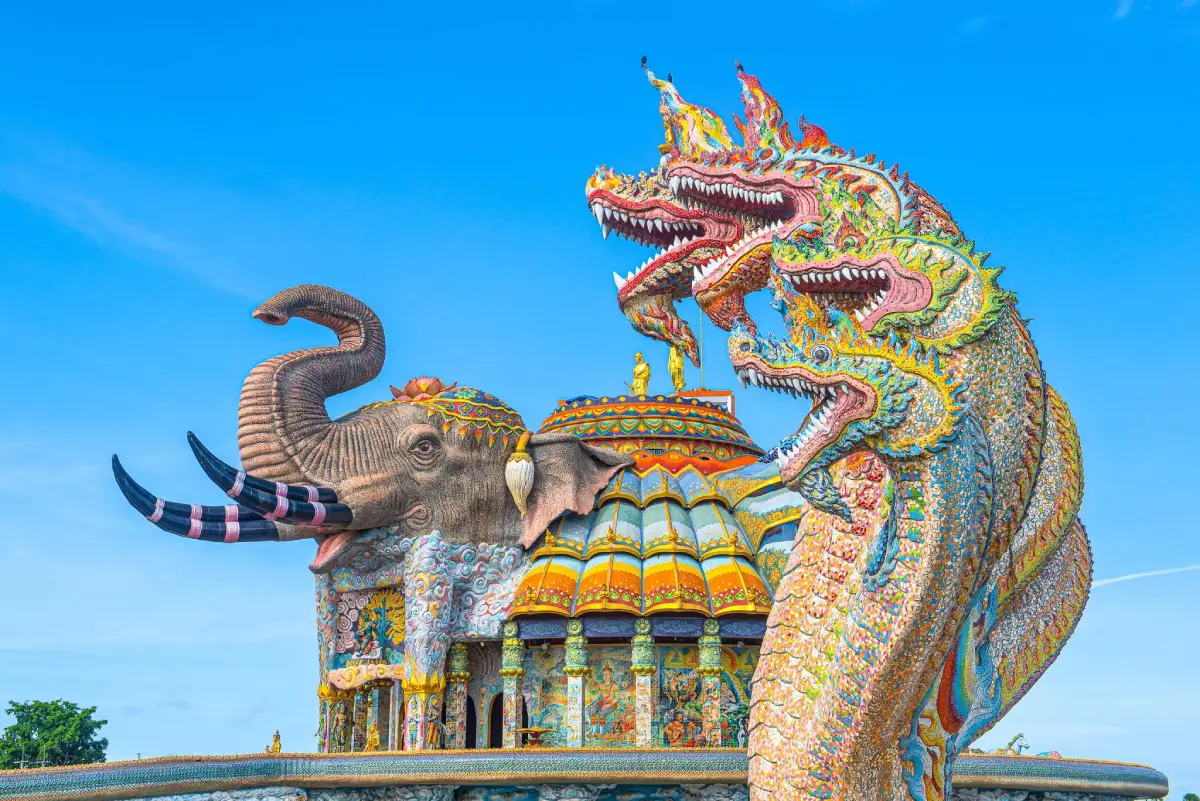
The most visually striking landmark of Wat Ban Rai today is Wihan Thep Witthayakhom, also known as Wihan Parisutthapanya. It is a large contemporary Buddhist art building standing in the middle of a 30-rai pond. The structure is often described as an elephant-shaped temple building and is one of the most distinctive religious landmarks in northeastern Thailand. It rises four levels high and is decorated with more than 20 million ceramic mosaic pieces. On the rooftop are images associated with the Buddha and Luang Pho Koon, creating a powerful visual symbol of faith and teaching.
Wihan Thep Witthayakhom was created to make Buddhist teaching accessible through art. Instead of presenting Dhamma only through books or sermons, the building uses paintings, sculptures, mosaics, symbolic scenes, and narrative spaces. Visitors can walk through the building and gradually encounter Buddhist ideas about karma, morality, human life, heaven, suffering, and liberation. This makes the wihan suitable for Thai Buddhists, families, students, cultural travelers, and foreign visitors who may not be familiar with Buddhist scriptures but can understand meaning through images and guided observation.
The wihan project began around 2011, was completed in 2013, and officially opened to visitors on 1 November 2013. The building stands on a circular platform in the middle of the pond, with an overall area approximately 60 meters wide and 60 meters long. The central structure is about 30 meters wide and the total height is around 40 meters. The scale of the building, combined with the density of its mosaic work, makes it one of the most impressive examples of contemporary Buddhist art in Thailand.
The interior of Wihan Thep Witthayakhom is organized as a learning route. The lower or underworld level presents themes of suffering, wrongdoing, and karmic consequences. The human level presents the life and work of Luang Pho Koon, including his teachings and service to society. The heavenly level presents Buddhist stories, heavenly realms, and the rewards of goodness. The uppermost level is connected with reverence and sacred relics. Through this sequence, visitors move from moral warning to human life, from human effort to spiritual aspiration.
The design is important because it turns abstract Buddhist teaching into visible experience. Children can learn about right and wrong through images. Adults can reflect on moral choices, generosity, and the consequences of action. Foreign travelers can see how Thai Buddhism communicates ethics through visual storytelling. The wihan is therefore not simply a decorative building; it is a contemporary Dhamma museum and sacred learning space.
Another important visual element is the naga sculpture in the water. The seven-headed naga and other decorative details around the wihan are covered with beautiful mosaic work. In Thai and northeastern Buddhist culture, the naga is associated with protection, water, fertility, and devotion to the Buddha. Placing the naga in the pond around the wihan creates a sacred landscape that combines faith, Buddhist symbolism, local belief, and artistic beauty.
Beyond Wihan Thep Witthayakhom, Wat Ban Rai includes several important areas: the ordination hall, sermon hall, Luang Pho Koon’s kuti, the Luang Pho Koon Museum, areas for paying respect to his image, a large pond, community shops, merit-making areas, and spaces used during Buddhist festivals. The museum and preserved living-related areas help visitors understand Luang Pho Koon as a person, not merely as a famous monk. They show his simple way of life, his direct teaching style, and his long relationship with the people of Ban Rai.
The Luang Pho Koon Museum is especially useful for visitors who want to understand the temple more deeply. It presents his biography, early life, ordination, meditation journeys, development work at Wat Ban Rai, moral teachings, and objects connected with his life. After visiting the museum, many travelers understand that devotion to Luang Pho Koon is not only about sacred objects. It is also about gratitude for a monk who transformed faith into schools, temples, hospitals, and public works.
Wat Ban Rai is also connected with local water development. Dan Khun Thot is an area known for dry conditions and soil-related water challenges. The development of water sources around Wat Ban Rai therefore carries both practical and symbolic meaning. The pond is not only part of the temple’s landscape. It also reflects the temple’s role in helping the surrounding community. Water, faith, and public benefit meet visibly within the temple grounds.
Walking around Wat Ban Rai, visitors can see how the temple functions on multiple levels. It is a place for worship, a cultural learning center, a memorial site, a community gathering space, and a local economic anchor. Community shops and food stalls serve visitors, especially during weekends and festivals. The temple therefore supports local livelihood as well as religious activity. This relationship between temple and community is an important feature of many Thai temples, and Wat Ban Rai is one of the clearest examples.
Luang Pho Koon was deeply connected with this temple from a young age. He studied with monks at Wat Ban Rai, later went on meditation journeys, and eventually returned to develop his home temple and local community. His teaching style was simple, direct, and memorable. He emphasized doing good, avoiding greed, practicing generosity, knowing contentment, and helping others. These teachings remain relevant because they are practical rather than abstract. They speak directly to everyday life.
Luang Pho Koon passed away in 2015, but his intention continues through Wat Ban Rai, Wihan Thep Witthayakhom, public benefit projects, and the devotion of his followers. Today, Phra Phawana Prachanat, also known as Phra Ajarn Nuch Rattanawichayo, serves as the abbot of Wat Ban Rai. The temple continues to welcome visitors who come to pay respect, make merit, learn, and remember Luang Pho Koon’s teachings.
For general travelers, the best time to visit is in the morning or late afternoon. Dan Khun Thot can be hot during the middle of the day, and the temple grounds are spacious. Visitors who want to explore Wihan Thep Witthayakhom properly should allow at least 1.5 to 2 hours. Each level of the building contains many details, and the mosaic work rewards slow observation. If the visit includes the museum, Luang Pho Koon’s memorial areas, the pond, merit-making, and community shops, a half-day plan is more suitable.
From Nakhon Ratchasima city, travelers can take Mittraphap Road to around kilometer 237, turn toward Kham Thale So and Dan Khun Thot, then continue to Dan Khun Thot District. From the area near Dan Khun Thot Hospital, take Highway 2217 for about 11 kilometers to Wat Ban Rai. This is the commonly used route from Korat city. Travelers from Bangkok can also use Mittraphap Road and continue toward Dan Khun Thot before taking the local road to Kut Phiman.
Getting There by private car is the most convenient option because the temple is outside central Korat and can be combined with nearby attractions such as Huai Bong Wind Farm. Public transportation is possible, including vans and buses serving Dan Khun Thot, followed by local shared vehicles, three-wheeled vehicles, or hired transport to the temple. For foreign travelers, private car, taxi, or arranged transport is recommended because it reduces transfer complexity and makes the trip more comfortable.
There is no admission fee for Wat Ban Rai and Wihan Thep Witthayakhom. Visitors may enter during opening hours, pay respect, walk through the main areas, and make voluntary donations according to personal faith. This is important for foreign visitors to understand. A Thai temple is primarily a living religious place, not a ticket-based attraction. Donations are acts of merit-making and support, not compulsory entrance charges.
Visitors should dress modestly. Shoulders and knees should be covered, especially when entering worship areas. Shoes should be removed where required. Do not touch mosaic walls, sculptures, Buddha images, sacred objects, or exhibits unless clearly allowed. Do not climb on railings or restricted areas. Around the pond, visitors should watch children carefully. Respectful behavior allows everyone to enjoy the temple without disturbing worshippers or damaging the art.
For foreign visitors, Wat Ban Rai is one of the best places in Nakhon Ratchasima to understand contemporary Thai Buddhist devotion. The temple combines monk reverence, merit-making, Buddhist art, community development, moral storytelling, and local northeastern culture in one place. It shows that Thai temples can be places of worship, education, art, charity, and community economy at the same time. This makes Wat Ban Rai much deeper than a simple sightseeing stop.
The temple can be combined with a wider Dan Khun Thot travel route. A short visit may include Wat Ban Rai, Wihan Thep Witthayakhom, the Luang Pho Koon Museum, and nearby local restaurants. A full-day route can continue to Huai Bong Wind Farm, cafés along the wind-farm route, and viewpoints in the district. This combination gives travelers a balance of faith, art, local food, and rural scenery.
During weekends, long holidays, and Buddhist festivals, Wat Ban Rai may receive large numbers of visitors. It is better to arrive early, prepare for parking time, and carry drinking water. Groups should contact the temple or Wihan Thep Witthayakhom information office in advance so that visits can be arranged smoothly. This helps protect the sacred atmosphere of the temple and makes the visit more organized.
Wat Ban Rai is suitable for many types of visitors. Elderly visitors come to pay respect to Luang Pho Koon. Families come to teach children about Buddhism and moral conduct. Students come to learn about Buddhist art and local history. Photographers come for the wihan, pond, naga sculptures, and mosaic details. International visitors come to understand how Thai faith can be expressed through large-scale contemporary religious art. Each group can experience the temple differently, but all should approach it with respect.
The most important lesson of Wat Ban Rai is that greatness can grow from simplicity. Wihan Thep Witthayakhom is large, colorful, and spectacular, but the heart of the temple remains Luang Pho Koon’s teaching about doing good, knowing contentment, reducing greed, giving, and helping society. Visitors should therefore look beyond the beauty of the building and take time to read the moral messages, observe the symbolic scenes, and reflect on how these teachings can be applied in everyday life.
In summary, Wat Ban Rai in Nakhon Ratchasima is one of the most meaningful Buddhist temples in northeastern Thailand. It is the temple of Luang Pho Koon Parisuttho, a revered monk whose life and work continue to inspire people across the country. Its major highlights include Wihan Thep Witthayakhom, more than 20 million mosaic pieces, the naga sculptures in the pond, Luang Pho Koon Museum, his preserved kuti, the ordination hall, and community spaces for merit-making. The temple is open daily, has no admission fee, and is suitable for Thai and foreign visitors who want to understand Korat through faith, Buddhist art, local community life, and the enduring legacy of Luang Pho Koon.
| Name | Wat Ban Rai, Nakhon Ratchasima |
| Related Names | Luang Pho Koon Temple, Wat Ban Rai Temple, Wihan Thep Witthayakhom Wat Ban Rai |
| Location | Kut Phiman Subdistrict, Dan Khun Thot District, Nakhon Ratchasima Province |
| Address | Kut Phiman, Dan Khun Thot, Nakhon Ratchasima 30210, Thailand |
| Coordinates | 15.22370, 101.71480 |
| Type | Buddhist temple, faith-based attraction, contemporary Buddhist art learning site |
| Highlights | Wihan Thep Witthayakhom in the middle of a 30-rai pond, more than 20 million mosaic pieces, Luang Pho Koon image, Luang Pho Koon Museum, Luang Pho Koon kuti, ordination hall, and sacred worship areas |
| History | The temple became widely developed during the time of Luang Pho Koon Parisuttho, who began building the ordination hall around 1953 and later developed monks’ residences, a sermon hall, water areas, and a school for the local community |
| Importance | An important temple of Dan Khun Thot District and the temple associated with Luang Pho Koon Parisuttho, one of Thailand’s most respected monks |
| Travel Information | From Nakhon Ratchasima city, take Mittraphap Road to around kilometer 237, turn toward Kham Thale So and Dan Khun Thot, then take Highway 2217 from the Dan Khun Thot Hospital area for about 11 km to Wat Ban Rai |
| Current Status | Active Buddhist temple and major religious, cultural, and art-based attraction in Nakhon Ratchasima |
| Open Days | Daily, including public holidays |
| Opening Hours | 08.30 – 17.00 |
| Fees | No admission fee; voluntary donations may be made according to personal faith |
| Facilities | Ordination hall, sermon hall, Wihan Thep Witthayakhom, Luang Pho Koon Museum, Luang Pho Koon kuti, worship areas, community shops, parking, restrooms, and rest areas around the pond |
| Main Areas / Zones | Wihan Thep Witthayakhom Underworld Level Of Wihan Thep Witthayakhom Human Level Of Wihan Thep Witthayakhom Heavenly Level Of Wihan Thep Witthayakhom Upper Relic Worship Area Naga Sculptures In The Pond Ordination Hall Sermon Hall Luang Pho Koon Museum Luang Pho Koon Kuti Luang Pho Koon Image Worship Area Pond And Rest Areas Community Shops And Local Souvenirs |
| Abbot / Caretaker | Phra Phawana Prachanat (Nuch Rattanawichayo) |
| Main Contact Number | 082-834-9109, 065-826-7686 |
| Website / Contact Channel | Wihan Thep Witthayakhom Wat Ban Rai |
| Nearby Tourist Attractions | 1. Luang Pho Koon Parisuttho Museum Inside Wat Ban Rai, about 0.2 km 2. Wihan Thep Witthayakhom Inside Wat Ban Rai, about 0.2 km 3. Luang Pho Koon Parisuttho Hospital, about 11 km 4. Chao Pho Khun Thot Monument / Bueng Ban Han, about 12 km 5. Global House Dan Khun Thot, about 13 km 6. Naraset Mini Zoo / Naraset Farm, about 16 km, Tel. 096-995-6363 7. Huai Bong Wind Farm, about 34 km |
| Nearby Restaurants | 1. Krua Steak Lung Koet Dan Khun Thot, about 8.5 km 2. Bubble Bee Dan Khun Thot, about 11 km, Tel. 093-564-2287 3. Malini Korean Barbecue Dan Khun Thot, about 11 km, Tel. 086-257-9394 4. La Mayon Coffee Dan Khun Thot, about 12 km, Tel. 093-320-5258 5. Naraset Farm Cafe, about 16 km, Tel. 096-995-6363 6. Krua Rim Nam Ban Rai, about 34 km, Tel. 087-509-2815 |
| Nearby Accommodations | 1. Boonrod Resort, Kut Phiman, about 4.5 km, Tel. 089-717-5283 2. Ban Kingwongsa Dan Khun Thot Accommodation, about 11 km, Tel. 085-764-8348 3. Yu Sabai Guesthouse Dan Khun Thot, about 12 km, Tel. 081-389-9068 4. Romruen Resort Dan Khun Thot, about 12 km, Tel. 085-023-6590 5. Anchalee Dormitory Dan Khun Thot, about 12 km, Tel. 098-161-6464 6. Boonyok Resort Dan Khun Thot, about 13 km, Tel. 086-865-8488 |
Frequently Asked Questions (FAQ)
Q: Where is Wat Ban Rai located?
A: Wat Ban Rai is located in Kut Phiman Subdistrict, Dan Khun Thot District, Nakhon Ratchasima Province. It is a famous temple associated with Luang Pho Koon Parisuttho.
Q: What are the opening days and hours of Wat Ban Rai?
A: Wat Ban Rai and Wihan Thep Witthayakhom are open daily from 08.30 to 17.00. Morning is a suitable time for worship and detailed exploration of the wihan.
Q: Is there an admission fee at Wat Ban Rai?
A: There is no admission fee. Visitors may make voluntary donations, support temple activities, or make merit according to personal faith.
Q: What is Wat Ban Rai famous for?
A: Wat Ban Rai is famous for Luang Pho Koon Parisuttho, Wihan Thep Witthayakhom, more than 20 million mosaic pieces, naga sculptures, Luang Pho Koon Museum, and sacred worship areas.
Q: What is Wihan Thep Witthayakhom?
A: Wihan Thep Witthayakhom, also known as Wihan Parisutthapanya, is a contemporary Buddhist art building in the middle of a pond. It presents Buddhist teachings through mosaics, sculptures, symbolic stories, and visual Dhamma lessons.
Q: How can travelers get to Wat Ban Rai?
A: From Nakhon Ratchasima city, take Mittraphap Road to around kilometer 237, turn toward Dan Khun Thot, then take Highway 2217 for about 11 km from the Dan Khun Thot Hospital area to Wat Ban Rai.
Q: Is Wat Ban Rai suitable for foreign visitors?
A: Yes. Foreign visitors can learn about Luang Pho Koon, Thai merit-making, Buddhist cosmology, contemporary Buddhist art, and the role of temples in northeastern Thai communities.
Q: What should visitors wear to Wat Ban Rai?
A: Visitors should dress modestly, cover shoulders and knees, remove shoes where required, keep quiet in worship areas, avoid touching mosaics or sacred objects, and respect the temple atmosphere throughout the visit.
 Category: ●Places of Worship
 Group: ●Temple
Last Update : 2 MonthAgo
 Last Update : 2 MonthAgo
 Click to Access the Navigation Map GPS
Wat Ban Rai Map
Gellery
Recommend

 Art, Culture and Heritage
 Historical Sites and Monuments(20)
 Landmarks and Memorials(5)
 Art, Craft Centres, Tradition(7)
 Museums(6)
 Art Gallery(1)
 Educational Places
 Educational Gardens, Farm(4)
Temple(29)
Educational Gardens, Farm(4)
Temple(29)
 Mosque(1)
 Other Sacred Sites(6)
 Research and Development
 Royal Project(3)
 Suburban Living
 Village, Community(6)
 Local Market(4)
 Floating Market(1)
 Nature and Wildlife
 National Parks and Marine Reserves(3)
 Mountain (Doi)(5)
 Dam, Reservoir, Lake(8)
 Waterfalls(9)
 Hot Springs(1)
 Caves(2)
 Flower Field(1)
 River, Canal(8)
 Bays and Beaches(2)
 Other natural attractions(3)
 Entertainment and Agricultural
 Zoos and Aquariums(1)
 Animal camps and shows(1)
 Farms, Parks and Ecotourism(21)
 Waterpark(2)
 Outdoor and Adventure Activities(6)
 Shopping
 Shopping and Night Market(2)
 Travel Articles, Recipes
 Travel Review, Food Review(5)


