
lovethailand home >Northeastern Travel Attractions >Nakhon Ratchasima Travel Attractions >Chok Chai >Kra Thok > Prasat Phakho
TL;DR: Prasat Phakho is located at Ban Phakho, Krathok Subdistrict, Chok Chai District, Nakhon Ratchasima, Thailand, open Daily, hours 06.00 – 18.00.
Prasat Phakho
Open Days: Daily
Opening Hours: 06.00 – 18.00
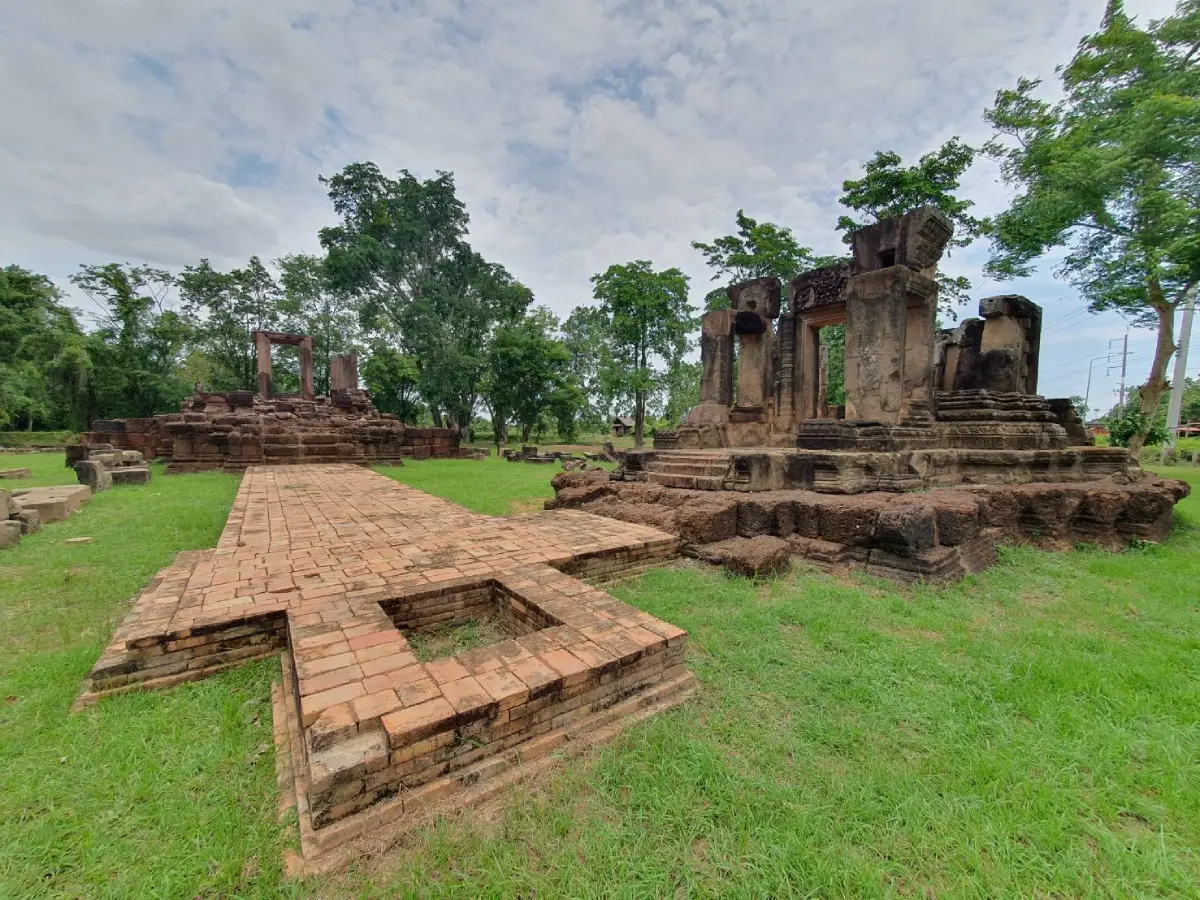
Prasat Phakho, also known as Prang Phakho, is a small ancient Khmer Hindu sanctuary beside Highway 224 in Krathok Subdistrict, Chok Chai District, Nakhon Ratchasima Province. Dating to approximately the 16th Buddhist century, the monument displays artistic characteristics associated with the Baphuon period. The original complex contained 3 sanctuary towers arranged on a T-shaped plan, although only 2 structures remain clearly visible. A brick walkway links the buildings, while a U-shaped moat surrounds the sacred compound. The monument is open daily and admission is free. Most travelers need approximately 45–90 minutes, and the site can be combined with Chok Chai town, Dan Kwian Pottery Village, Nakhon Ratchasima Zoo, and Khorat Fossil Museum.
Prasat Phakho in Nakhon Ratchasima Province is an ancient Khmer archaeological monument located in Ban Phakho, Krathok Subdistrict, Chok Chai District. The site is known by several related names, including Prang Phakho, Prang Ban Phakho, Prasat Ban Phakho, and Ban Pakho. Its position beside the Nakhon Ratchasima–Chok Chai road, Highway 224, makes it considerably easier to reach than many small Khmer ruins situated deep within agricultural villages.
Prasat Phakho is much smaller than Phimai, Phanom Wan, or the celebrated Khmer sanctuaries of Buriram and Surin. Its value, however, lies in the evidence it provides for the spread of settlements, religious institutions, artistic traditions, and building technology across the Khorat Plateau. The surviving structures demonstrate the combined use of brick, pale sandstone, and laterite, together with a carefully organized sacred plan and a surrounding moat.
The sanctuary was established according to Hindu religious beliefs during approximately the 16th Buddhist century, nearly 900–1,000 years ago. This period corresponded to the expansion of Khmer political, religious, artistic, and technological influence into what is now northeastern Thailand. The surviving architectural fragments and carved stonework are associated with the Baphuon artistic tradition, which preceded the fully developed Angkor Wat style.
Baphuon-period art developed during the 16th Buddhist century and is recognized through tall sanctuary forms, a central sacred chamber, functional and false doorways, and elaborately carved lintels and pediments. Decorative themes frequently included garlands, kala faces, lions, deities, vegetal motifs, and religious narratives. The ornament at Prasat Phakho no longer survives completely in its original position, but excavated fragments allow archaeologists to determine its approximate date and cultural connections.
Archaeological investigation shows that the original complex contained 3 sanctuary towers arranged on a plan resembling the letter T. The principal sanctuary stood in the center toward the western side and faced east. A projecting entrance porch extended from its central chamber, leading to a brick-paved walkway connected to 2 smaller sanctuaries positioned farther forward.
The northern and southern subsidiary sanctuaries originally faced one another across the brick walkway. The northern building faced south, while the southern building faced north. This arrangement created a shared ceremonial space between the 2 structures and connected all 3 sanctuaries into a coordinated architectural composition. Today, only the northern subsidiary sanctuary remains clearly visible, while the southern structure has largely disappeared.
The present monument therefore consists primarily of the remains of the principal sanctuary and 1 subsidiary sanctuary. The principal building retains its foundation, sections of wall, part of the central chamber, and the projecting eastern porch. Although the upper tower has collapsed, the foundations and brick walkway preserve the direction of ceremonial movement and allow visitors to reconstruct the original plan mentally.
The main entrance to the sacred compound was on the eastern side. Eastward orientation is common in Khmer architecture because it is connected with sunrise, renewal, and the ceremonial approach to a sacred center. Worshippers would have entered from the east, moved through the outer area and along the brick walkway, and approached the inner chamber of the principal sanctuary.
The projecting porch functioned as a transition between the external courtyard and the sacred interior. Khmer sanctuary chambers were usually relatively small because they were not designed to contain large congregations. Their principal purpose was to house a deity, linga, or sacred image, while priests or ritual specialists conducted ceremonies within or immediately in front of the chamber.
Published evidence does not conclusively identify the specific deity to whom Prasat Phakho was dedicated. It is therefore most accurate to describe the monument as a Hindu sanctuary without assigning it specifically to Shiva, Vishnu, or another deity. Nevertheless, its architecture and iconography clearly reflect the religious cosmology and ritual culture of the ancient Khmer world.
The monument was constructed from brick, sandstone, and laterite. Each material served a different purpose. Brick was suitable for continuous walls and shaped surfaces, laterite provided strength for foundations and structural cores, and sandstone could be cut and carved with precision. Sandstone was therefore selected for door frames, decorative columns, lintels, pediments, and architectural elements requiring fine workmanship.
The sandstone at Prasat Phakho is relatively pale or whitish. Its smooth appearance contrasts with the reddish tones of brick and the porous brown-red surface of laterite. Even after centuries of weathering, visitors can distinguish these materials and observe how ancient builders combined them according to structural and artistic requirements.
The surviving subsidiary sanctuary has only 1 functional entrance. The remaining 3 sides were designed as false doors. False doorways are a characteristic feature of Khmer architecture, maintaining visual balance while emphasizing symbolic directions. Although they could not be used for access, they were framed and decorated to resemble real ceremonial entrances.
Above the southern doorway of the subsidiary sanctuary is a carved lintel depicting lions holding sections of a garland extending to both sides. Such imagery is valuable for dating and stylistic analysis. A lintel was not merely a structural beam; it also offered an important surface for sacred imagery and demonstrated the technical skill of the stone carvers. Lions communicated strength, protection, and auspicious power.
Excavation and restoration conducted in 1990–1991 uncovered several significant artifacts. These included a lintel depicting Indra riding the elephant Airavata, a lotus-shaped tower finial, pediment fragments, and other architectural components. The Indra lintel is especially important because Indra is associated with the sky, rain, kingship, and the eastern direction, while Airavata is his sacred elephant mount.
Pediment fragments found at the site display Baphuon-period artistic influence. Important pieces were transferred to Phimai National Museum, where they could be conserved and studied under controlled conditions. Their removal means that visitors at the archaeological site cannot see the complete carved program in its original setting, but museum protection reduces the risk of theft, erosion, and damage.
Travelers interested in sculpture can continue to Phimai National Museum to examine artifacts from archaeological sites throughout Nakhon Ratchasima. Comparing lintels, pediments, deity images, and architectural elements in the museum helps visitors understand the monument more fully. The archaeological site provides the original landscape, while the museum offers close study of the surviving objects.
A U-shaped or horseshoe-shaped moat surrounds the sanctuary group, leaving an approach on the eastern side. The moat defined the separation between sacred and external space, assisted with drainage and water management, and may have expressed the cosmological image of the ocean surrounding Mount Meru in Hindu belief.
Prasat Phakho stands on an alluvial plain within the Mun River basin and the smaller Lam Phra Phloeng and Lam Nam Pak drainage systems. Lam Phra Phloeng passes approximately 400 metres north and west of the monument. Access to water was essential for settlement, agriculture, transport, and ritual life, making the sanctuary’s location part of a broader cultural landscape.
The archaeological area lies approximately 190 metres above mean sea level. The surrounding terrain is well suited to farming and permanent settlement. The monument, moat, walkway, natural waterways, and agricultural land should therefore be understood as interconnected elements rather than isolated features.
The local name Phakho or Pakho appears in several historical and modern sources. It should not be confused with Bago in Myanmar or with the Preah Ko artistic style, which belongs to a different chronological period of Khmer art. Variations such as Prang Ban Phakho, Ban Pakho, and Prasat Phakho all refer to this monument in Krathok Subdistrict, Chok Chai District.
Before excavation, parts of the monument were buried beneath soil and vegetation. Archaeological work therefore began with surveying, measurement, mapping, and photographic documentation. The Fine Arts Department surveyed and mapped the site in 1986 before undertaking major excavation, restoration, moat clearance, and landscape improvement between 1990 and 1991.
The restoration project covered approximately 10,192 square metres. Archaeologists cleared the structures, excavated the surrounding area, dredged the moat, and improved the landscape. This work revealed the foundations, brick walkway, and architectural relationship among the original 3 sanctuaries, making the T-shaped plan understandable.
Archaeological restoration does not mean rebuilding a monument completely according to imagination. The objective is to stabilize authentic remains, return documented components to reliable positions, and protect original fabric. Missing areas are not reconstructed without adequate evidence. Visitors therefore encounter Prasat Phakho as a conserved ruin rather than a newly recreated temple.
Prasat Phakho was registered as a national ancient monument in the Royal Gazette, Volume 53, page 1526, dated 27 September 1936, under the name Ban Pakho. Registration protects the site under Thai heritage law. Unauthorized excavation, alteration, graffiti, removal of stone, or damage to the structures is prohibited.
The principal authority responsible for the monument is the Fine Arts Department, through the 10th Regional Office of Fine Arts in Nakhon Ratchasima. This office oversees archaeological research, conservation, inspection, and official permission for activities. Local administrative organizations and residents of Krathok Subdistrict also contribute to cleanliness, monitoring, and community education.
Prasat Phakho is classified as an abandoned ancient religious site, meaning that no permanent Hindu priesthood or Buddhist monastic community continues the original ceremonies. It therefore has no abbot. The correct caretaker is the Fine Arts Department rather than a resident monk. Nearby modern temples are separate institutions and should not be confused with the archaeological monument.
The monument is open to visitors every day and there is no admission fee. Recommended public visiting hours are 06.00–18.00 because the site is outdoors and does not have a dedicated nighttime lighting system. Daylight is essential for seeing changes in ground level, loose materials, foundations, and the moat safely.
The most comfortable period is between approximately 07.00 and 10.00. Morning light from the east emphasizes the entrance porch, sandstone frames, brickwork, and surface texture. Late afternoon from about 15.30 to 17.30 is also attractive for photography, but visitors should leave before darkness. Midday can be extremely hot because much of the area is exposed.
November to February usually provides the most pleasant weather. March to May is hot, and midday visits require water, a hat, and sun protection. During the rainy season, grass and vegetation around the moat become greener, although brick, soil, and laterite surfaces may become slippery. Closed shoes with secure soles are recommended.
A logical visit begins at the eastern approach. From this position, observe the principal sanctuary, brick walkway, and surviving subsidiary structure. Follow the designated ground-level route without stepping onto ancient foundations. At the principal sanctuary, examine the base, projecting porch, and remaining central chamber before looking back along the walkway to understand the T-shaped arrangement.
The next important zone is the northern subsidiary sanctuary, which faces south. Its architecture demonstrates the difference between a functional doorway and false doors. Visitors should observe the stone frames, walls, and lintel without touching them. Standing along the brick walkway provides a clearer understanding of the relationship between the 2 surviving structures than photographing each building separately.
The moat deserves attention as an archaeological and environmental feature. Its water level and appearance vary according to the season, but its U-shaped form explains the boundary and ceremonial approach. Visitors should not enter the moat, collect plants, disturb wildlife, or throw food into the water.
The eastern side provides one of the most useful photographic views, capturing the porch, brick walkway, and both structures within a single composition. Oblique views from the northeast or southeast reveal the height of the foundations and thickness of the walls. A zoom lens is preferable to climbing onto stones or architectural remains.
Climbing, sitting, or standing on the sanctuary, lintels, door frames, laterite blocks, or foundations is prohibited. Even apparently solid masonry can be weakened by repeated pressure and vibration. Visitors must not scratch the surface, insert coins into gaps, attach decorations, or place equipment directly against the ancient structures.
Drone operation, commercial photography, performances, and large equipment require prior coordination with the 10th Regional Office of Fine Arts. Free admission does not mean unrestricted use. Ordinary personal photography is acceptable provided it does not disturb other visitors or endanger the monument.
Useful items include drinking water, a hat or umbrella, sunscreen, comfortable shoes for uneven ground, and an offline map. Prasat Phakho does not have a major visitor center, permanent exhibition hall, or souvenir shop. Reading basic information about Baphuon art and the monument’s plan before arrival greatly improves the experience.
The surrounding area includes grass and open space from which the monument can be viewed safely. Older visitors can see much of the site from relatively level ground, although wheelchair users may face restrictions caused by soil, brick pathways, and raised foundations. Vehicles should be parked without obstructing Highway 224 or the entrance.
In 2025, the monument hosted the cultural event “Stories of the Beautiful Women of Prang Phakho and the Finest Products of Chok Chai.” The program included light-and-sound performances, historical storytelling, local culture, food, and community products. Such events reconnect the archaeological site with contemporary residents and encourage local learning.
The dates and program are not necessarily identical every year. Travelers should not rely on an old schedule without checking current announcements. Updated information may be published by Chok Chai Municipality, Krathok Subdistrict authorities, the Tourism Authority of Thailand, and Nakhon Ratchasima provincial organizations.
Cultural events within archaeological grounds require a careful balance between public use and conservation. Stages, lighting, barriers, and equipment must not place pressure on ancient foundations. Visitors attending a festival should follow official routes and instructions even when the area is busier than during normal daytime visits.
Getting There from Nakhon Ratchasima city is straightforward by private car. Follow Highway 224, the Nakhon Ratchasima–Chok Chai road, for approximately 29 kilometres toward Chok Chai. Continue south in the direction of Khon Buri for another 3–5 kilometres. The monument stands beside the road on the right-hand side. Its coordinates are 14.698528, 102.173865.
From Chok Chai intersection, follow Highway 224 south for approximately 4.9 kilometres. Reduce speed before reaching the site and use a safe turning point. Do not stop suddenly or park on the highway shoulder where the vehicle could obstruct visibility.
Public buses operating between Nakhon Ratchasima, Chok Chai, Khon Buri, and Soeng Sang may pass near Ban Phakho. However, not every service stops directly beside the monument, and return transport may be infrequent. Confirm the stop and return schedule with the driver or terminal before departure.
Prasat Phakho works well as the first destination on a half-day route. Visit the monument in the morning, travel into Chok Chai for a local meal, and continue to Dan Kwian Pottery Village. This itinerary connects Khmer heritage with Korat food and a celebrated regional craft tradition.
A full-day itinerary can add Nakhon Ratchasima Zoo and Khorat Fossil Museum. The combination presents 3 distinct dimensions of the province: ancient archaeology, wildlife and conservation, and geological history extending millions of years into the past. Beginning at Prasat Phakho and returning toward the city creates a practical route.
Dan Kwian Pottery Village lies along Highway 224 between Chok Chai and Nakhon Ratchasima city. Visitors can view and purchase pottery and learn about the distinctive clay associated with the Mun River area. Combining Dan Kwian with Prasat Phakho also demonstrates how earth, water, and craft knowledge have shaped the region across different periods.
Nakhon Ratchasima Zoo is suitable for families and travelers with children. It lies approximately 25–30 kilometres from Prasat Phakho by road and contains animal habitats, bicycle routes, visitor vehicles, and activity zones. The zoo has its own admission fees and opening schedule, which are separate from the free archaeological site.
Khorat Fossil Museum in Suranaree Subdistrict presents petrified wood, dinosaurs, prehistoric elephants, and regional geological discoveries. Visiting the museum and Prasat Phakho on the same day allows travelers to move from deep geological time to the Khmer cultural world of approximately 1,000 years ago.
Most convenient restaurants are located in central Chok Chai, approximately 5–8 kilometres from the monument. Options include Korat noodles, northeastern Thai food, made-to-order dishes, cafés, and restaurants within local markets and retail centers. Opening days vary, so groups should telephone in advance.
Korat noodles are strongly associated with Chok Chai and local food identity. The rice noodles are stir-fried with a sweet, salty, and tangy sauce and served with bean sprouts, garlic chives, and other accompaniments. Combining Prasat Phakho with a Korat noodle meal creates a natural connection between history and local cuisine.
Accommodation is available in and around Chok Chai, ranging from small local resorts to hotels along the route toward Dan Kwian. A day trip from Nakhon Ratchasima city is easy, but staying in Chok Chai is practical for travelers continuing toward Khon Buri, Soeng Sang, Pak Thong Chai, or southern natural attractions the following day.
Confirm the precise location before booking because the word Chok Chai may refer to the district, a road, or businesses in other provinces. Properties listed in the summary table are operating accommodations with publicly available information in Chok Chai District or along the connecting route. Distances are approximate road distances.
Foreign travelers should save the Thai name “ปรางค์พะโค” and the coordinates on a mobile device. Permanent English interpretation and English-speaking guides may not be available. Reading about Baphuon art, Hindu temple architecture, lintels, and the T-shaped plan beforehand will make the surviving ruins easier to understand.
This is not an active Buddhist monastery, so there are no resident monks or abbot. Nevertheless, modest clothing and respectful conduct are appropriate because the site was originally sacred. Avoid loud behavior, inappropriate poses on architectural remains, or using the monument as a prop for activities that could cause damage.
Families should explain the rules to children before entering. Brickwork, loose stones, and the moat may encourage climbing or running. Close supervision protects both children and the monument and provides an opportunity to teach history, craftsmanship, and responsibility for shared cultural heritage.
A meaningful visit does not require many hours, but it benefits from systematic observation. Begin with the overall plan, compare construction materials, examine the eastern approach and brick walkway, identify the surviving structures, and finish at the moat. Relating these features to the excavation history and museum artifacts transforms an incomplete ruin into an intelligible cultural site.
The importance of Prasat Phakho lies not in monumental scale but in the evidence it provides for Chok Chai’s connection to the wider Khmer cultural network. Three sanctuaries, a ceremonial walkway, a moat, and high-quality carving indicate that the ancient community possessed resources, technical knowledge, and religious relationships extending beyond the immediate locality.
Compared with a fully preserved temple, the ruin makes construction techniques easier to observe. Visitors can see courses of brick, laterite blocks, sandstone frames, and exposed foundations. The incomplete condition therefore has educational value and should not be interpreted merely as damage or absence.
Conservation depends on government agencies, local residents, and travelers. The Fine Arts Department provides technical and legal protection, local authorities maintain the surroundings and organize learning activities, and visitors contribute by avoiding climbing, unnecessary contact, littering, and misinformation.
Prasat Phakho is suitable for travelers searching for historical attractions in Chok Chai, accessible Khmer ruins near Nakhon Ratchasima city, or a cultural stop between Korat and Khon Buri. A visit of approximately 1 hour provides insight into religion, sculpture, architecture, water management, landscape, and heritage conservation.
Travelers who arrive prepared, choose the cooler morning or late-afternoon hours, and combine the monument with food and attractions around Chok Chai will gain a more complete experience. The most important perspective is to recognize Prasat Phakho as evidence nearly 1,000 years old, surviving beside modern roads and communities while continuing to communicate the history of the Khorat Plateau.
| Name | Prasat Phakho or Prang Phakho |
| Alternative Names | Prang Ban Phakho, Prasat Ban Phakho, Ban Pakho |
| Site Type | Ancient Khmer archaeological monument and Hindu sanctuary |
| Location | Ban Phakho, Krathok Subdistrict, Chok Chai District, Nakhon Ratchasima, Thailand |
| Coordinates | 14.698528, 102.173865 |
| Historical Period | Approximately the 16th Buddhist century, displaying Baphuon-period Khmer artistic influence |
| Religion | Hinduism; the principal deity has not been conclusively identified in published evidence |
| Original Plan | 3 sanctuary towers arranged on a T-shaped plan, with the principal sanctuary facing east and 2 subsidiary sanctuaries facing one another |
| Visible Structures | 2 clearly visible structures: the principal sanctuary and the northern subsidiary sanctuary |
| Construction Materials | Brick, pale sandstone, and laterite |
| Distinctive Features | Projecting porches, brick walkway, functional and false doors, lion-and-garland lintel, and U-shaped moat |
| Important Artifacts | Lintel depicting Indra riding Airavata, lotus tower finial, and Baphuon-style pediment fragments; important pieces are preserved at Phimai National Museum |
| Moat | U-shaped or horseshoe-shaped moat surrounding the buildings, with the principal approach on the eastern side |
| Archaeological Work | Surveyed and mapped in 1986; excavated, restored, landscaped, and the moat cleared in 1990–1991 over approximately 10,192 square metres |
| National Registration | Registered in the Royal Gazette, Volume 53, page 1526, on 27 September 1936 |
| Caretaker | Fine Arts Department through the 10th Regional Office of Fine Arts, in cooperation with local authorities and the Krathok community |
| Current Status | Open to visitors; conserved abandoned religious monument with an improved surrounding landscape |
| Open Days | Daily |
| Opening Hours | 06.00 – 18.00 |
| Admission Fee | Free admission |
| Recommended Visit Duration | Approximately 45–90 minutes |
| Best Time to Visit | 07.00–10.00 or 15.30–17.30; November to February offers the most comfortable weather |
| Main Areas and Zones | 1. Eastern entrance 2. Principal sanctuary and projecting porch 3. Brick-paved walkway 4. Northern subsidiary sanctuary 5. Functional and false doorways 6. Foundation of the lost subsidiary sanctuary 7. U-shaped moat 8. Landscaped archaeological grounds |
| Facilities | Nearby parking, grassed open space, and outdoor walking areas; no permanent visitor center or shop at the monument |
| Visitor Guidelines | Do not climb, move stones, write on surfaces, light fires near the masonry, or remove objects. Drone use and commercial filming require prior permission. |
| Travel Information | From Nakhon Ratchasima city, follow Highway 224 toward Chok Chai for approximately 29 km. Continue south for approximately 4.9 km from Chok Chai intersection; the monument is beside the road on the right. |
| Main Contact Number | 10th Regional Office of Fine Arts: 044-471518 |
| Cultural Event | The grounds have hosted the Stories of the Beautiful Women of Prang Phakho and the Finest Products of Chok Chai festival; dates must be confirmed for each year |
| Nearby Tourist Attractions | 1. Chok Chai Town Market and Community Area, approximately 5 km 2. Dan Kwian Pottery Village, approximately 21 km, Tel. 044-338399 3. Nakhon Ratchasima Zoo, approximately 28 km, Tel. 044-934532, 083-3720404 4. Khorat Fossil Museum, approximately 31 km, Tel. 044-370739-41 5. Wat Na Phra That, Pak Thong Chai District, approximately 34 km 6. Prasat Phanom Wan, approximately 43 km, contact the 10th Regional Office of Fine Arts at 044-471518 |
| Nearby Restaurants | 1. Phat Mi Jae Khiao Chok Chai, approximately 5 km, Tel. 081-549-5655 2. PunThai Coffee, Nakhon Ratchasima–Chok Chai Road, approximately 5 km, Tel. 062-242-7861 3. Mong Du Cha, approximately 6 km, Tel. 082-012-5384 4. CHAT & CHEW, approximately 7 km, Tel. 090-986-8411, 097-342-7655 5. Krua Ai Oon, approximately 7 km, Tel. 093-489-4496 6. KFC Lotus Chok Chai, approximately 7 km, Tel. 061-410-2854 |
| Nearby Accommodations | 1. Suphachok Resort, approximately 6 km, Tel. 087-961-8632 2. Greenway Resort, approximately 7 km, Tel. 044-938886, 092-665-9988, 092-594-8889 3. Chokchai Resort, approximately 8 km, Tel. 089-846-8503 4. Goldenland Resort, approximately 18 km, Tel. 089-844-6109, 044-756341-2 5. Chan Place Hotel, Dan Kwian, approximately 21 km, Tel. 092-932-8792 6. Korat Resort Hotel, approximately 24 km, Tel. 098-005-5889 |
Frequently Asked Questions (FAQ)
Q: Where is Prasat Phakho located?
A: Prasat Phakho is in Ban Phakho, Krathok Subdistrict, Chok Chai District, Nakhon Ratchasima. It stands beside Highway 224, approximately 4.9 km south of Chok Chai intersection. The coordinates are 14.698528, 102.173865.
Q: When was Prasat Phakho built?
A: The monument dates to approximately the 16th Buddhist century and was constructed as a Hindu sanctuary. Its architectural and decorative fragments display Baphuon-period Khmer influence.
Q: How many sanctuaries were originally at Prasat Phakho?
A: The original complex contained 3 sanctuary towers arranged on a T-shaped plan. The principal sanctuary faced east, while 2 subsidiary sanctuaries faced one another. Only 2 structures remain clearly visible today.
Q: What are the opening hours and admission fee?
A: Prasat Phakho is open daily from 06.00 to 18.00 and admission is free. Morning and late afternoon are the most comfortable visiting periods.
Q: Which important artifacts were found at the site?
A: Excavations uncovered a lintel showing Indra riding Airavata, a lion-and-garland lintel, a lotus tower finial, and Baphuon-style pediment fragments. Important pieces are preserved at Phimai National Museum.
Q: Who takes care of Prasat Phakho?
A: The monument is supervised by the Fine Arts Department through the 10th Regional Office of Fine Arts, working with local authorities and the Krathok community. It is an abandoned archaeological sanctuary and has no abbot.
Q: Can visitors climb the ancient structures?
A: No. Climbing, sitting, or standing on the sanctuary, foundations, lintels, door frames, and stone blocks is prohibited because pressure and vibration can damage the ancient masonry.
Q: Which nearby attractions can be combined with Prasat Phakho?
A: Suitable nearby destinations include Chok Chai town, Dan Kwian Pottery Village, Nakhon Ratchasima Zoo, Khorat Fossil Museum, Wat Na Phra That, and Prasat Phanom Wan.
 Category: ●Art, Culture and Heritage
 Group: ●Historical Sites and Monuments
Last Update : 2 MonthAgo
 Last Update : 2 MonthAgo
 Click to Access the Navigation Map GPS
Prasat Phakho Map
Recommend
 Historical Sites and Monuments(20)
 Landmarks and Memorials(5)
 Art, Craft Centres, Tradition(7)
 Museums(6)
 Art Gallery(1)
 Educational Places
 Educational Gardens, Farm(4)
 Places of Worship
 Temple(29)
 Mosque(1)
 Other Sacred Sites(6)
 Research and Development
 Royal Project(3)
 Suburban Living
 Village, Community(6)
 Local Market(4)
 Floating Market(1)
 Nature and Wildlife
 National Parks and Marine Reserves(3)
 Mountain (Doi)(5)
 Dam, Reservoir, Lake(8)
 Waterfalls(9)
 Hot Springs(1)
 Caves(2)
 Flower Field(1)
 River, Canal(8)
 Bays and Beaches(2)
 Other natural attractions(3)
 Entertainment and Agricultural
 Zoos and Aquariums(1)
 Animal camps and shows(1)
 Farms, Parks and Ecotourism(21)
 Waterpark(2)
 Outdoor and Adventure Activities(6)
 Shopping
 Shopping and Night Market(2)
 Travel Articles, Recipes
 Travel Review, Food Review(5)


