
lovethailand home >Northeastern Travel Attractions >Nakhon Ratchasima Travel Attractions >Pak Chong >Nong Nam Daeng > Kaew Saraphat Neuk Cave
TL;DR: Kaew Saraphat Neuk Cave is located at Wat Tham Trairat, Nong Nam Daeng Subdistrict, Pak Chong District, Nakhon Ratchasima Province, Thailand, open Daily, hours 08.00 – 19.00.
Kaew Saraphat Neuk Cave
Open Days: Daily
Opening Hours: 08.00 – 19.00
Kaew Saraphat Neuk Cave in Nakhon Ratchasima is a sacred Buddhist cave located inside Wat Tham Trairat in Nong Nam Daeng Subdistrict, Pak Chong District. It sits near Mittraphap Road at kilometer marker 161, about 1 km from Farm Chokchai. The cave is known for natural stalactites and stalagmites, a golden pagoda, Buddhist relics, Luang Pho Kaew Saraphat Neuk Buddha image, Buddha Cave, the Hermit Skeleton zone, Dragon Gate, and the stone museum with a cave theater. The site is connected with respected Thai monks such as Luang Pu Dune Atulo, Luang Pu Chot Kunasampanno, and Luang Pho Phoem Barami. It is suitable for Buddhist pilgrimage, cave sightseeing, nature study, family trips, and travelers exploring the Pak Chong-Khao Yai route.
Kaew Saraphat Neuk Cave in Nakhon Ratchasima is a sacred cave attraction located within Wat Tham Trairat, Nong Nam Daeng Subdistrict, Pak Chong District. The temple stands close to Mittraphap Road at kilometer marker 161, near Farm Chokchai, making it one of the most accessible Buddhist cave attractions in the Pak Chong and Khao Yai travel area. The cave combines natural formations, Buddhist worship spaces, devotional history, and visitor-friendly zones. For travelers who want more than cafes, farms, and resorts, this cave offers a quieter and more spiritual side of Pak Chong.
Wat Tham Trairat is a Dhammayut Buddhist temple in Nong Nam Daeng, Pak Chong, Nakhon Ratchasima. The temple grounds include monastic buildings, worship areas, practice spaces, and the cave that has become its best-known attraction. The name Tham Trairat reflects the Three Jewels of Buddhism: the Buddha, the Dhamma, and the Sangha. The name Kaew Saraphat Neuk, meanwhile, suggests a sacred cave associated with prayer, blessings, and reflective intention. Together, the temple and cave create a place where natural beauty and Buddhist faith support one another.
The cave was discovered in 1968 by Phra Thepsutthachan, also known as Luang Pu Chot Kunasampanno. Over time, the cave was developed into a Buddhist practice site and a nature-based religious attraction. It is associated with several respected Thai monks, including Luang Pu Dune Atulo, Luang Pu Chot Kunasampanno, and Luang Pho Phoem Barami, or Phra Mongkhon Watthanakhun Phoem Kittiwatthano. Because of these connections, visitors do not come only to see cave formations; many come to pay respect to teachers of the Thai Buddhist tradition and to experience the atmosphere of a meditation-oriented sacred site.
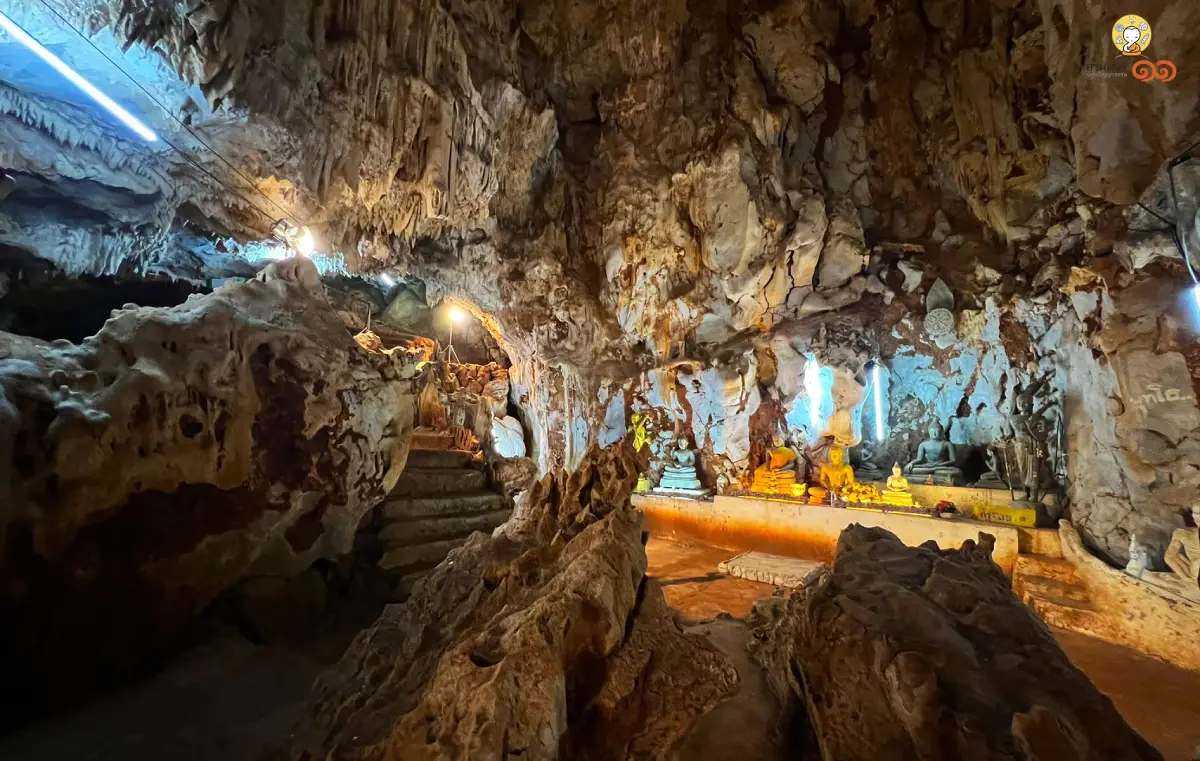
Inside the cave, visitors encounter stalactites, stalagmites, rock curtains, natural formations, Buddha images, relic shrines, and symbolic areas shaped by both geology and faith. The atmosphere is cooler and more humid than the outside air. The lighting inside the cave reveals the texture of rock surfaces and highlights forms that resemble pillars, flowers, mythical creatures, and natural sculptures. This setting rewards slow observation. Rather than walking quickly through the cave, visitors should take time to notice how stone, shadow, light, and sacred objects interact in each chamber.
Kaew Saraphat Neuk Cave is organized into major visitor zones, making the experience easier to follow than in many undeveloped natural caves. The route begins at the entrance area, where visitors can pay respect before moving into deeper spaces. The main zones include Kaew Saraphat Neuk Cave, Buddha Cave, the Hermit Skeleton zone, Dragon Gate, and the stone museum with a cave theater. This structure allows the cave to function as a Buddhist pilgrimage site, a natural cave attraction, and a learning space at the same time.
Zone 1, Kaew Saraphat Neuk Cave, forms the entrance and devotional starting point. This zone houses a golden pagoda containing Buddhist relics, the Luang Pho Kaew Saraphat Neuk Buddha image, and relics associated with Phra Thepsutthachan, or Luang Pu Chot Kunasampanno. Visitors usually begin here by paying respect, making merit, and calming the mind before entering the inner cave route. This first zone helps transition the visitor from the noise of road travel into a quiet sacred environment.
Zone 2 is Buddha Cave. It contains many Buddha images in different postures and serves as a central worship space inside the cave. The presence of Buddha images among natural rock formations creates a distinct Thai cave-temple atmosphere. Visitors can pay respect, observe the arrangement of the images, and experience the stillness of a Buddhist sanctuary formed inside the mountain. This zone is especially meaningful for foreign visitors because it shows how Thai Buddhist practice often integrates natural landscapes into sacred space.
Zone 3 is the Hermit Skeleton zone, one of the most memorable parts of the cave. It is known locally for the display called the 4,000-year-old hermit skeleton and is associated with prayers for health, work, and auspicious life conditions. The zone adds a legendary and mystical dimension to the cave experience. Visitors should treat the display with respect, avoid touching exhibits, and keep their voices low because many people approach this area with devotional intention.
Zone 4 is Dragon Gate. This section features a large natural rock formation that resembles a dragon guarding the path inside the cave. The shape is the result of natural geological processes, but local belief and visitor imagination have given it an auspicious meaning. It is one of the most photographed and easily remembered points in the cave. The Dragon Gate zone shows how natural formations can become part of a sacred landscape through interpretation and belief.
Zone 5 is the stone museum and cave theater. This area gives the cave an educational dimension beyond worship and sightseeing. The stone museum allows visitors to consider the natural processes that form caves and rock shapes, while the cave theater helps explain stories and meanings connected with the site. This makes the cave suitable for families, students, study groups, and travelers who want to understand both Buddhist culture and natural cave environments.
The importance of Kaew Saraphat Neuk Cave lies in this combination of nature, Buddhism, monastic history, local belief, and tourism interpretation. It is not just a cave with attractive rock formations. It is a layered place where visitors can pay respect to Buddhist relics, learn about revered monks, observe stalactites and stalagmites, and move through symbolic zones shaped by both faith and geology. This layered experience is why the cave remains one of Pak Chong’s notable sacred attractions.
Getting There is straightforward by private car. The temple is located near Mittraphap Road at kilometer marker 161. From the Farm Chokchai area, continue for roughly 500 meters to 1 km, use the designated U-turn, and enter the road toward the temple for about 1 km. The location makes it practical to include the cave in a Pak Chong day trip. Travelers using public transport can get off near Wat Wachiralongkon or a nearby roadside point, then continue by local motorcycle taxi or hired vehicle.
The temple’s location is highly convenient for a half-day trip. It is close to Farm Chokchai, Premium Outlet Khao-Yai, Thong Somboon Club, local restaurants, and the wider Khao Yai route. A practical itinerary can begin with cave worship and sightseeing in the morning, followed by lunch in Pak Chong or a drive toward Khao Yai in the afternoon. Families and older visitors should allow enough time to walk slowly inside the cave because some areas may be humid and require careful footing.
The cave is open daily from 08.00 to 19.00. The cave admission fee is 50 to 80 baht per person, used for cave maintenance and utilities. A youth guide fee of 30 baht per group is available for guided visits. Groups should contact the cave in advance through the listed numbers: 08-9445-6896, 08-1649-0824, and 08-3369-5109. The temple contact listed by the Nakhon Ratchasima Provincial Office of Buddhism is 089-806-1844, and the current abbot is Phra Khru Wisutthikhunakon.
Visitors should dress respectfully because the cave is part of a Buddhist temple. Modest clothing, comfortable walking shoes, and quiet behavior are appropriate. Running, shouting, touching stalactites, writing on cave walls, and disturbing worshippers should be avoided. A cave temple is both a natural environment and a sacred space. Proper conduct helps preserve the cave and protects the atmosphere for monks, local worshippers, and other visitors.
Stalactites and stalagmites form through slow natural processes over long periods of time. Water carrying dissolved minerals passes through limestone and gradually deposits minerals into shapes that become curtains, columns, and hanging forms. Touching these formations can leave oils and dirt on the surface, which may affect their natural condition. Even small damage becomes serious when repeated by many visitors. The best way to appreciate the formations is to observe them visually and follow the established walking route.
For travelers interested in Thai Buddhist teachers, the cave has particular meaning because of its connection with respected monks. Luang Pu Dune Atulo is widely respected in the Thai meditation tradition. Luang Pu Chot Kunasampanno is associated with the discovery and early development of the cave. Luang Pho Phoem Barami played an important role in the continuing development of Wat Tham Trairat as a practice place. These associations give the cave a deeper spiritual identity than an ordinary tourist attraction.
The cave also reflects the long relationship between caves and Buddhist practice in Thailand. Caves are quiet, cool, and separated from the distractions of daily life. For this reason, monks and meditation practitioners have often used caves as places of retreat and contemplation. Kaew Saraphat Neuk Cave still carries this atmosphere. Even though it has been developed for visitors, the core feeling of the place remains one of stillness, reflection, and respect.
Families can benefit from visiting because the cave combines worship, natural science, and cultural learning. Children can see stalactites and stalagmites, learn why caves are fragile, observe Buddha images inside a natural chamber, and understand how to behave respectfully in a temple. Parents should supervise children closely, especially in humid or uneven areas. A good family visit focuses on quiet observation and learning rather than fast movement or loud activity.
International travelers can understand Kaew Saraphat Neuk Cave as a Thai Buddhist cave temple rather than a purely geological cave. Unlike some cave attractions that focus only on rock formations, this site combines relic worship, Buddha images, monastic history, sacred legends, and natural cave formations. Foreign visitors should dress modestly, speak softly, and avoid touching sacred objects or rock surfaces. These simple practices help visitors experience the site appropriately.
For photography, the cave offers several strong subjects: Buddha images inside the cave, golden pagoda details, stalactites and stalagmites, the Dragon Gate rock formation, and the atmosphere of the walking route. Low light and humidity are normal inside caves, so phones and cameras should be handled carefully. Flash photography and large equipment should not disturb worshippers or block narrow paths. The best photographs are those taken without touching or damaging the cave environment.
The cave is also well placed for combining with other attractions. Farm Chokchai is very close and works well for families who want a farm experience after visiting the cave. Premium Outlet Khao-Yai is convenient for a short stop along Mittraphap Road. Thong Somboon Club provides outdoor activities, while the Khao Yai route offers restaurants, cafes, art museums, and national park access. This makes Wat Tham Trairat a flexible stop for travelers with different interests.
For Buddhist travel, Wat Thep Phithak Punnaram, also known as Wat Phra Khao, can be paired with Wat Tham Trairat. The large white Buddha image on the hill is one of Pak Chong’s recognizable spiritual landmarks. A one-day Buddhist route can begin at Kaew Saraphat Neuk Cave, continue to Wat Thep Phithak Punnaram, and then include nearby temples or viewpoints depending on time. This route gives visitors a broader view of sacred sites in Pak Chong.
Pak Chong has many nearby food options after a cave visit. Banmai Chay Nam Pak Chong is known for its riverside atmosphere and antique collection. Dairy Home Restaurant is a well-known dining stop in the Phaya Yen area. Krua Khao Yai Restaurant, The Chocolate Factory Khao Yai, Kuni Kuni at dusitD2 Khao Yai, Midwinter Khao Yai, and Bucolic Khaoyai can be included depending on the direction of travel. Visitors staying overnight can choose from Pak Chong town hotels, activity resorts, and Khao Yai accommodations.
The best time to visit is morning or early afternoon. This gives visitors enough time to walk through the cave, pay respect, take photographs, and continue to nearby attractions. During long weekends and public holidays, travelers should allow extra time for parking, admission, and group entry. Groups should contact the cave before arrival to arrange appropriate guidance and visitor management.
Useful items include modest clothing, comfortable shoes, drinking water, a camera or phone suitable for low light, and cash for admission, merit-making, or a youth guide. Older visitors should walk slowly and rest when needed because the cave may include stairs, damp floors, and areas with uneven surfaces. Anyone with knee, balance, or breathing concerns should take extra care and avoid rushing.
Culturally, Kaew Saraphat Neuk Cave is a clear example of how Pak Chong uses natural landscape as a foundation for faith and tourism. A natural cave has been developed into a place of worship, learning, and travel while retaining its geological character. The cooperation between the temple and supporting groups has helped organize the cave into zones and create a more structured visitor experience. The preservation of the cave still depends strongly on visitor behavior.
Kaew Saraphat Neuk Cave is therefore ideal for travelers seeking a calmer side of Pak Chong. Instead of only visiting farms, cafes, or resorts, visitors can enter a cool cave, pay respect to Buddhist relics, learn about respected monks, observe natural formations, and experience how faith and nature can exist together. This makes the cave valuable for Thai visitors and international travelers who want to understand the spiritual landscape of Khao Yai and Pak Chong.
In conclusion, Kaew Saraphat Neuk Cave at Wat Tham Trairat is an important sacred cave attraction in Pak Chong, Nakhon Ratchasima. It is easy to reach from Mittraphap Road near Farm Chokchai, open daily from 08.00 to 19.00, and organized into 5 main zones: Kaew Saraphat Neuk Cave, Buddha Cave, the Hermit Skeleton zone, Dragon Gate, and the stone museum with a cave theater. The site combines Buddhist relics, Buddha images, stalactites and stalagmites, monastic history, and a quiet sacred atmosphere, making it a meaningful stop on the Pak Chong-Khao Yai travel route.
| Name | Kaew Saraphat Neuk Cave / Wat Tham Trairat |
| Location | Wat Tham Trairat, Nong Nam Daeng Subdistrict, Pak Chong District, Nakhon Ratchasima Province, Thailand |
| Address | 289 Moo 1, Nong Nam Daeng Subdistrict, Pak Chong District, Nakhon Ratchasima 30130, Thailand |
| Spatial Coordinates | Mittraphap Road, kilometer marker 161, near Farm Chokchai, Nong Nam Daeng Subdistrict, Pak Chong District, Nakhon Ratchasima |
| Highlights | A sacred Buddhist cave within Wat Tham Trairat, featuring stalactites and stalagmites, a golden pagoda, Buddhist relics, Luang Pho Kaew Saraphat Neuk Buddha image, Buddha Cave, Hermit Skeleton zone, Dragon Gate, and stone museum |
| History / Importance | The cave was discovered in 1968 by Phra Thepsutthachan, or Luang Pu Chot Kunasampanno, and is associated with respected monks such as Luang Pu Dune Atulo, Luang Pu Chot Kunasampanno, and Luang Pho Phoem Barami |
| Name Origin | Kaew Saraphat Neuk refers to a sacred cave associated with prayer, intention, and the gem-like beauty of cave formations, while Wat Tham Trairat refers to the Three Jewels of Buddhism |
| Distinctive Features | A natural cave developed as a Buddhist learning and worship attraction, with organized walking zones, sacred objects, natural formations, belief-based areas, and educational displays |
| Travel Information | Use Mittraphap Road at kilometer marker 161. After passing Farm Chokchai for about 500 meters to 1 km, make the designated U-turn and enter the temple road for about 1 km. Public transport users can get off near Wat Wachiralongkon and continue by local hired transport. |
| Current Status | Open as a Buddhist cave attraction inside Wat Tham Trairat |
| Open Days | Daily |
| Opening Hours | 08.00 – 19.00 |
| Fees | Cave admission 50 – 80 baht/person for cave maintenance and utilities / Youth guide fee 30 baht/group |
| Facilities | Parking area, toilets, merit-making points, worship areas, cave walking route, youth guide service, cave displays, and temple service areas |
| Main Areas / Zones | Zone 1: Kaew Saraphat Neuk Cave / Cave Entrance, Golden Pagoda, Buddhist Relics, Luang Pho Kaew Saraphat Neuk Buddha Image Zone 2: Buddha Cave With Many Buddha Images Zone 3: Hermit Skeleton Zone Zone 4: Dragon Gate Zone 5: Stone Museum And Cave Theater |
| Caretaker | Wat Tham Trairat, together with Lu Prasong Foundation and the cave caretaker team / Abbot of Wat Tham Trairat: Phra Khru Wisutthikhunakon |
| Main Contact Number | Wat Tham Trairat Tel. 089-806-1844 / Cave and group visit contacts Tel. 08-9445-6896, 08-1649-0824, 08-3369-5109 / Additional temple information Tel. 098-662-5835 |
| Official Website / Official Page | Nakhon Ratchasima Provincial Office of Buddhism / Tourism Authority of Thailand / Wat Tham Trairat - Kaew Saraphat Neuk Cave, Pak Chong |
| Nearby Tourist Attractions | 1. Farm Chokchai, about 1 km, Tel. 044-935-504 2. Premium Outlet Khao-Yai, about 5 km, Tel. 044-377-555 to 8 3. Banmai Chay Nam Pak Chong, about 8 km, Tel. 044-314-236 4. Thong Somboon Club, about 12 km, Tel. 044-312-248, 093-326-6685 5. Wat Thep Phithak Punnaram / Wat Phra Khao, about 16 km, Tel. 044-361-667 to 8 6. Khao Yai Art Museum, about 20 km, Tel. 081-440-0202 7. PB Valley Khao Yai Winery, about 24 km, Tel. 081-733-8783, 085-481-1741 |
| Nearby Restaurants | 1. Dairy Home Restaurant, about 10 km, Tel. 081-991-0271 2. Banmai Chay Nam Restaurant, about 8 km, Tel. 044-314-236 3. Krua Khao Yai Restaurant, about 16 km, Tel. 086-865-9263 4. The Chocolate Factory Khao Yai, about 18 km, Tel. 092-443-8881 5. Kuni Kuni At dusitD2 Khao Yai, about 19 km, Tel. 044-003-000 6. Midwinter Khao Yai, about 23 km, Tel. 082-452-8888 7. Bucolic Khaoyai, about 24 km, Tel. 065-669-5497 |
| Nearby Accommodations | 1. Thong Somboon Club, about 12 km, Tel. 044-312-248, 093-326-6685 2. Hotel Labaris Khao Yai, about 18 km, Tel. 044-300-999 3. Thames Valley Khao Yai, about 19 km, Tel. 044-009-999 4. dusitD2 Khao Yai, about 19 km, Tel. 044-003-000 5. Lacol Khao Yai - A Chatrium Collection, about 20 km, Tel. 044-001-896 6. Kirimaya / Muthi Maya Khao Yai, about 24 km, Tel. 044-426-000 7. U Khao Yai, about 28 km, Tel. 044-079-999 |
Frequently Asked Questions (FAQ)
Q: Where is Kaew Saraphat Neuk Cave located?
A: Kaew Saraphat Neuk Cave is located inside Wat Tham Trairat in Nong Nam Daeng Subdistrict, Pak Chong District, Nakhon Ratchasima Province, near Mittraphap Road kilometer marker 161 and Farm Chokchai.
Q: Is Kaew Saraphat Neuk Cave open to visitors?
A: Yes. The cave is open daily from 08.00 to 19.00 as a Buddhist cave attraction inside Wat Tham Trairat.
Q: Is there an entrance fee for Kaew Saraphat Neuk Cave?
A: Yes. The cave admission fee is 50 to 80 baht per person for cave maintenance and utilities. A youth guide fee of 30 baht per group is also available.
Q: How many main zones are inside the cave?
A: The cave has 5 main zones: Kaew Saraphat Neuk Cave, Buddha Cave, the Hermit Skeleton zone, Dragon Gate, and the stone museum with a cave theater.
Q: Who is the abbot of Wat Tham Trairat?
A: The abbot of Wat Tham Trairat is Phra Khru Wisutthikhunakon.
Q: Which respected monks are connected with the cave?
A: The cave and temple are associated with respected monks such as Luang Pu Dune Atulo, Luang Pu Chot Kunasampanno, and Luang Pho Phoem Barami.
Q: How do travelers get to Kaew Saraphat Neuk Cave?
A: Use Mittraphap Road at kilometer marker 161. After passing Farm Chokchai for about 500 meters to 1 km, make the designated U-turn and enter the temple road for about 1 km to Wat Tham Trairat.
Q: What nearby places can be included in the same trip?
A: Nearby places include Farm Chokchai, Premium Outlet Khao-Yai, Thong Somboon Club, Wat Thep Phithak Punnaram, Khao Yai Art Museum, and the wider Khao Yai travel route.
 Category: ●Nature and Wildlife
 Group: ●Caves
Last Update : 4 WeekAgo
 Last Update : 4 WeekAgo
 Click to Access the Navigation Map GPS
Kaew Saraphat Neuk Cave Map
Recommend

 Art, Culture and Heritage
 Historical Sites and Monuments(20)
 Landmarks and Memorials(5)
 Art, Craft Centres, Tradition(7)
 Museums(6)
 Art Gallery(1)
 Educational Places
 Educational Gardens, Farm(4)
 Places of Worship
 Temple(29)
 Mosque(1)
 Other Sacred Sites(6)
 Research and Development
 Royal Project(3)
 Suburban Living
 Village, Community(6)
 Local Market(4)
 Floating Market(1)
 National Parks and Marine Reserves(3)
 Mountain (Doi)(5)
 Dam, Reservoir, Lake(8)
 Waterfalls(9)
 Hot Springs(1)
Caves(2)
Hot Springs(1)
Caves(2)
 Flower Field(1)
 River, Canal(8)
 Bays and Beaches(2)
 Other natural attractions(3)
 Entertainment and Agricultural
 Zoos and Aquariums(1)
 Animal camps and shows(1)
 Farms, Parks and Ecotourism(21)
 Waterpark(2)
 Outdoor and Adventure Activities(6)
 Shopping
 Shopping and Night Market(2)
 Travel Articles, Recipes
 Travel Review, Food Review(5)


