
lovethailand home >Northeastern Travel Attractions >Mukdahan Travel Attractions >Muang Mukdahan >Mukdahan > Wat Yot Kaeo Si Wichai
TL;DR: Wat Yot Kaeo Si Wichai is located at Si Mongkhon Yot Kaeo Community, near Samran Chai Khong Road and the Indochina Market, Mueang Mukdahan District, Mukdahan 49000, Thailand, open Daily, hours 08.00 – 17.00.
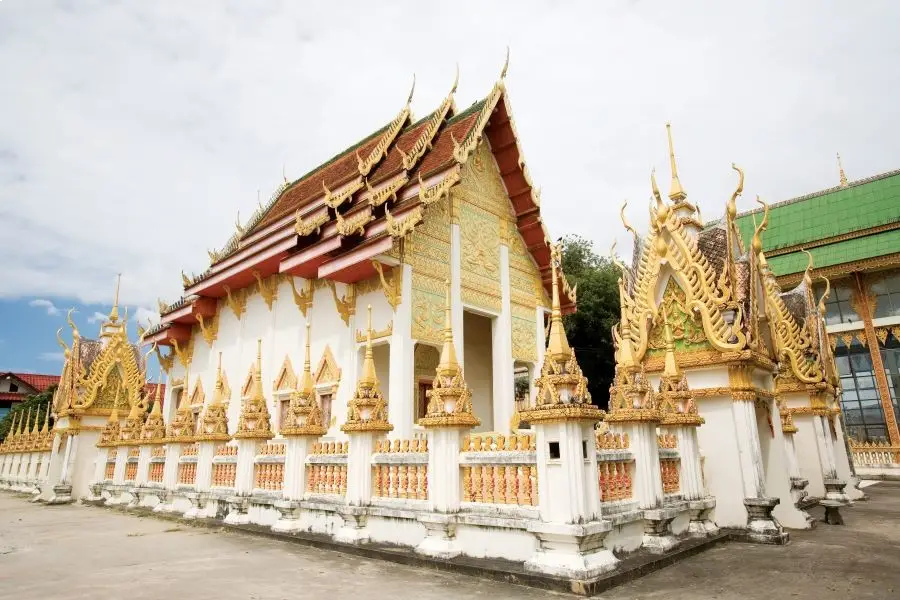
Wat Yot Kaeo Si Wichai
Open Days: Daily
Opening Hours: 08.00 – 17.00
Wat Yot Kaeo Si Wichai, also written as Wat Yod Kaew Sri Wichai and commonly known among local residents as “Wat Klang,” is a historic Buddhist temple near the Mekong riverfront in central Mukdahan. Founded in 1826 by Phraya Chan Suriyawong, the second ruler of Mukdahan, and his wife, the temple has remained closely connected with the development of the old riverfront community for approximately 200 years. It was substantially restored in 1846 by Phra Chan Suriyawong, the founder’s son, who gave it the name Wat Yot Kaeo Si Wichai. Important features include an ornate gold-decorated viharn, a large Buddha image in the posture of Bestowing Compassion upon Living Beings, a replica of Phra That Phanom, and 2 elaborately decorated stupas standing in front of the principal hall. The temple is close to the Indochina Market and can easily be included in a cultural walking or driving route through central Mukdahan.
Wat Yot Kaeo Si Wichai is located in the Si Mongkhon Yot Kaeo community, close to Samran Chai Khong Road and the Indochina Market in Mueang Mukdahan District, Mukdahan Province. Its coordinates are approximately 16.5408949, 104.7294634. The temple stands within a compact historical district containing several other Buddhist monasteries, a guardian-spirit shrine, traditional neighborhoods, markets, restaurants, and Mekong riverfront accommodation.
The local name Wat Klang means the Central Temple. It reflects the temple’s original position near the center of the old Mukdahan settlement before the modern city expanded westward and along major roads. The name also describes its traditional role as a central meeting point for religious ceremonies, merit-making, community gatherings, Buddhist education, and the everyday spiritual life of families living and trading beside the Mekong.
The temple was founded in 1826 during the early Rattanakosin period. At that time, Mukdahan was an important river settlement linked to communities on both banks of the Mekong through boat travel, trade, family relationships, and shared religious customs. Establishing a monastery was therefore not merely a matter of constructing accommodation for monks. It created a permanent spiritual and cultural center for a growing community.
The founder, Phraya Chan Suriyawong, was the second ruler of Mukdahan. His support for the monastery followed the traditional responsibility of local rulers to protect Buddhism and provide places for worship, education, ceremonies, and public gatherings. The involvement of his wife is equally significant, showing that women in leading local families also contributed property, resources, and religious patronage to the development of the city.
In 1846, approximately 20 years after the original foundation, Phra Chan Suriyawong, the founder’s son, carried out an important restoration. He renewed the religious buildings and formally gave the monastery the name Wat Yot Kaeo Si Wichai. The restoration demonstrates that the temple remained active and important to later generations rather than being preserved only as a memorial to its original patrons.
The formal name carries an auspicious meaning. Yot Kaeo may be understood as a precious or exalted jewel representing purity and supreme value, while Si Wichai conveys prosperity, honor, and victory. Together, the words express the aspiration that the temple should become a center of goodness, spiritual distinction, and victory achieved through moral conduct and Buddhist teaching.
Measured from its founding year, Wat Yot Kaeo Si Wichai reaches its 200th anniversary in 2026. During those 2 centuries, the temple has witnessed the changing role of river transport, the growth of border trade, the development of road networks, the creation of modern Mukdahan Province, and the expansion of tourism between Thailand and the Lao People’s Democratic Republic.
The temple’s importance is not based on age alone. Monks continue to live and perform religious duties here, residents visit for merit-making and ceremonies, and the surrounding area is maintained in cooperation with the local municipality. Houses, roads, shops, the market, and the Mekong remain close to the temple, allowing visitors to see how a historic monastery continues to function within the daily life of the city.
The Mekong River is an essential part of the temple’s identity. For generations, the river served as the principal route for travel, trade, communication, and cultural exchange. A monastery near the river could receive travelers, merchants, monks, and residents from communities on both banks. Although modern roads now carry most traffic, the riverfront setting continues to distinguish Wat Yot Kaeo Si Wichai from inland temples.
The surrounding district forms part of Mukdahan’s historic riverfront. Visitors can travel from Wat Yot Kaeo Si Wichai to Wat Si Sumang Wanaram, Wat Si Mongkhon Tai, the Chao Mae Song Nang Phi Nong Shrine, and the Indochina Market within a short distance. Visiting these places together reveals different layers of Buddhist art, foundation legends, local beliefs, trade, and community history.
The architecture of Wat Yot Kaeo Si Wichai is one of its most memorable features. The principal viharn has a dignified multi-tiered roof, long horizontal lines, and decorative elements associated with Thai and northeastern Buddhist architecture. Gold ornamentation contrasts with white exterior walls and the darker roof, allowing the building to stand out clearly from the open courtyard.
The roof is divided into several overlapping levels that gradually rise toward the central ridge. This arrangement gives depth to the structure and prevents the large roof from appearing excessively heavy. Chofa finials, bai raka ornaments, and hang hong details mark the building as a sacred Buddhist structure and create an elegant silhouette against the sky.
The front gable is covered with intricate gold ornamentation. Repeating motifs create a rich surface that remains visually coherent rather than crowded. Gold represents spiritual value, illumination, and the qualities of the Buddha, while the pale background makes the ornament visible from across the courtyard.
Morning and late-afternoon sunlight produces particularly attractive reflections on the gold details. Visitors interested in photography can observe how the appearance of the viharn changes as the angle of light moves across the gable, columns, window frames, and surrounding fence.
The exterior walls and columns are primarily white, with gold details used around architectural borders and sacred decorative elements. This combination creates a clean and peaceful appearance while maintaining the visual dignity expected of an important religious building. The colors also connect the viharn with the fence and smaller stupa-shaped ornaments around the enclosure.
The fence surrounding the viharn is not merely a boundary. Its pillars and finials resemble small stupas arranged in a continuous rhythm. Gold ornamentation against the white base allows visitors to see through and over the enclosure without losing a clear view of the main building.
Two important stupas stand in front of the viharn. Their carefully composed bases, bodies, and tall finials contribute to the balanced appearance of the forecourt. They are objects of worship as well as architectural elements that guide visitors from the open courtyard toward the sacred interior.
The position of the 2 stupas creates a sequence of movement. Visitors first enter the courtyard, approach the stupas, and then continue toward the viharn and the principal Buddha image. This gradual transition helps distinguish the everyday space outside the temple from the increasingly sacred areas within it.
The temple also contains a replica of Phra That Phanom, the renowned stupa in neighboring Nakhon Phanom Province. Phra That Phanom is one of the most important centers of Buddhist devotion in the middle Mekong region and is respected by communities in northeastern Thailand and Laos.
Creating a replica within Wat Yot Kaeo Si Wichai allowed local residents to express their connection with Phra That Phanom and to pay respect without making a longer journey. The replica also represents the wider religious network linking Mukdahan with Nakhon Phanom, Sakon Nakhon, and Lao communities across the Mekong.
The principal Buddha image inside the viharn is a large seated figure described as being in the posture of Bestowing Compassion or Teaching for the Benefit of Living Beings. Its scale immediately establishes it as the visual and spiritual center of the interior. The calm expression and balanced form create an atmosphere of kindness, stability, and contemplation.
The meaning of the posture emphasizes the Buddha’s compassion and his commitment to teaching beings how to overcome suffering. Visitors may use the image as a focus for reflecting on generosity, patience, kindness, and the responsibility to help others without expecting personal benefit.
Worship does not require elaborate offerings. Flowers, incense, candles, or a voluntary donation may be presented according to personal faith. Respectful conduct, a calm mind, and sincere reflection are more important than the value or quantity of material offerings.
Inside the viharn, the arrangement of light, columns, color, and decoration directs attention toward the principal Buddha image at the far end. Although the building contains many ornamental details, the image remains dominant. This clear hierarchy is characteristic of Thai Buddhist halls, in which architectural elements support rather than compete with the central sacred object.
The interior provides a quiet contrast to the market and roads outside. Visitors can sit for 10 to 20 minutes, recite a short prayer, meditate, or simply allow the mind to settle. Speaking loudly, walking directly between the Buddha image and people who are praying, or using the hall as an ordinary photographic studio should be avoided.
Wat Yot Kaeo Si Wichai remains an active monastery with resident monks and regular religious functions. The abbot is Phra Khru Wichai Rattanakon, who is responsible for the monastery, its monks and novices, sacred buildings, religious ceremonies, and its relationship with the surrounding community.
The work of an abbot includes administration, monastic discipline, religious education, ceremonies, maintenance, and coordination with local authorities and the provincial Sangha. Caring for a 200-year-old temple requires a balance between architectural conservation, active religious use, visitor access, and modern public facilities.
In 2024, Mukdahan Town Municipality cleaned and reorganized the pavement in front of the temple and the adjacent market. The project improved the landscape, removed obstructions, and opened a clearer view of the temple. Plans also included work associated with the entrance arch and boundary wall.
Keeping the front of the temple visually open improves more than appearance. It reduces congestion, creates safer access for pedestrians, and allows the historic viharn to be seen from the street. This benefits worshippers, residents, traders, and cultural visitors.
Municipal emergency-planning records identify electricity, a public water supply, and approximately 20 toilets at the temple. The site can also accommodate around 100 people during an emergency. In 2025, the temple was listed among religious sites meeting the HAS public-toilet hygiene standard, indicating continued maintenance of visitor facilities.
The main areas of the temple include the viharn housing the principal Buddha image, the Phra That Phanom replica, the 2 stupas in front of the hall, the ceremonial courtyard, the entrance and boundary wall, monks’ residences, parking areas, and public toilets. Visitors must distinguish between public spaces and the private monastic zone.
The viharn is the principal area for worship. Shoes should be removed and placed neatly before entry. Visitors may bow before the Buddha image, pray, meditate, or make a donation. When monks are conducting a ceremony, visitors should remain in an appropriate position and wait until the formal activity has ended before walking around the interior.
The stupa zone is suitable for observing architectural details and taking respectful photographs. Visitors can examine the bases, central sections, finials, and gold ornamentation from the designated walking area. Climbing onto the bases, placing personal belongings on the stupas, or repeatedly touching decorative surfaces can cause damage and is inappropriate.
The courtyard connects the major structures and accommodates community activities during Buddhist festivals. On holy days, the beginning and end of Buddhist Lent, the kathina season, and Songkran, the area may be occupied by monks and large groups of worshippers. Cultural visitors should give priority to ceremonies and follow instructions from the temple.
The entrance arch and boundary wall separate the monastery from the market district. After improvements to the surrounding landscape, visitors have a clearer view from the street. Photography is possible here, but attention must be given to passing vehicles, pedestrians, and market activity.
A large parking area is available within the compound and is used by both temple visitors and people walking to the nearby market. During festivals or major ceremonies, spaces may fill quickly. Vehicles must not block the entrance, monks’ residences, viharn steps, or emergency routes.
The temple is open daily from 08.00 to 17.00. The most comfortable visiting periods are approximately 08.00 to 10.00 and 15.30 to 16.30. Mornings are cooler and generally quieter, while late-afternoon light is attractive on the gold-decorated front of the viharn.
Visitors primarily interested in worship may prefer the morning, when the atmosphere is calm and monks are carrying out their daily routines. Those interested in architectural photography may choose late afternoon, but sufficient time should be allowed to enter the viharn and leave before closing.
Buddhist holy days and major festivals provide an opportunity to observe local merit-making traditions, although the temple may be more crowded. Travelers wishing to study the architecture in detail should consider a weekday or a period without a major ceremony.
Modest clothing is required. Shoulders should be covered, and trousers or skirts should extend to an appropriate length. Transparent, extremely tight, or revealing clothing is unsuitable even though the temple is located beside an informal market district.
Shoes must be removed before entering the viharn. Hats and sunglasses should also be removed where appropriate. Visitors should not point their feet toward the Buddha image or monks. Women should avoid direct physical contact with monks and use a receiving cloth or an intermediary when presenting an object.
Photography must be conducted respectfully. Devices should be silenced, flash should not disturb worshippers, and close photographs of monks or people praying should not be taken without permission. Visitors must not pose in a mocking manner, climb sacred structures, or cross barriers around important objects.
Families can use the temple as an educational place for children. Parents may explain the founding year, the role of Mukdahan’s second ruler, the origin of the name Wat Klang, and the connection between the Phra That Phanom replica and Mekong Buddhist culture. Children should not run inside the viharn or climb the stupas and fence.
The main courtyard is manageable for older travelers, although the viharn and some structures require the use of steps. Companions should provide assistance and allow additional time. Surfaces may become slippery during rain, and footwear with a secure grip is recommended.
During the rainy season, travelers should check the weather because central Mukdahan lies close to the Mekong and can experience heavy rain. An umbrella and non-slip shoes are useful. During the hot season, drinking water, a hat, and protection from strong midday sun are advisable.
The cooler season from approximately November to February is particularly comfortable for walking through the riverfront district. Mornings and evenings are mild, allowing visitors to combine temples, the market, and a Mekong sunset. A light outer layer can be useful during the coolest early mornings.
A visit of approximately 45 to 90 minutes is suitable for worshipping the principal Buddha image, viewing the viharn, the Phra That Phanom replica, the 2 stupas, and the exterior ornamentation. Travelers interested in local history, architectural photography, or meditation may choose to remain longer.
The Indochina Market begins beside the riverfront temple district and sells clothing, household items, food products, souvenirs, and merchandise associated with Thailand, Laos, Vietnam, and China. Visitors can combine the temple and market without a long transfer, making this one of the most practical cultural stops in central Mukdahan.
Exploring the market after visiting the temple also reveals the continuing commercial importance of the Mekong. The riverfront was historically a place where goods, people, languages, and cultural practices moved between communities. Modern retail has changed the form of exchange, but the border-city character remains visible.
Wat Si Sumang Wanaram is approximately 0.4 kilometers away. It contains an old sim, a Lao-style Buddha protected by a naga, and stupas influenced by Lan Xang architecture. Visiting both temples allows travelers to compare their viharns, stupas, sacred images, and artistic relationships with the wider Mekong region.
Wat Si Mongkhon Tai is also approximately 0.4 kilometers away. It houses Phra Chao Ong Luang, the revered guardian Buddha of Mukdahan, and preserves the legend of Phra Lup Lek. A half-day route including all 3 temples provides a substantial introduction to the city’s religious history.
The Chao Mae Song Nang Phi Nong Shrine is located within the central riverfront district. It represents local beliefs concerning female guardian spirits and the protection of the city. Visiting the shrine demonstrates that Mukdahan’s cultural landscape includes Buddhism, ancestral memory, community legends, and beliefs associated with the Mekong.
Mukdahan Tower, formally known as Ho Kaeo Mukdahan Chaloem Phra Kiat Kanchanaphisek, is approximately 2 kilometers from the temple. After exploring the historic district at street level, visitors can travel to the tower for a broader view of the city, the Mekong, and the urban area facing Savannakhet.
Wat Roi Phra Phutthabat Phu Manorom is approximately 6 kilometers away on elevated terrain outside the central district. It contains a monumental Buddha image, a large naga sculpture, and panoramic viewpoints. Combining the historic Wat Yot Kaeo Si Wichai with Phu Manorom creates a route involving heritage, devotion, sculpture, and landscape.
Mukdahan’s food reflects Thai, Isan, Lao, Vietnamese, and river cultures. Restaurants near the temple serve grilled and steamed fish, som tam, larb, local soups, naem nueang, Vietnamese steamed rice rolls, noodle soup, spring rolls, and ordinary Thai dishes. Several options are within a short drive or walk.
Nut Pob Restaurant is located along the Samran Chai Khong area and serves Thai and local food. Baan Lao Yuan Na Rim Khong combines Isan and Vietnamese dishes in a riverside setting, while Krua Saigon is known for naem nueang and a broad selection of Vietnamese food.
Bao Pradit and other riverside restaurants specialize in northeastern and Mekong dishes, while Ton Pho Nakhon serves Thai food in central Mukdahan. Travelers should call before making a special journey, particularly when dining with a large group or visiting during a public holiday.
Accommodation near the temple includes both riverfront hotels and central business hotels. Riverfront Hotel Mukdahan is located on Samran Chai Khong Tai Road close to the market. Hotel de Ladda offers Mekong-facing accommodation and modern facilities in the same general riverfront district.
Ploy Palace Hotel is a full-service property in central Mukdahan suitable for families and business travelers. HOP INN Mukdahan and B2 Mukdahan Boutique & Budget Hotel provide standardized accommodation for travelers using private vehicles or local transport.
Staying near Samran Chai Khong Road makes it possible to reach the temple and market on foot or by a very short ride. Travelers can worship in the morning, explore the market, return to their hotel during the heat of the day, and dine beside the Mekong in the evening.
Getting There is straightforward from central Mukdahan. Follow local signs toward the Indochina Market and Samran Chai Khong Road. The temple is in the Si Mongkhon Yot Kaeo community close to the riverfront. Private cars, rental vehicles, motorcycles, local tuk-tuks, and hired transport can all reach the area. Navigation systems can use the name Wat Yot Kaeo Si Wichai or the coordinates 16.5408949, 104.7294634.
Travelers arriving at Mukdahan Bus Terminal can hire a local tuk-tuk, taxi, or app-based vehicle to the Indochina Market district. It is useful to tell the driver that the destination is Wat Yot Kaeo Si Wichai, also called Wat Klang, in the Si Mongkhon Yot Kaeo community.
Visitors arriving from the Second Thai–Lao Friendship Bridge should follow routes into central Mukdahan and then continue toward the Indochina Market. Traffic may be slower around the riverfront during festivals and busy market periods, so additional travel time should be allowed.
Walking between the temple, market, and nearby religious sites is practical in mild weather. Some pavements are shared with vehicles or market activity, so travelers should remain alert when crossing roads and protect personal belongings. Older travelers may prefer local transport for destinations more than 1 kilometer away.
Wat Yot Kaeo Si Wichai demonstrates how architectural and social values can remain active in the same place. The viharn and stupas attract cultural interest, while monks, worshippers, and community ceremonies ensure that the monastery retains its original religious function.
Visitors can support conservation by avoiding contact with painted and carved surfaces, not climbing the stupas, disposing of waste properly, and respecting restricted monastic areas. Donations intended for restoration should be placed in official donation boxes or given through clearly identified temple channels.
Information shared online should accurately state the founding year, the names of the founders, the 1846 restoration, and the principal sacred features. Legends or objects belonging to other Mukdahan temples should not be incorrectly attached to Wat Yot Kaeo Si Wichai.
Historically, the temple reveals the role of Mukdahan’s ruling family in developing both the civic and spiritual life of the town. Phraya Chan Suriyawong did not limit his responsibility to administration. By supporting a monastery, he and his family provided a center for worship, education, collective memory, and social unity.
Artistically, the temple combines Thai, northeastern, and Mekong elements. The layered roof, gold ornamentation, Phra That Phanom replica, and forecourt stupas distinguish it from many recently constructed temples that rely primarily on monumental scale or contemporary design.
Spiritually, the principal Buddha image and the Phra That Phanom replica connect compassion with regional devotion. Visitors can learn the meaning of Buddhist forms while appreciating their visual beauty, rather than treating the temple only as a photographic background.
Socially, the enduring name Wat Klang expresses the temple’s closeness to local people. Although the commercial center of Mukdahan has expanded, residents still pass the temple, make offerings, join ceremonies, park nearby, and include it in their daily movement through the riverfront district.
For first-time visitors to Mukdahan, Wat Yot Kaeo Si Wichai deserves a place in a central-city itinerary. It is easy to reach, close to several attractions, and does not require an entire day. The visit provides quiet worship, a clear historical narrative, and one of the most distinctive gold-decorated religious buildings in the riverfront area.
A well-balanced day can begin with worship at Wat Klang, continue to Wat Si Sumang Wanaram and Wat Si Mongkhon Tai, include shopping at the Indochina Market and a Vietnamese or Isan lunch, and finish at Mukdahan Tower or Phu Manorom. Such a route presents the city through religion, architecture, trade, food, and geography.
Wat Yot Kaeo Si Wichai is important not simply because it is approximately 200 years old, but because it continues to connect past and present, faith and everyday life, and the city with the cultural world of the Mekong. Its gold-decorated viharn, Phra That Phanom replica, twin stupas, and compassionate Buddha image form part of a single story of patronage, community cooperation, and heritage preserved through generations of Mukdahan residents.
| Name | Wat Yot Kaeo Si Wichai |
| Alternative Name | Wat Klang, meaning the Central Temple |
| Location | Si Mongkhon Yot Kaeo Community, near Samran Chai Khong Road and the Indochina Market, Mueang Mukdahan District, Mukdahan 49000, Thailand |
| Coordinates | 16.5408949, 104.7294634 |
| Highlights | A 200-year-old temple with a gold-decorated viharn, a large compassionate Buddha image, a Phra That Phanom replica, and 2 ornate stupas |
| Founding Year | 1826 |
| Founders | Phraya Chan Suriyawong, the second ruler of Mukdahan, and his wife |
| Major Restoration | Restored in 1846 by Phra Chan Suriyawong, the founder’s son, and renamed Wat Yot Kaeo Si Wichai |
| Name Origin | The local name Wat Klang reflects its historical position near the center of the old Mukdahan community |
| Important Features | Large Buddha image in a compassionate teaching posture, Phra That Phanom replica, 2 forecourt stupas, and the gold-decorated viharn |
| Architectural Character | Multi-tiered viharn roof with chofa, bai raka, and hang hong ornaments, plus intricate gold decoration against white exterior surfaces |
| Abbot | Phra Khru Wichai Rattanakon |
| Main Areas / Zones | 1. Viharn housing the principal Buddha image 2. Phra That Phanom replica 3. Two stupas in front of the viharn 4. Courtyard and ceremonial area 5. Entrance and boundary wall 6. Monastic residences 7. Parking and public toilets |
| Current Status | Open and active as a monastery with resident monks and ongoing maintenance in cooperation with local authorities |
| Open Days | Daily |
| Opening Hours | 08.00 – 17.00 |
| Facilities | Electricity, public water supply, approximately 20 toilets, parking, and space capable of accommodating local residents; the toilets met the HAS public-hygiene standard in 2025 |
| Travel Information | Follow signs from central Mukdahan toward the Indochina Market and Samran Chai Khong Road. Accessible by private car, rental vehicle, motorcycle, tuk-tuk, and local hired transport. |
| Recommended Time | 08.00 – 10.00 or 15.30 – 16.30 |
| Suggested Visit Duration | Approximately 45 – 90 minutes |
| Visitor Guidelines | Dress modestly, remove shoes before entering the viharn, remain quiet, avoid flash photography, and do not climb or unnecessarily touch stupas and decorative surfaces |
| Nearby Tourist Attractions | 1. Indochina Market, 0.1 km 2. Wat Si Sumang Wanaram, 0.4 km 3. Wat Si Mongkhon Tai, 0.4 km 4. Chao Mae Song Nang Phi Nong Shrine, 0.8 km 5. Ho Kaeo Mukdahan Chaloem Phra Kiat Kanchanaphisek, 2 km 6. Wat Roi Phra Phutthabat Phu Manorom, 6 km |
| Nearby Restaurants | 1. Nut Pob Restaurant, 0.8 km, Tel. 089-711-6063 2. Baan Lao Yuan Na Rim Khong, 1.4 km, Tel. 042-611-111, 065-142-3915, 063-247-9654 3. Ton Pho Nakhon Restaurant, 1.6 km, Tel. 042-613-575 4. Krua Saigon Mukdahan, 1.9 km, Tel. 042-615-303, 081-320-1318 5. Bao Pradit Restaurant, 2.5 km, Tel. 096-358-9717 |
| Nearby Accommodations | 1. Riverfront Hotel Mukdahan, 0.6 km, Tel. 042-612-948, 042-612-949 2. Hotel de Ladda, 1.5 km, Tel. 042-611-499, 042-611-497 3. Ploy Palace Hotel, 1.8 km, Tel. 042-614-988 4. HOP INN Mukdahan, 2.4 km, Tel. 092-258-7318 5. B2 Mukdahan Boutique & Budget Hotel, 2.7 km, Tel. 052-009-161, 088-263-2897 |
Frequently Asked Questions (FAQ)
Q: Where is Wat Yot Kaeo Si Wichai located?
A: The temple is in the Si Mongkhon Yot Kaeo community near Samran Chai Khong Road and the Indochina Market in Mueang Mukdahan District. Its coordinates are 16.5408949, 104.7294634.
Q: When was Wat Yot Kaeo Si Wichai built and who founded it?
A: The temple was founded in 1826 by Phraya Chan Suriyawong, the second ruler of Mukdahan, and his wife.
Q: Why do local residents call it Wat Klang?
A: Wat Klang means the Central Temple. The name reflects the temple’s historical position near the center of the old Mukdahan community and its role as a major place of worship.
Q: What are the most important features inside the temple?
A: Important features include the large Buddha image in a compassionate teaching posture, a replica of Phra That Phanom, 2 ornate stupas, and the gold-decorated viharn.
Q: Who is the abbot of Wat Yot Kaeo Si Wichai?
A: The abbot is Phra Khru Wichai Rattanakon.
Q: What are the temple’s opening hours?
A: The temple is open daily from 08.00 to 17.00. Morning and late afternoon are the most comfortable times for worship and architectural sightseeing.
Q: Is parking available at the temple?
A: Parking is available within the temple compound. Drivers should use designated spaces and avoid blocking the viharn, monks’ residences, entrances, or emergency access routes.
Q: Which attractions can be combined with a visit to the temple?
A: Nearby attractions include the Indochina Market, Wat Si Sumang Wanaram, Wat Si Mongkhon Tai, and the Chao Mae Song Nang Phi Nong Shrine. Travelers can then continue to Mukdahan Tower or Wat Roi Phra Phutthabat Phu Manorom.
 Category: ●Places of Worship
 Group: ●Temple
Last Update : 2 MonthAgo
 Last Update : 2 MonthAgo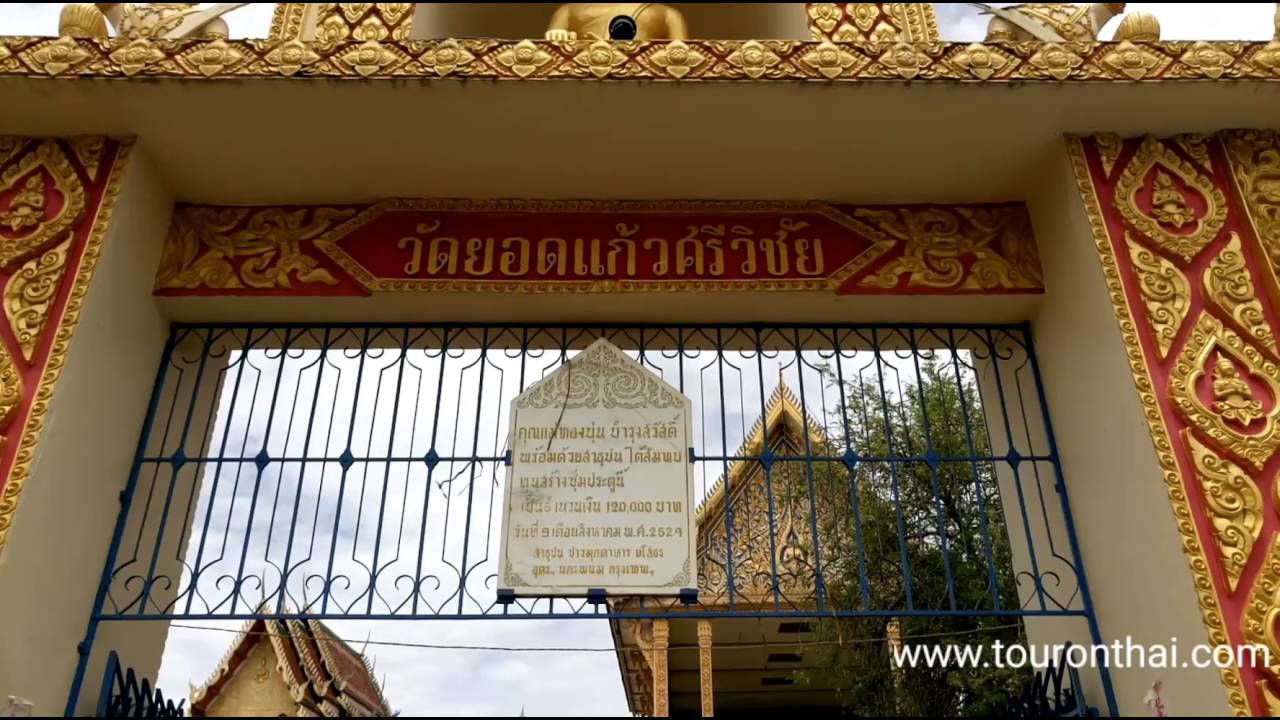
 Click to Access the Navigation Map GPS
Wat Yot Kaeo Si Wichai Map
Recommend

 Art, Culture and Heritage
 Historical Sites and Monuments(2)
 Landmarks and Memorials(3)
 Art, Craft Centres, Tradition(2)
 Museums(1)
Temple(17)
Museums(1)
Temple(17)
 Other Sacred Sites(3)
 Suburban Living
 Village, Community(4)
 Local Market(2)
 Nature and Wildlife
 National Parks and Marine Reserves(4)
 Mountain (Doi)(5)
 Dam, Reservoir, Lake(3)
 Waterfalls(5)
 Caves(2)
 River, Canal(2)
 Bays and Beaches(1)
 Other natural attractions(1)
 Entertainment and Agricultural
 Farms, Parks and Ecotourism(1)


