
lovethailand home >Northeastern Travel Attractions >Mukdahan Travel Attractions >Khamcha-i >Khamcha-i > Khamcha-i Waterfall
TL;DR: Khamcha-i Waterfall is located at Inside Mobile Development Unit 24, Ban Si Mongkhon, Moo 8, Khamcha-i Subdistrict, Khamcha-i District, Mukdahan Province, open Daily, hours 08.00 – 16.00.
Khamcha-i Waterfall
Open Days: Daily
Opening Hours: 08.00 – 16.00
Khamcha-i Waterfall, Mukdahan: A Small Year-Round Waterfall with a 100-Metre Natural Stream. Khamcha-i Waterfall is a small and attractive natural waterfall located inside Mobile Development Unit 24 at Ban Si Mongkhon, Moo 8, Khamcha-i Subdistrict, Khamcha-i District, Mukdahan Province. Water descends from a rock ledge approximately 4 metres high before flowing through a series of natural boulders and forming a stream about 100 metres long. Water remains present throughout the year, although its volume changes with rainfall and season. The shaded setting is suitable for supervised swimming, picnicking, family relaxation, and nature photography. Normal visiting hours are daily from 08.00 to 16.00. Travelers should contact Mobile Development Unit 24 before departure to confirm access, water conditions, and the regulations applying on the day of their visit.
Khamcha-i Waterfall is one of the natural attractions that best represents the quieter side of Khamcha-i District. It is not a vast waterfall descending from a towering mountain cliff, and it does not require a long expedition through remote forest. Its appeal comes from a combination of flowing water, shaded trees, layered rocks, accessible surroundings, and a relaxed local atmosphere. Visitors can spend time beside the stream without having to follow a demanding hiking route or prepare specialised outdoor equipment.
The waterfall lies within the grounds of Mobile Development Unit 24, Regional Development Office 2, Armed Forces Development Command, Royal Thai Armed Forces Headquarters. The unit is based at Ban Si Mongkhon in Moo 8 of Khamcha-i Subdistrict. Because the attraction is situated within a government and military development compound, visitors should understand that it is not an unrestricted public park. Entry arrangements, accessible zones, security requirements, and operating hours remain under the authority of the unit.
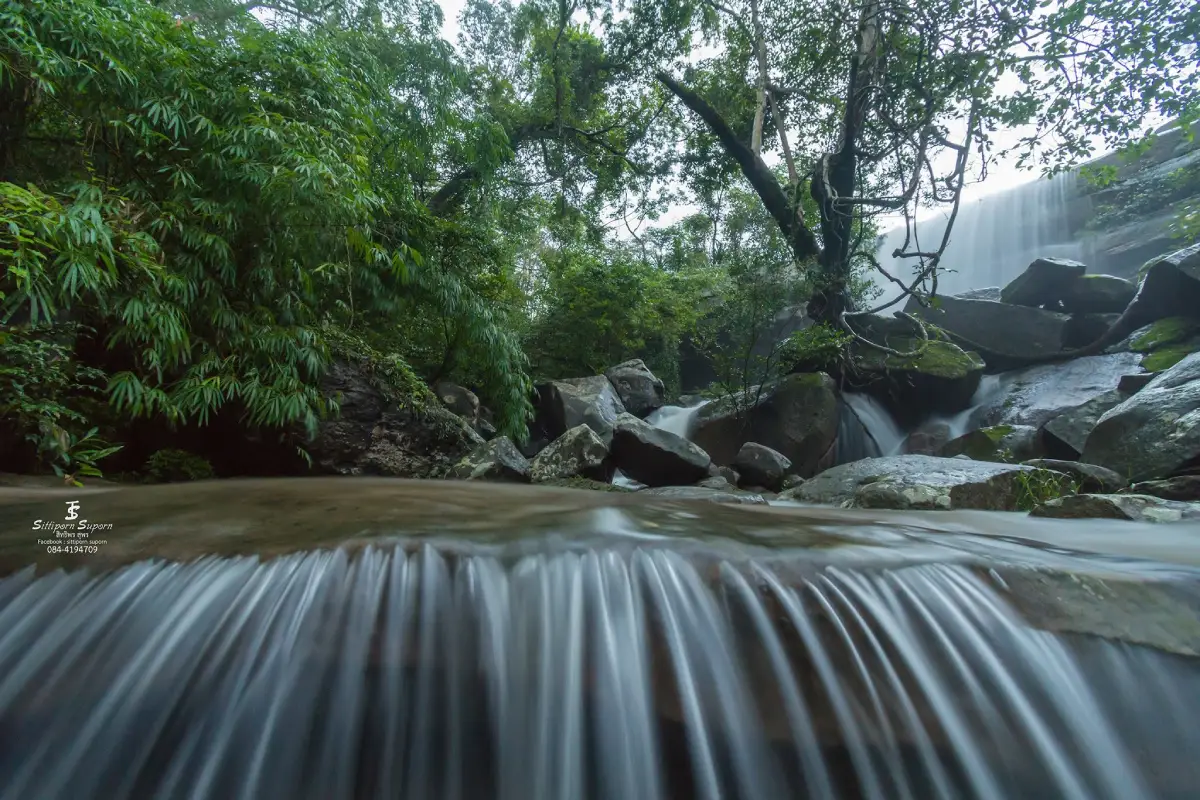
The principal drop is approximately 4 metres high. Water flows over the upper rock ledge, separates into smaller channels, and descends toward a natural pool and rocky stream below. Rather than producing a single tall vertical curtain, the water follows several grooves and uneven sections of stone. This creates a gentle, multi-level cascade with constantly changing patterns and sounds. The moderate height also allows visitors to observe the interaction between water and rock at close range from approved viewing positions.
After leaving the main cascade, the water continues through a natural channel approximately 100 metres long. Some parts flow across flat rock, while other sections form small rapids, shallow pools, narrow channels, and quieter pockets between boulders. The changing shape of the stream is one of the defining features of Khamcha-i Waterfall. Visitors can appreciate several small waterside environments rather than standing at a single viewpoint.
The source is associated with Huai Khan Thae Yai, a local stream flowing from the Ban Non Sawang area before reaching the waterfall. The watercourse collects rainfall and runoff from surrounding land and higher ground. Its appearance therefore changes with soil moisture, local rain, and seasonal conditions. The site is known for retaining water throughout the year, but this does not mean that the depth, width, or current remains identical every month.
During the rainy season, the cascade may spread across a wider section of rock and the stream can become faster, deeper, and darker because of naturally transported sediment. During the cool season, water conditions are often more moderate and the air is comfortable for outdoor relaxation. Near the end of the dry season, the flow may become smaller, revealing more of the rock ledges, channels, and natural pools. Every season presents a different version of the same landscape.
The waterfall is primarily a place for relaxation rather than strenuous adventure. Families, groups of friends, school groups, and local residents can enjoy the water and shade without spending several hours trekking through difficult terrain. Visitors can sit beneath the trees, have a picnic, watch water moving over the rocks, or swim in a zone approved by the caretaker. This uncomplicated experience is central to the character of the attraction.
Trees surrounding the waterfall provide shade and reduce the intensity of the tropical sun. The combination of moving water, rustling leaves, birds, and insects creates a peaceful natural soundscape. Mornings are generally cooler and quieter, with soft light passing through the branches. Later in the day, the canopy continues to provide shade in many locations, although visitors should avoid sitting beneath dead branches or beside unstable slopes.
The rocks have been gradually shaped by running water. Some surfaces have become rounded, while others contain narrow grooves that direct the current. Broad slabs may appear safe for walking, but any surface exposed to water can develop a thin layer of algae that is difficult to see. Secure footwear is essential. Visitors should walk slowly, test each step, and avoid running or jumping between stones.
The 100-metre stream provides several places that may appear suitable for swimming, but safety conditions must be confirmed each day. A shallow pool during dry weather may become deeper or faster after rain. Visitors should ask the staff which sections are open, remain away from strong currents, and never climb onto the upper edge of the waterfall. Jumping into a pool is unsafe when its depth and underwater rock structure are unknown.
Young children must remain within immediate reach of an adult whenever they are beside or inside the water. Even a shallow stream can contain unexpected holes, slippery stone, and continuously moving water. Properly fitted flotation equipment and secure water shoes are useful, but they do not replace direct adult supervision. Inflatable rings can slip away or be moved by a current.
Older visitors and people with reduced mobility can enjoy the shaded resting areas without walking across wet boulders. Access conditions depend on the ground, weather, and water level on the day of the visit. A walking aid or assistance from a companion may be useful on uneven surfaces. Resting places should be chosen on stable ground away from the stream edge.
The site can be understood through several practical visitor zones. The first is the entrance and contact point for Mobile Development Unit 24. The next is the parking and preparation area. Beyond it lies the principal four-metre waterfall, followed by the 100-metre rocky stream, approved swimming pools, shaded rest areas, and parts of the unit associated with community development and sufficiency-economy learning activities.
The entrance zone is where visitors should request information and follow the current entry procedure. Carrying identification is advisable because the attraction is located within a Royal Thai Armed Forces development unit. Visitors must follow signs, use only authorised roads, and avoid offices, accommodation, storage areas, or operational zones that are not open to tourists. Contacting the unit also provides an opportunity to confirm whether all stream sections are accessible.
The parking zone is the appropriate place to prepare before approaching the water. Vehicles should remain within the designated area and must not obstruct official buildings, service roads, emergency access, or staff operations. Before leaving the vehicle, visitors should check that they have drinking water, personal medication, secure footwear, dry clothing, towels, and a bag for carrying waste away.
The main waterfall zone offers the clearest view of the four-metre ledge. Water divides naturally as it passes through rock grooves and descends into the lower area. During stronger flow, the noise increases and fine spray may reach nearby viewing points. Photography should take place only from stable ground. Visitors should not climb above the cascade or gather on narrow stones where they may block access or lose their balance.
The 100-metre stream zone gives the attraction a broader and more varied character. Water passes through small rapids, channels, and pools, each with a different depth and speed. Visitors should remain within the route and sections opened by the caretaker. Stones should not be moved to build dams, deepen pools, or redirect the current, because these changes can damage the stream habitat and create hazards for other people.
Swimming should be limited to a pool approved on that particular day. A suitable section normally has manageable flow, a stable entry and exit point, and no immediate connection to a dangerous drop. Visitors should enter slowly, check the surface underfoot, and stay away from deep or unclear water. Glass containers must never be taken to the stream.
The shaded recreation zone is appropriate for eating, resting, or waiting while other for eating, resting, or waiting while other members of a group swim. Mats and personal items should be positioned without blocking access. Hammocks should not be attached to young or fragile trees, and heavy equipment should not be hung from branches. A resting place must also remain above any level that could be reached if the stream rises after rain.
Mobile Development Unit 24 also conducts community-development work and maintains a learning centre associated with Thailand’s sufficiency-economy philosophy. Access to learning activities, demonstration plots, or specific facilities depends on the unit’s programme and permission. Groups interested in combining the waterfall with an educational visit should make arrangements in advance rather than assuming every area is open.
The rainy season, generally from May to October, produces the greenest surroundings and a stronger cascade. Trees develop fresh foliage, the soil retains more moisture, and the stream becomes more energetic. This is an attractive period for photography, but it also requires the greatest caution. Rain falling farther upstream can raise the waterfall even when the sky directly above the visitor area appears clear.
Warning signs of a sudden rise include rapidly darkening water, a noticeable increase in depth, branches and leaves moving quickly downstream, a stronger-than-normal roar, or an instruction from staff to leave the stream. Anyone noticing these signs must exit immediately and move to higher ground. Taking photographs or returning to collect equipment beside the water should never delay evacuation.
Late rainy season and early cool season, particularly from October to December, often provide a good balance of attractive water flow, reduced rainfall, and comfortable temperatures. Mornings can be pleasantly cool, and the stream may remain full from the preceding rains. Visitors can spend more time outdoors without experiencing the extreme heat of the late dry season.
The cool season from approximately November to February is well suited to picnics and general relaxation. Morning and evening temperatures can be lower than expected. Children, older people, and anyone susceptible to muscle cramps should not remain in cool water for an extended period. Dry clothing and a towel should be ready for use immediately after swimming.
From March to May, Khamcha-i Waterfall becomes an appealing place to escape the heat. Water levels may be lower than during the rainy season, but the shaded stream still provides a refreshing environment. Visitors should arrive in the morning, drink sufficient water, and avoid exposed areas at midday. When the site is busy, groups should share the available shade and keep noise at a reasonable level.
The most practical arrival time is between 08.00 and 10.00. Temperatures are lower, staff can provide information, and visitors have sufficient time to swim, eat, and change clothing before the 16.00 closing time. Arriving shortly before closing creates unnecessary pressure and increases the chance of slipping, leaving belongings behind, or travelling back after dark.
Weekdays are generally quieter, while weekends and public holidays can attract local families and groups of friends. An early arrival improves parking and provides a wider choice of resting places. Large groups should avoid occupying an excessive length of the stream or blocking access to pools. The waterfall functions best when everyone shares the space respectfully.
Swimming and sitting beside the stream are the principal activities. Visitors may cool their feet in shallow water, relax in an approved pool, or simply listen to the flow from the bank. Shampoo, soap, detergent, and dishwashing liquid must not be used in the stream. Even products described as biodegradable can affect aquatic organisms and water quality.
Picnicking is appropriate when food is carried in secure, reusable containers. Foam boxes, small plastic packets, loose straws, and lightweight packaging should be avoided because they can be blown or washed into the stream. Open fires should not be made. Any cooking activity must follow the instructions of Mobile Development Unit 24 and remain within a permitted area.
Simple food that creates little waste is the best choice. Packed rice meals, prepared fruit, snacks in reusable boxes, and drinking water in personal bottles are practical. Oily food and dishes containing large quantities of liquid can easily spill onto the ground. Every food scrap must leave the site with the visitor and must not be poured into the stream or left for animals.
Photography should begin from a dry viewing position offering a clear sight of the cascade and stream. Morning light is generally softer and easier to manage beneath the canopy. Cameras and phones should have a wrist or neck strap and remain in a waterproof bag when not in use. Photographers should never walk backward without checking the ground or place tripods across a public path.
A slow shutter speed can create a smooth appearance in the flowing water, but the camera can be operated from stable ground. Entering the current is unnecessary. Portraits should be taken without blocking the stream or forcing other visitors to walk around equipment. Climbing onto a high wet boulder for a dramatic photograph is not worth the risk of a serious fall.
Drone use requires advance permission from Mobile Development Unit 24. The waterfall is located inside a military development compound, and unauthorised aerial photography can affect security, privacy, and official operations. Drone pilots must also comply with Thai registration, insurance, and aviation requirements. Permission should never be assumed simply because the aircraft is small.
Travelers wishing to bring pets should ask the caretaker before departure. When permitted, animals should remain on a lead, stay away from operational areas, and not disturb other visitors. Waste must be removed. Pets should not be released into the stream, where slippery rock and currents can create danger.
Recommended items include secure water shoes, a change of clothing, towels, drinking water, personal medicine, insect repellent, sun protection, a waterproof phone pouch, and a bag for rubbish. Families should carry appropriate flotation equipment for children. Anyone with an open wound should avoid swimming or protect the wound according to medical guidance.
Clothing should be comfortable, quick-drying, and light enough to move freely when wet. Heavy denim and loose garments can absorb water and restrict movement. Footwear must fit securely and provide grip on smooth stone. Walking barefoot is unsafe because sharp rock, wood fragments, or insects may be present.
Mobile reception can vary by network and exact location. Travelers should save a map, contact numbers, and route information before leaving the district centre. A family member should know the destination and expected return time. Groups should establish a meeting point and should not allow members to follow the stream alone.
In the event of an accident, staff should be informed immediately. A person who may have sustained a head, neck, or bone injury should not be moved unless the current location creates an immediate danger. A basic first-aid kit is useful for cleaning minor cuts. Unfamiliar medicine or unverified treatment methods should not be applied.
The stream supports small organisms living beneath stones, among leaves, and in shallow water. Fish, tadpoles, crabs, insects, and other animals should not be captured or removed. The appropriate principle is to observe, photograph, and leave everything in place. Plants, seeds, and stones should also remain within the natural area.
Leaves and branches in the stream are not automatically rubbish. Natural material provides food, shelter, and nutrients for the aquatic system. Visitors should not attempt to make the stream resemble a landscaped swimming pool by removing all organic matter. Human waste such as plastic, cans, food-stained paper, and used containers is what must be taken away.
Maintaining a quiet atmosphere is part of respecting the attraction. Loud speakers, prolonged shouting, and unnecessary engine noise reduce the experience for others and disturb wildlife around the stream. The sound of water and forest is one of the primary qualities of Khamcha-i Waterfall.
Ban Si Mongkhon and the surrounding communities form an important part of the journey. Visitors travel through residential and agricultural areas before reaching the unit. Drivers should reduce speed, avoid unnecessary horn use, and watch for children, motorcycles, farm vehicles, and animals. Purchasing food or supplies from local businesses helps distribute tourism income within Khamcha-i District.
Khamcha-i District includes hills, forest, streams, agricultural communities, and religious sites. A waterfall visit can therefore be combined with Wat Pa Wiwek Watthanaram, Si Trairat Anuson Chedi, Phu Pha San, and other local attractions. Such a route reveals a wider picture of the district, extending from a small flowing stream to mountain viewpoints and Buddhist forest traditions.
Wat Pa Wiwek Watthanaram is closely associated with the respected meditation master Luang Pu Cham Mahapunyo. The temple offers a quiet forest-monastery atmosphere. Visitors should wear appropriate clothing, speak softly, and avoid entering monastic areas that are not open to the public. Combining the temple and waterfall provides both physical relaxation and cultural reflection.
Si Trairat Anuson Chedi and the associated religious area provide another peaceful stop. Visitors should confirm separate opening arrangements and change out of wet swimming clothes before entering a sacred building. Carrying a modest dry outfit makes it possible to move respectfully from the waterfall to a temple itinerary.
Phu Pha San offers elevated scenery and a landscape different from the shaded stream. Visiting both places in one day is practical for travelers with a private vehicle who begin early. Sufficient time should be allowed for rural roads and each attraction. Driving quickly simply to include more places reduces safety and the quality of the journey.
Huai Lao Waterfall is another natural site in Khamcha-i District, but its access and seasonal water conditions differ from those of Khamcha-i Waterfall. Travelers should obtain current local information and should not assume that directions or regulations are interchangeable. Visiting the waterfalls on separate days can provide a more relaxed experience.
A half-day itinerary can begin in central Khamcha-i at approximately 08.00. After driving to Mobile Development Unit 24, visitors can contact the staff and spend two or three hours swimming and resting. Lunch can then be taken in the district centre. This plan suits families wishing to focus on a single attraction and avoid the hottest part of the afternoon.
A full-day itinerary can begin at the waterfall in the morning, followed by a change of clothing and lunch in Khamcha-i. The afternoon can include Wat Pa Wiwek Watthanaram or Si Trairat Anuson Chedi. Travelers continuing to Phu Pha San should arrive with sufficient daylight and leave the elevated route before darkness.
Visitors traveling from Mukdahan city should allow time to reach Khamcha-i District and continue along local roads to the waterfall. An overnight stay in Khamcha-i or a return to Mukdahan city can be selected according to the wider itinerary. Accommodation in the district generally consists of small local resorts. Calling in advance is important for confirming availability, room rates, check-in time, and facilities.
Restaurants are dispersed through local communities and the district centre rather than concentrated at the waterfall entrance. Travelers should not assume that food is available beside the stream at all times. Eating before entry or bringing a reasonable packed meal is practical. Khamcha-i offers local restaurants, Isan food, family dining, and cafés.
Small restaurants and resorts may become busy during holidays. Reservations improve certainty. The telephone numbers in the table are publicly advertised business contacts, but travelers should call again before visiting because opening days, prices, and available services can change.
Getting There from central Khamcha-i involves Highway 12 on the Khamcha-i–Somdet route. Turn onto the local road opposite Ban Khamcha-i Community School and continue toward Ban Si Mongkhon and Mobile Development Unit 24. The total distance from the district centre is approximately 12 kilometres. Digital navigation should be used together with local signs.
When using an online map, search for “Khamcha-i Waterfall” or “Mobile Development Unit 24 Khamcha-i” and confirm that the destination is in Ban Si Mongkhon, Moo 8. Save the contact numbers +66 42 635 450 and +66 81 827 6499 before departure in case route or access information is required.
A private or rented vehicle is the most convenient transport option. Fuel, tyres, brakes, and general vehicle condition should be checked. The journey is not especially long, but local roads are shared with motorcycles, agricultural vehicles, pedestrians, and animals. Drivers should slow down through villages and avoid parking on bends or in places that obstruct visibility.
Public transport directly to the waterfall is limited. Travelers without a vehicle should arrange a hired car from central Khamcha-i and agree on both the fare and return time. A vehicle may not be available for an immediate pickup at the unit. Foreign travelers can ask their accommodation to organise a driver and keep the Thai name of the destination available.
Before leaving, visitors should check resting areas, changing locations, and the parking zone for belongings and rubbish. Wet shoes should be dried sufficiently for safe driving. A driver who feels tired after swimming or spending time in hot weather should rest before beginning the return journey.
Responsible behavior is essential to keeping the waterfall available for visitors. Opening hours, security instructions, and access limits must be respected. Alcohol, illegal substances, and activities that damage government property are inappropriate. Offices and operational sections that are not designated for tourism must not be entered.
Small pieces of rubbish such as bottle caps, straws, wrappers, and elastic bands can be carried into rock crevices and downstream. A final check of the resting area before departure makes a meaningful difference. Removing litter found at the site, even when it belongs to someone else, helps protect the stream and reduces work for the caretaker.
Khamcha-i Waterfall has educational value as a visible example of the relationship between rainfall, an upstream catchment, a local stream, and community water resources. Water reaching the cascade has passed through the surrounding landscape. Protecting soil, vegetation, and natural drainage therefore supports tourism, agriculture, aquatic life, and downstream residents.
Schools can use the attraction for supervised lessons on the water cycle, rock erosion, seasonal stream change, waste management, and the role of development agencies. Group visits should be coordinated with Mobile Development Unit 24 in advance. Sufficient teachers or supervisors are required, and groups should be divided to prevent overcrowding beside the water.
Foreign travelers can experience a local Thai recreation area that differs from a large commercial waterfall attraction. There are no amusement facilities or highly developed entertainment zones. The central qualities are the manageable stream, natural shade, community atmosphere, and quiet use of the landscape. Respectful clothing, moderate noise, and compliance with the regulations of the military development unit are important.
Normal opening information does not guarantee access under every condition. The caretaker can adjust hours, close a pool, limit entry, or suspend visits because of severe rain, strong water, maintenance, official activity, or another safety concern. Calling before departure confirms not only whether the site is open but also which parts can be used.
No standard admission rate is publicly listed through the available visitor-information channels. Travelers should ask Mobile Development Unit 24 directly about any current charge, group arrangement, special activity, or additional service. An old social-media post or travel review should not be treated as confirmation of a current fee.
Although the principal drop is only about 4 metres high, the 100-metre stream gives Khamcha-i Waterfall more depth and variety than a single viewpoint. Visitors can follow the flow, observe small rapids, select a shaded resting place, and spend meaningful time together without rushing through a long activity schedule.
Year-round water adds to the value of the site. The flow helps maintain moisture and allows the waterfall to function as a community recreation area in several seasons. The rainy season offers the strongest water and greenest setting, the cool season brings comfortable temperatures, and the dry season reveals more of the underlying rocks while providing a refreshing escape from the heat.
For travelers seeking an alternative to Mukdahan’s Mekong riverfront attractions, Khamcha-i Waterfall presents a different side of the province. The journey moves away from the border city and Indochina Market into a rural landscape of hills, farms, communities, and natural streams. Including Khamcha-i creates a more varied understanding of Mukdahan.
A successful visit is not measured only by the number of photographs or the length of time spent in the water. It comes from resting peacefully, understanding the setting, following the caretaker’s instructions, and leaving no negative impact. Proper preparation and responsible behavior allow visitors to experience the waterfall safely and respectfully.
Khamcha-i Waterfall is therefore well suited to travelers who appreciate compact waterfalls, natural streams, and uncomplicated outdoor relaxation. From the approximately four-metre cascade, water continues among rocks for about 100 metres beneath the shade of trees. With the cooperation of visitors and the management of Mobile Development Unit 24, the site can remain a valuable natural recreation area for Khamcha-i District and Mukdahan Province.
| Name | Khamcha-i Waterfall |
| Thai Name | น้ำตกคำชะอี |
| Location | Inside Mobile Development Unit 24, Ban Si Mongkhon, Moo 8, Khamcha-i Subdistrict, Khamcha-i District, Mukdahan Province |
| Address | Ban Si Mongkhon, Moo 8, Khamcha-i, Khamcha-i District, Mukdahan 49110, Thailand |
| Approximate Coordinates | 16.5375, 104.3431 near Mobile Development Unit 24 |
| Place Type | Small waterfall, natural stream, swimming and recreation area inside a government compound |
| Caretaker | Mobile Development Unit 24, Regional Development Office 2, Armed Forces Development Command, Royal Thai Armed Forces Headquarters |
| Main Contact Numbers | Tel. +66 42 635 450 and +66 81 827 6499 Coordinator: +66 62 180 3218 |
| MDU-24@outlook.co.th | |
| Caretaker’s Official Page | https://www.facebook.com/MDU24/ |
| Waterfall Character | Water descends from a ledge approximately 4 metres high and continues through multi-level boulders and natural pools. |
| Stream Length | Approximately 100 metres |
| Water Source | Huai Khan Thae Yai, flowing from the Ban Non Sawang area |
| Highlights | Year-round water, a 100-metre rocky stream, shaded surroundings, supervised swimming, picnicking, and family relaxation |
| Main Areas And Zones | 1. Mobile Development Unit 24 entrance and contact point 2. Parking and preparation area 3. Main four-metre waterfall zone 4. Approximately 100-metre rocky stream 5. Swimming pools opened by the caretaker 6. Shaded resting and picnic areas 7. Community-development and learning areas accessible with permission |
| Activities | Swimming in approved areas, nature observation, photography, picnicking, relaxation, and scheduled community-development learning activities |
| Open Days | Daily |
| Opening Hours | 08.00 – 16.00. Access depends on weather, water conditions, and the unit’s operations on the day. |
| Admission Fee | No standard admission rate is publicly listed. Contact Mobile Development Unit 24 before travelling. |
| Facilities | Parking, a staff contact point, and basic recreation areas. Visitors should bring food, drinking water, dry clothing, and personal supplies. |
| Best Visiting Period | October–December for attractive water levels and cooler conditions. The hot season is suitable for cooling off after current water conditions have been confirmed. |
| Safety | Watch for slippery rock, rising water after rain, and underwater gaps. Do not jump from the ledge, cross barriers, or enter restricted government zones. |
| Travel Information | From central Khamcha-i, follow Highway 12 toward Somdet, turn onto the local road opposite Ban Khamcha-i Community School, and continue to Ban Si Mongkhon and Mobile Development Unit 24. The total distance is approximately 12 km. |
| Parking | Use the area designated by the unit. Do not obstruct government buildings, operational roads, or emergency access. |
| Current Status | Open under the visiting hours and regulations of Mobile Development Unit 24. Access may be limited or suspended because of heavy rain, strong water, official activity, maintenance, or safety concerns. |
| Nearby Tourist Attractions | 1. Sufficiency Economy Learning Centre, Mobile Development Unit 24, approximately 0.5 km, Tel. +66 42 635 450 2. Wat Pa Wiwek Watthanaram, approximately 10 km 3. Si Trairat Anuson Chedi and Mae Kaeo Nunnery, approximately 11 km 4. Phu Pha San, Khamcha-i District, approximately 18 km 5. Huai Lao Waterfall, Khamcha-i District, approximately 24 km |
| Nearby Restaurants | 1. Phayhard Cafe & Son, approximately 11 km, Tel. +66 92 171 8998 2. Phan Bai Restaurant, approximately 12 km, Tel. +66 42 642 140 3. Wang Cha Cafe By Krua Chao Wang, approximately 13 km, Tel. +66 93 475 7381, +66 92 545 2324 4. Lan Khun Ta Mukda Cafe, approximately 14 km, Tel. +66 61 447 8533 5. Nong Khian Homestay Restaurant, approximately 20 km, Tel. +66 96 828 7747 |
| Nearby Accommodations | 1. PT Resort Khamcha-i, approximately 12 km, Tel. +66 93 518 8327 2. Mayu Resort Khamcha-i, approximately 13 km, Tel. +66 93 251 2699 3. Chonlathan Resort Khamcha-i, approximately 14 km, Tel. +66 83 284 3088, +66 96 592 3806 4. Baan Yai Nang Resort, approximately 16 km, Tel. +66 84 428 7235, +66 90 587 9966 5. Sap Sathian Resort, approximately 17 km, Tel. +66 88 375 2525 |
Frequently Asked Questions (FAQ)
Q: Where is Khamcha-i Waterfall located?
A: It is located inside Mobile Development Unit 24 at Ban Si Mongkhon, Moo 8, Khamcha-i Subdistrict, Khamcha-i District, Mukdahan Province, approximately 12 kilometres from the district centre.
Q: What are the opening hours?
A: Normal visiting hours are daily from 08.00 to 16.00. Access can be adjusted according to weather, water conditions, official operations, and safety requirements.
Q: Does the waterfall have water throughout the year?
A: Water remains present throughout the year, but the volume changes by season. The rainy season produces a stronger cascade, while more rock is visible near the end of the dry season.
Q: Can visitors swim at Khamcha-i Waterfall?
A: Swimming is permitted only in the areas opened by the caretaker and when conditions are safe. Jumping from the waterfall, climbing on slippery rocks, and entering pools of unknown depth are unsafe.
Q: Is there an admission fee?
A: No standard admission rate is publicly listed. Visitors should contact Mobile Development Unit 24 for current information before departure.
Q: Is the waterfall suitable for children and older travelers?
A: It is suitable for family relaxation, but children require direct adult supervision. Older travelers should use stable resting areas and avoid wet, uneven rocks.
Q: What is the best time of year to visit?
A: October to December generally offers attractive water levels, lower rainfall than the middle of the rainy season, and comfortable outdoor temperatures.
Q: Should visitors contact the caretaker before travelling?
A: Yes. Contact Mobile Development Unit 24 to confirm opening arrangements, water conditions, accessible zones, and the entry procedure applying on the day.
 Category: ●Nature and Wildlife
 Group: ●Waterfalls
Last Update : 2 MonthAgo
 Last Update : 2 MonthAgo
 Click to Access the Navigation Map GPS
Khamcha-i Waterfall Map
Recommend

 Art, Culture and Heritage
 Historical Sites and Monuments(2)
 Landmarks and Memorials(3)
 Art, Craft Centres, Tradition(2)
 Museums(1)
 Places of Worship
 Temple(17)
 Other Sacred Sites(3)
 Suburban Living
 Village, Community(4)
 Local Market(2)
 National Parks and Marine Reserves(4)
 Mountain (Doi)(5)
 Dam, Reservoir, Lake(3)
Waterfalls(5)
Dam, Reservoir, Lake(3)
Waterfalls(5)
 Caves(2)
 River, Canal(2)
 Bays and Beaches(1)
 Other natural attractions(1)
 Entertainment and Agricultural
 Farms, Parks and Ecotourism(1)


