
lovethailand home >Northeastern Travel Attractions >Mukdahan Travel Attractions >Khamcha-i >Khamcha-i > Mae Chi Kaew Sianglam Stupa
TL;DR: Mae Chi Kaew Sianglam Stupa is located at Ban Huai Sai Mae Chi Nunnery, Khamcha-i Subdistrict, Khamcha-i District, Mukdahan Province, Thailand, open Daily, hours 08:00 – 17:00.
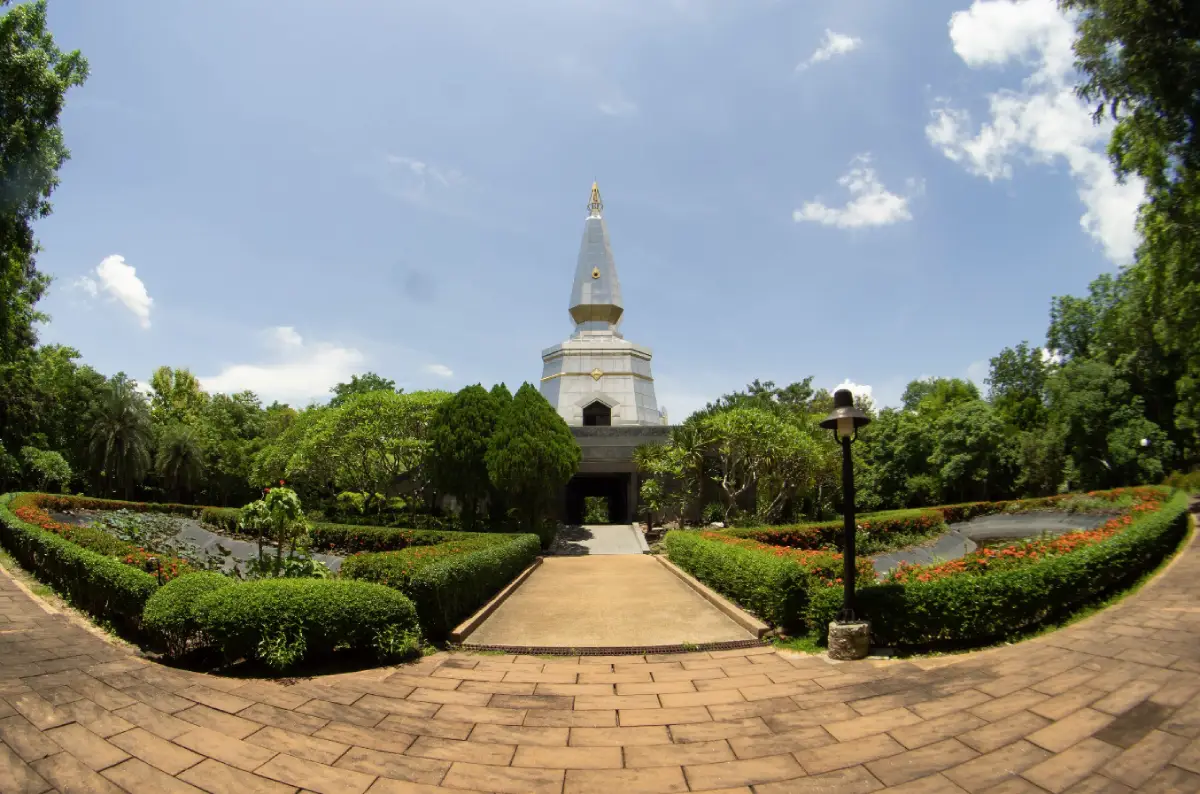
Mae Chi Kaew Sianglam Stupa
Open Days: Daily
Opening Hours: 08:00 – 17:00
The Mae Chi Kaew Sianglam Stupa in Mukdahan Province, officially named Cetiya Sri Triratananusorn, stands at the Ban Huai Sai Mae Chi Nunnery in Khamcha-i Subdistrict, Khamcha-i District. It is an important memorial, relic museum and meditation destination associated with the Thai Forest Tradition and the lineage of Luang Pu Mun Bhuridatta. The octagonal structure rises approximately 25.3 metres and measures about 16 metres across. Inside are relics, life-size representations of Mae Chi Kaew, personal objects, photographs and bilingual historical displays. The surrounding complex includes a memorial pavilion, rock garden, Dhamma courtyard, phayom-tree grove, meditation areas and the nunnery founded by Mae Chi Kaew in 1945.
The monument is exceptional because it explicitly honours a female Buddhist practitioner whose spiritual accomplishments are deeply revered within the Thai Forest Tradition. Most major memorial stupas in modern Thailand are dedicated to male monks. The Mae Chi Kaew Stupa therefore gives public architectural form to the principle that progress in Buddhist practice is not restricted by gender, social status or family background. Visitors come not only to admire the structure but also to study the life of a rural woman who renounced household life, established an independent community of female practitioners and became an enduring model of discipline and spiritual determination.
Ban Huai Sai has long been connected with forest meditation practice. Wat Pa Wiwek Watthanaram, Wat Pa Huai Sai and the Ban Huai Sai nunnery stand within the same local religious landscape. Monks, mae chis and lay residents have preserved meditation discipline, community ceremonies and the memory of important teachers for several generations. Although the institutions have separate residential and administrative areas, they cooperate through religious events, local support and the wider Dhamma tourism route of Mukdahan Province.
Mae Chi Kaew Sianglam was born on 8 November 1901 at Ban Huai Sai. Her original name was Ta Pai, and she was the youngest of 5 children in an agricultural family. Her mother died when she was approximately 5 years old, requiring her to encounter loss and family responsibility early in life. Growing up in a farming community taught her patience, practical work and dependence on seasonal conditions. These qualities later became important foundations for a demanding contemplative life.
During the early 20th century, Ban Huai Sai was reached largely through footpaths, cart tracks and forest routes. Agriculture shaped the rhythm of village life, while monasteries served as centres of education, ceremony and emotional support. The arrival of wandering forest monks was therefore a major event. Villagers could hear teachings that emphasised moral discipline, seated meditation, walking meditation and direct observation of body and mind.
Mae Chi Kaew encountered the teachings of Luang Pu Mun Bhuridatta when the meditation master practised in the region. His approach directed practitioners away from dependence on external ritual and toward careful observation of their own minds. Although family obligations and the social expectations placed upon women initially limited her freedom, her wish to renounce lay life and pursue meditation remained strong.
When circumstances allowed, she became a mae chi under Phra Ajarn Khamphan Kantasilo at Wat Nong Nong. A Thai mae chi shaves her head and eyebrows, wears white and normally observes 8 or more precepts. Although mae chis do not possess the same institutional status as fully ordained monks, serious practitioners renounce property, family attachment and personal comfort. For Mae Chi Kaew, taking white robes represented a complete redirection of life rather than a temporary religious observance.
After her renunciation, she followed Phra Ajarn Khamphan to Wat Phu Klao, approximately 30 kilometres south of the present nunnery. Travel in that period involved difficult roads and forest paths. Practitioners faced heat, rain, hunger, physical exhaustion and uncertain shelter. Wat Phu Klao consequently served not only as a meditation site but also as a demanding environment in which personal expectations and attachment to comfort were repeatedly tested.
The small practice community consisted of 4 mae chis and approximately 6 monks. Everyone helped maintain the grounds, obtain water, clean the residences and follow a strict schedule of chanting and meditation. Material resources were limited, making cooperation essential. A practitioner who insisted on personal convenience would have created hardship for the entire community.
Mae Chi Kaew remained at Wat Phu Klao for approximately 8 years. During intensive meditation she experienced forms of unusual knowledge and perception that she had never previously encountered. Accounts within her spiritual tradition describe subtle experiences that are difficult to explain through ordinary language. The central lesson, however, was not to become fascinated with exceptional states. Whatever arises in meditation must be observed as impermanent. Attachment to visions or special knowledge can become another obstacle rather than a source of liberation.
Forest teachers therefore instructed practitioners to remain balanced when concentration became deep and not to lose confidence when the mind was restless. Mae Chi Kaew had to distinguish temporary tranquillity from insight produced by careful investigation. Fear, delight, pride and attachment could continue beneath apparently peaceful states. Her years at Wat Phu Klao gave her the discipline required to guide her own practice after returning to an independent community of women.
Phra Ajarn Khamphan eventually disrobed. Mae Chi Kaew and her companions then returned to Ban Huai Sai. Rather than abandoning the religious life, they discussed the creation of a permanent nunnery with relatives, descendants and village residents. The Ban Huai Sai Mae Chi Nunnery was established in 1945 as a community without resident monks, dedicated specifically to disciplined female practice.
This arrangement was significant within Thai society of the period. Many mae chis lived within male monasteries and were expected to cook, clean or provide support for monks. Ban Huai Sai created an environment where women could organise their own timetable, maintain residences, meditate and observe precepts without allowing service duties to replace their primary contemplative purpose. It became an important chapter in the history of female renunciant communities in northeastern Thailand.
The early nunnery consisted of simple buildings constructed with local materials and community labour. Water, food and basic shelter required cooperation between the mae chis and villagers. Anyone joining the community had to accept limited comfort and strict conduct. The simplicity of the environment reduced distraction and exposed personal habits that might otherwise remain hidden.
Mae Chi Kaew periodically travelled to pay respect to Luang Pu Mun in Phanna Nikhom District, Sakon Nakhon Province. Such journeys were difficult and time-consuming, but guidance from an experienced teacher was essential. Meditation may produce calm, imagery or unusual perception, and without careful instruction a practitioner can mistake these experiences for the completion of the path. Luang Pu Mun consistently directed disciples toward investigation of impermanence, suffering and the absence of a permanent self.
When Luang Pu Mun died at Wat Pa Sutthawat in 1949, Mae Chi Kaew and Ban Huai Sai villagers travelled to attend his cremation. Their participation expressed gratitude to the teacher and commitment to preserving his method. Luang Pu Mun left no great material institution as his principal legacy. His influence continued through disciplined conduct, practical instructions and disciples who established forest monasteries and meditation communities throughout Thailand.
Mae Chi Kaew later received important guidance from Ajahn Maha Bua Ñanasampanno, widely known as Luang Ta Maha Bua. He taught her to use discernment to examine mental experience and warned her against attachment to extraordinary knowledge arising through concentration. His instruction helped redirect her practice from fascination with internal phenomena toward investigation of the fundamental causes of attachment.
Within the biographical and devotional tradition surrounding Mae Chi Kaew, she is believed to have attained full awakening on the morning of 1 November 1952 beneath a phayom tree. This memory is represented in the grove planted east of the stupa. Visitors are encouraged to meditate there and recollect her perseverance rather than approach the trees as objects for material requests.
Mae Chi Kaew continued living at the Ban Huai Sai nunnery for several decades. She established discipline, guided other mae chis and offered practical advice to lay practitioners. Her teachings emphasised honesty toward one’s own mind, patience, moral conduct and resistance to emotional impulses. As respect for her increased, she continued to live simply and did not promote luxury or personal fame.
Personal objects preserved in the museum include a kettle, toothbrush, betel spittoon, mat, white robes, walking stick, towels and other basic belongings. Individually these objects appear ordinary. Together with her biography, they demonstrate how a practitioner can lead a meaningful life with very limited material possessions. Visitors should view them as evidence of restraint rather than merely as old objects displayed behind glass.
Mae Chi Kaew died on 18 June 1991 at the age of 89, approaching her 90th year. After cremation, portions of her remains reportedly developed small crystalline forms and varied colours. Devotees regard these as sacred relics and as physical confirmation of her spiritual purity. Sermons by senior teachers, particularly Luang Ta Maha Bua, strengthened the wish to construct a monument where the relics and her life history could be preserved.
Before the stupa was built, the nunnery and Ban Huai Sai community preserved her memory through places associated with her residence, meditation, awakening and cremation. In 2003, Luang Pho Inthawai Santussako and supporters helped acquire land surrounding the nunnery. The additional space allowed construction of the stupa, Dhamma courtyard, parking, service buildings and landscape areas without disturbing the mae chis’ private residential compound.
Planning developed during 2004 and 2005 through consultation on design, location and construction. Work began in July 2005 and was completed in April 2006, requiring approximately 10 months. The rapid progress reflected cooperation among monks, mae chis, local residents and devotees from many provinces.
On 20–21 May 2006, Luang Ta Maha Bua presided over the opening and formal enshrinement ceremonies. In his sermon, he affirmed Mae Chi Kaew’s spiritual attainment and stated that liberation does not distinguish between men and women. The stupa consequently became both a personal memorial and a material declaration of the spiritual potential shared by all human beings.
The octagonal monument rises approximately 25.3 metres and measures about 16 metres in width. Its architecture draws clear inspiration from Phra That Phanom, the major sacred stupa of the Mekong region. The base, central body and spire were adapted to the site and to the building’s combined museum and devotional functions. Walking around the 8 sides provides changing perspectives and supports ritual circumambulation.
Buddha relics and relics associated with revered teachers are enshrined within the upper spire. Mae Chi Kaew’s bodily relics are displayed on the upper interior floor in glass urns placed before her life-like figure. This arrangement allows pilgrims to approach respectfully and observe the relics without opening their containers. Touching the cases or urns is prohibited because moisture, impact and repeated handling could cause damage.
In 2020, the exterior was covered with stainless steel to improve resistance to rain, sunlight and humidity. Four ornamental ponds that originally surrounded the structure were later filled after their liners deteriorated. These changes demonstrate that a religious monument requires continuing structural maintenance and cannot remain physically unchanged without repair.
The ground floor operates as a museum. A representation of Mae Chi Kaew walking in meditation, personal utensils, photographs, drawings and Thai–English information panels present her life in chronological form. International visitors can therefore understand her childhood, teachers, ordination, years at Wat Phu Klao, founding of the nunnery and later spiritual influence rather than viewing the relics without historical context.
The staircase to the upper floor combines marble with a surface intended to reduce discomfort to bare feet. Visitors remove their shoes before entering sacred areas, and ordinary stone can become extremely hot in direct sunlight. Everyone should move slowly, use the handrail and avoid stopping for photographs where other visitors need to pass.
The upper chamber contains a life-like seated representation of Mae Chi Kaew dressed in white. Glass urns holding relic fragments stand in front of the raised figure. The interior remains restrained and quiet, allowing visitors to bow, sit or contemplate her discipline. Loud conversation, touching the figure and moving books or altar objects are inappropriate.
Dhamma books and biographical publications are sometimes provided for visitors without charge while supplies remain available. Their purpose is to carry the teaching beyond the monument. The site deliberately avoids developing a large commercial market for amulets. Community leaders have sought to protect the atmosphere of practice and education rather than transform Mae Chi Kaew’s reputation into mass-produced merchandise.
A memorial pavilion known as Monthop Si Soraniyalai stands before the stupa and is associated with the ashes and memory of Mae Chi Kaew’s cremation. It links the closing stage of her physical life with the later construction of the stupa. Visitors should treat the pavilion as a sacred memorial and leave its objects in their existing positions.
The landscape was designed as a rock garden combined with shade trees and contemplative spaces. Rock represents firmness, endurance and determination, while vegetation creates gentleness and calm. Together they reflect the character attributed to Mae Chi Kaew: compassionate toward others but uncompromising in moral discipline and meditation.
The phayom grove east of the stupa is a particularly meaningful meditation area. It recalls the tree beneath which Mae Chi Kaew is believed to have attained awakening. Visitors can sit quietly, observe their breathing and reduce phone use. Food, litter and activities that damage roots or branches should remain outside the grove.
The stupa and nunnery are adjacent but separated by a wall and a small gate. This design protects the daily routine of the resident mae chis from tourist disturbance. Entry into the nunnery requires permission. Significant places inside may include her residence, practice area, the site associated with her awakening and the cremation ground, but visitors must never assume that they may enter simply because the gate is open.
The Ban Huai Sai nunnery remains active. Resident mae chis continue religious practice and participate in community events. Management of the stupa involves the nunnery, Ban Huai Sai residents, devotees and nearby forest monasteries. Donations support electricity, landscape maintenance, cleaning, annual events and part of the nunnery’s living expenses.
The site is not operated primarily for commercial return. Admission is free, and visitors may donate through authorised boxes or channels. A large donation does not provide special access to private areas. Appropriate support protects quiet, cleanliness and the continuity of the female religious community.
Main zones include the entrance and parking area, Monthop Si Soraniyalai, rock garden, Dhamma courtyard, ground-floor museum, staircase, upper relic chamber, phayom grove, meditation area and the controlled connection to the nunnery. Reading the museum information before ascending helps visitors understand the meaning of the upper chamber.
A major community commemoration is held near the end of March. Activities include merit-making, Dhamma teaching, circumambulation and the wrapping of a long handwoven white cloth around the stupa. The cloth relates to Phu Thai cultural traditions and honours both Mae Chi Kaew and the Buddha relics in the spire. After interruptions during the pandemic period, the event resumed at the end of March 2024.
Devotees also commemorate the anniversary of Mae Chi Kaew’s death on 18 June. The programme may vary from year to year according to the nunnery and community. Visitors should confirm current arrangements rather than relying automatically on an earlier schedule. Parking and nearby accommodation can fill quickly during major ceremonies.
Wat Pa Wiwek Watthanaram, associated with Luang Pu Jam Mahapuñño, stands close to the stupa. It contains Luang Pu Jam’s preserved body and a distinctive five-spired monument. Many pilgrims visit both sites on the same route, gaining insight into the contributions of male monks and female renunciants within the Ban Huai Sai meditation network.
Wat Pa Huai Sai, also known locally as Wat Nong Nong, is connected with Mae Chi Kaew’s ordination history and continues to cooperate with the nunnery and community. Its current abbot is Phra Athikan Thanaphon Dhanabalo. Large groups seeking local information may coordinate through the monastery, while recognising that the stupa itself is maintained through a broader collaborative structure.
Clothing should cover shoulders and the torso, with trousers or skirts of appropriate length. Shoes must be removed where indicated. Hats, loud conversation and music are unsuitable inside the museum and relic chamber. Organised groups should divide into smaller units so that the upper floor does not become congested.
Photography should remain discreet. Flash must not be directed toward relics, figures or museum objects. Resident mae chis and meditation practitioners should not be photographed closely without consent. Drones, professional lighting and commercial filming require advance approval because equipment and noise can disturb the nunnery.
Children must not run inside the museum, touch cases, climb religious bases or shout. A family visit can introduce patience, simplicity and the role of women in Buddhist practice. The subjects of relics and death can be explained calmly without presenting them as frightening.
Some outdoor and ground-floor areas may be accessible to wheelchair users, but reaching the upper chamber requires stairs. Older travelers should have assistance and avoid crowded periods. Visitors unable to climb can still experience the museum, gardens and meditation spaces meaningfully.
Allow at least 1–2 hours for the museum, relic chamber, rock garden and quiet contemplation. Visitors reading the displays carefully or meditating may spend 2–3 hours. A rushed photographic stop misses the principal value of the site, which lies in understanding Mae Chi Kaew’s discipline and reflecting upon one’s own conduct.
The most comfortable periods are 08:00–10:30 and 14:30–16:30. November through February provides mild conditions, while the rainy season makes the gardens lush but may leave paths wet. Secure footwear and an umbrella are useful outside the shoe-free sacred areas.
Getting There from Mukdahan city requires following Highway 12 toward Khamcha-i District for approximately 30–35 kilometres. In Khamcha-i, continue toward Ban Huai Sai and follow signs for Cetiya Sri Triratananusorn, the Mae Chi Kaew Stupa or Ban Huai Sai Mae Chi Nunnery. The road is paved and suitable for ordinary cars and motorcycles.
From central Khamcha-i, the stupa is only several kilometres away. Navigation should use the full destination name because Wat Pa Huai Sai, Wat Pa Wiwek Watthanaram and the nunnery appear close together. Confirm the destination before turning onto small community roads.
Interdistrict buses travelling between Mukdahan and Kalasin may stop in Khamcha-i, but the final section requires a hired vehicle or arranged pickup. Fare and return time should be agreed in advance. Private transport is more practical for travelers combining several Dhamma sites.
A half-day itinerary can include the Mae Chi Kaew Stupa, Wat Pa Wiwek Watthanaram and Wat Pa Huai Sai. Beginning early allows sufficient time at each site without disrupting monastic schedules. A full day may add Wat Tham Champa Kantasilawat, Wat Phu Sang Kaeo or other cultural places in Khamcha-i District.
Restaurants are concentrated in central Khamcha-i and along the main road. Phayad Cafe and Son, Cafe Seosulla, Wang Cha Cafe, Baan Rao Restaurant and Khak Doe Suan Yang Cafe provide drinks and local meals. Groups should telephone ahead because family-operated rural businesses may adjust opening days.
Accommodation near the district consists mainly of small resorts, including Chonthan Resort, PT Resort, Baan Yai Nan and Noi Khan Tae Resort. Larger hotels are available in Mukdahan city. Reservations are recommended during annual ceremonies and long weekends.
Staying inside the nunnery for practice requires advance permission. The nunnery is not commercial accommodation. Guests must observe precepts, follow the daily schedule, dress modestly, avoid alcohol and entertainment and assist with cleanliness.
The stupa is important for understanding women’s roles in Thai Buddhism. It demonstrates that mae chis have not served only as cooks or supporters of monks. The Ban Huai Sai community has maintained chanting, meditation, teaching and spiritual leadership. Architecture and museum interpretation give public visibility to this female contemplative history.
Visitors of other religions are welcome to learn without accepting every devotional interpretation. Removing shoes, remaining quiet, avoiding contact with objects and respecting worshippers are sufficient. The site can be approached as a memorial to a female renunciant, a local-history museum and an example of the relationship between religion and rural community life.
Respect for Mae Chi Kaew should extend beyond requests for blessings. Her reputation rests upon patience, moral discipline, serious meditation and a simple life. Reading her history and adopting one practical principle—such as reducing anger, speaking more carefully or acting honestly—expresses deeper respect than the pursuit of sacred merchandise.
The monument’s value does not lie only in its height or reflective surface. It preserves the story of a village woman who experienced loss and social limitation, became a renunciant, created a female meditation community and inspired later generations. The stupa gives that history a visible place within the public religious landscape of Thailand.
Looking from the museum toward the stupa, rock garden and phayom trees reveals the connection between architecture, nature and contemplation. Rock represents endurance, trees represent growth, and the stupa preserves memory. The site does not require every visitor to feel the same emotion; it provides conditions in which each person can observe their own life more carefully.
The Mae Chi Kaew Sianglam Stupa is suitable for pilgrims, students of the Thai Forest Tradition, researchers of women in Buddhism, families and travelers seeking the quiet atmosphere of Ban Huai Sai. A respectful pace, attention to the museum, protection of the nunnery’s privacy and time for contemplation transform the visit from ordinary sightseeing into a meaningful encounter with perseverance and simplicity.
| Name | Cetiya Sri Triratananusorn, Mae Chi Kaew Sianglam |
| Common Name | Mae Chi Kaew Sianglam Stupa |
| Type | Memorial stupa, relic museum and Dhamma tourism site associated with the Thai Forest Tradition |
| Location | Ban Huai Sai Mae Chi Nunnery, Khamcha-i Subdistrict, Khamcha-i District, Mukdahan Province, Thailand |
| Address | Ban Huai Sai, Moo 3, Khamcha-i, Khamcha-i District, Mukdahan 49110, Thailand |
| Important Person | Mae Chi Kaew Sianglam, a female meditation practitioner in the lineages of Luang Pu Mun Bhuridatta and Luang Ta Maha Bua Ñanasampanno |
| Date of Birth | 8 November 1901 at Ban Huai Sai, Mukdahan Province |
| Original Name | Ta Pai |
| Renunciation | Became a mae chi under Phra Ajarn Khamphan Kantasilo at Wat Nong Nong |
| Practice at Wat Phu Klao | Practised for approximately 8 years with 4 mae chis and about 6 monks |
| Nunnery Foundation | Established the Ban Huai Sai Mae Chi Nunnery in 1945 as a female practice community without resident monks |
| Important Teachers | Luang Pu Mun Bhuridatta, Phra Ajarn Khamphan Kantasilo and Luang Ta Maha Bua Ñanasampanno |
| Date of Death | 18 June 1991, aged 89 and approaching her 90th year |
| Construction Began | July 2005 |
| Construction Completed | April 2006, after approximately 10 months |
| Opening and Relic Ceremony | 20–21 May 2006, presided over by Luang Ta Maha Bua Ñanasampanno |
| Architecture | Octagonal stupa inspired by the architectural form of Phra That Phanom |
| Dimensions | Approximately 25.3 metres high and 16 metres wide |
| Renovation | The exterior was covered with stainless steel in 2020 to improve durability |
| Ground Floor | Museum displaying biography, figures, personal objects, photographs and Thai–English information panels |
| Upper Floor | Life-like representation of Mae Chi Kaew and glass urns containing relic fragments |
| Site Management | Ban Huai Sai Mae Chi Nunnery, Ban Huai Sai community, devotees and nearby Forest Tradition monasteries |
| Local Coordination Contact | Wat Pa Huai Sai, Tel. 095-751-7414; current abbot: Phra Athikan Thanaphon Dhanabalo |
| Main Areas / Zones | 1. Entrance and parking area 2. Monthop Si Soraniyalai memorial pavilion 3. Rock garden and Dhamma courtyard 4. Ground-floor museum 5. Staircase to the upper level 6. Upper relic and memorial chamber 7. Phayom grove and meditation area 8. Controlled connection to the Ban Huai Sai Nunnery 9. Places associated with Mae Chi Kaew’s residence and practice |
| Important Commemorations | Late-March commemoration and white-cloth wrapping ceremony, plus the 18 June anniversary of Mae Chi Kaew’s death |
| Open Days | Daily |
| Opening Hours | 08:00 – 17:00 |
| Admission Fee | Free admission; voluntary donations for the stupa, museum and nunnery are welcome |
| Facilities | Parking, toilets, Dhamma courtyard, garden, rest areas, museum, bilingual information and meditation spaces |
| Recommended Visit Duration | Approximately 1–2 hours, or 2–3 hours for detailed study and meditation |
| Recommended Visiting Time | 08:00–10:30 or 14:30–16:30 |
| Getting There | From Mukdahan city, follow Highway 12 toward Khamcha-i District and continue to Ban Huai Sai using signs for Cetiya Sri Triratananusorn or the Ban Huai Sai Mae Chi Nunnery |
| Visitor Etiquette | Dress modestly, remove shoes where required, remain quiet, avoid flash, never touch the relics or display cases and do not enter the nunnery without permission |
| Nearby Tourist Attractions | 1. Wat Pa Wiwek Watthanaram, approximately 1 km by road 2. Wat Si Chomphon, approximately 1 km by road 3. Wat Pa Huai Sai or Wat Nong Nong, approximately 2 km by road 4. Wat Phu Sang Kaeo, approximately 8 km by road 5. Wat Tham Champa Kantasilawat, approximately 10 km by road 6. Wat Pa Subhattharam and Phra That Phothiyan, approximately 13 km by road |
| Nearby Restaurants | 1. Phayad Cafe and Son, approximately 4 km, Tel. 084-294-9292 2. Cafe Seosulla Mukdahan, approximately 5 km, Tel. 091-867-0604, 087-218-1447 3. Wang Cha Cafe, approximately 7 km, Tel. 095-846-5878 4. Baan Rao Cafe and Restaurant, approximately 8 km, Tel. 089-276-3812, 093-485-0849 5. Khak Doe Suan Yang Cafe, approximately 10 km, Tel. 096-828-7747 6. Jui Moo Kratha, approximately 12 km, Tel. 089-812-1378 |
| Nearby Accommodations | 1. Chonthan Resort, approximately 5 km, Tel. 087-855-7564, 083-284-3088 2. PT Resort Khamcha-i, approximately 7 km, Tel. 093-518-8327 3. Baan Yai Nan, approximately 9 km, Tel. 084-428-7235, 090-587-9966 4. Noi Khan Tae Resort, approximately 10 km, Tel. 085-144-1680, 081-071-2796 5. Bird Day Boutique Hotel, approximately 34 km, Tel. 093-469-5588, 042-615-007 |
Frequently Asked Questions (FAQ)
Q: Where is the Mae Chi Kaew Sianglam Stupa located?
A: It is located at the Ban Huai Sai Mae Chi Nunnery in Khamcha-i Subdistrict, Khamcha-i District, Mukdahan Province, near Wat Pa Wiwek Watthanaram and Wat Pa Huai Sai.
Q: What are the opening hours and admission fee?
A: The stupa is open daily from 08:00 to 17:00. Admission is free, and visitors may make voluntary donations toward maintenance of the stupa, museum and nunnery.
Q: Who was Mae Chi Kaew Sianglam?
A: Mae Chi Kaew was a female meditation practitioner born at Ban Huai Sai on 8 November 1901. She trained within the lineages of Luang Pu Mun Bhuridatta and Luang Ta Maha Bua Ñanasampanno and founded the Ban Huai Sai Mae Chi Nunnery in 1945.
Q: When was the stupa constructed?
A: Construction began in July 2005 and was completed in April 2006. The opening and relic-enchrinement ceremonies were held on 20–21 May 2006.
Q: What can visitors see inside the stupa?
A: The ground floor contains a museum with Mae Chi Kaew’s biography, figures, photographs and personal objects. The upper floor contains a life-like representation of her and glass urns holding relic fragments.
Q: Can visitors enter the Ban Huai Sai Mae Chi Nunnery?
A: The nunnery remains a private residential and practice area for mae chis. Entry to residences or significant internal places requires permission from the caretakers.
Q: When are the principal commemorative events held?
A: A major commemoration and white-cloth wrapping ceremony is held near the end of March. Devotees also commemorate Mae Chi Kaew’s death on 18 June. Current annual schedules should be confirmed before travel.
Q: How long should travelers allow for a visit?
A: Allow approximately 1–2 hours for the museum, relic chamber and gardens, or 2–3 hours for detailed reading and meditation.
 Category: ●Places of Worship
 Group: ●Other Sacred Sites
Last Update : 2 MonthAgo
 Last Update : 2 MonthAgo
 Click to Access the Navigation Map GPS
Mae Chi Kaew Sianglam Stupa Map
Recommend

 Art, Culture and Heritage
 Historical Sites and Monuments(2)
 Landmarks and Memorials(3)
 Art, Craft Centres, Tradition(2)
 Museums(1)
 Temple(17)
Other Sacred Sites(3)
Temple(17)
Other Sacred Sites(3)
 Suburban Living
 Village, Community(4)
 Local Market(2)
 Nature and Wildlife
 National Parks and Marine Reserves(4)
 Mountain (Doi)(5)
 Dam, Reservoir, Lake(3)
 Waterfalls(5)
 Caves(2)
 River, Canal(2)
 Bays and Beaches(1)
 Other natural attractions(1)
 Entertainment and Agricultural
 Farms, Parks and Ecotourism(1)


