
lovethailand home >Northeastern Travel Attractions >Mukdahan Travel Attractions >Muang Mukdahan >Mukdahan > Chao Mae Song Nang Phi Nong Shrine
TL;DR: Chao Mae Song Nang Phi Nong Shrine is located at Samran Chai Khong Tai Road, Mukdahan Municipality, Mueang Mukdahan District, Mukdahan Province, Thailand, open Daily, hours 06:00 – 18:00.
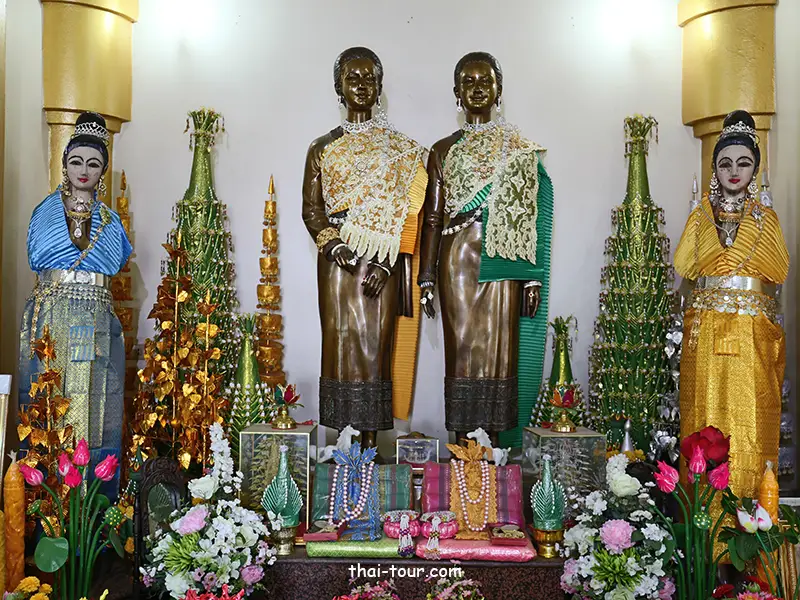
Chao Mae Song Nang Phi Nong Shrine
Open Days: Daily
Opening Hours: 06:00 – 18:00
Chao Mae Song Nang Phi Nong Shrine in Mukdahan Province, also known as the Shrine of the Two Sisters, is one of the most respected guardian shrines in the historic centre of Mukdahan. It stands on Samran Chai Khong Tai Road beside the Mekong River, close to the municipal pier and Mukdahan Immigration’s pier checkpoint. The shrine is within walking distance of Wat Si Mongkhon Tai, Indochina Market, the old riverside commercial district and other places connected with the founding of Mukdahan. Local residents honour the Two Sisters as spiritual guardians of the river, travelers and the city’s well-being. On the full-moon day of the sixth lunar month each year, a major ceremonial offering is held together with Chao Pho Chao Fa Mung Mueang Shrine.
The riverside location is fundamental to the meaning of the shrine. The Mekong is Thailand’s natural boundary with Savannakhet Province in Laos, but it has also connected communities through migration, fishing, commerce, family relationships and religious exchange. Before modern roads and the Second Thai–Lao Friendship Bridge, boats carried people and goods directly between the two banks. The legend of the Two Sisters centres on a fatal boat accident, explaining why the guardians are particularly associated with water, travel and the protection of communities living beside the river.
The site appears under several names, including Chao Mae Song Nang Phi Nong Shrine, Ho Chao Mae Song Nang Phi Nong and Ho Chao Mae Song Nang Sathit. All refer to the same sacred place. “Song Nang Phi Nong” emphasises the relationship between an elder and younger sister, while “Song Nang Sathit” conveys the belief that the sacred presence of the 2 women resides at the site. The name Song Nang Sathit is also preserved in a major road in central Mukdahan, demonstrating that the legend has become part of the city’s geography and collective memory.
Local tradition identifies the sisters as Phra Nang Phimpha and Phra Nang Lomphama, daughters of a ruler from the Lao side of the Mekong. One version connects their story with the movement of Chao Fa Ngum of the Lan Xang Kingdom and his descendants along the river past Nong Khai and Nakhon Phanom toward the Mukdahan area. Their boat reportedly capsized near the mouth of Huai Muk, causing both princesses to lose their lives. The account is preserved as sacred community tradition rather than simply as a story of a river accident. Their spirits came to be understood as benevolent protectors who remained connected with the place of their death.
The mouth of Huai Muk is closely associated with the establishment and naming of Mukdahan. A tributary entered the Mekong here, creating a productive area with abundant fish and practical access to water transport. Rivers offered food, mobility and communication, but also exposed travelers to strong currents, seasonal floods, storms and hidden underwater hazards. The death of Phra Nang Phimpha and Phra Nang Lomphama expresses the 2 sides of the Mekong: a river that sustains communities and a powerful natural force that requires respect.
The legend later became connected with the establishment of Mukdahan by Chao Chan Kinnari, commonly called Chao Kinnari, in 1770. He led followers from the eastern bank of the Mekong to establish a new community on the western bank after the area was found suitable for settlement. Accounts describe abundant fish, an abandoned religious site and a distinctive seven-crowned sugar palm. Houses, a monastery, trade areas and civic administration gradually developed before Mukdahan was officially recognised as a town during the Thonburi period.
The seven-crowned sugar palm is an important image in local accounts of both the city and the shrine. Sugar palms were useful trees whose fruit, sap, leaves and trunks supported local life, but a tree with 7 crowns gave the location an exceptional and sacred quality. According to tradition, after Chao Kinnari learned of the drowned princesses and the spiritual events associated with the riverbank, he established a shrine near the unusual palm so that their spirits would have a recognised dwelling and the community could honour them appropriately.
Local historical records place the establishment of the shrine in 1772, approximately 2 years after the founding of Mukdahan. The date indicates that creating a sacred guardian space was part of building the town itself, rather than a later addition after urban prosperity had developed. A shrine offered emotional security to newly settled families, created a recognised place for communal ritual and reinforced the understanding that the new town existed under spiritual protection.
Another local account concerns an iron Buddha image discovered near the present shrine while Chao Kinnari was establishing Mukdahan and building Wat Si Mongkhon Tai. The crown of the Buddha’s head was reportedly visible beneath the ground. The image was excavated and moved to the temple, but appeared back at the original location the following morning. After the event was repeated, residents called it Phra Lup Lek, referring to an iron Buddha that sank or disappeared into the earth. This story links the Two Sisters Shrine, Wat Si Mongkhon Tai and the city’s foundation into one sacred historical landscape.
Residents also told of hearing 2 women crying in the area on the eleventh waxing-moon night of the sixth lunar month. The voices were believed to belong to Phra Nang Phimpha and Phra Nang Lomphama. Repeated oral accounts and reports of unusual events strengthened local respect for the riverbank and contributed to the practice of making annual offerings during the sixth lunar month. The crying motif preserves the sorrow of the sisters while reminding later generations of the Mekong’s unpredictable power.
The original shrine was a small timber structure built in the style of a local guardian-spirit house. Timber was readily available and could be repaired by community craftsmen, but the riverside environment exposed it to rain, humidity, sun, insects and continuous use. As the city expanded and more people visited, the shrine was repeatedly renovated and eventually replaced by a stronger concrete structure. Although the building material changed, the location, rituals and guardian tradition continued from the earlier wooden shrine.
The present concrete building stands on a slightly raised base and has a gabled roof supported by columns. Gold ornament, red lanterns, carved decoration and extensive offerings create a visually rich interior. Its architecture combines Thai forms with Chinese shrine influences, reflecting Mukdahan’s multicultural history. Thai, Lao, Chinese, Vietnamese and several local ethnic communities have lived and traded in this border city, allowing several artistic and ritual traditions to develop together.
A carved panel at the entrance depicts 2 women standing side by side and immediately identifies the shrine’s subject. Floral, cloud and auspicious motifs frame the figures. Inside, representations of the Two Sisters stand on the principal altar, where visitors place flowers, garlands, bai si arrangements, fruit and other offerings. The compact layout allows the figures to be seen clearly from the entrance while preserving a defined devotional space.
The figures are frequently dressed with textiles, ornaments and garlands offered by devotees. Clothing the guardians is not only decorative; it expresses respect for them as royal daughters or high-status women in the local legend. Visitors must not touch, move or change the clothing independently. Anyone wishing to offer fabric or jewellery should consult the shrine caretakers so that new objects can be managed without damaging earlier offerings.
Common offerings include fresh flowers, marigold garlands, incense, candles, clean water, fruit and bai si. Some worshippers present cosmetics, textiles or personal ornaments associated with honouring female guardians. Offerings should remain within the spaces provided, must not obstruct circulation and should not create excessive organic or plastic waste. Simple offerings presented responsibly support the shrine better than large quantities that are difficult to manage.
Worship can begin by joining the palms, calming the mind, stating one’s name and home area, and expressing a respectful intention. Visitors often ask for safe travel, successful work, stable trade, family harmony and an auspicious beginning to a new undertaking. Because the legend involves a river journey and separation from home, the shrine has particular meaning for cross-border travelers, people whose work depends on the river and families whose members live on opposite banks of the Mekong.
Spiritual requests should remain consistent with non-harm and personal responsibility. Worship does not replace safe transport, honest work or practical preparation. A traveler asking for protection must still maintain the vehicle, use safety equipment and follow the law. A merchant asking for prosperity must still provide good products and deal fairly with customers. In this way, devotion supports confidence without replacing responsible action.
People who believe a request has been fulfilled may return with garlands, bai si, fruit, fabric or another promised offering. Large ceremonies should be arranged with the caretakers in advance. Firecrackers, loud sound systems, objects released into the river and activities blocking the pier or public roads are inappropriate. Gratitude may also be expressed through a maintenance donation, cleaning the area or supporting a public-benefit activity in the community.
The Two Sisters Shrine has long been worshipped together with Chao Pho Chao Fa Mung Mueang Shrine. Chao Pho is associated with protecting the urban territory, while the Two Sisters are strongly connected with the river and travel. Visiting both expresses the idea that a city’s security includes land and water, residential peace and safe movement. Many residents therefore include both shrines within the same ritual journey.
A common route begins at Mukdahan City Pillar Shrine and Chao Pho Chao Fa Mung Mueang Shrine on Song Nang Sathit Road, then continues to Wat Si Mongkhon Tai and the Two Sisters Shrine beside the Mekong. The sites are close together within central Mukdahan. Their combined interpretation distinguishes the official city pillar, the male urban guardian, the principal Buddhist image of the old city and the female river guardians.
The principal annual ceremony falls on the full-moon day of the sixth lunar month, usually during May. Ceremonial offerings are made to Chao Pho Chao Fa Mung Mueang and the Two Sisters on the same day. Residents prepare bai si, flowers, fruit, food and traditional ritual arrangements, followed by formal announcements and prayers for civic peace and freedom from danger. The occasion transforms individual belief into a public expression of Mukdahan’s shared identity.
The sixth-lunar-month ceremony is connected with the seasonal rhythm of farming and river life. It occurs near the beginning of the rainy season, when earlier communities prepared fields, watched river levels and depended heavily on water travel. The ritual therefore asked not only for spiritual favour but also for a safe transition into a new environmental cycle. Although Mukdahan now has a modern economy and road network, the ceremony continues to unite residents around the memory of the river.
Visitors attending the annual ceremony should dress modestly, arrive early and follow the space arrangements established by organisers. The shrine forecourt is limited, and sections may be reserved for offerings, officiants, provincial guests and the public. Photographers should remain to the side, avoid crossing in front of the ritual and leave clear access for older participants.
The shrine is also included in official worship routes before major provincial events, including the Mukdahan Red Cross and provincial products fair, tourism programs and civic celebrations. When provincial authorities and residents make a formal announcement to the guardians, the action symbolically places public activity within the city’s historical and moral framework.
It has also formed part of the governor-led worship route during Muk Chinese New Year and other cultural events. These routes connect the City Pillar Shrine, Chao Pho Chao Fa Mung Mueang, Wat Si Mongkhon Tai and the Two Sisters Shrine. Thai, Lao, Chinese and Vietnamese cultural elements are presented within the historic district without removing the distinct meaning of each sacred site.
The shrine stands beside the municipal pier and an immigration pier checkpoint. The area was especially important when boats provided a principal means of travel between Mukdahan and Savannakhet before the Second Thai–Lao Friendship Bridge opened. Although most current cross-border traffic uses the bridge, the old pier remains evidence of an era when people, goods and news crossed the river directly beside the shrine.
Visitors must distinguish shrine access from immigration services. The immigration checkpoint has its own security procedures and restricted areas. People visiting only the shrine should not enter offices, photograph officials, documents or controlled zones without permission. Questions about border travel must be directed to Mukdahan Immigration rather than to shrine caretakers.
The Mekong’s water level and current vary significantly by season. The river can be high and fast during the rainy season, while sandbanks and a wider river edge may appear during the dry months. Visitors should not enter closed pier areas, approach unprotected water edges or allow children to wander alone. Respect for the river guardians should include practical water safety.
Releasing garlands, plastic trays or other offerings into the Mekong creates waste and can harm the river ecosystem. Unless a formal ceremony is being managed by authorised organisers, offerings should remain in the designated shrine area. Reducing single-use plastic and allowing caretakers to dispose of completed offerings responsibly links religious respect with protection of the river at the centre of the legend.
This is a guardian shrine rather than a Buddhist monastery and therefore has no abbot. Care is shared by the shrine committee, Mukdahan Municipality, cultural agencies and local devotees. Groups planning a large ceremony, commercial filming or an organised visit should contact the municipality or the provincial cultural office rather than assuming that monks from a nearby temple administer the site.
The principal zones include the entrance forecourt, the main shrine building, the altar of the Two Sisters, offering tables, incense and bai si areas, the annual ceremonial space, the Mekong viewpoint and the connection toward the pier and Indochina Market. The entire complex is compact. Visitors should move slowly, keep luggage out of walkways and allow private space for people at prayer.
Clothing should be modest even though the shrine is not an ordination hall. Shoulders and the torso should be covered, and trousers or skirts should be of an appropriate length. Hats should be removed near the altar, conversation kept low and the sacred figures should not be used as a background for mocking or disrespectful poses.
Incense and candles must be used only in the designated location and in the recommended quantity. Smoke in a small building can affect children, older people and visitors with respiratory conditions. Flowers, garlands or silent prayer are appropriate alternatives for anyone unable to tolerate incense. Personal burners or additional open flames must not be brought into the shrine.
Photography is generally possible when no prohibition is displayed. Flash should be avoided near the altar, and cameras should never be extended through the offerings. People engaged in prayer deserve privacy. Tripods, large lighting systems, drones and commercial filming require advance permission because the shrine is beside an immigration facility with additional security concerns.
Children require close adult supervision around steps, the altar, the road and the river edge. They should not run around worshippers, touch the figures, play with candles or climb barriers. A family visit can introduce the history of Mukdahan, water safety and respect for different beliefs without presenting the legend in a frightening manner.
The urban location makes the shrine relatively accessible to older visitors and wheelchair users, although the main building may have steps or changes in floor level. Assistance is useful during crowded ceremonies. Arriving early provides easier access and reduces exposure to incense smoke in a congested area.
The shrine is open daily from 06:00 to 18:00 and charges no admission fee. Voluntary donations support building maintenance, electricity, cleaning and ceremonial activities. Donations should be placed in authorised boxes or given through official channels. Access arrangements may be temporarily adjusted during major rituals or repairs.
The most comfortable visiting periods are 06:00–09:00 and 16:00–18:00. Morning offers cooler temperatures and sunrise light across the Mekong, while late afternoon is suitable for continuing to the promenade or market. Summer midday temperatures can be high, requiring water and sun protection. Rain can make roadside and riverside surfaces slippery.
November through February generally provides the most comfortable weather for an extended walking tour. March through May is hotter but includes the period surrounding the sixth-lunar-month ceremony. The rainy season presents a more powerful view of the river, although visitors should monitor weather and water conditions near the pier.
Getting There from Mukdahan Bus Terminal involves following Chayangkun Road into the municipality and continuing toward Samran Chai Khong Tai Road and Indochina Market. The journey normally requires 10–15 minutes depending on traffic. Private cars, motorcycles, local tricycles and hired vehicles can reach the area. Navigation should use the full shrine name to avoid confusion with Song Nang Sathit Road or Chao Pho Chao Fa Mung Mueang Shrine.
From the Second Thai–Lao Friendship Bridge, follow Chayangkun Road toward central Mukdahan and turn toward Indochina Market and Samran Chai Khong Tai Road. The road distance is approximately 8 kilometres. The immigration pier beside the shrine is not the principal current international crossing, and travelers must use authorised border facilities and schedules.
Visitors staying near Indochina Market, Wat Si Mongkhon Tai or a riverfront hotel can walk to the shrine within several minutes. The streets are relatively level but remain active with motorcycles, delivery vehicles and market traffic. Morning reveals local commercial activity, while late afternoon provides pleasant river views toward Savannakhet.
Parking is limited and generally shared with the market, pier and surrounding community. Vehicles must not block immigration access, shops, homes or emergency routes. During annual ceremonies, drivers should use municipal parking arrangements and walk to the shrine. Local tricycles are practical when parking is difficult.
Wat Si Mongkhon Tai is the closest major attraction and can be reached on foot. The royal temple contains Phra Chao Ong Luang, a principal Buddha image of Mukdahan. Its history is linked to Chao Kinnari and the Phra Lup Lek legend, making the temple and shrine part of one historical narrative.
Indochina Market and the Mekong promenade are also immediately accessible. The district sells clothing, food, household goods and products reflecting trade among Thailand, Laos, Vietnam and China. Visiting the shrine, market and riverfront in sequence introduces Mukdahan’s religious, commercial and geographic identity without requiring a vehicle.
Chao Pho Chao Fa Mung Mueang Shrine and Mukdahan City Pillar Shrine are approximately 1–2 kilometres away. The city pillar represents official civic identity, while Chao Pho is the traditional protector of the urban territory. Adding the Two Sisters completes the relationship between the city and river.
Wat Si Sumang Wanaram and Wat Yot Kaeo Siwichai are other religious sites within the historic urban area. Mukdahan Tower lies approximately 3–4 kilometres away and provides elevated views over the city, Mekong and Savannakhet.
A half-day itinerary can begin at the City Pillar and Chao Pho Chao Fa Mung Mueang Shrine, continue to Wat Si Mongkhon Tai and the Two Sisters Shrine, and finish at Indochina Market and the Mekong promenade. The compact route is suitable for families, older travelers and visitors with limited time.
A full-day itinerary can add Wat Roi Phra Phutthabat Phu Manorom, the large Buddha and Phaya Si Mukda Maha Muni Nil Pal Nakarat. The morning explains the old city and riverside guardians, while the afternoon presents modern sacred landmarks and panoramic views from Phu Manorom.
Nearby dining includes Thai, Isan and Vietnamese food, jaew hon hotpot, Mekong fish and cafés. Baan Lao Yuan Na Rim Khong offers Vietnamese and regional dishes beside the river. Nudpob Rim Khong is a long-established restaurant listed by the Tourism Authority of Thailand, while Rattiya Jaew Hon introduces visitors to a distinctive Mukdahan hotpot tradition.
Mum Sabai Rim Khong and Narin Restaurant offer broad menus suited to families and groups. Mae Muk Tao Than specialises in grilled beef and Isan dishes. Groups should telephone ahead to confirm operating hours and reserve tables, particularly during provincial festivals.
Accommodation ranges from riverfront properties to central city hotels. Riverfront Hotel Mukdahan and Hotel de Ladda are convenient for guests wanting Mekong views and short access to the shrine. Mukdahan Grand Hotel, Ploy Palace Hotel, Submukda Grand Hotel and HOP INN Mukdahan provide connections to the wider city road network.
Riverfront guests can begin with sunrise, visit the shrine in the early morning and continue on foot to Wat Si Mongkhon Tai and Indochina Market. Visitors staying near Chayangkun Road can use a short local ride and arrange a return pickup, particularly in the evening when public transport becomes less frequent.
The shrine is an effective educational site because it brings together the founding of Mukdahan, river migration, royal-daughter legend, guardian belief and architectural change from timber to concrete. Teachers and parents can distinguish oral tradition from documented civic history while respecting the continuing faith of the community.
For students of multicultural society, the shrine demonstrates the combination of Lao-Isan guardian belief with Thai and Chinese visual forms. Lao princesses appear within a shrine decorated with red lanterns and contemporary ornament, while bai si and local offerings remain central to ritual. This combination reflects cultural exchange in a border trading city.
For international travelers, the shrine explains that religious life in Thailand extends beyond formal Buddhism. Many people honour the Buddha, monks, ancestors, city guardians and river spirits within the same cultural system. Non-Buddhist visitors are welcome when they dress modestly, remain quiet and give worshippers sufficient space.
Conservation must include the building, sacred figures, offerings, trees, riverbank and oral history. Renovation records, old photographs and memories of the wooden shrine are important historical resources. Preserving only the current concrete structure would leave later generations without an understanding of how community devotion changed over time.
The story of Phra Nang Phimpha and Phra Nang Lomphama should not be reduced to a frightening ghost story or a source of gambling numbers. Its deeper meaning concerns loss during travel, relationships between communities on both Mekong banks and the transformation of grief into respect for protective guardians.
Visitors contribute to preservation by avoiding contact with the sacred figures, leaving offerings undisturbed, disposing of waste correctly and refusing to present unsupported rumours as established history. Donations through authorised channels and spending at local businesses support both the shrine and the surrounding community.
The value of the Two Sisters Shrine lies not in architectural scale but in the continuity of belief from the founding of Mukdahan, the traditional date of 1772, the original wooden shrine, later concrete reconstruction, the sixth-lunar-month ceremony and continuing provincial activities. Each generation has added meaning to the same riverside location.
From the shrine, visitors can look across the Mekong toward Savannakhet and the Lao landscape connected with the origin of the legend. The story therefore remains attached to a visible geography rather than an abstract or distant place. Building, ceremony, oral tradition and river combine to create the shrine’s significance.
Chao Mae Song Nang Phi Nong Shrine is suitable for pilgrims, students of local history, travelers interested in Mekong culture and anyone beginning an exploration of old Mukdahan. Allow approximately 30–60 minutes for worship, observation and a riverside walk. At least half a day is recommended when combining the shrine with Wat Si Mongkhon Tai, Indochina Market, Chao Pho Chao Fa Mung Mueang Shrine and the City Pillar.
| Name | Chao Mae Song Nang Phi Nong Shrine |
| Alternative Names | Shrine of the Two Sisters, Ho Chao Mae Song Nang Phi Nong and Ho Chao Mae Song Nang Sathit |
| Type | Mekong riverside guardian shrine and sacred civic landmark of Mukdahan |
| Location | Samran Chai Khong Tai Road, Mukdahan Municipality, Mueang Mukdahan District, Mukdahan Province, Thailand |
| Address | Samran Chai Khong Tai Road, Mukdahan Subdistrict, Mueang Mukdahan, Mukdahan 49000, Thailand |
| Setting | Beside the Mekong River, municipal pier and Mukdahan Immigration pier checkpoint, slightly north of Wat Si Mongkhon Tai |
| Names of the Guardians | Phra Nang Phimpha and Phra Nang Lomphama |
| Legend | Two royal daughters from the Lao side of the Mekong died when their boat capsized near the mouth of Huai Muk |
| Traditional Establishment Date | 1772, during the period of Chao Kinnari, after Mukdahan was founded in 1770 |
| Original Shrine Site | Near the legendary seven-crowned sugar palm and the mouth of Huai Muk |
| Original Structure | A small timber guardian shrine maintained by the community |
| Present Architecture | Concrete gabled shrine decorated with gold details, red lanterns, carved panels and Thai–Chinese visual influences |
| Phra Lup Lek Story | A local account of an iron Buddha repeatedly returning to its original location after being moved to Wat Si Mongkhon Tai |
| Significance | A centre of faith associated with protection of the city, river, travelers and communities on both banks of the Mekong |
| Site Management | Shrine caretakers working with Mukdahan Municipality, cultural agencies and local devotees |
| Public Contacts | Mukdahan Municipality: 042-611-227; Mukdahan Provincial Cultural Office: 042-613-684 |
| Nearby Immigration Pier Contact | Mukdahan Immigration Municipal Pier Checkpoint: 042-611-994 |
| Main Areas / Zones | 1. Entrance forecourt 2. Main shrine building 3. Carved entrance panel of the Two Sisters 4. Main altar of Phra Nang Phimpha and Phra Nang Lomphama 5. Flower, bai si, fruit and offering area 6. Incense and candle area 7. Annual ceremonial space 8. Mekong viewpoint 9. Connection toward the pier and Indochina Market |
| Annual Ceremony | Full-moon day of the sixth lunar month, generally in May, held together with Chao Pho Chao Fa Mung Mueang Shrine |
| Appropriate Offerings | Flowers, garlands, incense, candles, clean water, fruit, bai si, textiles and offerings approved by the caretakers |
| Open Days | Daily |
| Opening Hours | 06:00 – 18:00 |
| Admission Fee | Free admission; voluntary donations are welcome |
| Facilities | Worship area, offering tables, incense container, riverside walkway, shops and public toilets in the nearby market area; roadside parking is limited |
| Recommended Visiting Time | 06:00–09:00 for sunrise over the Mekong or 16:00–18:00 for the riverfront and market atmosphere |
| Recommended Visit Duration | Approximately 30–60 minutes, or at least half a day when combined with the old-city sacred route |
| Getting There | From Mukdahan Bus Terminal, follow Chayangkun Road into the city and continue toward Samran Chai Khong Tai Road and Indochina Market; travel time is normally 10–15 minutes |
| Visitor Etiquette | Dress modestly, remain quiet, use incense only in designated areas, do not touch the sacred figures, never release offerings into the Mekong, avoid photographing immigration facilities and do not obstruct public access |
| Nearby Tourist Attractions | 1. Wat Si Mongkhon Tai, approximately 0.3 km 2. Indochina Market and Mekong Promenade, approximately 0.4 km 3. Chao Pho Chao Fa Mung Mueang Shrine, approximately 1.4 km 4. Mukdahan City Pillar Shrine, approximately 1.5 km 5. Wat Si Sumang Wanaram, approximately 1.8 km 6. Mukdahan Tower, approximately 3.7 km |
| Nearby Restaurants | 1. Baan Lao Yuan Na Rim Khong, approximately 0.8 km, Tel. 042-611-111, 065-142-3915, 063-247-9654 2. Rattiya Jaew Hon, approximately 2.2 km, Tel. 042-614-789 3. Nudpob Rim Khong, approximately 2.4 km, Tel. 042-632-543 4. Mum Sabai Rim Khong, approximately 3.1 km, Tel. 099-998-9443 5. Narin Restaurant, approximately 4.2 km, Tel. 081-545-5188, 042-630-036 6. Mae Muk Tao Than Beef Restaurant, approximately 4.7 km, Tel. 042-042-628, 093-551-3839 |
| Nearby Accommodations | 1. Riverfront Hotel Mukdahan, approximately 1 km, Tel. 042-612-948-9, 081-703-1705 2. Hotel de Ladda, approximately 1.7 km, Tel. 042-611-499, 042-611-497 3. Mukdahan Grand Hotel, approximately 2.3 km, Tel. 042-612-020 4. Ploy Palace Hotel, approximately 2.8 km, Tel. 042-614-988 5. Submukda Grand Hotel, approximately 3.2 km, Tel. 042-633-444 6. HOP INN Mukdahan, approximately 4.2 km, Tel. 092-258-7318 |
Frequently Asked Questions (FAQ)
Q: Where is Chao Mae Song Nang Phi Nong Shrine located?
A: The shrine is on Samran Chai Khong Tai Road beside the Mekong River in Mukdahan Municipality. It is next to the municipal pier and Mukdahan Immigration pier checkpoint and slightly north of Wat Si Mongkhon Tai.
Q: What are the opening hours and admission fee?
A: The shrine is open daily from 06:00 to 18:00. Admission is free, and voluntary donations for maintenance and ceremonies are welcome.
Q: What are the names of the Two Sisters?
A: Local tradition identifies them as Phra Nang Phimpha and Phra Nang Lomphama, royal daughters from the Lao side of the Mekong who died when their boat capsized near the mouth of Huai Muk.
Q: When was the shrine established?
A: Local historical tradition places its establishment in 1772 under Chao Kinnari, approximately 2 years after Mukdahan was founded. The original timber shrine was later rebuilt in concrete.
Q: When is the annual worship ceremony?
A: The ceremony is held on the full-moon day of the sixth lunar month, generally in May, together with the annual ceremony for Chao Pho Chao Fa Mung Mueang Shrine.
Q: What offerings are appropriate?
A: Appropriate offerings include flowers, garlands, incense, candles, clean water, fruit, bai si and suitable textiles. Offerings should remain in designated areas and must never be released into the Mekong.
Q: Is photography allowed?
A: Respectful photography is generally possible when no prohibition is displayed. Avoid flash, do not extend a camera across the altar, respect private prayer and never photograph immigration-controlled areas without permission.
Q: Which attractions can be visited on the same route?
A: The shrine can be combined with Wat Si Mongkhon Tai, Indochina Market, the Mekong promenade, Chao Pho Chao Fa Mung Mueang Shrine, Mukdahan City Pillar Shrine and Mukdahan Tower.
 Category: ●Places of Worship
 Group: ●Other Sacred Sites
Last Update : 2 MonthAgo
 Last Update : 2 MonthAgo
 Click to Access the Navigation Map GPS
Chao Mae Song Nang Phi Nong Shrine Map
Recommend

 Art, Culture and Heritage
 Historical Sites and Monuments(2)
 Landmarks and Memorials(3)
 Art, Craft Centres, Tradition(2)
 Museums(1)
 Temple(17)
Other Sacred Sites(3)
Temple(17)
Other Sacred Sites(3)
 Suburban Living
 Village, Community(4)
 Local Market(2)
 Nature and Wildlife
 National Parks and Marine Reserves(4)
 Mountain (Doi)(5)
 Dam, Reservoir, Lake(3)
 Waterfalls(5)
 Caves(2)
 River, Canal(2)
 Bays and Beaches(1)
 Other natural attractions(1)
 Entertainment and Agricultural
 Farms, Parks and Ecotourism(1)


