
lovethailand home >Northeastern Travel Attractions >Mukdahan Travel Attractions >Muang Mukdahan >Mukdahan > Chao Pho Chao Fa Mung Mueang Shrine
TL;DR: Chao Pho Chao Fa Mung Mueang Shrine is located at Song Nang Sathit Road, Mukdahan Municipality, Mueang Mukdahan District, Mukdahan Province, Thailand, open Daily, hours 08:00 – 17:00.
Chao Pho Chao Fa Mung Mueang Shrine
Open Days: Daily
Opening Hours: 08:00 – 17:00
Chao Pho Chao Fa Mung Mueang Shrine in Mukdahan Province is one of the city’s most respected guardian-spirit shrines. It stands on Song Nang Sathit Road in central Mukdahan Municipality, close to the present Mukdahan City Pillar Shrine, the historic commercial district, important Buddhist temples and the Mekong River. Local residents honour Chao Pho Chao Fa Mung Mueang as a spiritual protector who watches over the city, maintains peace and safeguards the well-being of its people. The compact shrine contains the principal altar, offerings and an older pillar associated with the site’s guardian tradition. The modern City Pillar Shrine is located nearby, allowing visitors to understand several layers of Mukdahan’s civic history and religious landscape within a short walking route.
The shrine occupies part of the old urban area, where government buildings, residential communities, shops, temples and roads leading toward the Mekong have developed over generations. It is not an isolated tourist attraction separated from everyday life. Local residents pass the site while travelling to work, shopping or visiting public offices, and many stop to pay respect before beginning an important activity. This close relationship with daily urban life distinguishes the shrine from remote pilgrimage places situated on mountains or in forests.
No surviving document identifies an exact construction date or the original founder of the shrine. Community memory associates its origin with the establishment of Mukdahan in 1770, when Chao Chan Kinnari, commonly called Chao Kinnari, brought his followers to settle on the western bank of the Mekong. This tradition does not mean that every part of the present concrete building dates from 1770. It demonstrates that belief in a guardian of the new settlement became closely connected with the city’s earliest historical identity.
Chao Chan Kinnari is a central figure in Mukdahan’s history. His family and followers had previously lived near Ban Luang Phon Sim and That Ing Hang on the eastern bank of the Mekong. In 1770, they established a settlement on the western bank in the area that developed into Mukdahan. The location supported fishing, agriculture, transport and communication throughout the Mekong region. In 1778, during the Thonburi period, the settlement received official recognition as Mueang Mukdahan, and Chao Chan Kinnari was appointed its first governor under the Siamese kingdom.
The circumstances of early settlement help explain the importance of a city guardian. A newly established community faced disease, difficult travel, environmental hazards, political uncertainty and the need to maintain cooperation among families. A guardian spirit offered a symbolic source of stability and collective responsibility. The shrine marked the city as a protected and organised place whose residents shared obligations toward one another.
The name Chao Pho Chao Fa Mung Mueang evokes the image of a powerful spiritual presence covering and protecting the city. Although no reliable biography identifies the guardian as a documented historical individual, the role has remained clear in local belief. Residents visit to ask for safety, peaceful family life, success in work, secure travel and protection for public events. The shrine’s importance therefore comes from centuries of shared faith and continued communal use rather than from a complete written biography.
The original structure was a modest wooden shrine constructed in the manner of many traditional guardian-spirit shelters. Timber was readily available and could be repaired by local craftsmen, but it gradually deteriorated through moisture, weather and continuous use. The shrine was later rebuilt in concrete to improve structural strength and provide a more durable place for worship. Although the material changed, the site retained its connection with the earlier wooden shrine and the protective role attributed to Chao Pho Chao Fa Mung Mueang.
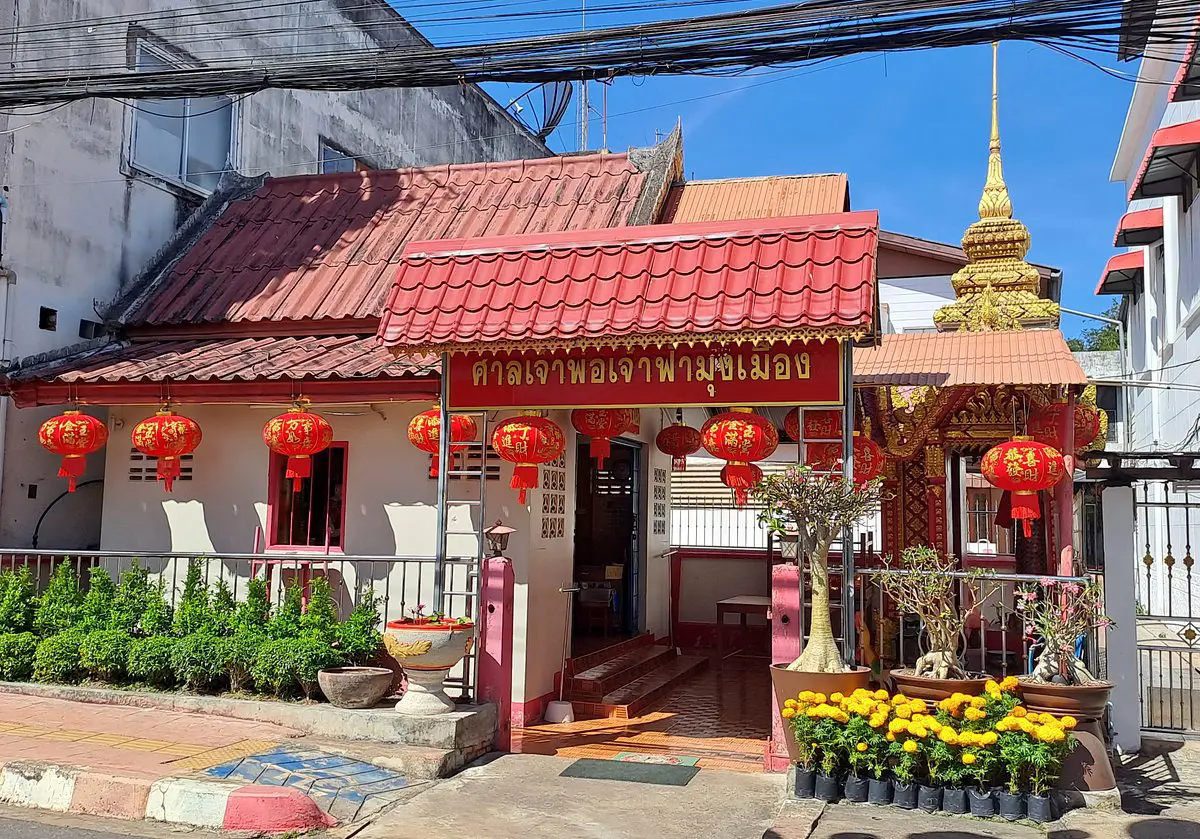
The present building is a compact concrete shrine decorated with red, gold, lanterns and architectural details combining Thai and Chinese influences. This design reflects the multicultural history of Mukdahan, where Lao-Isan, Phu Thai, Chinese, Vietnamese and other communities have contributed to the city’s development. The renovated structure does not reproduce every feature of the original wooden building. Instead, it uses an architectural language familiar to the modern border city and suitable for ceremonies attended by different communities.
Red gives the shrine a strong visual presence within the urban streetscape and is associated in Chinese culture with auspiciousness, vitality and prosperity. Gold emphasises the status of the principal altar and sacred objects. Thai roof and shrine elements remain visible in the overall composition. The combination shows that local guardian worship can adapt to several artistic traditions without losing its function as a centre of civic faith.
The principal worship area contains the altar of Chao Pho Chao Fa Mung Mueang, flowers, candles, incense and offerings arranged according to local practice. Visitors should place offerings only in designated locations, light incense or candles carefully and approach the altar quietly. Large or expensive offerings are unnecessary. Respectful conduct, sincerity and a request that causes no harm to other people are more important than quantity.
Common offerings include garlands, flowers, incense, candles, clean water and fruit. During formal ceremonies, organisers may prepare elaborate bai si arrangements, cooked dishes and ritual offerings. Independent visitors should not place alcohol, strong-smelling food or unusual objects on the altar without permission. Special offerings should be discussed with the site caretakers so that they do not create waste, fire risk or confusion.
An older city-related pillar is preserved within the shrine area. This should be distinguished from the present official Mukdahan City Pillar located in a separate shrine nearby. The modern City Pillar Shrine is a Thai-style four-gabled building containing a smooth cylindrical pillar made from chaiyaphruek wood, lacquered and gilded, with a decorative phum khao bin finial. Visitors can therefore pay respect to the guardian shrine, the older pillar tradition and the present official city pillar during one visit.
Understanding the distinction between the 2 shrines reveals different layers of civic belief. Chao Pho Chao Fa Mung Mueang Shrine is rooted in the community tradition of a supernatural guardian, while the modern City Pillar Shrine is an officially established civic monument used for provincial ceremonies. Their functions are not identical, but together they create a sacred urban landscape associated with the history and identity of Mukdahan.
On the full-moon day of the sixth lunar month, Mukdahan residents perform an annual ceremonial offering to Chao Pho Chao Fa Mung Mueang together with Chao Mae Song Nang Phi Nong, the Two Sisters guardians associated with the Mekong. The ceremony transforms individual devotion into a community event through ritual announcements, offerings and prayers for civic peace and prosperity. Its lunar-calendar date preserves connections with older agricultural and Mekong cultural traditions.
Chao Mae Song Nang Phi Nong Shrine is situated closer to the Mekong River and is traditionally worshipped together with the city guardian. Many residents visit both shrines on the same day. This practice shows that Mukdahan’s sacred geography is understood as a network of protective places related to the city, river and community rather than as a collection of unrelated monuments.
Provincial authorities continue to use Chao Pho Chao Fa Mung Mueang Shrine for ritual announcements before major public occasions, including the Mukdahan Red Cross and provincial products fair, the provincial foundation anniversary, tourism events and the arrival of senior officials. When a governor or government delegation pays respect, the action symbolically places public duties under the expectation of peace, responsibility and community welfare.
The shrine remained an official ceremonial location in 2026, when provincial representatives made ritual announcements connected with the annual Red Cross and Mukdahan products fair. This continuing use confirms that the site is not merely a historical attraction described in older travel guides. It remains part of contemporary provincial life.
During the Muk Chinese New Year festival, the City Pillar Shrine, Chao Pho Chao Fa Mung Mueang Shrine and Chao Mae Song Nang Phi Nong Shrine form part of a ceremonial route accompanied by lanterns, lion dances and cultural performances from Thai, Chinese, Vietnamese and Lao communities. The shrine consequently becomes part of a living multicultural district rather than a monument separated from modern celebrations.
Mukdahan Municipality also includes the guardian shrine in Songkran ceremonies honouring the city’s principal sacred places. Beginning the Thai New Year with respect for protective spirits expresses the hope that residents will live together peacefully. It also introduces younger generations to the shrine and the historical meaning of Song Nang Sathit Road.
Devotion operates at both personal and public levels. Individuals ask for safe travel, success in work, progress in study, business stability or harmony within the family. Public organisations make ritual announcements before activities affecting many residents. These different uses reinforce the shrine’s continued relevance throughout the year.
People who believe that a request has been fulfilled may return with flowers, fruit or other appropriate offerings. Any fulfilment ceremony should remain respectful and should not create excessive noise, traffic obstruction or fire risk. Expressing gratitude through donations, cleanliness or community service is also consistent with the shrine’s role as a guardian of collective well-being.
A simple act of worship can begin by joining the palms, becoming calm and stating one’s name and intention respectfully. No fixed formula is required. Requests should not involve harming another person or violating public responsibility. After worship, visitors must ensure that candles and incense are secure and that no burning material is left unattended.
Visitors who do not share belief in guardian spirits are welcome to experience the shrine as a cultural and historical site. They are not required to perform every ritual. Modest clothing, quiet behaviour and respect for people at prayer are sufficient. This openness allows the shrine to connect local belief with travelers from different religions and cultural backgrounds.
For international visitors, the shrine offers a useful distinction between a Buddhist temple and a guardian-spirit sanctuary. A temple is an institution of Buddhism with monks and formal monastic activities. The guardian shrine has no abbot and is not used for Sangha ceremonies. It represents local civic spirituality, ancestry and belief in protective beings, even though many worshippers are also practising Buddhists.
The coexistence of Buddhist temples, the City Pillar Shrine, guardian shrines and Chinese-style sanctuaries in central Mukdahan illustrates the flexible religious life of Mekong communities. A resident may make merit at a temple, bow before a Buddha image, pay respect to the city pillar and present offerings to local guardians on the same day without considering the practices contradictory.
The interior is relatively small and should be entered in small groups. When worshippers are already inside, visitors should wait until sufficient space is available. Bags must not be placed on offering tables, and the altar should not be blocked for extended periods. Clear access is particularly important for older residents during annual ceremonies.
Photography is generally possible when no prohibition is displayed. Flash should be avoided near worshippers, and cameras must not be extended across the altar. People engaged in private prayer should not be photographed closely without consent. Commercial filming, large lights and organised photo sessions require advance coordination.
Incense is a familiar part of worship, but excessive smoke in a small building can affect breathing and leave soot on surfaces and sacred objects. Visitors should use only the recommended number of incense sticks and place them securely in the provided container. Anyone sensitive to smoke can offer flowers or simply join the palms without reducing the sincerity of the visit.
The urban location allows year-round access. Early morning between 08:00 and 10:00 is generally cooler and less crowded. The period from 15:00 to 17:00 is suitable for combining the shrine with the Mekong promenade or Indochina Market. Annual ceremonies provide a richer communal atmosphere but also bring traffic and limited parking.
The shrine is open daily from 08:00 to 17:00 and charges no admission fee. Voluntary donations may be made toward maintenance. Access arrangements may change during provincial ceremonies, annual worship or repair work, and visitors should follow signs and official instructions.
Facilities are modest and include the worship area, offering tables, incense containers, walkways and a small forecourt. Parking is generally available along nearby streets or in designated public spaces and is limited during festivals. Vehicles must not block private homes, intersections, public buildings or emergency access.
The site is on level urban ground and is easier to approach than a mountain attraction, although small thresholds or changes in floor level may be present. Wheelchair users and older travelers may benefit from assistance, particularly during crowded ceremonies.
Mukdahan is hot during the summer, making drinking water and sun protection useful when continuing on foot to nearby sites. Rain can produce slippery pavement and standing water near the road. The cool season provides the most comfortable conditions for an extended walking tour of the city centre.
Getting There from Mukdahan Bus Terminal involves following Chayangkun Road into the city centre and turning onto Song Nang Sathit Road toward the City Pillar Shrine and old district. The journey normally takes approximately 10–15 minutes depending on traffic. Private cars, motorcycles, local tricycles and hired vehicles can reach the shrine directly.
Travelers staying near Indochina Market or Samran Chai Khong Road can reach the shrine through the central street network. The distance is approximately 1 kilometre, requiring 15–20 minutes on foot or only a few minutes by local transport. The route passes shops, temples and older urban buildings.
From the Second Thai–Lao Friendship Bridge, follow Chayangkun Road toward central Mukdahan and continue to Song Nang Sathit Road. The road distance is approximately 7–8 kilometres. Additional time should be allowed during school and work commuting periods.
The approximate coordinates are 16.54549, 104.72602. Navigation searches should use the full name “Chao Pho Chao Fa Mung Mueang Shrine, Mukdahan” and confirm Song Nang Sathit Road because search results may also display the City Pillar Shrine or Chao Mae Song Nang Phi Nong Shrine.
The closest related attraction is the modern Mukdahan City Pillar Shrine, which can be reached on foot within a few minutes. Its Thai four-gabled pavilion and gilded chaiyaphruek pillar demonstrate the official civic expression of city-pillar belief, complementing the older guardian tradition represented at Chao Pho Chao Fa Mung Mueang Shrine.
Wat Si Mongkhon Tai is less than 1 kilometre away. This royal temple contains Phra Chao Ong Luang, one of Mukdahan’s most revered Buddha images, and its history is connected with the early development of the city under Chao Chan Kinnari. Visiting both locations creates a coherent historical route.
Indochina Market and the Mekong promenade lie approximately 1 kilometre from the shrine. The market sells goods connected with Thailand, Laos, Vietnam, China and neighboring regions. From the riverfront, visitors can look toward Savannakhet and recognise Mukdahan’s continuing role as a cross-border commercial city.
Chao Mae Song Nang Phi Nong Shrine is approximately 1.3 kilometres away near the Mekong. The annual sixth-lunar-month ceremony connects it directly with Chao Pho Chao Fa Mung Mueang. Visiting both shrines provides a broader understanding of local beliefs concerning protection of the city and river.
Wat Si Sumang Wanaram and Wat Yot Kaeo Siwichai are other old-city temples that can be reached easily from the market area. Their presence demonstrates how Buddhist communities, guardian shrines, Chinese-style sanctuaries and multicultural commerce developed within a compact urban district.
Mukdahan Tower is approximately 3 kilometres from the shrine and provides elevated views over the city and Mekong. Beginning at the guardian shrine and ending at the tower allows travelers to understand Mukdahan from 2 perspectives: spiritual memory within the historic streets and the modern urban landscape viewed from above.
A half-day route can begin at the City Pillar Shrine and Chao Pho Chao Fa Mung Mueang Shrine, continue to Wat Si Mongkhon Tai, Indochina Market, the Mekong promenade and Chao Mae Song Nang Phi Nong Shrine. The sites are close together and suitable for families, older travelers and visitors with limited time.
A full-day itinerary can add Mukdahan Tower, Wat Roi Phra Phutthabat Phu Manorom and the Phaya Si Mukda Maha Muni Nil Pal Nakarat sculpture. The morning introduces the historic centre, while the afternoon provides panoramic views from Phu Manorom and a comparison between traditional city guardians and modern sacred landmarks.
Restaurants are plentiful because the shrine stands in a central commercial district. FINES on Song Nang Sathit Road provides contemporary dining, while Rattiya and Virin offer jaew hon, a local hotpot associated with Mukdahan. Baan Lao Yuan on the Mekong serves Thai, Isan and Vietnamese dishes in a riverside setting.
Nudpob Rim Khong is a long-established riverside restaurant suitable for families and groups, while Mum Sabai Rim Khong offers another choice for lunch or dinner. Groups should telephone ahead because operating hours may change during private functions or major festivals.
Nearby accommodation ranges from central city hotels to Mekong riverfront properties. Mukdahan Grand Hotel is located on Song Nang Sathit Road, while Submukda Grand Hotel provides convenient access to the old commercial district. Riverfront Hotel Mukdahan and Hotel de Ladda offer river locations, and Ploy Palace Hotel provides full hotel facilities in the city.
Guests staying along the river can begin with sunrise or a walk beside the Mekong, visit the shrine during the morning and continue to the market and temples. Hotels near Song Nang Sathit Road allow visitors to walk or use a short local ride, reducing parking difficulties during ceremonies.
Conservation must address the building, sacred objects, oral history and the shrine’s relationship with the neighborhood. Structural renovation is necessary, but the memory of the wooden shrine and older city pillar should not disappear. Photographs, renovation records and testimonies from older residents should be preserved for future study.
The absence of an exact construction record does not reduce the shrine’s cultural value. It makes the preservation of oral history more urgent. Descriptions of the original wooden building, former caretakers, ceremonies and past renovations can transform personal memory into a public historical resource.
Urban conditions create challenges including limited space, traffic, incense smoke, moisture and constant use. Effective management requires cooperation between Mukdahan Municipality, the Provincial Cultural Office, neighborhood residents and worshippers. Organised offering areas, fire safety, clear walkways and parking control protect both the shrine and visitors.
Mukdahan Municipality manages public space and urban activities, while the Provincial Cultural Office coordinates rituals associated with the province’s sacred sites. The surrounding community observes and supports the shrine in everyday life. Care is therefore shared among institutions and residents rather than assigned to a Buddhist abbot or a single individual.
Visitors contribute to conservation by limiting offerings, disposing of waste properly, avoiding contact with sacred objects and refusing to circulate unsupported legends as established fact. Respect is demonstrated through responsibility toward the place and other people, not through the size of an offering.
For families, the shrine introduces children to local history, public respect and cultural diversity. Adults can explain why early communities established guardian shrines, why a city pillar represents civic identity and how shared belief helped people cooperate. The history can be taught without fear or pressure to accept only one interpretation.
For researchers, the shrine raises questions about population movement across the Mekong, the establishment of Mukdahan, Thonburi-period administration and the adaptation of local guardian belief within a modern municipality. Historical documents, architecture, ritual and oral testimony should be studied together.
For students of multicultural society, the concrete shrine demonstrates the meeting of Lao-Isan guardian belief and Chinese-style visual language. Red and gold decoration does not replace the protective meaning of Chao Pho Chao Fa Mung Mueang. It records the influence of Chinese and Vietnamese communities within a border city.
For international travelers, the shrine shows that Thai religious life includes more than institutional Buddhism. Many communities respect the Buddha, monks, ancestors, guardian spirits and local sacred powers at the same time. These practices adapt to local history rather than following rigid divisions.
Chao Pho Chao Fa Mung Mueang Shrine is physically small but culturally extensive. It brings together the founding of Mukdahan, guardian belief, an older city pillar, annual ceremonies, modern festivals and the multicultural identity of a Mekong border city. Its significance comes from continuing public use rather than architectural scale.
Allow approximately 30–45 minutes for worship and observation, including the nearby City Pillar Shrine. A half day is appropriate when adding Wat Si Mongkhon Tai, Indochina Market and Chao Mae Song Nang Phi Nong Shrine. A slower route reveals the relationship between the sites more effectively than a quick photographic stop.
Standing before the shrine on Song Nang Sathit Road reveals sacred space within ordinary urban life. Shops, homes, traffic and public offices continue around it, while the guardian shrine remains a point of continuity. Respect for the shrine is therefore also respect for the generations of residents who built and sustained Mukdahan.
Chao Pho Chao Fa Mung Mueang Shrine is an appropriate starting point for understanding Mukdahan through history and belief before exploring the Mekong, markets, temples and Phu Manorom. Modest clothing, restrained offerings, cleanliness and an open interest in local culture allow this compact shrine to reveal the deeper story of a border city shaped by communities on both sides of the Mekong.
| Name | Chao Pho Chao Fa Mung Mueang Shrine |
| Type | Guardian-spirit shrine and sacred civic landmark of Mukdahan |
| Location | Song Nang Sathit Road, Mukdahan Municipality, Mueang Mukdahan District, Mukdahan Province, Thailand |
| Address | Song Nang Sathit Road, Mukdahan Subdistrict, Mueang Mukdahan, Mukdahan 49000, Thailand |
| Coordinates | 16.54549, 104.72602 |
| Historical Origin | No exact construction record survives. Local memory associates the shrine with Chao Chan Kinnari’s establishment of Mukdahan in 1770 |
| Original Structure | A small wooden guardian shrine, later rebuilt in concrete |
| Present Architecture | Compact concrete shrine combining Thai and Chinese-influenced decoration with prominent red and gold details |
| Significance | A centre of civic faith where residents and public authorities seek protection, peace and auspiciousness for Mukdahan |
| Older Pillar Tradition | The shrine contains an older pillar associated with local city-guardian belief, distinct from the present official City Pillar Shrine nearby |
| Nearby City Pillar | The modern Mukdahan City Pillar Shrine is a Thai four-gabled pavilion containing a gilded chaiyaphruek-wood pillar |
| Site Management | Mukdahan Municipality, the Mukdahan Provincial Cultural Office and the local community |
| Public Contact | Mukdahan Municipality, Tel. 042-611-227 |
| Main Areas / Zones | 1. Entrance and forecourt 2. Main guardian shrine 3. Principal altar 4. Offering and incense area 5. Older city-related pillar 6. Nearby modern City Pillar Shrine 7. Ceremonial area and Song Nang Sathit cultural route |
| Important Ceremony | Annual full-moon ceremony in the sixth lunar month, held together with Chao Mae Song Nang Phi Nong Shrine, plus official provincial rituals |
| Open Days | Daily |
| Opening Hours | 08:00 – 17:00 |
| Admission Fee | Free admission; voluntary donations are welcome |
| Facilities | Worship area, offering tables, level urban approach and limited roadside or public parking nearby |
| Recommended Visit Duration | Approximately 30–45 minutes, or half a day when combined with the City Pillar Shrine, Wat Si Mongkhon Tai and Indochina Market |
| Recommended Visiting Time | 08:00–10:00 or 15:00–17:00 |
| Getting There | From Mukdahan Bus Terminal, follow Chayangkun Road into the city and turn onto Song Nang Sathit Road toward the City Pillar Shrine |
| Visitor Etiquette | Dress modestly, remain quiet, use incense responsibly, avoid touching or moving sacred objects, respect private prayer and do not obstruct neighborhood access |
| Nearby Tourist Attractions | 1. Mukdahan City Pillar Shrine, 0.1 km 2. Wat Si Mongkhon Tai, 0.8 km 3. Indochina Market and Mekong Promenade, 1 km 4. Chao Mae Song Nang Phi Nong Shrine, 1.3 km 5. Wat Si Sumang Wanaram, 1.5 km 6. Mukdahan Tower, 3 km |
| Nearby Restaurants | 1. FINES, Song Nang Sathit Road, 0.5 km, Tel. 095-960-9931 2. Rattiya Jaew Hon Branch 1, 0.9 km, Tel. 042-612-627, 095-192-4665 3. Virin Jaew Hon, 1.4 km, Tel. 042-612-297 4. Baan Lao Yuan Na Rim Khong, 1.7 km, Tel. 065-142-3915, 042-611-111 5. Nudpob Rim Khong Restaurant, 2.5 km, Tel. 086-459-6263, 061-929-2459, 089-711-6063 6. Mum Sabai Rim Khong, 3 km, Tel. 099-998-9443 |
| Nearby Accommodations | 1. Mukdahan Grand Hotel, 0.8 km, Tel. 042-612-020 2. Submukda Grand Hotel, 1 km, Tel. 042-633-444 3. Riverfront Hotel Mukdahan, 1.2 km, Tel. 042-612-948-9, 081-703-1705 4. Ploy Palace Hotel, 1.8 km, Tel. 042-631-111 5. Hotel de Ladda, 2 km, Tel. 042-611-499, 042-632-777 6. HOP INN Mukdahan, 3 km, Tel. 092-258-7318 |
Frequently Asked Questions (FAQ)
Q: Where is Chao Pho Chao Fa Mung Mueang Shrine located?
A: The shrine is on Song Nang Sathit Road in Mukdahan Municipality, Mueang Mukdahan District, close to the modern Mukdahan City Pillar Shrine and the historic city centre.
Q: What are the opening hours and admission fee?
A: The shrine is open daily from 08:00 to 17:00. Admission is free, and visitors may make a voluntary donation toward maintenance.
Q: When was the shrine constructed?
A: No surviving record gives an exact construction date. Local tradition associates the shrine with Chao Chan Kinnari’s establishment of Mukdahan in 1770. The original wooden shrine was later rebuilt in concrete.
Q: Is the pillar inside the shrine the present official Mukdahan City Pillar?
A: The pillar associated with the guardian shrine belongs to an older local tradition. The present official city pillar is housed separately in the nearby Thai-style Mukdahan City Pillar Shrine.
Q: When is the annual ceremony held?
A: The main annual ceremony takes place on the full-moon day of the sixth lunar month and is held together with the ceremony for Chao Mae Song Nang Phi Nong.
Q: What offerings are appropriate?
A: Suitable offerings include flowers, garlands, incense, candles, clean water and fruit. Visitors should use the designated offering areas and avoid creating unnecessary smoke or waste.
Q: Is photography allowed inside the shrine?
A: Respectful photography is generally permitted when no prohibition is displayed. Avoid flash, do not extend a camera across the altar and never photograph people engaged in private prayer closely without consent.
Q: Which attractions can be visited on the same route?
A: The shrine can be combined with Mukdahan City Pillar Shrine, Wat Si Mongkhon Tai, Indochina Market, the Mekong promenade and Chao Mae Song Nang Phi Nong Shrine within a convenient central-city route.
 Category: ●Places of Worship
 Group: ●Other Sacred Sites
Last Update : 3 MonthAgo
 Last Update : 3 MonthAgo
 Click to Access the Navigation Map GPS
Chao Pho Chao Fa Mung Mueang Shrine Map
Recommend

 Art, Culture and Heritage
 Historical Sites and Monuments(2)
 Landmarks and Memorials(3)
 Art, Craft Centres, Tradition(2)
 Museums(1)
 Temple(17)
Other Sacred Sites(4)
Temple(17)
Other Sacred Sites(4)
 Suburban Living
 Village, Community(4)
 Local Market(2)
 Nature and Wildlife
 National Parks and Marine Reserves(4)
 Mountain (Doi)(5)
 Dam, Reservoir, Lake(3)
 Waterfalls(5)
 Caves(2)
 River, Canal(2)
 Bays and Beaches(1)
 Other natural attractions(1)
 Entertainment and Agricultural
 Farms, Parks and Ecotourism(1)
 Travel Articles, Recipes
 Travel Review, Food Review(1)


