
lovethailand home >Northeastern Travel Attractions >Mukdahan Travel Attractions >Muang Mukdahan >Mukdahan > Wat Si Mongkhon Tai
TL;DR: Wat Si Mongkhon Tai is located at Mekong riverfront beside the Indochina Market, near Mukdahan Immigration and the municipal pier, open Daily, hours 08.00 – 17.00.
Wat Si Mongkhon Tai
Open Days: Daily
Opening Hours: 08.00 – 17.00
Wat Si Mongkhon Tai is a historic royal Buddhist temple on the Mekong River in central Mukdahan. Located beside the Indochina Market, the municipal pier, and the provincial immigration checkpoint, the temple is best known as the home of Phra Chao Ong Luang, an ancient brick-and-stucco Buddha image revered as the spiritual guardian of Mukdahan. The temple is also associated with the legend of Phra Lup Lek, a small iron Buddha image said to have returned mysteriously to the sacred fig tree where it was first discovered. Wat Si Mongkhon Tai welcomes visitors every day without an admission charge and is one of the most important places for understanding the history, Buddhist heritage, and cross-border culture of the Mekong region.
The temple stands on Samran Chai Khong Tai Road in Mukdahan Subdistrict, Mueang Mukdahan District, Mukdahan Province. Its position directly beside the Mekong places it within sight of Savannakhet in the Lao People’s Democratic Republic. The surrounding district combines a border market, river transport, government facilities, local businesses, hotels, restaurants, and religious sites. This setting makes Wat Si Mongkhon Tai part of the living urban landscape rather than an isolated historical monument.
Visitors often notice the immediate contrast between the lively streets outside and the quieter atmosphere within the temple grounds. The nearby market is filled with shoppers, traders, and travelers, while the temple provides space for worship, meditation, merit-making, and cultural learning. Moving from the commercial riverfront into the temple therefore offers a clear impression of how religion, trade, and everyday community life continue to exist side by side in Mukdahan.
Wat Si Mongkhon Tai is classified as a third-class royal monastery of the ordinary category and belongs to the Mahanikaya order of Thai Theravada Buddhism. Temple records give 1742 as the year of establishment and 1788 as the year in which the temple received its official consecrated boundary. Its long history predates modern Mukdahan Province and is closely connected with the development of the original settlement during the Thonburi period.
The registered founding date and the local foundation legend represent different parts of the temple’s history. The official date records the institutional existence of the monastery, while the legend explains how the temple became connected with the construction of Mukdahan and the discovery of its most sacred Buddha images. Together, these accounts show that the site developed through several stages of settlement, restoration, religious patronage, and community memory.
According to the traditional account preserved in Mukdahan, an important event occurred in 1767. Chao Kinnari, also known in some historical accounts as Lord Chanthakinnaree, was supervising workers as they cleared land near a remarkable seven-crowned palmyra tree in preparation for a new settlement. Beneath a sacred fig tree, or bodhi tree, they discovered 2 Buddha images. The larger image was constructed from brick and stucco, while the smaller image was made of iron.
The discovery of the images was regarded as an auspicious sign for the new community. Chao Kinnari ordered a temple to be built in the area and arranged for both images to be enshrined there. Establishing a monastery at the center of the new settlement provided more than a place for religious ceremonies. It gave the community a spiritual foundation, a shared symbol of protection, and a gathering place around which civic life could develop.
The larger image was installed inside the principal sacred hall and became known as Phra Chao Ong Luang. The name may be understood as the Great Venerated Lord or Great Sacred Buddha. It refers not only to the physical size of the image but also to its superior spiritual status. For generations, residents have regarded it as the principal Buddha image of Mukdahan and a symbol of stability, protection, and communal identity.
The story of the smaller iron image follows a different course. After the image had been brought into the temple, monks later discovered that it was missing. A search of the surrounding area found it once again beneath the bodhi tree at the place where it had originally been discovered. The same event was said to have occurred repeatedly, leading local people to believe that the image wished to remain at its original sacred location.
The iron Buddha image gradually sank into the earth until only the ushnisha, or crown at the top of the Buddha’s head, remained visible. Chao Kinnari therefore ordered a worship platform to be constructed over the site. The image became known as Phra Lup Lek. In the local interpretation, the name refers to an iron Buddha that concealed or submerged itself in the ground.
The original site of Phra Lup Lek was close to the Mekong riverbank and was later affected by erosion. The image and its immediate setting are no longer visible in the same form described by the legend. A shrine and commemorative worship platform within the temple preserve the memory of Phra Lup Lek, allowing visitors to understand how sacred narratives can survive even when the physical landscape changes.
Phra Chao Ong Luang is a brick-and-stucco Buddha image in the posture of Subduing Mara. Its lap measures approximately 2.20 meters across, while the body reaches about 2 meters from the seated position to the top of the ushnisha. The total height from the base is approximately 3 meters. Its artistic characteristics reflect the Lan Xang tradition, which developed across the middle Mekong region and remains an important part of the shared heritage of northeastern Thailand and Laos.
In the Subduing Mara posture, the Buddha sits in meditation with the left hand resting palm upward on the lap. The right hand reaches downward over the knee and touches the earth. The gesture refers to the moment when the Buddha called the earth to witness his accumulated merit and overcame the forces that attempted to prevent his enlightenment. The image therefore represents perseverance, moral strength, and victory over obstacles.
Devotees commonly pray before Phra Chao Ong Luang for peace of mind, protection, success in overcoming difficulties, and blessings for their families. The deeper Buddhist meaning, however, lies in the reminder that genuine victory is achieved through wisdom, discipline, and inner stability. Visitors may offer flowers, incense, candles, or a voluntary donation, but sincere and respectful conduct is considered more important than the quantity of offerings.
Phra Chao Ong Luang has long been respected by communities on both sides of the Mekong. Thai and Lao residents share closely related languages, religious customs, family connections, food traditions, and artistic influences. Before modern border controls defined movement between Mukdahan and Savannakhet, the river functioned as a major route of communication rather than merely a political boundary. The devotion surrounding the Buddha image reflects this older cultural continuity.
The legend also explains why the temple site was recognized as sacred during the creation of the town. Finding Buddha images beneath an established bodhi tree suggested that religious activity or reverence existed there before the arrival of the new settlers. Building a monastery did not simply create a new sacred place; it preserved, organized, and transferred an inherited spiritual landscape into the center of the developing community.
The bodhi tree has a particularly important role in Buddhist symbolism because the historical Buddha attained enlightenment beneath such a tree. It represents wisdom, awakening, shelter, and spiritual continuity. The discovery of both images beneath a bodhi tree therefore gives the foundation story a clear Buddhist meaning and reinforces the suitability of the location for a permanent monastery.
The seven-crowned palmyra tree mentioned in the legend is another important element of Mukdahan’s cultural landscape. Local foundation narratives connect the tree, mysterious lights seen above the Mekong, sacred objects, and the naming of the city. These stories use visible features of the landscape to explain how the settlement acquired its identity and why particular locations came to be regarded as auspicious.
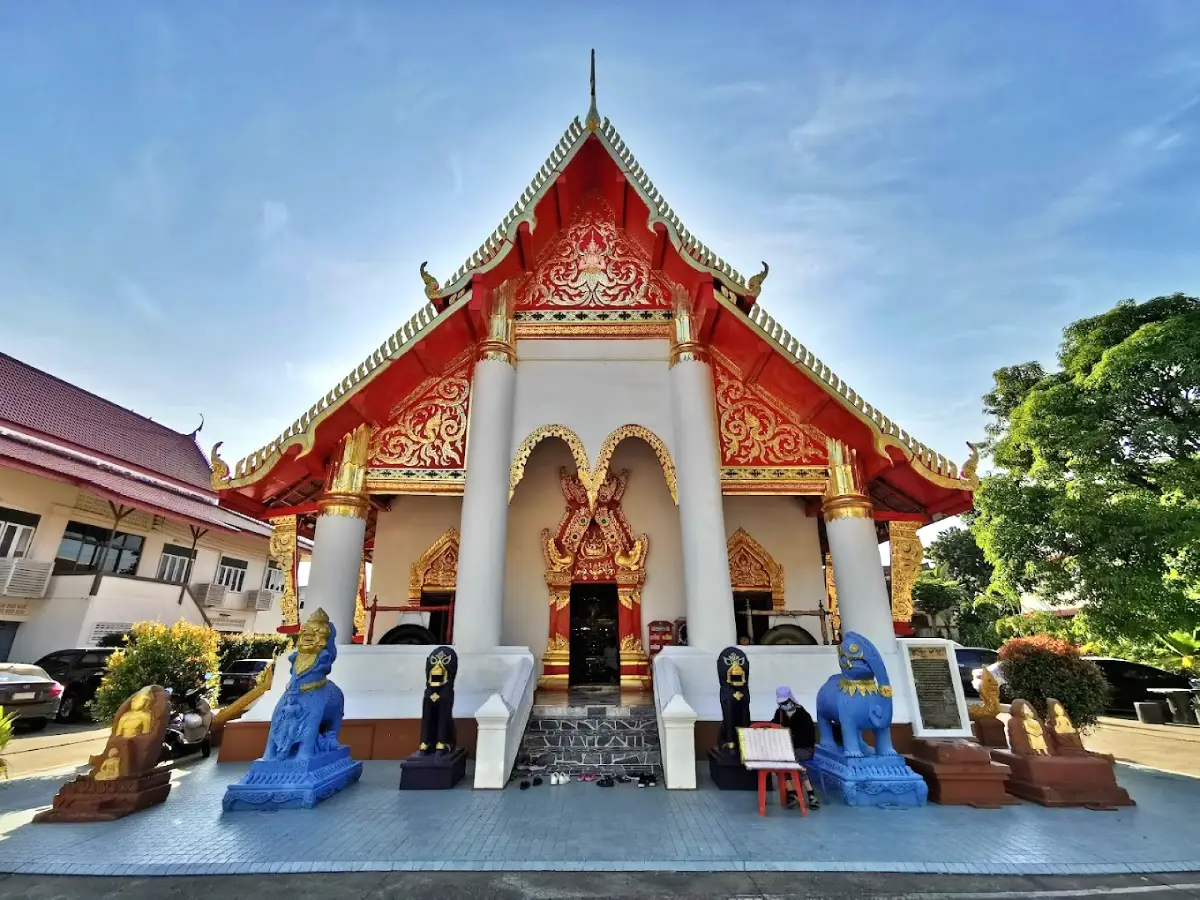
The principal sacred hall is a raised brick-and-stucco structure with a relatively low profile and a 2-tiered roof. Traditional decorative elements include chofa finials, bai raka roof ornaments, and hang hong details along the roof edges. Red and gold ornamentation around the gable, doors, windows, and entrance creates a strong visual identity, while large white columns emphasize the central approach to the hall.
Guardian figures and decorative sculptures stand near the entrance steps. From the courtyard, the balanced arrangement of the roof, red-and-gold gable, white columns, central staircase, and entrance creates one of the temple’s most recognizable views. Visitors may take photographs from the courtyard, provided that they do not obstruct worshippers or treat sacred objects as decorative props.
Inside the hall, red, gold, and darker decorative tones guide attention toward Phra Chao Ong Luang at the far end of the interior. Columns, ceiling details, lighting, and ornamented surfaces create a formal setting, but the Buddha image remains the clear visual and spiritual center. Visitors should take time to observe how the interior architecture frames the image and establishes a gradual transition from the entrance to the principal altar.
The hall remains an active religious space used for Buddhist ceremonies, monastic functions, and community events. Silence and respectful movement are therefore more important than photography. Visitors should avoid walking directly in front of people who are praying, speaking loudly, entering restricted monastic areas, or placing personal belongings on platforms reserved for monks or ceremonial objects.
Wat Si Mongkhon Tai continues to serve as an important center of the Buddhist administration in Mukdahan. The current abbot is Phra Wachirawut, formerly known by the ecclesiastical title Phra Khru Prachak Bunnyathon. His monastic name is Phimpha Thanavuttho, and he holds Pali Grade 4. He also serves as the ecclesiastical district chief of Mueang Mukdahan.
Phra Wachirawut was appointed abbot of Wat Si Mongkhon Tai in 2022. In 2024, he received the royal ecclesiastical title Phra Wachirawut as a Pali-qualified monastic dignitary. His position reflects the continuing administrative and religious importance of the temple within the provincial Sangha and the wider community.
The temple regularly hosts official religious ceremonies, provincial events, merit-making programs, and gatherings of monks and lay Buddhists. In 2025, Wat Si Mongkhon Tai hosted a royal kathina robe-offering ceremony attended by provincial authorities, members of the Sangha, educational institutions, and local residents. Such events demonstrate that the temple remains active and is not preserved merely as a historical attraction.
Visitors wishing to pay respect to Phra Chao Ong Luang may bring flowers, incense, candles, or make a voluntary donation. A simple visit may include bowing 3 times before the Buddha image, reciting a short Buddhist prayer, sitting quietly, and reflecting on the qualities of wisdom, compassion, and discipline. Elaborate offerings are not required.
Those interested in the legend of Phra Lup Lek should also visit the commemorative shrine and worship platform near the bodhi tree. Seeing the relative positions of the main hall, tree, courtyard, and Mekong riverbank helps explain why the story includes the image returning to its original location, sinking into the ground, and later being affected by changes in the riverbank.
The shrine should be approached as a place of inherited memory and worship. Visitors must not dig, move stones, climb on the platform, or disturb old architectural elements. Preserving the legend depends not only on protecting physical objects but also on maintaining the dignity of the place, the trees, the worship area, and the practices followed by the local community.
Wat Si Mongkhon Tai is generally open daily from 08.00 to 17.00 and does not charge an admission fee. Donations are voluntary. The morning is particularly suitable for a quiet visit, cooler temperatures, and soft light on the front of the sacred hall. Late afternoon is convenient for combining the temple with a walk along the Mekong and a visit to the Indochina Market.
On Buddhist holy days, major religious festivals, the beginning or end of Buddhist Lent, and during the kathina season, the temple may be crowded and ceremonial areas may be in active use. Cultural visitors should give priority to religious activities, follow instructions from monks or temple staff, and avoid blocking processional routes or spaces prepared for ceremonies.
Appropriate clothing should cover the shoulders and knees. Tight, transparent, or highly revealing clothing should be avoided. Shoes must be removed before entering the principal religious buildings. When sitting on the floor, visitors should not point their feet toward the Buddha image or monks. A side-seated or cross-legged position is more respectful.
Photography is normally possible in permitted areas, but visitors should silence their devices and avoid flash photography inside the hall. People who are praying or participating in ceremonies should not be photographed without permission. Visitors must not climb onto the altar, touch the Buddha image, cross barriers, or imitate sacred postures in a disrespectful manner.
Families may use the temple as an educational stop to introduce children to local history, Buddhism, architecture, and the development of a Mekong border town. Children should remain under supervision, avoid running inside religious buildings, and refrain from climbing guardian figures or handling offerings and ceremonial objects.
Most of the courtyard is manageable for older visitors, although some sacred buildings are reached by steps. Travelers accompanying elderly family members should provide assistance and allow additional time. Surfaces may become slippery during rain. Parking is available within the temple compound and in nearby designated areas, but vehicles must not block gateways, ceremonial entrances, or emergency access.
The cooler season from approximately November to February is comfortable for walking through central Mukdahan. Mornings and evenings are usually more pleasant than midday. During the hot season, visitors should carry drinking water and use a hat or umbrella. During the rainy season, non-slip footwear is useful, and extra care should be taken on wet steps and beside the river.
One of the temple’s practical advantages is its proximity to several attractions. The Indochina Market begins beside the temple and offers clothing, household items, regional products, and souvenirs. The Chao Mae Song Nang Phi Nong Shrine is located a short walk to the north near the immigration checkpoint. Wat Si Sumang Wanaram and Wat Yot Kaeo Si Wichai can also be included in a route through Mukdahan’s riverfront temples.
The Chao Mae Song Nang Phi Nong Shrine has its own foundation legend and is closely associated with the sacred geography around Wat Si Mongkhon Tai and the Mekong. Visiting both places reveals how Buddhism, guardian-spirit traditions, local history, and community beliefs coexist in Mukdahan. The route can be completed on foot when weather conditions are comfortable.
Mukdahan Tower, formally known as Ho Kaeo Mukdahan Chaloem Phra Kiat Kanchanaphisek, is approximately 1.2 kilometers from the temple. The tower offers elevated views and displays related to the province. Combining the tower with Wat Si Mongkhon Tai allows visitors to experience Mukdahan from 2 perspectives: the close view of temples, markets, and riverfront communities at street level, and the wider view of the city and Mekong landscape from above.
Travelers with at least half a day may continue to Wat Roi Phra Phutthabat Phu Manorom, approximately 6 kilometers from Wat Si Mongkhon Tai. The hilltop complex contains the monumental Phra Chao Yai Kaeo Mukda Si Trairat Buddha image, a large naga figure, and panoramic viewpoints over Mukdahan and the Mekong. Beginning with the historic Phra Chao Ong Luang and ending at Phu Manorom creates a balanced route combining history, devotion, sculpture, and landscape.
The surrounding area has Thai, Isan, Vietnamese, and riverside restaurants as well as cafés. Vietnamese food is an important part of Mukdahan’s culinary culture because of migration and regional exchange. Common dishes include naem nueang, Vietnamese steamed rice rolls, Vietnamese noodle soup, fried spring rolls, and pan-fried eggs. Dining locally after visiting the temple offers another way to experience the multicultural character of the border city.
Accommodation near the temple ranges from small city hotels to Mekong riverfront properties and larger full-service hotels. Travelers who want to explore the market and riverfront on foot may prefer a hotel on Samran Chai Khong Road. Those traveling by private vehicle can also stay in the central business area, where several hotels are located within a few kilometers of the temple.
A visit of approximately 45 to 90 minutes is suitable for paying respect to Phra Chao Ong Luang, viewing the sacred hall, learning about Phra Lup Lek, walking through the courtyard, and observing the riverfront setting. Visitors interested in architecture, photography, or local history may wish to stay longer before continuing to the market and nearby shrines.
Wat Si Mongkhon Tai differs from a newly constructed attraction because every major feature remains connected with living religious practice. Phra Chao Ong Luang is still actively worshipped, the memory of Phra Lup Lek continues through ritual and storytelling, the sacred hall is used for ceremonies, and the monastery remains involved in provincial Buddhist affairs. Visitors enter an active place of faith rather than a reconstructed historical display.
Responsible tourism is essential to the temple’s preservation. Visitors can help by avoiding unnecessary contact with painted or carved surfaces, disposing of waste properly, respecting restricted areas, protecting trees and old structures, and presenting the temple’s legends accurately when sharing photographs or travel information.
For travelers interested in the history of Mukdahan, the temple is an essential starting point. The story of Chao Kinnari, the discovery of the 2 Buddha images, the establishment of the new settlement, and the naming of Phra Chao Ong Luang demonstrates that founding a town involved more than constructing roads and houses. A spiritual center was needed to create a shared identity and bind the community together.
The temple also illustrates Mukdahan’s role as a gateway to Indochina. The Mekong enabled the movement of people, goods, languages, beliefs, and artistic traditions. The Lan Xang character of Phra Chao Ong Luang, the Vietnamese culinary heritage of the city, the border market, and continuing ties with Savannakhet all show that Mukdahan developed through regional exchange rather than in isolation.
The most comfortable visiting times are shortly after opening in the morning or between approximately 15.30 and 16.30. Morning visits are quieter and cooler, while late-afternoon light is attractive around the front of the sacred hall and the Mekong riverfront. Visitors who wish to enter the hall should arrive with sufficient time and avoid reaching the temple immediately before closing.
Getting There is straightforward from central Mukdahan. Follow local roads toward Samran Chai Khong Tai Road and the Indochina Market. The temple stands beside the Mekong opposite the municipal pier and near the immigration checkpoint. It can be reached by private car, rental vehicle, motorcycle, or local hired transport. Travelers staying near the market may walk to the temple. Navigation systems can use the name “Wat Si Mongkhon Tai” or the coordinates 16.5400058424, 104.733122795.
Travelers arriving by intercity bus can disembark at Mukdahan Bus Terminal and hire a local vehicle to Samran Chai Khong Road. It is useful to specify that the destination is Wat Si Mongkhon Tai beside the Indochina Market and immigration checkpoint because several temples in the region have similar names.
Before making a special trip, particularly on Buddhist holy days or during major ceremonies, visitors may contact the temple at 042-611-557. Confirming access to the principal hall can help travelers plan enough time to worship Phra Chao Ong Luang, learn about Phra Lup Lek, and continue to nearby attractions within the same day.
Wat Si Mongkhon Tai brings together a revered city Buddha image, the foundation legend of Mukdahan, Lan Xang art, northeastern Thai temple architecture, and the living culture of the Mekong riverfront. A visit offers more than a peaceful place to pray. It provides an understanding of how faith helped establish a town, preserved collective memory, and connected communities on both sides of the Mekong for generations.
| Name | Wat Si Mongkhon Tai |
| Type | Third-Class Royal Monastery of the Ordinary Category, Mahanikaya Order |
| Location | Mekong riverfront beside the Indochina Market, near Mukdahan Immigration and the municipal pier |
| Address | Samran Chai Khong Tai Road, Mukdahan Subdistrict, Mueang Mukdahan District, Mukdahan 49000, Thailand |
| Coordinates | 16.5400058424, 104.733122795 |
| Highlights | Worship Phra Chao Ong Luang, Mukdahan’s revered city Buddha image, and learn the legend of Phra Lup Lek |
| Principal Buddha Image | Phra Chao Ong Luang, a Lan Xang-style brick-and-stucco Buddha in the Subduing Mara posture, with a lap width of 2.20 meters |
| Important Features | Phra Chao Ong Luang, the Phra Lup Lek legend, the historic sacred hall, and the worship platform near the bodhi tree |
| History | Temple records give 1742 as the founding year. Its major foundation narrative is linked to Chao Kinnari and the establishment of Mukdahan during the Thonburi period. |
| Consecrated Boundary | Granted in 1788 |
| Distinctive Features | Raised brick-and-stucco sacred hall with a 2-tiered roof, traditional roof ornaments, and red-and-gold decoration |
| Abbot | Phra Wachirawut (Phimpha Thanavuttho, Pali Grade 4), Ecclesiastical District Chief of Mueang Mukdahan |
| Main Areas / Zones | 1. Sacred hall housing Phra Chao Ong Luang 2. Phra Lup Lek shrine and worship platform 3. Bodhi tree and temple courtyard 4. Entrance gate and forecourt 5. Mekong riverfront and Indochina Market area |
| Travel Information | Follow Samran Chai Khong Tai Road to the Indochina Market. Accessible by private car, rental vehicle, motorcycle, or local hired transport. |
| Current Status | Open and active as a royal monastery and an important venue for Buddhist ceremonies in Mukdahan Province |
| Open Days | Daily |
| Opening Hours | 08.00 – 17.00 |
| Fees | Free admission; voluntary donations are welcome |
| Facilities | Parking within and near the temple, worship and merit-making areas, and direct access to the Mekong riverfront market district |
| Visitor Guidelines | Dress modestly, remove shoes before entering sacred buildings, remain quiet, avoid flash photography, and do not touch historic artwork unnecessarily |
| Main Contact Number | 042-611-557 |
| Nearby Tourist Attractions | 1. Indochina Market, 0.2 km 2. Chao Mae Song Nang Phi Nong Shrine, 0.2 km 3. Wat Si Sumang Wanaram, 0.4 km 4. Wat Yot Kaeo Si Wichai, 1.1 km 5. Ho Kaeo Mukdahan Chaloem Phra Kiat Kanchanaphisek, 1.2 km 6. Wat Roi Phra Phutthabat Phu Manorom, 6 km |
| Nearby Restaurants | 1. The Pearl Bistro & Bar, 0.2 km, Tel. 087-359-8061 2. Aor Aem Vietnamese Food, 1 km, Tel. 082-787-2360 3. Krua Saigon Mukdahan, 1.4 km, Tel. 042-615-303, 081-320-1318 4. Savan Sumran, 1.8 km, Tel. 042-632-669 5. Khrua Anchan, 2 km, Tel. 094-223-2465 |
| Nearby Accommodations | 1. Riverfront Hotel Mukdahan, 0.5 km, Tel. 042-612-948, 042-612-949 2. Submukda Grand Hotel, 0.8 km, Tel. 042-633-444 3. Ploy Palace Hotel, 1.4 km, Tel. 042-614-988 4. Samranchaykhong Hotel, 1.5 km, Tel. 094-542-6388 5. Hotel de Ladda, 2.1 km, Tel. 042-611-499 |
Frequently Asked Questions (FAQ)
Q: Where is Wat Si Mongkhon Tai located?
A: The temple is on Samran Chai Khong Tai Road beside the Mekong River in central Mukdahan, next to the Indochina Market and near the provincial immigration checkpoint and municipal pier.
Q: What is the most important sacred object at Wat Si Mongkhon Tai?
A: The principal sacred object is Phra Chao Ong Luang, an ancient Lan Xang-style brick-and-stucco Buddha image revered as the guardian Buddha of Mukdahan.
Q: What is Phra Lup Lek?
A: Phra Lup Lek is the small iron Buddha image discovered beneath a bodhi tree with Phra Chao Ong Luang. According to local tradition, it repeatedly returned to its original location and gradually sank into the ground, leading to the construction of a worship platform at the site.
Q: What are the opening hours and admission fee?
A: Wat Si Mongkhon Tai is open daily from 08.00 to 17.00. Admission is free, and voluntary donations are welcome.
Q: Who is the current abbot of Wat Si Mongkhon Tai?
A: The current abbot is Phra Wachirawut, or Phimpha Thanavuttho, Pali Grade 4. He also serves as the ecclesiastical district chief of Mueang Mukdahan.
Q: Is parking available at the temple?
A: Parking is available within the temple compound and in nearby designated areas. Vehicles should not block the entrance, sacred hall steps, or emergency access routes.
Q: What should visitors wear and how should they behave?
A: Visitors should cover their shoulders and knees, remove shoes before entering religious buildings, remain quiet, avoid pointing their feet toward Buddha images, and refrain from using flash photography inside the sacred hall.
Q: Which attractions can be combined with a visit to the temple?
A: Nearby options include the Indochina Market, Chao Mae Song Nang Phi Nong Shrine, Wat Si Sumang Wanaram, Wat Yot Kaeo Si Wichai, Mukdahan Tower, and Wat Roi Phra Phutthabat Phu Manorom.
 Category: ●Places of Worship
 Group: ●Temple
Last Update : 2 MonthAgo
 Last Update : 2 MonthAgo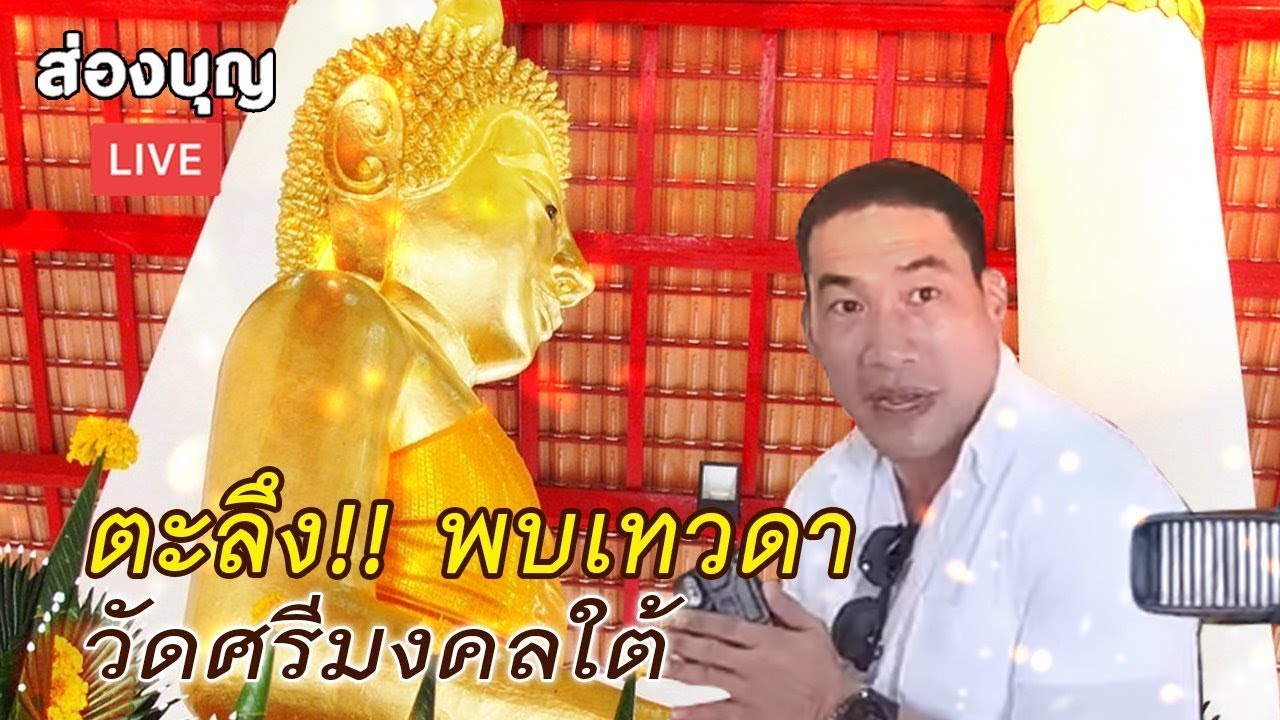
 Click to Access the Navigation Map GPS
Wat Si Mongkhon Tai Map
Recommend

 Art, Culture and Heritage
 Historical Sites and Monuments(2)
 Landmarks and Memorials(3)
 Art, Craft Centres, Tradition(2)
 Museums(1)
Temple(17)
Museums(1)
Temple(17)
 Other Sacred Sites(3)
 Suburban Living
 Village, Community(4)
 Local Market(2)
 Nature and Wildlife
 National Parks and Marine Reserves(4)
 Mountain (Doi)(5)
 Dam, Reservoir, Lake(3)
 Waterfalls(5)
 Caves(2)
 River, Canal(2)
 Bays and Beaches(1)
 Other natural attractions(1)
 Entertainment and Agricultural
 Farms, Parks and Ecotourism(1)


