
lovethailand home >Northeastern Travel Attractions >Mukdahan Travel Attractions >Muang Mukdahan >Si Bun Rueang > Wat Si Bun Rueang (Ban Tai)
TL;DR: Wat Si Bun Rueang (Ban Tai), Mukdahan attractions : Places of Worship, Temple.
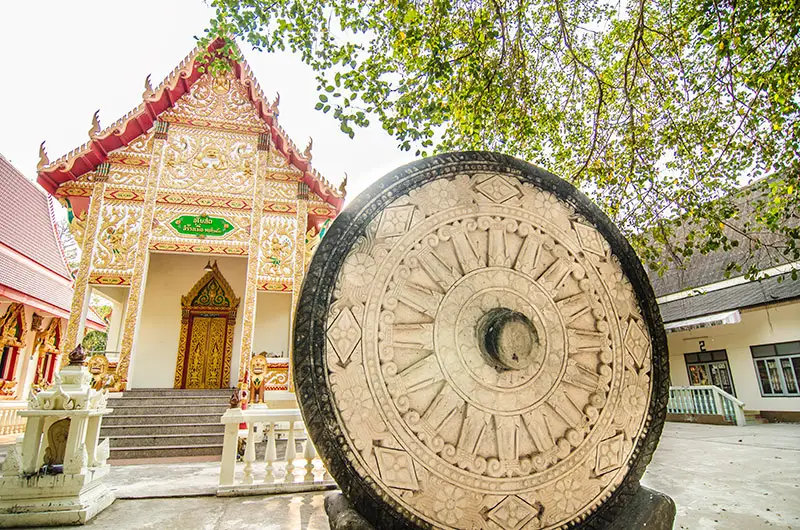
Wat Si Bun Rueang (Ban Tai)
Open Days: Daily
Opening Hours: 08.00 – 16.30. The ordination hall and ceremonial areas may close temporarily during monastic rites or temple activities.
Wat Si Bun Rueang (Ban Tai), Mukdahan is a historic Buddhist temple on the Mekong River closely connected with the founding of Mukdahan. It stands on Samran Chai Khong Tai Road in the Si Bun Rueang community within Mukdahan Municipality. Enshrined inside the ordination hall is Phra Phuttha Sing Song, a Lan Xang-style bronze Buddha image revered by local residents as one of the city’s sacred guardian images. Every Songkran, the image becomes the focus of an annual procession and ritual bathing ceremony. The temple therefore carries religious, historical, artistic, spiritual, and communal significance for the people of this Mekong riverside city.
The name Wat Si Bun Rueang is commonly followed by “Ban Tai” to distinguish the temple from other places or communities with similar names and to identify its position south of Mukdahan’s old town. In the traditional geography of the community, a temple was not merely a place of worship. It also served as a reference point for residential quarters, river landings, travel routes, and shared community spaces. Local people consequently referred to the temple by its location and community name, creating the name that has continued to the present day.
The temple lies close to the Mekong River, and its surroundings remain connected with the character of a border city where the river has long served as a source of food, a transport route, a trading corridor, and a link between communities in Thailand and the Lao People’s Democratic Republic. Samran Chai Khong Tai Road connects the temple with the Indochina Market, Wat Si Mongkhon Tai, the municipal pier, and the old community district. Visitors can therefore study the temple’s history while gaining a broader understanding of central Mukdahan along a single cultural route.
The temple’s history is associated with the early establishment of Mukdahan in the 18th century. The area was originally used as a resting place by monks and travelers. As the settlement expanded and the town became more formally organized, Chao Kinnari, also known as Phraya Chanthasri Suraraj Uparat, the first governor of Mukdahan, worked with officials and residents to restore the site and establish a temple as the Buddhist center of the community on the southern side of the town. Wat Si Bun Rueang is therefore contemporary with the foundations of Mukdahan itself.
Chao Kinnari is a major figure in local history because he helped gather settlers, organize the community, establish religious institutions, and shape the structure of the new town on the Mekong River. Building a temple in that period meant far more than providing buildings for monks. A temple functioned as a center of education, ritual, dispute resolution, village meetings, and annual merit-making festivals. Wat Si Bun Rueang was one of the institutions that helped the new settlement develop into a town with a distinct identity and a stable social structure.
Temple histories describe Wat Si Bun Rueang as the temple of the “lower end of the town,” while Wat Si Mongkhon Tai served as an important center toward the upper end. These terms reflect the way earlier communities understood space according to the river and traditional travel routes. Before modern roads were built, the Mekong was the principal transport corridor. The temple’s position was therefore understood in relation to boat routes, river landings, and settlement patterns rather than modern streets and house numbers.
The original ordination hall faced north. This orientation has been interpreted as a memorial to the former homeland and the route followed by Chao Kinnari and his people when they traveled south to establish the town. The direction of the building therefore carried meaning beyond physical convenience, preserving memories of migration, settlement, and the relationship between Mukdahan and communities farther north in the Mekong Basin through architectural form.
The temple’s most important sacred object is Phra Phuttha Sing Song, a bronze Buddha image with a lap width of approximately 1 meter and a height of about 1.20 meters from the seated base to the top of the ushnisha. The image belongs to the Lan Xang artistic tradition and shows influences from Chiang Saen and northern Thai Buddhist art. Its form conveys composure, strength, and balance, qualities appropriate to a principal Buddha image that has served as a spiritual focus for the community over many generations.
Local tradition relates that when Mukdahan was still a newly established town, Chao Kinnari traveled to Vientiane and brought Phra Phuttha Sing Song back to Mukdahan. The image was initially enshrined in the ordination hall of Wat Si Mongkhon Tai. After Chao Kinnari established a temple and ordination hall in the Si Bun Rueang community, the image was transferred from Wat Si Mongkhon Tai and placed on a pedestal inside the ordination hall of Wat Si Bun Rueang so that residents on the southern side of the town could worship it.
A temple history published by a Buddhist authority confirms the essential sequence: Phra Phuttha Sing Song was once enshrined at Wat Si Mongkhon Tai before being transferred to the newly built ordination hall established by Chao Kinnari at Wat Si Bun Rueang. The Vientiane tradition and the account of the transfer from Wat Si Mongkhon Tai can therefore be understood as parts of the same chronology: the image was brought into Mukdahan, housed temporarily at an earlier temple, and later moved to Wat Si Bun Rueang.
The word “Sing” in the name Phra Phuttha Sing Song is associated with groups of Buddha images influenced by Lanna and Chiang Saen art. These styles spread through Mekong communities through the movements of monks, craftspeople, rulers, and networks of neighboring towns. The word “Song,” meaning “two,” distinguishes this image from other Phra Phuttha Sing images remembered in local tradition. Its name is therefore both a specific title and evidence of how important Buddha images were classified within Mukdahan’s cultural memory.
The bronze used to create the image was produced by combining metals and casting them through a process requiring highly skilled artisans. A large Buddha image demanded careful control of proportion, metal thickness, and the flow of molten alloy throughout the mold. The successful casting reflects knowledge of sculpture, metallurgy, and religious ritual. Phra Phuttha Sing Song is not only an ancient devotional object but also an accomplished work of craftsmanship that provides insight into the technology and artistic preferences of Mekong Basin communities.
In the past, moving a Buddha image from one temple to another required the consent of leaders, monks, and local residents because such an image was not private property but a sacred possession of the community. The transfer of Phra Phuttha Sing Song to Wat Si Bun Rueang therefore reflected the importance of the new temple and the desire to establish a spiritual center for people living at the lower end of the town. After the transfer, the image continued to receive public devotion and became the temple’s principal symbol.
The original ordination hall once contained mural paintings on both its interior and exterior walls. Inside were scenes from the life of the Buddha, while the exterior depicted heaven, hell, karmic consequences, and moral teachings. These murals served as educational media for local people at a time when books were scarce. Viewers could learn about the Buddha’s birth, enlightenment, teaching, and final nirvana, while also understanding the principles of performing good deeds, avoiding wrongdoing, and accepting the consequences of one’s actions through directly visible images.
Although the original ordination hall deteriorated and eventually collapsed, traces of its foundations and stories passed down through the community remain valuable to the temple’s history. The loss of the original murals demonstrates the vulnerability of heritage made from timber, plaster, and natural pigments. Surviving information should therefore be documented systematically, including the building’s dimensions, orientation, mural subjects, names of artisans, oral histories from elders, and historic photographs, allowing future generations to understand what once existed even when the original structure can no longer be seen in full.
Construction of the present ordination hall began in 1957 during the abbacy of Phra Withun Thammaphon. Work continued for several years and was completed in 1966. The hall received its royal grant of consecrated boundary, or wisungkhamsima, in 1970, allowing formal monastic acts to be conducted in accordance with the Buddhist monastic code. This chronology reflects cooperation among monks, residents, devotees, and local leaders in creating a religious building suitable for both monastic functions and the veneration of Phra Phuttha Sing Song.
The construction of the new ordination hall did not erase the significance of the earlier building. Instead, it continued the temple’s religious function in a structure better suited to contemporary needs and long-term stability. Phra Phuttha Sing Song remains the principal sacred image within the temple. Visitors can therefore encounter several historical layers in one place: traditions from the founding of Mukdahan, traces of the original ordination hall, a building constructed in the mid-20th century, and living religious activities that continue today.
The original temple compound covered approximately 5 rai, 1 ngan, and 76 square wah. In 1947, a road was cut through the property, separating parts of the sacred precinct from some of the temple’s landholdings. This change reflects the growth of the town and the arrival of a modern road network that gradually replaced water-based travel. Although the road improved access, it also altered the temple’s traditional spatial arrangement and the relationship between its buildings and the Mekong River.
In 1983, the temple received an additional plot of approximately 2 ngan and 92.4 square wah for religious use and community activities. Subsequent work on land-title documentation and the consolidation of temple plots increased the total area to more than 6 rai. Proper land administration is essential for conserving buildings, creating ceremonial spaces, maintaining monastic zones, and preventing encroachment in an urban area where land values continue to rise.
The current abbot is Phra Ratcharattanamoli, also known as Phra Ratcharattanamoli Somyong Katapunyo, Pali Grade 7, who also serves as the Ecclesiastical Provincial Governor of Mukdahan. His responsibilities therefore include temple administration, supervision of monks and novices, organization of religious activities, conservation of Phra Phuttha Sing Song, and provincial monastic governance. Because the provincial ecclesiastical leader resides here, Wat Si Bun Rueang also functions as an important coordination center for Buddhism in Mukdahan.
The temple contains the ordination hall and the shrine of Phra Phuttha Sing Song, the remains of the former ordination hall, a sermon hall, monks’ living quarters, ceremonial courtyards, and spaces used to receive participants during merit-making events. Each area has a different purpose. The ordination hall is used for formal monastic rites, the shrine is a place for worship, the sermon hall is used for merit-making, teachings, and community meetings, and the residential quarters are private areas that visitors should not enter without permission.
The Phra Phuttha Sing Song area is the most important point of a visit. Worshippers commonly offer flowers, incense, and candles, then sit quietly in contemplation of the qualities of the Buddha. Devotion should emphasize respect and mental cultivation rather than requests for personal gain. Visitors may observe the image’s proportions, bronze surface, facial form, and craftsmanship without touching the image or its pedestal. Photography should follow the temple’s signs and instructions.
The remains of the former ordination hall are important as both archaeological evidence and a focus of community memory. Although the building no longer survives intact, the position of its foundation helps explain the layout of the early temple, the orientation of the hall, and its relationship with the lower end of the town. Visitors should avoid stepping, sitting, or placing objects on historic fragments because pressure and moisture can accelerate the cracking of brick, plaster, and other surviving materials.
The sermon hall and activity courtyard demonstrate the temple’s continuing role in everyday community life. In addition to merit-making on Buddhist observance days, these spaces host offerings to the monastic community, ordination ceremonies, memorial merit-making, monastic meetings, and public-service activities. During major events, the area can receive large numbers of people. Travelers should therefore check whether ceremonies or temporary access restrictions are scheduled on the day of their visit.
The temple’s most important living tradition is the annual removal of Phra Phuttha Sing Song from the ordination hall during Songkran so that residents of Mukdahan and visitors can pour scented water over the image. Under normal conditions, the Buddha image remains securely enshrined inside the temple. Its appearance in a special annual procession is therefore a highly anticipated event with deep meaning for the city’s shared identity. The ceremony connects an ancient sacred image with the present generation through a ritual performed in public every year.
The most recent clearly documented program took place on 13 April 2025. A bathing ceremony for Phra Phuttha Sing Song was held inside the temple during the day, followed in the afternoon by a procession carrying the image from the temple into the urban area and toward Mukdahan Municipality’s pier. The procession included a ceremonial vehicle, offerings, representatives of government agencies, community groups, and residents wearing local cultural dress. Times and routes may change each year according to announcements from the organizers.
Before the procession begins, monks and responsible officials carefully prepare the image, its pedestal, and the equipment used for transportation. Because Phra Phuttha Sing Song is a large bronze image of major historical value, lifting, moving, and securing it on the ceremonial vehicle require close attention to weight, balance, and safety. Members of the public should therefore not touch ropes, supports, platforms, or procession equipment without permission from officials.
As the procession passes through the town, residents set up worship tables and prepare clean water, scented water, and flowers to welcome the image. Pouring water is an expression of respect and a request for blessings at the Thai New Year. The water should be clean and poured gently. Water guns or forceful splashing should never be directed at the image, its ornaments, or monks in the procession because this may cause damage and contradict the meaning of the ceremony.
The significance of bathing the Buddha image extends beyond the hope of receiving good fortune. The act is connected with purification of the mind, a fresh beginning, and remembrance of the value of Buddhism. Songkran is also a time when younger family members return home, make merit for ancestors, pour water over the hands of elders to receive blessings, and strengthen community relationships. Phra Phuttha Sing Song therefore forms a central link between family ceremonies and the citywide celebration.
The tradition also allows younger generations to learn the temple’s history through direct participation rather than documents alone. Children and young people can observe the preparation of offerings, the respectful transfer of the Buddha image, management of the procession, and appropriate bathing practices. Elders can share stories of Chao Kinnari, Wat Si Mongkhon Tai, and the Ban Tai community during the event. Learning takes place through observation, participation, and family memory.
Beyond Songkran, the temple is used for merit-making on Buddhist observance days, Makha Bucha Day, Visakha Bucha Day, Asalha Bucha Day, the beginning of Buddhist Lent, and the end of Buddhist Lent, as well as for activities organized by the provincial monastic administration. Visitors arriving on major religious days may encounter large crowds and areas reserved for ceremonies. They should dress respectfully, silence mobile phones, and avoid walking directly in front of monks or people who are meditating or chanting.
Wat Si Bun Rueang remains an active monastery where monks reside and religious duties continue normally. It should not be visited as though it were a museum in which every area is open for unrestricted exploration. Monastic residences, administrative offices, and buildings without signs indicating public access should be treated as private. Groups wishing to request information or arrange a formal visit should contact the temple or the Mukdahan Provincial Office of Buddhism in advance.
Visitors should wear clothing that covers the shoulders and knees and should avoid garments that are excessively sheer or tight. Hats and sunglasses should be removed before worship inside the ordination hall, shoes should be left at the designated point, and seated visitors should keep their feet from pointing toward the principal Buddha image. Non-Buddhists are welcome and are not required to perform every ritual. Quiet behavior and respectful treatment of the site are sufficient.
Photography outside the buildings and around the courtyard is generally acceptable when it does not disturb activities. Inside the ordination hall, visitors should check signs or request permission before using a camera. Flash photography, tripods placed in walkways, and photographing people at prayer without consent should be avoided. Visitors should not climb onto architectural bases or move offerings to improve a composition. Good photography should always be compatible with quiet conduct and the protection of sacred objects.
The temple does not charge admission. Visitors may worship and learn about its history without purchasing a ticket. Donations toward water, electricity, building restoration, or public-benefit activities are voluntary. Contributions should be placed in official donation boxes or given at points designated by the temple. There is no obligation to give money to individuals who approach visitors without identification or authorization from the temple. Appropriate merit-making should always be voluntary and should not create financial pressure for travelers.
Facilities include parking areas, the temple courtyard, paths connecting the buildings, shoe-storage points, and resting areas in pavilions that the temple makes available to visitors. Parking may be limited during major merit-making events or Songkran. Wheelchair users and older visitors should be accompanied because some religious buildings have steps, raised thresholds, and uneven levels. Toilets and service areas should be used according to signs and kept clean for everyone.
The best times to visit are in the morning or later afternoon before closing, when the riverside weather is usually less intense than at midday. Morning light helps reveal architectural details and the atmosphere of the surrounding community, while late afternoon is suitable for continuing to the Mekong riverfront. Visitors should avoid the monks’ midday meal period and times when formal ceremonies are being conducted inside the ordination hall. If a building is closed, it should not be opened or entered without permission.
Mukdahan can be very hot during summer and Songkran, so visitors should carry drinking water, a hat, and an umbrella for outdoor areas, removing the hat before entering religious buildings. During the rainy season, courtyards and steps can become slippery; footwear with good grip is advisable, and electronic equipment should be protected. Winter is more comfortable and is well suited to a walking route that combines the temple with several Mekong riverside attractions.
The temple is important for studying the history of Mukdahan because its story connects settlement, the establishment of a religious center by Chao Kinnari, relationships with Vientiane and Wat Si Mongkhon Tai, the development of riverside roads, and the expansion of the municipality. Students can use the temple as a learning site for history, art, religion, geography, and heritage conservation. Explanations by a monk or knowledgeable local guide can help ensure accuracy and reveal how the different elements are connected.
Phra Phuttha Sing Song is also evidence of the movement of art through the Mekong Basin. Important Buddha images could travel with rulers, monks, or migrant communities, allowing artistic forms associated with Lanna, Chiang Saen, Lan Xang, and Vientiane to appear in towns along the river. The image should therefore be studied not only for its appearance but also for its journey, the authority of town founders, and the devotion of the community that accepted responsibility for its care.
The temple also demonstrates that Mukdahan’s urban identity did not arise from a single cultural group. It developed through people from several regions who shared related languages, beliefs, crafts, and traditions. Lao-style personal names, northern forms of Buddha imagery, river-based transportation, and a contemporary Songkran ceremony all coexist within the same place. Conserving the temple therefore preserves evidence of a border society shaped by continuous exchange rather than treating its buildings as isolated monuments.
Conservation of Phra Phuttha Sing Song must consider the condition of the metal, humidity, dust, incense smoke, and contact by worshippers. Bronze can develop deposits and corrosion in unsuitable environments. Cleaning should be performed by knowledgeable conservators, and visitors should never apply chemicals or polish the surface themselves. Controlling smoke and maintaining distance between offerings and the image can reduce heat and soot accumulation.
The remains of the former ordination hall should be protected from standing water, tree roots, and foot traffic. Interpretive signs showing the original plan, reconstructions of the murals, and a timeline from the era of Chao Kinnari to construction of the present hall would help visitors understand the site without rebuilding a replica. Good conservation should preserve as much original material as possible and use reliable interpretation to explain what has been lost.
Continuing the Songkran tradition requires a balance between public participation and protection of the Buddha image. The ceremonial vehicle, securing system, safety personnel, and control of the amount of water used are all important. Organizers should also explain the meaning of the ritual so that bathing the image does not become merely a photo opportunity or water-play activity without respect for the sacred object and the community that maintains the tradition.
For travelers interested in a cultural route, a visit to Wat Si Bun Rueang can begin with worship at Phra Phuttha Sing Song, study of the former ordination hall, and a walk through the temple grounds. The route can then continue to Wat Si Mongkhon Tai, which is connected with the earlier enshrinement of the image, followed by the Chao Mae Song Nang Phi Nong Shrine, the Indochina Market, and the Mekong riverfront. Together, these places present the history of the town, local belief, Buddhism, and border trade within a single journey.
Wat Si Mongkhon Tai is approximately 2 kilometers away and is the important temple where Phra Phuttha Sing Song was once enshrined before being transferred to Wat Si Bun Rueang. Visiting both temples makes the story of the image’s journey more complete. The Indochina Market and Chao Mae Song Nang Phi Nong Shrine are in the same riverside district, while Mukdahan Tower and Wat Roi Phra Phutthabat Phu Manorom provide elevated views across the city and the Mekong River.
The area around the temple has several riverside and local restaurants. Mukdahan specialties include Mekong fish, northeastern Thai cuisine, Lao dishes, and Vietnamese food. Travelers may dine at Nat Phop Rim Khong, Bao Pradit, Khrua Vietnam, Phuang Phet, or Ban Lao Yuan Na Rim Khong. These restaurants are approximately 1–3 kilometers from the temple. Opening hours should be checked on the day of travel, particularly during public holidays and festivals.
Nearby accommodations include both riverside and central-city hotels, such as Hotel de Ladda, Riverfront Hotel Mukdahan, Submukda Grand Hotel, Ploy Palace Hotel, and B2 Mukdahan. Travelers who want to explore the riverfront on foot should choose accommodation near Samran Chai Khong Road, while those traveling by car may prefer hotels farther inside the city. Advance booking is important during Songkran, the end-of-Buddhist-Lent boat-racing period, and major provincial festivals.
Getting There From Mukdahan Provincial Hall or the city center, follow Phithak Phanom Khet Road to Samran Chai Khong Tai Road and continue toward the Si Bun Rueang community. The temple is close to the Mekong River and can be located on digital maps under the name “Wat Si Bun Rueang Ban Tai.” Travelers arriving by interprovincial bus can get off at Mukdahan Bus Terminal and continue by hired vehicle, tuk-tuk, or another local transport service.
Travelers staying near the Indochina Market can reach the temple by hired vehicle or car over a distance of approximately 1–2 kilometers. Walking is possible in cooler weather, but visitors should assess pavement conditions and road crossings because Samran Chai Khong Road carries traffic and does not have a continuous footpath in every section. During the Songkran procession, some roads may close or operate under temporary traffic arrangements. Visitors should use parking areas designated by the municipality and the temple.
The temple’s reference coordinates are approximately 16.53534, 104.73306. These coordinates help drivers reach the temple more accurately than searching only by the community name. On approaching the site, visitors should still follow temple signs and the actual entrance. Vehicles should not block gates, monks’ residences, or emergency access routes. When the temple parking area is full, public parking should be used and the remaining distance covered on foot.
Visitors should allow at least 45–60 minutes to worship Phra Phuttha Sing Song, see the ordination hall, learn the temple’s history, and examine the remains of the earlier building. More time is appropriate for speaking with a monk or studying the historical details. A rushed visit may overlook the relationship among the Buddha image, the orientation of the buildings, the road, and the riverside landscape, all of which are essential to the temple’s story.
Because the Ecclesiastical Provincial Governor resides at the temple, activities may include meetings of senior monks, appointment ceremonies, training programs, and receptions for monastic delegations from different districts. Visitors may find certain areas reserved for ecclesiastical work on the day of their visit and should follow signs and staff instructions. The temple’s provincial responsibilities demonstrate that Wat Si Bun Rueang remains a contemporary religious institution rather than merely a historic site inherited from the past.
The value of Wat Si Bun Rueang arises from the combination of many elements. Phra Phuttha Sing Song is the center of devotion; Chao Kinnari connects the temple with the founding of Mukdahan; the former ordination hall and its lost murals represent earlier artistic traditions; the present ordination hall reflects the strength of a later community; and the Songkran tradition carries all these stories forward through continuing practice rather than leaving them only in documents and oral accounts.
For the people of Mukdahan, Phra Phuttha Sing Song is more than a large bronze Buddha image. It symbolizes continuity between ancestors and the present generation. Participating in the Songkran bathing ceremony, bringing children to worship, and helping care for the temple are ways in which the community expresses shared ownership of its heritage. Once visitors understand this meaning, a temple visit becomes more than sightseeing; it becomes a deeper study of the relationship among religion, the city, and its people.
Wat Si Bun Rueang (Ban Tai) is therefore an important destination for travelers who wish to understand Mukdahan through local history, Buddhist art, and a living tradition. Visitors can worship Phra Phuttha Sing Song, learn about the image’s route from Vientiane through Wat Si Mongkhon Tai, study traces of the town from the period of Chao Kinnari, and experience the atmosphere of a Mekong riverside community. A respectful visit that allows time for careful observation will reveal far more about Mukdahan than an ordinary sightseeing stop.
| Name | Wat Si Bun Rueang (Ban Tai) |
| English Name | Wat Si Bun Rueang (Ban Tai) |
| Place Type | Public Buddhist temple, important religious site, and learning center for the history of Mukdahan |
| Location | Samran Chai Khong Tai Road, Si Bun Rueang Community, Si Bun Rueang Subdistrict, Mueang Mukdahan District, Mukdahan Province |
| Address | Moo 3, Samran Chai Khong Tai Road, Si Bun Rueang Subdistrict, Mueang Mukdahan District, Mukdahan Province 49000, Thailand |
| Coordinates | 16.53534, 104.73306 |
| Open Days | Daily |
| Opening Hours | 08.00 – 16.30. The ordination hall may close temporarily during monastic rites or temple activities. |
| Admission Fee | Free admission; donations are voluntary |
| Current Status | Active temple and provincial center for monastic activities |
| Caretaker | Wat Si Bun Rueang and the Mukdahan provincial monastic administration |
| Current Abbot | Phra Ratcharattanamoli (Somyong Katapunyo, Pali Grade 7), Ecclesiastical Provincial Governor of Mukdahan |
| Founding Period | Early period of Mukdahan’s establishment, approximately 1767–1775 |
| Key Founder | Chao Kinnari, also known as Phraya Chanthasri Suraraj Uparat, the first governor of Mukdahan |
| Historical Significance | An important temple at the lower end of old Mukdahan, connected with the town’s founding, the transfer of Phra Phuttha Sing Song, and the life of the Mekong riverside community |
| Important Buddha Image | Phra Phuttha Sing Song, a Lan Xang-style bronze Buddha image influenced by Chiang Saen art |
| Size of Phra Phuttha Sing Song | Approximately 1 meter across the lap and about 1.20 meters high from the seated base to the top of the ushnisha |
| History of the Image’s Transfer | Local tradition states that Chao Kinnari brought the image from Vientiane. It was first enshrined at Wat Si Mongkhon Tai before being transferred to the ordination hall of Wat Si Bun Rueang. |
| Former Ordination Hall | Faced north. Its interior once contained murals of the Buddha’s life, while the exterior depicted heaven, hell, and the consequences of karma. Only traces of the foundation remain. |
| Present Ordination Hall | Construction began in 1957, was completed in 1966, and received a royal grant of consecrated boundary in 1970 |
| Temple Area | Originally approximately 5 rai, 1 ngan, and 76 square wah; the present combined landholding exceeds 6 rai after consolidation and land-title administration |
| Major Tradition | Annual Songkran procession in which Phra Phuttha Sing Song is taken from the ordination hall, carried through the city, and made available for public ritual bathing |
| Most Recently Documented Songkran Program | On 13 April 2025, the temple held a bathing ceremony during the day and carried Phra Phuttha Sing Song into the city in the afternoon. Future schedules should follow annual announcements from the temple and Mukdahan Municipality. |
| Main Areas / Zones | 1. Ordination hall and shrine of Phra Phuttha Sing Song 2. Remains of the former ordination hall 3. Sermon hall and ceremonial courtyard 4. Provincial monastic activity area 5. Monks’ residential area 6. Temple land and areas near the Mekong River 7. Parking and visitor-service areas |
| Facilities | Parking, resting pavilions, walkways, shoe-storage points, toilets, and ceremonial areas made available by the temple |
| Dress Code | Dress respectfully, cover the shoulders and knees, and remove shoes and hats before entering religious buildings |
| Travel Information | From central Mukdahan, follow Phithak Phanom Khet Road to Samran Chai Khong Tai Road, or take a hired vehicle from Mukdahan Bus Terminal to the Si Bun Rueang community |
| Temple Information Contact | Mukdahan Provincial Office of Buddhism: 042-611089 and 042-614090 |
| Nearby Tourist Attractions | 1. Mekong riverfront and Samran Chai Khong Tai Road, approximately 0.1 km 2. Indochina Market, Mukdahan, approximately 1.5 km 3. Chao Mae Song Nang Phi Nong Shrine, approximately 2 km 4. Wat Si Mongkhon Tai, approximately 2 km 5. Mukdahan Tower, approximately 3 km 6. Wat Roi Phra Phutthabat Phu Manorom, approximately 8 km |
| Nearby Restaurants | 1. Nat Phop Rim Khong, approximately 1 km, Tel. 086-4596263 2. Bao Pradit, approximately 1 km, Tel. 083-2900884 3. Khrua Vietnam, approximately 2 km, Tel. 042-614120 4. Phuang Phet, approximately 2 km, Tel. 083-1440546 5. Ban Lao Yuan Na Rim Khong, approximately 3 km, Tel. 042-611111 |
| Nearby Accommodations | 1. Hotel de Ladda, approximately 1 km, Tel. 042-611499 2. Riverfront Hotel Mukdahan, approximately 1 km, Tel. 042-612948–9 3. Submukda Grand Hotel, approximately 2 km, Tel. 042-633444 4. Ploy Palace Hotel, approximately 3 km, Tel. 042-614988 5. B2 Mukdahan Boutique & Budget Hotel, approximately 3 km, Tel. 1328 |
Frequently Asked Questions (FAQ)
Q: On which days and at what times is Wat Si Bun Rueang (Ban Tai) open?
A: The temple is open daily from 08.00 to 16.30. The ordination hall or certain areas may close temporarily during formal monastic rites, ecclesiastical activities, or important temple ceremonies.
Q: Why is Phra Phuttha Sing Song important?
A: Phra Phuttha Sing Song is a Lan Xang-style bronze Buddha image influenced by Chiang Saen art. It is one of Mukdahan’s most important sacred images and the focus of the annual Songkran bathing tradition.
Q: Who brought Phra Phuttha Sing Song to the temple?
A: Chao Kinnari, also known as Phraya Chanthasri Suraraj Uparat, the first governor of Mukdahan, is associated with bringing the image to the city. Local tradition states that it came from Vientiane, was first enshrined at Wat Si Mongkhon Tai, and was later transferred to Wat Si Bun Rueang.
Q: How large is Phra Phuttha Sing Song?
A: The bronze image measures approximately 1 meter across the lap and about 1.20 meters from the seated base to the top of the ushnisha.
Q: When is the Phra Phuttha Sing Song bathing tradition held?
A: It is held during Songkran in Mueang Mukdahan District. The image is carried from the temple through the city and made available for public ritual bathing. Visitors should follow the official annual announcement for the exact time and route.
Q: Who is the current abbot of Wat Si Bun Rueang?
A: The current abbot is Phra Ratcharattanamoli (Somyong Katapunyo, Pali Grade 7), who also serves as the Ecclesiastical Provincial Governor of Mukdahan.
Q: Does Wat Si Bun Rueang charge an admission fee?
A: No. Visitors may worship and learn about the temple’s history free of charge. Donations for temple maintenance are voluntary.
Q: How should visitors behave inside the temple?
A: Visitors should dress respectfully, remove shoes and hats before entering religious buildings, speak quietly, avoid touching Buddha images or historic objects, stay out of monastic residences without permission, and check signs before taking photographs inside the ordination hall.
 Category: ●Places of Worship
 Group: ●Temple
Last Update : 2 MonthAgo
 Last Update : 2 MonthAgo
 Click to Access the Navigation Map GPS
Wat Si Bun Rueang (Ban Tai) Map
Recommend

 Art, Culture and Heritage
 Historical Sites and Monuments(2)
 Landmarks and Memorials(3)
 Art, Craft Centres, Tradition(2)
 Museums(1)
Temple(17)
Museums(1)
Temple(17)
 Other Sacred Sites(3)
 Suburban Living
 Village, Community(4)
 Local Market(2)
 Nature and Wildlife
 National Parks and Marine Reserves(4)
 Mountain (Doi)(5)
 Dam, Reservoir, Lake(3)
 Waterfalls(5)
 Caves(2)
 River, Canal(2)
 Bays and Beaches(1)
 Other natural attractions(1)
 Entertainment and Agricultural
 Farms, Parks and Ecotourism(1)


