
lovethailand home >Northeastern Travel Attractions >Mukdahan Travel Attractions >Wan Yai >Cha Not > Wat Manophirom
TL;DR: Wat Manophirom is located at Ban Chanot, Chanot Subdistrict, Wan Yai District, Mukdahan Province, Thailand, open Daily, hours 08:30–16:30.
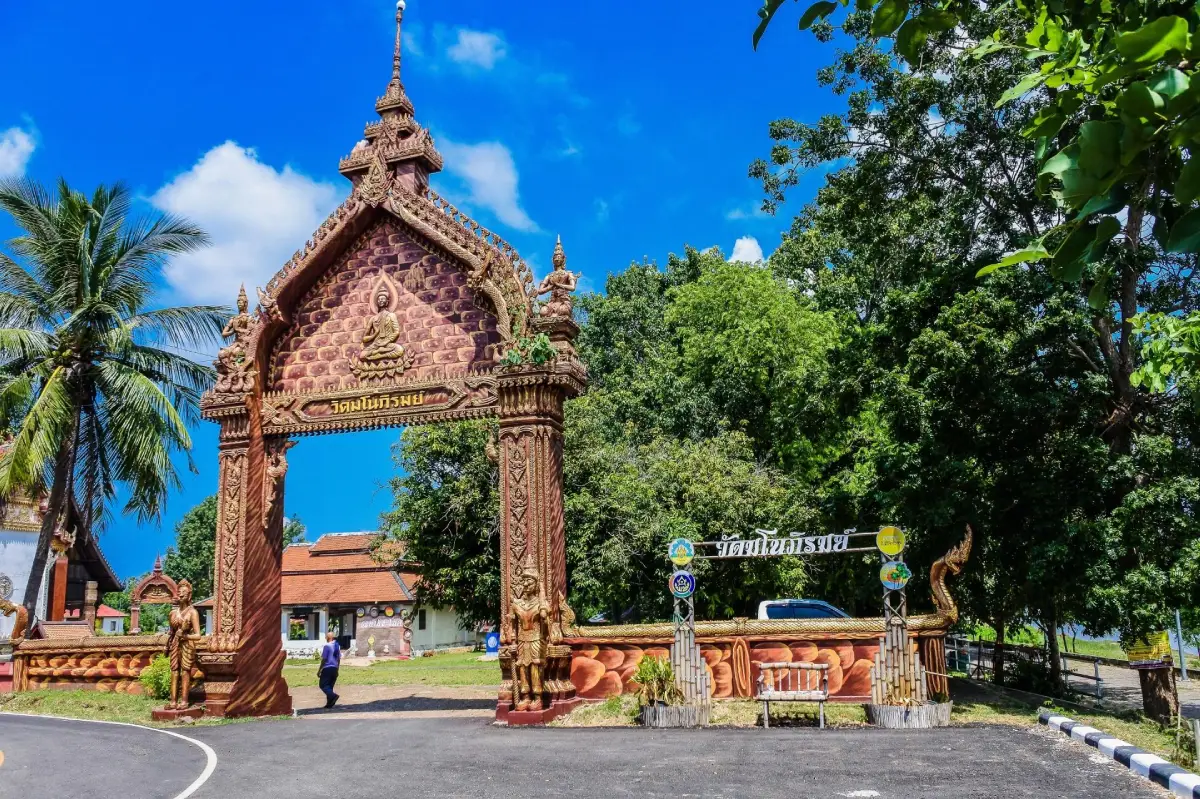
Wat Manophirom
Open Days: Daily
Opening Hours: 08:30–16:30
Wat Manophirom in Mukdahan Province is a historic Buddhist temple standing beside the Mekong River in Ban Chanot, Chanot Subdistrict, Wan Yai District. Located approximately 17 kilometres north of central Mukdahan, the temple is valued for its religious importance, its close relationship with the riverside community, and its exceptionally well-preserved Lan Xang artistic heritage. Its principal attraction is an ancient brick-and-stucco viharn constructed by craftsmen from Vientiane. The building is distinguished by sculpted entrance guardians, decorative stucco above the doorway, a low-relief carved wooden gable, traditional timber roof elements and details that reveal cultural connections across the Mekong. Sacred objects preserved at the temple include Phra Ong Tue, Phra Ong Saen, a standing Buddha in the Calming the Ocean posture, a naga-sheltered principal Buddha and Phra Nga, an extraordinary group of 8 miniature Buddha images carved into an old elephant tusk. The temple is open daily, admission is free, and the site is particularly suitable for travelers interested in Buddhist art, historic architecture, local history and the cultural landscapes of the Mekong River.
Wat Manophirom’s setting is inseparable from the geography of the Mekong. The temple belongs to Ban Chanot, an old settlement whose history developed around river transport, farming, religious life and contact between communities on both banks. From the temple grounds, visitors can experience an open riverside atmosphere and views toward Laos. These surroundings make it easier to understand that the temple was never an isolated monument. It functioned within a living network through which people, building materials, beliefs, artistic knowledge and commercial goods moved for centuries.
The temple was originally associated with the name of Ban Chanot and a nearby watercourse. It was later known as Wat Manophirom, a name conveying a sense of delight, contentment and inner tranquillity. The meaning suits a temple where the calm atmosphere of a rural Buddhist community meets the broad landscape of the Mekong. Although roads, vehicles and modern facilities have changed the surrounding area, the temple continues to retain the character of a traditional community sanctuary rather than that of a commercial attraction.
Historical records used by Thailand’s Fine Arts Department trace the establishment of the temple to 1687, corresponding to B.E. 2230 and the late Ayutthaya period. Thao Kham Sing, members of his extended family and other followers migrated from the Lao side of the Mekong and founded the settlement of Ban Chanot. Establishing a temple was an essential part of creating the new community. The temple provided a place for religious ceremonies, education, community meetings, merit-making and the transmission of shared values. The year 1687 therefore represents more than the date of an individual building; it marks the beginning of a religious institution that grew together with Ban Chanot.
The connection between Ban Chanot and Vientiane became especially visible in 1753, or B.E. 2296, when construction of the important viharn began. Fine Arts Department records name Ajarn Chot, Ajarn Kha and Ajarn Mok as craftsmen from Vientiane. Community accounts also describe materials and skilled builders being sent from Vientiane and transported downstream by raft. Construction continued for approximately 3 years, bringing the viharn to completion around 1756. The account demonstrates how the Mekong functioned as a cultural route rather than simply a political boundary. Craftsmen, timber, religious ideas and construction knowledge could move along the river and become embedded in the architecture of a community on the opposite bank.
The Vientiane craftsmen created a building that became the religious and artistic heart of Wat Manophirom. Its form belongs broadly to the Lan Xang tradition, yet it was adjusted to local materials, climate and craftsmanship. The building is not a rigid copy of a Vientiane monument. Instead, it combines principles associated with the Lan Xang cultural centre with decorative preferences developed in the Mekong borderlands. Certain details also show Vietnamese artistic influence, reflecting the movements of craftsmen and visual traditions through mainland Southeast Asia. The result is a structure that records cultural exchange in physical form.
A devastating fire struck Ban Chanot and the temple in 1904. Monastic buildings, religious objects, residences and community property suffered extensive damage. Because the temple served as the social and spiritual centre of the village, its destruction affected much more than the physical structures. Approximately 1 year later, the community invited Phra Upatcha Bu Nantawaro to lead the restoration. The work continued for about 6 years and was completed around 1911. The restored temple therefore contains more than one historical layer: elements of the 18th-century foundation coexist with repairs and artistic work completed in the early 20th century.
The rebuilding after the fire illustrates the resilience of Ban Chanot. Villagers contributed labour, materials and resources, while monks and local craftsmen coordinated the work. Phra Upatcha Bu Nantawaro acted not only as a religious leader but also as an important figure in the recovery of the temple. The restoration could not reproduce every lost object exactly, but it allowed the temple to resume its central place in the life of the community. Differences in the age, material and style of surviving elements are therefore part of the temple’s authentic history rather than imperfections that should be ignored.
The Fine Arts Department officially registered Wat Manophirom’s historic viharn as an ancient monument on 14 September 1982. The protected area covers approximately 1 rai and 34 square wah. Registration confirmed the national significance of the structure and placed major conservation work under professional supervision. Between 2000 and 2001, the Fine Arts Department restored the viharn and the temple’s sermon hall. The site remains an active Buddhist temple, meaning that conservation must balance the protection of historic fabric with the continuing needs of monks and the local community.
The ancient viharn has a rectangular plan and is constructed from brick covered with stucco. It measures approximately 9.45 metres by 16.35 metres and rises to a height of about 9.63 metres. The building faces east, following a widespread orientation used in Buddhist architecture. A projecting front porch establishes a clear transition from the outer courtyard to the sacred interior. Visitors ascend the stairs, pass through the porch and enter the main devotional space, creating a gradual movement from an everyday environment toward the principal Buddha image.
The building stands on a low lotus-form base that elevates it above ground level without making the structure appear excessively tall. The interior and exterior are organised into 5 structural bays, producing a stable and balanced rhythm. Three stairways provide access at the front, a practical arrangement during ceremonies attended by large numbers of people. Sculpted animals decorate the balustrades. These figures serve as symbolic guardians marking the approach to a sacred space rather than functioning merely as ornaments.
The stucco guardians combine features associated with lions, naga serpents and other imaginary creatures. Smaller animal figures appear along parts of the base. Such hybrid beings are characteristic of artistic traditions in the Mekong region, where craftsmen created powerful guardians that did not have to correspond to any single natural animal. Visitors should observe these details without touching, leaning on or climbing them. Old stucco is vulnerable to impact, moisture, repeated handling and gradual surface erosion.
The wooden entrance doors are relatively restrained in proportion, but the doorway is emphasised by elaborate stucco above it. The composition resembles a multi-tiered palace or sacred pavilion, evoking the idea of a celestial residence. Four-petalled flowers, diamond patterns and repeated geometric designs animate the wall surface. Weathering and changes in colour reveal the age of the building, allowing visitors to see the historic surface rather than a completely renewed decorative scheme.
Decorative stucco also appears around column capitals and at transitions between the walls, columns and roof structure. These locations received particular attention because the eye naturally follows structural junctions. Ornament transforms practical building components into a visual sequence and helps define the hierarchy of the façade. Although some portions have been repaired or weathered, the overall decorative logic associated with Lan Xang craftsmanship remains clearly visible.
The front gable contains low-relief carving executed in wood and is among the most valuable artistic features of the viharn. The craftsmen organised the carving within the triangular gable space and produced depth without removing so much material that the timber lost its strength. When morning or late-afternoon light crosses the surface at an angle, shadows reveal the levels of the carving more clearly. The work combines Buddhist symbolism with local ornamental vocabulary and demonstrates the technical skill of historic woodworkers.
The timber-framed gabled roof is covered with terracotta tiles. A small stupa-like element rises from the central ridge, while curved and pointed finials mark the ends of the roof. Carved wooden brackets resembling elephant ears support the projecting eaves. These components distribute structural weight, protect the walls from rain and direct sunlight, and give the roof a distinctive silhouette when viewed from the courtyard. They also show how practical construction and symbolic decoration were integrated into a single architectural system.
Side walls incorporate openings and timber latticework that admit light and air. Thick masonry walls would otherwise make the interior dark and hot. Filtered daylight creates a quiet atmosphere while drawing attention toward the sacred images. Ventilation reduces heat and humidity within the hall. These features demonstrate that the builders considered climate, comfort and religious atmosphere as carefully as exterior appearance.
Architecturally, the viharn is associated with the Vientiane branch of Lan Xang art, but local workmanship and Vietnamese influence are also present. The mixture can be seen in the treatment of entrance forms, stucco designs and certain guardian figures. This combination should not be interpreted as a lack of stylistic purity. It is evidence of the real cultural conditions of the Mekong region, where artisans, communities and visual ideas crossed linguistic and political boundaries. The building’s significance lies precisely in its ability to preserve that history of interaction.
Inside the viharn, the principal image is a stucco Buddha sheltered by a naga hood and displaying the Mara-vijaya, or Earth-touching, gesture. The image combines the protection offered by the naga with the moment in which the Buddha calls the earth to witness his victory over Mara. It forms the spiritual and visual centre of the building. Visitors should observe how the image, pedestal, structural bays and roof space work together to focus attention toward the principal shrine.
Phra Ong Tue is another highly respected Buddha image at Wat Manophirom. The name Ong Tue is used in Lao and northeastern Thai Buddhist culture for large or exceptionally revered images. Its presence reflects the continuation of devotional traditions linked with Vientiane and the wider Lan Xang world. Local residents worship the image for blessings connected with family, safety, travel and personal well-being, particularly during Buddhist holy days and community ceremonies.
Phra Ong Saen is regarded as a protective Buddha image of Ban Chanot and is deeply respected by the community. Provincial tourism information describes it as a bronze image related to the Chiang Saen artistic tradition. The word saen conveys immense value and the strength of collective faith. The image is important not only as a historic work of art but also as a living focus of worship linking current residents with earlier generations.
A standing Buddha in the Calming the Ocean posture adds another dimension to the temple’s collection of sacred art. The Buddha is shown standing with the hands raised in a restraining gesture, symbolising the calming of danger, conflict and disorder. The coexistence of several Buddha postures allows visitors to learn how physical gestures communicate episodes from Buddhist tradition and different spiritual meanings.
Phra Nga is one of the temple’s most distinctive sacred objects. It consists of 8 miniature Buddha images carved along an old elephant tusk. The work required exceptional control because the carver had to adapt each image to the natural curvature and narrowing form of the tusk. Community history associates its creation with Phra Upatcha Bu Nantawaro during the restoration following the 1904 fire. Phra Nga is consequently both a devotional object and a memorial to the community’s recovery after disaster.
Carving 8 Buddha images into a single tusk creates a form unlike that of ordinary freestanding statues. The maker preserved the recognisable shape of the tusk while organising the small images in a coherent sequence. Its value comes from several interconnected qualities: the unusual material, refined craftsmanship, age, religious significance and long relationship with Ban Chanot. For residents, it is not simply a rare artefact but part of their inherited spiritual identity.
On 15 February 2011, Phra Nga was stolen from Wat Manophirom. The theft caused profound distress because the object had remained with the community for generations. The search continued for 13 years. Authorities recovered the carving on 15 February 2024, exactly 13 years after the theft. Its return represented more than the recovery of valuable property. It restored a shared memory, a focus of faith and a symbol closely associated with the identity of Ban Chanot.
After the recovery, government agencies, the monastic community and local residents worked together to prepare for the object’s return and secure enshrinement at the temple. Because Phra Nga has a history of theft, controlled access and appropriate security remain essential. Visitors may pay respect and view the carving in accordance with temple regulations. They should not touch it, use flash photography at close range, enter restricted areas or attempt to move any protective covering.
The return of Phra Nga renewed public interest in the temple’s wider history. The founding of Ban Chanot, the arrival of Vientiane craftsmen, the fire, the 6-year restoration and the recovery of the stolen carving form a connected narrative of creation, loss and renewal. Wat Manophirom can therefore function as an educational site for local history, archaeology, conservation, religious studies and traditional craftsmanship.
The current abbot is Phra Athikan Banharn Narissaro, who oversees the monastic community, religious buildings, sacred objects and activities connecting the temple with Ban Chanot. Wat Manophirom continues to host merit-making, Buddhist holy-day observances, community ceremonies and religious education. Its responsibilities extend beyond tourism, and the preservation of the ancient monument must be coordinated with the living requirements of an active temple.
Visitors should remember that Wat Manophirom is not a museum separated from everyday life. Monks may be carrying out their duties, residents may be offering food, elderly worshippers may be chanting, and families may be conducting private ceremonies. Speaking quietly, allowing space for religious activities and following instructions from the temple demonstrate respect for the people whose cultural heritage visitors have come to experience.
The Mekong setting gives Wat Manophirom a character distinct from that of many inland temples. Morning light over the river is soft and the temperature is generally more comfortable. In the later afternoon, reflected light from the water changes the appearance of the temple courtyard and roofline. River breezes can reduce the heat, but open areas remain exposed to strong sunlight. Water, a hat and sun protection are useful, especially from March to May.
Hat Manophirom, also called Chanot Beach, lies close to the temple. It is a seasonal sandbank that becomes clearly visible when the Mekong level falls, generally from late November through April. During the rainy season, higher water naturally covers much of the sand. The dry season offers access to the sandy riverside landscape, while the rainy season provides a wider, fuller river and greener surroundings. Both seasons reveal different aspects of the Mekong environment.
Although the beach is close to the temple, visitors should distinguish between recreational and religious spaces. Before entering the temple, shoulders should be covered and trousers or skirts should be of a respectful length. Wet clothing and swimwear are not appropriate within the monastic compound. This simple separation allows riverside recreation and cultural visitation to coexist without disturbing the community.
The most comfortable periods for visiting are approximately 08:30–10:30 and 14:30–16:00. Morning light is particularly useful for examining the front façade and carved gable, while afternoon light defines the roof and riverside setting. Travelers interested in architecture should allow at least 1–2 hours to walk around the viharn, observe the stucco and woodwork, pay respect to the Buddha images and spend time beside the Mekong.
Exterior photography is generally possible when visitors maintain a safe distance from the historic structure. Bags, tripods and other equipment should not be leaned against old walls, and nobody should climb decorated stairs or architectural bases for a photograph. Inside, mobile phones should be silenced and flash should be avoided. Permission should be requested before photographing monks, worshippers or ceremonies.
Shoes must be removed before entering sacred halls. Visitors should not point their feet toward a Buddha image or sit in a position that obstructs worshippers. Food should not be consumed inside the viharn, and pets should remain outside sacred buildings. Donations can be placed in official donation boxes or given in accordance with the temple’s instructions.
Much of the courtyard and the exterior viewing area is accessible to older visitors, but the historic viharn has traditional steps and changes in floor level. Wheelchair users can view the architecture from outside more easily than they can enter certain interior areas. Families traveling with older relatives should provide assistance at the stairs and avoid walking across exposed paving during the hottest part of the day.
Getting There from central Mukdahan is most convenient by private car or rental vehicle. Follow Highway 212 north toward Wan Yai District and Nakhon Phanom, then take the local road into Ban Chanot. The journey covers approximately 17 kilometres and normally requires around 25–30 minutes, depending on traffic. A private vehicle also makes it practical to combine the temple with Hat Manophirom, Wat Song Khon and Kaeng Kabao.
Travelers approaching from That Phanom or Nakhon Phanom can follow Highway 212 south to Wan Yai District before turning toward Ban Chanot. This route can connect Phra That Phanom, Kaeng Kabao, Wat Song Khon and Wat Manophirom in a single cultural journey. Drivers should slow down after entering village roads because motorcycles, farm vehicles and pedestrians share the local route.
Public transportation directly into Ban Chanot is limited. Travelers without a vehicle should arrange a hired car, local driver or round-trip taxi from Mukdahan in advance. Agreeing on the return time is important, particularly on weekdays and in the late afternoon. The destination should be specified as Wat Manophirom, Ban Chanot, Wan Yai District, Mukdahan Province to avoid confusion with places of similar names.
A half-day itinerary can begin at Wat Manophirom in the morning, allowing 1–2 hours for the viharn, sacred images and riverfront. The journey can continue to the Nuhak Phoumsavan Birthplace Museum and then to Wat Song Khon and the Our Lady of the Martyrs of Thailand Shrine. This route introduces visitors to Buddhist heritage, Thai-Lao historical connections and the important Christian history of the Mukdahan borderlands.
For a full-day route, travelers can have lunch around Kaeng Kabao, where local restaurants specialise in roasted pork and northeastern Thai dishes. The afternoon can include the Phaya Si Phuchong Mukda Nakarat sculpture and views over the Mekong before returning to Mukdahan city. Organising the trip from north to south reduces unnecessary backtracking.
Restaurants in Wan Yai and Kaeng Kabao serve northeastern Thai food, Thai dishes, coffee and local specialities. Options include 62 Garden Cafe, Khrour Wan Yai Cafe, Ben Ben Coffee and the roasted-pork restaurants around Kaeng Kabao. Eating locally supports community businesses, but visitors should plan meals before the late afternoon because rural restaurants may close earlier than establishments in central Mukdahan.
Accommodation immediately beside Wat Manophirom is limited. Small rural properties around Ban Chanot and Wan Yai suit travelers seeking a quiet local atmosphere. Those requiring a wider range of facilities can stay in Mukdahan city, approximately 19–22 kilometres away. Riverside hotels in the city also provide convenient access to the Indochina Market, Mukdahan Tower and the Second Thai-Lao Friendship Bridge.
Conserving Wat Manophirom requires cooperation among the temple, community, government agencies and visitors. The building is exposed to river humidity, seasonal rain, sunlight and temperature changes. Timber, stucco and terracotta respond differently to these conditions. Repairs therefore require specialists and materials compatible with the historic structure. Unstudied repainting, replastering or replacement of components can erase important evidence.
Visitors can support conservation by avoiding contact with carvings and stucco, never writing on the building, and not attaching objects to historic fabric. Small actions repeated by many people can gradually wear away surfaces. Following temple rules, contributing through official donation channels and sharing accurate information are more constructive ways to support the site.
Wat Manophirom’s value extends far beyond the age of its architecture. It demonstrates that communities on both banks of the Mekong share cultural foundations. Vientiane craftsmen could travel to build a sacred hall in a settlement now located in Thailand, while language, ritual and Buddha-image traditions continued to reflect the wider Lan Xang cultural world. The viharn can be read as a historical document constructed from brick, stucco, timber and collective faith.
For art historians, Wat Manophirom expands understanding of Lan Xang architecture outside Vientiane. The base, stairs, doorway, gable and roof show how artisans transferred ideas from a cultural centre and adapted them to local conditions. Comparison with historic temples in Mukdahan, Nakhon Phanom and Sakon Nakhon reveals networks of craftsmanship distributed along rivers and settlement routes.
For community history, the 1904 fire and the completion of restoration in 1911 demonstrate resilience. More than a century later, the theft of Phra Nga in 2011 and its recovery in 2024 revealed the same enduring relationship between residents and their heritage. Both episodes show that the temple’s survival depends not only on architecture but also on people who continue to care for it.
Wat Manophirom rewards many types of travelers. Architecture enthusiasts can study a distinctive Lan Xang viharn. Buddhist visitors can pay respect to Phra Ong Tue, Phra Ong Saen, the principal image and Phra Nga. History enthusiasts can learn about migration, community formation and connections with Vientiane. Travelers seeking a peaceful landscape can experience the Mekong and the seasonal Hat Manophirom sandbank.
What makes the temple memorable is the continuity of life within it. Residents continue to make merit, ceremonies continue to take place, Buddha images remain active focuses of worship, and historical knowledge is passed to younger generations. Wat Manophirom is not frozen in the years of its construction or official registration. It survives through continuing use, care and respect.
Visitors should allow enough time to examine rather than simply photograph the site. Walking slowly around the viharn reveals changes in ornament from one side to another. Sitting quietly inside clarifies the proportions and spiritual atmosphere of the hall. Walking toward the river connects the architectural story with the historic route once used by craftsmen, materials and migrating families.
Wat Manophirom brings together history, sacred art, community faith and the natural landscape of the Mekong. Its foundation in 1687, construction by Vientiane craftsmen beginning in 1753, the destructive fire of 1904, the completion of restoration in 1911, official ancient-monument registration in 1982 and the return of Phra Nga in 2024 have each added a new layer of meaning. Travelers who engage carefully with the site will discover more than an old riverside temple. They will encounter a living cultural inheritance through which the Mekong community continues to preserve its historical roots.
| Name | Wat Manophirom |
| Location | Ban Chanot, Chanot Subdistrict, Wan Yai District, Mukdahan Province, Thailand |
| Address | Moo 1, Ban Chanot, Chanot Subdistrict, Wan Yai District, Mukdahan 49150, Thailand |
| Coordinates | 16.68239, 104.75220 |
| Highlights | Historic Lan Xang viharn built by Vientiane craftsmen, decorative stucco, a low-relief carved wooden gable, Phra Ong Tue, Phra Ong Saen and Phra Nga with 8 Buddha images carved into an elephant tusk |
| Foundation | Established with Ban Chanot in 1687 by Thao Kham Sing, his relatives and followers who migrated from the Lao side of the Mekong |
| Viharn Construction | Construction began in 1753 under Ajarn Chot, Ajarn Kha and Ajarn Mok, craftsmen from Vientiane, and continued for approximately 3 years |
| Major Historical Event | A major fire damaged the temple in 1904. Restoration led by Phra Upatcha Bu Nantawaro was completed around 1911 |
| Ancient Monument Status | The viharn was registered as an ancient monument on 14 September 1982 and restored by the Fine Arts Department in 2000–2001 |
| Architectural Style | Rectangular brick-and-stucco Lan Xang structure facing east, with a low lotus base, projecting porch, 3 stairways, stucco guardians, carved wooden gable and timber roof covered with terracotta tiles |
| Viharn Dimensions | Approximately 9.45 metres wide, 16.35 metres long and 9.63 metres high |
| Important Buddha Images | Naga-sheltered principal Buddha in the Mara-vijaya gesture, Phra Ong Tue, Phra Ong Saen, a standing Buddha in the Calming the Ocean posture and Phra Nga |
| Phra Nga | A group of 8 miniature Buddha images carved into an old elephant tusk, stolen on 15 February 2011 and recovered on 15 February 2024 |
| Name Origin | The temple was originally associated with the name of Ban Chanot and a nearby stream. Manophirom conveys delight, contentment and tranquillity |
| Main Areas / Zones | 1. Historic viharn and protected ancient-monument area 2. Sacred-image and Phra Nga enshrinement area 3. Ordination and religious-ceremony area 4. Sermon hall and monastic compound 5. Temple courtyard and Mekong viewpoint 6. Nearby Hat Manophirom or Chanot Beach |
| Abbot | Phra Athikan Banharn Narissaro |
| Current Status | Active Buddhist temple and community religious centre, open to worshippers and visitors |
| Open Days | Daily |
| Opening Hours | 08:30–16:30 |
| Fees | Free admission; voluntary donations for temple maintenance are welcome |
| Facilities | Parking area, rest area, toilets, merit-making area and Mekong River viewpoint |
| Travel Information | From central Mukdahan, follow Highway 212 north toward Wan Yai District and turn into Ban Chanot. The distance is approximately 17 kilometres and the drive takes about 25–30 minutes |
| Recommended Visiting Time | 08:30–10:30 or 14:30–16:00. Late November through April is suitable for seeing the seasonal Hat Manophirom sandbank |
| Visitor Etiquette | Dress respectfully, remove shoes before entering sacred buildings, do not touch stucco, woodcarving or Buddha images, avoid flash photography near sacred objects and follow temple instructions |
| Nearby Tourist Attractions | 1. Hat Manophirom or Chanot Beach, 0.5 km 2. Nuhak Phoumsavan Birthplace Museum, 1.5 km 3. Wat Latthikawan, 3 km 4. Wat Phra Si Maha Pho, 5 km 5. Our Lady of the Martyrs of Thailand Shrine at Wat Song Khon, 7 km 6. Kaeng Kabao and Phaya Si Phuchong Mukda Nakarat, 9 km |
| Nearby Restaurants | 1. 62 Garden Cafe, 8 km, Tel. 099-795-1962 2. Sirichai Moo Han at Kaeng Kabao, 9 km, Tel. 081-260-7358, 042-643-552 3. Chitra Moo Han at Kaeng Kabao, 9 km, Tel. 085-010-4756 4. Khrour Wan Yai Cafe, 10 km, Tel. 094-291-5979, 093-514-9569, 095-415-7822 5. Ben Ben Coffee, 11 km, Tel. 088-357-2123, 095-659-9076 |
| Nearby Accommodations | 1. Baan Kieng Sawan, 1 km 2. Hotel de Ladda, 19 km, Tel. 042-611-499, 042-611-497 3. Riverfront Hotel Mukdahan, 20 km, Tel. 042-612-948-9, 081-703-1705 4. Ploy Palace Hotel, 20 km, Tel. 042-614-988 5. Mukdahan Grand Hotel, 21 km, Tel. 042-612-020 6. Bird Day Boutique Hotel, 22 km, Tel. 093-469-5588, 042-615-007 |
Frequently Asked Questions (FAQ)
Q: Where is Wat Manophirom located?
A: Wat Manophirom is in Moo 1, Ban Chanot, Chanot Subdistrict, Wan Yai District, Mukdahan Province, beside the Mekong River and approximately 17 kilometres from central Mukdahan.
Q: What are Wat Manophirom’s opening hours and admission fee?
A: The temple is open daily from 08:30 to 16:30. Admission is free, and visitors may make a voluntary donation toward temple maintenance.
Q: What are the main highlights of Wat Manophirom?
A: The main highlights are the historic Lan Xang viharn built by Vientiane craftsmen, decorative stucco, a carved wooden gable, Phra Ong Tue, Phra Ong Saen and Phra Nga, which has 8 miniature Buddha images carved into an elephant tusk.
Q: What is the history of Phra Nga?
A: Phra Nga is an old elephant-tusk carving containing 8 Buddha images. It was stolen on 15 February 2011 and recovered on 15 February 2024 after being missing for 13 years.
Q: Can visitors see and photograph Phra Nga?
A: Visitors may pay respect to Phra Nga within the area and schedule established by the temple. Photography must follow the caretaker’s instructions, flash should not be used, and the carving must never be touched.
Q: What should visitors wear at Wat Manophirom?
A: Shoulders should be covered, trousers or skirts should be of a respectful length, and shoes must be removed before entering sacred buildings. Swimwear or wet beach clothing is not suitable inside the temple compound.
Q: When is the best time to visit Wat Manophirom and Hat Manophirom?
A: The most comfortable temple-visiting periods are 08:30–10:30 and 14:30–16:00. From late November through April, the lower Mekong water level usually reveals the seasonal sandbank at Hat Manophirom.
Q: Which attractions can be combined with Wat Manophirom in one day?
A: A one-day route can include the Nuhak Phoumsavan Birthplace Museum, Wat Song Khon, the Our Lady of the Martyrs of Thailand Shrine, Kaeng Kabao and the Phaya Si Phuchong Mukda Nakarat sculpture.
 Category: ●Places of Worship
 Group: ●Temple
Last Update : 2 MonthAgo
 Last Update : 2 MonthAgo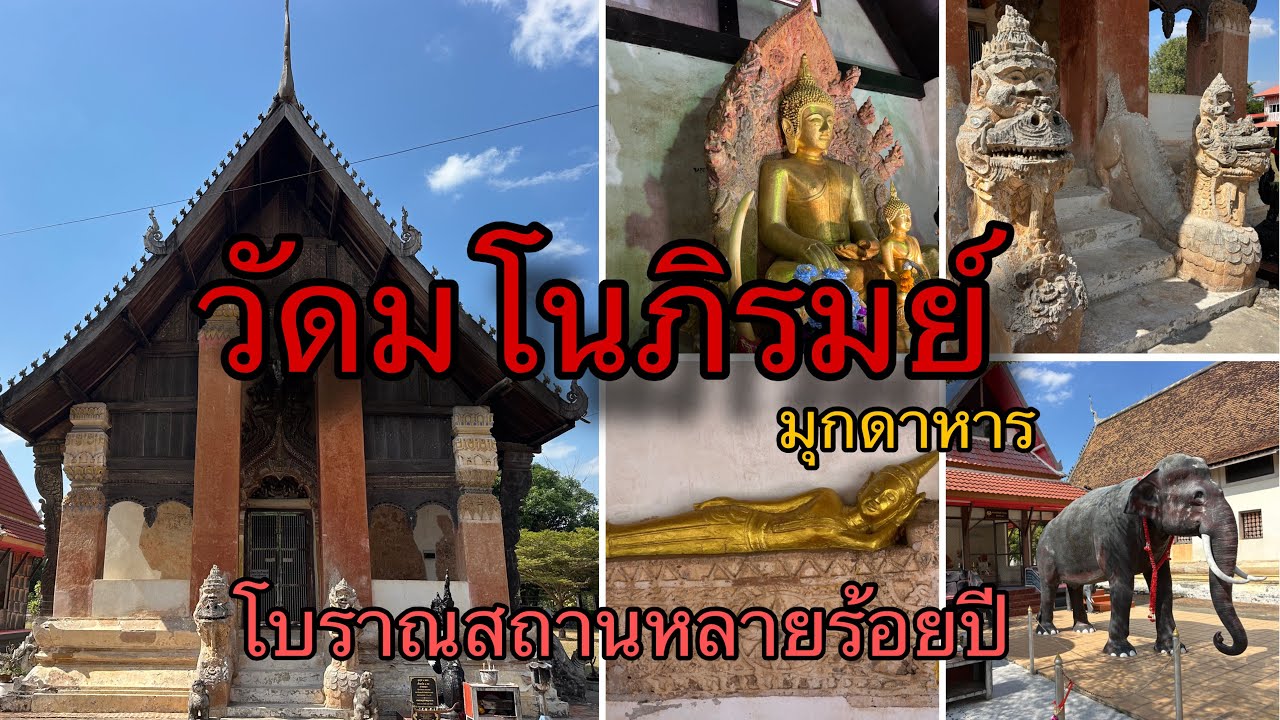
 Click to Access the Navigation Map GPS
Wat Manophirom Map
Recommend

 Art, Culture and Heritage
 Historical Sites and Monuments(2)
 Landmarks and Memorials(3)
 Art, Craft Centres, Tradition(2)
 Museums(1)
Temple(17)
Museums(1)
Temple(17)
 Other Sacred Sites(3)
 Suburban Living
 Village, Community(4)
 Local Market(2)
 Nature and Wildlife
 National Parks and Marine Reserves(4)
 Mountain (Doi)(5)
 Dam, Reservoir, Lake(3)
 Waterfalls(5)
 Caves(2)
 River, Canal(2)
 Bays and Beaches(1)
 Other natural attractions(1)
 Entertainment and Agricultural
 Farms, Parks and Ecotourism(1)


