
lovethailand home >Northeastern Travel Attractions >Mukdahan Travel Attractions >Nikhom Kham Soi >Chok Chai > Wat Phuttho Thammatharo
TL;DR: Wat Phuttho Thammatharo is located at 133 Moo 1, Ban Chai Mongkhon, Chok Chai Subdistrict, Nikhom Kham Soi District, Mukdahan Province, Thailand, open Daily, hours 06.00 – 20.00.
Wat Phuttho Thammatharo
Open Days: Daily
Opening Hours: 06.00 – 20.00
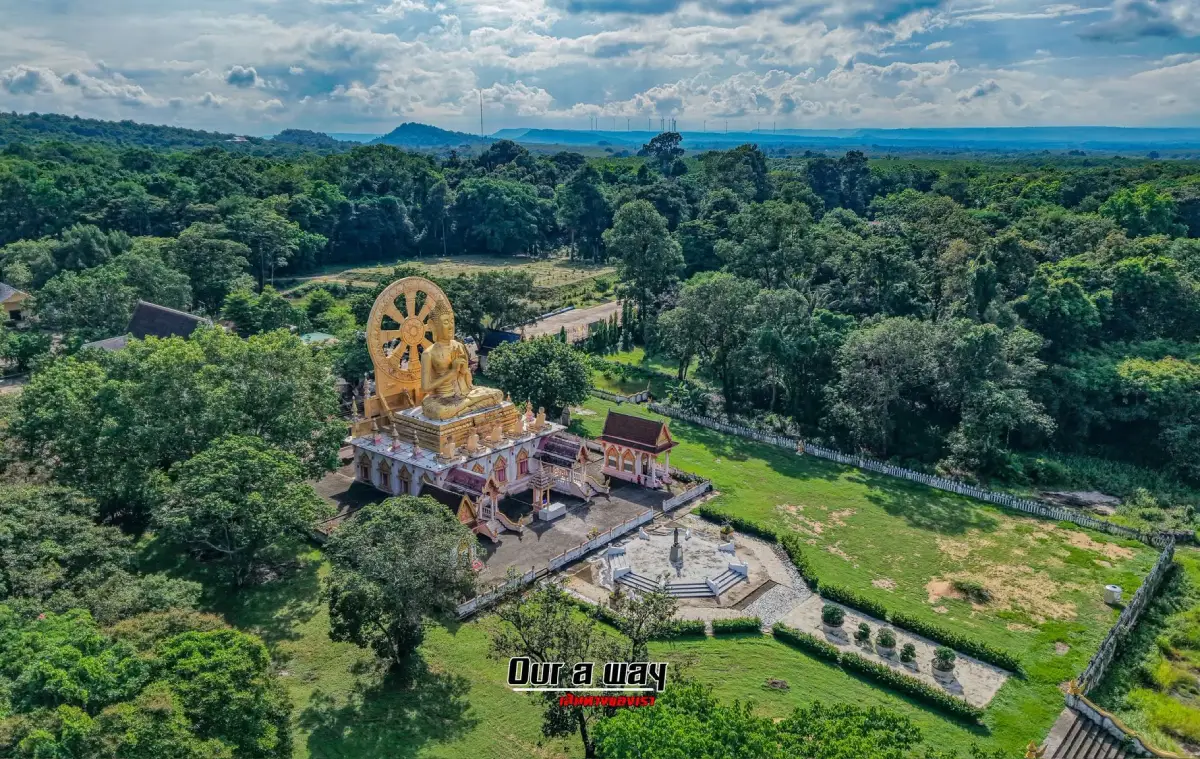
Wat Phuttho Thammatharo, commonly known as Wat Phu Dan Tae, is one of the most distinctive Buddhist temples in Nikhom Kham Soi District, Mukdahan Province. Its principal landmark is Luang Pho Thammachak, a monumental brick-and-stucco Buddha image representing the First Sermon. The image rises above the roof of the ordination hall, with an enormous radiant Dhamma Wheel behind it and statues of the Five Ascetics seated in front. Together, these elements create a large visual narrative of the Buddha teaching the Four Noble Truths for the first time. The temple stands at 133 Moo 1, Ban Chai Mongkhon, Chok Chai Subdistrict, beside Highway 212 near kilometer marker 134 and approximately 4 kilometers from the center of Nikhom Kham Soi. Its natural rock plateau, small hill, quiet atmosphere, and highly visible Buddha image make it an important place for worship, Buddhist learning, contemplation, and cultural travel.
The official Thai name used by the Mukdahan Provincial Office of Buddhism is Wat Phuttho Thammatharo. The temple also appears under several alternative spellings, including Wat Phutthothammatharo, Wat Phuttho Thammatharo, Wat Phu Dan Tae, and Wat Phu Dan Tae. These variations refer to the same monastery in Ban Chai Mongkhon. Travelers using online navigation should confirm that the result is in Chok Chai Subdistrict, Nikhom Kham Soi District, Mukdahan, and look for the monumental Buddha with the large wheel-shaped halo.
The temple lies close to Highway 212, also known as Chayangkun Road, a major route linking Mukdahan with Nikhom Kham Soi, Amnat Charoen, and other parts of northeastern Thailand. Travelers heading south from Mukdahan can identify the entrance near kilometer marker 134. The main Buddha image stands approximately 500 meters from the highway, but its height and the enormous Dhamma Wheel make it clearly visible above the trees while approaching the area.
The distant view is one of the temple’s defining experiences. From the highway, the pale Buddha figure and circular wheel appear together above the wooded slope. As visitors move closer, individual details become visible: the Buddha’s face, hands, robes, the structure beneath the image, and the Five Ascetics facing the central figure. The composition was created not simply to be monumental but to communicate a specific event in Buddhist history.
The landscape differs from that of many lowland Thai temples. Natural exposed rock forms much of the ground around the hill and courtyard. Variations in color, mineral texture, cracks, and elevation preserve the character of the original terrain. These rock surfaces contribute to the restrained atmosphere associated with a meditation monastery, although visitors must walk carefully because the stone can become slippery during rain.
Wat Phu Dan Tae is an active monastery rather than a monument maintained only for tourism. Resident monks conduct daily chanting, meditation, religious ceremonies, Buddhist holy-day activities, kathina offerings, monastic training, and community programs. Government and Sangha organizations also use the temple for important provincial and district events.
The current abbot is Phra Khru Khosit Thammasunthon, who formally received his appointment on July 9, 2022. His responsibilities include supervising monks and novices, maintaining monastic discipline, managing the buildings and grounds, organizing ceremonies, and coordinating with the local community, government agencies, and the provincial Sangha.
The continuing importance of the monastery was demonstrated in July 2025, when Mukdahan Province and the provincial Sangha organized a royal commemorative Buddhist chanting ceremony in the temple’s sermon hall. Senior monks, provincial authorities, district officials, community representatives, and lay Buddhists attended the event, confirming the temple’s active role in the religious life of Nikhom Kham Soi.
In 2024, the temple became the location of a Chiwaphiban monastic-care residence and the Nikhom Kham Soi District Monk Health Care Center. It also hosted training for Buddhist monks serving as temple health volunteers. The facility supports sick, elderly, or recovering monks and provides health education for the Sangha. It is not a tourist clinic or a general medical facility for members of the public.
The history of Luang Pho Thammachak is closely connected with Phra Ajarn Lee Dhammadharo, widely known as Than Pho Lee, an influential meditation master of the Thai Dhammayut tradition and former abbot of Wat Asokaram in Samut Prakan Province. Than Pho Lee designed a monumental Buddha image that he originally intended to build facing the Gulf of Thailand.
His concept was to create a visible spiritual refuge for sailors, travelers, fishermen, and communities living along the coast. The Buddha was intended to rise above the surrounding landscape so that people could see it from far away and remember the Buddha, Dhamma, and Sangha while facing the uncertainty of travel and life at sea.
Than Pho Lee passed away before the project was completed at Wat Asokaram. The design and intention were later continued by Phra Thep Sutthimoli, also known as Luang Pu Somphong Khantiko, a disciple of Than Pho Lee and a former abbot of Wat Phuttho Thammatharo. He brought the concept to Wat Phu Dan Tae and constructed the image in accordance with his teacher’s original design.
This continuation reflects the relationship between teacher and disciple within the Thai forest meditation tradition. A disciple preserves more than spoken teachings; he may also maintain the teacher’s practices, fulfill unfinished beneficial work, and transmit the teacher’s spiritual intention to a new generation. Luang Pho Thammachak therefore represents both the Buddha and the continuity of a meditation lineage.
The monumental image was built from brick and stucco and placed above the roof of the ordination hall. Raising the Buddha to this height allows the figure to rise above nearby trees and buildings. It also creates a powerful silhouette with the Dhamma Wheel against the sky, making the temple easy to identify from Highway 212.
Luang Pho Thammachak faces east. The direction brings morning light onto the front of the image, revealing the facial expression, hand gestures, and lines of the robe. Early morning is therefore one of the best times to worship and photograph the composition, particularly on clear days when the sunlight is soft.
The Buddha image is classified as an example of applied Rattanakosin art. Traditional forms associated with Buddha images of the Rattanakosin period were adjusted to suit the enormous scale, outdoor setting, structural requirements, and symbolic program. The resulting image appears graceful from a distance while retaining the visual strength required for an exposed hilltop monument.
Official temple information identifies Luang Pho Thammachak as a Buddha image in the posture of the First Sermon. This refers to the Dhammacakkappavattana Sutta, delivered to the Five Ascetics at the Deer Park of Isipatana near Varanasi after the Buddha’s enlightenment. The sermon is regarded as the first formal proclamation of his teaching and the beginning of the community of enlightened disciples.
The term Dhammacakkappavattana means setting the Wheel of Dhamma in motion. When the Buddha explained the truth he had realized, the teaching began to move from the awakened teacher to other people. The enormous wheel behind Luang Pho Thammachak is therefore not merely a decorative halo. It represents the active transmission of the Dhamma into the world.
The central teaching of the First Sermon is the Four Noble Truths: the truth of suffering, the origin of suffering, the cessation of suffering, and the path leading to its cessation. These principles do not teach pessimism. They begin by identifying the human problem accurately and then provide a practical method for understanding and transforming it.
The First Noble Truth concerns dukkha, a term covering suffering, stress, dissatisfaction, and the instability of conditioned life. Birth, aging, illness, death, separation from what is loved, association with what is disliked, and failure to obtain what is desired are traditional examples. Recognizing dukkha is not surrender; it is the honest diagnosis required before a problem can be treated.
The Second Noble Truth identifies the origin of suffering. Craving, attachment, and ignorance cause the mind to struggle against change and to demand that experience conform permanently to personal desire. Examining this origin encourages practitioners to look within themselves instead of blaming every difficulty entirely on external circumstances.
The Third Noble Truth is the cessation of suffering. When craving and attachment are abandoned, the mind is no longer dominated by greed, anger, and delusion. Peace and freedom become possible. This truth affirms that human beings can train the mind and are not condemned to remain trapped in the same destructive reactions forever.
The Fourth Noble Truth is the path leading to cessation. The Noble Eightfold Path consists of right view, right intention, right speech, right action, right livelihood, right effort, right mindfulness, and right concentration. It integrates wisdom, ethical conduct, and mental discipline, requiring personal practice rather than passive dependence on supernatural intervention.
The hands and fingers of Luang Pho Thammachak were designed as a visual Dhamma puzzle. They are associated with the Four Noble Truths and the 3 aspects of ignorance mentioned in local explanations of the image. Visitors who understand this symbolism can view the hand gesture as an invitation to examine ignorance within themselves rather than seeing it only as an elegant artistic pose.
The Dhamma Wheel behind the Buddha is almost as high as the image itself. From the front, the circle resembles a radiant halo expanding from the Buddha, while a side view reveals it as a separate architectural structure. Its circular form conveys completeness and continuity, while its spokes recall the disciplined path through which understanding is developed.
Using the Dhamma Wheel as the principal backdrop distinguishes the monument from many outdoor Buddha images framed by flame-shaped halos, naga canopies, or ornamental arches. At Wat Phu Dan Tae, the teaching itself forms the visual radiance. The Buddha and the wheel appear as a unified statement: the awakened teacher setting truth in motion.
Five statues sit in front of the monumental Buddha and face toward him. They represent the Pancavaggiya, or Five Ascetics, who listened to the First Sermon. Their placement transforms the upper area of the ordination hall into a visual reconstruction of the historic teaching and allows visitors to understand the subject without relying entirely on written explanation.
The Five Ascetics are Kondanna, Vappa, Bhaddiya, Mahanama, and Assaji. They had previously attended the Bodhisatta during his period of extreme ascetic practice. When he abandoned self-mortification and adopted the Middle Way, they mistakenly believed that he had given up his effort and left him. They later listened to the First Sermon and attained realization in stages.
Kondanna was the first to gain the Dhamma Eye after hearing the Dhammacakkappavattana Sutta. He became the first enlightened disciple and the first member of the Buddhist Sangha in this sense. His realization completed the Triple Gem: the Buddha as teacher, the Dhamma as teaching, and the Sangha as those who had understood and practiced the teaching.
Vappa, Bhaddiya, Mahanama, and Assaji subsequently gained realization through further instruction. Assaji later delivered a concise teaching on dependent causation to Sariputta, who immediately attained the Dhamma Eye. The story demonstrates how understanding received by one person can be communicated and become the condition for another person’s awakening.
The Buddha, wheel, and Five Ascetics together form a monumental narrative. Visitors can read the sequence visually: the disciples receive the teaching, the Buddha occupies the central position, and the wheel represents the Dhamma beginning to move outward. The architecture functions simultaneously as a sacred object, a landmark, and an educational medium.
The axial arrangement creates visual balance. The Buddha occupies the highest and central point, the disciples sit below and face inward, and the circular wheel unifies the composition. A frontal viewpoint emphasizes symmetry, while oblique angles reveal the structural separation, depth, and scale of the individual elements.
Placing the image above the ordination hall also creates 2 sacred levels. The lower building is used for monastic acts and religious ceremonies, while the upper composition communicates Buddhist history to everyone who approaches the temple. Even when the interior is closed during a ceremony or monastic activity, visitors can still worship and study the exterior monument.
The natural rock plateau reinforces the austere quality of the setting. Walking across the exposed stone allows visitors to experience the terrain that existed before the construction of the major buildings. The simplicity is consistent with a meditation monastery, but visitors should remain on established routes because cracks, slopes, vegetation, and wet surfaces can create hazards.
As visitors move away from the highway, traffic noise becomes less prominent and is replaced by wind, birds, and ordinary monastic activity. The quieter environment is suitable for brief meditation. No previous experience is necessary; visitors may sit in an approved area, maintain awareness of breathing, and avoid disturbing monks or other practitioners.
Devotees may offer flowers, incense, candles, or a voluntary donation. A meaningful visit can begin with paying respect to the Triple Gem and reflecting on the Four Noble Truths represented by the monument. Instead of concentrating only on requests for external success, visitors may choose one aspect of the Noble Eightfold Path to apply in daily life.
Prayers at a Buddhist temple are most consistent with the teaching when they concern wisdom, mindfulness, patience, moral courage, and the strength to address problems responsibly. Worship is not a guarantee of wealth or success without effort. The First Sermon emphasizes understanding causes and following an effective path, making the temple particularly meaningful for people reviewing their lives or seeking to abandon harmful habits.
The monastery can be understood through several functional zones: the entrance and parking area, the ordination hall, Luang Pho Thammachak and the Dhamma Wheel, the Five Ascetics, the natural rock courtyard, the sermon hall, the Chiwaphiban monastic-care residence, monks’ living quarters, and surrounding green areas.
The entrance road connects Highway 212 with the main courtyard. Drivers should slow down before turning because traffic on the highway moves quickly. Vehicles must be parked in designated areas without blocking the ordination hall, monks’ access, ceremonial routes, or emergency vehicles. Parking may be busier on Buddhist holy days and during major ceremonies.
The ordination-hall zone is used for formal Sangha acts and important ceremonies. Shoes must be removed before entering, clothing must be modest, and visitors must not cross areas being used by monks. When the interior is closed, worship is still possible from outside, and the monumental Buddha remains fully visible above the roof.
The Luang Pho Thammachak zone is the principal visitor area. It is useful to begin from a distance to understand the full composition before approaching to observe the face, hands, robe, wheel, and disciples. Wide-angle photographs from the courtyard usually capture the design more successfully than standing very close to the base.
The Five Ascetics and the Dhamma Wheel form an outdoor Buddhist-learning area. Parents can explain the First Sermon to children by using the statues as visual references. Learning through a complete scene helps the names Kondanna, Vappa, Bhaddiya, Mahanama, and Assaji become meaningful rather than remaining an abstract list.
The sermon hall is used for chanting, meetings, ceremonies, and community programs. A major provincial chanting event was held there in 2025. Visitors should check whether a ceremony is underway before entering and must not move chairs, monks’ seats, altars, or ceremonial equipment for photography or personal convenience.
The Chiwaphiban residence supports the health care of monks and novices in Nikhom Kham Soi District and provides a venue for training monastic health volunteers. It is not a public tourist clinic. Visitors experiencing illness or an emergency should contact standard medical services rather than arriving at the temple expecting general treatment.
Monks’ residences are private areas. Visitors wishing to meet the abbot, present an offering, or ask about temple activities should first contact a monk or authorized attendant near the public hall. Entering residences, calling loudly outside doors, or photographing living quarters without permission is inappropriate.
The rock courtyard and green areas may be explored respectfully. Stones, plants, religious objects, and natural materials must not be removed as souvenirs. Visitors should use existing paths, avoid climbing high rock formations, and never light fires or discard cigarettes in the surrounding vegetation.
The temple is open daily from 06.00 to 20.00. Early morning is suitable for merit-making, east-facing light on the Buddha, and comfortable walking temperatures. Late afternoon and early evening are convenient for travelers using Highway 212. Visitors should leave uneven rock areas before darkness when visibility becomes limited.
Admission is free. Donations for electricity, water, maintenance, monastic education, or religious activities may be made voluntarily through official temple donation boxes or clearly identified channels. Expensive offerings are unnecessary, and money should not be handed to unidentified individuals claiming to represent the monastery.
Clothing should cover the shoulders and knees and should not be transparent or excessively tight. Shoes must be removed before entering the ordination hall or ceremonial buildings. Visitors should not point their feet toward Buddha images or monks. Women should avoid direct physical contact with monks and use an offering cloth where required.
Photography is generally possible in public areas, but devices should be silenced and drones must not be used without permission. Visitors must not climb statues, bases, roofs, or restricted structures to obtain photographs. Flash should be avoided inside buildings, particularly during chanting or ceremonies, and close photographs of individuals require consent.
Families must supervise children because the natural rock courtyard contains uneven surfaces and changes in level. Children should not run on steps, climb religious statues, or touch painted details. Older visitors should wear shoes with good grip, move slowly, and receive assistance on wet or sloping stone.
Mukdahan’s hot season can be intense, particularly around midday, and exposed rock absorbs heat. Drinking water, a hat, and an umbrella are useful, while morning or late-afternoon visits are more comfortable. During the rainy season the landscape becomes greener, but stone surfaces and steps may become extremely slippery.
November through February generally provides the most pleasant conditions for walking around the temple. Mornings and evenings are cooler, skies are often clearer, and the Buddha and wheel stand out sharply against the background. Photographers may prefer early morning because the image faces east.
Getting There from Mukdahan city is straightforward. Follow Highway 212 toward Nikhom Kham Soi for approximately 15 to 16 kilometers. Near kilometer marker 134, look for the temple sign and the monumental Buddha on the small hill, then turn onto the temple access road for approximately 500 meters. The coordinates are 16.33755, 104.51796.
From the center of Nikhom Kham Soi, follow Highway 212 toward Mukdahan for approximately 4 kilometers. The temple is in Ban Chai Mongkhon, Chok Chai Subdistrict. Drivers should signal and reduce speed well before the turn because this is a main highway. Anyone missing the entrance should continue to a safe turning point rather than stopping or reversing in a traffic lane.
Travelers without a private vehicle may use a bus or van operating between Mukdahan and Nikhom Kham Soi and request to leave near Ban Chai Mongkhon or the temple entrance. Local transport may then be needed for the final 500 meters. Return transportation and operating times should be arranged in advance because vehicles do not wait continuously at the temple.
The temple is best treated as more than a brief roadside photo stop. Allow approximately 45 to 90 minutes to worship, view the Dhamma Wheel, study the Five Ascetics, walk across the natural rock, and rest quietly. Visitors interested in meditation or Buddhist history may remain for 2 hours without exhausting the site.
Phu Mu Forest Park is approximately 4.3 kilometers away and offers a contrasting natural environment of forest and hilly terrain. Access conditions, opening arrangements, and seasonal restrictions should be checked before entering, particularly during heavy rain or periods when forest authorities limit access.
Nikhom Kham Soi City Pillar Shrine is approximately 5 kilometers from the temple and can be visited before or after a meal in the district center. Huai Khi Lek Reservoir, approximately 8 kilometers away, provides a waterside landscape. Combining the temple, shrine, and reservoir creates a compact route involving faith, community, and nature.
Wat Phu Phra Bat Kaen Chan is approximately 10 kilometers away and is another religious place connected with elevated natural terrain. Wat Dan Phra In, approximately 20 kilometers away in Rom Klao Subdistrict, contains several large religious sculptures and can be included in a full-day pilgrimage route.
Rai Phas Thong is approximately 23 kilometers away and represents the agricultural-tourism side of Mukdahan. Visitors should check current opening days, seasonal activities, and admission arrangements directly with the property because access and programs may depend on the agricultural cycle.
Most restaurants are located in Nikhom Kham Soi town, approximately 4 to 6 kilometers from the temple. Options include Isan food, grilled meat, seafood, noodle dishes, shabu, and ordinary Thai meals. Common choices include som tam, larb, koi, grilled beef, prawns, basil stir-fry, and boat noodles.
Yo Kung Phao is approximately 4 kilometers away and serves Thai and seafood dishes. Nuea Dee at Nikhom Kham Soi, approximately 4.5 kilometers away, specializes in beef. Rim Ping Boat Noodles and Moo Uan Shabu are located in the district area approximately 5 kilometers from the temple.
Song Phi Nong Garden Restaurant is situated along the Highway 212 corridor approximately 6 kilometers away and is suitable for families or groups requiring a broader menu. Local restaurant schedules may change, so calling in advance is advisable during holidays or when traveling with a large party.
Accommodation is concentrated in Nikhom Kham Soi town and along Highway 212. S Family Residence, Ban Bua Resort, Boonmee Resort, and Home Sabai House Resort are approximately 4 to 6 kilometers from the temple and are practical for road travelers wishing to remain close to the district.
Phee King Nong Ploy Resort is located in Ban Kaset Sombun within Nikhom Kham Soi District, approximately 12 kilometers from the temple. Small properties may not operate a staffed reception desk throughout the night, so travelers should confirm availability, rates, check-in time, and directions before arrival.
A half-day itinerary can begin at Wat Phu Dan Tae around 07.00, followed by Phu Mu Forest Park or the Nikhom Kham Soi City Pillar Shrine and lunch in the town center. The route involves limited driving and is manageable for families and older travelers who do not wish to spend the entire day on the road.
A full-day route may add Huai Khi Lek Reservoir, Wat Phu Phra Bat Kaen Chan, or Wat Dan Phra In before returning to Mukdahan city in the evening. Drivers should plan according to weather and sunset time, avoid unfamiliar forest or hill roads after dark, and purchase fuel in the district center.
Responsible travel begins by recognizing that the monastery is a religious community rather than an amusement park or photography set. Visitors must remain quiet, remove waste, avoid touching stucco surfaces, and never climb the statues. Social-media posts should use the correct temple name and history and should not invent miracles or exaggerated claims about answered prayers.
Visitors can support the monastery through official donations, public-benefit activities, and respectful use of local businesses. Eating in Nikhom Kham Soi and staying at local accommodation distributes tourism income within the district, while following temple rules reduces maintenance and repair burdens.
The monastic health-care facility demonstrates the contemporary social role of the temple. In addition to worship and Buddhist art, Wat Phuttho Thammatharo cooperates with public-health organizations to care for elderly or sick monks and train monastic volunteers. Thai temples therefore continue to participate in community welfare as well as religious ceremonies.
Wat Phu Dan Tae brings together several layers of significance: the intention of Than Pho Lee Dhammadharo, the continuation of Luang Pu Somphong Khantiko, the First-Sermon Buddha image, the enormous Dhamma Wheel, the Five Ascetics, the natural rock plateau, and the monastery’s active role in Ban Chai Mongkhon. Each element makes the site more meaningful than its monumental appearance alone.
A traveler may see the Buddha from Highway 212 for only a few seconds, but entering the temple reveals that the wheel is not simply decoration, the disciples are not ordinary statues, and the hand gesture is not merely graceful. Every part points toward the Four Noble Truths: suffering, its cause, its cessation, and the practical path leading beyond it.
Wat Phu Dan Tae is therefore suitable for pilgrims, cultural travelers, families, students of Buddhist history, and road travelers seeking a quiet pause. The natural rock landscape, the commanding presence of Luang Pho Thammachak, and the story of a teacher’s intention fulfilled by his disciple make this one of the most distinctive Buddhist sites in Mukdahan Province.
| Name | Wat Phuttho Thammatharo, also known as Wat Phu Dan Tae |
| Alternative Names | Wat Phutthothammatharo, Wat Phu Dan Tae, Wat Phu Dan Tae Temple |
| Type | Public Buddhist Monastery of the Dhammayut Tradition |
| Address | 133 Moo 1, Ban Chai Mongkhon, Chok Chai Subdistrict, Nikhom Kham Soi District, Mukdahan Province, Thailand |
| Roadside Location | Highway 212 near kilometer marker 134, approximately 4 km from central Nikhom Kham Soi |
| Coordinates | 16.33755, 104.51796 |
| Highlights | Luang Pho Thammachak, a monumental First-Sermon Buddha, the enormous Dhamma Wheel, and statues of the Five Ascetics |
| Principal Buddha Image | Luang Pho Thammachak, an applied Rattanakosin-style brick-and-stucco Buddha placed above the ordination-hall roof and facing east |
| Original Designer | Than Pho Lee Dhammadharo, former abbot of Wat Asokaram, Samut Prakan |
| Construction Continued By | Phra Thep Sutthimoli, also known as Luang Pu Somphong Khantiko, a disciple of Than Pho Lee and former abbot of the temple |
| Buddhist Meaning | A monumental representation of the First Sermon and the Buddha’s teaching of the Four Noble Truths to the Five Ascetics |
| Five Ascetics | Kondanna, Vappa, Bhaddiya, Mahanama, and Assaji |
| Natural Setting | A small hill with exposed natural rock, quiet courtyards, and surrounding trees |
| Abbot | Phra Khru Khosit Thammasunthon |
| Main Areas / Zones | 1. Ordination hall 2. Luang Pho Thammachak and the monumental Dhamma Wheel 3. Statues of the Five Ascetics 4. Sermon hall 5. Natural rock courtyard 6. Chiwaphiban Monastic Care Residence and Nikhom Kham Soi Monk Health Care Center 7. Monastic residences 8. Parking and green areas |
| Current Status | Open and active, with resident monks and continuing Buddhist ceremonies |
| Open Days | Daily |
| Opening Hours | 06.00 – 20.00; access to ceremonial buildings follows the temple’s religious schedule |
| Admission Fee | Free admission; voluntary donations are welcome |
| Facilities | Parking, sermon hall, worship areas, toilets, and rest areas within the temple grounds |
| Main Contact Number | 042-651-116 |
| Travel Information | From Mukdahan city, follow Highway 212 toward Nikhom Kham Soi for approximately 15 – 16 km. Turn near kilometer marker 134 and continue approximately 500 meters to the temple. |
| Recommended Time | 06.30 – 10.00 or 16.00 – 18.00 |
| Suggested Visit Duration | Approximately 45 – 90 minutes |
| Visitor Guidelines | Dress modestly, remove shoes before entering religious buildings, do not climb statues or sacred bases, obtain permission before flying a drone, and take care on wet rock surfaces |
| Nearby Tourist Attractions | 1. Phu Mu Forest Park, 4.3 km 2. Nikhom Kham Soi City Pillar Shrine, 5 km 3. Huai Khi Lek Reservoir, 8 km 4. Wat Phu Phra Bat Kaen Chan, 10 km 5. Wat Dan Phra In, 20 km 6. Rai Phas Thong, 23 km |
| Nearby Restaurants | 1. Yo Kung Phao Nikhom Kham Soi, 4 km, Tel. 065-253-0354 2. Nuea Dee @ Nikhom Kham Soi, 4.5 km, Tel. 089-504-5496, 086-900-0314 3. Rim Ping Boat Noodles, Nikhom Kham Soi Branch, 5 km, Tel. 096-876-1284 4. Moo Uan Shabu and Grill Buffet, Nikhom Kham Soi Branch, 5 km, Tel. 064-086-9819 5. Song Phi Nong Garden Restaurant, 6 km, Tel. 088-549-5231, 091-419-3814, 061-009-7147 |
| Nearby Accommodations | 1. S Family Residence @ Nikhom Kham Soi, 4 km, Tel. 042-040-205, 042-040-253, 080-168-6710 2. Ban Bua Resort Nikhom Kham Soi, 5 km, Tel. 042-638-069 3. Boonmee Resort, 5 km, Tel. 087-873-2697 4. Home Sabai House Resort, 6 km, Tel. 083-521-0896 5. Phee King Nong Ploy Resort, 12 km, Tel. 080-006-9157 |
Frequently Asked Questions (FAQ)
Q: Where is Wat Phu Dan Tae located?
A: The temple is at 133 Moo 1, Ban Chai Mongkhon, Chok Chai Subdistrict, Nikhom Kham Soi District, Mukdahan Province, beside Highway 212 near kilometer marker 134.
Q: What is the name of the large Buddha image?
A: The image is called Luang Pho Thammachak. It is a monumental brick-and-stucco Buddha in the First-Sermon posture, created in an applied Rattanakosin style and placed above the ordination-hall roof.
Q: What does the large wheel behind the Buddha represent?
A: The Dhamma Wheel represents the Buddha’s First Sermon and the setting in motion of his teaching for those who study and practice it.
Q: Who are the 5 monks represented in front of the Buddha?
A: They are the Five Ascetics: Kondanna, Vappa, Bhaddiya, Mahanama, and Assaji, who listened to the Buddha’s First Sermon.
Q: Who is the current abbot of Wat Phuttho Thammatharo?
A: The current abbot is Phra Khru Khosit Thammasunthon, who formally received his appointment on July 9, 2022.
Q: What are the opening hours and admission fee?
A: The temple is open daily from 06.00 to 20.00. Admission is free, and voluntary donations are welcome.
Q: Does the monastic health-care facility treat tourists?
A: No. The Chiwaphiban facility supports the health care of monks and novices and is used for training monastic health volunteers. It is not a general tourist clinic.
Q: How much time should visitors allow for the temple?
A: Allow approximately 45 to 90 minutes to worship Luang Pho Thammachak, view the Dhamma Wheel and Five Ascetics, walk through the natural rock courtyard, and visit the main public areas.
 Category: ●Places of Worship
 Group: ●Temple
Last Update : 2 MonthAgo
 Last Update : 2 MonthAgo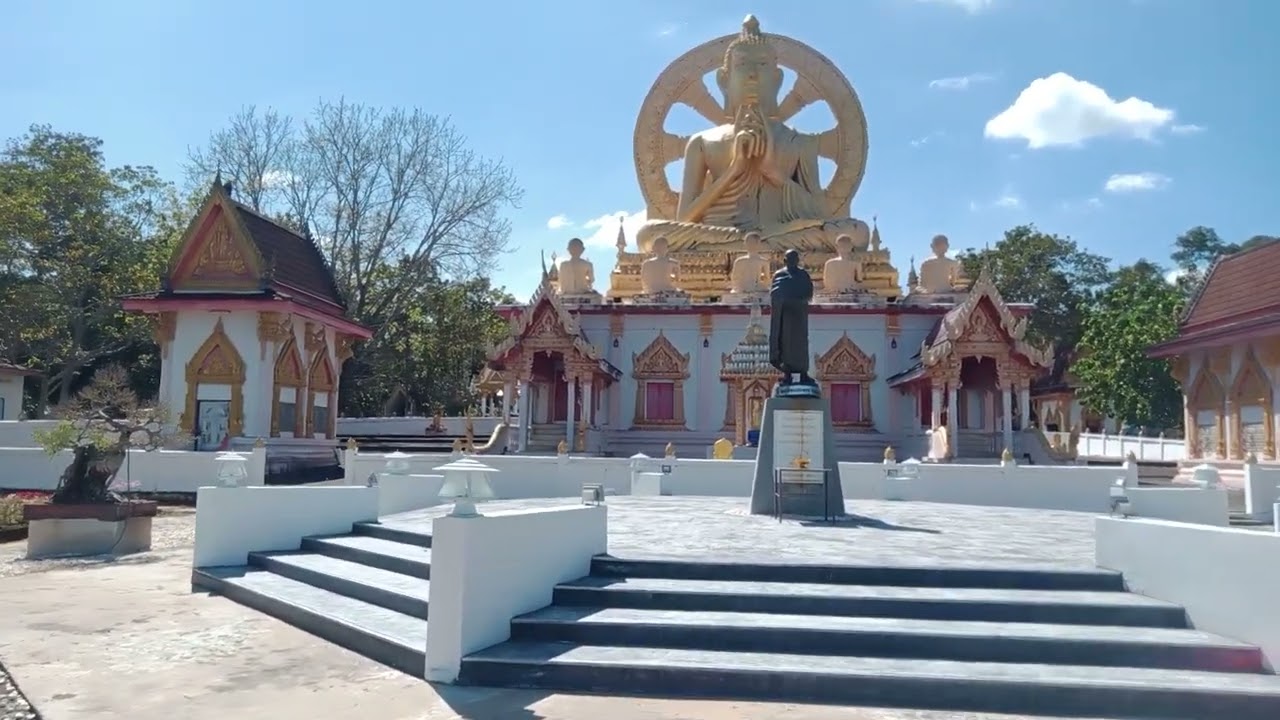
 Click to Access the Navigation Map GPS
Wat Phuttho Thammatharo Map
Recommend

 Art, Culture and Heritage
 Historical Sites and Monuments(2)
 Landmarks and Memorials(3)
 Art, Craft Centres, Tradition(2)
 Museums(1)
Temple(17)
Museums(1)
Temple(17)
 Other Sacred Sites(3)
 Suburban Living
 Village, Community(4)
 Local Market(2)
 Nature and Wildlife
 National Parks and Marine Reserves(4)
 Mountain (Doi)(5)
 Dam, Reservoir, Lake(3)
 Waterfalls(5)
 Caves(2)
 River, Canal(2)
 Bays and Beaches(1)
 Other natural attractions(1)
 Entertainment and Agricultural
 Farms, Parks and Ecotourism(1)


