
lovethailand home >Northeastern Travel Attractions >Maha Sarakham Travel Attractions >Kanthara Wichai >Tha Khon Yang > Illuminated Boat Procession Festival
TL;DR: Illuminated Boat Procession Festival, Maha Sarakham attractions : Art, Culture and Heritage, Art, Craft Centres, Tradition.
Illuminated Boat Procession Festival
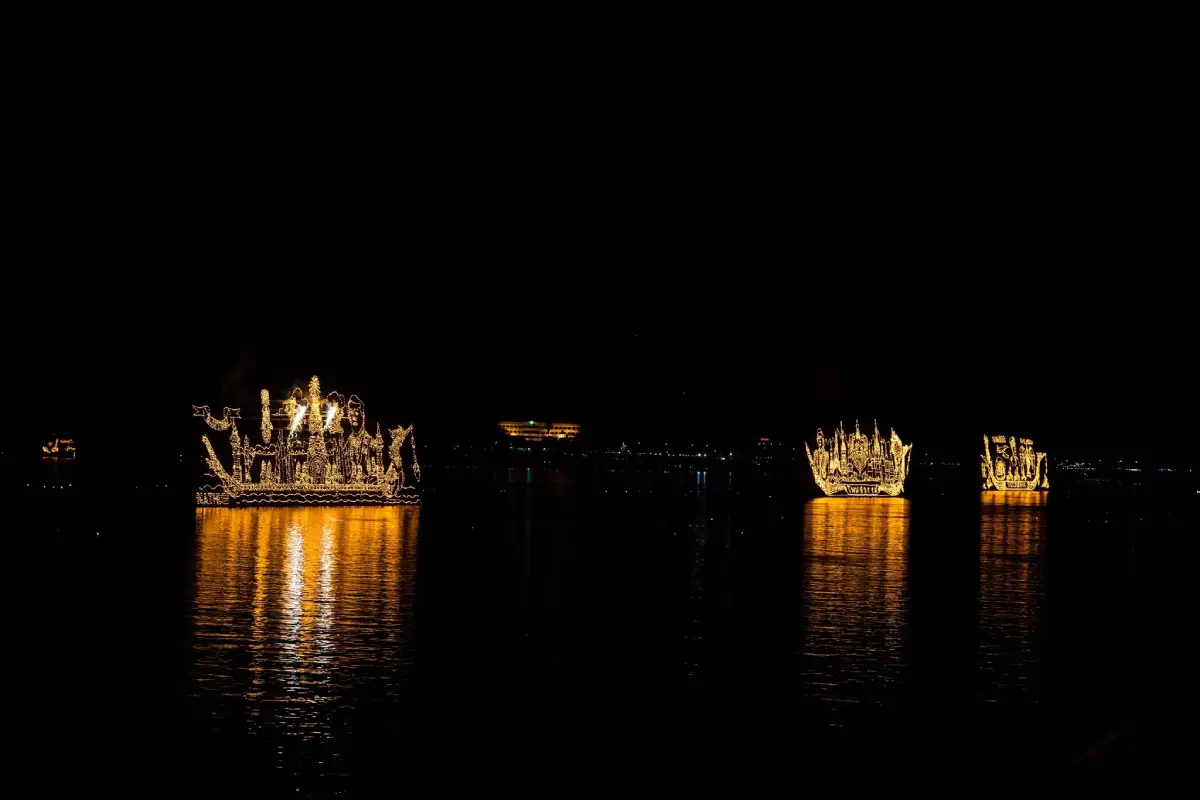
Open Days: The 2026 Nakhon Phanom Illuminated Boat Procession Festival is scheduled from 16 – 27 October 2026, with the main illuminated boat night on Buddhist Lent Day, 26 October 2026.
Opening Hours: The Mekong riverside area in Nakhon Phanom Municipality is a public riverside space open throughout the day. The main festival activities follow the provincial schedule, and the best time to watch the illuminated boats is from evening to night.
The Illuminated Boat Procession Festival, known in Thai as Prapheni Lai Ruea Fai and in the local Isan language as Heua Fai, is one of the most spectacular Buddhist and cultural traditions in northeastern Thailand. The festival is especially famous in Nakhon Phanom Province, where giant illuminated boats are floated along the Mekong River on the night of the full moon in the 11th lunar month. For foreign travelers, this is one of the most meaningful festivals in Isan because it combines Buddhist devotion, reverence for water, local craftsmanship, community identity, and the breathtaking beauty of firelight moving across the river.
The festival is traditionally held from the full-moon day of the 11th lunar month to the first waning day of the same month, which usually falls in October. This period coincides with Ok Phansa, the end of Buddhist Lent. In Nakhon Phanom, the festival has developed into a major cultural event along the Mekong riverside, attracting visitors from across Thailand and beyond. Yet beneath the scale of the modern celebration, the spiritual meaning remains clear: the illuminated boat is an offering of light, gratitude, apology, and renewal.
The meaning of the festival is deeply rooted in Buddhism and river-based life. Local belief connects the ritual with the worship of the Buddha’s footprint on the bank of the Nammatha River in ancient India, the worship of the Buddha, the veneration of Phaka Brahma, the worship of Chulamani Chedi, and the act of asking forgiveness from the river for human pollution and carelessness. The fire on the boat also symbolizes the burning away of suffering, allowing sorrow, misfortune, and inner darkness to drift away with the current.
The Thai word “lai” means to flow, while “ruea fai” means a boat of fire or illuminated boat. In the local Isan language, the boat is often called “heua fai.” Traditionally, these boats were made from banana trunks, bamboo, and other natural floating materials. They were decorated with candles, lamps, flowers, incense, and offerings. Once lit, the boat was released into the river and allowed to float away. The movement of the boat on the water gave the ritual its name and its emotional power.
One of the most important beliefs behind the festival concerns the Buddha’s footprint on the Nammatha River. According to Buddhist legend, the Buddha once went to the realm of the naga to teach the Dhamma. When he returned, the naga requested him to leave his footprint on the riverbank so that gods, humans, and all beings could pay respect. The illuminated boat is therefore offered as a lighted tribute to that sacred footprint. For local Buddhists, the ritual expresses devotion, merit-making, and a wish for long-lasting happiness and well-being.
Before releasing the boat, worshippers may recite a Pali-style prayer: “Ahang imina padipena Nammakaya nadiya puleni padava-anching abhipucheni ayam padipena munino padava-anchang puja mayhang thikharattang hitaya sukhaya sangvattakatu.” The meaning is: With this lamp, I humbly worship the footprint of the Great Sage established on the sandy bank of the Nammatha River. May this offering of light to the Buddha’s footprint bring benefit and happiness to us for a long time. This prayer shows that the illuminated boat is not merely decorative; it is a religious offering.
Another key meaning of Lai Ruea Fai is gratitude toward the river. Communities along the Mekong River have depended on the river for generations. The river provides water, food, transportation, fishing grounds, agricultural support, and a cultural connection between people on both sides of the border. Releasing an illuminated boat is therefore a symbolic act of apology to the river, especially for the pollution and waste caused by human activity. It is also an expression of gratitude to Mae Khongkha, the river goddess, and to the Mekong River itself.
Fire is the central symbol of the festival. It represents Buddhist worship, spiritual light, wisdom, purification, and the burning away of distress. When the illuminated boat is lit and released into the river, it visually expresses the wish to let suffering, sorrow, and bad fortune leave one’s life. As the boat slowly moves into the darkness, the viewer sees a powerful image of impermanence: a bright form appears, shines beautifully for a moment, and then gradually disappears downstream.
In earlier times, fire boats were small and simple. Villagers used bamboo, banana trunks, and local materials to build floating structures. The boats were decorated with candles, torches, incense, flowers, food, and symbolic offerings. Monks and villagers gathered at a temple or riverbank to pray, listen to sermons, and make merit. At dusk, the boats were carried to the river, lit, and released. These early forms were intimate community rituals, focused on faith rather than spectacle.
Modern Nakhon Phanom fire boats have become much larger and more elaborate. Giant illuminated boats are built with large frames, thousands of lights, detailed patterns, and complex engineering. Each boat may represent a district, a religious theme, a naga image, a chedi, a royal tribute, a Buddhist symbol, or a story connected with local pride. These boats require weeks or months of work by local artisans, technicians, volunteers, and community members. Every completed boat is a collective artwork created through devotion and teamwork.
Nakhon Phanom is an ideal setting for the festival because of its long Mekong riverside and its view across the river to Thakhek in Khammouane Province, Lao PDR. On the festival night, the Mekong becomes a shared cultural stage. The illuminated boats float between two lands that have long been connected by Buddhism, river life, language, trade, kinship, and belief. This cross-border atmosphere gives the Nakhon Phanom festival a special character that cannot be separated from the Mekong itself.
The main festival area is along the Mekong riverside in Nakhon Phanom Municipality. Important zones include Phanom Naga Plaza, the Phaya Si Sattanakarat landmark, Sunthon Wichit Road, the Indochina Market area, the walking street, and activity spaces near the provincial hall. During the festival, the riverside transforms into a large cultural corridor with performances, local food, market stalls, charity fair activities, photo spots, illuminated sculptures, boat-making exhibitions, and public service areas.
For the 2026 festival, Nakhon Phanom Province has scheduled the event from 16 to 27 October 2026, totaling 12 days. The main illuminated boat night falls on 26 October 2026, the day of Ok Phansa. Important activities include giant illuminated boats from 12 districts, display boats, traditional fire boats, floating candle lines, community boat-making exhibitions, local cultural performances, contemporary molam shows, pong lang music, illuminated sculptures, local markets, and the ceremonial dance in honor of Phra That Phanom.
The most important visitor zone is the riverside viewing area. This is where travelers can watch the giant boats moving along the Mekong at night. Phanom Naga Plaza and the Phaya Si Sattanakarat landmark are major photo points. The riverside walking street is ideal for food, local products, and evening atmosphere. The Indochina Market zone is good for shopping and border-town scenery. The Red Cross fair and performance zones are suitable for families and visitors who want to enjoy cultural activities before or after the boat procession.
The craft behind the boats is one of the most impressive aspects of the festival. A giant illuminated boat requires careful planning, frame construction, pattern design, lighting installation, weight balance, and river safety management. Local artisans must combine artistic creativity with technical knowledge. The glowing images seen from the riverbank are the result of countless hours of collective work. In this sense, each illuminated boat is not only a festival object, but also a moving artwork made by the community.
The designs on the boats carry strong cultural meaning. Naga designs reflect the spiritual imagination of the Mekong region. Chedi images express Buddhist devotion. Patterns of mythical animals, royal barges, garudas, dragons, sacred symbols, and local landmarks show the creativity of the designers and the pride of each participating community. When the lights form these patterns in the darkness, the river becomes an outdoor gallery of Isan folk art.
Lai Ruea Fai also connects generations. Elders pass on stories, prayers, meanings, and ritual knowledge. Experienced boat makers teach younger people how to build frames, place lights, and balance the structure. Children and youth observe how a community creates something beautiful through cooperation. Visitors learn that the spectacle is not produced by technology alone, but by faith, patience, and teamwork.
Socially, the festival brings the whole city to life. Hotels, restaurants, markets, shops, and transport services become busy throughout the event. Local people earn income from food, handicrafts, souvenirs, and tourism services. At the same time, public agencies, private organizations, volunteers, and residents work together to manage traffic, parking, toilets, safety, cleanliness, and crowd flow. The festival therefore functions as both cultural heritage and a major civic event.
Travelers planning to attend should book accommodation early, especially for the main night on 26 October 2026. Staying near Sunthon Wichit Road, Phanom Naga Plaza, the Vietnamese Memorial Clock Tower, or the Indochina Market makes it easier to walk to the riverside. Visitors should arrive in the area before evening, choose a viewing spot in advance, and allow enough time for walking through crowded areas. The best atmosphere is along the river, where the boats can be seen moving against the dark surface of the Mekong.
Comfortable clothing and walking shoes are recommended. The festival area can be crowded, and visitors may need to walk for a long time. Photographers should arrive early to secure a clear view. Families traveling with children or elderly visitors should agree on a meeting point and avoid overly crowded sections. Drinking water, light rain protection, and a fully charged phone are practical essentials.
Getting There to Nakhon Phanom is possible by private car, interprovincial bus, or flight. Nakhon Phanom Airport is the most convenient air gateway, with local transport available into the city. From the bus terminal, travelers can continue by local taxi, songthaew, or hired vehicle to Sunthon Wichit Road, Phanom Naga Plaza, the Indochina Market, or other riverside festival zones. During the festival, travelers should allow extra time for traffic control and parking.
Nearby attractions can easily be combined with the festival. The Phaya Si Sattanakarat landmark is one of the most important riverside symbols of Nakhon Phanom. Wat Okat Si Bua Ban is an old riverside temple and home to the sacred Phra Tio and Phra Thiam Buddha images. The Vietnamese Memorial Clock Tower reflects the historical relationship between Thai and Vietnamese communities. The Old Governor’s Residence Museum is known for its colonial-style architecture. The Indochina Market offers a lively shopping and riverside walking experience.
Nakhon Phanom is also a good city for food lovers. Travelers should try Vietnamese-style dishes, Isan food, Mekong fish dishes, naem nueang, Vietnamese-style breakfast, khai krata, khao piak sen, moo yor, and local riverside restaurants. During the festival, restaurants near the event area are busy, so reservations are useful where available.
Accommodation choices include riverside hotels, city hotels, hostels, boutique hotels, and guesthouses. Travelers who want easy access to the festival should stay near Sunthon Wichit Road, Phanom Naga Plaza, the Vietnamese Memorial Clock Tower, or the Indochina Market. Those traveling by car may choose hotels slightly farther from the main crowd, as long as parking is available. Early booking is strongly recommended during the festival period.
Visitors should respect the spiritual and public nature of the festival. Do not climb barriers, do not enter restricted riverbank areas, do not disturb officials or boat crews, and never throw waste into the Mekong River. The illuminated boat procession is both a sacred tradition and a public celebration. Responsible behavior helps preserve the dignity and beauty of the festival.
On a philosophical level, Lai Ruea Fai offers a powerful reflection on human life. A fire boat is built with care, shines brightly for a brief moment, and then slowly disappears downstream. This can be seen as a reminder that human life also has birth, growth, beauty, decline, and disappearance. The festival’s beauty lies not only in the lights, but also in its quiet message about impermanence and the value of doing good while life is still bright.
In summary, the Nakhon Phanom Illuminated Boat Procession Festival is far more than a riverside light show. It is a living expression of Buddhist faith, gratitude to the Mekong River, Isan craftsmanship, community cooperation, and cross-border cultural identity. For foreign travelers, witnessing the giant illuminated boats floating across the Mekong on the night of Ok Phansa is one of the most memorable ways to experience the spiritual heart of northeastern Thailand.
| Name | Nakhon Phanom Illuminated Boat Procession Festival |
| Alternative Names | Lai Ruea Fai, Loi Ruea Fai, Long Ruea Fai, Plai Ruea Fai, Heua Fai |
| Location | Mekong riverside area, Nakhon Phanom Municipality, Mueang Nakhon Phanom District, Nakhon Phanom Province |
| Main Venue Address | Sunthon Wichit Road, Phanom Naga Plaza, Indochina Market, and Mekong riverside area, Nakhon Phanom Municipality, Nakhon Phanom 48000, Thailand |
| Highlights | Giant illuminated boats from 12 districts floating on the Mekong River on Ok Phansa night, display boats, traditional fire boats, floating candle lines, cultural performances, and riverside festival atmosphere |
| Festival Period | Full moon of the 11th lunar month to the first waning day of the 11th lunar month, usually in October |
| 2026 Schedule | 16 – 27 October 2026, totaling 12 days. The main illuminated boat night falls on 26 October 2026. |
| Importance | Worship of the Buddha’s footprint at the Nammatha River, worship of the Buddha, veneration of Phaka Brahma and Chulamani Chedi, apology to the river, gratitude to Mae Khongkha, and symbolic burning away of suffering |
| History | A long-standing Isan Heet Sip Song tradition practiced by Mekong communities, with Nakhon Phanom recognized as one of the most prominent places for the festival |
| Name Origin | “Lai” means to flow, while “ruea fai” means a fire boat or illuminated boat released to float along the river |
| Main Ritual | Reciting the worship prayer, making a wish, lighting the boat, and releasing the illuminated boat to flow along the Mekong River at night |
| Distinctive Features | Traditional boats were made from bamboo, banana trunks, banana sheaths, and lamps; modern giant boats use large frames, thousands of lights, and detailed Buddhist, naga, chedi, and auspicious designs |
| Travel Information | Travel to Nakhon Phanom by private car, bus, or flight, then continue to Sunthon Wichit Road, Phanom Naga Plaza, Indochina Market, and the Mekong riverside festival area |
| Current Status | Still held as a major annual cultural festival of Nakhon Phanom and one of the most important travel events in Isan |
| Fees | No admission fee for the main riverside viewing area |
| Facilities | Viewing areas, riverside walking paths, local markets, food stalls, public service points, temporary toilets, parking areas, and safety officers during the festival |
| Main Areas / Zones | Mekong riverside viewing zone, Phanom Naga Plaza and Phaya Si Sattanakarat zone, riverside walking street, Indochina Market zone, Red Cross fair zone, cultural performance stage, boat-making exhibition zone, illuminated sculpture zone, parking and public service zones |
| Caretaker / Related Authorities | Nakhon Phanom Province, Nakhon Phanom Municipality, Nakhon Phanom Provincial Cultural Office, Nakhon Phanom Tourism and Sports Office, public agencies, private sector, and communities from 12 districts |
| Main Contact Number | Nakhon Phanom Municipality, Tel. 0-4251-2005 |
| Official Website / Official Page | Nakhon Phanom Provincial Office, Nakhon Phanom Public Relations Office, Nakhon Phanom Municipality, Lai Ruea Fai Nakhon Phanom page |
| Nearby Tourist Attractions | 1. Phaya Si Sattanakarat, about 0.1 km 2. Phanom Naga Plaza, about 0.1 km 3. Indochina Market Nakhon Phanom, about 0.5 km 4. Vietnamese Memorial Clock Tower, about 0.8 km 5. Wat Okat Si Bua Ban, about 1 km, Tel. 042-513490 6. Old Governor’s Residence Museum, about 1.2 km, Tel. 0-4251-1574 |
| Nearby Restaurants | 1. Sabai Dee @ Nakhon Phanom, about 0.5 km, Tel. 042-064200, 091-5699662 2. Rabiang Khong Nakhon Phanom, about 1 km, Tel. 092-8655889 3. View Khong Restaurant, about 2 km, Tel. 0-4252-2314 4. Kitchen Khong The River Front, about 3 km, Tel. 085-9247898 5. Pen Pla Pen, about 4 km, Tel. 081-1197663 |
| Nearby Accommodations | 1. Landmark Nakhon Phanom Hotel, about 0.3 km, Tel. 091-7403001 2. Non Nakhon Hotel & Bistro, about 0.7 km, Tel. 064-7894645 3. Rim Khong Pan Suk, about 1 km, Tel. 042-511035, 081-4494665 4. Khong Phu Mok Hometel, about 2 km, Tel. 042-513323, 062-1951828 5. The Square Hotel Nakhon Phanom, about 2 km, Tel. 081-2611011 |
Frequently Asked Questions (FAQ)
Q: When is the Illuminated Boat Procession Festival held?
A: It is traditionally held from the full moon of the 11th lunar month to the first waning day of the same month, usually in October. In 2026, the Nakhon Phanom festival is scheduled from 16 to 27 October, with the main boat night on 26 October.
Q: Why is Lai Ruea Fai important?
A: It is important as a Buddhist offering, a tribute to the Buddha’s footprint, an act of apology to the river, an expression of gratitude to Mae Khongkha, and a symbolic burning away of suffering.
Q: Where is the best place to watch the festival in Nakhon Phanom?
A: The best viewing area is along the Mekong riverside in Nakhon Phanom Municipality, especially near Phanom Naga Plaza, the Phaya Si Sattanakarat landmark, Sunthon Wichit Road, the Indochina Market, and the official riverside viewing zones.
Q: Is there an entrance fee?
A: No. The main riverside viewing area has no admission fee.
Q: How are traditional and modern fire boats different?
A: Traditional boats were small and made from bamboo, banana trunks, banana sheaths, and lamps. Modern giant boats use large frames, thousands of lights, and detailed artistic designs created by local communities.
Q: How should travelers prepare for the festival?
A: Travelers should book accommodation early, arrive before evening, choose a viewing point in advance, wear comfortable shoes, prepare water and camera equipment, and follow official safety instructions.
Q: How is the festival connected to the Mekong River?
A: The Mekong River is both the ritual space and the life source of the local community. Releasing illuminated boats is a way to ask forgiveness from the river and express gratitude for its long-standing support of life.
Q: What nearby attractions can be visited with the festival?
A: Visitors can combine the festival with Phaya Si Sattanakarat, Phanom Naga Plaza, the Indochina Market, the Vietnamese Memorial Clock Tower, Wat Okat Si Bua Ban, and the Old Governor’s Residence Museum.
 Category: ●Art, Culture and Heritage
 Group: ●Art, Craft Centres, Tradition
Last Update : 2 MonthAgo
 Last Update : 2 MonthAgo
 Click to Access the Navigation Map GPS
Illuminated Boat Procession Festival Map

 Historical Sites and Monuments(4)
Art, Craft Centres, Tradition(5)
Historical Sites and Monuments(4)
Art, Craft Centres, Tradition(5)
 Museums(3)
 Places of Worship
 Temple(17)
 Other Sacred Sites(7)
 Research and Development
 Royal Project(2)
 Suburban Living
 Village, Community(5)
 Nature and Wildlife
 National Parks and Marine Reserves(3)
 Dam, Reservoir, Lake(10)
 River, Canal(2)
 Bays and Beaches(2)
 Other natural attractions(2)
 Entertainment and Agricultural
 Farms, Parks and Ecotourism(3)
 Travel Articles, Recipes
 Food Menu, Northeastern Recipes(1)


