
lovethailand home >Northeastern Travel Attractions >Maha Sarakham Travel Attractions >Muang Maha Sarakham >Talat > Mahasarakham City Museum
TL;DR: Mahasarakham City Museum is located at Inside Nong Kha Public Park, Talat Subdistrict, Mueang Maha Sarakham District, Maha Sarakham Province, open Monday – Friday. On Saturdays, Sundays, and public holidays, visits are, hours 08.30 – 16.30.
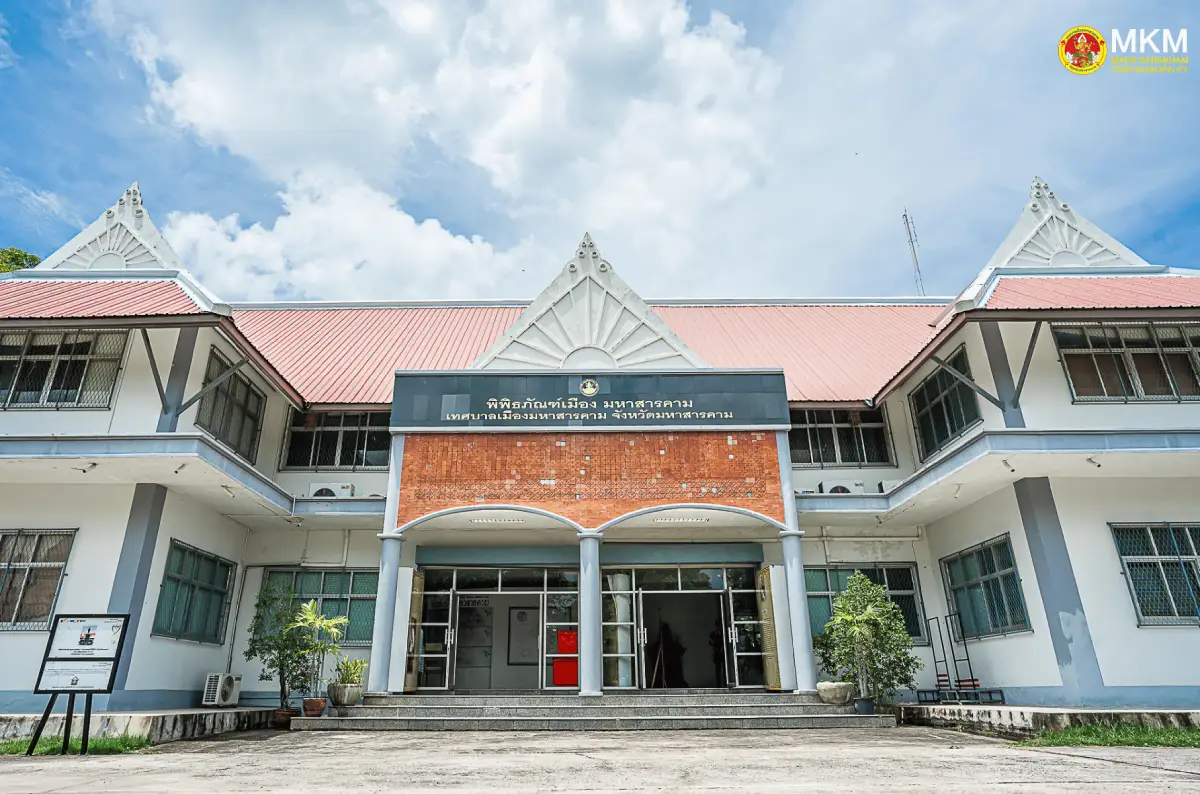
Mahasarakham City Museum
Open Days: Monday – Friday. On Saturdays, Sundays, and public holidays, visits are available only for groups that contact the museum in advance.
Opening Hours: 08.30 – 16.30
Mahasarakham City Museum, officially known as Mahasarakham City Museum and Local Product Promotion Center, is an important cultural learning site managed by Maha Sarakham Town Municipality. Located inside Nong Kha Public Park in Talat Subdistrict, Mueang Maha Sarakham District, the museum tells the story of Maha Sarakham through the lives of its people, the development of the city, local memory, community identity, and the relationship between urban growth and rural roots. Its main interpretive theme is “A City Layered With Rural Life,” a phrase that captures the distinctive character of Maha Sarakham: a city that has expanded through education, administration, trade, and modern public services, while still preserving the social memory and everyday patterns of rural Isan life.
The museum began in 2000 during the administration of Mrs. Sirilert Mekpaiboon as Governor of Maha Sarakham Province and Mr. Surachit Yontrakul as Mayor of Maha Sarakham Municipality. It received a construction budget of 8,434,000 baht from the regional production and employment distribution fund. Later, in the 2003 fiscal year, Maha Sarakham Town Municipality allocated an additional 2,000,000 baht for exhibition research, design, and installation. This background shows that the museum was not built merely as a public building, but as a cultural project intended to gather local knowledge, research the city’s identity, and create a permanent learning space for residents and visitors.
The museum stands within Nong Kha Public Park, a green public space of about 40 rai. The park includes trees, a pond, open leisure areas, and a peaceful atmosphere in the middle of the city. In front of the museum stands the monument of Phra Charoen Ratchadet, also known as Thao Mahachai, the first ruler of Maha Sarakham. This location gives the museum strong symbolic meaning. Visitors do not only enter an exhibition building; they enter a public landscape where city history, civic memory, public recreation, and local pride meet in one place.
Mahasarakham City Museum officially opened in August 2004, together with a ceremony honoring Phra Charoen Ratchadet. The opening of the museum marked the city’s intention to create a central space for telling its own story. The building has two floors. The lower floor includes part of the permanent exhibition, museum storage, office space, and areas connected with the promotion of local products. The upper floor is used for permanent and temporary exhibitions. This layout allows the museum to function both as a cultural display area and as a working center for local heritage management.
The most distinctive feature of the museum is that it focuses on the lives of people rather than only on political events or official chronology. Its displays use objects, photographs, models, text panels, reconstructed scenes, tools, household items, and community memories to show how people in Maha Sarakham lived, worked, studied, traded, adapted, and built the city over time. In this sense, it is a city museum that gives importance to everyday life and ordinary people as much as to rulers, government, and formal history.
The concept of “A City Layered With Rural Life” is central to the museum’s identity. Maha Sarakham grew from a rural Isan setting into a provincial city known for education, government offices, markets, and public services. Yet rural ways of life still remain visible in community relationships, kinship networks, food culture, local trade, memories of fields and ponds, and the continuing connection between the city and surrounding villages. The museum helps visitors understand that Maha Sarakham is not a city separated from its rural past. It is a city where rural memory continues to shape urban identity.
The exhibition presents the history of the city through five major periods: the period before the founding of Maha Sarakham, the period of local rulers, the period of administration by government officials, the period of educational expansion, and the period of the economic bubble. This structure helps visitors follow the development of the city step by step, from early settlement and local governance to modern administration, education-led growth, and economic transformation.
The first period, before the founding of Maha Sarakham, reminds visitors that the area did not begin as an empty space. Before it became a formal town, the region already contained communities, waterways, agricultural land, local paths, and relationships with nearby settlements. The museum presents the founding of Maha Sarakham as part of a longer process of settlement, resource use, and local organization. A city does not appear suddenly; it grows from landscape, people, and social relationships.
The period of local rulers is closely connected with Phra Charoen Ratchadet, the first ruler of Maha Sarakham. His role in the establishment of the city remains central to local memory. The museum explains the importance of local leadership, the relationship between rulers and communities, and the formation of Maha Sarakham’s early civic identity. The monument in front of the museum reinforces this story, linking the indoor exhibition with the physical landscape outside.
The period of administration by government officials reflects the transition from local ruler-based governance to a modern administrative system. This transformation affected taxation, public services, education, communication, transportation, and the relationship between the city and the central state. Through this part of the exhibition, visitors can see how Maha Sarakham gradually became part of a wider modern provincial system while still preserving its own local character.
The period of educational expansion is especially important because Maha Sarakham is widely known today as an educational city of northeastern Thailand. The growth of schools, colleges, universities, teachers, students, and academic institutions shaped the economy, housing, social structure, and public image of the city. Education became more than a service; it became one of the defining forces of modern Maha Sarakham. The museum helps visitors understand how this identity developed over time.
The economic bubble period introduces visitors to the changes brought by rapid growth, investment, commercial buildings, consumer culture, and new expectations of urban life. Like many Thai cities, Maha Sarakham experienced the impact of national economic expansion and later adjustment. Including this period in the museum makes the exhibition more balanced. The city’s story is not only about origins and pride, but also about change, growth, uncertainty, and lessons for the future.
The museum’s objects can be understood in several major groups. One group includes tools and objects used in daily life, such as farming tools, fishing equipment, household objects, and items connected with rural living. These objects make the idea of “A City Layered With Rural Life” concrete. Although the museum is located in the city, many objects point back to the rural roots that continue to shape the memory of Maha Sarakham.
Another important group includes objects related to the rulers of Maha Sarakham, their family lines, and the early governance of the town. These materials help transform local history from names and dates into something more tangible. Visitors can see that the city’s founders and leaders were connected to real objects, households, duties, and community relationships. This gives local history a more human dimension.
A third group includes objects connected with Maha Sarakham Municipality. These materials reflect the development of local administration and public services. Municipal work is central to the making of a modern city: roads, public spaces, sanitation, events, education, and civic management all depend on local institutions. By including municipal materials, the museum shows that the city was shaped not only by historical leaders, but also by ongoing public administration and community cooperation.
The lower floor of the building is important because it combines exhibition space with museum storage, office work, and local product promotion. The idea of a local product center connects the museum with the present-day economy of the community. Local products represent skill, labor, creativity, and living knowledge. When placed within the museum context, they show that heritage is not only something in the past. It continues in the hands of makers, communities, and small local producers.
The upper floor provides a more continuous exhibition experience through permanent and temporary displays. Visitors can learn through models, old photographs, reconstructed scenes, captions, and other interpretive media. This type of city museum is valuable because it allows residents to see their own everyday environment as history. Streets, markets, schools, ponds, temples, and public buildings become part of a larger story.
The museum’s location in Nong Kha Public Park makes the visit more pleasant and meaningful. Visitors can combine cultural learning with relaxation. After viewing the exhibition, they can walk around the park, enjoy the pond and trees, take photos with the Phra Charoen Ratchadet monument, or simply observe how local residents use the public space. The museum and park together create a balanced experience of history, memory, and urban leisure.
The museum was also designed to become a living learning center, not a static storage place. Plans have included activities with educational institutions, temporary exhibitions, seasonal activities, new exhibition techniques, interactive displays, a museum storage system, a historical document center, community participation, volunteer guides, demonstrations of local wisdom, and a center for local products. These ideas give the museum the potential to remain active and relevant to the city.
A museum archive and historical document center are especially important for a city like Maha Sarakham. A city that wants to understand itself needs to collect documents, photographs, objects, stories, and public memory. Without such efforts, many local memories disappear with older generations. The museum’s role as a collecting and documentation center can preserve parts of city history that may not appear in official records.
Community participation is also essential. A city museum cannot be complete without the voices of its residents. Volunteer guides, local demonstrations, community storytelling, and public activities allow people to become part of the museum rather than only visitors. This makes the museum a shared civic space where people can help define and preserve the story of their own city.
Mahasarakham City Museum is suitable for many types of visitors. Students can learn local history from real objects and visual displays. Residents can reconnect with the memory of their city. Researchers can study the relationship between city museums and local identity. General travelers can understand Maha Sarakham more deeply than by visiting markets or temples alone. Families can use the museum as a calm educational stop in a green public setting.
Getting There is convenient because the museum is located in Maha Sarakham city, inside Nong Kha Public Park in Talat Subdistrict. Visitors driving can navigate directly to Mahasarakham City Museum or Nong Kha Public Park. Those arriving by bus can get off at Maha Sarakham Bus Terminal and continue by local taxi or hired vehicle. The location is suitable for a one-day city itinerary that includes the museum, nearby landmarks, local food, and evening market areas.
Nearby places include the Phra Charoen Ratchadet Monument, Nong Kha Public Park, Khlong Somthawin, Maha Sarakham Clock Tower, the night market, Maha Sarakham City Pillar Shrine, and Wat Mahachai Museum. Visitors can start at the museum during the day, continue to central city landmarks, and finish the evening at the night market or Khlong Somthawin. This route presents the city through history, public space, food, and everyday urban life.
The surrounding city area also has many restaurants, cafes, and hotels. Visitors can find Thai food, Isan food, family restaurants, coffee shops, and night-market food within a short drive. Accommodation options in the city include mid-range hotels, budget hotels, daily apartments, and properties near commercial and government areas. Staying in central Maha Sarakham makes it easy to visit the museum and nearby attractions.
Visitors should check the opening schedule before traveling, especially on weekends and public holidays, when visits are available only for groups that contact the museum in advance. Inside the exhibition area, visitors should keep the space clean, avoid touching displays without permission, and respect the museum environment. Since the museum is located inside a public park, visitors should also help maintain the cleanliness of the shared outdoor space.
Mahasarakham City Museum helps visitors understand the city in a structured and meaningful way. Maha Sarakham is not only an educational city, not only an administrative center, and not merely a stop between provinces. It is a city with history, people, neighborhoods, memory, public life, and a continuing relationship with rural Isan. The theme “A City Layered With Rural Life” gives visitors a clear way to understand this complexity.
In conclusion, Mahasarakham City Museum and Local Product Promotion Center is a valuable cultural and historical destination. It presents the city through five major periods: before the founding of Maha Sarakham, the period of local rulers, the period of government administration, the period of educational expansion, and the economic bubble period. Through the theme “A City Layered With Rural Life,” the museum explains the identity of Maha Sarakham through people, objects, memory, and everyday life. For travelers who want to understand the city beyond ordinary sightseeing, this museum is an appropriate starting point.
| Name | Mahasarakham City Museum And Local Product Promotion Center |
| Alternative Name | City Museum |
| Location | Inside Nong Kha Public Park, Talat Subdistrict, Mueang Maha Sarakham District, Maha Sarakham Province |
| Address | Nong Kha Public Park, Talat Subdistrict, Mueang Maha Sarakham District, Maha Sarakham 44000, Thailand |
| Coordinates | 16.200799301471, 103.29044518794 |
| Highlights | Exhibition on the way of life of Maha Sarakham people under the theme “A City Layered With Rural Life,” two-storey museum building, Nong Kha Public Park, Phra Charoen Ratchadet Monument, and local product promotion area |
| History / Importance | The project began in 2000 with a construction budget of 8,434,000 baht and an exhibition design budget of 2,000,000 baht. It was created as a city learning center presenting Maha Sarakham’s history and way of life. |
| Official Opening | Officially opened in August 2004, together with a ceremony honoring Phra Charoen Ratchadet, the first ruler of Maha Sarakham |
| Main Theme | “A City Layered With Rural Life,” representing Maha Sarakham as a modern city that still carries rural roots, community relationships, and agricultural memory |
| Historical Periods Presented | 1. Before The Founding Of Maha Sarakham 2. Period Of Local Rulers 3. Period Of Government Administration 4. Period Of Educational Expansion 5. Economic Bubble Period |
| Building Features | Two-storey building with permanent exhibition areas, museum storage, office space, local product center, and permanent/temporary exhibition areas |
| Exhibition Objects | Daily life tools, farming tools, fishing equipment, objects related to Maha Sarakham rulers, family lines of local rulers, and objects related to Maha Sarakham Municipality |
| Travel Information | From Maha Sarakham Bus Terminal, take a local taxi or hired vehicle to Nong Kha Public Park in Talat Subdistrict. Private cars can navigate directly to Mahasarakham City Museum or Nong Kha Public Park. |
| Current Status | Open as a city museum and learning center under Maha Sarakham Town Municipality |
| Open Days | Monday – Friday. On Saturdays, Sundays, and public holidays, visits are available only for groups that contact the museum in advance. |
| Opening Hours | 08.30 – 16.30 |
| Fees | No Admission Fee |
| Facilities | Public park, exhibition areas, office space, museum storage, visitor contact point, local product center, leisure areas around Nong Kha, and nearby parking areas |
| Main Areas / Zones | A City Layered With Rural Life exhibition zone, pre-founding period zone, local ruler period zone, government administration period zone, educational expansion zone, economic bubble period zone, museum storage zone, office zone, local product center, Nong Kha Public Park zone, and Phra Charoen Ratchadet Monument zone |
| Caretaker / Related Authorities | Maha Sarakham Town Municipality; the museum is under the Education Division of Maha Sarakham Town Municipality |
| Main Contact Number | Mahasarakham City Museum, Tel. 043-723467, 043-723469 Maha Sarakham Town Municipality, Tel. 043-725573-6 |
| Official Information Channels | Maha Sarakham Town Municipality, Museum Database in Thailand by Princess Maha Chakri Sirindhorn Anthropology Centre, and Mahasarakham City Museum Facebook page |
| Nearby Tourist Attractions | 1. Phra Charoen Ratchadet Monument, about 0.1 km 2. Nong Kha Public Park, about 0.1 km 3. Khlong Somthawin, about 1.5 km 4. Maha Sarakham Clock Tower, about 2 km 5. Maha Sarakham Night Market, about 2 km 6. Maha Sarakham City Pillar Shrine, about 2.5 km 7. Wat Mahachai Museum, about 3 km |
| Nearby Restaurants | 1. In Mahasarakham, about 2 km, Tel. 083-265-6646, 095-624-6649 2. Oksang & Coffee In Mind By Mum Aroi, about 2 km, Tel. 082-596-6544 3. Yaowarat, about 2.5 km, Tel. 089-571-6969 4. Maha Sarakham Night Market, about 2 km 5. Farmsook Cafe & Restaurant Maha Sarakham, about 8 km, Tel. 064-996-6414 |
| Nearby Accommodations | 1. Taksila Hotel Maha Sarakham, about 1.5 km, Tel. 043-719-999 2. Wichaya Place, about 2 km, Tel. 043-712-355, 062-582-8979 3. Ketsara Hotel, about 3 km, Tel. 095-236-2395 4. Top Inn Hotel Mahasarakham, about 3 km 5. HOP INN Mahasarakham, about 4 km, Tel. 065-950-4683, 02-080-2222 |
Frequently Asked Questions (FAQ)
Q: Where is Mahasarakham City Museum located?
A: Mahasarakham City Museum is located inside Nong Kha Public Park in Talat Subdistrict, Mueang Maha Sarakham District, Maha Sarakham Province.
Q: What are the opening days and hours?
A: The museum is open Monday to Friday from 08.30 to 16.30. On Saturdays, Sundays, and public holidays, visits are available only for groups that contact the museum in advance.
Q: Is there an admission fee?
A: No. The museum does not charge an admission fee.
Q: What does the museum display?
A: The museum presents the way of life of people in Maha Sarakham Municipality under the theme “A City Layered With Rural Life,” divided into five historical periods: before the founding of the city, the period of local rulers, the period of government administration, the period of educational expansion, and the economic bubble period.
Q: What does “A City Layered With Rural Life” mean?
A: It refers to Maha Sarakham’s identity as a modern city that still carries rural roots, community relationships, agricultural memory, and Isan ways of life within its urban character.
Q: Who should visit Mahasarakham City Museum?
A: It is suitable for students, families, cultural travelers, local residents, researchers, and anyone interested in the history, identity, and everyday life of Maha Sarakham.
Q: How can visitors get to the museum?
A: Visitors can drive directly to Nong Kha Public Park or take local transport from Maha Sarakham Bus Terminal to the museum area in central Maha Sarakham.
Q: What nearby places can be visited with the museum?
A: Visitors can also explore Phra Charoen Ratchadet Monument, Nong Kha Public Park, Khlong Somthawin, Maha Sarakham Clock Tower, Maha Sarakham Night Market, Maha Sarakham City Pillar Shrine, and Wat Mahachai Museum.
Tel : 043712439
 Tel : 043712439
 Category: ●Art, Culture and Heritage
 Group: ●Museums
Last Update : 2 MonthAgo
 Last Update : 2 MonthAgo
 Click to Access the Navigation Map GPS
 Historical Sites and Monuments(4)
 Art, Craft Centres, Tradition(5)
Museums(3)
Art, Craft Centres, Tradition(5)
Museums(3)
 Places of Worship
 Temple(17)
 Other Sacred Sites(7)
 Research and Development
 Royal Project(2)
 Suburban Living
 Village, Community(5)
 Nature and Wildlife
 National Parks and Marine Reserves(3)
 Dam, Reservoir, Lake(10)
 River, Canal(2)
 Bays and Beaches(2)
 Other natural attractions(2)
 Entertainment and Agricultural
 Farms, Parks and Ecotourism(3)
 Travel Articles, Recipes
 Food Menu, Northeastern Recipes(1)


