
lovethailand home >Northeastern Travel Attractions >Maha Sarakham Travel Attractions >Kanthara Wichai >Khok Phra > Phra Yuen Mongkhon and Phra Buddha Ming Mueang
TL;DR: Phra Yuen Mongkhon and Phra Buddha Ming Mueang is located at Wat Suwannawat, Ban Khok Phra, Khok Phra Subdistrict, Kantharawichai District, Maha Sarakham Province, open Daily, hours 08.00 – 18.00.
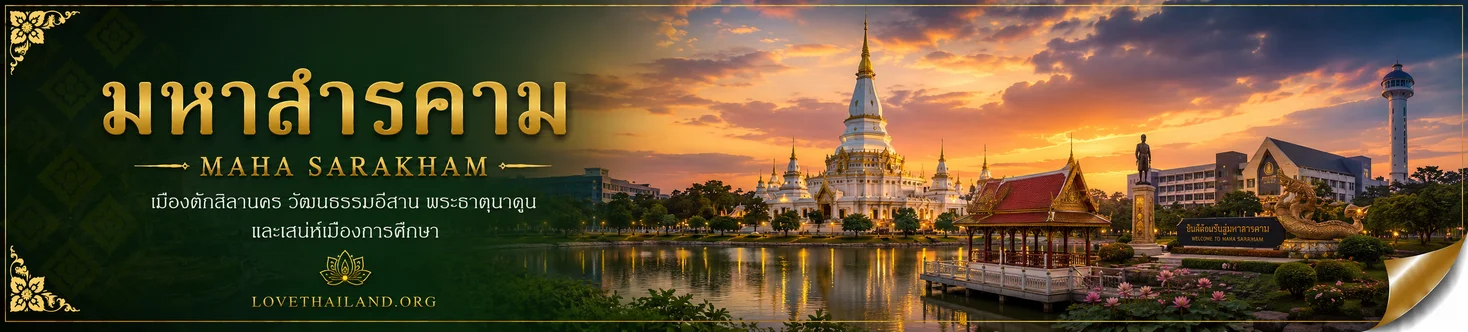
Phra Yuen Mongkhon and Phra Buddha Ming Mueang
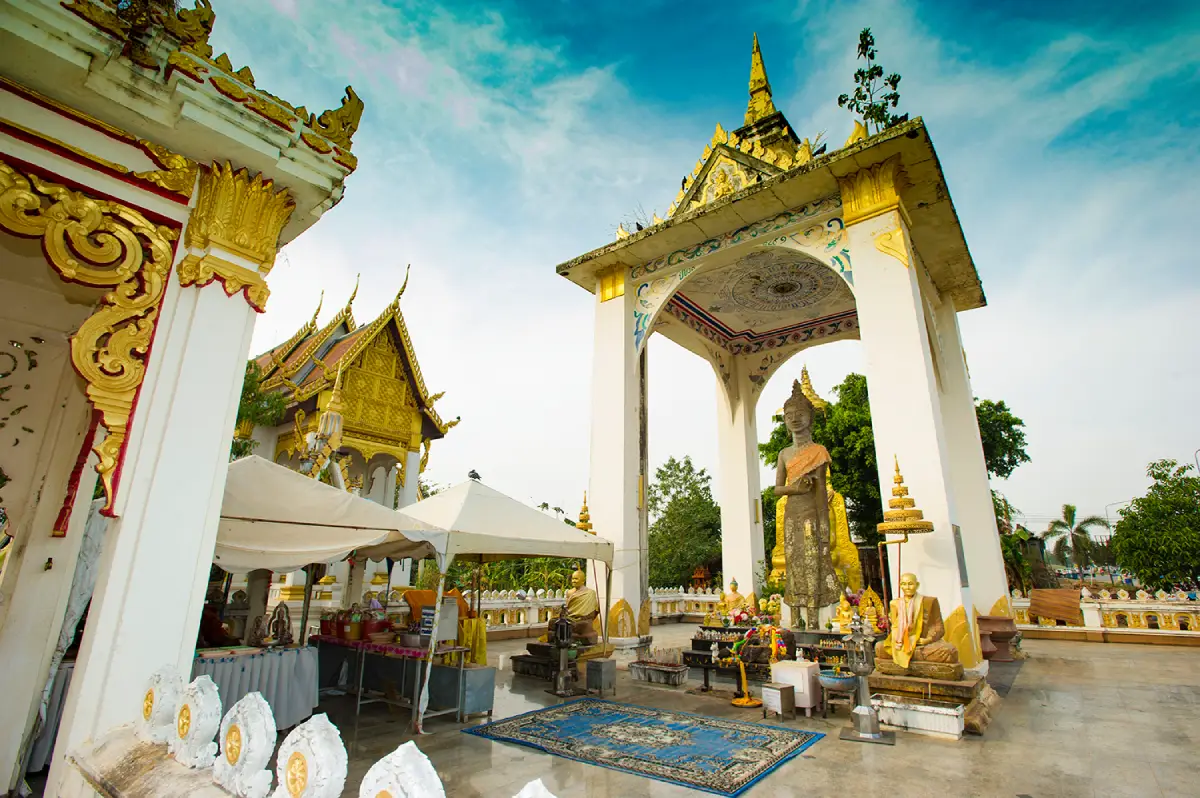
Open Days: Daily
Opening Hours: 08.00 – 18.00
Phra Buddha Ming Mueang, also known as Phra Buddha Suwan Mali, is an ancient standing Buddha image enshrined at Wat Suwannawat in Ban Khok Phra, Khok Phra Subdistrict, Kantharawichai District, Maha Sarakham Province. Created from red sandstone, this sacred Buddha image is associated with the Dvaravati period and is one of the most revered spiritual landmarks in Maha Sarakham. Local people believe that the image brings seasonal rainfall, prosperity, and peace to the community, making it an important destination for both worshippers and cultural travelers.
Wat Suwannawat is located along Highway 213, the Maha Sarakham – Kalasin route, about 14 km from Maha Sarakham city. When traveling from the city toward Kantharawichai District, the temple is on the left-hand side. Its convenient roadside location makes it easy to include in a half-day cultural route. Visitors can pay respect to the ancient Buddha image, observe a rare local Buddhist tradition, and explore an old Isan ordination hall within the same temple grounds.
Phra Buddha Ming Mueang is locally known as Luang Pho Phra Yuen, meaning the standing Buddha, or Luang Pho Phra Buddha Ming Mueang. The image stands about 8 sok high and about 2 sok wide, facing south. Its form reflects a blend of Dvaravati art and local Isan interpretation. The image is not highly decorative in a modern sense; instead, its power lies in its calm posture, ancient surface, balanced proportions, and the strong sense of sacred presence that has been preserved through generations of local devotion.
This Buddha image is closely connected with another ancient standing Buddha image, Phra Buddha Mongkhon at Wat Phutthamongkhon in Ban Sa, Kanthararath Subdistrict. Together, the 2 standing Buddha images are regarded as sacred Buddha images of Kantharawichai and Maha Sarakham. According to local tradition, both images were created at the same time during a period of drought. Men created Phra Buddha Ming Mueang, while women created Phra Buddha Mongkhon. After both images were completed and celebrated, rain began to fall according to the season. This story made the 2 Buddha images symbols of abundance, hope, and rainfall in the local imagination.
The rainfall belief gives Phra Buddha Ming Mueang a meaning that goes beyond art history. In northeastern Thailand, rain is closely tied to rice cultivation, livelihood, food security, and community well-being. For farming communities, seasonal rain is not only weather; it is life. The belief that this Buddha image can bless the land with proper rainfall has made it a spiritual refuge for local people, especially in times of drought, difficulty, or uncertainty.
Another important legend links the image to the ancient city of Kantharathirat, a former settlement in the area of present-day Kantharawichai District. The story tells of a Khmer ruler named Thao Lin Thong, also known as Sing To Dam, who was remembered as a cruel ruler. After committing serious wrongdoing against his parents and seizing power, he was tormented by unrest. Astrologers advised him to create Buddha images as an act of repentance. He then ordered the creation of 2 standing Buddha images: one in the city to honor his father, now Phra Buddha Ming Mueang at Wat Suwannawat, and another outside the city to honor his mother, now Phra Buddha Mongkhon at Wat Phutthamongkhon.
This legend gives the image a layered cultural meaning. It speaks of sin, remorse, filial memory, Buddhist merit, local kingship, and the transformation of violence into religious devotion. For local people, Phra Buddha Ming Mueang is not only a statue. It is a moral memory, a sacred center, and a reminder that faith can transform a troubled past into a source of peace and protection for the community.
Wat Suwannawat was formerly known as Wat Khok Phra. The name came from the local landscape and the presence of the standing Buddha image. In the past, the area was a wooded mound or khok where the ancient Buddha image stood. Local people therefore called it Khok Phra Yuen, or the mound of the standing Buddha. Later, Phra Khru Winaithon Plian Rueangsriman and local villagers cleared the area, marked the temple boundary, and built a pavilion for religious and community use. The temple later became known as Wat Suwannawat, a name with auspicious meaning connected with beauty and value.
Inside Wat Suwannawat, visitors can also see an old sim, or traditional Isan ordination hall. The structure is made of brick and plaster and shows Vietnamese artisan influence, especially in its simple form without a front porch. Although modest in size, the sim is valuable because it reflects the craftsmanship of earlier Isan builders and the cultural exchanges that shaped local Buddhist architecture. It is one of the most interesting features of the temple and should be visited together with the main Buddha image.
A meaningful visit to Wat Suwannawat should not be rushed. Visitors should begin by paying respect to Phra Buddha Ming Mueang, then observe the texture and form of the ancient red sandstone image. The height of the standing Buddha, the direction of the face, and the calm expression all contribute to the atmosphere of reverence. After that, visitors can walk to the old sim and appreciate the temple’s architectural heritage. Together, these elements make the temple important both as a sacred site and as a cultural heritage destination.
The temple atmosphere is simple and local. It does not present itself as a large commercial tourist site. Its appeal lies in the quiet character of an Isan community temple. Worshippers come to pray for peace, success, health, safe travel, education, career stability, and prosperity. Some visitors come with their families, while others stop on the way between Maha Sarakham and Kalasin. The temple remains part of daily religious life rather than a place created only for tourism.
Phra Buddha Ming Mueang is especially suitable for cultural travelers because it brings together Dvaravati art, local belief, ancient city legends, and the sacred geography of Kantharawichai. Travelers can visit Wat Suwannawat first and then continue to Wat Phutthamongkhon to see Phra Buddha Mongkhon, the companion standing Buddha image. Visiting both sites helps foreign travelers understand why these 2 standing Buddha images are so important to the people of Kantharawichai and Maha Sarakham.
From an art historical perspective, Phra Buddha Ming Mueang is valuable because it represents the Dvaravati artistic tradition as interpreted in the central Isan region. Dvaravati Buddhist art often reflects a blend of Indian Buddhist influence, early Southeast Asian forms, and local craftsmanship. Standing Buddha images from this tradition communicate serenity, compassion, and protection. At Wat Suwannawat, this artistic heritage continues to function as living faith rather than as an object kept only in a museum.
The standing posture of the image gives a strong sense of protection and stability. This matches the local belief that the image is a guardian-like sacred Buddha image for the community. When people come to worship, they do not only ask for personal blessings; they also honor a shared spiritual heritage. The image connects past and present, ancient art and living practice, local legend and everyday devotion.
The rainfall belief is one of the most important reasons why Phra Buddha Ming Mueang remains so meaningful. In Isan, many religious traditions are connected with agriculture, water, and seasonal cycles. The belief that the Buddha image brings timely rain reflects the close relationship between Buddhism and the farming life of local people. Even today, the image is remembered as a sacred source of hope and abundance.
Wat Suwannawat also plays an active role in the religious life of Kantharawichai District. It is a Maha Nikaya temple and remains an important community temple. Phra Khru Pariyat Khanathon serves as the abbot and a key monk in the local ecclesiastical community. Religious ceremonies, merit-making events, and community activities continue to keep the temple alive as a functioning Buddhist institution.
Visitors should behave respectfully when visiting the temple. Modest clothing is recommended, and shoes should be removed where required. Visitors should not climb on or touch the ancient Buddha image unnecessarily. Photography should be done with care, especially near worshippers. If offering flowers, incense, candles, or cloth, use the areas prepared by the temple. Respectful behavior helps preserve both the sacred atmosphere and the dignity of this ancient religious site.
For foreign travelers, Wat Suwannawat offers a clear example of local Thai Buddhism beyond major tourist cities. It is not only a place to see an old statue. It is a temple where art, faith, legend, rainfall belief, and community identity continue to meet. The image can be described as an ancient Dvaravati standing Buddha image and a sacred rain-blessing Buddha image respected by the people of Maha Sarakham.
A half-day itinerary can begin in the morning at Wat Suwannawat, allowing time to worship Phra Buddha Ming Mueang and see the old sim. After that, visitors can continue to Wat Phutthamongkhon to see Phra Buddha Mongkhon, the companion standing Buddha image. The route can then continue to Mahasarakham University Museum or cafés and restaurants in the Kham Riang area. Travelers with more time can continue into Maha Sarakham city to visit the City Pillar Shrine, Wat Mahachai, Wat Phutthawanaram, and Kaeng Loeng Chan.
The best time to visit is in the morning or late afternoon, when the weather is cooler and the light is suitable for photography. The site can be visited throughout the year. Morning visits are quieter and ideal for those who want to take time observing the Buddha image and old ordination hall. Late afternoon is convenient for travelers coming from Kalasin or returning toward Maha Sarakham city.
Getting There from Maha Sarakham city is straightforward. Take Highway 213, the Maha Sarakham – Kalasin route, toward Kantharawichai District. The temple is about 14 km from the city and is located on the left-hand side of the road. Traveling by private car is the easiest option because visitors can park inside or near the temple grounds and continue to nearby attractions afterward. Local transport can also be used by traveling to Kantharawichai or Ban Khok Phra and then continuing to the temple.
For travelers coming from Kalasin, Highway 213 leads directly toward Kantharawichai and Maha Sarakham. Wat Suwannawat is a convenient stop along this route, especially for those who want to pay respect before entering Maha Sarakham city. The road is a main route with local communities, shops, and places to stop along the way.
Visitors should prepare modest clothing, easy-to-remove shoes, drinking water during the hot season, and a camera or mobile phone for respectful photography. When visiting the old sim, walk carefully and avoid touching fragile parts of the building. Ancient religious structures should be appreciated gently and responsibly.
A typical visit takes about 30 to 60 minutes. This is enough time to pay respect, walk around the temple, observe the old sim, and learn the basic story of the 2 standing Buddha images of Kantharawichai. Travelers interested in Dvaravati art, local legend, or Isan temple architecture may want to spend more time here and continue to related sites nearby.
The surrounding area of Kantharawichai and Kham Riang has restaurants, cafés, and accommodations that make the temple easy to include in a longer trip. Food options range from local grilled chicken and casual Thai restaurants to cafés and western-style dining. Accommodation options include resorts in Kantharawichai and hotels in Maha Sarakham city, making the area suitable for both short visits and overnight stays.
Visiting Phra Buddha Ming Mueang also reveals a deeper side of Maha Sarakham Province. The province is often known as an educational center, but it also has ancient Buddhist art, Dvaravati heritage, local city legends, Khmer-related stories, and sacred community sites. Wat Suwannawat helps visitors see Maha Sarakham not only as a modern city, but as a place with deep cultural roots.
Overall, Phra Buddha Ming Mueang or Phra Buddha Suwan Mali is more than an ancient standing Buddha image beside the Maha Sarakham – Kalasin road. It is a sacred image of faith, a Dvaravati art treasure, a symbol of rainfall and abundance, and a key cultural landmark for understanding Kantharawichai. Visitors who come with respect will gain not only a peaceful temple experience, but also a deeper understanding of Isan spirituality and local history.
| Name | Phra Buddha Ming Mueang, or Phra Buddha Suwan Mali, Wat Suwannawat |
| Location | Wat Suwannawat, Ban Khok Phra, Khok Phra Subdistrict, Kantharawichai District, Maha Sarakham Province |
| Address | Moo 17, Ban Khok Phra, Khok Phra Subdistrict, Kantharawichai District, Maha Sarakham 44150, Thailand |
| Coordinates | 16.322309, 103.298860 |
| Highlights | Ancient Dvaravati standing Buddha image made from red sandstone, regarded as a sacred Buddha image of Kantharawichai and Maha Sarakham |
| History | Associated with the Dvaravati period, the ancient city of Kantharathirat, Thao Lin Thong or Sing To Dam, and the companion standing Buddha image at Wat Phutthamongkhon |
| Name Origin | Locally known as Luang Pho Phra Yuen or Luang Pho Phra Buddha Ming Mueang; the name Phra Buddha Suwan Mali is associated with the auspicious identity of Wat Suwannawat. |
| Distinctive Features | Standing Buddha image about 8 sok high and 2 sok wide, facing south, with Dvaravati and local Isan artistic characteristics |
| Sacred Objects / Key Features | Phra Buddha Ming Mueang, Phra Buddha Suwan Mali, the old sim of Wat Suwannawat, and the worship area inside the temple |
| Local Belief | Local people believe the Buddha image can bless the land with seasonal rainfall and bring peace, abundance, and good fortune. |
| Travel Information | From Maha Sarakham city, take Highway 213 toward Kantharawichai and Kalasin. The temple is about 14 km from the city and is located on the left-hand side of the road. |
| Current Status | Open daily for worshippers and visitors |
| Open Days | Daily |
| Opening Hours | 08.00 – 18.00 |
| Fees | No admission fee |
| Facilities | Parking area, worship area, pavilion for Phra Buddha Ming Mueang, old sim, sala, and temple walking areas |
| Main Areas / Zones | Pavilion of Phra Buddha Ming Mueang, worship area, old sim, four-sided sala, temple court, and community religious activity areas |
| Abbot / Caretaker | Phra Khru Pariyat Khanathon and the monastic community of Wat Suwannawat |
| Local Authority Contact | Khok Phra Subdistrict Municipality, Tel. 043-789-323 |
| Official Website / Official Page | Khok Phra Subdistrict Municipality, Kantharawichai District, Maha Sarakham Province |
| Nearby Tourist Attractions | 1. Wat Phutthamongkhon and Phra Buddha Mongkhon, about 2 km 2. Mahasarakham University Museum, about 8 km 3. Mahasarakham University Kham Riang Area, about 8 km 4. Maha Sarakham City Pillar Shrine, about 15 km 5. Wat Mahachai, about 16 km 6. Wat Phutthawanaram or Wat Pa Wang Nam Yen, about 16 km 7. Kaeng Loeng Chan, about 17 km 8. Sadue Isan, Kosum Phisai District, about 25 km |
| Nearby Restaurants | 1. Mae Tim Restaurant, Khok Phra, about 1 km, Tel. 084-276-7932 2. Less Is More Steak & Cafe, about 9 km, Tel. 094-735-1678 3. GG CAMP Maha Sarakham, about 9 km, Tel. 088-561-8060 4. Harmonickoff, about 10 km, Tel. 081-590-2544 5. Mor Mai Kai Yang Kham Riang, about 10 km, Tel. 091-061-3353 6. Jungle Cafe Kosum Phisai, Hua Khwang Branch, about 25 km, Tel. 086-755-9085 |
| Nearby Accommodations | 1. The Orchid Resort & Relax, about 10 km, Tel. 085-517-8295 2. Methalada Dormitory, about 9 km, Tel. 095-664-5345 3. Perfect Living Serviced Apartment, about 10 km 4. Your Place Hotel Maha Sarakham, about 15 km, Tel. 082-018-8242, 043-710-888 5. Top Inn Hotel Maha Sarakham, about 15 km, Tel. 043-711-979 6. Hop Inn Maha Sarakham, about 16 km, Tel. 02-080-2222 |
Frequently Asked Questions (FAQ)
Q: Where is Phra Buddha Ming Mueang located?
A: Phra Buddha Ming Mueang is enshrined at Wat Suwannawat in Ban Khok Phra, Khok Phra Subdistrict, Kantharawichai District, Maha Sarakham Province, along Highway 213.
Q: Why is Phra Buddha Ming Mueang important?
A: It is an ancient Dvaravati standing Buddha image made from red sandstone and is regarded as a sacred Buddha image of Kantharawichai and Maha Sarakham.
Q: What are the opening hours of Wat Suwannawat?
A: Wat Suwannawat is open daily from 08.00 to 18.00.
Q: Is there an admission fee?
A: No. Visitors can enter the temple and pay respect to Phra Buddha Ming Mueang free of charge during opening hours.
Q: How is Phra Buddha Ming Mueang connected with rainfall?
A: Local people believe that the Buddha image can bless the land with seasonal rainfall, which is important to the agricultural life and prosperity of the community.
Q: What else can visitors see inside Wat Suwannawat?
A: Visitors can also see an old Isan sim, or ordination hall, with Vietnamese artisan influence, along with the temple’s worship areas and local religious atmosphere.
Q: How can travelers get to Wat Suwannawat?
A: From Maha Sarakham city, take Highway 213 toward Kantharawichai and Kalasin for about 14 km. The temple is on the left-hand side of the road.
Q: Is Wat Suwannawat suitable for foreign travelers?
A: Yes. It is suitable for foreign travelers interested in ancient Buddha images, Dvaravati art, local Isan temples, rainfall beliefs, and the cultural history of Kantharawichai.
 Category: ●Places of Worship
 Group: ●Other Sacred Sites
Last Update : 2 MonthAgo
 Last Update : 2 MonthAgo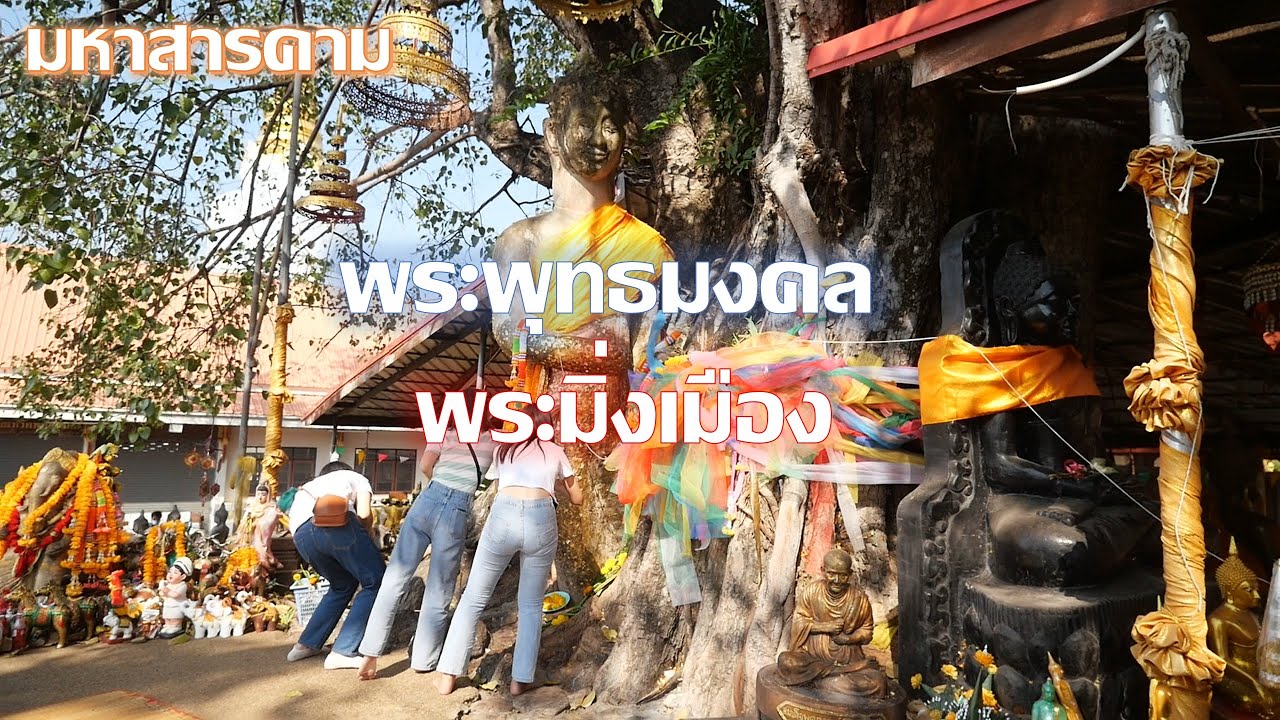
 Click to Access the Navigation Map GPS
Phra Yuen Mongkhon and Phra Buddha Ming Mueang Map

 Art, Culture and Heritage
 Historical Sites and Monuments(4)
 Art, Craft Centres, Tradition(5)
 Museums(3)
 Temple(17)
Other Sacred Sites(7)
Temple(17)
Other Sacred Sites(7)
 Research and Development
 Royal Project(2)
 Suburban Living
 Village, Community(5)
 Nature and Wildlife
 National Parks and Marine Reserves(3)
 Dam, Reservoir, Lake(10)
 River, Canal(2)
 Bays and Beaches(2)
 Other natural attractions(2)
 Entertainment and Agricultural
 Farms, Parks and Ecotourism(3)
 Travel Articles, Recipes
 Food Menu, Northeastern Recipes(1)


