
lovethailand home >Northeastern Travel Attractions >Loei Travel Attractions >Wang Saphung >Wang Saphung > Sandstone Sema Stones of Ban Pak Baeng and Ban Na ..
TL;DR: Sandstone Sema Stones of Ban Pak Baeng and Ban Na Lak is located at Ban Pak Baeng and Ban Na Lak, Wang Saphung Subdistrict, Wang Saphung District, Loei Province, open Daily, hours 06.00 – 18.00.
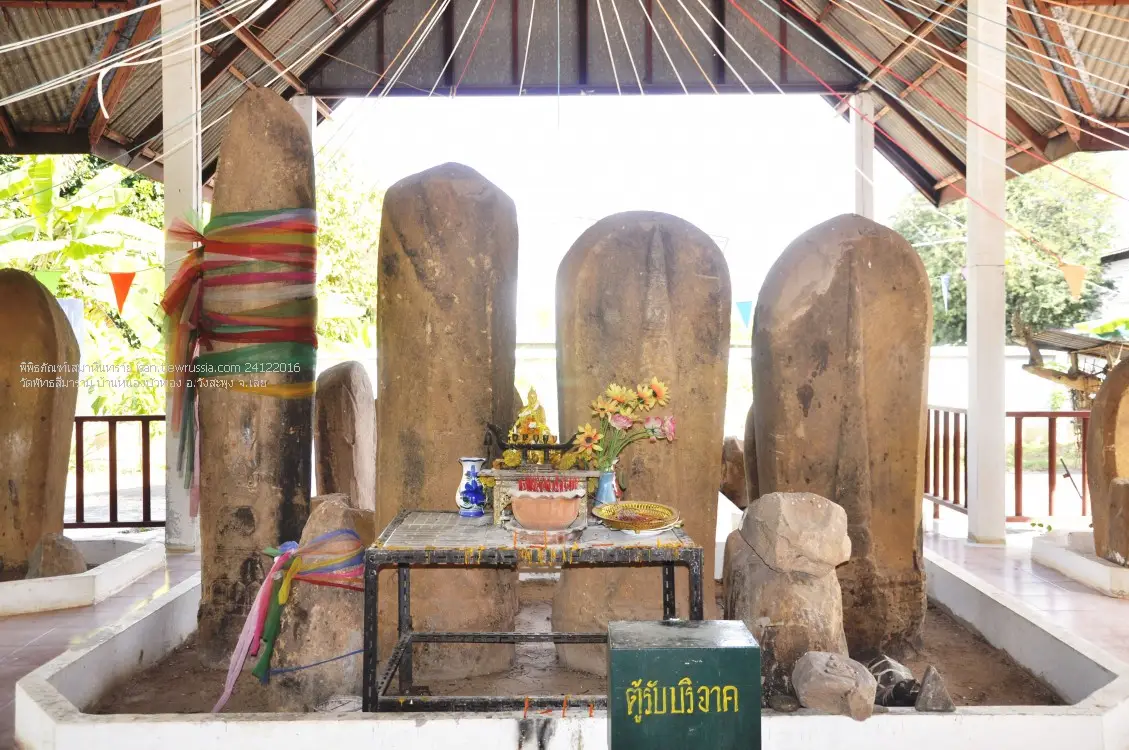
Sandstone Sema Stones of Ban Pak Baeng and Ban Na Lak
Open Days: Daily
Opening Hours: 06.00 – 18.00
The Sandstone Sema Stones of Ban Pak Baeng and Ban Na Lak are important cultural and archaeological remains in Wang Saphung District, Loei Province, not in Khon Kaen Province. The two old villages are located in Wang Saphung Subdistrict, about 4 km apart, with Ban Na Lak to the north and Ban Pak Baeng to the south. Both communities are situated along the Loei River, a natural waterway that has long supported local settlement and cultural life. The importance of this site lies in the discovery of ancient sandstone sema stones, or Buddhist boundary stones, which reflect religious belief, artistic influence, and the long cultural history of the upper northeastern region of Thailand.
The sema stones at Ban Pak Baeng and Ban Na Lak are not large entertainment-style attractions. They are quiet historical evidence that requires careful observation and an interest in cultural meaning. A sema stone is traditionally connected with sacred Buddhist space. It may mark a religious boundary or relate to an area used for ritual purposes. When such stones are found in old riverside communities, they suggest that the area was not merely a settlement but also a place where belief, ritual, and artistic expression were present. This makes the stones valuable even though the physical site may appear modest at first glance.
Ban Pak Baeng and Ban Na Lak are old villages along the Loei River. Rivers were important for ancient communities because they provided water, supported agriculture, allowed movement, and connected settlements. The discovery of sandstone sema stones in this riverside landscape helps visitors imagine how people in the past lived, worshipped, and organized sacred space. The present-day villages may look ordinary, but beneath that ordinary appearance lies a deep historical layer connected with Buddhism and early regional art.
The sema stone at Ban Pak Baeng was first discovered in late 1965. Its artistic features are especially interesting. The stone has a lotus motif carved on the base and a stupa-like form placed in the center of the sema slab. The upper part resembles a conical finial similar to stupa or chedi forms found in many parts of northeastern Thailand. This composition clearly reflects Buddhist symbolism. The lotus is associated with purity and spiritual awakening, while the stupa or chedi represents sacred memory, relic worship, and devotion to the Buddha. The combination of these motifs makes the Ban Pak Baeng sema stone highly meaningful as a religious and artistic object.
The sema stones at Ban Na Lak are simpler but equally important. They were described as a pair of upright sandstone sema stones with raised forms near the top resembling stupas, but without decorative patterns. This simplicity is valuable because it shows another side of ancient craftsmanship. Not every ancient object was highly decorated. Some were made with minimal visual elements, focusing on the essential symbol rather than elaborate ornamentation. The Ban Na Lak sema stones therefore help visitors understand that Buddhist boundary stones in Isan can vary greatly in style, detail, and function.
In 1976, one of the Ban Na Lak sema stones was moved to the Khon Kaen National Museum for preservation. As a result, only one of the original pair remains in the original location. This connection between the local site and the museum is important. The village preserves the original context where the stone was found, while the museum provides a controlled environment for conservation and scholarly study. Visitors who are especially interested in sema stones can gain a fuller understanding by considering both the original community context and the museum context together.
Many sema stones found in northeastern Thailand are associated with Dvaravati and Lopburi artistic traditions. These traditions are important for understanding how Buddhism, art, and cultural influence spread through the region. Some sema stones have carvings of stupas, lotuses, Jataka scenes, Buddha images, or symbolic designs, while others are more plain. Comparing sema stones from different areas helps scholars and travelers see regional diversity. The Ban Pak Baeng and Ban Na Lak stones are part of this wider cultural network, showing that the upper Isan region had deep connections with Buddhist artistic development.
To appreciate the site properly, visitors should look beyond the stones themselves. The meaning of sema stones becomes clearer when viewed together with the landscape, the villages, the river, and the history of settlement. Ban Pak Baeng and Ban Na Lak are not isolated archaeological points. They are living communities where ancient evidence remains connected to present-day life. This is one of the most important aspects of visiting small archaeological sites in Thailand: the past and present often remain close to each other.
A visit to the sandstone sema stones may take around 30 minutes to 1 hour, depending on how much time visitors spend observing, photographing, and exploring the surroundings. Travelers with a deeper interest in history may want to spend longer, especially if they also visit related places in Wang Saphung. The site is best combined with nearby cultural attractions such as the Sandstone Sema Museum at Wat Phatthasimaram in Ban Nong Bua Thong, Sirindhorn Art Center, Phra Phutthabat Tham Pha Bing, and Wat Pa Sammanuson. Together, these sites create a route that includes archaeology, art, Buddhism, and local history.
The stones are especially suitable for visitors interested in archaeology, Buddhist art, Isan culture, and heritage travel. This is not a place for quick entertainment. It is a place for quiet learning. Standing before an old sandstone object in a village landscape gives a different feeling from reading about it in a book. Visitors can see the material, the weathered surface, the scale, and the marks of time. These details help make the past more tangible.
The relationship between the original site and Khon Kaen National Museum is also significant. Khon Kaen National Museum displays sema stones and stone sculptures from the upper northeastern region, allowing visitors to understand sema stones within a broader academic and museum framework. The local site provides the original cultural landscape, while the museum provides systematic preservation and interpretation. For serious cultural travelers, connecting both places can make the experience more complete.
Conservation behavior is very important at this site. Visitors should not climb, sit on, lean against, scratch, rub, or repeatedly touch the sema stones. Sandstone is vulnerable to natural erosion, and unnecessary physical contact can accelerate surface wear. Visitors should take photos from a respectful distance and avoid using hard objects to point, tap, or test the stone surface. Nothing should be moved from the site. The best way to study the stones is through careful visual observation and photography.
Visitors should also respect the local community. Ban Pak Baeng and Ban Na Lak are residential villages, not enclosed museum spaces. Travelers should park properly, avoid blocking house entrances, speak politely with residents, keep the area clean, and ask respectfully if they need local guidance. Cultural tourism is sustainable only when both the heritage objects and the community around them are treated with respect.
Getting There is easiest by private car or hired local transport. From Loei city, travel toward Wang Saphung District and continue into Wang Saphung Subdistrict. Use map keywords such as “Ban Pak Baeng,” “Ban Na Lak,” or the Thai name “เสมาหินทรายบ้านปากแบ่งและบ้านนาหลัก.” The two villages are about 4 km apart, so visitors should allow time to move between them. From Khon Kaen, travelers can drive toward Loei Province, then continue to Wang Saphung before entering the village areas.
Because the site is located in local village areas, public transport may not reach every point conveniently. Travelers without a private vehicle should first reach Wang Saphung town and then use a local taxi or hired vehicle. It is useful to show the Thai place name to the driver. Foreign visitors should note that this site is in Loei Province, while the connection to Khon Kaen comes from the preservation of one Ban Na Lak sema stone at Khon Kaen National Museum.
The best time to visit is in the morning or late afternoon. The weather is more comfortable, and the softer light helps reveal details on the stone surface. Midday can be hot, especially if the viewing area is exposed. Visitors should bring water, a hat, an umbrella, and comfortable walking shoes. Since this is an outdoor heritage site in a village setting, practical preparation is more important than expecting formal tourist facilities.
The main areas of interest can be understood as the Ban Pak Baeng sema point, the Ban Na Lak sema point, the riverside village landscape along the Loei River, the route connecting the two villages, and the related museum context at Khon Kaen National Museum. Visitors who want a deeper understanding should consider all of these elements. The physical stones show the material evidence, the villages show the cultural landscape, and the museum helps explain the broader importance of sema stones in northeastern Thailand.
The Ban Pak Baeng sema stone is notable for its carved lotus base and stupa-like central form. Visitors should observe the relationship between the base, central form, and upper finial. The Ban Na Lak stone, by contrast, is more restrained. Its raised form near the top resembles a stupa, but it lacks additional ornamentation. Comparing these two styles helps visitors understand how ancient Buddhist symbols could be expressed in both decorative and minimal forms.
For international travelers, the site provides a useful introduction to a cultural object that is not always familiar outside Thailand. A sema stone can be explained as a Buddhist boundary stone connected with sacred space. It is different from a statue or temple building, but it can be equally important in understanding how Buddhist communities organized ritual areas. The Ban Pak Baeng and Ban Na Lak stones are valuable because they connect art, belief, and local settlement in a rural riverside setting.
A good one-day route in Wang Saphung can begin with the sandstone sema stones in the morning, followed by the Sandstone Sema Museum at Wat Phatthasimaram, Sirindhorn Art Center, Phra Phutthabat Tham Pha Bing, or Wat Pa Sammanuson. This creates a cultural route that includes ancient stones, Buddhist heritage, contemporary art, and local community atmosphere. Travelers can then eat in Wang Saphung town and continue either to Loei city or other districts such as Chiang Khan or Phu Ruea.
Nearby restaurants in Wang Saphung include Na Wang Restaurant, Melody Coffee, Zaploei, Ahtee Shabu Buffet, Yot Nam, and Rim Bueng Coffee Bar. Accommodation options include Plus Hotel Loei, The Cozy Hotel, Rim Loei Homestay, Tonsak Loei Resort, and other local resorts in Wang Saphung. These nearby services make it possible to build a comfortable heritage route without needing to return immediately to Loei city.
Although the sandstone sema stones of Ban Pak Baeng and Ban Na Lak form a small heritage site, their value is substantial. They are not newly created tourist objects but surviving traces of earlier religious and artistic life. The stones preserve evidence of Buddhist symbolism, local settlement, and Isan artistic traditions. Visitors who approach the site with patience and respect will find that it offers a quiet but meaningful connection to the past.
In conclusion, the sandstone sema stones of Ban Pak Baeng and Ban Na Lak in Loei Province are important archaeological and cultural remains in Wang Saphung District. Ban Pak Baeng is known for its lotus-base carving and stupa-like central motif, while Ban Na Lak is known for its paired sema stones with a simple raised stupa-like form. One Ban Na Lak stone was moved to Khon Kaen National Museum in 1976 for preservation, while the original villages remain important as the discovery context. For travelers interested in Buddhist art, Isan history, and quiet heritage destinations, this site offers a meaningful way to understand the cultural depth of the Loei River region.
| Name | Sandstone Sema Stones of Ban Pak Baeng and Ban Na Lak |
| Location | Ban Pak Baeng and Ban Na Lak, Wang Saphung Subdistrict, Wang Saphung District, Loei Province |
| Area Description | Old riverside villages along the Loei River; Ban Na Lak lies to the north and Ban Pak Baeng to the south, about 4 km apart |
| Highlights | Ancient sandstone Buddhist boundary stones; Ban Pak Baeng has a lotus-base carving and central stupa motif, while Ban Na Lak has paired sema stones with a simple raised stupa-like form |
| History / Period | The Ban Pak Baeng sema stone was first discovered in late 1965. The sema stones in this group are associated with Dvaravati and Lopburi artistic traditions in northeastern Thailand |
| Cultural Significance | Evidence of Buddhist sacred space, religious symbolism, and ancient artistic traditions in the Loei River community landscape |
| Preservation Information | In 1976, one Ban Na Lak sema stone was moved to Khon Kaen National Museum for preservation, leaving one stone in the original location |
| Travel Information | From Loei city, travel to Wang Saphung District and continue into Wang Saphung Subdistrict. Use a private car or hired local vehicle and search for the Thai name “เสมาหินทรายบ้านปากแบ่งและบ้านนาหลัก” or the village names on a map application |
| Current Status | A local archaeological and cultural learning site in Wang Saphung District, Loei Province |
| Open Days | Daily |
| Opening Hours | 06.00 – 18.00 |
| Admission Fee | No Admission Fee |
| Facilities | Village-area heritage site; visitors should prepare drinking water, a hat, an umbrella, and use food or accommodation services in Wang Saphung town |
| Main Areas / Zones | Ban Pak Baeng sema point, Ban Na Lak sema point, Loei River village landscape, route between the two villages, and related learning context at Khon Kaen National Museum |
| Caretaker / Local Authority | Local communities of Ban Pak Baeng and Ban Na Lak in Wang Saphung Subdistrict; local information can be requested through Wang Saphung Municipality or Wang Saphung Subdistrict Administrative Organization. The museum-preserved stone is under Khon Kaen National Museum, Fine Arts Department |
| Main Contact Number | Wang Saphung Municipality Tel. 042-841393, 042-842135 / Wang Saphung SAO Tel. 042-810950 / Khon Kaen National Museum Tel. 043-246170 |
| Official Website / Official Page | www.wangsaphung.go.th / www.wangsapunglocal.go.th / www.finearts.go.th/khonkaenmuseum |
| Nearby Tourist Attractions | 1. Sandstone Sema Museum, Wat Phatthasimaram, Ban Nong Bua Thong, about 3 km 2. Sirindhorn Art Center, Si Songkhram School, about 5 km, Tel. 089-862-5806 3. Phra Phutthabat Tham Pha Bing, about 8 km 4. Luang Pu Lui Chanthasaro Chedi Museum, about 8 km 5. Wat Pa Sammanuson, about 16 km 6. Phu Bo Bit, Loei Province, about 28 km |
| Nearby Restaurants | 1. Na Wang Restaurant, Wang Saphung, about 4 km, Tel. 042-841-418 2. Melody Coffee, Wang Saphung, about 5 km, Tel. 042-810-567 3. Zaploei Wang Saphung, about 5 km, Tel. 080-684-8959 4. Ahtee Shabu Buffet Wang Saphung, about 5 km, Tel. 097-320-2878, 092-249-7588 5. Yot Nam, Wang Saphung, about 5 km, Tel. 080-832-0950 6. Rim Bueng Coffee Bar, Wang Saphung, about 6 km, Tel. 093-418-5636 |
| Nearby Accommodations | 1. Plus Hotel Loei, about 4 km 2. The Cozy Hotel Wang Saphung, about 5 km 3. Rim Loei Homestay Wang Saphung, about 5 km, Tel. 098-923-9808, 081-234-9859 4. Tonsak Loei Resort, about 6 km, Tel. 093-546-3633 5. Tonsak Loei Resort & Hotel, about 6 km 6. Suan Lamyai Resort Wang Saphung, about 8 km |
Frequently Asked Questions (FAQ)
Q: Where are the sandstone sema stones of Ban Pak Baeng and Ban Na Lak located?
A: They are located in Wang Saphung Subdistrict, Wang Saphung District, Loei Province. Ban Na Lak lies to the north and Ban Pak Baeng to the south, about 4 km apart.
Q: Are these sema stones in Khon Kaen or Loei?
A: The original site is in Loei Province. The Khon Kaen connection is that one Ban Na Lak sema stone was moved to Khon Kaen National Museum for preservation in 1976.
Q: What is special about the Ban Pak Baeng sema stone?
A: It has a carved lotus base and a stupa-like motif in the center of the sema slab, with an upper form resembling a chedi finial found in ancient Isan art.
Q: What is special about the Ban Na Lak sema stone?
A: Ban Na Lak is known for paired sandstone sema stones with a simple raised stupa-like form near the top and no additional decorative patterns. One stone remains in the original location.
Q: What are the opening hours?
A: The site is open daily from 06.00 to 18.00.
Q: Is there an admission fee?
A: No. There is no admission fee, but visitors should respect the local community and avoid touching, climbing, or damaging the sema stones.
Q: What nearby places can be visited in the same trip?
A: Nearby places include the Sandstone Sema Museum at Wat Phatthasimaram, Sirindhorn Art Center, Phra Phutthabat Tham Pha Bing, Wat Pa Sammanuson, and attractions in Loei city.
Q: What should visitors prepare before visiting?
A: Visitors should use a private car or hired local transport, bring drinking water, wear comfortable shoes, and observe the stones carefully without touching or moving any part of the heritage site.
 Category: ●Art, Culture and Heritage
 Group: ●Historical Sites and Monuments
Last Update : 1 MonthAgo
 Last Update : 1 MonthAgo
 Click to Access the Navigation Map GPS
Sandstone Sema Stones of Ban Pak Baeng and Ban Na Lak Map
Recommend
 Historical Sites and Monuments(2)
 Landmarks and Memorials(3)
 Art, Craft Centres, Tradition(2)
 Museums(4)
 Art Gallery(1)
 Educational Places
 Educational Gardens, Farm(2)
 Places of Worship
 Temple(16)
 Other Sacred Sites(8)
 Research and Development
 Royal Project(3)
 Suburban Living
 Village, Community(3)
 Local Market(1)
 Nature and Wildlife
 National Parks and Marine Reserves(5)
 Mountain (Doi)(10)
 Dam, Reservoir, Lake(7)
 Waterfalls(21)
 Caves(3)
 River, Canal(5)
 Bays and Beaches(1)
 Other natural attractions(1)
 Entertainment and Agricultural
 Farms, Parks and Ecotourism(8)
 Waterpark(1)
 Outdoor and Adventure Activities(2)


