
lovethailand home >Northeastern Travel Attractions >Khon Kaen Travel Attractions >Phu Wiang >Nai Muang > Phu Wiang Dinosaur Museum
TL;DR: Phu Wiang Dinosaur Museum is located at Nai Mueang Subdistrict, Wiang Kao District, Khon Kaen Province, open Tuesday – Sunday; Closed Every Monday, hours 09.30 – 16.30.
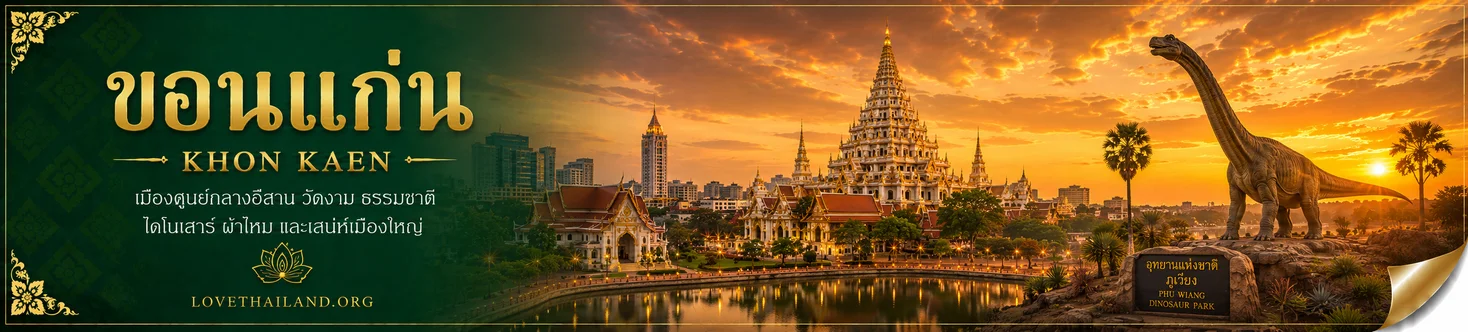
Phu Wiang Dinosaur Museum
Open Days: Tuesday – Sunday; Closed Every Monday
Opening Hours: 09.30 – 16.30
Phu Wiang Dinosaur Museum, officially known as The Dinosaur Research Centre and Museum, Khon Kaen Province, is located in Nai Mueang Subdistrict, Wiang Kao District, Khon Kaen Province. It is one of Thailand’s most important museums for fossils, geology, natural history, and dinosaur research. The museum is closely connected to the Phu Wiang mountain range, where the first dinosaur fossil in Thailand was discovered. For foreign travelers, families, students, and science lovers, this museum is one of the best places in northeastern Thailand to understand how dinosaurs, rocks, fossils, field research, and the geological history of Thailand are connected.
Phu Wiang Dinosaur Museum is part of the Phu Wiang Dinosaur Fossil Research Centre. It was established through cooperation between the Tourism Authority of Thailand, Khon Kaen Province, and the Department of Mineral Resources. Its purpose is to study dinosaur fossils, preserve geological heritage, support scientific research, and share knowledge about earth science and natural resources with the public. The museum building is divided into three main functional parts: the service area, the academic area, and the exhibition area. This structure allows the museum to serve both ordinary visitors and researchers.
What makes Phu Wiang Dinosaur Museum especially meaningful is that it is not a museum separated from its landscape. It stands near real fossil discovery sites in the Phu Wiang area, where important dinosaur remains were found in rock layers. The museum therefore helps visitors understand the local environment, the scientific importance of the area, and the story of Thai dinosaurs in one place. It is not simply a display of dinosaur models. It is a learning centre built on real scientific discoveries.
The story of Thai dinosaurs began at Phu Wiang in 1976, when Sutham Yaemniyom, a geologist of the Department of Mineral Resources, discovered the first dinosaur fossil in Thailand while surveying uranium in the Huai Pratu Ti Ma area of Phu Wiang National Park. The fossil was part of the lower end of a thigh bone from a large plant-eating sauropod dinosaur. This discovery became a turning point for Thai paleontology, because it proved that Thailand had significant dinosaur fossil evidence and deserved systematic scientific investigation.
In 1981, dinosaur exploration in the Phu Wiang area became more systematic. Thai geologists and French specialists conducted field surveys and found many fossils, including bones of large herbivorous dinosaurs, teeth of carnivorous dinosaurs, crocodile teeth, turtle shells, ancient fish teeth, and fish scales. These discoveries showed that Phu Wiang was once part of a rich prehistoric ecosystem. The area became one of the most important fossil localities in Thailand and later led to the establishment of the museum and research centre.
Several dinosaur names associated with Phu Wiang have become important in Thai science. One of the best known is Phuwiangosaurus sirindhornae, a large long-necked herbivorous sauropod that became a symbol of Phu Wiang. Another important dinosaur is Siamotyrannus isanensis, a carnivorous dinosaur discovered from an excavation pit in Phu Wiang National Park. These dinosaurs show that Thailand has made real contributions to international paleontology, not only through local exhibitions but through scientific discovery and classification.
The museum exhibition is designed to guide visitors from the broad history of the universe to the specific story of Phu Wiang. This sequence helps visitors understand that fossils are not isolated objects. They are the result of long natural processes, including the formation of the universe, the birth of Earth, the creation of rocks and minerals, the evolution of life, environmental change, extinction, burial, fossilization, and scientific discovery. By the time visitors reach the Phu Wiang dinosaur section, they already understand the larger context of life on Earth.
The exhibition is divided into five main zones. Zone 1 presents the origin of the universe, the evolution of life, and the story of dinosaurs around the world. This section introduces visitors to the formation and destruction cycle of rocks, early life, Paleozoic fossils, and the rise of dinosaurs. It shows that before dinosaurs appeared, Earth had already passed through many stages of environmental change and biological evolution. This makes the dinosaur story easier to understand as part of the wider history of the planet.
Zone 1 also explains the extinction of dinosaurs about 65 million years ago. This is one of the most fascinating subjects for both children and adults. The exhibition introduces the idea that a major asteroid impact near present-day Mexico caused severe global environmental effects. This event contributed to the extinction of many life forms and marked the end of the age of dinosaurs. Learning about extinction helps visitors understand that life on Earth depends strongly on environmental conditions and that even dominant species can disappear when the planet changes dramatically.
Zone 2 is the heart of the museum because it focuses directly on dinosaurs from the Phu Wiang mountain range. This section presents the first dinosaur fossil discovered in Thailand, the history of geological surveys, a large map of nine excavation pits, and fossil examples found in the area. Visitors can see how the museum connects field discoveries, rock layers, excavation sites, and scientific interpretation. This zone makes it clear that paleontology requires careful fieldwork, mapping, observation, and laboratory analysis.
The Phu Wiang dinosaur zone also helps visitors understand that fossils are not just old bones. They are scientific evidence that can reveal the age of rock layers, ancient environments, animal behavior, food chains, and prehistoric ecosystems. The discovery of herbivorous dinosaurs, carnivorous dinosaurs, crocodiles, turtles, fish, and other ancient animals in the same region suggests that Phu Wiang once supported a diverse living environment very different from the landscape seen today.
Zone 3 introduces the fossil and geology laboratory. Visitors can observe the working environment of geologists and fossil specialists through a clear glass partition. This section is important because it shows that the work does not end after fossils are found in the field. Fossils must be cleaned, conserved, recorded, compared, studied, and stored properly. This zone helps visitors see paleontology as a careful scientific process that requires time, precision, and responsibility.
The laboratory zone is especially useful for young visitors who may be interested in scientific careers. It shows that becoming a paleontologist, geologist, or fossil specialist involves both fieldwork and laboratory work. Studying dinosaurs is not simply memorizing names. It requires observation, evidence, comparison, technical knowledge, and cooperation between scientists from different fields.
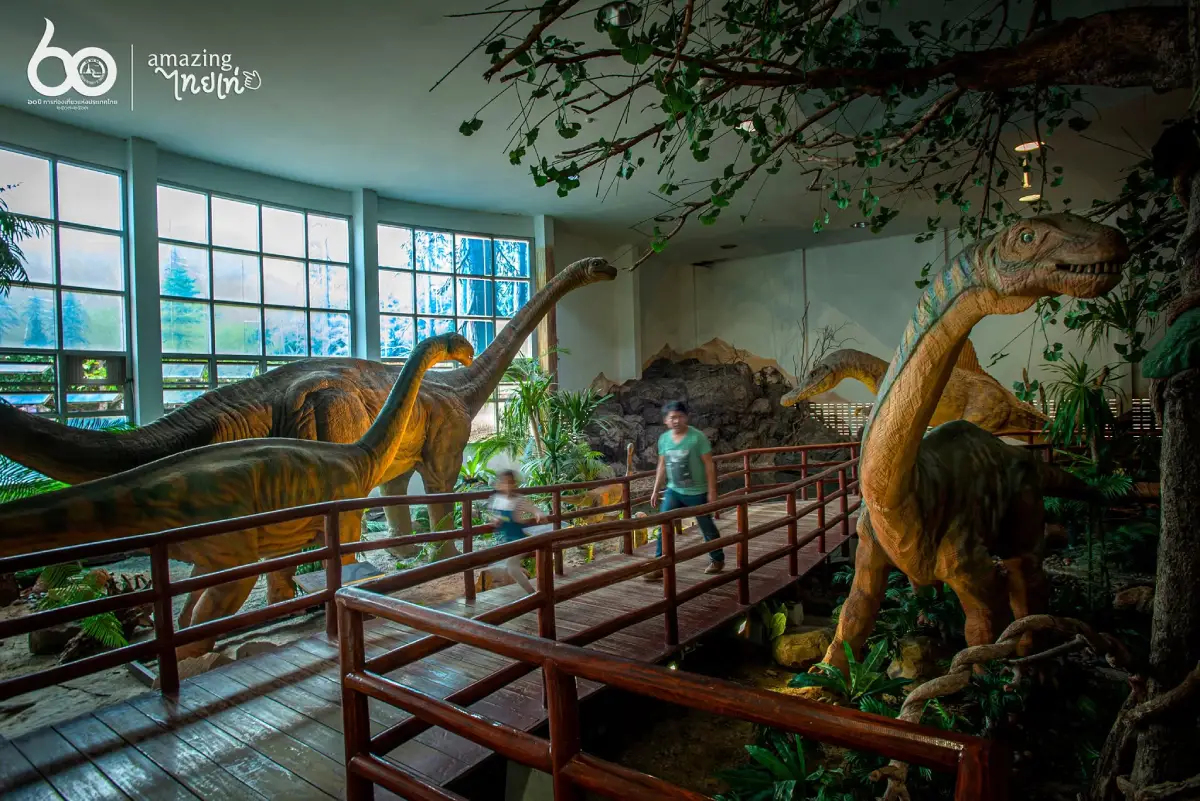
Zone 4 is the dinosaur garden, one of the most exciting areas for families and children. This zone is designed as a prehistoric forest with life-size dinosaur models, lighting, sound effects, and a simulated ancient atmosphere. The experience helps visitors imagine the world of dinosaurs more clearly. For children, seeing large dinosaur models can create curiosity and lead to deeper questions about dinosaur size, diet, habitat, movement, and extinction.
The dinosaur garden also connects entertainment with education. Parents can use the models to explain differences between herbivores and carnivores, the function of teeth, the meaning of long necks, body size, tails, claws, and other forms of adaptation. This type of visual learning helps young visitors enjoy science without feeling that they are studying a difficult subject.
Zone 5 presents the Tertiary period, the use of rocks and minerals, geological survey equipment, petroleum, geological hazards, and the royal tribute room honoring Her Royal Highness Princess Maha Chakri Sirindhorn. This zone expands the visitor’s understanding beyond dinosaurs. It shows that geology is important for everyday life, including construction, energy, natural resources, environmental safety, and disaster monitoring.
The royal tribute room in Zone 5 connects science with education and public knowledge. It reflects the importance of academic learning, science communication, and the role of knowledge in national development. This final zone helps visitors see the museum not only as a place about prehistoric animals but as a wider centre for earth science, natural resources, and public education.
In addition to the main exhibition zones, the museum includes research and support areas such as an exploration and research section, conservation area, specimen storage, a 140-seat meeting room, cafeteria, welfare shop, and souvenir shop. These facilities allow the museum to support visitors, school groups, researchers, educational activities, fossil conservation, and public outreach. This makes the museum a complete learning and research centre rather than a simple tourist attraction.
For families with children, Phu Wiang Dinosaur Museum is highly recommended. Children can see life-size dinosaur models, fossil displays, excavation maps, rock samples, and prehistoric dioramas. Parents can ask simple questions during the visit: What did dinosaurs eat? How did bones become fossils? Why did some dinosaurs have long necks? Why did dinosaurs become extinct? How do scientists know dinosaurs lived here? These questions help children develop scientific thinking through curiosity and observation.
For students, the museum is a strong field-learning destination. It connects science, earth science, biology, geology, geography, natural history, environmental studies, and conservation. Students can see how classroom knowledge is used in real places. Rock layers, fossils, excavation pits, maps, and laboratory work show that science is built from evidence. This makes the museum valuable for school trips, university visits, and independent learning.
For general travelers, the museum adds a deeper dimension to visiting Khon Kaen. Many people know Khon Kaen for temples, food, markets, shopping, and city life, but Phu Wiang reveals another side of the province: geological heritage and dinosaur science. A trip to Phu Wiang can be combined with Phu Wiang National Park, dinosaur excavation pits, Wat Tham Pha Koeng, Si Wiang Dinosaur Park, Pha Chom Tawan viewpoint, Tad Fa Waterfall, and local community attractions in Wiang Kao District.
The museum has also helped shape the identity of Khon Kaen Province. Dinosaurs, especially the long-necked Phuwiangosaurus, have become a recognizable symbol of the region. The museum strengthens this identity by showing that the dinosaur story is not a marketing image but a real scientific heritage based on fossil discoveries in the area. This makes Phu Wiang one of the most distinctive travel routes in northeastern Thailand.
Visitors should allow about 2 to 3 hours for a meaningful visit. Families with young children may spend extra time in the dinosaur garden, while science-focused visitors may want to read labels carefully and study the fossil information in more detail. The strength of the museum is not only its dinosaur models but also the scientific explanations behind them. A slower visit gives a much richer understanding of the Phu Wiang fossil story.
Visitors should follow basic museum etiquette. Fossils, display items, and models should not be touched or climbed on unless clearly permitted. Flash photography should be avoided in restricted areas. Visitors should keep noise under control, especially when school groups or guided tours are present. Groups should contact the museum in advance to arrange visits and guided activities, as staff can help explain the content more effectively for different age groups.
Getting There from Khon Kaen city is most convenient by private car or rental car. Take Highway 12 toward Chum Phae for about 48 km, then turn right onto Highway 2038 toward Phu Wiang and Wiang Kao District. Continue for about 25 km. The museum is located about 3 km before Phu Wiang National Park. Traveling by car allows visitors to combine the museum with nearby excavation sites, viewpoints, restaurants, cafés, and accommodations.
Visitors using public transport can travel from Khon Kaen city to Phu Wiang or Wiang Kao District and then continue by local transport or hired vehicle to the museum. This option is possible but requires advance planning, especially for the return journey. For families and school groups, private transport or a hired vehicle is usually more convenient and allows better control of time.
A good half-day itinerary begins with Phu Wiang Dinosaur Museum in the morning, followed by lunch in Wiang Kao or Phu Wiang. After that, visitors can continue to Phu Wiang National Park, the dinosaur excavation pits, or Wat Tham Pha Koeng. If there is more time, Pha Chom Tawan, Tad Fa Waterfall, and Rai Than Khun Phaendin can be added to the route. This creates a trip that combines science, nature, local food, and community atmosphere.
For a full-day trip, the museum can be used as the starting point for a geological and nature route in Khon Kaen. Begin with the museum to understand the dinosaur story, continue to Phu Wiang National Park to see the landscape related to the fossil discoveries, visit excavation sites, and then stop at scenic viewpoints or local cafés. This route is suitable for families, students, and foreign travelers who want a meaningful experience beyond ordinary sightseeing.
For foreign travelers, Phu Wiang Dinosaur Museum offers a different perspective on Thailand. Many visitors know Thailand for temples, beaches, food, and culture, but Phu Wiang shows that the country also has important geological and fossil heritage. The museum explains that northeastern Thailand once had ancient ecosystems where dinosaurs lived. It is therefore an excellent stop for travelers interested in science, nature, family travel, and lesser-known cultural landscapes of Isan.
Phu Wiang Dinosaur Museum is more than a place for taking photos with dinosaur models. It is a centre where fossils tell the story of Earth, ancient life, changing environments, scientific discovery, and Thai geological heritage. For anyone who wants to understand Khon Kaen with more depth, this museum is one of the most important educational attractions in the province.
| Name | Phu Wiang Dinosaur Museum / The Dinosaur Research Centre and Museum, Khon Kaen Province |
| Thai Name | พิพิธภัณฑ์ไดโนเสาร์ภูเวียง / ศูนย์ศึกษาวิจัยและพิพิธภัณฑ์ไดโนเสาร์ จังหวัดขอนแก่น |
| Location | Nai Mueang Subdistrict, Wiang Kao District, Khon Kaen Province |
| Address | The Dinosaur Research Centre and Museum, Nai Mueang Subdistrict, Wiang Kao District, Khon Kaen 40150, Thailand |
| Coordinates | 16.679074, 102.267133 |
| Highlights | Thailand’s first dinosaur museum, featuring fossils, geology, natural history, life-size dinosaur models, and the story of dinosaur discoveries in the Phu Wiang mountain range |
| History | Thailand’s first dinosaur fossil was discovered in Phu Wiang in 1976. Systematic exploration began in 1981, and the Phu Wiang Dinosaur Research Centre and Museum opened in 2001. |
| Name Origin | The museum is named after Phu Wiang, the important fossil discovery area that became the starting point of dinosaur research in Thailand. |
| Distinctive Features | The museum building includes a service area, academic area, and exhibition area, together with research, conservation, specimen storage, meeting, cafeteria, welfare shop, and souvenir facilities. |
| Key Evidence | Phu Wiang dinosaur fossils, a map of nine excavation pits, fossil examples from Khon Kaen Province, dinosaur models, and information on Thai dinosaurs such as Phuwiangosaurus sirindhornae and Siamotyrannus isanensis |
| Main Areas / Zones | 1. Origin of the Universe, Evolution of Life, and Dinosaurs Around the World Zone 2. Dinosaurs of the Phu Wiang Mountain Range Zone 3. Fossil, Geology, and Khon Kaen Fossil Laboratory Zone 4. Dinosaur Garden Zone 5. Tertiary Period, Rocks and Minerals, Geological Hazards, and Royal Tribute Room Honoring Her Royal Highness Princess Maha Chakri Sirindhorn Zone |
| Travel Information | From Khon Kaen city, take Highway 12 toward Chum Phae for about 48 km, then turn right onto Highway 2038 toward Phu Wiang and Wiang Kao District for about 25 km. The museum is located about 3 km before Phu Wiang National Park. |
| Current Status | Open |
| Open Days | Tuesday – Sunday; Closed Every Monday |
| Opening Hours | 09.30 – 16.30 |
| Fees | Thai Visitors: Children 10 Baht, Adults 20 Baht / Foreign Visitors: Children 30 Baht, Adults 60 Baht |
| Facilities | Exhibition areas, 140-seat meeting room, cafeteria, welfare shop, souvenir shop, academic section, conservation area, specimen storage, and guided visit services by arrangement |
| Caretaker | Department of Mineral Resources, Ministry of Natural Resources and Environment |
| Director | Dr. Pradit Nule |
| Main Contact Number | 081-846-2760 Office, 081-845-8628 Activities / Guided Visits, 043-438-204 |
| pw_dino@hotmail.com | |
| Official Website / Official Page | Department of Mineral Resources Website: dmr.go.th Museum Service System: e-service.dmr.go.th/rcmk Facebook: Phu Wiang Dinosaur Museum, Department of Mineral Resources - PWDM |
| Nearby Tourist Attractions | 1. Phu Wiang National Park, about 3 km 2. Rai Than Khun Phaendin, about 3 km 3. Wat Tham Pha Koeng, about 6 km 4. Si Wiang Dinosaur Park, about 8 km 5. Phu Wiang Dinosaur Excavation Pits, about 9 km 6. Pha Chom Tawan, Phu Wiang National Park, about 12 km 7. Tad Fa Waterfall, Phu Wiang National Park, about 16 km |
| Nearby Restaurants | 1. DinoFe' Dinosaur Coffee, about 1 km, Tel. 080-230-9268 2. Kiangna Cafe Wiang Kao, about 2 km, Tel. 089-621-6294 3. Khao Kaeng Pak Tai Nai Phu, about 7 km, Tel. 089-572-9353 4. Krua Boonma Phu Wiang, about 14 km, Tel. 092-495-4525 5. Ma De' Phu Wiang, about 15 km, Tel. 092-659-8598 6. Flowbrew Coffee | Vibes, about 16 km, Tel. 096-268-3232, 094-369-9455 |
| Nearby Accommodations | 1. PhuaomVille, about 1 km, Tel. 098-585-7446, 089-943-6603 2. Rai Than Khun Phaendin, about 3 km, Tel. 089-939-7122 3. Pitchaya Ville Resort, about 14 km, Tel. 080-831-7399 4. Phuwiang Grand Hotel, about 17 km, Tel. 093-989-7180 5. The Pool Resort Phu Wiang, about 18 km, Tel. 098-280-7106, 098-280-7100 6. Pruksa Gardenhouse Hotel, about 19 km, Tel. 043-291-639 |
Frequently Asked Questions (FAQ)
Q: Where is Phu Wiang Dinosaur Museum located?
A: Phu Wiang Dinosaur Museum is located in Nai Mueang Subdistrict, Wiang Kao District, Khon Kaen Province. It is about 3 km before Phu Wiang National Park and about 80 – 90 km from Khon Kaen city by road.
Q: What are the opening days and hours of Phu Wiang Dinosaur Museum?
A: The museum is open from Tuesday to Sunday, from 09.30 to 16.30, and is closed every Monday.
Q: How much is the admission fee?
A: The admission fee is 10 Baht for Thai children, 20 Baht for Thai adults, 30 Baht for foreign children, and 60 Baht for foreign adults.
Q: What can visitors see inside Phu Wiang Dinosaur Museum?
A: Visitors can see exhibitions on the origin of the universe, evolution of life, dinosaurs around the world, Phu Wiang dinosaurs, nine excavation pits, fossil laboratories, life-size dinosaur models, a dinosaur garden, rocks, minerals, and geological hazards.
Q: Is Phu Wiang Dinosaur Museum suitable for children?
A: Yes. It is highly suitable for children because it has dinosaur models, fossil displays, a dinosaur garden, and easy-to-understand exhibitions that introduce prehistoric life, fossils, geology, and science through real experiences.
Q: How long should visitors spend at the museum?
A: Visitors should allow about 2 to 3 hours to explore the main exhibitions, dinosaur garden, laboratory area, and information about the Phu Wiang fossil discovery sites at a comfortable pace.
Q: How can visitors get to Phu Wiang Dinosaur Museum from Khon Kaen city?
A: From Khon Kaen city, take Highway 12 toward Chum Phae for about 48 km, then turn right onto Highway 2038 toward Phu Wiang and Wiang Kao District for about 25 km. The museum is about 3 km before Phu Wiang National Park.
Q: What nearby attractions can visitors combine with the museum?
A: Nearby attractions include Phu Wiang National Park, Phu Wiang Dinosaur Excavation Pits, Wat Tham Pha Koeng, Si Wiang Dinosaur Park, Pha Chom Tawan, Tad Fa Waterfall, and Rai Than Khun Phaendin.
 Category: ●Educational Places
 Group: ●Museum for Study
Last Update : 3 MonthAgo
 Last Update : 3 MonthAgo
 Click to Access the Navigation Map GPS
Phu Wiang Dinosaur Museum Map
Recommend

 Art, Culture and Heritage
 Historical Sites and Monuments(7)
 Landmarks and Memorials(3)
 Art, Craft Centres, Tradition(2)
 Museums(4)
Museum for Study(2)
Museums(4)
Museum for Study(2)
 Places of Worship
 Temple(27)
 Other Sacred Sites(5)
 Suburban Living
 Village, Community(3)
 Local Market(1)
 Nature and Wildlife
 National Parks and Marine Reserves(5)
 Mountain (Doi)(1)
 Dam, Reservoir, Lake(4)
 Waterfalls(8)
 Caves(9)
 River, Canal(10)
 Bays and Beaches(3)
 Islands(1)
 Other natural attractions(5)
 Entertainment and Agricultural
 Zoos and Aquariums(2)
 Animal camps and shows(2)
 Farms, Parks and Ecotourism(7)
 Waterpark(3)
 Travel Articles, Recipes
 Travel Review, Food Review(1)


