lovethailand home >Northeastern Travel Attractions >Khon Kaen Travel Attractions >Puai Noi >Kham Pom > Prasat Pueai Noi
TL;DR: Prasat Pueai Noi is located at Ban Hua Khua, Mu 1, Pueai Noi Subdistrict, Pueai Noi District, Khon Kaen Province, open Daily, hours No specific opening and closing hours stated.
Prasat Pueai Noi
Open Days: Daily
Opening Hours: No specific opening and closing hours stated
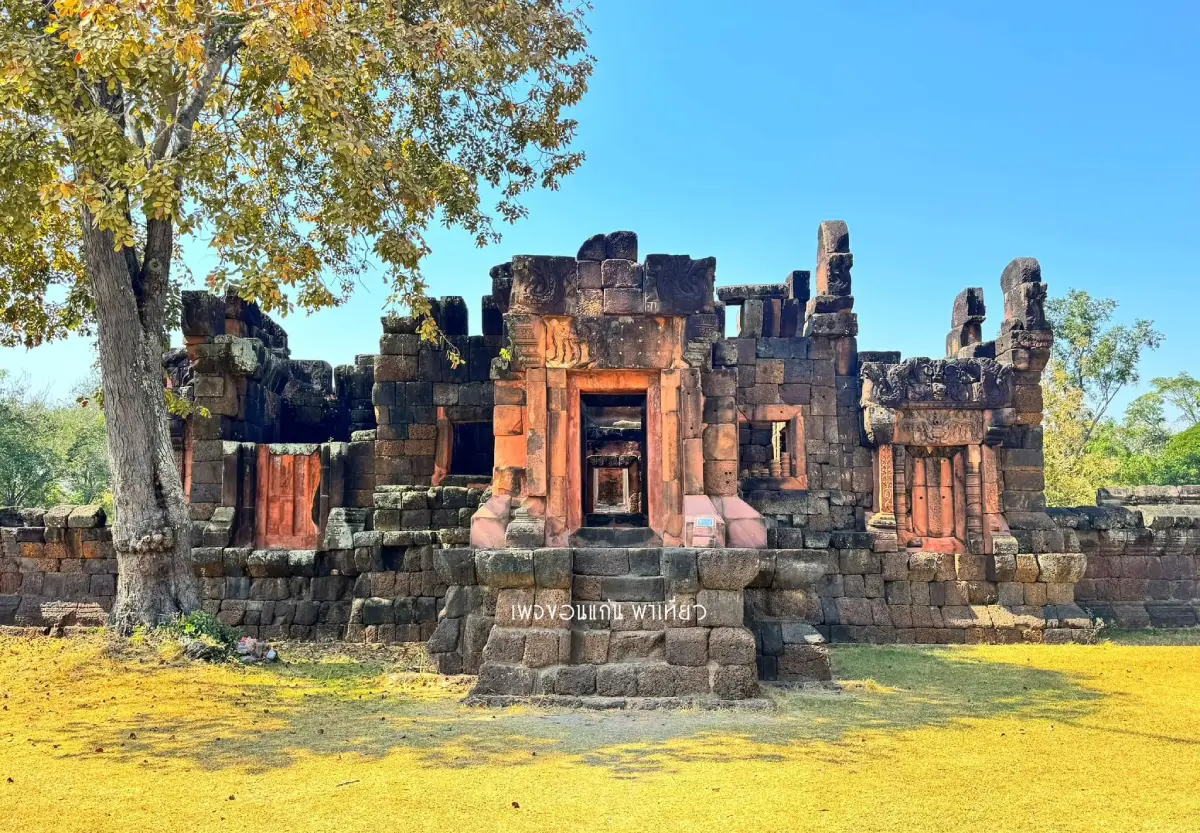
Prasat Pueai Noi, also known locally as Phra That Ku Thong, is one of the most important Khmer sanctuaries in Khon Kaen Province. Located at Ban Hua Khua, Mu 1, Pueai Noi Subdistrict, Pueai Noi District, this ancient monument may not be as large as Phimai Historical Park, Phanom Rung, or other major Khmer temples in the lower Northeast, but it is widely regarded as one of the most complete Khmer sanctuaries in the upper northeastern region of Thailand. Built around the 16th–17th Buddhist centuries, it served as a Hindu religious sanctuary and shows a refined blend of ancient Khmer artistic styles, especially the Baphuon and Angkor Wat traditions. The site is known for its symbolic Mount Meru layout, brick towers, laterite base, sandstone carvings, library building, gopuras, enclosure wall, moat, and beautifully preserved decorative elements such as the reclining Vishnu lintel and the naga pediment.
For foreign travelers who want to understand Khon Kaen beyond the modern city, markets, reservoirs, and Buddhist temples, Prasat Pueai Noi offers a deep historical experience. It reveals the cultural connection between this part of northeastern Thailand and the ancient Khmer world. The sanctuary stands in a small district town, close to Wat That Ku Thong and the local community, making it different from isolated archaeological parks. Visitors can see how an ancient Hindu monument continues to exist within a living Isan community, surrounded by local traditions, Buddhist temple life, and annual cultural festivals.
The name “Prasat Pueai Noi” comes from the district and subdistrict where the monument is located. The local name “Phra That Ku Thong” reflects the community’s respect for the sanctuary. In Isan usage, “ku” often refers to an ancient sanctuary or ruin, especially one connected with Khmer architecture. “Thong” means gold and suggests sacred value, auspiciousness, and local pride. The name therefore shows that the monument is not viewed only as an old structure. It is a cultural treasure, a sacred landmark, and a symbol of Pueai Noi identity.
Historically, Prasat Pueai Noi is believed to have been built around the 16th–17th Buddhist centuries, roughly 800 years ago. This was a period when Khmer cultural, religious, and artistic influence spread widely across northeastern Thailand. The sanctuary was created as a Hindu shrine, and scholars have discussed whether its religious orientation was connected mainly with Vaishnavism, which centers on Vishnu, or with Shaivism, which centers on Shiva. This discussion comes from the variety of artistic evidence at the site. The famous reclining Vishnu lintel points strongly to Vaishnava imagery, while the overall temple-mountain concept and Khmer religious setting can also be understood within the broader Hindu world.
The architectural plan of Prasat Pueai Noi is deeply symbolic. Like many Khmer sanctuaries, it represents Mount Meru, the sacred cosmic mountain believed to be the center of the universe and the dwelling place of the gods. This idea transforms the sanctuary into a religious landscape. The central tower, surrounding structures, enclosure wall, entrances, and moat all work together to create a symbolic universe. Walking into the site from the east is therefore not simply a physical movement. It is a symbolic passage from the ordinary world toward sacred space.
The main group of buildings consists of 3 brick towers standing on the same laterite base and facing east, which is the traditional direction for many Khmer religious monuments. The central tower functions as the principal shrine, while the side towers support the overall sacred composition. Within the enclosure, there is also a bannalai or library building located toward the southeast. The sanctuary has gopuras, or entrance pavilions, on the eastern and western sides, and an enclosing laterite wall surrounds the sacred precinct. Outside the wall, a horseshoe-shaped moat completes the cosmic and spatial design.
The construction materials of Prasat Pueai Noi include laterite, sandstone, and brick. Laterite was used for the base, wall, and structural elements requiring strength. Sandstone was used for doorframes, decorative pillars, lintels, pediments, and carved details. Brick was used for the main towers. Each material had a specific role, reflecting the skill and planning of ancient builders. The visual character of the monument comes from the contrast between the reddish brick, the rough laterite, and the refined sandstone carvings.
The principal tower is the symbolic heart of the sanctuary. Its pediment is carved with a beautiful naga motif, showing the importance of the serpent in Khmer religious art. The naga is associated with water, protection, fertility, sacred power, and the connection between the human and divine worlds. At Prasat Pueai Noi, the naga decoration is more than ornament. It helps mark the shrine as a sacred structure and gives the monument one of its most memorable artistic features.
The reclining Vishnu lintel is one of the most significant and admired works of art at Prasat Pueai Noi. The scene depicts Vishnu reclining on the serpent Ananta in the cosmic ocean, a powerful image connected with creation, preservation, and the renewal of the universe. The relatively well-preserved condition of this lintel makes it an important example of Khmer sandstone carving in Khon Kaen. For visitors, it is one of the clearest visual clues that the sanctuary was connected with Hindu religious concepts.
The eastern and western gopuras are important because they control movement into and out of the sacred enclosure. The side walls of the gopuras include window openings, creating rhythm and architectural balance. These gateways were not merely practical doors. They defined the ceremonial sequence of the sanctuary. Entering from the east allows visitors to follow the original sacred axis, moving from the outside world through the gateway toward the central shrine.
The enclosing wall, or kamphaeng kaeo in Thai, is built of laterite and has a base decorated in the form of inverted and upright lotus mouldings. Some laterite blocks were shaped into moulded bands, adding architectural refinement to what might otherwise appear to be a simple wall. In Khmer sacred architecture, an enclosure wall separates ordinary space from sacred space. At Prasat Pueai Noi, the wall helps visitors understand the sanctuary as a complete religious plan rather than a collection of isolated ruins.
The library building, or bannalai, stands in the southeastern area of the enclosure. Buildings of this type are often interpreted as places for sacred texts, ritual objects, or ceremonial functions. Although the exact use of the building in the past cannot be reconstructed completely, its position and form are typical of Khmer religious architecture. The presence of a library building shows that Prasat Pueai Noi was carefully planned and followed the architectural conventions of ancient Khmer sanctuaries.
The horseshoe-shaped moat surrounding the sanctuary is also important. In Hindu and Khmer cosmology, water can represent the cosmic ocean, purification, fertility, and the boundary between sacred and ordinary space. The moat therefore has symbolic meaning as well as environmental and practical functions. Visitors who look only at the towers may miss this wider landscape meaning. The monument should be understood together with its water system, enclosure, approach, and surrounding community.
In front of the sanctuary to the east is an elevated platform area and the nearby Sa Wong reservoir, both of which are part of the present-day landscape of Pueai Noi. These elements help connect the ancient monument with the modern town. After walking through the sanctuary, visitors can also spend time around Sa Wong Public Park, making the trip more relaxed and allowing them to experience the atmosphere of the local community.
Prasat Pueai Noi has been registered as an important national ancient monument and was significantly restored between 1989 and 1994. The restoration helped preserve the major structures and made the site more readable for modern visitors. Although some parts are damaged by time, the overall composition remains highly intact when compared with many Khmer sites in the upper Northeast. Continued care by the Fine Arts Department, the 8th Regional Office of Fine Arts in Khon Kaen, Pueai Noi Municipality, Wat That Ku Thong, and the local community keeps the monument accessible and meaningful.
Wat That Ku Thong lies beside the northern side of the sanctuary. This temple setting is important because it shows how the ancient Hindu monument has become part of a living Buddhist and community landscape. Local people visit the temple, take part in merit-making, and help care for the surrounding area. For foreign travelers, this relationship between ancient Khmer architecture and present-day Isan temple life is one of the most interesting aspects of the site.
The most important annual tradition connected with Prasat Pueai Noi is the Bun Ku festival, also known in recent cultural programs as “Shivaratri Puchaniyalai Prasat Pueai Noi.” It is held around the full moon of the 5th lunar month. The event includes religious rituals, cultural performances, historical light-and-sound presentations, and the phuk siao friendship ceremony, an important Isan tradition associated with Khon Kaen. This festival keeps the ancient sanctuary alive in the memory and identity of the local people.
The phuk siao tradition is especially meaningful in Isan culture. The word “siao” refers to a close friend or lifelong companion. The ceremony creates bonds of trust, friendship, and social solidarity. When it is held in connection with Prasat Pueai Noi, the ancient monument becomes more than an archaeological site. It becomes a cultural stage where community relationships are renewed and local identity is celebrated.
The historical performances during the festival help make the story of the sanctuary accessible to a wider audience. Through dance, music, lighting, and narrative, visitors can better imagine the meaning of Mount Meru, the Hindu shrine, the spread of Khmer culture, and the role of Pueai Noi as a community preserving its heritage. These contemporary cultural activities do not replace historical study; instead, they help the monument remain meaningful for younger generations.
A recommended way to explore Prasat Pueai Noi is to begin from the eastern side. This follows the main sacred axis of the original plan. Visitors should first observe the eastern gopura, then move into the enclosure to see the laterite wall, lotus mouldings, window openings, sandstone doorframes, brick towers, central shrine, library building, and carved details. After viewing the inner structures, they should walk around the outer area to understand the moat and the wider landscape.
There are several good photography points at the site. The front view through the eastern gopura frames the central shrine beautifully. The enclosure wall and window openings create strong architectural lines. The side view of the brick towers on the laterite base shows the monument’s mass and texture. Morning and late afternoon light bring out the warm colors of brick, laterite, and sandstone. Visitors who want to photograph carvings should avoid touching the stone surface and should keep a respectful distance from fragile elements.
Because the site is adjacent to Wat That Ku Thong and is respected by the local community, visitors should dress politely and behave carefully. Climbing on the towers, enclosure wall, laterite base, or loose stone elements should be avoided. Visitors should not scratch, move, or collect any fragments from the site. Keeping the area clean and quiet helps preserve the monument and respects both the archaeological value and the community’s spiritual connection to the place.
The best times to visit are in the morning and late afternoon. The weather is more comfortable, and the light makes the surface of the brick, laterite, and sandstone appear more vivid. Morning visits offer a quiet atmosphere for studying details, while late afternoon visits are good for photography. During the Bun Ku festival, the area becomes more lively with rituals and performances. Travelers who prefer a peaceful visit may choose a weekday outside the festival period.
Getting There from Khon Kaen city is easiest by private car or rental car. Take Highway 2 on the Khon Kaen–Ban Phai route for about 44 kilometers, then continue on Highway 23 on the Ban Phai–Borabue route for about 11 kilometers. From there, turn right toward Pueai Noi District and continue for about 24 kilometers. The sanctuary is located near Wat That Ku Thong and Route 2279. Public transportation is possible to nearby larger towns such as Ban Phai, but travelers will need local transport to reach the monument.
Upon arrival, visitors can park around Wat That Ku Thong or in areas arranged by the local community, then walk a short distance to the ancient monument. The site is relatively easy to walk around, but comfortable shoes are recommended because the ground includes soil, grass, stone, and uneven surfaces. Elderly visitors can enjoy the site if they move slowly and avoid stepping on fragile ancient remains.
Prasat Pueai Noi can be visited as a half-day trip from Ban Phai or as a full-day cultural trip from Khon Kaen city. Travelers can combine the site with Wat That Ku Thong, Sa Wong Public Park, and the ancient sandstone quarry at Ban Nong Tap Tao. Those who want to continue into nearby Maha Sarakham Province can also include Phra That Na Dun or Ku Santarat in the same wider cultural route.
The sandstone quarry at Ban Nong Tap Tao is particularly relevant to Prasat Pueai Noi. The quarry contains traces of ancient stone extraction, and the size and type of sandstone blocks have been associated with construction materials used at the sanctuary. Visiting both places helps travelers understand not only the finished monument but also the process behind it: selecting stone, cutting blocks, transporting materials, and carving architectural elements.
As a learning site, Prasat Pueai Noi helps reveal that Khon Kaen is not only a modern provincial center but also a region with deep historical layers. The sanctuary proves that the Pueai Noi area was once connected with the wider Khmer cultural world, including Hindu religion, temple architecture, sandstone carving, and cosmic symbolism. Seeing the monument in person makes this regional history easier to understand than reading about it in a textbook alone.
The site is suitable for many types of visitors. For archaeology enthusiasts, it offers a clear Khmer sanctuary plan. For art lovers, it provides important sandstone carvings from the transition between Baphuon and Angkor Wat styles. For families and students, it works as an outdoor classroom. For photographers, it offers rich textures, geometry, and warm natural light. For travelers interested in local culture, the Bun Ku festival, phuk siao ceremony, and Wat That Ku Thong community setting add living cultural depth.
The strength of Prasat Pueai Noi lies in the balance between architectural beauty and community life. The sanctuary has not been separated from the people around it. It remains linked to the temple, local festivals, and the identity of Pueai Noi District. This makes the visit feel authentic. Travelers do not simply look at ancient stones; they encounter a heritage site that local people still remember, protect, and celebrate.
In summary, Prasat Pueai Noi or Phra That Ku Thong is one of Khon Kaen’s most valuable historical destinations. Its brick towers, laterite base, sandstone carvings, reclining Vishnu lintel, naga pediment, gopuras, enclosure wall, moat, and annual Bun Ku festival together tell the story of Khmer civilization, Hindu cosmology, Isan community identity, and cultural continuity. A visit to this site is not just a stop at an old temple ruin. It is an opportunity to read centuries of history through a living cultural landscape in northeastern Thailand.
| Name | Prasat Pueai Noi, also known as Phra That Ku Thong |
| Location | Ban Hua Khua, Mu 1, Pueai Noi Subdistrict, Pueai Noi District, Khon Kaen Province |
| Address | Mu 1, Pueai Noi Subdistrict, Pueai Noi District, Khon Kaen 40340, near Wat That Ku Thong |
| Coordinates | 15.880050, 102.909064 |
| Highlights | One of the most complete Khmer sanctuaries in the upper Northeast, featuring a reclining Vishnu lintel, naga pediment, brick towers, library building, gopuras, enclosure wall, and horseshoe-shaped moat |
| History | Built around the 16th–17th Buddhist centuries as a Hindu sanctuary in ancient Khmer art, showing a transition from Baphuon to Angkor Wat styles |
| Name Origin | The name Prasat Pueai Noi comes from the local place name, while Phra That Ku Thong is the respectful local name used by the community for this ancient sanctuary |
| Distinctive Features | Three brick towers on a shared laterite base facing east, a library building in the southeastern area, laterite enclosure wall, eastern and western gopuras, and a surrounding moat |
| Key Evidence | Reclining Vishnu lintel, naga pediment, decorated door pillars, gopuras, enclosure wall, laterite base, library building, moat, and sandstone carved elements |
| Travel Information | From Khon Kaen, take Highway 2 toward Ban Phai for about 44 km, continue on Highway 23 for about 11 km, then turn right toward Pueai Noi District for about 24 km. |
| Current Status | Open to visitors as a nationally important ancient monument and historical attraction of Pueai Noi District |
| Open Days | Daily |
| Opening Hours | No specific opening and closing hours stated |
| Fees | No admission fee |
| Facilities | Parking area around Wat That Ku Thong, walking paths, information signs, worship area, nearby rest area around Sa Wong, and local shops in Pueai Noi town |
| Main Areas / Zones | 1. Eastern Gopura 2. Western Gopura 3. Main Prang 4. Subsidiary Towers 5. Library Building 6. Enclosure Wall 7. Horseshoe-Shaped Moat 8. Wat That Ku Thong Area 9. Sa Wong Reservoir Area |
| Abbot / Caretaker | Caretakers of the ancient monument: The 8th Regional Office of Fine Arts, Khon Kaen, together with Pueai Noi Municipality, Wat That Ku Thong, and the local community |
| Main Contact Number | Pueai Noi Municipality Tel. 043-494-119 8th Regional Office of Fine Arts, Khon Kaen Tel. 043-242-129 |
| Official Website / Official Page | Pueai Noi Municipality, 8th Regional Office of Fine Arts Khon Kaen, and Rak Prasat Pueai Noi page |
| Nearby Tourist Attractions | 1. Wat That Ku Thong, about 0 km 2. Sa Wong Public Park, about 1 km 3. Ban Nong Tap Tao Sandstone Quarry, about 12 km 4. Wat Si Hong, Pueai Noi District, about 2 km 5. Phra That Na Dun, Maha Sarakham Province, about 32 km 6. Ku Santarat, Maha Sarakham Province, about 37 km |
| Nearby Restaurants | 1. Mong Ni Cha Cafe Pueai Noi, about 1 km, Tel. 083-771-2067 2. Moom Tuek Bar&Restaurant, about 2 km 3. KFC Big C Banphai, about 31 km, Tel. 1150 4. Monkey Cafe’, about 32 km, Tel. 094-429-6287 5. NANA FARM, about 38 km, Tel. 061-025-3555 6. Hugchee Grand Coffee & Resort, about 42 km, Tel. 091-442-9444 |
| Nearby Accommodations | 1. Baan Suan Rak Resort Pueai Noi, about 1 km, Tel. 080-199-0773 2. Isan Homestay, about 6 km, Tel. 093-185-8374 3. Baan Rim Nam Resort, about 9 km, Tel. 098-185-5966 4. Inpawa Hotel Ban Phai, about 31 km, Tel. 043-272-333 5. Highway Hotel Ban Phai, about 32 km, Tel. 043-273-111 6. Rungreang Resort 3, about 38 km, Tel. 082-242-9246 |
Frequently Asked Questions (FAQ)
Q: Where is Prasat Pueai Noi located?
A: Prasat Pueai Noi is located at Ban Hua Khua, Mu 1, Pueai Noi Subdistrict, Pueai Noi District, Khon Kaen Province, near Wat That Ku Thong and Sa Wong.
Q: Why is Prasat Pueai Noi important?
A: It is one of the most complete ancient Khmer sanctuaries in the upper Northeast, built around the 16th–17th Buddhist centuries as a Hindu sanctuary with important carvings such as the reclining Vishnu lintel and naga pediment.
Q: Is there an admission fee for Prasat Pueai Noi?
A: No. There is no admission fee, and visitors can enter daily while respecting the ancient monument and temple area.
Q: What can visitors see inside Prasat Pueai Noi?
A: Visitors can see eastern and western gopuras, 3 brick towers, the main prang, the library building, the enclosure wall, the horseshoe-shaped moat, the reclining Vishnu lintel, and the naga pediment.
Q: Which religion is Prasat Pueai Noi associated with?
A: Prasat Pueai Noi was built as a Hindu sanctuary with Mount Meru cosmology and Khmer religious symbolism.
Q: When is the Bun Ku festival at Prasat Pueai Noi held?
A: The Bun Ku festival, also known as Shivaratri Puchaniyalai Prasat Pueai Noi, is held around the full moon of the 5th lunar month and includes religious rituals, phuk siao friendship tradition, and cultural performances.
Q: How can travelers get to Prasat Pueai Noi?
A: From Khon Kaen city, take Highway 2 toward Ban Phai, continue on Highway 23, and then turn toward Pueai Noi District. The site is near Wat That Ku Thong and is most convenient by private car.
Q: What nearby attractions can be combined with Prasat Pueai Noi?
A: Travelers can combine the visit with Wat That Ku Thong, Sa Wong Public Park, Ban Nong Tap Tao Sandstone Quarry, Phra That Na Dun, and Ku Santarat.
 Category: ●Art, Culture and Heritage
 Group: ●Historical Sites and Monuments
Last Update : 5 MonthAgo
 Last Update : 5 MonthAgo

 Click to Access the Navigation Map GPS
Prasat Pueai Noi Map
Recommend
 Historical Sites and Monuments(7)
 Landmarks and Memorials(3)
 Art, Craft Centres, Tradition(2)
 Museums(4)
 Educational Places
 Museum for Study(2)
 University
 Public university(2)
 Autonomous Universities(2)
 Rajamangala University of Technology(1)
 Private University(2)
 Places of Worship
 Temple(27)
 Other Sacred Sites(5)
 Suburban Living
 Village, Community(3)
 Local Market(2)
 Nature and Wildlife
 National Parks and Marine Reserves(5)
 Mountain (Doi)(1)
 Dam, Reservoir, Lake(4)
 Waterfalls(8)
 Caves(9)
 River, Canal(10)
 Bays and Beaches(3)
 Islands(1)
 Other natural attractions(5)
 Entertainment and Agricultural
 Zoos and Aquariums(2)
 Animal camps and shows(2)
 Farms, Parks and Ecotourism(7)
 Waterpark(3)
 Shopping
 Department Store(6)
 Travel Articles, Recipes
 Travel Review, Food Review(1)


