
lovethailand home >Northeastern Travel Attractions >Kalasin Travel Attractions >Muang Kalasin >Kalasin > Wat Klang
TL;DR: Wat Klang is located at Kalasin Subdistrict, Mueang Kalasin District, Kalasin Province, open Daily, hours Morning chanting at 08.00 and evening chanting at 18.00; advance contact is.
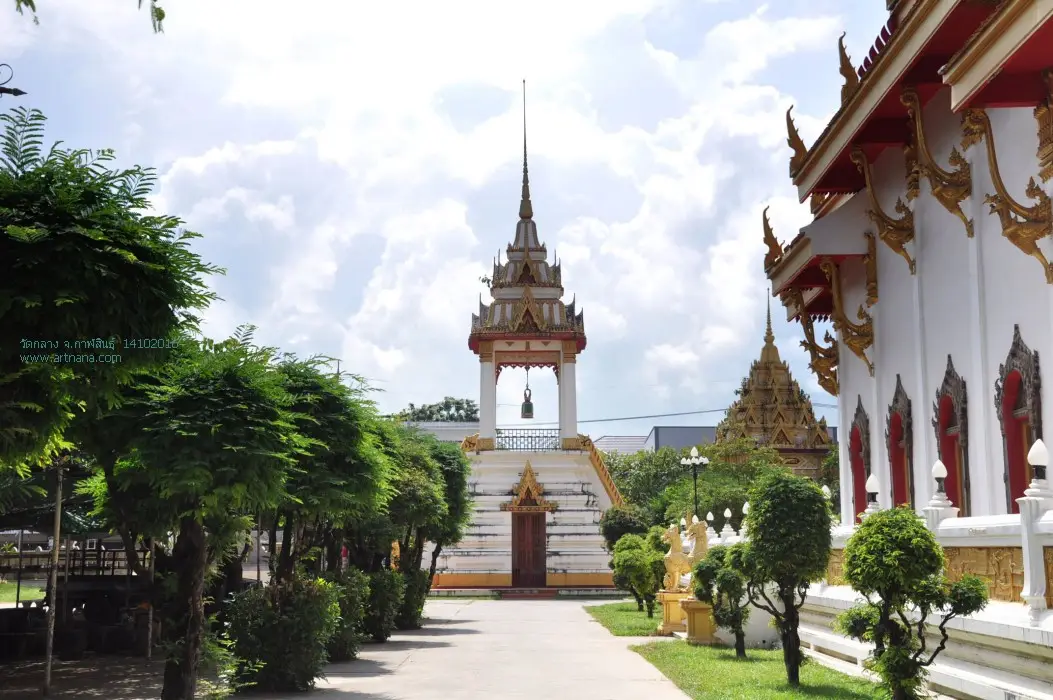
Wat Klang
Open Days: Daily
Opening Hours: Morning chanting at 08.00 and evening chanting at 18.00; advance contact is required for visiting Wat Klang Kalasin Museum
Wat Klang in Kalasin Province is a third-class royal temple of the ordinary type located in the heart of Mueang Kalasin, close to the Phraya Chai Sunthon Monument. It is one of the most meaningful Buddhist landmarks in the city, especially for travelers who want to understand Kalasin through its religious heritage, local history, and community faith. The temple is best known for Phra Phuttha Samrit Nirrokhantarai, commonly called Luang Pho Ong Dam, a revered bronze Buddha image associated with the identity of Kalasin and the traditional rain-seeking procession of local people.
For foreign travelers, Wat Klang is not just another temple to visit briefly. It is a compact but culturally layered destination where architecture, mural painting, sacred images, old inscriptions, local legends, and museum collections come together in one place. Within the temple grounds are a Thai-style ubosot, carved wooden doors depicting scenes from the life of the Buddha, windows carved with Jataka stories, stucco guardian figures, murals of the Vessantara Jataka, a laterite replica of the Buddha’s footprint, and Wat Klang Kalasin Museum, which preserves many objects related to the local history of the province.
The temple’s name, Wat Klang, can be understood through its location. In Thai, “klang” means “middle” or “central.” The temple stands in the central area of Kalasin town, historically between Wat Nuea, also known as Wat Si Bun Rueang, and Wat Tai, also known as Wat Tai Pho Kham. This position gives the temple both geographical and symbolic importance. It has long served as a central religious space for local residents, a place for merit-making, Buddhist ceremonies, daily chanting, monastic education, and community gatherings.
Wat Klang was established in the 19th century, with sources recording its foundation around 1844 to 1846. Although the earliest founder and first abbot are not clearly documented, the temple developed alongside Kalasin town and gradually became one of the province’s most respected religious institutions. It received its consecrated boundary for ordination ceremonies on 4 August 1937 and was later elevated to the status of a third-class royal temple, ordinary type, on 31 May 1978. This official status reflects the temple’s importance in both religious and civic life.
The temple belongs to the Mahanikaya order of Thai Theravada Buddhism and has also played an important role in Buddhist education. It has long been connected with monastic learning, Pali studies, and the ecclesiastical structure of Kalasin Province. The current abbot is Phra Methiwatcharacharn, Dr. (Worawit Dhammacaro), who also serves as the ecclesiastical provincial chief of Kalasin. This role strengthens Wat Klang’s position as more than a local temple; it is a major religious centre for the province.
One of the most impressive buildings in the temple is the ubosot, or ordination hall. The current structure was expanded from an older ubosot and designed in traditional Thai style. It is decorated with chofa finials, bai raka roof ornaments, carved wooden doors, and sculptural elements that give the building a dignified and elegant appearance. The wooden doors are carved with scenes from the Buddha’s life, while the windows tell various Jataka stories. These carvings make the ubosot a valuable space for both religious practice and visual storytelling.
At the front and back of the ubosot are stucco guardian figures. In Thai Buddhist temple architecture, such guardians symbolically protect sacred space and mark the transition from the ordinary world into a place of spiritual discipline. For visitors, noticing these details helps transform the experience from simply walking through a temple into a deeper reading of Thai religious architecture. The exterior of the ubosot should be observed slowly, especially the roofline, door panels, window carvings, and guardian figures.
Inside the ubosot are murals depicting the Vessantara Jataka, one of the most important Buddhist birth stories in Theravada tradition. The story of Prince Vessantara emphasizes generosity, self-sacrifice, and the perfection of giving. In Northeastern Thailand, this story is strongly connected with the Bun Phawet or Bun Mahachat tradition, in which the Vessantara Jataka is recited and celebrated as part of community merit-making. At Wat Klang, the murals therefore carry both religious meaning and regional cultural significance.
The most revered image at Wat Klang is Phra Phuttha Samrit Nirrokhantarai, or Luang Pho Ong Dam. It is a bronze Buddha image with a lap width of about 20 inches, or around 51 centimetres. The image is admired for its elegant form and calm expression. An inscription in ancient Thai appears on the pedestal, indicating that the image was created during the period of King Khu Na Kham. Later, Phraya Chai Sunthon, also known as Chao Somphamit, brought the image to be honoured as a sacred Buddha image of Kalasin town.
Luang Pho Ong Dam is deeply connected with the belief in rain, fertility, and the well-being of the community. Whenever drought affected the area, local people traditionally carried the Buddha image in a procession to ask for rain. This practice reflects the relationship between Buddhism, agriculture, and the natural environment in Isan culture. The ritual was not merely a request for rainfall; it was also a collective act of faith, unity, and hope among the people of Kalasin.
For Thai visitors, Luang Pho Ong Dam is a sacred image for blessing, protection, health, and peace. For foreign travelers, it offers an opportunity to understand how a Buddha image can function as a spiritual centre of a city. In many Thai provinces, a revered Buddha image is more than a religious object. It becomes part of local identity, historical memory, civic pride, and ritual life. At Wat Klang, this role is particularly visible through the image’s association with Phraya Chai Sunthon and the rain-seeking tradition.
Another important sacred object at Wat Klang is the ancient replica of the Buddha’s footprint made of laterite. It is approximately 1 sok wide and 4 sok long, corresponding to about 20 inches by 80 inches according to tourism records. The footprint was originally located on the bank of Lam Pao near Kaeng Samrong. When the riverbank gradually collapsed, local people became concerned that the sacred object might be damaged by water erosion, so they relocated it to Wat Klang for preservation.
The Buddha footprint is believed to date back to the Lawa period, making it an important object for those interested in the deeper historical layers of Kalasin and the surrounding region. In Buddhist symbolism, a Buddha footprint represents the presence and teachings of the Buddha. It is not simply a decorative object but a reminder of the path of practice. Its relocation from the Lam Pao riverside to Wat Klang also shows how local communities protect sacred heritage when the natural landscape changes.
Wat Klang Kalasin Museum adds another layer of meaning to the temple. Built within the temple grounds, the museum displays a wide range of old objects, including Buddha images, deity figures, pottery related to Ban Chiang culture, old silver coins, household utensils, carved wooden doors, religious manuscripts, old books, Tripitaka texts, and lacquered cabinets used for storing ancient scriptures. The museum helps visitors see that Wat Klang is not only a living religious site but also a local heritage centre.
The museum is especially useful for travelers who want to understand Kalasin beyond its famous dinosaur attractions. It introduces the everyday objects, beliefs, craftsmanship, and religious materials that shaped local life. By visiting the museum after paying respect to Luang Pho Ong Dam and exploring the ubosot, visitors can connect sacred art, community history, and material culture in a single route. Since the museum requires advance contact, travelers should call ahead before planning a focused visit.
The temple grounds also include several important functional areas: the ubosot, the old and new Phra Phuttha Samrit halls, a sermon hall, a merit-making pavilion, the museum building, monks’ residences, a Pali and Buddhist studies school, a bell tower, a drum tower, and public restrooms. These facilities show that Wat Klang remains an active temple. It is not a static monument but a living Buddhist institution serving monks, laypeople, students, and visitors.
Wat Klang is also associated with provincial sacred water ceremonies. Kut Nam Kin, a public pond in Kalasin town, is recognised as the province’s sacred water source. Water from this source has been used in important royal and provincial rituals, and the ubosot of Wat Klang serves as the place where sacred Buddhist water is consecrated. This connection gives the temple an additional ceremonial role in the province and links it with the broader ritual identity of Kalasin.
The temple is a meaningful place to visit during important Buddhist days such as Makha Bucha, Visakha Bucha, Asalha Bucha, and the Buddhist Lent period. At such times, Wat Klang becomes a gathering space for monks, local residents, government officials, students, and Buddhist devotees. Visitors may see chanting, candlelight processions, merit-making activities, and a more active temple atmosphere. On ordinary days, the temple is quieter and suitable for slow cultural exploration.
Because Wat Klang is close to the Phraya Chai Sunthon Monument, visitors can easily combine the two sites. Phraya Chai Sunthon, or Chao Somphamit, is remembered as the founder of Kalasin. The monument stands near the Kalasin Post Office and is one of the key historical symbols of the city. A simple route begins with paying respect at the monument, then continuing to Wat Klang to worship Luang Pho Ong Dam and explore the temple’s art and history.
Another nearby site is Wat Si Bun Rueang, also known as Wat Nuea. This old temple is known for Dvaravati-style boundary stones brought from Mueang Fa Daet Song Yang, an ancient settlement in Kalasin Province. When Wat Klang and Wat Si Bun Rueang are visited together, travelers can see a fascinating timeline of Kalasin’s cultural history, from early Buddhist art and ancient boundary stones to royal temple architecture and a city-protecting Buddha image.
Kalasin Museum, located in the former provincial hall, is also a good addition to the route. The museum presents the province’s local heritage, including Phu Thai culture, Phrae Wa silk, handicrafts, religious materials, and traditional ways of life. Together with Wat Klang Kalasin Museum, it gives visitors a broader understanding of the province. Travelers with a strong interest in culture should consider allocating at least half a day to explore these nearby sites.
For most visitors, Wat Klang can be explored in about 45 minutes to 1.5 hours. A short visit may include the ubosot, Luang Pho Ong Dam, and a walk around the temple grounds. A deeper visit should include careful observation of the murals, carved doors, window panels, guardian figures, the Buddha footprint, and the museum. Photography should be done respectfully, especially inside sacred spaces or when monks and worshippers are present.
The best time to visit is in the morning or late afternoon. Morning visits offer a calm atmosphere and cooler weather, while late afternoon light gives the temple buildings a softer appearance. Travelers who enjoy local food can combine the temple visit with nearby cafés and restaurants in town, or continue to Rongsi Market, a local food and community market in Mueang Kalasin. This makes Wat Klang easy to include in a relaxed city itinerary.
Visitors should dress respectfully. Shoulders and knees should be covered, shoes should be removed before entering sacred buildings, and voices should be kept low. It is better not to touch old objects, murals, carvings, or museum displays unless permission is clearly given. For the museum, calling ahead is recommended because access may depend on the availability of the temple caretaker or responsible staff.
Getting There is straightforward because Wat Klang is located in central Mueang Kalasin. Travelers can arrive by private car, rental car, local transport, or taxi-style services within town. From the Kalasin Bus Terminal, the temple can be reached within a short ride. Those driving from nearby provinces such as Maha Sarakham, Roi Et, Khon Kaen, or Sakon Nakhon can use map navigation by searching for Wat Klang Royal Monastery Kalasin or Phiphitthaphan Wat Klang Kalasin.
Staying in central Kalasin makes the visit more convenient. Several hotels and small residences are located within a short distance of the temple, especially around Saneha Road, Phang Mueang Road, and the Thung Si Mueang area. Travelers without private transport should choose accommodation in the city centre so they can easily reach Wat Klang, local restaurants, museums, and nearby attractions.
Wat Klang is suitable for many types of travelers: Buddhist pilgrims, cultural tourists, families, elderly visitors, history enthusiasts, and foreign travelers seeking a better understanding of Isan religious life. Its main value lies in the way it combines a living temple, royal status, sacred art, provincial rituals, and local heritage. It is one of the best places in Kalasin city to understand how Buddhism remains woven into the daily life and identity of the community.
Overall, Wat Klang is one of the essential cultural stops in Kalasin. Luang Pho Ong Dam reveals the spiritual identity of the city; the ubosot preserves Thai religious art and Buddhist storytelling; the Buddha footprint connects the temple with older regional traditions; the museum preserves local heritage; and the temple’s role in sacred water ceremonies shows its importance at the provincial level. For travelers who want to go beyond surface-level sightseeing, Wat Klang offers a compact but meaningful introduction to the history, faith, and cultural memory of Kalasin.
| Name | Wat Klang, the Royal Monastery, Kalasin Province |
| Location | Kalasin Subdistrict, Mueang Kalasin District, Kalasin Province |
| Address | 47 Kalasin Road, Kalasin Subdistrict, Mueang Kalasin District, Kalasin 46000, Thailand |
| Coordinates | 16.437497, 103.501928 |
| Highlights | Luang Pho Ong Dam, a revered bronze Buddha image of Kalasin; Thai-style ubosot; Vessantara Jataka murals; ancient laterite Buddha footprint; and Wat Klang Kalasin Museum |
| History | Established around 1844–1846, received its consecrated boundary on 4 August 1937, and was elevated to a third-class royal temple of the ordinary type on 31 May 1978 |
| Name Origin | The name Wat Klang refers to its central position in Kalasin town, historically between Wat Nuea or Wat Si Bun Rueang and Wat Tai or Wat Tai Pho Kham |
| Distinctive Features | Traditional Thai ubosot with chofa and bai raka roof decorations, carved wooden doors showing the Buddha’s life, Jataka-carved windows, and stucco guardian figures |
| Sacred Objects | Luang Pho Ong Dam, the principal Buddha image in the ubosot, an ancient replica of the Buddha’s footprint, various Buddha images, and an image of Guan Yin |
| Related Traditions / Rituals | Rain-seeking procession of Luang Pho Ong Dam during drought years, Buddhist holy day ceremonies, daily morning and evening chanting, and provincial sacred water consecration at the ubosot |
| Travel Information | Accessible by private car, rental car, or local transport in Mueang Kalasin. From Kalasin Bus Terminal, the temple is only a short ride away. Search for Wat Klang Royal Monastery Kalasin or Phiphitthaphan Wat Klang Kalasin on map navigation |
| Current Status | Open and active as a royal temple and an important Buddhist centre of Kalasin Province |
| Open Days | Daily |
| Opening Hours | Morning chanting at 08.00 and evening chanting at 18.00; advance contact is required for Wat Klang Kalasin Museum |
| Fees | Wat Klang Kalasin Museum does not charge an admission fee |
| Facilities | Ubosot, Buddha image halls, sermon hall, merit-making pavilion, museum building, Pali and Buddhist studies school, bell tower, drum tower, monks’ residences, and public restrooms |
| Main Areas / Zones | Ubosot, Phra Phuttha Samrit Nirrokhantarai hall, Luang Pho Ong Dam shrine area, Buddha footprint area, Wat Klang Kalasin Museum, sermon hall, bell tower, drum tower, and monastic residence area |
| Abbot / Caretaker | Phra Methiwatcharacharn, Dr. (Worawit Dhammacaro, Pali Studies Level 4, Ph.D.), abbot of Wat Klang Royal Monastery and ecclesiastical provincial chief of Kalasin |
| Main Contact Number | Wat Klang Royal Monastery Tel. 098-654-5789 Wat Klang Kalasin Museum Tel. 08-6222-8675 |
| Official Website / Official Page | Facebook: Wat Klang Phra Aram Luang Kalasin |
| Nearby Tourist Attractions | 1. Wat Klang Kalasin Museum, about 0 km 2. Phraya Chai Sunthon Monument, about 1 km 3. Wat Si Bun Rueang or Wat Nuea, about 1 km 4. Kalasin Museum, about 1 km 5. Kut Nam Kin Public Park, about 1 km 6. Rongsi Market Kalasin, about 3 km 7. Phutthasathan Phu Po, about 28 km |
| Nearby Restaurants | 1. NICE TIME CAFE KALASIN, about 1 km, Tel. 088-562-4518 2. Khwan Oey Restaurant, about 1 km, Tel. 043-813-457 3. Tam Yua Yeh Mueang Kalasin, about 2 km, Tel. 063-968-3937 4. Singfarm Coffee Roaster, about 2 km, Tel. 089-944-1854 5. Khong kwan House Steak Khao Soi Nam Ngiao, about 2 km, Tel. 064-462-6263, 095-532-3978 6. Ban Tan Fa Kalasin, about 3 km, Tel. 086-717-0774 |
| Nearby Accommodations | 1. Supak Hotel, about 1 km, Tel. 043-811-595 2. Phaiboonplace Hotel, about 1 km, Tel. 081-117-8896 3. A.P. Garden Hotel, about 2 km, Tel. 086-354-6193 4. Nub Thong Residence, about 2 km, Tel. 095-520-7290 5. TK Residence Hotel, about 3 km, Tel. 095-338-0515 6. Rimpao Hotel, about 3 km |
Frequently Asked Questions (FAQ)
Q: Why is Wat Klang in Kalasin important?
A: Wat Klang is a third-class royal temple in central Kalasin and is home to Luang Pho Ong Dam, a revered Buddha image closely connected with the spiritual identity of the province.
Q: What is Luang Pho Ong Dam?
A: Luang Pho Ong Dam is the common name of Phra Phuttha Samrit Nirrokhantarai, a bronze Buddha image with a lap width of about 20 inches and an ancient Thai inscription on its pedestal.
Q: How is Wat Klang related to the rain-seeking tradition?
A: In drought years, local people traditionally carried Luang Pho Ong Dam in a procession to ask for rain, reflecting the relationship between Buddhism, agriculture, and community faith in Kalasin.
Q: What should visitors see inside Wat Klang?
A: Key highlights include the Thai-style ubosot, Vessantara Jataka murals, Luang Pho Ong Dam, the ancient laterite Buddha footprint, and Wat Klang Kalasin Museum.
Q: Can visitors enter Wat Klang Kalasin Museum?
A: Yes, but advance contact is recommended. The museum does not charge an admission fee and can be contacted at 08-6222-8675.
Q: What attractions are near Wat Klang?
A: Nearby attractions include Phraya Chai Sunthon Monument, Wat Si Bun Rueang, Kalasin Museum, Kut Nam Kin Public Park, and Rongsi Market Kalasin.
Q: How can travelers get to Wat Klang?
A: Travelers can reach the temple by private car, rental car, or local transport in Mueang Kalasin. It is located on Kalasin Road in the city centre.
Q: How long should travelers spend at Wat Klang?
A: A basic visit takes about 45 minutes to 1 hour. Visitors who want to study the art, museum, and sacred objects in detail should allow around 1.5 hours.
 Category: ●Places of Worship
 Group: ●Temple
Last Update : 3 MonthAgo
 Last Update : 3 MonthAgo
 Click to Access the Navigation Map GPS
 Art, Culture and Heritage
 Historical Sites and Monuments(2)
 Landmarks and Memorials(3)
 Art, Craft Centres, Tradition(4)
 Museums(3)
 Art Gallery(1)
 Educational Places
 Educational Gardens, Farm(1)
Temple(21)
Educational Gardens, Farm(1)
Temple(21)
 Other Sacred Sites(6)
 Suburban Living
 Village, Community(3)
 Nature and Wildlife
 National Parks and Marine Reserves(3)
 Mountain (Doi)(2)
 Dam, Reservoir, Lake(5)
 Waterfalls(4)
 Caves(2)
 River, Canal(3)
 Bays and Beaches(1)
 Other natural attractions(2)
 Entertainment and Agricultural
 Animal camps and shows(1)
 Farms, Parks and Ecotourism(2)


