
lovethailand home >Northeastern Travel Attractions >Kalasin Travel Attractions >Tha Khantho >Na Tan > Phu Phra Forest Park
TL;DR: Phu Phra Forest Park is located at Na Tan Subdistrict, Tha Khantho District, Kalasin Province, Thailand, open Daily, hours 08.30 – 18.00.

Phu Phra Forest Park
Open Days: Daily
Opening Hours: 08.30 – 18.00
Phu Phra Forest Park in Kalasin is a distinctive natural and spiritual destination in Na Tan Subdistrict, Tha Khantho District, Kalasin Province. The area was originally part of Phu Phra forest within the Dong Mun National Reserved Forest. Its landscape is defined by a mountain standing close to local communities, dry dipterocarp forest, sandstone cliffs, caves, streams, viewpoints, wildlife habitats, and sacred Buddhist sites. On the rear plateau of the mountain, ancient stone Buddha images and Phra Phuttha Ananta Chin Khiri are enshrined, making this forest park a place where nature, geology, Buddhist faith, and local culture come together in one meaningful setting.
For foreign travelers looking for a deeper nature experience in Kalasin, Phu Phra Forest Park is a rewarding stop. It is not a large commercial attraction, but a quiet forested mountain where visitors can explore viewpoints, sandstone formations, caves, forest trails, and sacred Buddhist areas. The experience is best enjoyed slowly. Travelers can stop at Pha Sawoey viewpoint, walk through dry dipterocarp woodland, observe natural rock layers, visit Tham Siam Sap, Tham Phra Rot, Pha Hin Yaek, and Tham Phra, and pay respect to Phra Phuttha Ananta Chin Khiri at the higher part of the forest park.
The forest park clearly reflects the natural character of Thailand’s northeastern region. The dry dipterocarp forest, locally known as pa teng rang or pa daeng, changes with the seasons. During the rainy season, the woodland becomes greener, cooler, and more vibrant. Grass and small plants cover the forest floor, and the air feels fresh after rain. During the dry season, many trees shed their leaves, turning the landscape into shades of brown, gold, and reddish earth. This seasonal transformation is part of Phu Phra’s charm, showing visitors that a forest can be beautiful in different ways throughout the year.
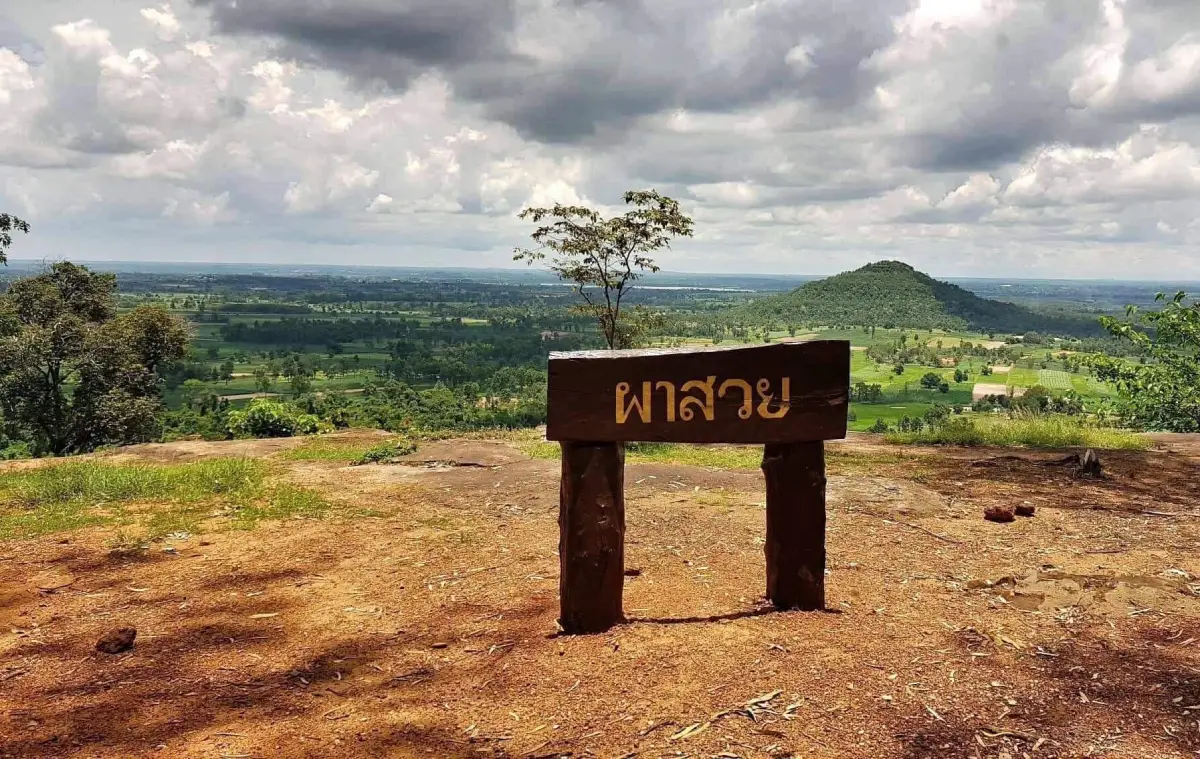
Pha Sawoey is one of the main highlights inside Phu Phra Forest Park. It is a wide sandstone cliff terrace with a drop of approximately 150–200 meters. From this viewpoint, visitors can see the landscape of Tha Khantho District, forested hills, local communities, and the surrounding countryside. The open rock platform gives the feeling of standing on a natural balcony above the forest. Morning and late afternoon are especially good times for photography because the light is softer and the weather is more comfortable.
The appeal of Pha Sawoey is not only its height but also its broad view and geological character. The sandstone surface, open sky, and distant landscape make it an ideal place to pause and observe the relationship between mountain, forest, and village life. In the rainy season, the lower forest appears lush and green. In the dry season, the shape of the land and the structure of the trees become clearer. This makes Pha Sawoey suitable for landscape photographers, nature travelers, and anyone who wants a quiet viewpoint away from crowded attractions.
Tham Siam Sap is another interesting site in the forest park. It is a cave-like sandstone cliff formation whose shape resembles a spade cutting into rock. From the cave mouth area, visitors can see high sandstone walls and visible rock layers. These formations make the site useful for basic geological observation. Even without specialist knowledge, travelers can notice how sandstone has been shaped by erosion, cracking, water, wind, and time. The site gives a strong sense of natural history and the slow processes that created the mountain landscape.
Unlike the open viewpoint at Pha Sawoey, Tham Siam Sap feels more enclosed and intimate. The cliff, rock overhangs, shade, and surrounding trees create a calmer atmosphere. During the rainy season, moisture-loving plants may appear around the rocks, adding freshness to the area. Visitors should walk carefully, avoid climbing unstable rock surfaces, and never remove stones, plants, or natural materials from the site. The value of Tham Siam Sap lies in allowing people to see natural rock formations in their original setting.
Tham Phra Rot is a cave formed by the separation of sandstone cliffs. Inside the cave, the walking passage is about 2 meters wide and approximately 30 meters long. In the past, monks came to stay and practice meditation in this area. This history gives the cave both a natural and spiritual meaning. Visitors can understand that caves in Thailand are often more than geological formations. They may also serve as quiet places for meditation, retreat, and religious practice, especially when located within forested mountains.
Pha Hin Yaek, or the split rock cliff, is another distinctive site. The cliff has separated into a long opening of about 20 meters, with a depth of around 6 meters. The separated rock mass leans at an angle, creating an unusual and visually striking formation. It is also a viewpoint where visitors can look across the surrounding landscape. Travelers should be especially careful here because the rock surface, gaps, and uneven levels can be risky. Families with children or older visitors should supervise movement closely.
Tham Phra is one of the most important spiritual points in Phu Phra Forest Park. The cave is around 30 meters deep, with an opening about 15 meters wide, and contains Buddha images respected by local people. The atmosphere inside and around the cave is calm and sacred. Visiting Tham Phra turns the trip from a simple nature walk into an experience connected with local Buddhist faith. Travelers can pay respect, observe the cave environment, and appreciate how natural formations become sacred places within Thai communities.
Phra Phuttha Ananta Chin Khiri is an important Buddha image located at the highest point of the forest park area. Local residents and visitors come to pay respect here. The site is also connected with an annual local tradition after the Songkran festival, when people walk up Phu Phra for a water-pouring ceremony and offer a robe to the Buddha image. This tradition shows that Phu Phra is not only a protected natural area but also a spiritually important mountain for the community of Na Tan and nearby villages.
The presence of Buddha images and sacred caves makes Phu Phra different from many other nature attractions. Visitors should remember that some areas have religious meaning for local people. Modest clothing, quiet behavior, and respectful photography are recommended. Avoid climbing on sacred structures, touching Buddha images unnecessarily, or making loud noise near meditation and worship areas. A respectful visit helps preserve the balance between tourism, nature conservation, and local faith.
Phu Phra Forest Park is also a useful learning site for families, students, teachers, and nature enthusiasts. The area offers direct examples of dry dipterocarp forest, sandstone geology, caves, cliffs, seasonal vegetation, streams, and wildlife habitat. Students can learn that forests differ according to soil, rock, water, elevation, and climate. Seeing these features in a real landscape makes environmental learning more meaningful than reading from textbooks alone.
The forest park also demonstrates why conservation areas near communities are important. Even though Phu Phra is close to villages and roads, its forest still provides habitat for wildlife, protects plants, supports water systems, and offers a natural recreation space for residents and visitors. Damage from fire, littering, plant collecting, hunting, or irresponsible tourism would affect both the forest and nearby communities. Responsible travel is therefore essential for keeping Phu Phra healthy and accessible.
Some internal roads and routes inside the forest park may be dirt roads or uphill sections. During the rainy season, the surface can become slippery or muddy in places. Visitors traveling by car should drive carefully and check road conditions on arrival. Some areas may be accessible by ordinary vehicles, while others require more caution. To visit several points comfortably, travelers should allow at least half a day rather than rushing through the forest park.
Recommended activities include viewing the landscape from Pha Sawoey, walking through dry dipterocarp forest, observing sandstone formations, visiting Tham Siam Sap, Tham Phra Rot, Pha Hin Yaek, and Tham Phra, paying respect to Phra Phuttha Ananta Chin Khiri, photographing nature, watching birds, and studying the relationship between forest, rock, cave, and local faith. The best experience comes from slow observation rather than fast sightseeing.
The best time to visit is from morning to late afternoon. Morning offers cooler weather and good conditions for forest walking. Afternoon light can be suitable for viewpoints and rock formations, but visitors should avoid staying on unfamiliar trails or cliff areas near dusk. During the rainy season, shoes with good grip are recommended. During the dry season, bring drinking water, a hat, and sun protection.
Photographers will find many types of scenes at Phu Phra Forest Park. Pha Sawoey provides wide landscape views, Tham Siam Sap shows sandstone texture and rock layers, Tham Phra offers a sacred cave atmosphere, Pha Hin Yaek presents unusual rock forms, and Phra Phuttha Ananta Chin Khiri adds a strong spiritual element. Good travel photography here should tell the story of the forest, the mountain, the caves, the Buddha images, and the local community’s connection to the place.
Families traveling with children or elderly visitors should plan the route carefully. Start with easier access points, such as the forest park office, main viewpoints, and worship areas. For caves and cliffs, consider the physical condition of each visitor and avoid walking after heavy rain. Drinking water, personal medicine, comfortable shoes, and a flexible schedule will make the trip safer and more enjoyable.
Getting There from Tha Khantho District is straightforward. Use Highway 2299 around kilometer 16 to reach the forest park area. Travelers using public transportation can take the Udon Thani–Kalasin bus route and get off at Wat Sawang Tham Koeng, which is located near the front of the forest park. From there, local transport or a private vehicle is useful for entering the area. A private car is the most convenient option because it allows visitors to move between viewpoints, caves, and nearby attractions more easily.
From Kalasin city, travelers can drive toward Tha Khantho District and continue to Na Tan Subdistrict. Near Wat Sawang Tham Koeng, follow signs for Phu Phra Forest Park or use a navigation map. The site can be visited as a day trip and combined with nearby attractions such as Tha Khantho City Pillar Shrine, Hat Khantho, Thep Suda Bridge, or Sirindhorn Museum, depending on available time.
A well-planned route can begin in the morning at Phu Phra Forest Park, visiting Pha Sawoey, Tham Siam Sap, Pha Hin Yaek, Tham Phra, and Phra Phuttha Ananta Chin Khiri. Afterward, travelers can have lunch in Tha Khantho town, then continue to Hat Khantho or drive toward Lam Pao Dam, Thep Suda Bridge, or Sahatsakhan District. This route gives a broad experience of Kalasin, including forest, mountain, caves, Buddhist sites, reservoir scenery, and local food.
Visitors should follow basic forest-park rules. Register with officers if required, avoid littering, do not light fires, do not collect plants or rocks, do not disturb wildlife, and stay on safe routes. Around cliffs and caves, walk carefully and avoid risky behavior. If rain or poor road conditions occur, adjust the plan instead of forcing the route. Safety and conservation are the priorities when visiting natural areas.
Overall, Phu Phra Forest Park is one of Kalasin’s most complete nature-and-faith destinations. It combines dry dipterocarp forest, sandstone cliffs, caves, viewpoints, streams, Buddha images, and local tradition in one mountain landscape. Its beauty is not grand in a commercial sense, but deep, quiet, and meaningful. For travelers who take time to observe carefully and respect both nature and local faith, Phu Phra Forest Park reveals a memorable and valuable side of Kalasin Province.
| Name | Phu Phra Forest Park |
| Location | Na Tan Subdistrict, Tha Khantho District, Kalasin Province, Thailand |
| Address | Ban Nong Saeng / Phu Phra Forest Park Area, Na Tan Subdistrict, Tha Khantho District, Kalasin 46190, Thailand |
| Coordinates | 16.880875, 103.247637 |
| Highlights | Dry dipterocarp forest, Pha Sawoey viewpoint, Tham Siam Sap, Tham Phra Rot, Pha Hin Yaek, Tham Phra, Phra Phuttha Ananta Chin Khiri, and the annual Phu Phra water-pouring tradition |
| History | The area was originally Phu Phra forest within Dong Mun National Reserved Forest. It was declared a forest park on 1 October 1983 and is now managed as a conservation and nature-tourism area under the Department of National Parks, Wildlife and Plant Conservation. |
| Distinctive Features | A sandstone mountain near local communities, with dry dipterocarp forest, dense seasonal vegetation, streams, wildlife, cliffs, caves, and several viewpoints |
| Important Features Inside The Area | Pha Sawoey Tham Siam Sap Tham Phra Rot Pha Hin Yaek Tham Phra Phra Phuttha Ananta Chin Khiri Dry Dipterocarp Nature Trail |
| Annual Tradition | The Phu Phra water-pouring ceremony and robe-offering tradition for Phra Phuttha Ananta Chin Khiri are held annually after the Songkran festival. |
| Travel Information | From Tha Khantho District, use Highway 2299 around kilometer 16. Travelers can also take the Udon Thani–Kalasin bus route and get off at Wat Sawang Tham Koeng near the front of the forest park. |
| Current Status | Open as a forest park, nature-learning site, dry dipterocarp forest area, and sacred community mountain of Na Tan Subdistrict |
| Open Days | Daily |
| Opening Hours | 08.30 – 18.00 |
| Fees | No Admission Fee |
| Facilities | Forest park office, parking area, nature routes, viewpoints, worship areas, and restrooms at selected points |
| Main Areas / Zones | Forest Park Office And Checkpoint Dry Dipterocarp Forest Route Pha Sawoey Zone Tham Siam Sap Zone Tham Phra Rot Zone Pha Hin Yaek Zone Tham Phra Zone Phra Phuttha Ananta Chin Khiri Zone Viewpoint And Sandstone Terrace Areas Route Connecting To Wat Sawang Tham Koeng |
| Caretaker | Phu Phra Forest Park, Department of National Parks, Wildlife and Plant Conservation / Protected Area Regional Office 8 (Khon Kaen), with Na Tan Subdistrict Municipality supporting local religious-site care and community activities |
| Main Contact Number | Phu Phra Forest Park, Tel. 087-866-0788 Na Tan Subdistrict Municipality, Tel. 043-840925, 043-840929 |
| Official Website / Official Page | natal.go.th thai.tourismthailand.org |
| Nearby Tourist Attractions | 1. Wat Sawang Tham Koeng, About 0.5 km 2. Tha Khantho City Pillar Shrine, About 6 km 3. Hat Khantho, About 7 km 4. Wat Sang Kaeo, About 12 km 5. Wat Tham Nam Thip, About 14 km 6. Thep Suda Bridge, About 28 km 7. Sirindhorn Museum, About 36 km |
| Nearby Restaurants | 1. Krua Mae Phon Chao Kao, About 6 km, Tel. 089-710-4245 2. Toem Sap Restaurant, About 6 km, Tel. 081-260-7053 3. Kuai Tiao Ruea Ma Bin & Coffee House, About 7 km, Tel. 061-224-1599 4. PunThai Coffee Tha Khantho Branch, About 7 km, Tel. 061-414-3459 5. Cafe Amazon PTT Tha Khantho, About 7 km, Tel. 095-323-5441 |
| Nearby Accommodations | 1. Kittichai House Hotel, Na Tan Subdistrict, About 4 km, Tel. 087-772-5257 2. Kanokphon Garden View Resort, About 5 km, Tel. 080-107-9299 3. The Boss Place Tha Khantho, About 6 km, Tel. 061-224-1599 4. Phu No Resort Tha Khantho, About 13 km, Tel. 081-061-9855 5. Eidi Homestay Nong Kung Si, About 30 km, Tel. 087-223-1883 6. Duang Dee Hotel Nong Kung Si, About 32 km, Tel. 093-479-9468 |
Frequently Asked Questions (FAQ)
Q: Where Is Phu Phra Forest Park Located?
A: Phu Phra Forest Park is located in Na Tan Subdistrict, Tha Khantho District, Kalasin Province, within the Dong Mun National Reserved Forest area.
Q: What Are The Main Highlights Of Phu Phra Forest Park?
A: The main highlights include Pha Sawoey, Tham Siam Sap, Tham Phra Rot, Pha Hin Yaek, Tham Phra, Phra Phuttha Ananta Chin Khiri, dry dipterocarp forest, streams, and scenic viewpoints.
Q: What Are The Opening Hours?
A: Phu Phra Forest Park is open daily from 08.30 to 18.00. Morning to afternoon is the best time to visit safely and see the main sites clearly.
Q: Is There An Admission Fee?
A: No. There is no admission fee for visiting Phu Phra Forest Park.
Q: Why Is Pha Sawoey Special?
A: Pha Sawoey is a wide sandstone cliff terrace with a drop of about 150–200 meters. It is one of the most scenic viewpoints inside the forest park.
Q: Why Is Tham Phra Important?
A: Tham Phra is a sacred cave containing Buddha images respected by local residents. During the Songkran period, people traditionally walk up Phu Phra to pour water over the Buddha images.
Q: How Can Travelers Get To Phu Phra Forest Park?
A: From Tha Khantho District, use Highway 2299 around kilometer 16. Travelers can also take the Udon Thani–Kalasin bus route and get off at Wat Sawang Tham Koeng near the front of the forest park.
Q: What Should Visitors Prepare Before Going?
A: Visitors should bring drinking water, comfortable walking shoes, a hat, sun protection, mosquito repellent, a camera or phone, and modest clothing for visiting the Buddhist areas.
 Category: ●Entertainment and Agricultural
 Group: ●Farms, Parks and Ecotourism
Last Update : 3 MonthAgo
 Last Update : 3 MonthAgo
 Click to Access the Navigation Map GPS
Phu Phra Forest Park Map

 Art, Culture and Heritage
 Historical Sites and Monuments(2)
 Landmarks and Memorials(3)
 Art, Craft Centres, Tradition(4)
 Museums(3)
 Art Gallery(1)
 Educational Places
 Educational Gardens, Farm(1)
 Places of Worship
 Temple(21)
 Other Sacred Sites(6)
 Suburban Living
 Village, Community(3)
 Nature and Wildlife
 National Parks and Marine Reserves(3)
 Mountain (Doi)(2)
 Dam, Reservoir, Lake(5)
 Waterfalls(4)
 Caves(2)
 River, Canal(3)
 Bays and Beaches(1)
 Other natural attractions(2)
 Animal camps and shows(1)
Farms, Parks and Ecotourism(2)
Animal camps and shows(1)
Farms, Parks and Ecotourism(2)


