
lovethailand home >Northeastern Travel Attractions >Buri Ram Travel Attractions >Prakhon Chai >Chorakhe Mak > Phanom Rung Mountain Climbing Festival
TL;DR: Phanom Rung Mountain Climbing Festival is located at 114 Ta Pek Subdistrict, Chaloem Phra Kiat District, Buri Ram 31110, Thailand, open Open Daily; The Phanom Rung Mountain Climbing Festival Is Held Every April, hours 07.00 – 18.00.
Phanom Rung Mountain Climbing Festival
Open Days: Open Daily; The Phanom Rung Mountain Climbing Festival Is Held Every April
Opening Hours: 07.00 – 18.00
The Phanom Rung Mountain Climbing Festival is one of the most important cultural traditions of Buri Ram Province. Held at Phanom Rung Historical Park in Chaloem Phra Kiat District, the festival combines pilgrimage, local merit-making, community gathering, ancient Khmer architecture, traditional textiles, cultural performances, and the remarkable sunrise alignment through the sanctuary’s 15 doorways. For travelers who want to understand Buri Ram beyond sightseeing, this festival offers a rare opportunity to experience living southern Isan culture in one of Thailand’s most iconic historical landscapes.
The tradition is held in April every year and is connected with the full moon of the fifth lunar month. Its historical origin is linked to Phra Khru Ophat Thammayan of Wat Tha Prasit in Surin Province, who traveled to Phanom Rung to practice Vipassana meditation at a time when there was no convenient road leading up to the sanctuary. In those days, people who wished to visit the ruins climbed up individually without a fixed date. Inspired by the tradition of climbing Khao Sawai in Surin, he saw that a mountain-climbing tradition could encourage people to make merit, meet one another, strengthen community unity, and enjoy a time of rest. The first organized Phanom Rung mountain-climbing tradition was therefore held on the full moon day of the fifth lunar month in 1942, and it has continued to the present day.
The heart of the festival lies in the relationship between people and a sacred mountain. Phanom Rung is an ancient Khmer sanctuary built on the summit of an extinct volcano. In religious symbolism, the mountain represents a sacred cosmic center, comparable to Mount Meru in Hindu cosmology. Walking up to the sanctuary during the festival is therefore more than a physical journey. It is a symbolic movement toward a sacred space, where visitors make merit, pay respect, meet members of the community, and connect with a historical monument that remains meaningful in the present.
One of the most famous features of the festival is the sunrise alignment through the 15 doorways of Prasat Phanom Rung. In April, visitors gather on the western side of the sanctuary and look eastward through the long axis of the temple. When the sun rises in alignment with the architectural axis, its light shines directly through the layered doorways of the stone sanctuary. The scene is both beautiful and intellectually impressive, showing how ancient architecture was designed in relation to direction, light, sacred space, and the movement of the sun.
The solar alignment at Phanom Rung occurs four times a year. The sun sets through the 15 doorways in March, rises through them in April, rises again in September, and sets again in October. The April sunrise is closely associated with the Phanom Rung Mountain Climbing Festival, making the event both a cultural celebration and an architectural-astronomical experience. Visitors do not only come to see a performance or procession. They come to witness the meeting of nature, ancient engineering, sacred symbolism, and living tradition.
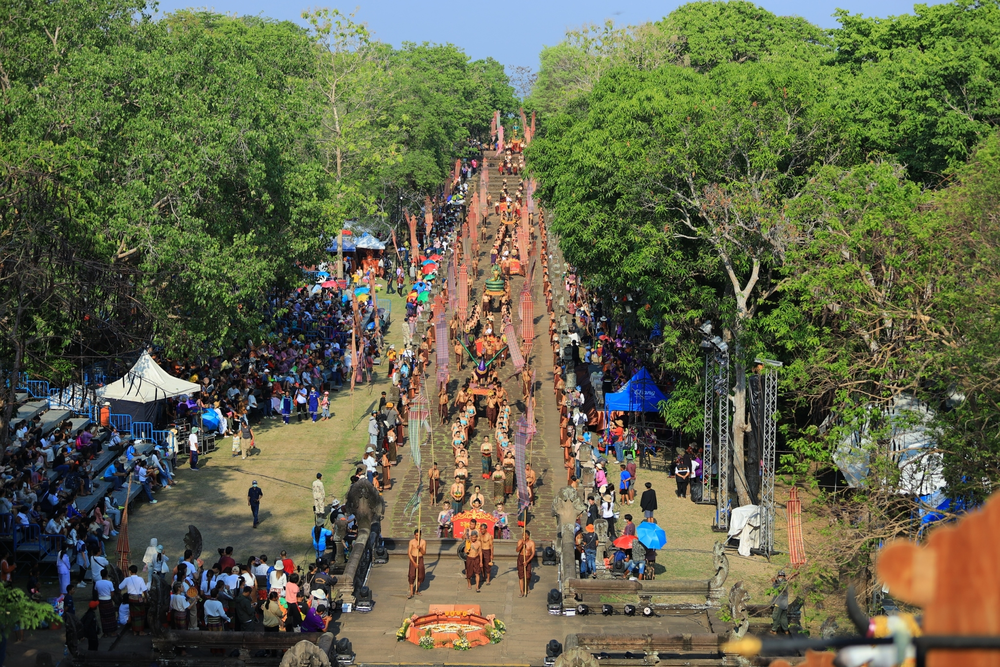
During the festival, Phanom Rung Historical Park becomes especially lively. Visitors arrive before dawn to wait for the sunrise. Later in the day, the area fills with processions, cultural performances, local markets, traditional costumes, and community activities. Major highlights include the Phanom Rung ceremonial procession, the procession inviting Lord Shiva, the parade of the 10 divine vehicles, the graceful Buriram Apsara dance, light and sound performances, and the Vanam Rung Civilization Market, where visitors can enjoy local food, community products, crafts, and the atmosphere of southern Isan.
The processions are among the most visually impressive parts of the festival. They recreate an atmosphere inspired by ancient Khmer civilization through costume, ornament, ceremonial movement, and performance design. Participants often wear outfits inspired by Khmer art and local silk weaving, creating a dramatic scene against the stone stairways and sanctuary architecture. The Buriram Apsara dance adds elegance and depth, expressing the softness of dance and the strength of cultural memory in the lower northeastern region.
Traditional silk clothing is another important element. In the past, women and men from nearby communities wore their finest handwoven silk to join the festival. This was not simply dressing up for a public event. It was a way to show weaving skill, family pride, community identity, and the beauty of local craftsmanship. The sight of people wearing richly patterned silk while climbing toward the sanctuary gives the festival a distinctive beauty and reflects the long relationship between textiles and cultural identity in Buri Ram.
The festival also strengthens unity among people in Chaloem Phra Kiat, Prakhon Chai, and nearby districts. Organizing the event requires cooperation among government offices, local authorities, community groups, artists, performers, vendors, and residents. Each group contributes to the processions, visitor services, performances, food markets, traffic management, and public order. The festival is therefore not only a tourism event. It is a collective cultural effort that shows the readiness and unity of local communities.
For travelers, the festival offers several layers of experience. The first is the chance to visit Phanom Rung, one of the most important Khmer stone sanctuaries in Thailand. The second is the opportunity to see the sunrise through the 15 doorways, a rare phenomenon that happens only a few times a year. The third is the cultural atmosphere created by processions, dance, textiles, food, music, and community participation. Together, these layers make the festival one of the most meaningful ways to experience Buri Ram.
Walking up to Phanom Rung during the festival feels different from visiting on an ordinary day. The route itself has ritual meaning. Visitors move from the lower approach to the stairways, the Naga bridges, the stone-paved ceremonial path, the aligned doorway system, and finally the main sanctuary. The architecture gradually leads the body and mind toward the sacred center. When many people climb together during the festival, the journey carries a sense of pilgrimage, celebration, and respect for place.
Phanom Rung is also remarkable for its art and architecture. Built of sandstone and laterite, the sanctuary includes finely carved lintels, pediments, Naga motifs, deities, Makara forms, and narrative scenes from Hindu tradition. During the festival, these carvings become more than museum-like objects. They become the background for processions, dance, music, silk costumes, and contemporary ritual life. This is what makes the festival especially powerful: the ancient monument becomes a living cultural stage.
The Vanam Rung Civilization Market makes the festival accessible and enjoyable for visitors of all ages. Travelers can taste local food, shop for community products, see handicrafts, and support local producers. The name Vanam Rung is connected with the ancient Khmer-derived name of Phanom Rung, meaning a great mountain. The market therefore functions not only as a commercial area but also as a cultural storytelling space, linking food, crafts, and community life with the identity of the mountain.
Visitors who want to see the sunrise through the 15 doorways should plan carefully. It is best to arrive before dawn because many people gather early to reserve good viewing positions on the western side of the sanctuary. Useful items include a flashlight, comfortable walking shoes, drinking water, a camera, and respectful clothing suitable for a historical and sacred site. The phenomenon depends on weather conditions. Clouds, fog, or rain may obscure the sun, but the morning atmosphere of Phanom Rung is still memorable.
Respectful behavior is essential because the festival takes place inside an important ancient monument. Visitors should dress politely, avoid climbing on the ruins, avoid touching or scratching stone surfaces, keep the area clean, follow staff instructions, and avoid blocking ceremonial routes. Photography is welcome in many areas, but visitors should not interfere with processions, rituals, performers, or other visitors. Respectful travel helps protect both the festival and the historical site.
For those interested in local history, the festival reveals the continuing relationship between Phanom Rung and surrounding communities. Although the sanctuary was built centuries ago, the fact that people still climb the mountain, make merit, wear local silk, organize processions, and celebrate every year shows that the monument is not separated from community life. It remains a place of gathering, memory, pride, and identity.
The area around Phanom Rung can easily be combined with other important attractions, including Prasat Mueang Tam, Mueang Tam Baray, Ban Khok Mueang community, Kudi Rishi Ban Khok Mueang, and Wat Khao Angkhan. Travelers can design a one-day or two-day route that includes ancient Khmer architecture, local communities, textiles, food, volcanic landscapes, and traditional culture. This makes the festival a strong starting point for understanding Buri Ram as a complete cultural destination.
Getting There is easiest by private car, rental car, or local transport arranged in advance. From Buri Ram city, travel toward Prakhon Chai and Chaloem Phra Kiat District. The distance is about 77 kilometers. From Nang Rong District, travelers can continue to Ta Pek Subdistrict and Phanom Rung Historical Park. Those using public transport should plan the final connection carefully, especially during the festival when traffic and parking arrangements may change.
Visitors who want to watch the sunrise should consider staying near Chaloem Phra Kiat, Prakhon Chai, or Nang Rong so they can reach the park before dawn. Those staying in Buri Ram city should allow extra travel time. During the festival, road management and parking may be arranged specially, so early departure is recommended. Proper preparation helps visitors enjoy the event more comfortably.
The Phanom Rung Mountain Climbing Festival is suitable for many types of travelers: history lovers, cultural travelers, photographers, families, students, textile enthusiasts, and international visitors interested in local Thai traditions. For foreign travelers, it offers a view of Thailand that goes beyond Bangkok, beaches, and general temple tourism. It reveals the Khmer-influenced heritage and living community culture of southern Isan.
What makes this festival special is that it brings an ancient monument back to life each year. Processions, dances, silk costumes, music, food, local markets, and the shared act of climbing the mountain turn Phanom Rung from an archaeological site into a living cultural landscape. Every April, people gather to make merit, watch the sunrise, meet one another, and pass on community memory through celebration.
The Phanom Rung Mountain Climbing Festival is therefore one of the clearest expressions of Buri Ram’s identity as a land of stone sanctuaries, extinct volcanoes, silk traditions, and living southern Isan culture. It brings together faith, history, architecture, nature, art, and community unity in a single place. Those who experience the festival will remember not only the sunlight through the ancient doorways, but also the people, textiles, music, processions, and pride of Buri Ram communities that continue to preserve this cultural heritage from generation to generation.
| Tradition Name | Phanom Rung Mountain Climbing Festival |
| Venue | Phanom Rung Historical Park, Ta Pek Subdistrict, Chaloem Phra Kiat District, Buri Ram Province |
| Address | 114 Ta Pek Subdistrict, Chaloem Phra Kiat District, Buri Ram 31110, Thailand |
| Coordinates | 14.532000927173375, 102.94044433298218 |
| Festival Period | Every April, around the full moon of the fifth lunar month. In 2026, the festival is scheduled for 3 – 5 April 2026 |
| Park Opening Hours | 07.00 – 18.00 |
| Admission Fees | Thai Visitors 20 Baht, Foreign Visitors 100 Baht, Combined Ticket For Phanom Rung And Mueang Tam: Thai Visitors 30 Baht, Foreign Visitors 150 Baht. Gate 3 Vehicle Fee: Motorcycle 20 Baht, Car 50 Baht |
| Caretaker / Event Coordinator | Phanom Rung Historical Park, Fine Arts Department, Ministry Of Culture, Together With Buri Ram Province And Local Authorities |
| Main Contact Number | 044-666-251 |
| History | Initiated by Phra Khru Ophat Thammayan of Wat Tha Prasit, Surin Province. The first organized festival was held on the full moon day of the fifth lunar month in 1942 |
| Importance | A merit-making and cultural gathering tradition that strengthens community unity, preserves local heritage, and promotes cultural tourism in Buri Ram |
| Highlights | Sunrise Through The 15 Doorways, Phanom Rung Ceremonial Procession, Lord Shiva Procession, Parade Of The 10 Divine Vehicles, Buriram Apsara Dance, Light And Sound Performances, And Vanam Rung Civilization Market |
| Main Areas / Zones | Parking And Visitor Service Area Mountain Approach And Naga Stairway Western Viewing Area For Sunrise Alignment Naga Bridge And Ceremonial Walkway Main Sanctuary And Smaller Prang Area Procession And Cultural Performance Area Vanam Rung Civilization Market And Community Product Area |
| Travel Information | From Buri Ram city, travel by private car or rental car toward Prakhon Chai and Chaloem Phra Kiat District, about 77 kilometers. From Nang Rong District, continue to Ta Pek Subdistrict and Phanom Rung Historical Park |
| Visitor Etiquette | Dress Politely, Do Not Climb On Ancient Structures, Do Not Touch Or Scratch Stone Surfaces, Keep The Area Clean, Avoid Blocking Processions, And Follow Staff Instructions |
| Current Status | Still Held As An Annual Cultural Tradition Of Buri Ram Province And Recognized As A Major Southern Isan Cultural Tourism Event |
| Nearby Tourist Attractions | 1. Prasat Mueang Tam, About 8 km 2. Mueang Tam Baray, About 8 km 3. Ban Khok Mueang Tourism Community, About 9 km 4. Kudi Rishi Ban Khok Mueang, About 9 km 5. Wat Khao Angkhan, About 20 km |
| Nearby Restaurants | 1. Krua Khun Nong Restaurant, About 1 km, Tel. 065-303-1688 2. 3 Num Mum Aroi Phanom Rung, About 3 km, Tel. 044-628-266 3. AERY Coffee&Space Buriram, About 4 km, Tel. 096-361-9666 4. Cafe de Phanomrung, About 5 km, Tel. 093-565-9954 5. Suan Hom Khanun Ban Khok Mueang, About 8 km, Tel. 081-074-8996 |
| Nearby Accommodations | 1. Smart Resort, About 5 km, Tel. 081-660-0968 2. Phanomrung Hostel & Linn Chan Café, About 12 km, Tel. 061-539-4965 3. NaLinNaa Resort Buriram, About 14 km, Tel. 093-226-9143 4. Hotel de l'amour Buriram, About 22 km, Tel. 044-651-555 5. Eireann Boutique Hotel, About 23 km, Tel. 044-666-199 |
Frequently Asked Questions (FAQ)
Q: When is the Phanom Rung Mountain Climbing Festival held?
A: The festival is held every April, around the full moon of the fifth lunar month, and is closely associated with the sunrise alignment through the 15 doorways of Phanom Rung.
Q: When did the tradition begin?
A: The tradition was initiated by Phra Khru Ophat Thammayan and was first organized on the full moon day of the fifth lunar month in 1942.
Q: What are the main highlights of the festival?
A: Highlights include the sunrise through the 15 doorways, ceremonial processions, Lord Shiva procession, parade of the 10 divine vehicles, Buriram Apsara dance, light and sound performances, and Vanam Rung Civilization Market.
Q: Is there an admission fee?
A: Yes. Admission follows the Fine Arts Department rate, with 20 baht for Thai visitors and 100 baht for foreign visitors. Combined tickets with Prasat Mueang Tam are also available.
Q: What time should visitors arrive to see the sunrise?
A: Visitors should arrive before dawn to allow time for parking, walking up the mountain, and finding a good viewing position on the western side of the sanctuary.
Q: Who should visit this festival?
A: The festival is ideal for history lovers, cultural travelers, photographers, families, students, textile enthusiasts, and international visitors interested in local Thai traditions and ancient Khmer heritage.
Q: What should visitors wear?
A: Visitors should dress politely and wear comfortable walking shoes because the festival takes place at an ancient sacred site and involves walking uphill.
Q: What nearby attractions can be combined with the festival?
A: Nearby attractions include Prasat Mueang Tam, Mueang Tam Baray, Ban Khok Mueang community, Kudi Rishi Ban Khok Mueang, and Wat Khao Angkhan.
 Category: ●Art, Culture and Heritage
 Group: ●Art, Craft Centres, Tradition
Last Update : 3 MonthAgo
 Last Update : 3 MonthAgo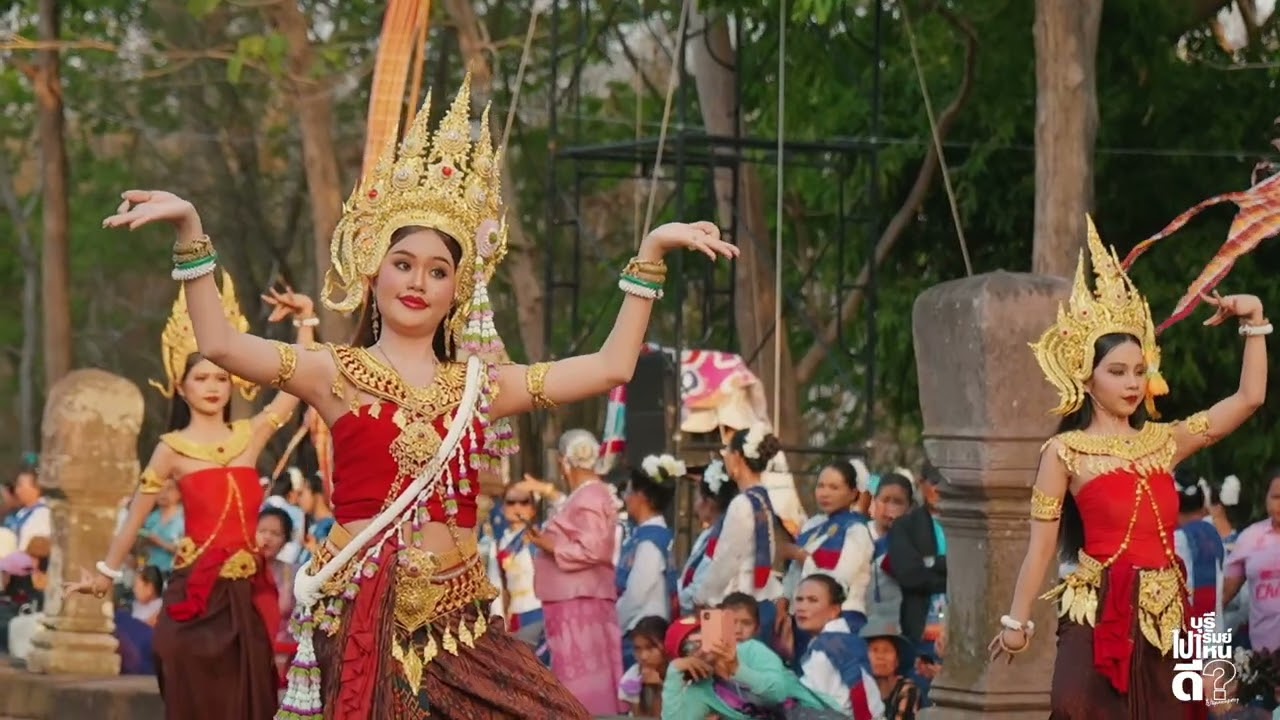
 Click to Access the Navigation Map GPS
Phanom Rung Mountain Climbing Festival Map
Recommend

 Historical Sites and Monuments(14)
 Landmarks and Memorials(2)
Art, Craft Centres, Tradition(6)
Landmarks and Memorials(2)
Art, Craft Centres, Tradition(6)
 Museums(3)
 Educational Places
 Museum for Study(1)
 Places of Worship
 Temple(74)
 Other Sacred Sites(5)
 Suburban Living
 Village, Community(3)
 Nature and Wildlife
 National Parks and Marine Reserves(2)
 Mountain (Doi)(1)
 Dam, Reservoir, Lake(14)
 River, Canal(1)
 Bays and Beaches(1)
 Other natural attractions(2)
 Entertainment and Agricultural
 Animal camps and shows(1)
 Stadium(2)
 Farms, Parks and Ecotourism(2)
 Waterpark(1)


