
lovethailand home >Northeastern Travel Attractions >Buri Ram Travel Attractions >Na Pho >Ban Du > Phra Prang Wat That
TL;DR: Phra Prang Wat That is located at Wat That, Ban Du Subdistrict, Na Pho District, Buri Ram Province, open Daily, hours 08.00 – 17.00.

Phra Prang Wat That
Open Days: Daily
Opening Hours: 08.00 – 17.00
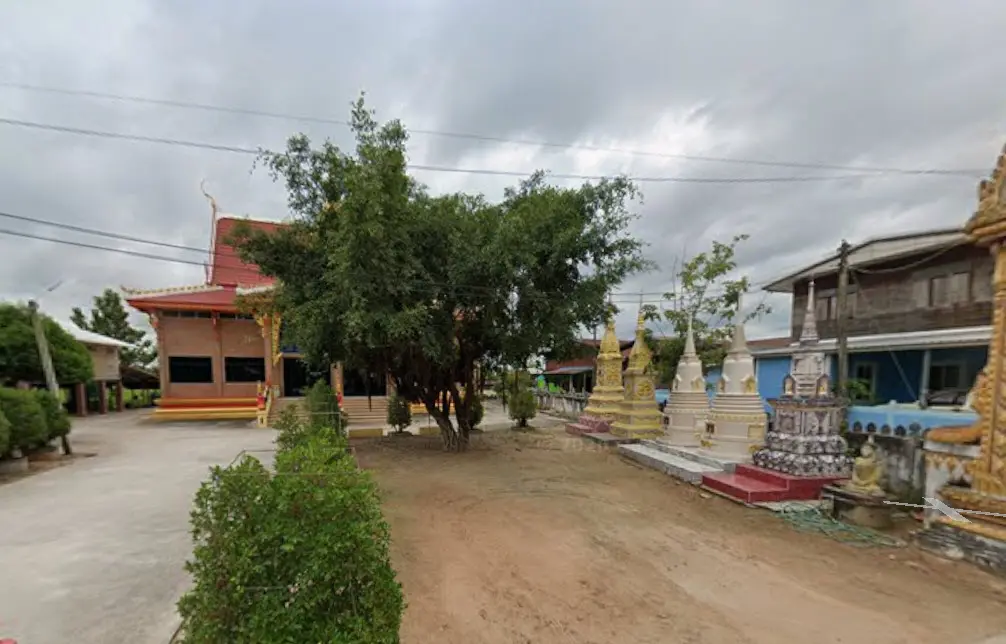
Phra Prang Wat That is an ancient laterite prang located inside Wat That Ban Du in Ban Du Subdistrict, Na Pho District, Buri Ram Province. Although there is no clear evidence identifying the exact period of construction, local elders describe it as an old sacred monument that has long stood together with the Mahesak Lak Mueang, a community guardian spirit shrine located to the north of the prang. The structure was restored in 1976 with an effort to preserve its original form as much as possible. Today, it remains a quiet and valuable local heritage site for travelers interested in small archaeological monuments, old community temples, laterite architecture, and the cultural landscape of northern Buri Ram.
Phra Prang Wat That is a small but meaningful historical monument located within Wat That Ban Du, a community temple in Ban Du Subdistrict, Na Pho District, Buri Ram Province. It is not a large-scale tourist attraction like Phanom Rung or Prasat Muang Tam, but it carries a different kind of value. The site offers visitors a calm view of a laterite prang that still stands in good condition within the living environment of a village temple. For travelers seeking a quieter side of Buri Ram, this is a place where local faith, archaeological remains, and community memory can be experienced in a direct and unpolished way.
Wat That Ban Du is an active Buddhist temple in Ban Du, an old community area of Na Pho District. The word “That” in Thai and Isan cultural contexts often refers to a relic monument, stupa, sacred chedi, or a structure associated with religious importance. The temple name therefore suggests a long-standing sacred character. Wat That is still used for Buddhist activities today, while the ancient prang remains an important historical feature within the temple grounds. This combination makes the site both a place of worship and a local heritage landmark.
The most distinctive feature of the site is the prang built of laterite. Laterite is a common material in northeastern Thailand and was widely used in religious and historical structures because of its strength and availability. Its reddish-brown texture gives old monuments a solemn and earthy character. At Wat That, the use of laterite makes the prang visually connected to the architectural traditions of the region. The surface of the stone, weathered by time, gives visitors a strong sense of age and continuity.
A prang is a sacred tower-like structure with deep religious and symbolic meaning in Thai architecture. In many historical contexts, prang forms are connected with Khmer influence, early Buddhist sanctuaries, and later developments in Ayutthaya-period temple architecture. They often represent a sacred mountain or a cosmic center rising toward the heavens. Although the exact date of Phra Prang Wat That is not clearly documented, the structure itself remains an important piece of evidence showing that this area once held special religious or spiritual significance.
According to local oral tradition, Phra Prang Wat That has long stood together with the Mahesak Lak Mueang, located to the north of the prang. This detail is important because it shows how Buddhist sacred architecture and local guardian beliefs coexist within the same landscape. In many Isan communities, guardian spirits, village pillars, and sacred local shrines remain deeply respected alongside Buddhist temples. At Wat That Ban Du, the prang and the Mahesak Lak Mueang together express the layered spiritual world of the community.
This relationship between the prang and the local guardian shrine makes the site more than a historical object. For local people, the prang is not simply an old stone structure. It is part of a sacred place connected with protection, community identity, and continuity. Visitors should therefore approach the area with respect. The monument should not be climbed, touched unnecessarily, or treated as a casual photo prop. It is both a heritage structure and a sacred space for the local community.
In 1976, the prang was restored with an effort to keep it as close to its original condition as possible. This form of restoration is important for cultural heritage. The goal is not to make an old monument look new, but to stabilize and preserve what remains so that its historical character is not lost. The prang seen today therefore retains a quiet and authentic atmosphere. It is modest, compact, and visually strong, with a sense of age that cannot be reproduced by new construction.
The good condition of the prang makes it valuable for local historical study. Even though written documentation is limited, the monument itself can still be read through its material, form, orientation, and relationship with the surrounding sacred area. Visitors interested in local archaeology may observe the laterite blocks, the tower form, the temple setting, and the position of the Mahesak Lak Mueang to the north. These elements help reveal how sacred space was shaped by both religious architecture and community belief.
Wat That Ban Du is a royal common temple under the Maha Nikaya order and remains an active village temple. Monks reside at the temple, and local residents continue to use the space for merit-making and Buddhist ceremonies. For this reason, visitors should remember that the temple is not an abandoned archaeological site. It is a living religious place. Modest clothing, quiet behavior, and respect for monks and worshippers are expected.
For cultural travelers, Phra Prang Wat That is best appreciated slowly. Its charm lies in its simplicity. Unlike major historical parks that are managed as large tourist destinations, this site gives a more intimate experience of local heritage. Visitors can stand close to the world of a village temple, observe an ancient laterite structure, and understand how heritage survives within everyday community life. The site is especially suitable for those who enjoy small monuments, old temples, and local history outside the main tourist routes.
Na Pho District is also known for silk weaving and local handicrafts. A visit to Phra Prang Wat That can be combined with the Na Pho District Handicraft Center and local silk-weaving communities. This creates a richer cultural route: the ancient prang represents sacred heritage, while the weaving communities represent living craftsmanship. Together, they show that Na Pho is not only a rural district but also a place of historical memory, religious faith, and skilled local production.
Several nearby places can be included in the same itinerary. These include Wat Tha Riab, Khlong Phang Chu, Wat Hong and Phra Chao Yai in Phutthaisong District, and Prang Ku Suan Taeng in Ban Mai Chaiyaphot District. This route gives travelers a broad view of northern Buri Ram, combining ancient monuments, sacred Buddha images, local canals, silk handicrafts, and community temples. It is a quieter but highly meaningful alternative to the better-known southern Buri Ram routes around Phanom Rung.
The phrase “no clear evidence of the construction period” should be understood carefully. It does not reduce the importance of the site. Many local monuments in Thailand have limited written records, yet they remain valuable through their physical presence and the memory of the community. Phra Prang Wat That is important precisely because it preserves a local layer of history that might otherwise be overlooked. Its value comes from age, material, community belief, and continuous association with sacred space.
For photography, the site is suitable for documentary-style images of local heritage and old temple architecture. Morning and late afternoon light can help bring out the texture of the laterite blocks. Visitors should photograph respectfully, avoid blocking worshippers, and keep a safe distance from the structure. The best visual story usually includes not only the prang itself, but also the temple grounds, the surrounding atmosphere, and the relationship between the monument and the village setting.
The best time to visit is during the morning or early afternoon. The temple is open daily from 08.00 to 17.00. Morning visits are especially pleasant because the weather is cooler and the atmosphere is calm. During the rainy season, visitors should check local road conditions and drive carefully, as village roads may be wet after rainfall. Comfortable footwear is useful, but visitors should also be ready to remove shoes when entering religious buildings.
Getting There is easiest by private car. Set the destination as Wat That Ban Du, Ban Du Subdistrict, Na Pho District, Buri Ram Province, or use the coordinates 15.699046, 103.002457. The temple can be reached from Na Pho, Phutthaisong, and Ban Mai Chaiyaphot districts. Travelers coming from Buri Ram city can drive toward Phutthaisong and continue to Na Pho. Those coming from Maha Sarakham or Khon Kaen may connect through Phayakkhaphum Phisai or Ban Phai depending on their starting point.
Travelers using public transportation should first reach Na Pho or Phutthaisong town, then arrange a local vehicle to Wat That Ban Du. Because the monument is located in a village temple rather than on a major highway, private transport or a hired local vehicle is more convenient. This is especially true for visitors who plan to continue to the Na Pho handicraft center, Khlong Phang Chu, or Prang Ku Suan Taeng in the same trip.
Temple and heritage etiquette should be observed. Visitors should dress modestly, speak quietly, avoid climbing on the prang, avoid writing or scratching on the stone, and never remove any object from the site. If local residents are performing rituals or merit-making activities, visitors should give them space and respect. The monument belongs not only to history, but also to the living spiritual world of the Ban Du community.
The appeal of Phra Prang Wat That lies in its quiet authenticity. It is not a place designed for mass tourism, but a place that rewards careful observation. The laterite prang, the village temple, the guardian belief, and the modest surroundings together create a deeply local experience. For travelers who want to understand Buri Ram beyond its famous historical parks, this small site offers a meaningful look into community heritage.
In summary, Phra Prang Wat That in Buri Ram Province is a valuable laterite monument combining local history, religious architecture, community belief, and living temple culture. Its construction period remains uncertain, but its importance is clear. Standing inside Wat That Ban Du and associated with the Mahesak Lak Mueang to the north, the prang is a quiet witness to the spiritual memory of Ban Du. Travelers visiting Na Pho District should include this site in a cultural route to experience a deeper, calmer, and more local side of Buri Ram.
| Name | Phra Prang Wat That / Wat That Ban Du |
| Location | Wat That, Ban Du Subdistrict, Na Pho District, Buri Ram Province |
| Address | Moo 2, Ban Du Subdistrict, Na Pho District, Buri Ram Province 31230, Thailand |
| Coordinates | 15.699046, 103.002457 |
| Highlights | A well-preserved laterite prang inside a village temple, associated with the Mahesak Lak Mueang located to the north of the monument |
| History | The exact construction period is unknown. Local information identifies Wat That Ban Du as an old temple area, and the temple was formally established in 1928. |
| Name Origin | The name Wat That is connected with sacred religious structures within the temple, while Phra Prang Wat That refers to the laterite prang standing inside the temple grounds. |
| Distinctive Features | A laterite prang in very good condition, restored in 1976 with an effort to preserve its original appearance as much as possible |
| Important Sacred Objects / Areas | The laterite prang, the Mahesak Lak Mueang to the north, Wat That temple grounds, and the old sacred atmosphere of Ban Du community |
| Main Areas / Zones | 1. Laterite Prang Zone 2. Mahesak Lak Mueang Zone North Of The Prang 3. Wat That Worship Area 4. Temple Religious Activity Area 5. Temple Courtyard And Community Activity Area 6. Walking And Photography Area Around The Monument |
| Abbot / Caretaker | Phra Khru Nikhrot Phutthikhun Thitathammo |
| Current Status | Active Buddhist temple under the Maha Nikaya order and a local historical–spiritual landmark of Ban Du, Na Pho District |
| Open Days | Daily |
| Opening Hours | 08.00 – 17.00 |
| Fees | No Admission Fee |
| Facilities | Temple courtyard, parking area, worship area, pavilions, merit-making area, and walking space around the monument |
| Travel Information | Private car is recommended. Set the destination as Wat That Ban Du, Ban Du Subdistrict, Na Pho District, Buri Ram Province, or use the coordinates 15.699046, 103.002457. |
| Nearby Tourist Attractions | 1. Na Pho District Handicraft Center, about 8 km 2. Wat Tha Riab, Na Pho District, about 8 km 3. Khlong Phang Chu, Na Pho District, about 10 km 4. Wat Hong / Phra Chao Yai, Phutthaisong District, about 18 km 5. Prang Ku Suan Taeng, Ban Mai Chaiyaphot District, about 23 km |
| Nearby Restaurants | 1. Jungle Cafe Na Pho Buriram, about 8 km, Tel. 085-374-3003 2. U_na Cafe, about 8 km, Tel. 082-639-3647 3. Sixteen Cafe, Na Pho District, about 12 km, Tel. 087-244-1565 4. Khrua Khun Ploy, Na Pho District, about 9 km 5. Louis Farm Restaurant, about 15 km |
| Nearby Accommodations | 1. Ying Lee Lalla Resort, Ban Khu Subdistrict, Na Pho District, about 12 km, Tel. 083-336-6044 2. Pha Toomthong Homestay, Ban Na Pho, about 9 km, Tel. 044-686-044, 084-960-4291 3. Thanyaras Resort, Phutthaisong District, about 20 km, Tel. 081-876-4202 4. Ruanrattakarn Resort, Phutthaisong District, about 23 km 5. Play La Ploen Boutique Resort, Khu Mueang District, about 42 km |
Frequently Asked Questions (FAQ)
Q: Where is Phra Prang Wat That located?
A: Phra Prang Wat That is located inside Wat That in Ban Du Subdistrict, Na Pho District, Buri Ram Province, Thailand.
Q: When was Phra Prang Wat That built?
A: There is no clear evidence identifying its exact construction period, but it is regarded as an old local monument associated with Wat That Ban Du and the Ban Du community.
Q: What material was used to build the prang?
A: The prang was built with laterite, a durable reddish-brown stone commonly found in historical structures in northeastern Thailand.
Q: Why is Phra Prang Wat That important?
A: It is a well-preserved laterite monument associated with the Mahesak Lak Mueang to the north of the prang, reflecting both local history and community belief.
Q: Has the prang been restored?
A: Yes. The prang was restored in 1976 with an effort to keep its original condition as much as possible.
Q: What are the opening hours of Wat That Ban Du?
A: The temple is open daily from 08.00 to 17.00.
Q: Who is the abbot of Wat That Ban Du?
A: The abbot is Phra Khru Nikhrot Phutthikhun Thitathammo.
Q: What nearby places can travelers visit after Phra Prang Wat That?
A: Nearby places include the Na Pho District Handicraft Center, Wat Tha Riab, Khlong Phang Chu, Wat Hong / Phra Chao Yai, and Prang Ku Suan Taeng.
 Category: ●Places of Worship
 Group: ●Other Sacred Sites
Last Update : 3 MonthAgo
 Last Update : 3 MonthAgo
 Click to Access the Navigation Map GPS
Phra Prang Wat That Map
Recommend

 Art, Culture and Heritage
 Historical Sites and Monuments(14)
 Landmarks and Memorials(2)
 Art, Craft Centres, Tradition(6)
 Museums(3)
 Educational Places
 Museum for Study(1)
 Temple(74)
Other Sacred Sites(5)
Temple(74)
Other Sacred Sites(5)
 Suburban Living
 Village, Community(3)
 Nature and Wildlife
 National Parks and Marine Reserves(2)
 Mountain (Doi)(1)
 Dam, Reservoir, Lake(14)
 River, Canal(1)
 Bays and Beaches(1)
 Other natural attractions(2)
 Entertainment and Agricultural
 Animal camps and shows(1)
 Stadium(2)
 Farms, Parks and Ecotourism(2)
 Waterpark(1)


