
lovethailand home >Northeastern Travel Attractions >Buri Ram Travel Attractions >Ban Kruat >Prasat > Lan Hin Tat
TL;DR: Lan Hin Tat is located at Prasat Subdistrict, Ban Kruat District, Buri Ram Province, open Daily, hours Outdoor Site; Daytime Visits Are Recommended.

Lan Hin Tat
Open Days: Daily
Opening Hours: Outdoor Site; Daytime Visits Are Recommended
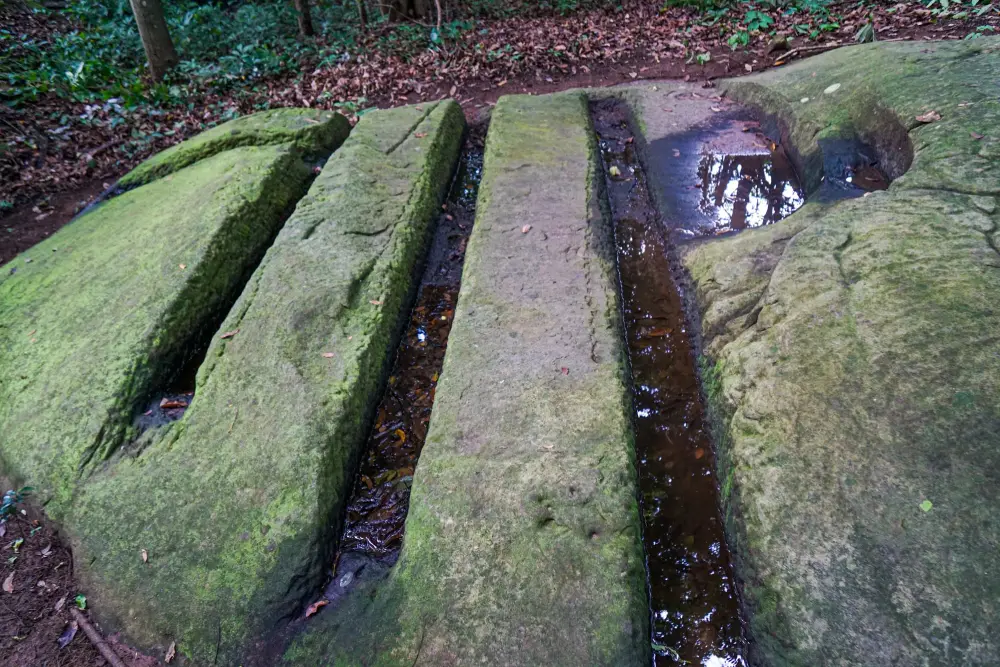
Lan Hin Tat, also known as the Ban Kruat Stone Quarry Site, is an important archaeological and historical learning site in Prasat Subdistrict, Ban Kruat District, Buri Ram Province. It is a large sandstone quarry landscape where visitors can still see grooves, cut marks, extraction lines, and sandstone blocks that were prepared in rectangular forms. The Fine Arts Department identifies this site as a major ancient sandstone source used for constructing Khmer-style sanctuaries in southern Isan, with an estimated age around the 15th–18th Buddhist centuries. The site is especially meaningful because it is closely connected with the sandstone used in major monuments such as Phanom Rung and Mueang Tam.
The value of Lan Hin Tat is not only in its natural rock formations. It is a rare place where the ancient stone-working process can still be observed directly on the surface of the rock. Visitors can see how natural sandstone was selected, grooved, separated, shaped, and prepared for transport. These marks reveal the technical skill, labor organization, and material knowledge of ancient craftsmen who worked long before modern machinery existed. For travelers who have visited Phanom Rung Historical Park, this quarry helps answer an important question: where did the stone come from?
The site is located in the sandstone hills of Ban Kruat District, especially around the Ban Sai Tri 3 area in Prasat Subdistrict. This area lies southeast of Phanom Rung and is part of a wider geological and cultural landscape connected with Khmer-period temple construction. Academic information explains that sandstone from this area is similar to the stone used at Phanom Rung and Mueang Tam, especially pink sandstone with dense, strong texture suitable for carving and construction. This makes Ban Kruat an important source area behind the great stone sanctuaries of Buri Ram.
Walking through Lan Hin Tat, visitors will find sandstone blocks of different sizes scattered through the forested landscape. Some stones show long grooves cut into the surface. Others appear to have been separated into rectangular shapes but were never transported away. These unfinished blocks make the site feel like a frozen workshop from the past. Instead of seeing only a finished temple, visitors see the earlier stage of the process: the quarry, the raw stone, and the technical preparation before architecture was born.
The site is important for understanding the relationship between landscape and ancient architecture. Khmer sanctuaries did not begin only at the construction site. They required a complete supply chain: stone sources, quarrying, shaping, transportation, labor, planning, and final assembly. Lan Hin Tat preserves the beginning of that chain. It shows how natural stone from Ban Kruat became part of religious architecture, artistic expression, and political power in the ancient Khmer cultural world.
The ancient quarrying process likely began with preparing a flat stone surface. Craftsmen then carved long grooves to outline the intended block, inserted wedges, and used force to separate the stone. After the block was removed from the bedrock, it could be shaped into a rectangular form and transported for further finishing. This process required careful knowledge of stone grain, fracture lines, weight, tools, and timing. A mistake could break the stone and make it unusable. For this reason, the quarry is an excellent place to appreciate the practical intelligence of ancient builders.
The present site has a shady and natural atmosphere. Trees and undergrowth surround the sandstone formations, creating a calm walking environment. Some pathways have been improved to make the site easier to access, allowing visitors to walk through the area and observe stone-cutting traces more comfortably. The improved walkways also help reduce damage to important archaeological remains because visitors can follow clearer routes rather than walking randomly over sensitive surfaces.
One of the most interesting things to observe is the pattern of cut marks and grooves on the sandstone. Some marks appear as long parallel lines, while others show where blocks were separated or prepared. These marks should be observed carefully and respectfully. Visitors should not write on the stones, climb on fragile areas, move stone pieces, or damage the surface. Even small marks may contain important information about ancient quarrying methods.
Lan Hin Tat is suitable for travelers who want to understand Buri Ram beyond the finished Khmer temples. It gives context to places like Phanom Rung and Mueang Tam by showing the source of the material. When travelers stand among the quarry stones, they can imagine how each block was extracted, shaped, and moved across the landscape before becoming part of stairs, door frames, pillars, lintels, and sanctuary walls. This makes the site both educational and deeply atmospheric.
The site is also useful for educational visits. It connects archaeology, art history, geology, geography, Khmer culture, engineering, and natural-resource management. Students can learn about sandstone and rock layers. History learners can study the relationship between material sources and monument construction. General visitors can understand that ancient civilization depended not only on belief and royal power, but also on skilled labor and practical technology.
Getting There from Ban Kruat District town is straightforward by private car. Travel along the Ban Kruat–Ta Phraya route toward Prasat Subdistrict and Ban Sai Tri 3. The distance from Ban Kruat town is about 9 km before turning into the local road leading to the quarry area. Travelers should use a navigation map together with local signs, and daytime travel is recommended because the area is rural and easier to navigate in clear light.
Travelers without a private car can first reach Ban Kruat town and then arrange local transport or a hired vehicle to Lan Hin Tat. Return time should be agreed in advance because the quarry is outside the town center and public transport does not normally pass directly through the site throughout the day. For foreign travelers, a rental car with a driver is the most convenient choice, especially when combining the quarry with Prasat Thong, Tao Sawai Ancient Kiln, Sai Taku Border Trade Checkpoint, and other local sites.
The best time to visit is in the morning or late afternoon when the heat is lower. Although the site is shaded in many areas, exposed sandstone can become hot during the day. The cool season and the period after the rainy season are especially pleasant. During the rainy season, visitors should be careful because wet leaves, moss, and stone surfaces can become slippery. Good walking shoes are recommended.
Recommended activities include walking along the quarry trail, observing cut marks, photographing sandstone blocks, reading information signs, studying ancient stone-working techniques, and resting in the shaded natural area. The experience is quiet and observational rather than adventurous. The more slowly visitors walk, the more details they will notice on the stones.
For photographers, Lan Hin Tat offers strong visual subjects: large sandstone blocks, long quarry grooves, forest pathways, weathered stone surfaces, roots and trees growing around ancient remains, and soft light filtering through the canopy. Morning light gives a calm and fresh atmosphere, while late afternoon light creates stronger shadows and texture on the stone surface. Visitors should avoid climbing on stones for photographs because it may be dangerous and can damage the archaeological evidence.
Lan Hin Tat can be combined with Prasat Thong or Prasat Ta Chia in Ban Kruat District. Prasat Thong is an ancient Khmer sanctuary built with brick and sandstone. Visiting the quarry together with the sanctuary helps travelers see the connection between the source of stone and the final religious architecture. This creates a more complete understanding of ancient construction in southern Isan.
Ban Kruat District also contains other important archaeological sites, including Tao Sawai Ancient Kiln, Tao Nai Chian Ancient Kiln, the iron-smelting site at Ban Sai Tho 5 Tai, Prasat Bai Baek, Prasat Thamo, and Sai Taku Border Trade Checkpoint. Together, these sites show that Ban Kruat was not only a border district, but also an area of production, craft technology, trade, settlement, and ancient cultural activity.
Tao Sawai Ancient Kiln is especially useful for travelers interested in ancient production technology. Ban Kruat is known for traces of ceramics and kiln activity, while Lan Hin Tat represents stone production. Combining these two types of sites helps visitors understand ancient industry in the region more broadly: stone for architecture, ceramics for use and ritual, and iron for tools and local economy.
Sai Taku Border Trade Checkpoint adds a modern borderland dimension to the route. Travelers with enough time can visit the quarry in the morning, return to Ban Kruat town for lunch, and continue toward the border area or other historical sites in the afternoon. This route offers archaeology, community life, local food, and the Thai–Cambodian border atmosphere in one day.
Food options are mostly available in Ban Kruat town rather than at the quarry itself. Visitors can find local restaurants, Isan food, cafes, and casual dining places in town. It is practical to eat before or after visiting Lan Hin Tat. Groups should call restaurants in advance when possible, especially on weekends or during holidays.
Accommodation is available in Ban Kruat District through local resorts and small hotels. Staying in Ban Kruat is suitable for travelers who want to explore the quarry, Prasat Thong, Tao Sawai Ancient Kiln, and Sai Taku Border Trade Checkpoint in a relaxed way. Travelers who plan to continue to Phanom Rung or Mueang Tam may also choose to stay in Prakhon Chai or Nang Rong depending on their route.
Responsible behavior is essential at Lan Hin Tat. Visitors should not scratch, write on, chip, collect, or move any stone pieces. They should not climb unsafe blocks, leave trash, or disturb the natural setting. Every mark on the stone may be part of the archaeological story, so careful travel helps protect the site for future study and future visitors.
Families visiting with children should explain that the site is a historical place, not a playground. Children can walk, observe, and learn, but they should not run on the stones or climb on uneven surfaces. Elderly visitors should use the improved path and avoid slippery or steep areas. Drinking water, a hat, insect repellent, and suitable shoes will make the visit more comfortable.
For international travelers, Lan Hin Tat offers a deeper understanding of Buri Ram’s Khmer heritage. After seeing Phanom Rung, visiting the quarry reveals the source of the sandstone and the labor behind the monument. It helps foreign visitors understand that ancient sanctuaries were not only artistic or religious achievements, but also engineering projects supported by material knowledge, landscape use, and organized labor.
In summary, Lan Hin Tat or Ban Kruat Stone Quarry Site is one of the most important archaeological learning sites in Buri Ram Province. It preserves visible evidence of ancient sandstone extraction used in Khmer sanctuary construction. With its quarry marks, rectangular sandstone blocks, shaded natural setting, improved walkway, and close connection to Phanom Rung, the site is suitable for history lovers, students, photographers, and travelers who want to understand the origin of the stone behind southern Isan’s great monuments.
| Name | Lan Hin Tat / Ban Kruat Stone Quarry Site |
| Location | Prasat Subdistrict, Ban Kruat District, Buri Ram Province |
| Address | Ban Kruat Stone Quarry Site, Ban Sai Tri 3 / Khao Kloi and Khao Makok Area, Prasat Subdistrict, Ban Kruat District, Buri Ram 31180, Thailand |
| Coordinates | 14.364938, 103.085438 |
| Highlights | Ancient sandstone quarry, quarry grooves, cut sandstone blocks, shaded walking route, and strong connection with the construction of Phanom Rung and other Khmer sanctuaries |
| History | Estimated to date to the 15th–18th Buddhist centuries as a major sandstone production site for ancient Khmer sanctuary construction |
| Name Origin | The name refers to the natural sandstone plateau where clear traces of ancient stone cutting remain visible |
| Distinctive Features | Sandstone hill landscape with long quarry grooves, rectangular cut blocks, scattered ancient stone remains, forest surroundings, and improved walking paths |
| Local Importance | Important evidence of sandstone production used for ancient Khmer sanctuaries in southern Isan, especially Phanom Rung and Mueang Tam |
| Travel Information | From Ban Kruat town, use the Ban Kruat–Ta Phraya route toward Prasat Subdistrict and Ban Sai Tri 3 for about 9 km, then continue on the local access road to the quarry area |
| Current Status | Archaeological and historical learning site open for sightseeing, education, photography, and quiet nature-based visits |
| Open Days | Daily |
| Opening Hours | Outdoor site; daytime visits are recommended |
| Fees | No admission fee |
| Facilities | Walking path, shaded natural area, visible quarry marks, some information points, road access, and restaurants / accommodation in Ban Kruat town |
| Main Areas / Zones | Sandstone quarry area, quarry-groove viewing points, cut sandstone blocks, nature walking path, Wat Pa Lan Hin Tat area, hill viewpoint, and shaded forest area around the quarry |
| Caretaker | Fine Arts Department / 10th Regional Office of Fine Arts, Nakhon Ratchasima, and Prasat Subdistrict Municipality as the local administrative authority of the area |
| Main Contact Number | Prasat Subdistrict Municipality Tel. 044-679-412 / 10th Regional Office of Fine Arts, Nakhon Ratchasima Tel. 044-471-518 |
| Official Website / Official Page | www.finearts.go.th/fad10 / www.prasath.go.th |
| Nearby Tourist Attractions | 1. Wat Pa Lan Hin Tat, about 1 km 2. Prasat Thong / Prasat Ta Chia, Ban Kruat, about 9 km 3. Ban Kruat Market And Town Area, about 9 km 4. Tao Sawai Ancient Kiln, about 12 km 5. Iron-Smeling Site At Ban Sai Tho 5 Tai, about 18 km 6. Sai Taku Border Trade Checkpoint, about 25 km 7. Mekha Dam / Huai Mekha Dam, about 30 km |
| Nearby Restaurants | 1. RINTR Plus Cafe Bar Restaurant, about 10 km, Tel. 081-966-1766 2. Coco Cool Cafe, about 10 km, Tel. 064-778-7799 3. Krua Tam Laek Na Ban Kruat, about 10 km, Tel. 089-011-3610, 063-041-3380 4. First Da & Ped, about 11 km, Tel. 098-597-1641 5. Tam Laek Ban Kruat, about 10 km, Tel. 098-457-4357 6. Local Restaurants Around Ban Kruat Market, about 9 km |
| Nearby Accommodations | 1. Ban Kruat Garden Resort, about 10 km, Tel. 044-679-263, 086-250-4186 2. King Kruat Resort, about 10 km, Tel. 089-846-1177 3. Ruean Mai Resort, about 10 km, Tel. 083-374-2046 4. Wonsin Resort, about 11 km, Tel. 080-354-6956, 044-115-225, 095-612-2565, 064-739-1434 5. Muang Sud Bungalow, about 15 km, Tel. 089-832-1875 6. Fresh Garden Resort, about 18 km, Tel. 061-038-4295 7. Idin Resort, about 30 km, Tel. 089-925-5453 |
Frequently Asked Questions (FAQ)
Q: Where is Lan Hin Tat located?
A: Lan Hin Tat, or Ban Kruat Stone Quarry Site, is located in Prasat Subdistrict, Ban Kruat District, Buri Ram Province, around the Ban Sai Tri 3 sandstone hill area.
Q: Why is Lan Hin Tat important?
A: It is an ancient sandstone production site used for constructing Khmer sanctuaries in southern Isan, especially monuments such as Phanom Rung and Mueang Tam.
Q: What can visitors see at Lan Hin Tat?
A: Visitors can see sandstone quarry grooves, cut marks, rectangular stone blocks, a shaded walking route, and evidence of ancient stone-working techniques.
Q: Is there an admission fee?
A: No. Visitors can enter the site without an admission fee during suitable daytime hours.
Q: How can travelers get to Lan Hin Tat?
A: From Ban Kruat town, take the Ban Kruat–Ta Phraya route toward Prasat Subdistrict and Ban Sai Tri 3 for about 9 km, then continue on the local access road to the quarry area.
Q: When is the best time to visit Lan Hin Tat?
A: Morning and late afternoon are the best times because the weather is more comfortable, the light is suitable for photography, and the stone surfaces are easier to observe.
Q: What nearby attractions can be combined with Lan Hin Tat?
A: Nearby places include Wat Pa Lan Hin Tat, Prasat Thong, Tao Sawai Ancient Kiln, Sai Taku Border Trade Checkpoint, and Mekha Dam.
Q: Is Lan Hin Tat suitable for foreign travelers?
A: Yes. It is suitable for foreign travelers who want to understand the origin of the sandstone used at Phanom Rung, learn about ancient quarrying technology, and explore a historical site in a natural setting.
 Category: ●Nature and Wildlife
 Group: ●Other natural attractions
Last Update : 3 MonthAgo
 Last Update : 3 MonthAgo
 Click to Access the Navigation Map GPS
 Art, Culture and Heritage
 Historical Sites and Monuments(14)
 Landmarks and Memorials(2)
 Art, Craft Centres, Tradition(6)
 Museums(3)
 Educational Places
 Museum for Study(1)
 Places of Worship
 Temple(74)
 Other Sacred Sites(5)
 Suburban Living
 Village, Community(3)
 National Parks and Marine Reserves(2)
 Mountain (Doi)(1)
 Dam, Reservoir, Lake(14)
 River, Canal(1)
 Bays and Beaches(1)
Other natural attractions(2)
Bays and Beaches(1)
Other natural attractions(2)
 Entertainment and Agricultural
 Animal camps and shows(1)
 Stadium(2)
 Farms, Parks and Ecotourism(2)
 Waterpark(1)


