
lovethailand home >Northeastern Travel Attractions >Buri Ram Travel Attractions >Prakhon Chai >Khao Khok > Prasat Ban Bu
TL;DR: Prasat Ban Bu is located at Inside Ban Bu Wittayasan School, Ban Bu Village, Moo 5, Chorakhe Mak Subdistrict, Prakhon Chai District, Buriram Province, open Daily, hours Daytime Visits And School Office Hours Are Recommended.

Prasat Ban Bu
Open Days: Daily
Opening Hours: Daytime Visits And School Office Hours Are Recommended
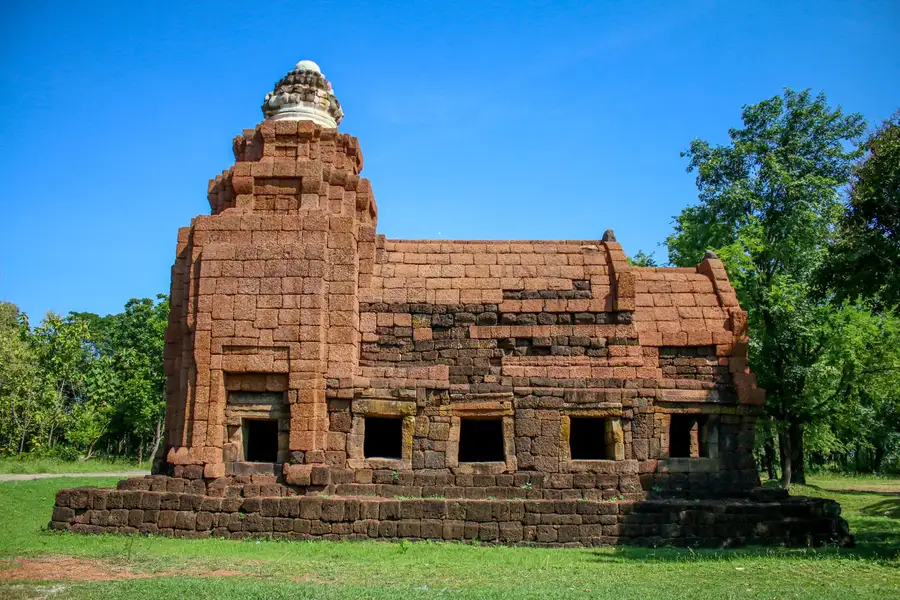
Prasat Ban Bu, also known as Kuti Ruesi Ban Bu, is a small but historically important Khmer monument located inside Ban Bu Wittayasan School in Chorakhe Mak Subdistrict, Prakhon Chai District, Buriram Province. Standing near Highway 2221 on the same route to Prasat Mueang Tam and Phanom Rung, it is identified as a “Vahnigriha” or ancient travelers’ rest house from the reign of King Jayavarman VII. Its key evidence includes a laterite rectangular building, sandstone door and window frames, an inner pedestal for a sacred image, and a lintel fragment showing a seated Buddha in meditation, reflecting Mahayana Buddhist belief along the ancient route between Angkor and Phimai.
Prasat Ban Bu is located inside Ban Bu Wittayasan School, Ban Bu Village, Moo 5, Chorakhe Mak Subdistrict, Prakhon Chai District, Buriram Province. Although it is smaller and less monumental than Phanom Rung or Prasat Mueang Tam, it has exceptional historical value. This small Khmer structure helps travelers understand the ancient road system of the Khmer Empire, especially the route connected with King Jayavarman VII. It shows that the area around Phanom Rung was not only a landscape of large sanctuaries but also a network of rest houses, communities, pilgrimage routes, trade routes, and religious infrastructure.
The monument stands near Highway 2221 on the same road used to reach Prasat Mueang Tam. From the junction leading into Prasat Mueang Tam, continue toward Prakhon Chai for about 1.5 km and you will reach Ban Bu Wittayasan School, where the monument is located. This position makes Prasat Ban Bu ideal for a historical route linking Prasat Mueang Tam, Phanom Rung Historical Park, Baray Mueang Tam, Kuti Ruesi Ban Khok Mueang, and other archaeological sites around the Phanom Rung cultural landscape.
Architecturally, Prasat Ban Bu differs from the common image of Khmer temples as tall tower sanctuaries. It is a rectangular laterite building with sandstone door and window frames. The building extends along an east-west axis and faces east, an important orientation in Khmer sacred architecture. The front entrance connects with the main chamber of the structure, while the interior contains a pedestal for a sacred image. This shows that the building was not simply a practical shelter but also a small religious space where travelers could rest, worship, and prepare spiritually before continuing their journey.
Prasat Ban Bu belongs to a group of monuments known as Vahnigriha, often translated as “houses of fire.” In the Khmer context, these were religious rest houses or dharmasalas for travelers. The term does not refer to an ordinary house but to a structured resting place along important routes, serving pilgrims, merchants, officials, and caravans traveling between major cities. The Preah Khan inscription in Cambodia records that King Jayavarman VII ordered the construction of 121 Vahnigriha along routes from Angkor to important cities. One route led toward Phimai, and 17 Vahnigriha were built along that road.
Prasat Ban Bu is important because it was one of those rest houses on the ancient route between Angkor and Phimai. This route was more than a road in the modern sense. It was a cultural, religious, political, and economic network connecting major centers of the Khmer world. Several related sites are found in present-day Thailand, including Prasat Ta Muean in Surin, Prasat Ban Bu in Buriram, Prasat Nong Kong, Prasat Nong Plong, Prasat Nong Ta Pleng, Prasat Ban Samrong, and sites in Nakhon Ratchasima before reaching Phimai.
The location of Prasat Ban Bu suggests that it functioned as an important resting point near the foot of Phanom Rung. Travelers moving through this region would have been close to the route leading up to Phanom Rung and to the ancient communities around Ban Khok Mueang and Prasat Mueang Tam. Prasat Ban Bu was therefore not an isolated monument. It formed part of a sacred and practical landscape that included a mountain sanctuary, lowland temple, communities, reservoirs, and travel routes.
The artistic style of Prasat Ban Bu belongs to the Bayon period of Khmer art, around the 13th century CE or the 18th Buddhist century, during the reign of King Jayavarman VII. This was a period strongly associated with Mahayana Buddhism and the construction of public religious infrastructure, including rest houses and hospitals. Prasat Ban Bu therefore confirms that Buriram was part of the Khmer network of movement, faith, and administration during that period.
The building is made primarily of laterite, a durable material commonly used in Khmer construction. Earlier descriptions give its size as about 5.10 meters wide and 11.50 meters long, while art-historical databases describe the broader structure as approximately 6 x 23 meters. The important point is that the building has a long rectangular form, faces east, and preserves sandstone elements within its laterite walls. Laterite provided strength and endurance, while sandstone was used for more refined architectural details such as door and window frames.
The southern wall contains several window openings, while the northern wall is mostly solid. This pattern is consistent with other Vahnigriha structures, where one side often has openings for light and ventilation while the other remains closed. The original upper part of the building has collapsed, but surviving evidence indicates that a vaulted roof once connected the corridor and the front chamber. Even in its present condition, visitors can still read the basic plan of the building and understand how the space was used.
Inside the monument is a pedestal for a sacred image. This is a crucial feature because it shows that the rest house also had a religious function. Ancient travelers may have stopped here to rest, offer worship, seek protection, or perform small rituals before continuing toward major sanctuaries such as Phanom Rung or Phimai. Rest houses like this supported both the physical needs and spiritual needs of travelers.
One of the most important pieces of evidence from Prasat Ban Bu is a lintel fragment carved with a seated Buddha in meditation inside a double arched niche. This Buddhist image reflects the Mahayana Buddhist context of the reign of Jayavarman VII and helps confirm the date and religious meaning of the monument. It links the building, the road system, and Buddhist devotion into one coherent historical picture.
Other architectural evidence shows that older sandstone elements were reused in the construction of Prasat Ban Bu. Some sandstone door frames carry four-petal floral patterns and appear to come from an earlier architectural tradition. Reuse of older elements is found at several Khmer monuments and reflects continuity of sacred space, practical use of available materials, and the transformation of older architectural fragments within a new religious context.
About 4 meters from the main building, traces of a laterite wall remain at ground level. These remains help define the original boundary of the monument. The site was therefore not just a single isolated building but once had a defined sacred or functional area. The wall marked a separation between the inner space of rest and worship and the surrounding landscape.
The Fine Arts Department officially defined the protected boundary of Prasat Ban Bu in the Royal Gazette on March 15, 1983, covering an area of 10 rai, 3 ngan, and 38 square wah. Archaeological clearing was first carried out in 1988, followed by archaeological excavation in 2009. Restoration took place between 2013 and 2017, making the architectural form easier to understand today. These conservation efforts have turned Prasat Ban Bu into an important learning site for local students, travelers, historians, and anyone interested in Khmer civilization.
The appeal of Prasat Ban Bu lies in how it reveals the infrastructure of the ancient world. While Phanom Rung expresses sacred power, mountain symbolism, and monumental architecture, Prasat Ban Bu reveals how people actually traveled. Travelers needed rest points, water, fire, shelter, sacred protection, and routes linking one city to another. This small building is therefore a key to understanding that the Khmer Empire was not built only through grand temples but also through roads, rest houses, and organized networks of movement.
Compared with Prasat Mueang Tam, which has ponds, gateways, galleries, and multiple towers, Prasat Ban Bu is much simpler. That simplicity is exactly what makes it valuable. Visitors can clearly see its function through the single laterite building, window openings, door frames, wall traces, and inner pedestal. It is an excellent site for understanding Khmer culture from the viewpoint of travel and daily movement rather than royal ceremonial architecture alone.
Prasat Ban Bu is also important for local education because it stands inside Ban Bu Wittayasan School. Students in the area grow up with a real archaeological monument within their own school environment. This gives the community a direct connection to history. Local children can learn from real stone, real walls, real archaeological evidence, and understand that their village is part of a much larger regional story.
For travelers, a visit to Prasat Ban Bu usually takes about 20 to 40 minutes. Walk around the main building, observe the southern window openings, the sandstone door frames, the laterite wall remains, and the interior pedestal. If visited as part of a route with Prasat Mueang Tam and Phanom Rung, Prasat Ban Bu should be included either before or after Mueang Tam because the sites are very close to each other and together explain the ancient Khmer road network more completely.
The best time to visit is in the morning or afternoon when the light is not too harsh. Because the monument is located inside a school, visitors should dress respectfully, speak quietly, avoid disturbing classes, and stay within the archaeological area. Do not enter school buildings or unrelated areas. This respect is important because Prasat Ban Bu is both a historic site and part of a living educational space.
For photography, Prasat Ban Bu is suited to wide shots of the laterite building, close-up images of the window openings, sandstone door frames, and the rough texture of laterite blocks. Its beauty is not monumental grandeur but quiet historical depth. Morning side light can bring out the surface of the laterite and make the structure appear more dimensional.
Prasat Ban Bu should be understood together with Phanom Rung and Prasat Mueang Tam. Phanom Rung represents the mountain sanctuary, Prasat Mueang Tam represents the lowland religious center and ancient community, while Prasat Ban Bu represents the road system and travelers’ rest infrastructure. Visiting all 3 sites gives a much deeper understanding of Khmer heritage in Buriram as a connected landscape rather than isolated monuments.
Getting There is most convenient by private car, rental car, or hired local vehicle. From Buriram city, travel toward Prakhon Chai District and Chorakhe Mak Subdistrict on the same route used for Prasat Mueang Tam. From the junction into Prasat Mueang Tam, continue toward Prakhon Chai for about 1.5 km to Ban Bu Wittayasan School on Highway 2221. If starting from Prasat Mueang Tam, the distance is very short and the site can be easily included before continuing to Phanom Rung or returning to Prakhon Chai.
Travelers coming from Phanom Rung can descend from the mountain toward the Mueang Tam route and stop at Prasat Ban Bu afterward. The road is paved and suitable for self-drive travel. Travelers without private transport should rent a car from Buriram city, Nang Rong, or Prakhon Chai, as direct public transport to smaller archaeological sites in this area is limited.
Visitors should not climb on the monument, move stones, touch or scratch architectural fragments, or leave waste in the area. Since the site is inside a school, visitors should also respect school safety, student areas, and local regulations. Every laterite block and sandstone fragment is part of an archaeological record that cannot be replaced.
Prasat Ban Bu is therefore a small monument with a large meaning in the historical map of Buriram. It fills the gap between grand sanctuaries and the lived reality of ancient travel. It shows that Khmer heritage was not only about royal temples but also about rest houses, roads, communities, and support systems that allowed people to move between major centers. A stop at Prasat Ban Bu on the route between Prasat Mueang Tam and Phanom Rung opens a deeper perspective on Buriram as a land of Khmer stone monuments with a rich and layered history.
| Name | Prasat Ban Bu |
| Alternative Name | Kuti Ruesi Ban Bu |
| Location | Inside Ban Bu Wittayasan School, Ban Bu Village, Moo 5, Chorakhe Mak Subdistrict, Prakhon Chai District, Buriram Province |
| Address | Ban Bu Wittayasan School, Moo 5, Chorakhe Mak Subdistrict, Prakhon Chai District, Buriram 31140, Thailand |
| Coordinates | 14.533918, 102.979771 |
| Highlights | A Small Khmer Vahnigriha Or Travelers’ Rest House From The Reign Of King Jayavarman VII, Located On The Ancient Route Between Angkor And Phimai |
| History | Bayon-Style Khmer Art, 18th Buddhist Century, Related To Mahayana Buddhism And The Ancient “House Of Fire” Rest-House System |
| Name Origin | Named After Ban Bu Village In Chorakhe Mak Subdistrict, Where The Monument Is Located Inside Ban Bu Wittayasan School |
| Distinctive Features | Rectangular Laterite Building Facing East, With Sandstone Door And Window Frames, Window Openings On The South Wall, A Solid North Wall, And An Inner Pedestal For A Sacred Image |
| Main Areas / Zones | 1. Rectangular Laterite Building 2. Eastern Entrance 3. Sandstone Door And Window Frames 4. Southern Window Openings 5. Interior Chamber And Sacred Image Pedestal 6. Laterite Wall Traces About 4 M From The Building 7. Ban Bu Wittayasan School Area Around The Monument |
| Key Evidence | Lintel Fragment Showing A Seated Buddha In Meditation Inside A Double Arched Niche, Sacred Image Pedestal, Sandstone Door Frame With Four-Petal Floral Motifs, And Laterite Wall Remains |
| Registration | The Fine Arts Department Defined The Protected Boundary In The Royal Gazette, Volume 100, Section 36, On March 15, 1983, Covering 10 Rai, 3 Ngan, And 38 Square Wah |
| Travel Information | On The Same Route To Prasat Mueang Tam, Beside Highway 2221, About 1.5 Km From The Mueang Tam Junction Toward Prakhon Chai. Best Reached By Private Car, Rental Car, Or Hired Local Vehicle. |
| Current Status | Archaeological Site Inside Ban Bu Wittayasan School, Used As A Local Learning Site And A Stop On The Mueang Tam – Phanom Rung Heritage Route |
| Open Days | Daily |
| Opening Hours | Daytime Visits And School Office Hours Are Recommended |
| Fees | No Admission Fee |
| Facilities | Parking Area Around The School, Outdoor Learning Area, Walking Access To The Monument, And Nearby Community Shops |
| Caretaker | The Fine Arts Department Through Phanom Rung Historical Park, Together With Ban Bu Wittayasan School Area |
| Main Contact Number | Phanom Rung Historical Park, Tel. 044-666-251, 044-666-252 |
| Official Website / Official Page | Phanom Rung Historical Park, Fine Arts Department |
| Nearby Tourist Attractions | 1. Prasat Mueang Tam, About 2 Km 2. Baray Mueang Tam, About 3 Km 3. Kuti Ruesi Ban Khok Mueang, About 3 Km 4. Phanom Rung Historical Park, About 13 Km 5. Wat Khao Angkhan, About 24 Km 6. Lam Nang Rong Dam, About 37 Km |
| Nearby Restaurants | 1. NATEE Cafe’ Buriram, About 12 Km, Tel. 098-197-8004 2. Ran Laang Wang Prakhon Chai, About 15 Km, Tel. 084-605-4324, 099-170-9199 3. Sobhlasta Restaurant At Eireann Boutique Hotel, About 16 Km, Tel. 087-493-9919, 044-666-199 4. Le Loft Bar & Restaurant, About 25 Km, Tel. 094-310-9913 5. Steve & Lek Restaurant, About 25 Km |
| Nearby Accommodations | 1. Hotel De L’amour Buriram, About 15 Km, Tel. 098-102-7809, 044-651-555 2. Eireann Boutique Hotel, About 16 Km, Tel. 087-493-9919, 044-666-199 3. Sohground Boutique Resort, About 17 Km, Tel. 080-488-3183 4. Phanomrungpuri Hotel, About 28 Km, Tel. 044-632-222, 086-336-6618 5. Alvarez Hotel Buriram, About 57 Km, Tel. 044-611-555 |
Frequently Asked Questions (FAQ)
Q: Where Is Prasat Ban Bu Located?
A: Prasat Ban Bu is located inside Ban Bu Wittayasan School, Ban Bu Village, Moo 5, Chorakhe Mak Subdistrict, Prakhon Chai District, Buriram Province, near Highway 2221 on the route to Prasat Mueang Tam.
Q: Why Is Prasat Ban Bu Important?
A: It is a Vahnigriha, or ancient travelers’ rest house, from the reign of King Jayavarman VII. It stood on the ancient route between Angkor and Phimai and was connected with pilgrimage travel toward Phanom Rung.
Q: When Was Prasat Ban Bu Built?
A: It belongs to the Bayon style of Khmer art, dating to the 18th Buddhist century during the reign of King Jayavarman VII, and is associated with Mahayana Buddhism.
Q: What Are The Main Highlights Of Prasat Ban Bu?
A: Its highlights include the rectangular laterite building, sandstone door and window frames, southern window openings, an inner sacred image pedestal, and a lintel fragment showing a seated Buddha in meditation.
Q: Is There An Admission Fee For Prasat Ban Bu?
A: No. There is no admission fee, but visitors should behave respectfully because the monument is located inside a school area.
Q: What Nearby Places Can Be Visited With Prasat Ban Bu?
A: Nearby places include Prasat Mueang Tam, Baray Mueang Tam, Kuti Ruesi Ban Khok Mueang, Phanom Rung Historical Park, and Wat Khao Angkhan.
Q: How Do Travelers Get To Prasat Ban Bu?
A: Use the same route as Prasat Mueang Tam. From the Mueang Tam junction, continue toward Prakhon Chai for about 1.5 km to Ban Bu Wittayasan School on Highway 2221.
Q: What Should Visitors Be Careful About?
A: Visitors should dress respectfully, speak quietly, avoid disturbing the school area, not climb on the monument, not move stones, and keep the site clean.
 Category: ●Art, Culture and Heritage
 Group: ●Historical Sites and Monuments
Last Update : 3 MonthAgo
 Last Update : 3 MonthAgo
 Click to Access the Navigation Map GPS
Prasat Ban Bu Map
Recommend
 Historical Sites and Monuments(14)
 Landmarks and Memorials(2)
 Art, Craft Centres, Tradition(6)
 Museums(3)
 Educational Places
 Museum for Study(1)
 Places of Worship
 Temple(74)
 Other Sacred Sites(5)
 Suburban Living
 Village, Community(3)
 Nature and Wildlife
 National Parks and Marine Reserves(2)
 Mountain (Doi)(1)
 Dam, Reservoir, Lake(14)
 River, Canal(1)
 Bays and Beaches(1)
 Other natural attractions(2)
 Entertainment and Agricultural
 Animal camps and shows(1)
 Stadium(2)
 Farms, Parks and Ecotourism(2)
 Waterpark(1)


