
lovethailand home >Central Travel Attractions >Samut Prakan Travel Attractions >Bang Phle >Bang Cholong > Huachiew Chalermprakiet University (Bang Phli Camp..
TL;DR: Huachiew Chalermprakiet University (Bang Phli Campus), Samut Prakan attractions : University, Private University.
Huachiew Chalermprakiet University (Bang Phli Campus)
Open Days: Monday – Friday (General Administrative Office Contact Hours)
Opening Hours: 08:30 – 16:30
Huachiew Chalermprakiet University, Bang Phli Campus, is the main campus of one of Thailand's private universities with a long history closely connected to the Thai-Chinese community and the charitable work of the Poh Teck Tung Foundation. Located at 18/18 Debaratna Road, Kilometer 18, Bang Chalong Subdistrict, Bang Phli District, Samut Prakan Province 10540, Thailand, the campus covers 178 rai, 1 ngan and 88 square wah, according to the university's published information. The institution is particularly known for health sciences, Chinese studies, traditional Chinese medicine, and community-oriented education under its guiding principle, "Learning to Serve Society." Its historical roots reach back to the Midwifery and Health School of Huachiew Hospital, established by the Poh Teck Tung Foundation in 1942. The school developed into Huachiew College in 1982 and was elevated to university status in 1992. On May 11, 1992, King Bhumibol Adulyadej bestowed the name Huachiew Chalermprakiet University upon the institution and later presided over its official opening on March 24, 1994. Today, the university continues to connect professional education, healthcare, Chinese cultural heritage, research, and social responsibility.
Huachiew Chalermprakiet University's Bang Phli Campus is situated along Debaratna Road, also known as Bang Na–Trat Road, at Kilometer 18. This major transportation corridor connects Bangkok with Samut Prakan Province and eastern Thailand. The surrounding area contains residential neighborhoods, businesses, educational establishments, and commercial developments that have expanded alongside the growth of Bangkok's eastern metropolitan region. Its location provides access for students and staff traveling from Bangkok, Samut Prakan, and nearby provinces.
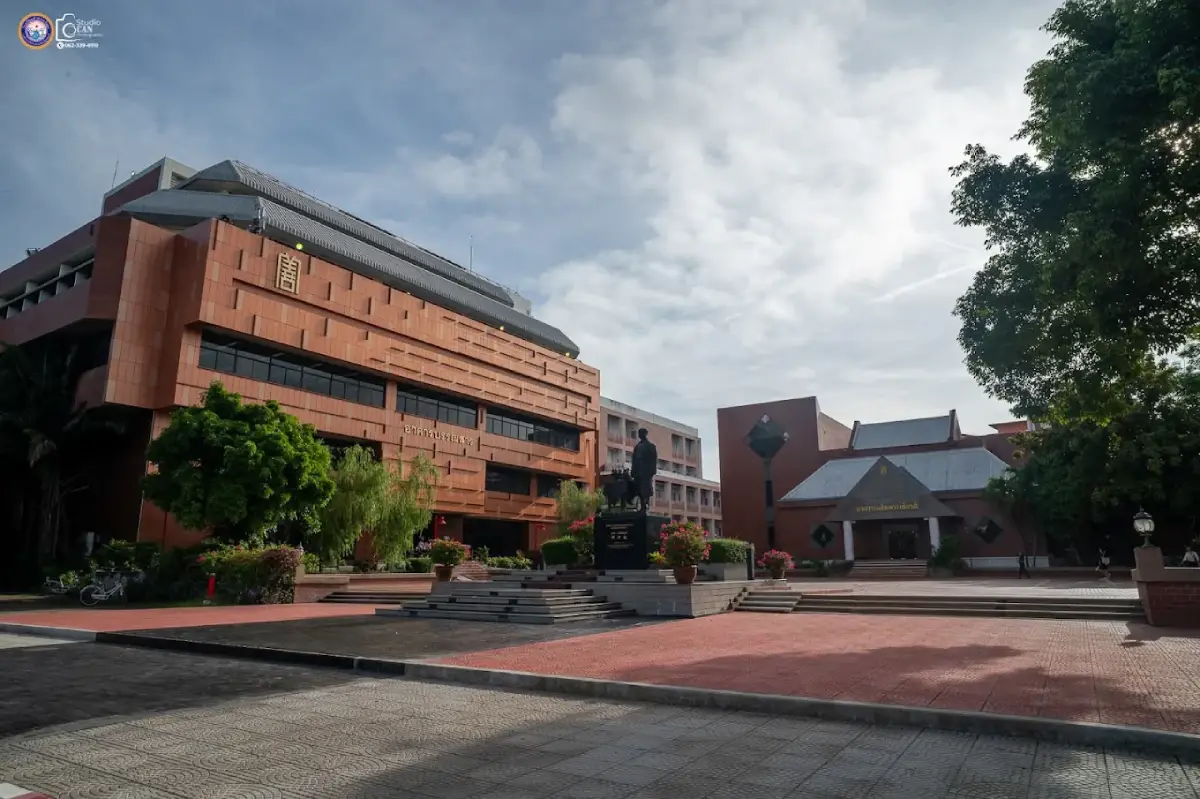
The campus combines modern academic facilities with architectural features reflecting its Thai-Chinese heritage. Academic buildings, administrative offices, laboratories, student activity areas, auditoriums, and landscaped spaces are connected by internal pedestrian routes. Some structures feature contemporary architecture, while the entrance gateway incorporates elements inspired by traditional Chinese design. These visual characteristics reflect the cultural background of the university's founding foundation and its commitment to maintaining the historical relationship between Thai and Chinese communities.
To understand the university's history, it is necessary to begin with the Poh Teck Tung Foundation, a major charitable organization established by the Chinese community in Thailand. The foundation has played an important role in relief operations, emergency assistance, social welfare, and healthcare services. Its expansion into education reflected the belief that developing knowledgeable and capable people could create lasting benefits for society beyond immediate charitable assistance.
In 1942, the Poh Teck Tung Foundation established the Midwifery and Health School at Huachiew Hospital. Its purpose was to educate personnel in nursing and midwifery so they could contribute to the healthcare needs of the population. The establishment of the school was particularly significant during a period when Thailand required more trained healthcare personnel, including professionals responsible for maternal and infant health.
The early educational philosophy emphasized both theoretical knowledge and practical experience. Students needed to understand healthcare principles while developing the ability to apply their knowledge in real clinical environments. This approach eventually became an important foundation of Huachiew Chalermprakiet University's educational identity, which continues to emphasize professional competence together with ethical conduct and service to society.
In 1982, the Poh Teck Tung Foundation expanded the educational institution into Huachiew College, establishing higher education programs in nursing and midwifery. The transformation represented an important step in the development of private professional education in Thailand. By offering degree-level nursing education, the institution sought to produce graduates capable of supporting the country's increasingly complex healthcare system.
Huachiew College subsequently expanded into social work education. This development was consistent with the foundation's wider charitable mission because social work focuses on supporting vulnerable individuals, improving community welfare, and responding to social difficulties. The addition of social welfare education demonstrated that the institution's commitment to serving society extended beyond medical treatment and healthcare alone.
The year 1990 marked another important stage in the institution's development. As the Poh Teck Tung Foundation commemorated its 80th anniversary, its leadership proposed expanding Huachiew College into a full university. The initiative received support from members of Thailand's Chinese community and charitable contributors who shared the objective of creating higher education opportunities for the public. The proposed university was intended to promote educational accessibility, professional development, and service to the nation.
Following the necessary approval process, Huachiew College was elevated to university status in 1992. On May 11 of that year, King Bhumibol Adulyadej graciously bestowed the name Huachiew Chalermprakiet University. This occasion became a defining milestone in the institution's history, representing the formal transformation of the former college into a university with an expanded educational mission.
On March 24, 1994, King Bhumibol Adulyadej presided over the official opening ceremony of Huachiew Chalermprakiet University and planted a Bodhi tree on the campus. This event holds exceptional historical significance for the institution. It represents both royal recognition and the collective efforts of the foundation and the Thai-Chinese community to establish an educational institution dedicated to public benefit.
The university subsequently designated March 24 as Huachiew Chalermprakiet Day, an annual occasion for commemorating the royal opening ceremony and reflecting upon the institution's history. Activities associated with the occasion include Buddhist merit-making, ceremonies honoring important spiritual symbols, recognition of university personnel, and community participation. The anniversary has therefore become an important part of the university's institutional culture and collective memory.
In 2026, the university celebrated its 34th anniversary through Huachiew Chalermprakiet Day activities held on March 26. The ceremony was presided over by Associate Professor Dr. Uraipan Jenvanitpanjakul, the university president. Activities included the offering of dried food to Buddhist monks, ceremonies honoring sacred objects, recognition of long-serving staff members and faculty members receiving academic promotions, Buddhist chanting, and a campus-wide cleaning activity. These events demonstrated the continuing significance of gratitude, community service, and institutional tradition.
The name "Huachiew" is associated with overseas Chinese communities. Before the university was established, the name had already been used by Huachiew Hospital and Huachiew College, both associated with the Poh Teck Tung Foundation. Its continuation in the university's name therefore preserves a connection between Chinese charitable traditions, healthcare, education, and the historical contributions of the Thai-Chinese community.
The university's guiding principle is "Learning to Serve Society." This philosophy emphasizes the responsibility of educated individuals to use their knowledge for the benefit of others. It is closely associated with the Poh Teck Tung Foundation's tradition of public service and the belief that professional competence should be accompanied by moral integrity. The university identifies six important virtues: diligence, perseverance, frugality, compassion, honesty, and gratitude.
The university emblem consists of a circular design incorporating a symbol inherited from the Poh Teck Tung Foundation. The central symbol represents moral goodness, purity, and the performance of good deeds, while the outer circle contains the university's name in Thai, English, and Chinese. The design symbolizes the institution's historical foundations and its relationship with the Thai-Chinese community.
The university's official color is golden yellow, while the Bodhi tree is its symbolic tree. In Buddhist tradition, the Bodhi tree is associated with enlightenment, wisdom, and spiritual understanding. Its adoption as the university's symbolic tree also commemorates the occasion when King Bhumibol Adulyadej planted a Bodhi tree during the university's opening ceremony in 1994.
Among the university's most significant works of art is the sculpture known as Phra Borom Pho Thisomphan, designed by Professor Emeritus Chalood Nimsamer, a National Artist in sculpture. The artwork uses the symbolism of the Bodhi tree to express royal benevolence, protection, tranquility, and the enlightening power of wisdom. It represents an important connection between Buddhist symbolism, Thai artistic traditions, and the university's historical identity.
Another significant landmark is the Royal Entrance Gate, through which King Bhumibol Adulyadej passed when attending the university's official opening ceremony on March 24, 1994. The gateway has five openings symbolizing five auspicious blessings: material prosperity, authority and good fortune, longevity, happiness, and celebration. The structure combines architectural design with cultural symbolism and remains closely associated with the history of the university.
The Huachiew Chalermprakiet University Cultural Center is a major educational resource dedicated to Thai-Chinese history, cultural heritage, and the history of the institution. The center preserves and presents information about the Poh Teck Tung Foundation, Chinese communities in Thailand, local traditions, and the cultural relationship between Thailand and China. It also organizes exhibitions and cultural activities that provide opportunities for students, researchers, and the public to learn about cultural history.
The Cultural Center's museum and exhibition activities include themes concerning Thai-Chinese relations, the foundation's charitable history, community life, traditional medicine, and the heritage of Samut Prakan Province. These collections and educational displays help explain how Chinese traditions have been preserved and adapted within Thai society. Groups wishing to arrange educational visits should coordinate with the Cultural Center in advance so that appropriate arrangements can be made.
In 2026, the Cultural Center continued publishing educational content and organizing activities associated with Thai-Chinese heritage. Topics included Luang Pu Tai Hong Kong, a figure closely connected to the historical origins of the Poh Teck Tung Foundation, as well as Chinese puppet theater and its cultural presence in Thailand. These subjects provide insights into religious traditions, performing arts, migration history, and the preservation of Chinese cultural identity within Thai communities.
On April 9, 2026, the university organized a ceremonial procession and installation of an image of Luang Pu Tai Hong at its HCU 2 area. University administrators, faculty members, staff, and students participated. This ceremony reflected the enduring relationship between the university and the spiritual and charitable traditions associated with the Poh Teck Tung Foundation, while reinforcing the importance of cultural continuity within the university community.
The Wai Khru ceremony is another important element of the university's educational culture. This traditional Thai ceremony allows students to express gratitude and respect toward their teachers. During the 2026 academic year, the university organized a Wai Khru ceremony presided over by Associate Professor Dr. Uraipan Jenvanitpanjakul. Activities included the ceremonial blessing of textbooks and recognition of students who had demonstrated positive conduct. The event reflects the university's emphasis on gratitude, ethical values, and the relationship between teachers and students.
Within the Faculty of Nursing, the Nursing Cap Stripe and Pin Ceremony is particularly meaningful. In 2026, the university published information about the ceremony for its 41st group of nursing students. The event symbolizes students' professional development and their preparation for responsibilities in nursing practice. It also emphasizes the importance of applying knowledge with compassion and accountability when caring for patients and communities.
The university also participates in traditional Thai Buddhist activities. One example is its annual preservation program associated with the Buddhist Lent candle procession. On July 8, 2026, university representatives, staff, and students participated in a candle-offering ceremony at Wat Sri Waree Noi in Bang Sao Thong District, Samut Prakan Province. The event demonstrated cooperation between the university and the local religious community in preserving Buddhist customs and encouraging cultural participation.
Academically, Huachiew Chalermprakiet University is especially recognized for its health sciences education, reflecting its origins in nursing and midwifery. Its health-related faculties include Nursing, Pharmacy, Medical Technology, Physical Therapy, Public Health and Environment, and Traditional Chinese Medicine. These programs require a combination of theoretical study, laboratory training, practical professional experience, and ethical development.
The Faculty of Nursing has particularly strong historical connections to the institution's original educational mission. Nursing education prepares students to provide patient care, promote health, prevent disease, and work collaboratively within healthcare systems. Clinical preparation and ethical education are essential components of this process, helping graduates develop the knowledge and responsibilities expected of professional nurses.
The Faculties of Pharmacy, Medical Technology, and Physical Therapy also contribute significantly to the university's health sciences profile. Pharmacy education addresses medicines and their appropriate use. Medical Technology involves laboratory analysis supporting diagnosis and patient care, while Physical Therapy focuses on rehabilitation, mobility, and improving quality of life among individuals with musculoskeletal, neurological, and other functional conditions. Together, these disciplines support different aspects of healthcare delivery.
The Faculty of Traditional Chinese Medicine offers a distinctive connection between Chinese medical knowledge and higher education in Thailand. The field encompasses traditional Chinese medical principles, herbal medicine, acupuncture, and approaches to health and well-being. Its development is also connected to academic relationships between Thai institutions and educational organizations in China, reflecting the university's wider commitment to Chinese studies and international cooperation.
In 2025, the university signed a cooperation agreement with a Chinese educational institution and a technology company to support innovation in traditional Chinese medicine through artificial intelligence. The collaboration included plans to establish a center for innovation and artificial intelligence in traditional Chinese medicine. This initiative illustrated the potential integration of advanced technology with traditional medical knowledge and the university's strategic interest in healthcare research and innovation.
Chinese studies form another major academic strength. The College of Chinese Studies provides education associated with Business Chinese, Chinese Language and Culture, and Chinese Studies. These disciplines are important for communication, international commerce, cultural understanding, and cooperation between Thailand and China. The university's Confucius Institute of Traditional Chinese Medicine and other educational units further contribute to academic and cultural exchange between the two countries.
The Faculties of Business Administration, Liberal Arts, Communication Arts, Law, and Social Work and Social Welfare extend the university's academic scope into business, languages, communication, legal studies, and social development. These disciplines complement the health sciences and create opportunities for interdisciplinary learning. They also reflect the institution's broader objective of preparing graduates capable of contributing to economic and social development in different professional fields.
The Faculty of Science and Technology offers programs associated with Computer Science, Medical Science, Artificial Intelligence, and Health Robotics. The combination of technology and healthcare has become increasingly relevant to modern medical services, digital health systems, and scientific research. Education in artificial intelligence and health robotics also provides opportunities for students to develop skills related to technological change and emerging professional fields.
At postgraduate level, the university publishes programs in Social Welfare Administration, Community Nurse Practitioner, Thai Communication as a Second Language, Chinese for Business Communication, Digital Business, and Teaching Chinese. Doctoral programs are also available in selected related fields. Graduate education plays an important role in developing advanced professional expertise, research skills, academic leadership, and the ability to contribute new knowledge to society.
The university has developed a strategic direction known as New HCU, emphasizing its role as a center for health sciences and Chinese studies, lifelong learning, educational quality, digital transformation, and sustainable management. This strategy recognizes that universities serve more than traditional undergraduate students. They can also provide educational opportunities for working adults, professionals seeking additional qualifications, and older learners interested in continuing education.
In August 2026, Huachiew Chalermprakiet University entered into an agreement supporting the provision of electric bicycles for transportation within the campus. The initiative was associated with the university's Green University approach and the objective of reducing dependence on fossil fuels. Encouraging alternative transportation within the campus reflects a broader commitment to environmental responsibility and the development of low-carbon institutional practices.
Research is another important part of the university's mission. In 2026, the university announced support for research proposals concerning innovative pharmaceutical formulations, food products, and medicinal herbs, with an emphasis on improving standards and developing commercial applications. This direction is closely related to the university's expertise in health sciences and demonstrates efforts to connect academic research with practical benefits for communities, businesses, and the healthcare sector.
The university's Library and Information Center plays a central role in supporting teaching and research by providing access to books, academic journals, databases, and information resources. Opening hours vary by floor and academic period. During the regular semester, floors 1, 3, 4, and 6 are scheduled to open Monday to Friday from 08:00 to 18:00 and on Saturdays and Sundays from 09:00 to 17:00. Other floors and university vacation periods follow different service schedules.
The university also maintains an archives service dedicated to preserving historical documents and institutional records. Its collections relate to the history of the university, the Poh Teck Tung Foundation, Thai-Chinese relations, and the local history of Samut Prakan Province. The archives provide valuable resources for researchers interested in institutional history, Chinese communities in Thailand, cultural heritage, and the development of private higher education.
Additional campus facilities include student accommodation, dining areas, sports facilities, student activity spaces, academic service centers, and healthcare-related facilities connected with professional education. The university also identifies services associated with Physical Therapy and Traditional Chinese Medicine. These facilities support the daily needs of students and staff while connecting professional training with practical services.
For visitors interested in educational and cultural tourism, Huachiew Chalermprakiet University's Bang Phli Campus offers several places of interest, including the Royal Entrance Gate, the Phra Borom Pho Thisomphan sculpture, the Cultural Center, the museum, and the university archives. These locations help explain the relationship between Thai-Chinese charitable history, royal recognition of the university, and the educational philosophy of using knowledge for the benefit of society.
However, the campus remains an active educational institution. Access to classrooms, laboratories, administrative facilities, or restricted areas may require permission. Groups planning to visit the museum or Cultural Center for educational purposes should contact the relevant office in advance so that the university can make suitable arrangements for guidance and access.
The wider Bang Phli area also offers opportunities for cultural exploration. Wat Bang Phli Yai Nai is known for its revered Luang Pho To Buddha image, while Wat Bang Phli Yai Klang is associated with a large reclining Buddha. Bang Phli Old Market reflects the area's traditional canal-side community life. Shopping and service facilities in the Bang Phli and Suvarnabhumi areas also provide convenient options for university visitors and their families.
Getting There is convenient by private car via Debaratna Road, commonly known as Bang Na–Trat Road. From Bangkok, travelers can proceed eastward toward Chonburi and enter the university at approximately Kilometer 18 in Bang Chalong Subdistrict, Bang Phli District, Samut Prakan Province. Depending on the point of departure, Debaratna Road can be accessed through Srinagarindra Road, King Kaeo Road, and other connecting routes. Travelers should check traffic conditions and the appropriate turning point before departure.
Public transportation is available along the Bang Na–Trat corridor, with services passing the university area. Travelers should verify current bus routes, stops, and operating schedules before traveling. Those arriving at Suvarnabhumi Airport can continue by taxi or hired vehicle through roads connecting the airport area with Debaratna Road and the Bang Phli Campus.
For general administrative inquiries, visitors should plan their visit during the commonly published office contact period of Monday to Friday, 08:30 to 16:30. The Library and Information Center, admissions office, university clinics, and individual academic units may follow different schedules. Anyone wishing to apply for admission, submit documents, arrange a study visit, or receive a specialized service should contact the university at +66 2 713 8100 or +66 2 312 6300 before traveling.
Huachiew Chalermprakiet University's Bang Phli Campus is therefore more than a location for university education. It represents a distinctive history connecting the Poh Teck Tung Foundation's charitable activities with the development of professional education and the Thai-Chinese community. From the establishment of the Midwifery and Health School in 1942 to university status in 1992 and the royal opening ceremony in 1994, the institution has developed an identity centered on healthcare, Chinese studies, cultural preservation, and service to society. Its educational programs, cultural landmarks, and continuing academic activities make it an important institution in Samut Prakan Province and a meaningful example of education inspired by public service.
| University Name | Huachiew Chalermprakiet University, Bang Phli Campus |
| Thai Name | มหาวิทยาลัยหัวเฉียวเฉลิมพระเกียรติ วิทยาเขตบางพลี |
| Institution Type | Private University |
| Address | 18/18 Debaratna Road, Kilometer 18, Bang Chalong Subdistrict, Bang Phli District, Samut Prakan Province 10540, Thailand |
| Reference Coordinates | 13.615841, 100.752325 |
| Campus Area | 178 Rai, 1 Ngan And 88 Square Wah, According To The University Website |
| Original Educational Institution | Midwifery And Health School, Huachiew Hospital, Established In 1942 |
| Development Into Huachiew College | 1982 |
| University Establishment Year | 1992 |
| Royal Naming Date | May 11, 1992 |
| Royal Opening Ceremony | March 24, 1994 |
| University Age In 2026 | 34 Years Since Elevation To University Status |
| Founding Organization | Poh Teck Tung Foundation, With Support From Thai-Chinese Communities And Charitable Contributors |
| President In 2026 | Associate Professor Dr. Uraipan Jenvanitpanjakul |
| Guiding Principle | Learning To Serve Society |
| University Color | Golden Yellow |
| Symbolic Tree | Bodhi Tree |
| Six Core Virtues | Diligence, Perseverance, Frugality, Compassion, Honesty And Gratitude |
| Academic Strengths | Health Sciences, Chinese Studies, Traditional Chinese Medicine, Community Service And Lifelong Learning |
| Faculties And College | 12 Faculties And 1 College: Physical Therapy, Traditional Chinese Medicine, Medical Technology, Law, Communication Arts, Business Administration, Nursing, Pharmacy, Science And Technology, Liberal Arts, Social Work And Social Welfare, Public Health And Environment, And The College Of Chinese Studies |
| Other Campus | Yos Se Campus, 121 Anantanak Road, Pom Prap Sattru Phai District, Bangkok 10100 |
| Important Campus Landmarks | Royal Entrance Gate, Phra Borom Pho Thisomphan Sculpture, Cultural Center, Museum, University Archives, Library And Information Center, And Thai Pavilion |
| Traditions And Activities | Huachiew Chalermprakiet Day, Wai Khru Ceremony, Nursing Cap Stripe And Pin Ceremony, Thai-Chinese Cultural Activities, And Buddhist Lent Candle Procession |
| Facilities | Classrooms, Laboratories, Library, Student Dormitories, Dining Facilities, Sports Areas, Parking, Academic Service Centers And Healthcare Service Units |
| General Administrative Contact Days | Monday – Friday |
| General Administrative Contact Hours | 08:30 – 16:30 |
| Campus Visits | Advance Coordination Is Recommended For Group Study Visits And Access To Restricted Facilities |
| Getting There | Via Debaratna Road (Bang Na–Trat Road), Kilometer 18, Bang Chalong, Bang Phli, Samut Prakan, By Private Car Or Public Transport Serving The Main Road |
| Nearby Attractions And Learning Sites | 1. Huachiew Chalermprakiet University Museum, Inside The Campus 2. Wat Bang Phli Yai Nai 3. Wat Bang Phli Yai Klang 4. Bang Phli Old Market 5. Wat Sri Waree Noi 6. Central Village |
| Nearby Restaurants And Cafés | 1. Butter Steak Bistro, Tel. +66 98 999 6285 2. MALATIME Malatang @ Huachiew, Tel. +66 90 254 6625 3. Shalala Cafe' X Studio, Tel. +66 88 956 4164 4. Kawee Grilled Fish, Tel. +66 97 226 7897 5. 9M. Coffee Bar, Tel. +66 92 519 9938 |
| Nearby Accommodation | 1. iChapter Hotel Suvarnabhumi 2. Tubtim Siam Suvarnabhumi Hotel 3. Herma Hotel 4. Atrium Suvarnabhumi Hotel, Tel. +66 65 225 6969 5. Airport 17 Apartel |
| University Telephone | +66 2 713 8100, +66 2 312 6300 |
| Cultural Center Telephone | +66 2 312 6300 Ext. 1534 |
| Official Website | https://www.hcu.ac.th/ |
| Current Status | Operating Private University With Academic And Institutional Activities In Samut Prakan Province |
Huachiew Chalermprakiet University Academic Programs Published On The University's Website (Reviewed In 2026)
| Faculty / College | Programs And Fields Of Study |
| Faculty Of Physical Therapy | Bachelor's Degree 1. Bachelor Of Science In Physical Therapy |
| Faculty Of Traditional Chinese Medicine | Professional Undergraduate Degree 1. Bachelor Of Traditional Chinese Medicine |
| Faculty Of Medical Technology | Bachelor's Degree 1. Bachelor Of Science In Medical Technology |
| Faculty Of Law | Bachelor's Degree 1. Bachelor Of Laws Associate Degree Level 1. Associate Degree In Law, As Listed In The University Program Information |
| Faculty Of Communication Arts | Bachelor's Degree 1. Bachelor Of Communication Arts Published Professional Concentrations Include Digital Communication Innovation, Creative Arts, Performing Arts, Music And Singing |
| Faculty Of Business Administration | Bachelor's Degree 1. Bachelor Of Accountancy 2. Bachelor Of Business Administration, With Majors In Management And Entrepreneurship, Marketing, International Business Management, And Digital Business 3. Bachelor Of Business Administration In Logistics And Supply Chain Management 4. Bachelor Of Business Administration In Chinese Business (Multidisciplinary Program) Master's Degree 5. Master Of Business Administration In Digital Business |
| Faculty Of Nursing | Bachelor's Degree 1. Bachelor Of Nursing Science Master's Degree 2. Master Of Nursing Science In Community Nurse Practitioner |
| Faculty Of Pharmacy | Professional Undergraduate Degree 1. Bachelor Of Pharmacy |
| Faculty Of Science And Technology | Bachelor's Degree 1. Bachelor Of Science In Computer Science 2. Bachelor Of Science In Medical Science 3. Bachelor Of Science In Artificial Intelligence 4. Bachelor Of Science In Health Robotics (International Multidisciplinary Program) |
| Faculty Of Liberal Arts | Bachelor's Degree 1. Bachelor Of Arts In English 2. Bachelor Of Arts In English And Chinese 3. Bachelor Of Arts In Thai Communication As A Second Language Master's Degree 4. Master Of Arts In Thai Communication As A Second Language Doctoral Degree 5. Doctor Of Arts In Thai Communication As A Second Language |
| Faculty Of Social Work And Social Welfare | Bachelor's Degree 1. Bachelor Of Social Work Master's Degree 2. Master Of Social Work In Social Welfare Administration Doctoral Degree 3. Doctor Of Philosophy In Social Welfare Administration |
| Faculty Of Public Health And Environment | Bachelor's Degree 1. Bachelor Of Science In Medical Records And Hospital Medical Statistics Management 2. Bachelor Of Science In Occupational Health And Safety 3. Bachelor Of Public Health In Community Public Health 4. Bachelor Of Management In Medical Services 5. Bachelor Of Science In Disaster Management And Mitigation |
| College Of Chinese Studies | Bachelor's Degree 1. Bachelor Of Arts In Business Chinese 2. Bachelor Of Arts In Chinese Language And Culture 3. Bachelor Of Arts In Chinese Studies Master's Degree 4. Master Of Arts In Teaching Chinese 5. Master Of Arts In Chinese For Business Communication Doctoral Degree 6. Doctor Of Arts In Teaching Chinese |
Frequently Asked Questions (FAQ)
Q: Where is Huachiew Chalermprakiet University, Bang Phli Campus located?
A: The campus is located at 18/18 Debaratna Road, Kilometer 18, Bang Chalong Subdistrict, Bang Phli District, Samut Prakan Province 10540, Thailand.
Q: What are the opening days and hours of Huachiew Chalermprakiet University?
A: The commonly published general administrative contact period is Monday to Friday, 08:30 to 16:30. Individual facilities, including the Library and Information Center, follow separate schedules. Visitors should confirm the hours of the specific office before traveling.
Q: When was Huachiew Chalermprakiet University established?
A: The institution originated as a midwifery and health school in 1942, developed into Huachiew College in 1982, and received university status in 1992. King Bhumibol Adulyadej bestowed its name on May 11, 1992.
Q: Who founded Huachiew Chalermprakiet University?
A: The Poh Teck Tung Foundation was the principal organization responsible for developing the institution, with support from members of the Thai-Chinese community and charitable contributors.
Q: What is Huachiew Chalermprakiet University known for?
A: The university is particularly recognized for health sciences, Chinese studies, traditional Chinese medicine, lifelong learning, and community-oriented education under its guiding principle, "Learning to Serve Society."
Q: What faculties and academic programs does Huachiew Chalermprakiet University have?
A: The university identifies 12 faculties and 1 college, covering health sciences, social sciences, business, technology, law, communication, and Chinese studies. It publishes information about bachelor's, master's, and doctoral programs.
Q: How many campuses does Huachiew Chalermprakiet University have?
A: The university lists two principal campus locations: Bang Phli Campus in Samut Prakan Province and Yos Se Campus in Bangkok.
Q: Can members of the public visit the university museum and Cultural Center?
A: The Cultural Center provides educational resources relating to Thai-Chinese history and cultural heritage. Groups wishing to arrange a visit should contact the university in advance at +66 2 312 6300, extension 1534.
 Category: ●University
 Group: ●Private University
Last Update : 3 DayAgo
 Last Update : 3 DayAgo

 Click to Access the Navigation Map GPS
Huachiew Chalermprakiet University (Bang Phli Campus) Map
Recommend

 Art, Culture and Heritage
 Historical Sites and Monuments(2)
 Landmarks and Memorials(1)
 Art, Craft Centres, Tradition(9)
 Museums(5)
 Historic Homes and Cities(1)
Private University(1)
 Places of Worship
 Temple(30)
 Mosque(1)
 Other Sacred Sites(9)
 Suburban Living
 Local Market(1)
 Floating Market(3)
 Nature and Wildlife
 River, Canal(1)
 Bays and Beaches(2)
 Entertainment and Agricultural
 Zoos and Aquariums(1)
 Animal camps and shows(1)
 Farms, Parks and Ecotourism(1)
 Outdoor and Adventure Activities(1)
 Travel Articles, Recipes
 Travel Review, Food Review(1)


