
lovethailand home >North Travel Attractions >Sukhothai Travel Attractions >Si Sat Chana Lai >Si Sat Chana Lai > Wat Phra Sri Rattana Mahathat Worawihan (Wat Phra ..
TL;DR: Wat Phra Sri Rattana Mahathat Worawihan (Wat Phra Prang) is located at Si Satchanalai Subdistrict, Si Satchanalai District, Sukhothai Province, open Daily, hours 08.00 – 17.00.
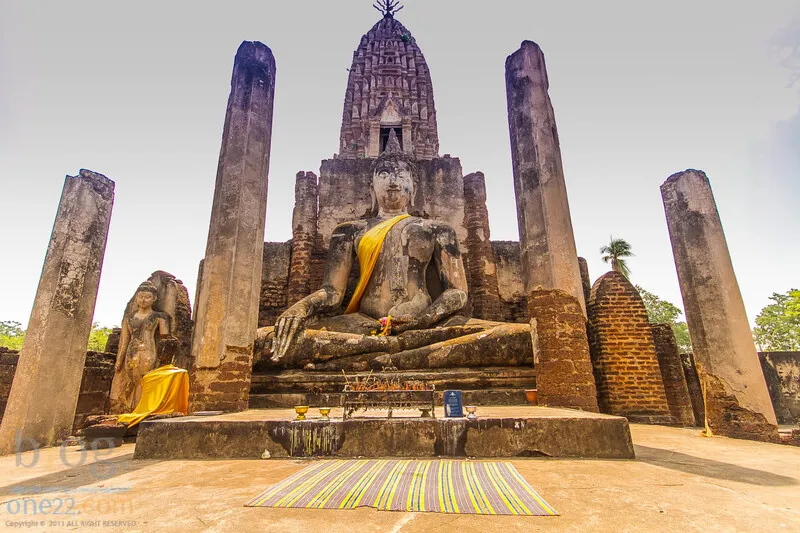
Wat Phra Sri Rattana Mahathat Worawihan (Wat Phra Prang)
Open Days: Daily
Opening Hours: 08.00 – 17.00
Wat Phra Si Rattana Mahathat Ratchaworawihan in Sukhothai Province, also known as Wat Phra Si Rattana Mahathat Chaliang, Wat Phra Borommathat Mueang Chaliang, or Wat Phra Prang, is one of the most important historic temples in Si Satchanalai District. Located in Moo 6, Si Satchanalai Subdistrict, Sukhothai Province, this first-class royal monastery stands in the old Chaliang area near the Yom River. It is a major cultural landmark for travelers who want to understand the deeper historical landscape of Sukhothai beyond the main Sukhothai Historical Park.
The temple is especially valuable because it combines living Buddhist faith with ancient architecture. Visitors will find a large laterite main prang, old viharns, important Buddha images, laterite boundary walls, ancient gateways, and sacred monuments that reflect the artistic development of Chaliang, Si Satchanalai, Sukhothai, and Ayutthaya. It is not only a place to take photographs, but also a site where travelers can learn how religion, urban history, river landscapes, and craftsmanship shaped this part of northern Thailand.
The most striking feature of Wat Phra Si Rattana Mahathat Ratchaworawihan is the main prang, which gives the temple one of its common names, Wat Phra Prang. Built mainly with laterite and plaster, the prang rises prominently within the temple compound. Its form reflects architectural developments associated with the Ayutthaya period, while the surrounding structures preserve older layers of Sukhothai and Chaliang heritage. Even though time has worn away some details, the structure still conveys the dignity and sacred power of an ancient royal temple.
The temple’s location is historically significant. Chaliang was an old settlement that played an important role before and alongside Si Satchanalai. The temple stands near a bend of the Yom River, showing how ancient communities often placed major religious sites in relation to rivers. In the past, rivers served as transportation routes, sources of water, trade corridors, and geographical anchors for cities. For this reason, the temple should be understood as part of a wider cultural landscape rather than as an isolated monument.
The name “Wat Phra Si Rattana Mahathat” reflects the Buddhist concept of a major relic shrine at the spiritual center of a city. The name “Wat Phra Borommathat Mueang Chaliang” emphasizes the temple’s association with the sacred relic monument of old Chaliang, while “Wat Phra Prang” refers to the large prang that dominates the temple compound. These different names help reveal the temple’s multiple identities: a sacred relic temple, a historic city temple, and an architectural landmark.
Historically, the temple is believed to have been established around the 17th–18th Buddhist centuries and became an important monastery of old Chaliang. Its long history makes it one of the most meaningful sites in the Si Satchanalai area. The temple preserves evidence of religious devotion, local craftsmanship, and artistic exchange across different periods. For travelers interested in Thai history, it offers a clear view of how Sukhothai civilization developed through a network of cities rather than through one single capital alone.
The main prang is the central architectural focus of the temple. Built on a raised base, it uses laterite as a primary material, a common construction choice in Sukhothai and Si Satchanalai. Laterite was durable, locally available, and widely used in walls, temples, viharns, and ancient monuments. The prang’s position within the compound shows that the temple was planned as a ceremonial and devotional center, where sacred architecture guided the movement and attention of worshippers.
Inside the temple, one of the most revered images is Luang Pho To, a large Buddha image in the posture of subduing Mara. The image is associated with Sukhothai art and is enshrined as the principal Buddha image in the viharn. Its calm expression, large scale, and balanced proportions create a strong sense of serenity and devotion. Paying respect to Luang Pho To is one of the most important experiences for Thai visitors and Buddhist pilgrims who come to this temple.
The temple also contains beautiful standing and walking Buddha images, which help visitors appreciate the elegance of Sukhothai Buddhist art. The walking Buddha image is especially meaningful because the walking posture is one of the most distinctive expressions of Sukhothai aesthetics. Its graceful movement, gentle body line, and spiritual calm reflect the artistic ideal of the Buddha as both humanly graceful and spiritually awakened.
The laterite walls and boundary structures are also worth close observation. They define the sacred area of the temple and create a sense of order around the main monument. Walking along the old walls and looking back toward the prang allows visitors to see how the temple compound was organized. The layout was not accidental; it reflected religious meaning, ritual movement, and architectural planning.
The ancient gateways are another important feature. Their upper parts show decorative forms that reflect complex religious and artistic influences. Some elements are associated with the idea of the Bodhisattva Avalokitesvara, showing that the temple’s artistic background includes more than one religious current. This makes the site especially interesting for travelers who want to understand the layered nature of Thai Buddhist art.
Behind the main prang outside the inner wall stands Phra That Mutao, a Mon-style chedi. Its presence shows cultural connections between Chaliang, Si Satchanalai, and other communities in the region. The combination of the main prang, Sukhothai Buddha images, laterite walls, and Mon-style chedi makes the temple an excellent example of cultural exchange in mainland Southeast Asia.
The temple is also connected with national history. Historical accounts associate the sacred relic of Chaliang with King Taksin the Great, who came to pay homage after his campaign against the Phra Fang community. The temple is also linked with ancient royal ritual traditions, including ceremonial water associated with royal consecration. These connections add another layer of meaning to the site, showing that it was not only a local temple but also a place of wider political and spiritual significance.
Today, Wat Phra Si Rattana Mahathat Ratchaworawihan remains an active royal monastery. The current abbot is Phra Thep Wachirawethi, Dr. Boonroj Chanthapanyo, Pali IX, who also serves as the ecclesiastical provincial governor of Sukhothai. The temple therefore continues to function as a place of worship, monastic administration, heritage conservation, and cultural tourism.
Unlike some archaeological sites that feel completely separated from daily life, this temple still has the atmosphere of a living monastery. Monks, local residents, worshippers, and travelers share the same sacred space. The sound of chanting, the scent of incense, the quiet movement of visitors, and the shadow of the prang on laterite surfaces all create a strong sense of continuity between the past and the present.
A good visit should begin at the front of the temple, passing through the boundary and gateway area before entering the main sacred zone. Visitors can pay respect to Luang Pho To in the viharn, then walk around the main prang to observe the materials, base, niches, walls, and layout. After that, continue toward Phra That Mutao behind the prang to understand how the temple’s sacred landscape extends beyond the inner enclosure.
The best times to visit are in the morning or late afternoon. Morning offers a quieter atmosphere and good light for photography, while late afternoon brings warm light onto the laterite and prang surfaces. Since the site includes open areas, visitors should bring drinking water, a hat, and comfortable walking shoes. The temple is suitable for cultural travelers, history lovers, photographers, and anyone interested in the heritage of Sukhothai and Si Satchanalai.
Getting There is most convenient by private car. From Sukhothai city, drive north toward Si Satchanalai District, which usually takes about 1 hour depending on traffic. From Sawankhalok District, the journey is shorter. Travelers can follow the route toward Si Satchanalai Historical Park and continue to the Wat Phra Prang area in Si Satchanalai Subdistrict. Local transport is possible, but travelers without a private vehicle should plan the schedule carefully.
The temple fits well into a full cultural route in Si Satchanalai. Nearby attractions include Wat Chom Chuen, Si Satchanalai Historical Park, Wat Nang Phaya, Wat Chedi Chet Thaeo, Wat Chang Lom, and the Sangkhalok kiln conservation sites. A full-day itinerary can begin at Wat Phra Si Rattana Mahathat Ratchaworawihan in the morning, continue through the main historical park, and end with a riverside café or local restaurant near the Yom River.
For travelers interested in World Heritage landscapes, the Si Satchanalai area is essential. Together with Sukhothai and Kamphaeng Phet, it represents the historical urban network of the Sukhothai period. Visiting this temple helps travelers see that the Sukhothai kingdom was not centered on one city alone, but developed through interconnected cities, religious sites, production centers, and river-based communities.
Visitors should dress respectfully because the temple is still an active monastery and a royal temple. Avoid climbing ancient structures, touching stucco work or old walls, writing on surfaces, or placing objects on ancient remains. Responsible travel helps preserve the site and allows future visitors to experience the same historical and spiritual atmosphere.
For photography, the temple offers several beautiful angles, including the front view of the prang, the laterite walls, the gateway, Phra That Mutao, and views of the prang framed by trees and sky. However, visitors should avoid disturbing worshippers and should never climb on ancient structures for photos. The beauty of the site is best appreciated through respectful observation.
Wat Phra Si Rattana Mahathat Ratchaworawihan should be included in any serious Sukhothai travel plan, especially for visitors who want to go beyond the better-known central Sukhothai Historical Park. It reveals the importance of Chaliang and Si Satchanalai, two historic areas that played a major role in the development of Sukhothai civilization. The temple’s combination of sacred atmosphere, monumental architecture, local faith, and ancient artistry makes it one of the most rewarding cultural sites in Sukhothai Province.
In summary, Wat Phra Si Rattana Mahathat Ratchaworawihan in Sukhothai Province is a royal monastery, an ancient monument, a sacred temple of old Chaliang, and a key destination for cultural tourism in Si Satchanalai. Its highlights include the main laterite prang, Luang Pho To, Sukhothai-style Buddha images, laterite walls, ancient gateways, Phra That Mutao, and its deep relationship with the history of Sukhothai. A visit here offers peace, historical depth, and a powerful sense of Thailand’s living heritage.
| Name | Wat Phra Si Rattana Mahathat Ratchaworawihan, also known as Wat Phra Si Rattana Mahathat Chaliang / Wat Phra Borommathat Mueang Chaliang / Wat Phra Prang |
| Location | Si Satchanalai Subdistrict, Si Satchanalai District, Sukhothai Province |
| Address | Moo 6, Si Satchanalai Subdistrict, Si Satchanalai District, Sukhothai 64130, Thailand |
| Coordinates | Approximately 17.4330, 99.7930 |
| Highlights | Main laterite prang, Luang Pho To, Sukhothai-style Buddha images, Phra That Mutao, ancient gateway, laterite walls, and the old Chaliang riverside atmosphere |
| History | Established around the 17th–18th Buddhist centuries as an important temple of old Chaliang, with later development through the Sukhothai and Ayutthaya periods |
| Name Origin | The names refer to the sacred relic temple of old Chaliang, while Wat Phra Prang comes from the large main prang inside the temple compound |
| Distinctive Features | A first-class royal monastery and large ancient temple reflecting Sukhothai, Ayutthaya, and Chaliang cultural heritage |
| Travel Information | About 1 hour by car from Sukhothai city to Si Satchanalai District; closer from Sawankhalok District; follow the route toward Si Satchanalai Historical Park and Wat Phra Prang |
| Current Status | Active royal monastery and major historical attraction in Sukhothai Province |
| Open Days | Daily |
| Opening Hours | 08.00 – 17.00 |
| Fees | Thai visitors 20 baht, foreign visitors 100 baht for Si Satchanalai Historical Park area |
| Facilities | Parking areas, walking paths, restrooms in nearby tourist areas, local shops and restaurants in Si Satchanalai community |
| Main Areas / Zones | Main prang, main viharn, Luang Pho To, standing Buddha image, walking Buddha image, laterite wall, ancient gateway, and Phra That Mutao |
| Abbot / Caretaker | Phra Thep Wachirawethi, Dr. Boonroj Chanthapanyo, Pali IX |
| Main Contact Number | 055-950-714, 061-268-6383 |
| Official Website / Official Page | Si Satchanalai Historical Park, Fine Arts Department |
| Nearby Tourist Attractions | 1. Wat Chom Chuen, about 0.5 km 2. Si Satchanalai Historical Park, about 3 km 3. Wat Nang Phaya, about 3 km 4. Wat Chedi Chet Thaeo, about 3 km 5. Wat Chang Lom, about 4 km 6. Sangkhalok Kiln Conservation Site No. 61 and 42, about 6 km |
| Nearby Restaurants | 1. ChomPrang, about 0.3 km, Tel. 063-465-6168 2. Thaowali, about 1 km 3. Jeedja Fresh Coffee, about 1.1 km 4. Kaeng Sak Beer Garden, about 1.5 km 5. Baan Klang Na Si Satchanalai Restaurant, about 4 km 6. Krua Ton Aoy Si Satchanalai, about 8 km, Tel. 098-156-9393, 087-208-5526 |
| Nearby Accommodations | 1. Akara House Sukhothai, about 0.3 km 2. Sisatchanalai Heritage Resort, about 3 km, Tel. 055-615-423, 086-443-2799 3. Nong Or Blue House Resort, about 7 km 4. Downhill Resort, about 10 km 5. Chanalai Resort And Hotel, about 12 km, Tel. 055-672-555 |
Frequently Asked Questions (FAQ)
Q: Where is Wat Phra Si Rattana Mahathat Ratchaworawihan in Sukhothai located?
A: It is located in Moo 6, Si Satchanalai Subdistrict, Si Satchanalai District, Sukhothai Province, near Si Satchanalai Historical Park.
Q: Is this temple the same as the temple of Phra Phuttha Chinnarat in Phitsanulok?
A: No. Wat Phra Si Rattana Mahathat Ratchaworawihan in Sukhothai is in Si Satchanalai District, while the temple of Phra Phuttha Chinnarat is in Phitsanulok Province.
Q: What are the main highlights of this temple?
A: The main highlights are the laterite main prang, Luang Pho To, Sukhothai-style Buddha images, the walking Buddha image, ancient gateway, laterite walls, and Phra That Mutao.
Q: What are the opening hours?
A: The temple area is open daily from 08.00 to 17.00.
Q: Is there an admission fee?
A: The Si Satchanalai Historical Park area charges 20 baht for Thai visitors and 100 baht for foreign visitors.
Q: How long should I spend here?
A: Allow about 1 hour for the temple itself, or at least half a day if you combine it with Si Satchanalai Historical Park and nearby temples.
Q: How can I get there from Sukhothai city?
A: The easiest way is by private car. Drive from Sukhothai city toward Si Satchanalai District, which usually takes about 1 hour.
Q: What nearby attractions should I visit after this temple?
A: Nearby attractions include Wat Chom Chuen, Si Satchanalai Historical Park, Wat Nang Phaya, Wat Chedi Chet Thaeo, Wat Chang Lom, and the Sangkhalok kiln conservation sites.
 Category: ●Places of Worship
 Group: ●Temple
Last Update : 4 MonthAgo
 Last Update : 4 MonthAgo
 Click to Access the Navigation Map GPS
Wat Phra Sri Rattana Mahathat Worawihan (Wat Phra Prang) Map
Recommend

 Art, Culture and Heritage
 Historical Sites and Monuments(4)
 Landmarks and Memorials(5)
 Art, Craft Centres, Tradition(11)
 Museums(5)
Temple(40)
Museums(5)
Temple(40)
 Other Sacred Sites(10)
 Suburban Living
 Village, Community(3)
 Nature and Wildlife
 National Parks and Marine Reserves(3)
 Mountain (Doi)(2)
 Dam, Reservoir, Lake(4)
 Waterfalls(8)
 Caves(4)
 River, Canal(2)
 Entertainment and Agricultural
 Farms, Parks and Ecotourism(3)


