
lovethailand home >Central Travel Attractions >Pathum Thani Travel Attractions >Muang Pathum Thani >Lak Hok > Rangsit University
TL;DR: Rangsit University, Pathum Thani attractions : University, Private University.
Rangsit University
Open Days: Monday – Friday for the Admissions Office and Registrar's Office (closed on Saturdays, Sundays, and public holidays)
Opening Hours: 08:30 – 16:30 for administrative services. Class schedules, library services, and access to individual campus facilities may follow different operating hours.
Rangsit University is a private university located in Muang Ake, Lak Hok Subdistrict, Mueang Pathum Thani District, Pathum Thani Province, Thailand. Established as Rangsit College on January 25, 1985, the institution welcomed its first students in the 1986 academic year and officially became Rangsit University on July 31, 1990. Today, its academic fields include medicine, health sciences, engineering, digital technology, business, communication arts, design, and other professional disciplines. The university grew from the vision of Prasit Ourairat and his fellow founders, who sought to create an institution combining academic knowledge, professional competence, and ethical responsibility.
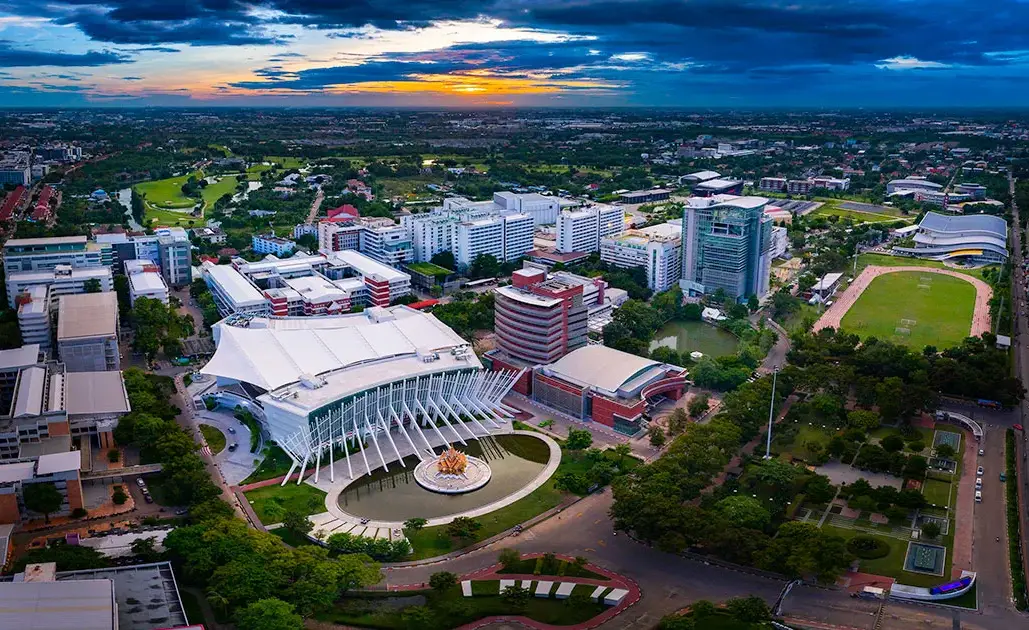
Rangsit University occupies approximately 597 rai of land in the Muang Ake community, north of central Bangkok. Its surroundings include residential neighborhoods, restaurants, student accommodation, commercial establishments, and transport routes connecting Pathum Thani with the wider Bangkok metropolitan area. The campus contains teaching buildings, laboratories, libraries, student activity spaces, sports facilities, and landscaped areas. Together, these elements create an environment for formal education, professional training, cultural activities, and interaction with the surrounding community.
The university's location is closely associated with the historical Rangsit Plain, an area that was once an important part of central Thailand's agricultural landscape. Over several decades, land previously associated with rice cultivation and rural communities gradually became part of an expanding suburban region. Residential developments, roads, businesses, and educational institutions transformed the area. Rangsit University represents one aspect of that transition, illustrating how higher education became part of the social and economic development of Pathum Thani and the northern metropolitan corridor.
The origins of Rangsit University lie in the educational vision of Prasit Ourairat, a former senior public administrator, and a group of educators, academics, and experienced professionals. They recognized the need to increase access to higher education in Thailand and believed that institutions should prepare graduates for the changing requirements of society and industry. Their objectives emphasized academic standards, technological knowledge, professional training, and moral development rather than education understood solely as the acquisition of qualifications.
Science, technology, design, and management were among the fields considered particularly important to national development. Establishing the institution required land preparation, construction, academic planning, staffing, and the creation of administrative systems. The founders also wanted learning to connect with practical experience, allowing students to develop skills that could be applied in their future careers.
A foundation-stone ceremony for the first building was held on July 7, 1984. On January 25, 1985, Thailand's Ministry of University Affairs authorized the establishment of Rangsit College as a private higher education institution. Although the authorization marked the institution's formal foundation, teaching did not begin until the following academic year. These dates refer to distinct milestones and are both important to the university's history.
Rangsit College opened in the 1986 academic year with two faculties: Business Administration and Nursing. The first intake comprised 478 students, including 428 students in Business Administration and 50 in Nursing. The choice of these two disciplines demonstrated an early commitment to professional education in both organizational management and healthcare, areas that would continue to influence the university's development.
The college subsequently expanded its academic provision. In 1989, it received permission to offer a Doctor of Medicine program, marking a significant development in private medical education in Thailand. Graduate-level education also began to develop, including studies in business administration. These changes increased the institution's academic scope and helped establish the foundation for its transition from a college into a university.
On July 31, 1990, the Ministry of University Affairs approved the conversion of Rangsit College into Rangsit University. A formal university inauguration ceremony took place on November 29, 1990, with Her Royal Highness Princess Maha Chakri Sirindhorn presiding. The transition represented an important institutional milestone, recognizing the development of its academic organization and broadening educational mission.
In the following decades, Rangsit University expanded into medicine, dentistry, pharmacy, nursing, medical technology, engineering, applied sciences, architecture, communication arts, law, political science, design, music, tourism, and international business. This expansion reflected changing needs within Thailand's economy, from industrial development and the growth of service industries to the emergence of digital technologies and creative businesses.
The institution's educational philosophy remains closely associated with its founders' intention to produce graduates equipped with knowledge and ethical principles. This philosophy places importance on intellectual development, professional responsibility, and the ability to use knowledge constructively. Depending on the program, students may combine classroom instruction with laboratory work, projects, workplace training, professional practice, and other forms of experiential learning.
Prasit Ourairat occupies a central place in the university's founding history. Dr. Arthit Ourairat has also played an important role in its subsequent administration and development. His name is associated with the Arthit Ourairat Building, one of the university's principal administrative buildings. Its importance is therefore both practical and historical: it serves students and visitors while commemorating a major figure in the institution's development.
The name Rangsit University developed from the institution's original name, Rangsit College, and its connection to the Rangsit geographical area. Although the campus is administratively situated in Pathum Thani Province, Rangsit is widely recognized as a major suburban district and regional center north of Bangkok. The name therefore links the university to its local historical and geographical setting.
Rangsit University's identity is expressed through its emblem, official colors, symbolic tree, student uniforms, and university songs. Its emblem has evolved since the institution's establishment. The earlier designs reflected its ambitions in science, technology, knowledge, and national development, while later symbolic elements communicate ideas associated with enlightenment and learning.
The university's official colors are magenta pink and light blue. Light blue also appears on the university flag. The Payom tree, scientifically known as Shorea roxburghii, is the university's symbolic tree. This choice reflects the founders' concern for the campus environment and the transformation of former agricultural land into an educational setting. The tiger is another university symbol, particularly associated with sporting activities and the university football team.
The Payom tree is a flowering tree belonging to the dipterocarp family. It is recognized for its clusters of small, fragrant white flowers. At Rangsit University, it represents more than a botanical feature: the tree forms part of the institution's visual identity and the shared memories of generations of students. University activities that draw on this symbol help maintain a connection between the natural environment and campus culture.
University songs also contribute to that shared identity. Among the songs associated with Rangsit University are Tawan Rung Thung Rangsit and La Laeo La Ban Yen Fa. Their titles evoke the Rangsit landscape, the university's colors, and the emotions associated with student life. Music and other forms of cultural expression help connect present students with alumni and the university's history.
Student traditions at Rangsit University include teacher appreciation ceremonies, orientation activities, student organization events, sporting competitions, and cultural programs. The Wai Khru ceremony reflects the importance placed on respect for teachers within Thai educational culture. Orientation and student club activities provide opportunities for new students to become familiar with campus life, develop friendships, and practice teamwork. Dates and arrangements vary according to the university's academic calendar.
The university's foundation anniversary is observed on January 25, commemorating the authorization of Rangsit College in 1985. Activities associated with the institution's 41st anniversary in 2026 included Buddhist merit-making ceremonies. Such commemorations connect the modern university with its origins and provide occasions for administrators, staff, students, and alumni to reflect on its development.
Sports, music, performances, exhibitions, and student clubs form another important part of campus culture. These activities give students from different academic disciplines opportunities to collaborate outside their usual classes. Organizing events and participating in teams can develop communication, leadership, planning, and interpersonal skills alongside formal academic study.
One of the university's most important buildings is the Arthit Ourairat Building, also known as Building 1. The Admissions Office is located in Room 1-103, while the Registrar's Office operates from Room 1-102 on the first floor. Visitors commonly use these offices for inquiries about applications, enrollment, student records, registration, and educational documents. Their regular service hours are Monday through Friday, 08:30 to 16:30, excluding weekends and public holidays.
Rangsit University Library supports teaching, learning, and academic research through its information resources and study facilities. The University Archives, situated on the sixth floor of the library building, preserves historical materials concerning the institution's establishment, important individuals, symbols, buildings, and significant events. These collections are particularly valuable to readers interested in the history of private higher education in Thailand.
Phra Si Satsada Mondop is another significant place on campus, reflecting the religious and cultural dimensions of university life. It provides a connection between academic surroundings and Thailand's Buddhist artistic heritage. Visitors should observe the rules applying to religious areas and maintain appropriate conduct when entering such spaces.
The university's music education facilities, including spaces associated with the College of Music and Suryadhep Music Sala, support performance, rehearsal, and cultural activities. Practical experience is particularly important for students studying music and the performing arts, allowing them to develop artistic technique, work with other performers, and communicate with audiences.
Specialized learning facilities throughout the campus support different professional disciplines. These include healthcare laboratories, engineering laboratories, design studios, media production spaces, food-related practical facilities, and sporting environments. Their importance lies in the opportunity to connect theoretical knowledge with supervised practice, technical equipment, professional procedures, and creative experimentation.
One of Rangsit University's distinctive academic characteristics is the range of healthcare disciplines available within a single institution. Its academic areas include medicine, dentistry, pharmacy, nursing, medical technology, radiological technology, physical therapy, optometry, and traditional medicine. Together, these disciplines relate to medical diagnosis, treatment, rehabilitation, pharmaceutical science, public health, and the development of healthcare products and services.
The College of Medicine is especially significant to the university's history because the institution received permission to establish medical education in 1989. Medical training requires a combination of scientific foundations, clinical knowledge, practical skills, and supervised experience in healthcare settings. The university's broader health sciences programs similarly emphasize professional knowledge and the practical requirements of their respective disciplines.
Engineering and digital technology are also major areas of study. The university offers fields related to mechanical, electrical, civil, chemical, industrial, and computer engineering, as well as transportation systems, automotive technology, aviation maintenance, artificial intelligence, computing, gaming, and digital media. These subjects provide different routes into engineering practice, software development, technological innovation, and the application of digital systems in business and society.
In communication arts and creative industries, students can study subjects associated with broadcasting, digital filmmaking, advertising, marketing communication, performance, content production, digital art, fashion, and design. These disciplines respond to a media environment shaped by technological change and evolving audience behavior. Professional preparation involves creative thinking, technical proficiency, communication skills, and practical production experience.
The university's programs in business, economics, law, political science, and the social sciences contribute to professional preparation in corporate organizations, public administration, policy, justice, and international affairs. Subjects such as digital business, finance, logistics, digital economics, international relations, and criminology require analytical thinking and an understanding of complex economic and social environments.
International education is another component of the university's academic activities. Rangsit International College, the International Chinese College, and other academic units provide programs or learning opportunities involving English and other languages. Applicants should check the language of instruction, admission requirements, tuition arrangements, and program-specific conditions before applying, because these details vary considerably across courses.
Graduate education at Rangsit University includes master's and doctoral studies in business, engineering, technology, communication arts, law, education, public administration, healthcare, and other fields. These programs support advanced professional development, management expertise, and academic research. Some subjects are available through alternative study formats, while others require specialized qualifications or practical experience.
Research and innovation reflect the university's broad academic profile. Activities cover areas such as healthcare, applied science, biomedical engineering, information technology, communication, management, and social development. The university maintains research support arrangements and publishes opportunities related to academic projects and research funding. Its professional and technological programs also provide settings in which new ideas, devices, and methods can be developed and evaluated.
Rangsit University's relationship with the Muang Ake community extends beyond formal teaching. Students, employees, and visitors contribute to local demand for accommodation, food, transport, and everyday services. Academic events, exhibitions, cultural performances, and public activities also create connections with people outside the institution. The university consequently functions as part of a broader social and economic network within Pathum Thani.
For visitors interested in educational tourism, Rangsit University offers opportunities to learn about the history of private universities in Thailand, the development of the Rangsit area, and contemporary academic disciplines. Public open-house events, exhibitions, and performances provide ways to explore specific aspects of campus life. Access to classrooms, laboratories, library facilities, and restricted areas may require permission. Visitors should consult the relevant event announcements or contact the responsible academic unit before arriving.
Getting There by private car is possible via Phahonyothin Road and the roads leading into the Muang Ake community. The campus is connected to the broader road network serving Don Mueang and Rangsit. Public transport users can take the SRT Red Line to Lak Hok Station, also identified as Lak Hok (Rangsit University), and continue by local transport to the campus. Visitors should check their destination building, available parking, and any event-specific transport arrangements in advance.
Those visiting the Admissions Office or Registrar's Office should plan to arrive on a weekday between 08:30 and 16:30, avoiding public holidays. The hours for classes, the university library, performances, exhibitions, and individual facilities may differ. Event-specific announcements are therefore the most useful source of information for anyone planning to visit for purposes other than routine administrative services.
Rangsit University has played a continuing role in Thai private higher education since its establishment in 1985. From a college with two faculties, it developed into a university offering a wide range of professional, creative, scientific, and graduate programs. Its history is closely tied to the Rangsit landscape, the development of the Muang Ake community, and the vision of its founders. Its magenta and blue colors, Payom tree, cultural activities, and shared student traditions continue to connect the institution's past with the experiences of its present academic community.
| University Name | Rangsit University (มหาวิทยาลัยรังสิต) |
| Institution Type | Private University |
| Address | 52/347 Muang Ake, Phahonyothin Road, Lak Hok, Mueang Pathum Thani, Pathum Thani 12000, Thailand |
| Coordinates | 13.964355, 100.586705 |
| Campus Area | Approximately 597 rai |
| Institution Founded | January 25, 1985, as Rangsit College |
| First Academic Year | 1986 |
| University Status Granted | July 31, 1990 |
| University Inauguration | November 29, 1990 |
| Institutional Age in 2026 | 41 years since its establishment in 1985 |
| Founder | Prasit Ourairat and fellow founders |
| President | Dr. Arthit Ourairat |
| University Colors | Magenta Pink and Light Blue |
| Symbolic Tree | Payom Tree (Shorea roxburghii) |
| Animal Symbol | Tiger |
| University Songs | Tawan Rung Thung Rangsit; La Laeo La Ban Yen Fa |
| Major Academic Fields | Health Sciences, Medicine, Engineering, Digital Technology, Business, Communication Arts, Design, and International Studies |
| Important Campus Places | Arthit Ourairat Building, University Library, University Archives, Phra Si Satsada Mondop, Suryadhep Music Sala, and Academic Laboratories |
| Traditions And Activities | Foundation Anniversary, Wai Khru Ceremony, Student Orientation, Open-House Events, Sports, Music, Student Clubs, and Alumni Activities |
| Administrative Open Days | Monday – Friday; closed on weekends and public holidays |
| Administrative Opening Hours | 08:30 – 16:30 for Admissions and Registrar's Office services |
| Visitor Access | Public events are accessible according to their announcements; certain buildings and facilities require permission |
| Getting There | By car via Phahonyothin Road and Muang Ake, or by SRT Red Line to Lak Hok Station followed by local transport |
| Nearby Attractions And Places Of Interest | Wat Nawong, Si Mum Mueang Market, Zeer Rangsit, Future Park Rangsit, and Rangsit Market |
| Restaurants In The Surrounding Area | Uminari Japanese Food, Suncurry, Kanha Sushi & Sashimi, Kamin Kub Puu, and Naep Nuea Meat & Co. |
| Accommodation In Muang Ake And Rangsit | Resort Residence Muang Ake, Woodroof Residence Rangsit, The Star Apartment Rangsit, Asias Boutique Club, and Novotel Bangkok Future Park Rangsit |
| University Telephone | +66 2 791 6000 |
| Registrar's Office | Arthit Ourairat Building, First Floor, Room 102; +66 2 791 5535 to +66 2 791 5557 |
| Admissions Office | Arthit Ourairat Building, First Floor, Room 103 |
| Official Website | https://www.rsu.ac.th/ |
| Graduate School Website | https://grad.rsu.ac.th/ |
| Current Status | Operating as a private university with academic programs in the 2026 academic year |
Rangsit University Academic Programs And Fields Of Study — Academic Year 2026 (B.E. 2569)
| Faculty / College / Academic Unit | Academic Programs And Fields Of Study |
| College Of Medicine | Professional Degree 1. Medicine |
| College Of Dental Medicine | Professional Degree 1. Dentistry (Bilingual Program) |
| College Of Pharmacy | Professional Degree 1. Pharmaceutical Care 2. Industrial Pharmacy |
| Faculty Of Nursing | Bachelor's Degree 1. Nursing Science 2. Nursing Science, 2.5-Year Entry Pathway for Eligible Applicants |
| Faculty Of Radiological Technology | Bachelor's Degree 1. Radiological Technology |
| Faculty Of Medical Technology | Bachelor's Degree 1. Medical Technology |
| Faculty Of Physical Therapy And Sports Medicine | Bachelor's Degree 1. Physical Therapy 2. Exercise Science and Sports Performance 3. Charansuk Studies |
| College Of Oriental Medicine | Bachelor's Degree 1. Herbal Product and Cosmeceutical Innovation 2. Thai Traditional Medicine 3. Traditional Chinese Medicine |
| Faculty Of Science | Bachelor's Degree 1. Biomedical Sciences |
| College Of Biomedical Engineering | Bachelor's Degree 1. Biomedical Engineering |
| Faculty Of Optometry | Bachelor's Degree 1. Optometry |
| Faculty Of Food Technology | Bachelor's Degree 1. Food Technology 2. Food Business |
| Faculty Of Agricultural Innovation | Bachelor's Degree 1. Agricultural Innovation |
| College Of Digital Innovation Technology | Bachelor's Degree 1. Computer Science 2. Digital Innovation and Artificial Intelligence 3. Computer Games and Esports 4. Financial Planning with Artificial Intelligence Technology 5. Creative Technology and Social Media |
| College Of Engineering | Bachelor's Degree 1. Mechanical Engineering 2. Electrical Engineering 3. Civil Engineering 4. Chemical Engineering 5. Industrial Engineering 6. Computer Engineering 7. Railway Systems Engineering 8. Modern Automotive Engineering and Motorsport 9. Aircraft Maintenance Engineering 10. Sustainable Energy Systems Engineering 11. Credit-Transfer Pathways for Eligible Higher Vocational Diploma Graduates |
| Aviation Institute | Bachelor's Degree 1. Commercial Pilot Studies |
| College Of Design | Bachelor's Degree 1. Photography and Media Arts 2. Interior Design 3. Communication Design 4. Creative Product Design (English Program) 5. Fashion Design |
| Faculty Of Digital Art | Bachelor's Degree 1. Computer Art |
| Faculty Of Architecture | Bachelor's Degree 1. Architecture |
| Faculty Of Accountancy | Bachelor's Degree 1. Accountancy 2. Credit-Transfer Pathway for Eligible Higher Vocational Diploma Graduates |
| College Of Business Administration | Bachelor's Degree 1. Management Innovation 2. Digital Business 3. Finance and Investment 4. Digital Marketing and Communication Innovation 5. Logistics and Supply Chain Management 6. Entrepreneurship 7. International Business Administration |
| Faculty Of Economics | Bachelor's Degree 1. Digital Economy |
| College Of Liberal Arts | Bachelor's Degree 1. Japanese 2. Thai for Communication 3. English 4. Chinese 5. French 6. Korean Language and Culture |
| College Of Communication Arts | Bachelor's Degree 1. Multiplatform Radio and Television 2. Event Creation and Digital Public Relations 3. Advertising and Creative Media 4. Digital Film 5. Performing Arts Communication 6. Digital Marketing Communication and Branding 7. Multimedia 8. Sports Communication Arts 9. Film and Series Writing and Directing 10. Digital Content Creation 11. Communications Arts (English Program) |
| Faculty Of Law | Bachelor's Degree 1. Law 2. Distance Education and Second-Degree Study Pathways Subject to Admission Requirements |
| College Of Tourism And Hospitality | Bachelor's Degree 1. Tourism, Hospitality and MICE Innovation 2. Aviation and Transportation Business Management 3. Culinary Arts and Technology 4. Tourism, Hospitality and Sports |
| Sports Institute | Bachelor's Degree 1. Golf |
| College Of Leadership And Social Innovation | Bachelor's Degree 1. Leadership in Society, Business and Politics 2. Internet-Based Distance Education Pathway According to Program Requirements |
| Faculty Of Political Science | Bachelor's Degree 1. Political Science |
| Faculty Of Criminology And Justice Administration | Bachelor's Degree 1. Criminology and Forensic Science 2. Criminology and Justice Studies |
| College Of Music | Bachelor's Degree 1. Music |
| Rangsit International College | Bachelor's Degree / International Programs 1. International Business 2. Information and Communication Technology |
| Institute Of Diplomacy And International Studies | Bachelor's Degree / International Program 1. International Relations and Development |
| International Chinese College | Bachelor's Degree / International Program 1. International Business Management |
| Graduate School: Business And Economics | Master's Degree 1. Master of Business Administration 2. Golf Industry Administration 3. International Digital Business 4. Logistics and Supply Chain Management 5. Entrepreneurship 6. Master of Accountancy 7. Digital Economy Doctoral Degree1. Doctor of Business Administration 2. Golf Industry Administration 3. Digital Economy |
| Graduate School: Humanities, Social Sciences, Law And Education | Master's Degree 1. Digital Communication Arts and New Media 2. Communication Arts (English Program) 3. Film and Series Writing and Directing 4. Public Administration 5. Politics and Government 6. Master of Laws 7. English for Professions 8. Diplomacy and International Studies 9. Leadership in Society, Business and Politics 10. Criminology and Justice Administration 11. Bilingual Education 12. Educational Administration 13. Curriculum and Instruction Doctoral Degree1. Leadership in Society, Business and Politics 2. Public Administration 3. Criminology and Justice Administration 4. International Political Economy and Development 5. Doctor of Laws 6. Educational Studies 7. Politics and Government 8. Digital Communication Arts and New Media |
| Graduate School: Art, Design And Music | Master's Degree 1. Design 2. Computer Art 3. Music |
| Graduate School: Engineering And Technology | Master's Degree 1. Cyber Security Management and Technology 2. Social Media Technology 3. Digital Innovation Management 4. Civil Engineering 5. Electrical and Computer Engineering Doctoral Degree1. Information Technology 2. Social Media Technology 3. Civil Engineering 4. Biomedical Engineering |
| Graduate School: Science And Health | Master's Degree 1. Herbal Innovation and Healthcare Business 2. Pharmacy 3. Dermatology and Dermatosurgery 4. Clinical Optometry 5. Dentistry 6. Adult and Gerontological Nursing 7. Biomedical Engineering 8. Biotechnology 9. Biomedical Sciences 10. Smart Healthcare Management Doctoral Degree1. Pharmacy Graduate Diploma1. Dentistry |
Frequently Asked Questions (FAQ)
Q: Where is Rangsit University located?
A: Rangsit University is located at 52/347 Muang Ake, Phahonyothin Road, Lak Hok, Mueang Pathum Thani, Pathum Thani Province 12000, Thailand.
Q: What days and hours is Rangsit University open?
A: The Admissions Office and Registrar's Office provide services Monday through Friday, from 08:30 to 16:30, excluding weekends and public holidays. Library hours, teaching schedules, and access to other campus facilities may differ.
Q: When was Rangsit University founded?
A: It was established as Rangsit College on January 25, 1985, began teaching in the 1986 academic year, and became Rangsit University on July 31, 1990.
Q: Who founded Rangsit University?
A: Prasit Ourairat and a group of fellow founders established the institution. Dr. Arthit Ourairat subsequently played an important role in its administration and development.
Q: Is Rangsit University a public or private university?
A: Rangsit University is a private university authorized to operate as a private higher education institution in Thailand.
Q: What is Rangsit University known for?
A: Its academic fields include medicine, healthcare, engineering, digital technology, communication arts, design, business, and international education.
Q: Can I travel to Rangsit University by train?
A: Yes. Take the SRT Red Line to Lak Hok Station, also known as Lak Hok (Rangsit University), and continue to the campus using local transport.
Q: Can members of the public visit Rangsit University?
A: Visitors can attend public events under the conditions announced by the university. Entry to classrooms, laboratories, libraries, and restricted areas may require prior permission.
 Category: ●University
 Group: ●Private University
Last Update : 2 DayAgo
 Last Update : 2 DayAgo

 Click to Access the Navigation Map GPS
Rangsit University Map
Recommend

 Art, Culture and Heritage
 Historical Sites and Monuments(2)
 Landmarks and Memorials(1)
 Art, Craft Centres, Tradition(2)
 Museums(11)
 Art Gallery(1)
 Educational Places
 Museum for Study(1)
 Library(1)
 Training Center(1)
 Public university(2)
 Rajamangala University of Technology(1)
 Rajabhat University(1)
Private University(7)
 Places of Worship
 Temple(44)
 Mosque(1)
 Other Sacred Sites(1)
 Research and Development
 Royal Project(1)
 Suburban Living
 Local Market(2)
 Floating Market(3)
 Nature and Wildlife
 River, Canal(1)
 Entertainment and Agricultural
 Animal camps and shows(1)
 Stadium(2)
 Amusement Park(1)
 Waterpark(1)
 Travel Articles, Recipes
 Travel Review, Food Review(1)


