
lovethailand home >North Travel Attractions >Chiang Rai Travel Attractions >Mae Suai >Wa Wi > Doi Laolee
TL;DR: Doi Laolee is located at Ban Laolee, Wawee Subdistrict, Mae Suai District, Chiang Rai Province, open Open Daily, hours Accessible All Day.
Doi Laolee
Open Days: Open Daily
Opening Hours: Accessible All Day
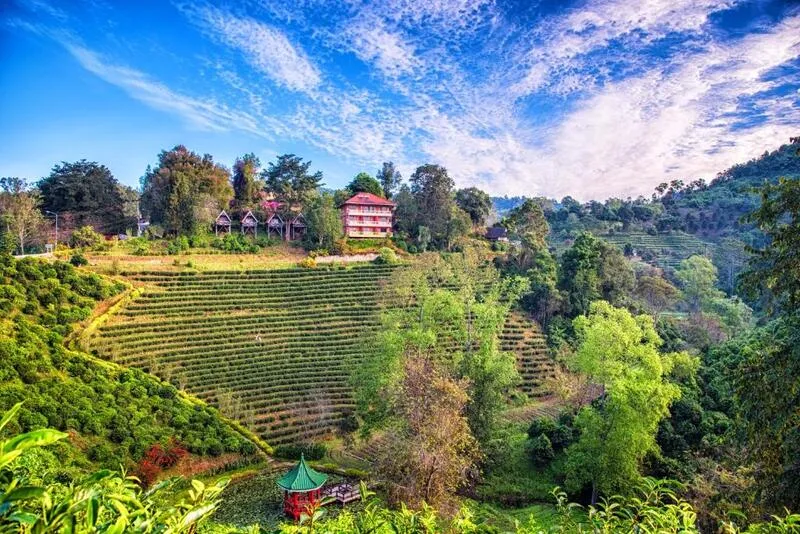
Doi Laolee is one of Chiang Rai’s quieter mountain destinations and an excellent addition to a Doi Wawee or Doi Chang itinerary. Although it is not as widely known as some of the province’s major peaks, it offers a very distinctive kind of beauty: rolling tea-covered hills, cool weather, fruit orchards, peaceful mountain accommodation, and a rural landscape that often feels closer to the highlands of southern China than to a typical Thai tourist stop. At around 1,300 meters above sea level, Doi Laolee provides a refreshing mountain atmosphere throughout the year and is especially suitable for travelers who prefer calm scenery and slow travel.
In the simplest terms, Doi Laolee is a small mountain area with a strong sense of place. Its charm does not come from dramatic cliffs or crowded viewpoints, but from its gentler beauty: tea fields arranged across the slopes, scenic mountain roads, citrus orchards, and houses that sit naturally within the landscape. This makes it ideal for visitors who value atmosphere, quiet, and a more intimate experience of the Chiang Rai highlands.
One of the reasons Doi Laolee feels so memorable is the journey itself. As travelers make their way uphill, they pass rows of tea plantations, orchards, and mountain homes, all spread across the ridges and valleys in a way that feels highly organic. The landscape has a distinctly Yunnan-like mood, with highland agriculture shaping the view as much as the mountains themselves. This visual character is one of the strongest reasons why Doi Laolee leaves such a lasting impression.
Doi Laolee also has an interesting historical background. The name “Laolee” is associated with a former soldier from Division 93, linked to the same broader historical movement that shaped places such as Doi Mae Salong. When return to their homeland was no longer possible, settlers began building a new life in this valley, clearing land, establishing homes, and planting oolong tea on the mountain slopes. Because of that, Doi Laolee is not just a scenic hill. It is also part of the historical story of settlement, adaptation, and highland agriculture in northern Thailand.
From a landscape perspective, Doi Laolee is especially appealing because it combines mountain scenery with visible human livelihood. Tea fields, orchards, homes, and ridges all appear in the same frame. Instead of feeling like an isolated scenic platform, the place feels like a living mountain environment. Visitors do not just see nature; they see a cultivated highland landscape shaped by people over time.
The area today is closely associated with Laulee Hill Resort, which serves both as an accommodation base and one of the main access points for enjoying the scenery. What makes the place especially appealing is that, although privately managed, it remains open in spirit to general visitors who want to come up and enjoy the mountain atmosphere. This gives Doi Laolee a special balance between being well cared for and still feeling relaxed rather than commercialized.
Overnight stays are particularly rewarding here. The resort and surrounding mountain setting allow visitors to experience the cool air, quiet evening atmosphere, and morning light over tea-covered hills in a much more immersive way than a short daytime stop would allow. Looking out from the accommodation area, guests often see hills, tea rows, and mountain ridges blending together into a calm and highly photogenic landscape.
Doi Laolee is also ideal for slow travel. There is no need to rush through a list of attractions. The essence of the destination lies in spending time well: walking through tea fields, sitting at a scenic viewpoint, drinking hot oolong tea, tasting local oranges, and enjoying a meal in cool mountain air. This style of travel makes the destination especially attractive for couples, photographers, and anyone looking for genuine relaxation.
Tea and citrus are part of the local identity here. Visitors often associate Doi Laolee with oolong tea grown on the surrounding slopes and sweet oranges from local orchards. This combination gives the destination a strong sensory character. It is not only beautiful to look at; it is also a place of aroma and flavor, where tea, fruit, and mountain air all contribute to the travel memory.
The final section of the road to Doi Laolee includes unpaved stretches, and this is one of the practical points travelers should know in advance. A 4WD vehicle is generally more convenient, especially in wet conditions. At the same time, this slightly rougher access is part of what has helped preserve the mountain’s more private and less commercial atmosphere. Reaching Doi Laolee feels a little more intentional, which adds to the sense of reward once you arrive.
For photographers, Doi Laolee offers many strong compositions: tea terraces, mountain ridges, orchard scenery, resort houses within the landscape, and soft light across the hills. Morning tends to produce a gentler, more humid atmosphere, while late afternoon gives stronger mountain definition and richer shadows. This makes the site excellent for scenic photography throughout the day.
Doi Laolee works especially well as part of a wider Doi Wawee journey. After visiting Ban Wawee market, tea shops, local viewpoints, or places such as Doi Kad Phi, coming to Doi Laolee provides a quieter and more contemplative mountain experience. It complements the wider Wawee area very well by adding a stronger sense of retreat and slow mountain living.
The destination can be enjoyed in every season. During the rainy season, the tea fields and orchards become especially green and vibrant. The late rainy and early cool season offer beautiful skies and fresh visibility. Winter is ideal for cold air, overnight stays, and a tranquil mountain atmosphere. Because each season has its own character, Doi Laolee remains appealing year-round.
Getting There From Chiang Rai city, take Highway 118 toward Mae Suai. Around kilometer 25–26 before reaching Mae Suai District, turn right toward Doi Wawee. Continue about 50 km toward the Wawee area, then follow the rural road toward Ban Mok Cham. After passing Ban Wawee for about 4 km, you will reach Doi Laolee. The last part of the route includes rough road conditions, so a four-wheel-drive vehicle is more convenient, especially after rain.
The drive itself is part of the pleasure. Travelers gradually leave the lowland roads behind and enter a highland landscape of tea fields, orchards, mountain villages, and ridges. On clear days, even the road journey feels like a destination in itself, which is one reason Doi Laolee works so well as a scenic side trip.
Overall, Doi Laolee is one of Chiang Rai’s most appealing lesser-known mountain destinations. It combines tea landscapes, historical depth, rural scenery, cool weather, and a peaceful highland atmosphere in a way that feels deeply satisfying. For travelers exploring Doi Wawee and wanting a quieter, more atmospheric addition to their trip, Doi Laolee is absolutely worth including.
| Name | Doi Laolee |
| Summary | A small mountain destination in the Wawee area of Mae Suai, Chiang Rai, at around 1,300 meters above sea level, known for tea fields, mountain scenery, citrus orchards, and a peaceful retreat atmosphere |
| Location | Ban Laolee, Wawee Subdistrict, Mae Suai District, Chiang Rai Province |
| Address | 15 Moo 20, Ban Laolee, Wawee, Mae Suai, Chiang Rai 57180 |
| Highlights | Oolong tea terraces, mountain scenery, citrus orchards, peaceful resort atmosphere, and a Yunnan-like rural mountain landscape |
| History / Period | The name comes from a former Division 93 soldier linked to the wider Mae Salong historical movement, with early settlement focused on tea cultivation and mountain living |
| Distinctive Features | Ideal for relaxing, tea tasting, orange tasting, scenic overnight stays, and highland landscape photography |
| Travel Information | From Chiang Rai, take Highway 118 to km 25–26 before Mae Suai, turn right toward Doi Wawee for about 50 km, then continue past Ban Wawee for about 4 km to Doi Laolee |
| Current Status | Open to visitors and still one of the peaceful scenic stops in the wider Doi Wawee area |
| Open Days | Open Daily |
| Opening Hours | Accessible All Day |
| Fees | No direct entrance fee information found for the mountain area itself |
| Facilities | Accommodation, restaurant service, tea-viewing areas, and scenic mountain rest areas within the resort zone |
| Caretaker | Laulee Hill Resort / Ban Laolee community / Wawee Subdistrict Administrative Organization |
| Main Contact Number | Laulee Hill Resort: 053-760150, 053-760152, 081-9927686 / Wawee SAO: 053-602816 |
| Official Website / Official Page | www.lauleehillresort.com / www.wawee.go.th |
| Nearby Tourist Attractions | 1. Ban Wawee Market about 4 km 2. Doi Kad Phi about 16 km 3. Doi Chang about 20 km 4. Akha FarmVille about 25 km 5. Viewpoints in the Wawee Highland Agricultural Station area about 6 km |
| Nearby Restaurants | 1. Laulee Hill Resort Restaurant about 0 km Tel. 053-760150-152, 081-9927686 2. Wawee Tea Shop about 4 km Tel. 095-4148652 3. U and ME 6395 Doichang about 18 km Tel. 097-4632915 |
| Nearby Accommodations | 1. Laulee Hill Resort about 0 km Tel. 053-760150-152, 081-9927686 2. WAWEE Retreat about 13 km Tel. 063-9515974 3. Ban Suan Phuwin, Doi Chang about 18 km Tel. 096-8749545 |
Frequently Asked Questions (FAQ)
Q: Where is Doi Laolee?
A: It is in Ban Laolee, Wawee Subdistrict, Mae Suai District, Chiang Rai Province, within the wider Doi Wawee highland zone.
Q: What is Doi Laolee known for?
A: It is known for tea-covered hills, mountain scenery, citrus orchards, peaceful accommodation, and a calm Yunnan-like highland atmosphere.
Q: When is the best time to visit?
A: It can be visited in every season. The rainy season is lush and green, while the cool season is especially pleasant for overnight stays and mountain views.
Q: Do I need a 4WD vehicle?
A: A 4WD vehicle is more convenient because the final section includes rough road conditions, especially after rain.
Q: Is there accommodation on Doi Laolee?
A: Yes. Laulee Hill Resort is the main accommodation in the area and is one of the best-known overnight options.
Q: Who is Doi Laolee suitable for?
A: It is ideal for travelers who enjoy peaceful mountain scenery, tea culture, scenic driving, slow travel, and overnight stays in nature.
 Category: ●Nature and Wildlife
 Group: ●Mountain (Doi)
Last Update : 5 MonthAgo
 Last Update : 5 MonthAgo
 Click to Access the Navigation Map GPS
 Art, Culture and Heritage
 Historical Sites and Monuments(3)
 Landmarks and Memorials(7)
 Art, Craft Centres, Tradition(6)
 Museums(8)
 Historic Homes and Cities(1)
 Educational Places
 Museum for Study(1)
 Library(1)
 Educational Gardens, Farm(3)
 Places of Worship
 Temple(38)
 Other Sacred Sites(5)
 Research and Development
 Royal Project(9)
 Suburban Living
 Village, Community(16)
 Local Market(5)
 National Parks and Marine Reserves(18)
Mountain (Doi)(20)
National Parks and Marine Reserves(18)
Mountain (Doi)(20)
 Dam, Reservoir, Lake(8)
 Waterfalls(16)
 Hot Springs(6)
 Caves(8)
 River, Canal(10)
 Sea, Beach(1)
 Other natural attractions(3)
 Entertainment and Agricultural
 Animal camps and shows(1)
 Farms, Parks and Ecotourism(9)
 Shopping
 Shopping and Night Market(2)
 Call Customer Service in Tourism
 Call Customer Service in Tourism(1)
 Travel Articles, Recipes
 Travel Review, Food Review(1)
 Food Menu, North Recipes(1)


