
lovethailand home >North Travel Attractions >Chiang Rai Travel Attractions >Mae Fa Luang >Mae Salong Nai > Huai Mae Kham Waterfall Forest Park
TL;DR: Huai Mae Kham Waterfall Forest Park is located at Mae Salong Nai Subdistrict, Mae Fa Luang District, Chiang Rai, open Monday–Friday, hours 09:00–17:00.
Huai Mae Kham Waterfall Forest Park
Open Days: Monday–Friday
Opening Hours: 09:00–17:00
Huai Mae Kham Waterfall Forest Park, often referred to together with Doi Hua Mae Kham, is one of Chiang Rai’s more atmospheric mountain destinations for travelers who prefer highland scenery, waterfalls, cool weather, and a quieter experience away from the province’s busier tourist routes. It is a place where forest landscapes, mountain villages, and seasonal golden wildflowers come together in a way that feels distinctly northern and deeply local.
Huai Mae Kham Waterfall Forest Park is located in Mae Salong Nai Subdistrict, Mae Fa Luang District, Chiang Rai, within the Mae Kham, Mae Salong, and left-bank Mae Chan national forest reserve areas. The forest park covers around 3,500 rai and was officially established by the Royal Forest Department on November 20, 1998. The setting is defined by a chain of mountains near the Thai–Myanmar border, giving the area a strong sense of elevation, remoteness, and scenic drama.
The landscape is made up of high mountain ranges layered one behind another, with elevations generally around 1,300–1,700 meters above sea level. Slopes are steep across much of the area, averaging around 35–45 percent, and this creates the kind of sweeping mountain views that many travelers look for when heading into northern Chiang Rai. In the waterfall zones, large and small boulders lie naturally along the streams, adding texture and beauty to the forest setting.
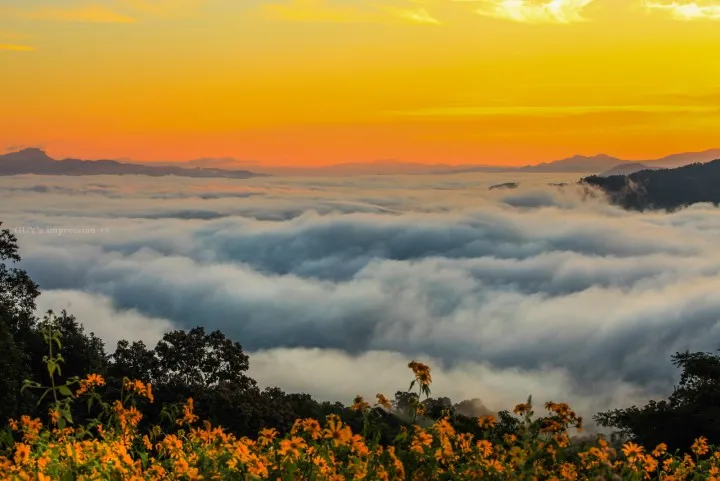
Part of the charm of this destination is that it offers more than a single viewpoint or a single waterfall. The wider Hua Mae Kham area combines natural forest, upland village scenery, cool weather, and seasonal flower fields. During the flowering season, the surrounding hills become bright with Mexican sunflowers, known in Thai as bua tong, turning the landscape into one of the best-known golden mountain scenes in Chiang Rai.
The climate follows a tropical monsoon pattern. The hot season usually runs from March to May, though the high elevation keeps temperatures more comfortable than the lowlands. The rainy season is generally from June to September, with the heaviest rains often extending into October. The cool season, from October to February, is the most popular period for travel because the weather can become distinctly cold, especially in the mornings and evenings. This is also the season most closely associated with the area’s sunflower bloom and panoramic mountain views.
Vegetation in the forest park is mainly montane evergreen forest, although parts of the higher slopes were previously used for agriculture and now have a lighter tree cover than the more protected valleys. In the lower ravines and along the year-round streams, the forest remains more lush and humid. A variety of plant life can be found here, including ferns, lichens, aroids, grasses, and many upland tree species such as dipterocarps, bamboo, fig trees, Indian gooseberry, Lagerstroemia, and other native forest trees. This plant diversity helps create the layered textures that make the area feel rich and alive throughout the year.
Wildlife seen in the area includes civets, rabbits, and various bird species. Even for visitors who are not specifically coming for wildlife watching, the sense of being in a functioning upland forest ecosystem is part of what makes Hua Mae Kham appealing. The streams, ravines, forest floor vegetation, and mountain air all contribute to a more immersive nature experience than many short-stop roadside viewpoints.
The waterfall and bua tong landscape around Ban Hua Mae Kham form the most talked-about attraction zone. The village itself sits at around 1,400 meters above sea level, and the flowing water in the area comes from tributaries of Mae Kham stream that continue running through much of the year. At Huai Pong Li there is a 2-tier waterfall, with each tier around 5–10 meters high, while along Huai Mae Kham stream there are many smaller falls and cascades, said to number around 20 points in total. These are not massive single-drop waterfalls, but rather a series of intimate forest water features that fit naturally into the mountain environment.
For many visitors, however, the most memorable image of Hua Mae Kham is the bua tong bloom. When the flowers come into season, the mountainsides around the village turn bright yellow, creating one of Chiang Rai’s signature cool-season landscapes. This is the time when travel to the area becomes especially popular. Some years also include local flower festivals and community-based events that add a cultural dimension to the trip, making it about more than scenery alone.
Activities in the forest park and nearby area include viewpoint stops, plant appreciation, nature study walks, trekking, waterfall visits, and seasonal flower viewing. Photographers are drawn here for the contrast between yellow flower fields, blue skies, and layered mountain ridges, while slower-paced travelers often appreciate the cool air, the village atmosphere, and the feeling of being surrounded by highland nature.
Facilities in the forest park are simple. There are restrooms, staff contact points, and camping space for visitors who want an overnight nature experience. Those planning to camp should contact the forest park staff in advance for permission and current conditions. Travelers looking for more comfortable accommodation usually stay in nearby mountain lodging areas such as Mae Salong, Mae Fa Luang, or other highland resorts and homestays along the access route.
The journey itself is one of the highlights of the trip. From Chiang Rai city, travelers first drive about 30 kilometers to Mae Chan. From there, the route continues along the mountain road toward Mae Salong and the turnoff toward Ban Therd Thai. This stretch climbs along scenic ridges and hillside curves, offering beautiful views throughout the drive. After the junction, the road continues toward Ban Therd Thai and then onward past upland villages such as Ban Na To and Ban Pang Mahan before reaching Hua Mae Kham. The total distance from Chiang Rai city is about 103 kilometers.
Getting There is easiest by private car. Although most of the route is paved, it is still a mountain road with curves and steep sections, so careful driving is important, especially during the rainy season or on misty mornings. Leaving Chiang Rai city early is a good idea, as it gives travelers enough time to enjoy the viewpoints, waterfalls, and nearby attractions before descending the mountain later in the day.
The wider travel route around Hua Mae Kham can also be combined with other destinations such as Ban Therd Thai, Doi Mae Salong, Phra That Santikhiri Temple, and other highland community attractions in Mae Fa Luang District. Because of this, the area works well as a full-day mountain itinerary or as part of a 2-day trip focused on northern Chiang Rai’s cooler upland landscapes.
For travelers who value peace, scenery, and a more natural pace, Huai Mae Kham Waterfall Forest Park stands out as a rewarding destination. It is not designed as a heavily commercial tourist complex. Its appeal comes instead from mountain air, forest streams, rolling ridgelines, village surroundings, and the seasonal beauty of the sunflower fields. That combination gives the place a distinct identity and makes it one of the more memorable nature trips in Chiang Rai.
If you are looking for a Chiang Rai destination that combines waterfalls, mountain landscapes, cool weather, and the charm of a highland village, Huai Mae Kham Waterfall Forest Park is well worth adding to your list. During the late rainy season and winter months especially, the scenery becomes even more impressive, and the journey feels like a true northern mountain escape.
| Name | Huai Mae Kham Waterfall Forest Park |
| Location | Mae Salong Nai Subdistrict, Mae Fa Luang District, Chiang Rai |
| Address | Ban Hua Mae Kham, Mae Salong Nai, Mae Fa Luang, Chiang Rai 57110, Thailand |
| Coordinates | Hua Mae Kham / Doi Hua Mae Kham area, Mae Fa Luang District, Chiang Rai |
| Highlights | Huai Mae Kham Waterfall, Ban Hua Mae Kham sunflower fields, border mountain scenery, and nature trails |
| History | Officially established by the Royal Forest Department on November 20, 1998 |
| Name Origin | Named after the Mae Kham stream and the Hua Mae Kham upland village area |
| Distinctive Features | Mountain terrain at 1,300–1,700 meters, steep slopes, multiple stream waterfalls, montane evergreen forest, and seasonal bua tong blooms |
| Travel Information | From Chiang Rai city, drive 30 km to Mae Chan, continue 23 km toward the Mae Salong route and Ban Therd Thai junction, then pass Ban Therd Thai, Ban Na To, and Ban Pang Mahan to reach the forest park. Total distance is about 103 km |
| Current Status | The Hua Mae Kham area continues to be promoted as a travel destination, especially during the annual bua tong flower season |
| Open Days | Monday–Friday |
| Opening Hours | 09:00–17:00 |
| Facilities | Restrooms, camping space, staff contact point, viewpoints, and nature-based activity areas |
| Main Areas / Zones | Huai Mae Kham Waterfall, Huai Pong Li, Huai Mae Kham stream zone, Ban Hua Mae Kham sunflower fields, and mountain viewpoints around the village |
| Main Contact Number | 095 675 8491 |
| Official Website / Official Page | Facebook: Doi Hua Mae Kham Forest Park, Chiang Rai |
| Nearby Tourist Attractions | 1. Ban Hua Mae Kham Sunflower Fields 1 km 2. Ban Therd Thai 13 km 3. Doi Mae Salong 31 km 4. Wat Phra That Santikhiri 31 km 5. Doi Tung 37 km |
| Nearby Restaurants | 1. Ban Hua Mae Kham Community Food Stalls 1 km 2. Restaurants in Ban Therd Thai 13 km 3. Restaurants in Doi Mae Salong 31 km 4. Ban Hom Muen Lee Restaurant Area 29 km 5. 101 Tea Green View Resort Restaurant 31 km |
| Nearby Accommodations | 1. Hua Mae Kham Highland Agriculture Promotion Center 1 km. Tel. 053 918 101 2. Ban Hom Muen Lee 29 km 3. 101 Tea Green View Resort 31 km 4. Doi Tung Lodge 37 km 5. Katiliya Mountain Resort & Spa 38 km |
Frequently Asked Questions (FAQ)
Q: Where is Huai Mae Kham Waterfall Forest Park located?
A: It is located in Mae Salong Nai Subdistrict, Mae Fa Luang District, Chiang Rai, in the Hua Mae Kham highland area near the Thai–Myanmar border.
Q: What is the main highlight of Huai Mae Kham?
A: Its main highlights are the mountain scenery, the waterfall and stream areas, and the famous sunflower bloom around Ban Hua Mae Kham during the cool season.
Q: When is the best time to visit?
A: The best time is from late rainy season into winter, especially around November when the weather is cool and the bua tong flowers are often at their best.
Q: Can visitors stay overnight in the area?
A: Yes. Camping is possible with advance coordination, and travelers can also stay at nearby mountain lodges, resorts, or local accommodation along the route.
Q: How far is it from Chiang Rai city?
A: The total driving distance from Chiang Rai city to the forest park is about 103 kilometers.
Q: Who is this destination suitable for?
A: It is ideal for travelers who enjoy mountains, cool weather, waterfalls, flower scenery, nature walks, and a quieter side of Chiang Rai.
Tel : 053711402
 Tel : 053711402
 Category: ●Nature and Wildlife
 Group: ●National Parks and Marine Reserves
Last Update : 6 MonthAgo
 Last Update : 6 MonthAgo
 Click to Access the Navigation Map GPS
Huai Mae Kham Waterfall Forest Park Map
Recommend

 Art, Culture and Heritage
 Historical Sites and Monuments(3)
 Landmarks and Memorials(7)
 Art, Craft Centres, Tradition(6)
 Museums(8)
 Historic Homes and Cities(1)
 Educational Places
 Museum for Study(1)
 Library(1)
 Educational Gardens, Farm(3)
 Places of Worship
 Temple(38)
 Other Sacred Sites(5)
 Research and Development
 Royal Project(9)
 Suburban Living
 Village, Community(16)
 Local Market(5)
National Parks and Marine Reserves(18)
Local Market(5)
National Parks and Marine Reserves(18)
 Mountain (Doi)(20)
 Dam, Reservoir, Lake(8)
 Waterfalls(16)
 Hot Springs(6)
 Caves(8)
 River, Canal(10)
 Sea, Beach(1)
 Other natural attractions(3)
 Entertainment and Agricultural
 Animal camps and shows(1)
 Farms, Parks and Ecotourism(9)
 Shopping
 Shopping and Night Market(2)
 Call Customer Service in Tourism
 Call Customer Service in Tourism(1)
 Travel Articles, Recipes
 Travel Review, Food Review(1)
 Food Menu, North Recipes(1)


