
lovethailand home >North Travel Attractions >Chiang Rai Travel Attractions >Chiang Saen >Pa Sak > Wat Pa Sak
TL;DR: Wat Pa Sak is located at Wiang Subdistrict, Chiang Saen District, Chiang Rai, open Every Day, hours 08:00 – 17:00.
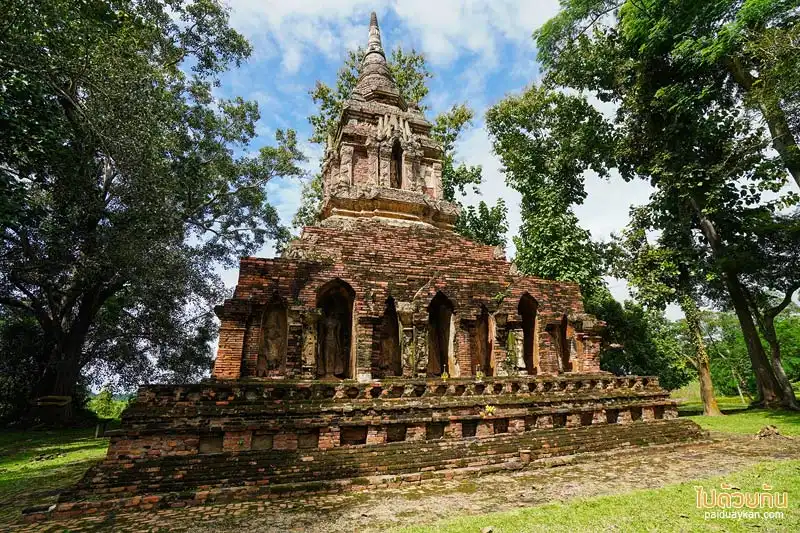
Wat Pa Sak
Open Days: Every Day
Opening Hours: 08:00 – 17:00
Wat Pa Sak is one of the most important historical attractions in Chiang Saen, Chiang Rai, and one of the finest places to visit for travelers who want more than a quick temple stop. The short version is simple: this is an ancient Lanna temple ruin built in the era of King Saen Phu to enshrine sacred relics, and it is best known for its magnificent prang-like chedi with exceptionally refined stucco decoration. Located only about 1 kilometer west of Chiang Saen town, Wat Pa Sak is easy to visit and works perfectly as part of a broader old-city heritage itinerary.
The site stands just outside the western side of the old Chiang Saen city, close to the moat, the old city wall, and the historic gate area. That setting is one of the reasons Wat Pa Sak is so rewarding. Visitors are not only looking at a single monument, but also stepping into the wider urban landscape of ancient Chiang Saen. The temple helps explain how religion, city planning, and royal patronage once came together in one of the most important historic centers in northern Thailand.
Wat Pa Sak is associated with King Saen Phu of the Mangrai dynasty, who commissioned the temple as a sacred site for the enshrinement of Buddhist relics. According to the historical tradition attached to the temple, the relic was brought from Pataliputra by Phra Phutthakhosachan. The temple then became not only a religious monument, but also a place tied to high ecclesiastical status. The story continues with the planting of 300 teak trees around the temple grounds, which gave the site its name: “Pa Sak,” or the teak forest temple.
The role of Phra Phutthakhosachan adds another layer of importance to the site. He was appointed as Sangharaja and resided at this temple, giving Wat Pa Sak significance beyond the local level. It was not simply a shrine for relic worship, but a major religious center connected to royal and monastic authority in ancient Chiang Saen. For travelers interested in cultural history, this makes the temple much more meaningful than a visually attractive ruin alone.
The most celebrated feature of Wat Pa Sak is its principal chedi, often described as a mondop-topped bell-form monument or a Lanna-style prasat chedi. This structure is regarded as one of the most beautiful examples of Chiang Saen and early Lanna art. Its surface is richly decorated with elaborate stucco work, and that decorative quality is one of the main reasons the monument is so highly valued. Even for visitors without a specialist background in archaeology or art history, the craftsmanship is immediately striking.
Architecturally, the main chedi shows a remarkable blend of artistic influences. Lanna forms are dominant, but the monument also reflects stylistic connections with Hariphunchai, Sukhothai, Pagan, and broader Buddhist visual traditions. Around the chedi, niches contain Buddha images and divine figures in alternating rhythm, giving the structure both visual richness and symbolic depth. This layered artistic character is exactly what makes Wat Pa Sak so important in the study of northern Thai art.
Although Wat Pa Sak is now a ruined temple, the site has been excavated, restored, and landscaped, so it is much easier to explore than many travelers expect. Visitors can walk around the monument comfortably and see not only the principal chedi, but also traces of other structures within the temple compound. These remains help reconstruct the scale and layout of the ancient temple complex, making the visit more engaging than simply standing in front of one surviving monument.
The atmosphere at Wat Pa Sak is quiet and reflective. Unlike highly commercial temple destinations, it offers a more understated experience focused on form, texture, and historical depth. Photographers will appreciate the balance between the old brickwork, the stucco details, and the surrounding greenery. History-minded visitors will enjoy the sense of being inside an authentic archaeological landscape rather than a recreated or overly modernized attraction.
Another advantage is the location. Wat Pa Sak is close to several other major sites in Chiang Saen, including Wat Phra That Chom Kitti, Chiang Saen National Museum, Wat Phra Chao Lan Thong, Wat Chedi Luang, and Wat Phra Yuen. This makes it ideal for a half-day or full-day historical route through the old city. Travelers who want to understand Chiang Saen as more than just a stop on the way to the Golden Triangle will find Wat Pa Sak especially worthwhile.
For travelers searching for a meaningful historical site in Chiang Rai, Wat Pa Sak is one of the strongest options because it combines accessibility, historical importance, and artistic distinction. It is close to town, easy to reach, and rich in cultural content. Instead of offering spectacle in a modern sense, it offers depth. That is exactly what makes it memorable.
It is best to visit in the morning or late afternoon, when the light makes the stucco surfaces and brick textures more beautiful and the weather is more comfortable for walking. A visit usually takes around 30 minutes to 1 hour, though travelers with a strong interest in art, history, or photography may want to stay longer. Since the site is an ancient monument, respectful behavior is important. Avoid climbing on the structures and help preserve the details that have survived for centuries.
Getting There is straightforward from Chiang Saen town. Wat Pa Sak is about 1 kilometer west of the district center in Wiang Subdistrict, within the broader old-city area. Travelers with private transport can reach it easily and combine it with several nearby heritage sites on the same day. Those staying in Chiang Saen can also arrange local transport or a short self-guided historical route around the old city.
In summary, Wat Pa Sak is one of the most impressive temple ruins in Chiang Rai for travelers who appreciate Lanna architecture, Buddhist heritage, and old-city archaeology. Its main chedi, royal foundation story, sacred relic tradition, and exceptional stucco decoration make it one of Chiang Saen’s essential cultural stops.
| Name | Wat Pa Sak |
| Location | Wiang Subdistrict, Chiang Saen District, Chiang Rai |
| Address | Old Chiang Saen area, Wiang, Chiang Saen, Chiang Rai 57150 |
| Coordinates | 20.274108, 100.076804 |
| Highlights | Main mondop-topped chedi, exceptional stucco decoration, major Chiang Saen monument, historical attraction near central Chiang Saen |
| History | Lanna period, around the 20th Buddhist century, founded in the era of King Saen Phu to enshrine Buddhist relics |
| Name Origin | The temple was surrounded by 300 teak trees, giving rise to the name “Pa Sak,” the teak forest temple |
| Distinctive Features | Ancient ruined temple complex with a Lanna-style prasat chedi and extensive stucco ornamentation |
| Travel Information | About 1 km west of Chiang Saen town center, easy to reach by car and convenient for same-day visits with other old-city monuments |
| Current Status | Ancient temple ruin and cultural attraction, open daily for visits and worship |
| Open Days | Every Day |
| Opening Hours | 08:00 – 17:00 |
| Fees | No Admission Fee |
| Main Contact Number | 061-808-8140, 053-650803 |
| Official Website / Official Page | Amazing Thailand |
| Nearby Tourist Attractions | 1) Wat Phra That Chom Kitti – about 1 km 2) Chiang Saen National Museum – about 2 km 3) Wat Phra Chao Lan Thong – about 2 km 4) Wat Chedi Luang Chiang Saen – about 2 km 5) Wat Phra Yuen – about 1 km |
| Nearby Restaurants | 1) 3 Ying Chiang Saen – about 1 km, Tel. 053-777-040 2) Dé Balcony Chiang Saen Cafe & Restaurent – about 2 km, Tel. 053-777-300, 084-615-0241 3) Krua Fa Mai Rim Khong Chiang Saen – about 3 km, Tel. 088-252-3158 4) Rim Khong Restaurant Chiang Saen – about 4 km, Tel. 053-160-845, 081-993-1061 5) COME MOON : Kham Moon 2 – about 4 km, Tel. 093-430-2300 |
| Nearby Accommodations | 1) A Hotel Cozy – about 1 km, Tel. 053-651115, 082-790-1741 2) Pak Ping Rim Khong – about 2 km, Tel. 053-650151, 081-993-3763 3) Siam Triangle Hotel Chiang Saen – about 2 km, Tel. 053-651115-17, 094-641-4447 4) One Budget Hotel Chiangsaen – about 3 km, Tel. 080-075-4988, 080-085-3988 5) Athita Hotel Chiang Saen – about 3 km, Tel. 063-426-9464, 053-602-731 |
Frequently Asked Questions (FAQ)
Q: Where is Wat Pa Sak located?
A: Wat Pa Sak is in Wiang Subdistrict, Chiang Saen District, Chiang Rai, about 1 kilometer west of Chiang Saen town center.
Q: Is Wat Pa Sak open every day?
A: Yes. It is open every day from 08:00 to 17:00.
Q: Is there an entrance fee?
A: No. There is no admission fee.
Q: What is the main highlight of Wat Pa Sak?
A: The main highlight is its beautifully decorated principal chedi, famous for its refined stucco work and important place in Lanna art history.
Q: Is Wat Pa Sak still an active temple?
A: No. It is currently an ancient temple ruin and protected historical site.
Q: How long should I plan for a visit?
A: Most visitors spend around 30 minutes to 1 hour, and many combine it with other Chiang Saen heritage sites.
Q: What kind of travelers will enjoy Wat Pa Sak?
A: It is especially suitable for travelers interested in Lanna architecture, Buddhist history, archaeology, and the old city of Chiang Saen.
Tel : 053650803
 Tel : 053650803
 Category: ●Places of Worship
 Group: ●Temple
Last Update : 5 MonthAgo
 Last Update : 5 MonthAgo
 Click to Access the Navigation Map GPS
Wat Pa Sak Map
Recommend

 Art, Culture and Heritage
 Historical Sites and Monuments(3)
 Landmarks and Memorials(7)
 Art, Craft Centres, Tradition(6)
 Museums(8)
 Historic Homes and Cities(1)
 Educational Places
 Museum for Study(1)
 Library(1)
 Educational Gardens, Farm(3)
Temple(38)
Educational Gardens, Farm(3)
Temple(38)
 Other Sacred Sites(5)
 Research and Development
 Royal Project(9)
 Suburban Living
 Village, Community(16)
 Local Market(5)
 Nature and Wildlife
 National Parks and Marine Reserves(18)
 Mountain (Doi)(20)
 Dam, Reservoir, Lake(8)
 Waterfalls(16)
 Hot Springs(6)
 Caves(8)
 River, Canal(10)
 Sea, Beach(1)
 Other natural attractions(3)
 Entertainment and Agricultural
 Animal camps and shows(1)
 Farms, Parks and Ecotourism(9)
 Shopping
 Shopping and Night Market(2)
 Call Customer Service in Tourism
 Call Customer Service in Tourism(1)
 Travel Articles, Recipes
 Travel Review, Food Review(1)
 Food Menu, North Recipes(1)


