
lovethailand home >North Travel Attractions >Chiang Rai Travel Attractions >Mae Fa Luang >Mae Fah Luang > Mae Fah Luang Garden
TL;DR: Mae Fah Luang Garden is located at Doi Tung Royal Villa Area, Doi Tung Development Project, Mae Fa Luang Subdistrict, Mae Fa Luang District, Chiang Rai Province, Thailand, open Daily, hours 08:00 – 17:00.
Mae Fah Luang Garden
Open Days: Daily
Opening Hours: 08:00 – 17:00
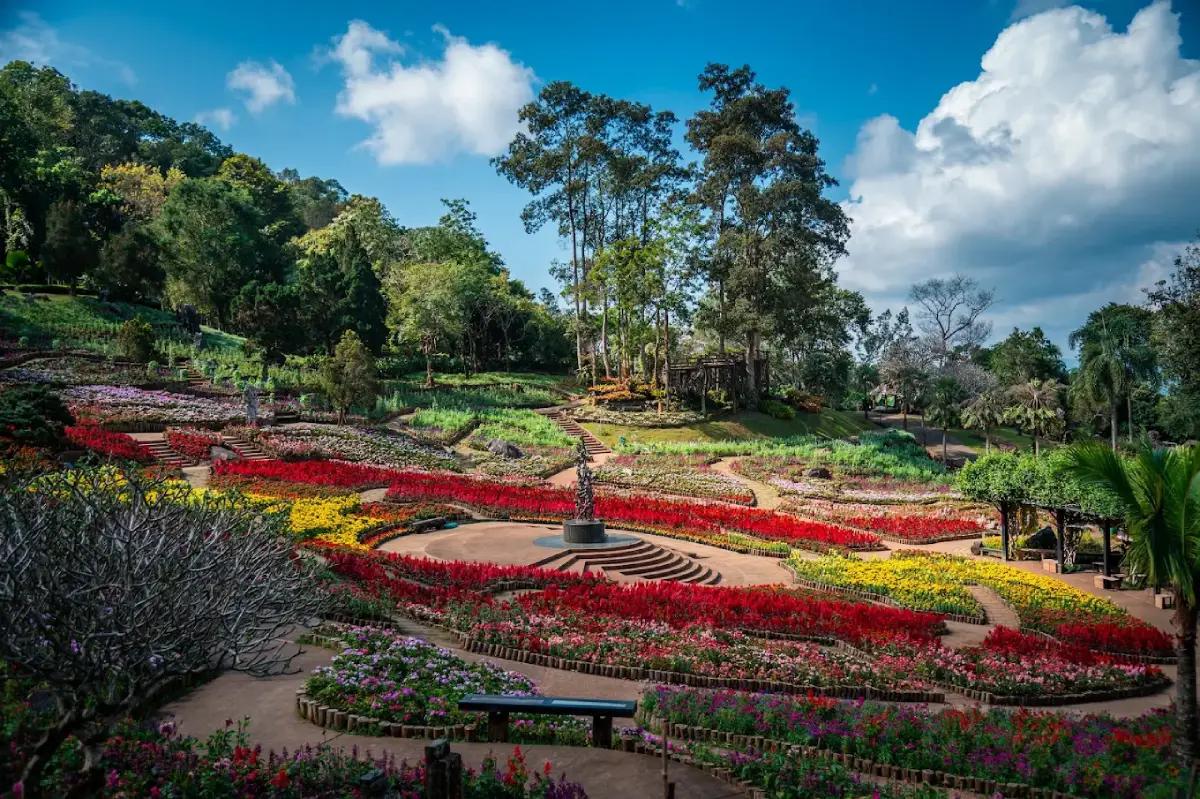
Mae Fah Luang Garden, Chiang Rai is one of Thailand's most celebrated cool-climate flower gardens. Located below the Doi Tung Royal Villa within the Doi Tung Development Project in Mae Fa Luang Subdistrict, Mae Fa Luang District, Chiang Rai Province, the garden covers approximately 32 rai, or 5.12 hectares. It is renowned for its magnificent displays of colourful flowers throughout the year, beautifully landscaped hillsides, refreshing mountain climate, and surrounding restored forests. The garden was established under the royal initiative of Her Royal Highness Princess Srinagarindra, widely known as the Princess Mother, to give Thai people the opportunity to enjoy the beauty of temperate-climate flowers while creating sustainable employment and income for local communities. Today, Mae Fah Luang Garden is open daily from 08:00 to 17:00, with a standard admission fee of 90 baht. It is managed by the Mae Fah Luang Foundation under Royal Patronage.
The significance of Mae Fah Luang Garden extends far beyond its flowers. Its landscape brings together natural beauty, garden design, history, and decades of community development. Land that was once associated with opium trafficking and other illegal activities has been transformed into a nationally recognized botanical attraction. Local residents play an essential role in growing, maintaining, and arranging the plants. The colourful flowerbeds descending the mountainside therefore represent more than visual beauty. They symbolize a remarkable transition from poverty, environmental degradation, and limited economic opportunities toward legitimate livelihoods, forest restoration, and sustainable development.
Mae Fah Luang Garden is situated on Doi Tung, part of the mountainous landscape of northern Chiang Rai. The surrounding geography consists of ridges, valleys, and forested slopes at varying elevations. Its mountain location creates a cooler climate than the provincial lowlands, particularly during the winter months, when morning temperatures can fall considerably and mist may gather along the hillsides. These climatic conditions support the cultivation of many ornamental plants that thrive in relatively cool environments. The sloping terrain also gives the garden a distinctive visual character, allowing visitors to appreciate the flowers from several elevations rather than viewing everything across a flat landscape.
Travellers arriving at the Doi Tung Development Project will discover several closely connected attractions: the Doi Tung Royal Villa, Mae Fah Luang Garden, the Hall of Inspiration, and the Mae Fah Luang Arboretum on Doi Chang Mub. Each destination offers a different experience. Mae Fah Luang Garden focuses on ornamental horticulture and landscaped flower displays. The Royal Villa introduces the Princess Mother's life and work in Doi Tung. The Hall of Inspiration presents the history and contributions of the Mahidol family, while the arboretum on Doi Chang Mub concentrates on highland plant conservation. Together, these sites provide a comprehensive introduction to the natural and cultural significance of Doi Tung.
Mae Fah Luang Garden on Doi Tung should not be confused with Mae Fah Luang Art and Cultural Park in Chiang Rai city. Although both are associated with the Mae Fah Luang Foundation, they are separate attractions with different purposes and locations. Mae Fah Luang Garden is a mountain flower garden near the Royal Villa, whereas Mae Fah Luang Art and Cultural Park is a centre for Lanna art and cultural heritage within Mueang Chiang Rai District. The Mae Fah Luang Arboretum on Doi Chang Mub is another separate destination, situated farther along the mountain roads and not within the flower garden below the Royal Villa.
The history of Mae Fah Luang Garden begins with the difficult conditions that once affected the Doi Tung region. For decades, the surrounding mountains experienced deforestation, shifting cultivation, poverty, and opium production. Many highland residents lacked reliable access to education, healthcare, and basic public utilities. Economic opportunities were limited, and some forms of livelihood placed considerable pressure on the natural environment. The severely degraded, partly treeless hillsides of that period contrasted sharply with the green mountain landscapes visitors see in Doi Tung today.
On January 15, 1987, Princess Srinagarindra visited Doi Tung and recognized that poverty and limited opportunities were fundamental causes of the area's difficulties. Her approach to addressing opium cultivation and forest degradation focused on improving people's lives rather than forcing occupational changes without providing realistic alternatives. The resulting development philosophy emphasized healthcare, education, income generation, and environmental restoration as mutually supporting priorities. The objective was to create conditions in which residents could pursue legitimate occupations, develop greater economic security, and live alongside the forest without depending on its destruction.
The Doi Tung Development Project, established under royal initiative, began operations in 1988. The Mae Fah Luang Foundation under Royal Patronage became a principal organization responsible for implementing the programme. Its integrated development strategy started with improvements to basic living conditions, healthcare, and education, followed by employment opportunities and the restoration of degraded watershed forests. The work was not limited to planting trees. It also sought to establish an economic system in which local residents could earn sustainable incomes and recognize the long-term benefits of protecting natural resources.
A central principle of the project is that sustainable environmental protection depends on the well-being of the people living near the forest. Communities need practical ways to support themselves without expanding cultivation into sensitive natural areas. The project consequently promoted Arabica coffee, macadamia cultivation, handicrafts, agricultural processing, and tourism services. These activities became important foundations of the DoiTung social enterprise brand, whose commercial operations generate income while supporting further community development and environmental management.
Before becoming Mae Fah Luang Garden, the site was associated with the former Akha settlement of Pa Kluay and served as a stopping point along routes used by caravans transporting opium, chemicals associated with illicit drug production, and weapons. This history reflects the social and economic problems affecting remote borderland communities when legitimate livelihood opportunities were extremely limited. Transforming the area into a flower garden therefore represented a major change in both land use and local economic activity, replacing a landscape associated with illicit trade with one dedicated to recreation, employment, and environmental recovery.
The garden's development was accompanied by improvements to settlement conditions and public services. Residents of the original Pa Kluay Akha community were relocated to a more suitable residential area, where infrastructure and access to essential services were improved. This transformation allowed the former settlement site to become a tourist attraction while creating new employment opportunities in ornamental horticulture, landscape maintenance, and visitor services. The garden's success is therefore closely connected to the wider programme of improving living conditions and economic opportunities for the people who formerly occupied the area.
Mae Fah Luang Garden first opened to visitors in 1992. It was created in accordance with Princess Srinagarindra's wish to make beautiful cool-climate flowers accessible to Thai people without requiring them to travel abroad. The garden was designed to display a variety of flowering plants throughout the year, using seasonal planting arrangements that complemented the slopes and surrounding mountain landscape. Its opening marked an important development in Doi Tung tourism, demonstrating that environmental restoration and community development could also generate economic benefits through responsible visitation.
In 1993, Mae Fah Luang Garden received a PATA Gold Award for tourism development from the Pacific Asia Travel Association. This recognition highlighted the significance of a tourism initiative that combined attractive landscaping with employment creation, community improvement, and environmental rehabilitation. The award helped establish the garden's reputation as an example of tourism development with wider social benefits. Its importance lies not only in the quality of the landscape but also in the transformation of an area previously affected by poverty and environmental decline.
The garden has continued to evolve since its establishment. What began as a landscaped collection of cool-climate flowers has developed into a garden covering approximately 32 rai, with seasonal flowerbeds, lawns, pathways, mature trees, and artistic features. The terrain allows visitors to experience the landscape from different levels, including higher pathways, central garden areas, and lower terraces descending the hillside. These changing perspectives create the impression of colourful flowerbeds flowing across the mountain slopes.
One of Mae Fah Luang Garden's defining characteristics is the regular rotation of flowering plants according to seasonal conditions. As a result, the garden remains attractive throughout the year rather than depending entirely on the cool season. Maintaining these displays requires careful planning, plant propagation, soil preparation, irrigation, and ongoing horticultural work. When one planting cycle reaches the end of its display period, new plants are introduced according to the landscape management schedule. This continuous maintenance supports the garden's appearance while providing skilled horticultural employment within the development project.
The garden features a varied selection of ornamental plants, including salvia, petunias, begonias, roses, and other species suited to the highland climate. Ferns, ornamental foliage plants, mature trees, and lady's slipper orchids also contribute to its botanical diversity. Different species have distinct requirements for sunlight, moisture, temperature, and growing conditions. Their arrangement must therefore consider both their horticultural needs and their contribution to the overall visual composition, allowing plants with different heights, colours, and forms to complement one another.
Salvia is among the flowers that bring particularly vivid colour to the garden. Its upright flower spikes, especially those in bright red, create a dramatic contrast with the green lawns. Petunias offer trumpet-shaped flowers in a broad range of colours, making them well suited to continuous borders and large colour-themed arrangements. Begonias contribute both attractive flowers and foliage, adding texture to the planting design. Combining these plants allows the garden to create varied visual effects instead of relying on a single species or colour throughout the landscape.
Roses are another important feature of cool-climate ornamental gardens. Their distinctive flowers and fragrances make them attractive to visitors, while their cultivation requires appropriate soil management, pruning, and plant-health care. Other flowering plants are introduced according to seasonal conditions, helping maintain the garden's changing appearance. The selection of plants is based not only on their appearance at peak bloom but also on their growth patterns, flowering periods, and ability to maintain a high-quality landscape throughout the year.
Lady's slipper orchids are particularly interesting because of their unusual flower shapes and botanical significance. Different species require carefully managed growing conditions, making their conservation and cultivation a specialized horticultural activity. The Doi Tung Development Project has undertaken work involving plant tissue culture and propagation, supporting efforts to conserve valuable plant species. The display of these orchids connects ornamental gardening with botanical education, showing that plant conservation involves both protecting natural populations and developing knowledge of propagation and cultivation.
Ferns and ornamental foliage plants are essential to the garden's lush atmosphere. Their green textures help connect the colourful flowerbeds with mature trees and surrounding woodland. Ferns are especially suitable for appropriately shaded and humid areas, creating a contrast with the brighter flower displays in more exposed positions. The variety of foliage forms also gives the garden visual interest during periods when particular flowering plants have not yet reached their peak.
Mature trees provide more than an attractive background. They create shade, moderate conditions along parts of the pathways, and contribute to the garden's ecological character. Their presence helps connect the carefully maintained ornamental landscape with the surrounding mountain forest. Areas beneath established trees tend to feel quieter and more sheltered than the open flower terraces, creating a welcome variation in atmosphere for visitors exploring the grounds.
The garden's landscape design makes effective use of the natural slopes. Flowerbeds follow the contours of the hillside, while winding pathways connect areas at different elevations. From higher positions, visitors can appreciate the patterns created by the planting arrangements. Descending along the designated paths reveals the individual plants and finer details of the displays. This changing relationship between viewing height and landscape composition makes Mae Fah Luang Garden particularly enjoyable to explore on foot.
Large flowerbeds are arranged through a considered combination of colours, shapes, and planting densities. Some sections feature broad groups of flowers in a single colour, producing a strong visual effect when viewed from above. Others combine contrasting colours to create more intricate patterns. Successful arrangements require attention to plant height, growth habits, spacing, and flowering time. These factors determine whether the design remains coherent both from distant viewpoints and at close range along the walking paths.
Lawns and green spaces provide visual balance between the colourful planting areas. Rather than filling every section with flowers, the landscape uses open greenery to create a sense of calm and allow visitors to appreciate the surrounding hills and sculptural elements. Moving from a brightly coloured flowerbed into an open lawn or shaded area creates a noticeable change in atmosphere. The connected paths encourage exploration through these contrasting environments without requiring visitors to retrace every section of their route.
One of the garden's most important artistic landmarks is the sculpture named "Continuity," created by Misiem Yipintsoi, an influential Thai artist and sculptor. The work depicts children standing on one another, symbolizing cooperation and the passing of responsibilities from one generation to the next. Princess Srinagarindra bestowed the name "Continuity" upon the sculpture to express the principle that meaningful achievements require sustained effort, cooperation, and commitment over time. Its message reflects the importance of working together rather than relying on isolated individual actions or short-term results.
The meaning of "Continuity" is closely related to the philosophy of the Doi Tung Development Project. Addressing poverty, restoring forests, and creating lasting economic opportunities cannot be accomplished overnight. Such work requires cooperation across different organizations and generations, together with the transmission of knowledge and responsibility to younger people. The sculpture is therefore much more than a decorative garden feature or a popular photographic subject. It expresses the project's long-term development philosophy through a work of art that visitors can understand within the landscape itself.
The planting arrangements surrounding the sculpture create a visual relationship between art and nature. At different stages of the garden's development, patterns inspired by the woven textiles and cultural traditions of Doi Tung's ethnic communities have also influenced the landscape. These designs connect contemporary artistic expression with the cultural identity of highland residents. Visitors can therefore appreciate how the garden presents both the beauty of flowers and elements of local heritage within a unified setting.
Mae Fah Luang Garden has undergone design improvements to reflect changing visitor interests. A major redesign was introduced for the tenth Colours of Doi Tung Festival under the concept "Flowers Painting the Mountain." Landscape architect Thatchapol Suntaracharn worked with the Mae Fah Luang Foundation team to create a more naturalistic interpretation of the garden. The design aimed to transform strongly defined ornamental flowerbeds into broader flowing landscapes, using colour arrangements that make visitors feel as though they are walking through a large botanical painting.
The redesign also emphasized seasonal colour changes, giving the garden a different character at different times of year. Contemporary landscape design was applied without abandoning the identity of the original hillside garden. The work preserved the relationship between mountain terrain, planted terraces, and floral patterns while creating a more immersive experience for visitors. This development demonstrates that Mae Fah Luang Garden is an evolving cultural and natural attraction rather than a landscape preserved in an unchanged form since its opening.
The garden's appearance changes considerably with the seasons. The cool season, from approximately November to February, is particularly popular because temperatures on Doi Tung are generally pleasant for outdoor activities and suitable for many cool-climate flowers. Early mornings can be especially refreshing, with cooler air and occasional mist gathering around the hillsides. The exact appearance of the flowers depends on annual weather and planting schedules, but the cool season remains an excellent period for walking, photography, and enjoying the mountain atmosphere.
From approximately March to May, the weather becomes warmer and midday sunshine grows stronger. The garden continues to display ornamental plants selected for the prevailing conditions, although its appearance differs from the cool-season landscape. Morning visits are particularly comfortable because the sun is generally less intense. Shaded pathways and mature trees provide places to rest between sections of the garden. Seasonal changes in flowers and foliage create a different visual experience, demonstrating that the garden does not need to look identical to its winter displays throughout the year.
The rainy season, from approximately June to October, brings increased moisture and lush greenery to Doi Tung. Forested slopes become particularly vibrant, while clouds and mountain mist contribute to a softer landscape atmosphere. However, exposed paths and sloping surfaces can become wet and slippery. Visitors should take extra care when moving through areas where the ground changes elevation. Heavy rainfall and thunderstorms may also affect the safety and comfort of outdoor sightseeing, making suitable footwear and attention to weather conditions especially important.
Maintaining an attractive garden throughout the year requires detailed horticultural knowledge. Different flowers need different levels of water, soil nutrients, sunlight, and temperature. Plant propagation must be scheduled well in advance so that suitable plants are available when existing displays are replaced. Transplanting requires attention to root health and the ability of plants to adapt to their new conditions. The garden team must therefore manage both the visible flowerbeds and the behind-the-scenes process of preparing new plants, demonstrating the extensive work required to maintain the landscape.
Soil preparation is especially important on a sloping site. Planting areas need appropriate drainage and sufficient nutrients, while the hillside terrain requires attention to erosion during heavy rain. Choosing suitable planting techniques helps maintain soil stability and the condition of the flowerbeds. Irrigation must provide the moisture needed by different plants without creating excessive runoff that could damage paths or lower planting areas. These practical considerations form an essential part of the landscape's long-term maintenance.
Pruning and ongoing plant care help preserve the clarity of the garden's ornamental patterns. Shrubs must be shaped to maintain continuous borders, while faded flowers and damaged plant material need to be managed to keep displays healthy and attractive. This work is not undertaken solely for photographic appearance. Proper maintenance supports plant health and helps reduce problems associated with deteriorating vegetation. The quality of the garden depends on a combination of technical horticultural knowledge and experience gained through regular work.
Mae Fah Luang Garden is also valuable as an educational example of landscape architecture. Visitors can observe how colour, plant form, spacing, and elevation are combined to create an integrated garden. Horticulture enthusiasts can examine the differences among plant species and planting styles. Those interested in art can consider how the central sculpture relates to the surrounding landscape, while nature enthusiasts can appreciate the relationship between ornamental plants, mature trees, and the mountain environment. The garden therefore offers learning opportunities beyond ordinary flower viewing.
The garden can be understood through several main landscape areas: the entrance and principal walking routes, terraced flowerbeds, the "Continuity" sculpture, lawns and ornamental planting areas, orchid and specialist plant displays, shaded areas beneath mature trees, and the children's playground. These divisions describe the garden's physical characteristics rather than separate ticketed zones. Flower arrangements and the position of seasonal displays may change as part of the ongoing planting and maintenance programme.
The entrance area connects the visitor facilities with the main landscaped grounds. Paths lead toward the flowerbeds and important features of the garden. Approaching from a higher level provides an opportunity to appreciate the overall design before exploring individual plants at closer range. Because the garden follows the natural slope, some sections of the paths are relatively level while others involve changes in elevation. Visitors can choose how much time to spend in different areas according to their interests and physical abilities.
The open-air flower terraces create some of the garden's most memorable views. Masses of colourful flowers descend across the hillside in carefully arranged groups, forming patterns that are particularly impressive when seen from elevated positions. At ground level, visitors can observe the shapes of individual flowers and foliage in greater detail. The displays are designed as connected parts of a larger composition, allowing the landscape to reveal different colours and forms as visitors continue along the pathways.
The area around the "Continuity" sculpture connects the garden's visual beauty with the philosophy of the Doi Tung Development Project. Visitors can view the artwork from nearby paths or appreciate it within the wider landscape from a distance. The image of children supporting one another is particularly meaningful beside flowerbeds that themselves require sustained care and cooperation. This relationship between art and horticulture makes the sculpture area an important place for both photography and understanding the garden's historical significance.
The lawns and shaded spaces provide a calmer rhythm to the walking experience. Open areas reveal broader views of the surrounding hills and mature trees, while shaded locations offer a quieter atmosphere between the colourful flower displays. This variation prevents the garden from feeling visually repetitive. Visitors move between sunny, brightly coloured sections and green areas with more subdued tones, experiencing several distinct aspects of the mountain landscape within the same attraction.
The orchid and specialist ornamental plant displays are of particular interest to visitors who enjoy botany. Lady's slipper orchids, with their distinctive flowers, are closely related to the Doi Tung Development Project's work in plant propagation and conservation. Examining different flowers, leaves, and display methods provides an introduction to the diversity of ornamental horticulture. Because the plants on display change with the seasons and maintenance schedules, visitors may encounter different species and arrangements on subsequent trips.
The children's playground adds another dimension to the garden's suitability for family travel. It gives younger visitors an opportunity to enjoy recreational activities while their families explore the grounds. Children should use playground equipment appropriate to their age and remain under adult supervision, particularly near changes in ground level or planted areas. Remaining on designated pathways and keeping clear of flowerbeds helps protect the plants and allows all visitors to enjoy the garden responsibly.
Mae Fah Luang Garden has also been associated with the development of treetop walking activities, allowing participants to experience the surrounding vegetation from a different elevation. Such activities are distinct from ordinary walking routes and involve specific safety procedures and operating arrangements. Their availability depends on the programme offered by the managing organization, and participation is not automatically included in the standard admission ticket for the flower garden.
Another distinctive development is the garden's recognition as a registered dark-sky conservation area on privately managed land. The National Astronomical Research Institute of Thailand registered Mae Fah Luang Garden for the 2025–2027 period. This designation recognizes the value of the garden's environment for observing the night sky and supporting astronomical education. It adds a new dimension to the site's role, extending its educational potential beyond daytime horticulture to supervised activities involving astronomy and the natural environment after dark.
Doi Tung's stargazing activities have been developed as part of an astronomy-related tourism programme. They introduce participants to stars, constellations, planets, and other celestial objects visible under suitable weather and seasonal conditions. The relatively low levels of light pollution compared with densely developed urban areas make the location valuable for observing the night sky. The programme also includes forms of guided night walking that explore nocturnal organisms, lichens, and ecological relationships. These experiences operate under dedicated arrangements rather than the garden's normal daytime admission system.
The Doi Tung Stargazing programme offers sessions for members of the public and special arrangements for organized groups. Information published by the dark-sky programme describes activities on the first and fourth Fridays of each month, along with options for families, students, and educational groups to register for special sessions. Participation requires the appropriate booking or registration rather than unrestricted nighttime access. Inquiries about these activities can be directed to the programme's published contact number, +66 99 297 3797.
Dark-sky conservation is connected to environmental management in ways that differ from conventional forest restoration. Suitable lighting helps protect nighttime sky visibility and can reduce disturbance to organisms that are active after dark. Managing these activities therefore involves careful consideration of light, noise, safety, and participant numbers. Astronomy and night-nature programmes demonstrate that conservation education can encompass both the visible daytime landscape and the ecological environment experienced after sunset.
Mae Fah Luang Garden contributes directly to the local economy through the employment opportunities required to operate it. These include plant propagation, ornamental cultivation, irrigation, landscape maintenance, visitor services, and the organization of special activities. The jobs provide alternatives to livelihoods that previously placed pressure on natural resources. The garden's success can therefore be measured not only through the beauty of its displays but also through the opportunities it creates for local residents to develop skills and secure income.
The involvement of local people makes the garden more than a landscape conceived by professional designers. Behind its colourful displays are teams of residents who have developed practical horticultural and service skills through long-term work. Knowledge gained through cultivation, plant care, and landscape management can also support employment and enterprise in other areas of agriculture and tourism. The transfer of such skills is closely aligned with the Doi Tung Development Project's emphasis on human development and lasting economic independence.
The relationship between the garden and the ethnic communities of Doi Tung is also reflected in local handicrafts and cultural activities. Highland communities possess distinctive traditions involving textiles, clothing, food, craftsmanship, and everyday mountain life. Tourism development has provided opportunities for these skills and products to be presented to visitors. A trip to Mae Fah Luang Garden can therefore be combined with an appreciation of the cultural diversity of the people who have participated in Doi Tung's transformation.
Products sold under the DoiTung brand are another important outcome of the development programme. They include coffee, macadamia products, handicrafts, textiles, ceramics, and agricultural goods. Developing products with commercial value and access to wider markets helps provide income for local producers and their communities. These items are not simply souvenirs. They form part of an economic system designed to replace activities that once contributed to environmental and social problems with more sustainable forms of employment.
Arabica coffee is one of Doi Tung's most important agricultural products. The highland climate supports the cultivation of quality coffee, while the development project has helped connect farmers with processing and retail opportunities. This creates a value chain extending from cultivation through production to consumers. Café DoiTung, located within the wider visitor complex, offers coffee and related products that reflect this connection. Enjoying a locally produced coffee can therefore provide a practical introduction to the region's agricultural transformation and community enterprise.
Macadamia is another important economic crop promoted through the Doi Tung Development Project. As a long-lived tree producing valuable nuts, it can support agricultural income over an extended period. Macadamia products can be processed into different foods and commercial goods, helping farmers gain additional value from their harvests. Their role in the local economy illustrates how carefully selected agricultural activities can provide income while contributing to the broader objectives of sustainable land management.
Doi Tung's handicraft activities are also important for preserving and developing local knowledge. Textiles, ceramics, and mulberry-paper products are among the traditional craft forms incorporated into the social enterprise programme. Combining established techniques with contemporary designs has helped create products suitable for modern use and wider markets. At the same time, these activities preserve practical skills that have been passed through local communities. Shops within the visitor area allow travellers to encounter the results of these development efforts directly.
Environmental restoration has been a fundamental part of the Doi Tung Development Project since its beginning. Forest regeneration and long-term land management have helped transform degraded hillsides into a greener and more ecologically productive landscape. The restoration effort is closely connected to income generation because residents need viable livelihoods if the forests are to remain protected. The project has developed a land-use approach that distinguishes conservation forests, community-use forests, and economic forests according to their management purposes.
Conservation forests are intended to protect ecological systems and biodiversity. Community-use forests support regulated access to natural resources under agreed local rules, while economic forests are associated with income-generating crops such as coffee and macadamia. This approach recognizes that conservation does not necessarily require separating people entirely from nature. Instead, carefully managed land use can reduce environmental damage while allowing communities to maintain secure livelihoods and participate in the protection of their surroundings.
The transformation of Doi Tung from a landscape affected by extensive forest degradation into an area with substantial green cover reflects decades of sustained work. Looking beyond Mae Fah Luang Garden toward the surrounding hills, visitors can appreciate the extent of the restored vegetation. The scenic mountain backdrop is therefore connected to conservation efforts extending far beyond the ornamental garden itself. Understanding this relationship gives the landscape greater meaning and helps explain why the garden is regarded as one component of a much larger development initiative.
The Colours of Doi Tung Festival is an important seasonal event associated with the area's tourism and cultural activities. It is organized during periods announced by the responsible organizers, particularly around the cool season when Doi Tung attracts considerable visitor interest. Previous festivals have included ethnic cultural performances, traditional foods, locally made products, and creative activities. These events connect flower viewing with the traditions and livelihoods of surrounding communities. Exact dates and programmes are determined through announcements by the Mae Fah Luang Foundation and the event organizers.
Cultural activities in Doi Tung provide opportunities to learn about the different ethnic communities of northern Thailand. Traditional languages, clothing, foods, and handicrafts reflect the diverse heritage of the highland population. Presenting these traditions through tourism can help younger generations recognize the value of their community knowledge while creating opportunities for local income. Visitors consequently discover that Doi Tung is not simply a destination of mountains and flowers, but a living region whose people have played a central role in shaping its social and environmental transformation.
Mae Fah Luang Garden is well suited to educational visits, particularly for students and groups interested in community development, horticulture, and environmental management. The garden provides visible examples of how agricultural knowledge and landscape architecture can create a sustainable tourism attraction. Learning about the wider project explains why employment development and forest restoration were necessary in the first place. Together, these experiences demonstrate how economic, social, and environmental priorities can support one another when development is planned over the long term.
Photography enthusiasts will find many attractive viewpoints throughout the garden. Elevated paths are well suited to capturing broad compositions of the terraced flowerbeds and surrounding mountains, while lower paths offer opportunities for close-up photographs of individual flowers and the central sculpture. Morning light often reveals fine details in petals and foliage, particularly when the weather is clear or light mist is present. Afternoon light creates different combinations of shadows and colour, allowing the same landscape to produce varied photographic results at different times of day.
Visitors taking photographs should help protect the planted areas. Many ornamental flowers have delicate stems and petals, and stepping into flowerbeds or moving plants to improve a composition can cause damage. The garden's designated pathways already provide a wide selection of viewpoints because the landscape has been designed for appreciation from different levels. Taking photographs from these paths protects the displays and helps ensure that other visitors can enjoy the same high-quality environment.
Mae Fah Luang Garden is suitable for family visits because its extensive grounds offer floral displays, scenic viewpoints, and opportunities to learn about plants. Children can discover different flowers and seasonal changes through direct observation, while older visitors may appreciate the cool climate and peaceful scenery. Nevertheless, the garden occupies sloping terrain, and some paths involve changes in elevation. Visitors with limited mobility should choose routes appropriate to their physical abilities and make use of suitable resting areas when needed.
Some facilities within the wider Doi Tung visitor area are designed to accommodate travellers with different mobility requirements. However, this does not mean that every path in the hillside garden is completely level or equally accessible. The suitability of a particular route depends on its actual gradient and the assistance available at the site. Visitors who use wheelchairs or require mobility support can contact the Doi Tung Development Project for information about access arrangements and facilities relevant to their needs.
Clothing and equipment should be selected according to the season. During the cool months, a light jacket or warm outer layer can be useful, especially for early-morning journeys or windy days. In hotter weather, drinking water and sun protection are important because exploring the garden involves spending time outdoors. During the rainy season, footwear with good grip can make walking on wet or sloping paths more secure. Preparing for the prevailing conditions helps visitors enjoy the garden comfortably and safely.
A general visit to Mae Fah Luang Garden usually takes approximately one to two hours for travellers wishing to explore the flower displays, sculpture, and main landscape features without rushing. Those interested in detailed photography or horticulture may spend longer. A full-day Doi Tung itinerary should also allow time for the Royal Villa, Hall of Inspiration, and nearby food and shopping facilities. These attractions complement the flower garden and make it possible to understand the wider purpose of the development project.
Doi Tung Royal Villa is the closest major heritage attraction to Mae Fah Luang Garden. Built as a residence and working base for Princess Srinagarindra, it combines elements of traditional Lanna architecture with Swiss chalet design. The building reflects simplicity, practicality, and the Princess Mother's personal approach to daily life. One of its most distinctive features is the carved wooden ceiling of the main hall, where a celestial design represents the arrangement of stars on the date of her birth. Visiting the villa provides a deeper understanding of her life and connection to the Doi Tung region.
The Hall of Inspiration is another important attraction within the Royal Villa visitor area. Its exhibitions present stories of the Mahidol family and their contributions to improving the lives of Thai people. The displays explore subjects connected with education, healthcare, public service, and the inspiration members of the royal family drew from one another. Combining the hall with Mae Fah Luang Garden gives visitors a clearer understanding of the development philosophy behind the project and the practical changes that have taken place in the surrounding communities.
Mae Fah Luang Arboretum on Doi Chang Mub is a separate highland botanical attraction located farther along the mountain roads. Unlike the flower garden below the Royal Villa, the arboretum places greater emphasis on plant conservation, particularly rhododendrons, wild orchids, and species associated with higher elevations. The nearby Chang Mub Stupa adds historical and scenic interest. Travellers interested in seeing different forms of mountain vegetation can combine the ornamental landscapes of Mae Fah Luang Garden with the more conservation-focused surroundings of the arboretum.
Chang Mub Stupa stands on a large rock whose shape resembles a resting elephant, giving the surrounding area its distinctive name. The site is connected with local history and overlooks a mountainous landscape near the Thailand–Myanmar border. Its combination of natural scenery and cultural significance makes it an interesting addition to a Doi Tung itinerary. Roads leading from the garden toward Doi Chang Mub include mountain bends and steep sections, so driving conditions and weather should be considered carefully.
Wat Phra That Doi Tung is one of Chiang Rai's most important Buddhist religious sites. Located on Doi Tung, the temple is associated with a highly revered sacred relic monument and longstanding Lanna Buddhist traditions. Its most recognizable architectural feature is a pair of golden chedis set within the mountain temple grounds. A visit adds a religious and cultural dimension to an excursion that might otherwise focus primarily on flowers and natural landscapes. Appropriate clothing and respectful behaviour are expected when visiting the temple.
Phra That Doi Tung is also connected with Buddhist observances and local traditions in northern Thailand. The temple attracts worshippers during important religious occasions and community merit-making events. Visiting it alongside Mae Fah Luang Garden highlights the different forms of significance associated with the mountain. The temple is primarily a sacred place of worship, while the garden is a landscaped attraction created through a royal development initiative. Both contribute to the wider cultural and historical identity of Doi Tung.
Ban Pha Hee is another destination that can be connected with a journey through the Doi Tung region. Situated in Pong Ngam Subdistrict, Mae Sai District, the highland village is widely known for its coffee production and panoramic mountain scenery. Visitors can discover locally operated coffee shops, homestays, and activities connected with Arabica coffee cultivation. The village provides a different perspective on highland tourism, emphasizing community life and agricultural products rather than formal ornamental gardens.
Ban Pha Mi is another mountain community in Mae Sai District with strong connections to Akha culture and community-based tourism. Visitors can explore local coffee traditions, food, and scenic viewpoints overlooking the surrounding mountains. Combining Doi Tung, Ban Pha Hee, and Ban Pha Mi creates an itinerary that connects landscapes, highland livelihoods, and cultural heritage. Travel between these locations involves mountain roads with bends and changing elevations, making careful route planning important.
Dining options in the Mae Fah Luang Garden and Doi Tung Royal Villa area include restaurants and cafés serving different visitor needs. Krua Tamnak is a Thai restaurant within the main visitor service area, offering Thai dishes and meals prepared with ingredients associated with the region. It provides a convenient place to eat between visits to the garden, villa, and exhibition hall. Café DoiTung near Mae Fah Luang Garden focuses on coffee, desserts, and products connected with the DoiTung brand, allowing visitors to take a break without driving down the mountain.
Food services in Doi Tung are closely connected to agricultural products promoted through the development project, including coffee, macadamia, and locally grown ingredients. Using local produce can create economic opportunities for farmers and businesses within the region. Restaurants and cafés therefore contribute to the wider social enterprise system rather than serving solely as conveniences for tourists. They offer an opportunity to experience products associated with the economic transformation of the highland communities.
Laba Café & Bistro Doi Tung, located in the Ban Musoe Laba area, offers meals and beverages in a mountain setting. It can be included in a route toward Phra That Doi Tung or Mae Fah Luang Arboretum. In Ban Pha Hee, Phahee Coffee House and Phuphahee Coffee offer drinks accompanied by expansive mountain views. Their atmosphere differs from cafés within the Royal Villa complex, providing a stronger connection to village life and the local coffee-growing environment.
Staying overnight in the Doi Tung area allows visitors to enjoy the mountain atmosphere and explore the attractions without rushing. One of the closest accommodation options is Doi Tung Lodge, located within the Doi Tung Development Project. The property has historical associations with accommodation used for royal attendants and personnel during Princess Srinagarindra's visits to Doi Tung. It was later adapted to provide guest accommodation. Doi Tung Lodge therefore has significance both as a practical place to stay and as part of the history of the development project.
Doitung Hengthana Homestay is another accommodation option in Mae Fa Luang District near the principal Doi Tung attractions. Farther down the mountain, properties such as Poonyamantra Resort, Pingdoi Resort, and Pang Sarapee Resort provide different accommodation styles around the lower slopes and Huai Khrai area. Staying near the base of the mountain can be convenient for travellers planning to continue toward Mae Sai or other destinations, as these locations connect more directly with the main roads leading to and from Doi Tung.
Travellers interested in a highland village experience can also consider homestays in the Ban Pha Hee area. These properties often emphasize mountain scenery, local hospitality, and activities connected with coffee cultivation. Staying in a village allows visitors to appreciate the early-morning atmosphere and the rhythms of local community life. However, travelling between highland villages and Mae Fah Luang Garden involves winding mountain roads, so the suitability of the journey depends on transportation arrangements and weather conditions.
Mae Fah Luang Garden is suitable for a day trip from Chiang Rai city. A practical itinerary begins with a morning journey to Doi Tung, followed by a visit to the flower garden while the mountain air is still relatively cool. Travellers can then explore the Royal Villa and Hall of Inspiration before having lunch within the visitor complex. The afternoon can be devoted to Wat Phra That Doi Tung or Mae Fah Luang Arboretum on Doi Chang Mub before returning to the lowlands. This route provides a varied introduction to the natural, historical, and cultural significance of Doi Tung.
With more than one day available, the journey can be divided between the Doi Tung Development Project and the surrounding mountain communities. An overnight stay reduces the need to drive up and down the mountain repeatedly and provides opportunities to experience the highland atmosphere in the morning and evening. Travellers interested in culture can include community learning activities and handicrafts, while those interested in nature may prefer viewpoints, botanical attractions, and conservation areas. The additional time makes it easier to appreciate the region without rushing between destinations.
Transportation is an important consideration when visiting Doi Tung. The mountain roads have numerous curves and substantial changes in elevation. A private car or rental vehicle offers flexibility when arranging visits to several attractions, while travellers who prefer not to drive can arrange a vehicle with a driver or join an organized tour from Chiang Rai city. Public transport may provide connections to towns near the mountain, but reaching individual attractions can require additional local transportation. A suitable travel arrangement makes it easier to manage the distances between destinations and the mountain terrain.
The standard admission fee for Mae Fah Luang Garden is 90 baht per person. Published discounted rates are 45 baht for eligible students and senior visitors, subject to the site's admission conditions. The Tourism Authority of Thailand also lists a combined ticket for four principal Doi Tung attractions at 220 baht for regular visitors and 110 baht for eligible discounted visitors. The combined ticket covers the Doi Tung Royal Villa, Mae Fah Luang Garden, Hall of Inspiration, and Mae Fah Luang Arboretum. Admission categories and ticket use are governed by the conditions established by the managing organization.
Admission to the flower garden is separate from special activities that operate under dedicated arrangements, including adventure experiences and nighttime astronomy programmes. A standard garden ticket is intended for admission during normal daytime hours, while activities involving special supervision or scheduled sessions have their own registration procedures. This distinction allows the site to serve ordinary sightseeing visitors and groups seeking specialized educational or recreational experiences.
Visitor facilities within the wider Doi Tung Royal Villa complex include parking, toilets, food services, coffee shops, and outlets selling products from the development project. These amenities make the area convenient for families and organized groups. Nevertheless, Mae Fah Luang Garden is located on a mountainside, and certain paths involve changes in level. Visitors should take care when walking on wet surfaces or during misty weather, and select routes appropriate to their mobility and the prevailing conditions.
Protecting the garden's plants and maintaining a clean environment are essential responsibilities shared by visitors and staff. The ornamental flowerbeds require substantial time and resources to maintain. Avoiding picking flowers, stepping into planted areas, or leaving rubbish helps preserve their condition for everyone. Remaining on designated paths also supports safety on sloping terrain and protects the landscape design. Respectful use of the grounds is an important part of ensuring that the garden continues to provide an enjoyable experience throughout the year.
Mae Fah Luang Garden is significant to Chiang Rai Province as an attraction that connects the history of highland development with contemporary tourism. Its beauty brings visitors to the region, while restaurants, accommodation, community products, and educational activities create economic opportunities for different groups. Management under the Mae Fah Luang Foundation maintains a close connection between tourism and broader social and environmental objectives. The garden consequently serves as a recreational destination, educational resource, and visible example of development designed to benefit local communities.
The garden also demonstrates how well-managed tourism can support conservation. Its activities create employment requiring technical skills, encourage ornamental plant production, and contribute to income generation for local residents. At the same time, maintaining healthy forests and protecting the surrounding environment remain essential to the area's attractiveness and long-term sustainability. The relationship between tourism and conservation is therefore based on continued cooperation between people, businesses, and natural-resource management rather than on appearance alone.
Getting There From Chiang Rai city, follow Highway 1, also known as Phahonyothin Road, north toward Mae Chan and Mae Sai. Turn onto Highway 1149 at the Doi Tung access junction, then follow the mountain road and signs toward the Doi Tung Royal Villa and Mae Fah Luang Garden. The total road distance from central Chiang Rai is approximately 60 kilometres, including around 15 kilometres of mountain ascent. The route is paved but contains many bends and changes in elevation. Travelling in a well-maintained vehicle with a driver comfortable on mountain roads is important for a safe and pleasant journey.
From Mae Fah Luang–Chiang Rai International Airport, travellers can reach the garden by rental car or hired vehicle using the main roads toward Mae Chan and Doi Tung. Visitors coming from Mae Sai can approach the mountain through connecting roads leading to the Doi Tung route. Daytime travel generally offers better visibility, particularly during the rainy season or when mountain mist is dense. Return journeys should account for attraction closing times and daylight conditions on the winding roads.
Travellers relying on public transport can use available services from Chiang Rai city toward Mae Chan or Mae Sai, followed by locally arranged transport for the ascent to Doi Tung. A private vehicle or car with a driver is generally more convenient for reaching Mae Fah Luang Garden because the attractions are distributed across the mountainside and some connections involve winding roads. Agreeing on pickup points and return times is particularly important when travelling without a private car.
Upon arriving at the Doi Tung Royal Villa visitor area, travellers can use the designated service facilities and ticketing points for the attractions within the development project. Mae Fah Luang Garden is situated below the Royal Villa and close to the Hall of Inspiration, allowing visitors to explore several places in a logical sequence. Those particularly interested in flowers may prefer to visit the garden first, while visitors seeking historical context may begin with the exhibitions and Royal Villa before exploring the landscape that represents the results of the wider development programme.
Safe travel practices are essential throughout the Doi Tung area. Drivers should maintain appropriate speeds on mountain bends and remain alert to vehicles approaching from the opposite direction. Rain and mist can reduce visibility and make road surfaces more hazardous. Vehicles should be parked only in authorized areas without obstructing access routes. Within the garden, visitors should follow staff instructions and avoid restricted planting areas or unstable surfaces. Thoughtful preparation allows travellers to enjoy the region's scenery, history, and cultural attractions more comfortably.
Mae Fah Luang Garden is one of Chiang Rai's most meaningful destinations because of its profound historical and social significance. An area once associated with illicit drug trafficking and forest degradation has been transformed into a celebrated cool-climate flower garden that supports local employment. Its colourful plantings, "Continuity" sculpture, hillside landscape, and connection to the Doi Tung Development Project give it a significance far beyond that of an ordinary photographic attraction. A visit offers an opportunity to appreciate nature, art, royal development initiatives, and the results of decades of sustained investment in people and their environment.
Today, Mae Fah Luang Garden remains one of Doi Tung's principal year-round attractions. Seasonal planting programmes maintain its colourful displays, while careful landscape management preserves the beauty of the surrounding environment. Visitors can enjoy the flowers, learn about sustainable community development, experience the refreshing mountain climate, and continue their journey to the Royal Villa, Hall of Inspiration, Wat Phra That Doi Tung, and Mae Fah Luang Arboretum. The combination of natural scenery, history, cultural heritage, and livelihood development makes the garden an exceptional expression of Chiang Rai's identity and the enduring value of sustainable development.
| Name | Mae Fah Luang Garden, Doi Tung, Chiang Rai |
| Attraction Type | Cool-Climate Flower Garden, Landscaped Botanical Attraction, and Sustainable Community Development Learning Site |
| Location | Doi Tung Royal Villa Area, Doi Tung Development Project, Mae Fa Luang Subdistrict, Mae Fa Luang District, Chiang Rai Province, Thailand |
| Address | 920/4 Moo 7, Multipurpose Building, Doi Tung Royal Villa, Mae Fa Luang, Chiang Rai 57240, Thailand |
| Reference Coordinates | 20.28885, 99.80968 |
| Highlights | Year-Round Cool-Climate Flower Displays, the Continuity Sculpture, Terraced Hillside Landscaping, and Refreshing Doi Tung Mountain Scenery |
| Garden Area | Approximately 32 Rai, According to the Doi Tung Development Project |
| First Opened | 1992 |
| History | Developed from the former Pa Kluay Akha settlement and an opium caravan route under the royal initiative of Princess Srinagarindra to create sustainable employment and income through ornamental horticulture and tourism |
| Significance | A Model of Tourism Development Combining Employment Creation, Forest Restoration, and Improved Living Conditions for Highland Communities |
| Major Award | 1993 PATA Gold Award for Tourism Development |
| Important Sculpture | Continuity, Created by Misiem Yipintsoi and Named by Princess Srinagarindra |
| Notable Plants | Salvia, Petunias, Begonias, Roses, Lady's Slipper Orchids, Ferns, Ornamental Foliage Plants, and Mature Trees |
| Managing Organization | Mae Fah Luang Foundation under Royal Patronage, through the Doi Tung Development Project |
| Current Status | Open to Visitors as of November 8, 2026 |
| Open Days | Daily |
| Opening Hours | 08:00 – 17:00 |
| Standard Admission Fee | THB 90 Per Person |
| Discounted Admission | THB 45 for Eligible Students and Senior Visitors, Subject to Admission Conditions |
| Combined Attraction Ticket | THB 220 for Regular Visitors and THB 110 for Eligible Discounted Visitors. Covers Doi Tung Royal Villa, Mae Fah Luang Garden, Hall of Inspiration, and Mae Fah Luang Arboretum. |
| Main Garden Areas | 1. Garden Entrance and Main Pathways 2. Terraced Cool-Climate Flowerbeds 3. Continuity Sculpture Area 4. Lawns and Ornamental Plant Displays 5. Orchid and Specialist Plant Displays 6. Mature Trees and Shaded Areas 7. Children's Playground |
| Facilities | Parking, Toilets, Garden Paths, Rest Areas, Children's Playground, and Nearby Restaurants, Coffee Shops, and DoiTung Product Outlets |
| Main Activities | Flower Viewing, Photography, Botanical Learning, Exploring the History of the Doi Tung Development Project, and Special Activities According to Scheduled Programmes |
| Special Activities | Colours of Doi Tung Festival, Community Cultural Activities, Stargazing, and Guided Nature Experiences According to Organizer Schedules |
| Dark-Sky Conservation | Registered by the National Astronomical Research Institute of Thailand as a Private-Sector Dark-Sky Conservation Area for 2025–2027 |
| Stargazing Programme Contact | +66 99 297 3797 |
| Best Visiting Season | Year-Round; November – February Is Particularly Popular for Cool Weather and Seasonal Flower Displays |
| Recommended Visiting Time | Morning After Opening or During the Cooler Part of the Afternoon |
| Suggested Visit Duration | Approximately 1 – 2 Hours for General Garden Sightseeing |
| Getting There | From Chiang Rai City, Take Highway 1 Toward Mae Chan and Mae Sai, Then Follow Highway 1149 Up Doi Tung Toward the Royal Villa and Mae Fah Luang Garden |
| Distance From Chiang Rai City | Approximately 60 km by Road |
| Main Contact Numbers | Doi Tung Development Project: +66 53 767 015 to +66 53 767 017 |
| Official Websites | www.doitung.com and www.maefahluang.org |
| Nearby Tourist Attractions | 1. Doi Tung Royal Villa – Approximately 0.5 km 2. Hall of Inspiration – Approximately 0.5 km 3. Wat Phra That Doi Tung – Approximately 6 km 4. Mae Fah Luang Arboretum, Doi Chang Mub – Approximately 7 km 5. Chang Mub Stupa – Approximately 7 km 6. Ban Pha Hee Village – Approximately 14 km |
| Nearby Restaurants and Cafés | 1. Café DoiTung, Mae Fah Luang Garden – Approximately 0.3 km. Tel: +66 94 084 8589 2. Krua Tamnak Doi Tung – Approximately 0.5 km. Tel: +66 53 767 003 3. Laba Café & Bistro Doi Tung – Approximately 7 km. Tel: +66 86 193 2456 4. Phahee Coffee House – Approximately 14 km. Tel: +66 89 431 7479 5. Phuphahee Coffee – Approximately 14 km. Tel: +66 90 948 2784 |
| Nearby Accommodations | 1. Doi Tung Lodge – Approximately 0.5 km. Tel: +66 53 767 015 2. Doitung Hengthana Homestay – Approximately 2 km. Tel: +66 63 813 3159 3. Poonyamantra Resort – Approximately 10 km. Tel: +66 53 763 111 4. Pingdoi Resort – Approximately 10 km. Tel: +66 91 479 9494 5. Pang Saraphi Resort – Approximately 10 km. Tel: +66 53 763 558 6. Doi Tung View Resort – Approximately 12 km. Tel: +66 53 763 619 |
Frequently Asked Questions (FAQ)
Q: Is Mae Fah Luang Garden in Chiang Rai currently open?
A: Yes. As of November 8, 2026, Mae Fah Luang Garden on Doi Tung remains open to visitors daily from 08:00 to 17:00. The garden is located within the Doi Tung Development Project in Mae Fa Luang District, Chiang Rai Province.
Q: Where is Mae Fah Luang Garden, and how do I get there from Chiang Rai city?
A: The garden is located below Doi Tung Royal Villa in Mae Fa Luang District, approximately 60 km from Chiang Rai city by road. Take Highway 1 north toward Mae Chan, then turn onto Highway 1149 and follow the mountain road to Doi Tung.
Q: How much is the entrance fee to Mae Fah Luang Garden?
A: Standard admission is THB 90 per person, with a published discounted rate of THB 45 for eligible students and seniors. A combined ticket covering four major Doi Tung attractions costs THB 220 for regular visitors and THB 110 for eligible discounted visitors, subject to admission conditions.
Q: When was Mae Fah Luang Garden established, and why is it important?
A: The garden first opened in 1992 under the royal initiative of Princess Srinagarindra to provide opportunities for Thai people to enjoy cool-climate flowers while creating sustainable employment for Doi Tung communities. It received a PATA Gold Award for tourism development in 1993.
Q: What are the main highlights of Mae Fah Luang Garden?
A: Highlights include approximately 32 rai of seasonal flower displays, lady's slipper orchids, ferns, ornamental plants, green lawns, landscaped walking paths, mountain scenery, and the Continuity sculpture created by Thai artist Misiem Yipintsoi.
Q: What is the best time of year to visit Mae Fah Luang Garden?
A: The garden can be visited throughout the year because its flower displays change with the seasons. November through February is especially popular for the cool mountain weather and seasonal flowers, while the rainy season brings lush vegetation and misty mountain scenery.
Q: Does Mae Fah Luang Garden offer nighttime stargazing activities?
A: Yes. Mae Fah Luang Garden is registered as a dark-sky conservation area for 2025–2027 and offers organized stargazing and nighttime nature activities. These programmes require separate registration and are not part of normal daytime garden admission. Inquiries can be made at +66 99 297 3797.
Q: What attractions, restaurants, and accommodations are near Mae Fah Luang Garden?
A: Nearby attractions include Doi Tung Royal Villa, Hall of Inspiration, Wat Phra That Doi Tung, Mae Fah Luang Arboretum, and Doi Chang Mub. Dining options include Krua Tamnak, Café DoiTung, and Laba Café & Bistro. Accommodation options include Doi Tung Lodge, Doitung Hengthana Homestay, Poonyamantra Resort, Pingdoi Resort, and Pang Saraphi Resort.
 Category: ●Entertainment and Agricultural
 Group: ●Farms, Parks and Ecotourism
Last Update : 3 WeekAgo
 Last Update : 3 WeekAgo
 Click to Access the Navigation Map GPS
Mae Fah Luang Garden Map
Recommend

 Art, Culture and Heritage
 Historical Sites and Monuments(3)
 Landmarks and Memorials(8)
 Royal Palace(1)
 Art, Craft Centres, Tradition(6)
 Museums(8)
 Historic Homes and Cities(1)
 Educational Places
 Museum for Study(1)
 Library(1)
 Educational Gardens, Farm(3)
 University
 Public university(1)
 Autonomous Universities(1)
 Rajamangala University of Technology(1)
 Rajabhat University(1)
 Places of Worship
 Temple(41)
 Other Sacred Sites(5)
 Research and Development
 Royal Project(9)
 Suburban Living
 Village, Community(16)
 Local Market(5)
 Nature and Wildlife
 National Parks and Marine Reserves(20)
 Mountain (Doi)(20)
 Dam, Reservoir, Lake(8)
 Waterfalls(16)
 Hot Springs(6)
 Caves(8)
 River, Canal(10)
 Sea, Beach(1)
 Other natural attractions(3)
 Animal camps and shows(1)
Farms, Parks and Ecotourism(10)
 Waterpark(1)
 Shopping
 Shopping and Night Market(2)
 Department Store(4)
 Travel Articles, Recipes
 Travel Review, Food Review(1)
 Food Menu, North Recipes(1)
 Call Customer Service in Tourism
 Call Customer Service in Tourism(1)


