
lovethailand home >North Travel Attractions >Chiang Rai Travel Attractions >Thoeng >Ngiw > Rai Ruen Rom Organic Farm
TL;DR: Rai Ruen Rom Organic Farm is located at Ngio Subdistrict, Thoeng District, Chiang Rai, open Daily, hours 08:00 – 17:00.
Rai Ruen Rom Organic Farm
Open Days: Daily
Opening Hours: 08:00 – 17:00
Rai Ruen Rom is one of the most rewarding places to visit in Chiang Rai for travelers who want more than a quick stop for photos. Set in Thoeng District, this organic farm and farm stay combines healthy food, green landscapes, hands-on learning, and peaceful accommodation in a way that feels natural rather than staged. For visitors looking for a Chiang Rai destination focused on wellness, sustainability, and slow living, Rai Ruen Rom stands out as a place where relaxation and meaningful travel come together in the same space.
As health-conscious and environmentally aware travel continues to grow, agritourism has become much more than a niche interest. Many travelers now want places where they can eat better, rest better, and understand where food comes from. Rai Ruen Rom responds to that demand beautifully. It is not simply a farm where visitors walk around vegetable plots for a few minutes. It is a working organic farm, a farm café, a farm stay, and a learning space that invites people to spend real time with the land and the lifestyle built around it.
Located in Ngio Subdistrict, Thoeng District, Chiang Rai Province, the farm sits in a calm rural setting surrounded by mountains, fields, and open skies. The journey itself helps set the tone. As you leave the busier parts of Chiang Rai behind and drive toward the eastern side of the province, the atmosphere gradually becomes quieter and more spacious. By the time you arrive at Rai Ruen Rom, the pace of city life already feels far away. This sense of distance from noise is one of the place’s biggest strengths, because it allows visitors to settle into a slower rhythm almost immediately.
The property covers more than 200 rai and is thoughtfully organized into functional zones rather than decorative tourist corners. There are organic vegetable plots, rice areas, accommodation spaces, activity zones, a café, and animal areas, all connected within the broader landscape of the farm. Because this is a real working environment, the experience feels authentic. Visitors are not just looking at a curated backdrop; they are entering a place with an ongoing daily life, where food is grown, products are made, guests are welcomed, and agricultural work continues as part of the natural flow of the farm.
What truly defines Rai Ruen Rom is its commitment to organic agriculture and responsible living. The farm is built around the idea that good food begins with healthy soil, careful growing practices, and a respectful relationship with nature. That philosophy runs through everything here, from the crops and meals to the design of the visitor experience. Even travelers who do not usually think much about farming often leave with a deeper appreciation for how agriculture, food, health, and environmental care connect to one another.
The story behind the farm adds another important layer to the visit. Rai Ruen Rom was established in 2014 and developed into an agritourism destination and social enterprise. The founder most closely associated with the farm is Sirivimol Kitaphanich, widely known as Apple, whose vision helped shape the place into more than a commercial attraction. Her work has centered on building harmony between farmers, eaters, the surrounding community, and the environment. This background gives Rai Ruen Rom a sense of purpose that visitors can feel throughout the property.
The name itself reflects the spirit of the farm. “Ruen Rom” carries a sense of joy, ease, and harmony. The idea is not just to create a pretty rural destination, but to build a place where people can reconnect with nature and with a more balanced way of living. That philosophy is not limited to marketing language. It appears in the quiet atmosphere, the organic meals, the thoughtful details in the accommodations, and the variety of workshops that encourage visitors to engage rather than just observe.
One reason Rai Ruen Rom appeals to such a wide range of travelers is that it works on several levels at once. It can be a comfortable countryside stay, a food destination, an educational stop, or a peaceful day trip. Some people come for the café and scenic setting. Others come specifically for the farm stay experience. Families enjoy the child-friendly activities, while couples appreciate the calm natural atmosphere. Friends traveling together often find it an easy place to spend half a day or an overnight trip without needing a packed schedule.
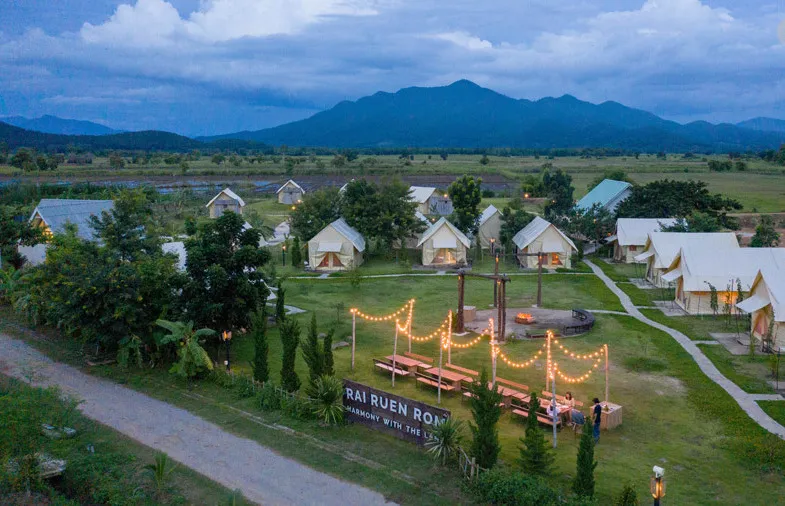
Accommodation is one of the highlights of the farm. Guests can choose between tent-style stays close to nature and air-conditioned rooms with more conventional comfort. This flexibility makes the property attractive to both adventurous travelers and those who want a gentler countryside experience. The accommodations fit the overall identity of the farm, especially through small thoughtful touches. One detail that many guests remember is the use of homemade soap and shampoo made from ingredients connected to the farm, which helps the stay feel personal and rooted in place.
Mornings at Rai Ruen Rom are especially memorable. Waking up to fresh air, open views, and the quiet sounds of the countryside creates a very different start to the day from what most people experience in urban life. It is the kind of place where a simple cup of coffee in the early light feels genuinely restorative. The atmosphere encourages slow movement: a walk through the farm, a relaxed breakfast, and time to notice the details of the landscape instead of rushing from one attraction to another.
Food is central to the experience here. Much of the produce used in the farm’s cooking comes directly from the organic fields, which means meals are tied closely to the land around them. This farm-to-table approach gives visitors a much clearer sense of what organic food really means in practice. It is not just about labels or trends, but about freshness, seasonality, and respect for ingredients. Eating at Rai Ruen Rom is therefore more than a meal stop. It becomes part of the educational and emotional experience of the visit.
The farm café adds to that appeal. Travelers can sit down for homemade-style food, drinks, and baked items in a setting that feels open and unforced. The café is an excellent place to slow down after walking around the property or joining an activity. Many visitors come away appreciating how simple ingredients, when grown and prepared with care, can create meals that are both satisfying and meaningful. That connection between landscape and food is one of the strongest reasons Rai Ruen Rom leaves such a lasting impression.
Activities at the farm help turn the visit into an experience of participation rather than passive sightseeing. Guests can learn about rice cultivation and rice milling, try tie-dye workshops, make salted eggs, feed goats and sheep, or cycle around the property. These experiences are especially valuable for families with children, but adults also enjoy them because they offer something hands-on and grounded. The activities are designed in a way that feels approachable, allowing visitors to enjoy the process without needing prior knowledge.
These workshops and farm activities also reveal an important truth about Rai Ruen Rom: it is a place where rural knowledge is treated with dignity. Everyday practices like growing rice, preserving food, or making handmade products are presented not as quaint curiosities, but as living skills with continuing relevance. For visitors from bigger cities, this can be a refreshing change of perspective. It reminds them that sustainable living is not abstract theory. It is something people can see, touch, taste, and learn from directly.
The animal feeding and cycling areas add another layer of enjoyment. Children tend to love the chance to interact with the goats and sheep, while adults often enjoy cycling slowly through the farm and taking in the broader views of the landscape. These are not dramatic activities, but that is part of their appeal. Rai Ruen Rom succeeds precisely because it does not depend on spectacle. It creates value through calm, care, and thoughtful engagement with nature.
Another point that sets the farm apart is its emphasis on sustainability in practical terms. Official information from the farm explains that alternative energy and solar power play an important role in supporting the farm’s daily operations, including the café, accommodation, and water systems. That commitment gives the destination more depth. Travelers are not only enjoying a green-looking place; they are spending time in a property that has invested in a more responsible way of operating behind the scenes as well.
Rai Ruen Rom also matters because of its relationship with the wider community. As a social enterprise, it has grown beyond the boundaries of a single farm business. It supports local livelihoods, contributes to value-added agricultural products, and promotes a broader understanding of healthy food systems and responsible tourism. This community dimension helps make the visit feel worthwhile in a deeper sense. Spending money here does not feel like consuming a rural image. It feels like supporting a model of tourism that tries to benefit both visitors and the place itself.
The farm’s atmosphere changes gently with the seasons. During the rainy season and the cooler months, the landscape is especially green and photogenic, with soft mountain views and fresh air that make walking around the property particularly enjoyable. The cool season is often the most popular time for overnight stays, but the farm can be visited year-round. Even in warmer months, its open space and slower pace make it a comfortable countryside retreat, especially for travelers who arrive in the morning or late afternoon.
For photographers and content creators, Rai Ruen Rom offers a wide visual range: green fields, farm details, homemade food, accommodation corners, workshop moments, and a broad natural backdrop. Yet the place never feels overly curated for social media. Its beauty comes from being lived-in and real. That authenticity gives images more character and makes the visit feel richer than destinations built mainly around photo spots.
Rai Ruen Rom is also a strong addition to a wider eastern Chiang Rai itinerary. Travelers can pair it with nearby cultural and natural attractions in Thoeng District, including Wat Phra That Chom Cho, scenic mountain routes toward Phu Chi Fa, and other countryside stops along the way. This makes the farm a useful anchor point for a slower, more meaningful Chiang Rai trip, especially for those who prefer a mix of nature, local culture, and practical comfort rather than a packed checklist of quick sightseeing stops.
To make the most of the visit, it is worth allowing more time than a brief stop. A half day is enough for a meal, a walk, and a little browsing, but an overnight stay offers a far fuller experience. Guests who stay longer get to enjoy the property at its calmest moments, especially early in the morning and late in the day. Comfortable clothing, easy walking shoes, and a bit of flexibility in schedule are all that is needed to enjoy the farm well.
Getting There is straightforward for travelers using a private car. From Chiang Rai city, drive toward Thoeng District and continue to Ngio Subdistrict, following the online map directly to the farm. Travel time is generally around 1.5 to 2 hours depending on your starting point and traffic conditions. Guests planning to stay overnight or join specific activities should contact the farm in advance, especially during long weekends or cooler-season travel periods.
Ultimately, Rai Ruen Rom is memorable because it gives visitors something increasingly rare: a chance to slow down without feeling bored, to eat well without fuss, and to reconnect with nature without sacrificing comfort. It is a destination where healthy food, rural knowledge, sustainability, and hospitality come together in a way that feels genuine. For anyone searching for a Chiang Rai experience built around wellness, organic living, and peaceful rest, Rai Ruen Rom is a destination well worth making time for.
| Name | Rai Ruen Rom |
| Place Summary | An organic farm, farm stay, and agritourism destination in Thoeng, Chiang Rai, focused on healthy food, countryside relaxation, learning activities, and sustainable living |
| Location | Ngio Subdistrict, Thoeng District, Chiang Rai |
| Address | 97 Moo 10, Ngio, Thoeng, Chiang Rai 57160, Thailand |
| Coordinates | 19.657521, 100.157017 |
| Highlights | Organic farm of more than 200 rai, farm café, farm stay, rice and craft workshops, goat and sheep feeding zone, wellness-oriented natural atmosphere |
| History | Established in 2014 and developed into an organic agritourism destination and social enterprise in Thoeng District |
| Name Origin | The concept reflects harmony between people, community, and nature, creating a truly “pleasant” and balanced way of living |
| Distinctive Features | Organic agriculture, farm-to-table meals, countryside accommodation, homemade products from farm ingredients, and educational activities for all ages |
| Travel Information | About 1.5 – 2 hours by private car from Chiang Rai city, driving toward Thoeng District and continuing to Ngio Subdistrict |
| Current Status | Open daily, with farm café, farm stay, organic products, and official channels for activity and accommodation inquiries |
| Open Days | Daily |
| Opening Hours | 08:00 – 17:00 |
| Fees | No entrance fee for general visits; special activities or overnight stays should be checked with the farm in advance |
| Facilities | Parking, restrooms, farm café, restaurant, farm stay, workshop space, outdoor activity areas |
| Main Areas / Zones | Organic vegetable plots, rice-learning area, farm café, farm stay zone, animal zone, workshop and activity space |
| Caretaker | Sirivimol Kitaphanich (Founder) and the Rai Ruen Rom team |
| Main Contact Number | 095-134-8821, 088-776-8473 |
| Official Website / Official Page | www.rairuenrom.com, Facebook: Rai Ruen Rom Organic Farm, Line Official: @rrr.ch |
| Nearby Tourist Attractions | 1. Wat Phra That Chom Cho, about 12 km, Tel. 053-666-449 2. Huai Tao Waterfall, Ban Mon Phaya In, about 14 km 3. Kiao Tawan Than Farm, about 18 km 4. Phu Chi Fa, about 61 km, Tel. 053-795-345 5. Doi Pha Mon Highland Agricultural Center, about 66 km |
| Nearby Restaurants | 1. Kung Phen & Coffee, about 7 km, Tel. 085-716-9955, 088-267-4743 2. Paragraph Cafe & Eatery, about 12 km, Tel. 090-096-9888 3. SAPA Cafe&Restaurant, about 13 km, Tel. 084-378-7182 4. Thung Kung Thong Prawn Kitchen, about 14 km, Tel. 097-296-4325 5. Lung Suban Kitchen Urai, about 15 km, Tel. 081-020-9259 |
| Nearby Accommodations | 1. Rai Ruen Rom Farm Stay, about 0 km, Tel. 095-134-8821, 088-776-8473 2. Sann View Hotel, about 12 km, Tel. 052-020-467, 063-202-7056 3. Happy Camp Phuchifa, about 62 km, Tel. 095-172-0522, 090-330-5131 4. Phumork Camp Phu Chi Fa, about 60 km, Tel. 081-884-1739 5. Phuthong Camp Phu Chi Fa, about 62 km, Tel. 065-485-7827 |
Frequently Asked Questions (FAQ)
Q: Who is Rai Ruen Rom suitable for?
A: It suits families, couples, friends, and travelers who enjoy nature, organic food, and quiet countryside stays.
Q: Is there an entrance fee?
A: General visits do not have an entrance fee, but special workshops or overnight stays should be arranged with the farm in advance.
Q: What kind of accommodation is available?
A: Guests can choose between tent-style stays close to nature and air-conditioned rooms with more comfort.
Q: What activities can visitors do here?
A: Popular activities include learning about rice, tie-dye workshops, salted egg making, feeding goats and sheep, and cycling around the farm.
Q: How much time should I allow for the visit?
A: A half day works for a short visit, but an overnight stay gives a much fuller experience of the farm atmosphere.
Q: Is it easy to reach from Chiang Rai city?
A: Yes. It is a straightforward drive of around 1.5 to 2 hours by private car.
 Category: ●Entertainment and Agricultural
 Group: ●Farms, Parks and Ecotourism
Last Update : 5 MonthAgo
 Last Update : 5 MonthAgo
 Click to Access the Navigation Map GPS
Rai Ruen Rom Organic Farm Map
Recommend

 Art, Culture and Heritage
 Historical Sites and Monuments(3)
 Landmarks and Memorials(7)
 Art, Craft Centres, Tradition(6)
 Museums(8)
 Historic Homes and Cities(1)
 Educational Places
 Museum for Study(1)
 Library(1)
 Educational Gardens, Farm(3)
 Places of Worship
 Temple(38)
 Other Sacred Sites(5)
 Research and Development
 Royal Project(9)
 Suburban Living
 Village, Community(16)
 Local Market(5)
 Nature and Wildlife
 National Parks and Marine Reserves(18)
 Mountain (Doi)(20)
 Dam, Reservoir, Lake(8)
 Waterfalls(16)
 Hot Springs(6)
 Caves(8)
 River, Canal(10)
 Sea, Beach(1)
 Other natural attractions(3)
 Animal camps and shows(1)
Farms, Parks and Ecotourism(9)
Animal camps and shows(1)
Farms, Parks and Ecotourism(9)
 Shopping
 Shopping and Night Market(2)
 Call Customer Service in Tourism
 Call Customer Service in Tourism(1)
 Travel Articles, Recipes
 Travel Review, Food Review(1)
 Food Menu, North Recipes(1)


