
lovethailand home >Central Travel Attractions >Bangkok Travel Attractions >Bang Kapi >Hua Mak > Ramkhamhaeng University
TL;DR: Ramkhamhaeng University, Bangkok attractions : University, Public university.
Ramkhamhaeng University
Open Days: Monday – Friday (University Administrative Offices, Except Public and University Holidays)
Opening Hours: 08:30 – 16:30 (Administrative Office Hours, Not General Access Hours for Every Campus Facility)
Ramkhamhaeng University (RU) is a public university in Bangkok widely recognized for its commitment to expanding access to higher education through Thailand's talat wicha, or open academic marketplace, system. Its main campus is located on Ramkhamhaeng Road in Hua Mak, Bang Kapi, Bangkok 10240. The university was established under the Ramkhamhaeng University Act B.E. 2514 (1971) to address the shortage of university places and create opportunities for people who could not gain admission to conventional limited-enrollment universities. November 26 is celebrated as the university's annual foundation anniversary, commemorating the royal inauguration of the King Ramkhamhaeng the Great Monument and the presentation of degrees to the university's first graduates in 1975. The institution approaches its 55th anniversary in November 2026 and continues to serve students of different ages, educational backgrounds, and professional circumstances. Its educational network includes the Hua Mak main campus, a second campus in Bang Na, regional academic service branches, and learning systems supported by educational technology.
Ramkhamhaeng University is particularly distinctive because its educational philosophy emphasizes access rather than making competitive university admission the principal barrier to learning. Many of its open-program students can organize their studies around work, family responsibilities, or other commitments. This has made the university an important option for recent secondary-school graduates, employed adults, self-employed individuals, people returning to education, and graduates seeking an additional degree or professional knowledge.
The Hua Mak campus is commonly called Ramkhamhaeng 1, or Ram 1, to distinguish it from the university's Bang Na campus, generally known as Ramkhamhaeng 2. The main campus contains substantial academic buildings, faculty offices, the Central Library, the Office of the Rector, student-service facilities, and major assembly spaces. Its most recognizable historical landmark is the King Ramkhamhaeng the Great Monument, which occupies an important place in the university community's ceremonies and shared identity.
Hua Mak is one of Bangkok's busy educational, commercial, residential, and sporting districts. Ramkhamhaeng Road connects the neighborhood with major routes including Rama IX Road, Lat Phrao Road, and Srinagarindra Road. Around the university are bookstores, food stalls, restaurants, accommodation, shopping facilities, and transport services that have developed alongside the student population. The surrounding neighborhood is closely associated with the everyday experience of studying at one of Thailand's best-known open universities.
Before Ramkhamhaeng University was established, Thailand faced a substantial shortage of places in higher education. The number of secondary-school graduates had increased, but the capacity of public universities remained limited. Consequently, many qualified young people could not continue their education. People already in employment faced additional obstacles because conventional full-time university programs generally required regular attendance at fixed times and locations.
These circumstances encouraged legislators, educators, and government officials to consider a different model of higher education. The objective was to establish a public university capable of admitting qualified students without restricting total enrollment in the same way as traditional limited-admission institutions. This approach emphasized personal responsibility, independent study, and assessment of acquired knowledge rather than making a competitive entrance examination the defining feature of access to education.
Proposals for the new university moved through the legislative process during 1970 and 1971. Professor Dr. Sak Phasukniran was among the important figures involved in preparing its academic and administrative foundations and later became the university's first rector. The establishment of Ramkhamhaeng University was a collective public initiative involving the government, legislators, and educational specialists who sought to address a major social need.
The Ramkhamhaeng University Act B.E. 2514 provided the legal foundation for the institution. The law was signed on February 26, 1971, and published in the Royal Gazette on March 2, 1971. The university began teaching in the same year, adopting a system intended to make higher education available to a much larger number of qualified students than conventional restricted-admission arrangements would have allowed.
The university's first premises were in the former international trade fair exhibition buildings in Hua Mak. The complex initially served as a temporary educational site. The government subsequently approved approximately 300 rai of land in the area for the university's permanent development. The transformation of the site into a large higher education institution contributed significantly to the growth of Hua Mak as a university district, encouraging the expansion of housing, transport services, shops, restaurants, and other facilities.
Ramkhamhaeng University opened with four faculties: Law, Business Administration, Humanities, and Education. These fields reflected the country's demand for legal knowledge, administrative skills, language studies, and educators. A total of 37,198 students enrolled in the first intake, demonstrating the considerable demand for wider access to university education and the relevance of the institution's founding mission.
The open academic marketplace model allowed students to learn through lectures, textbooks, course materials, and independent study. For many open-program learners, attendance at every lecture was not the sole measure of academic participation; knowledge could be developed through personal study and assessed through scheduled examinations. This arrangement expanded the meaning of university education beyond the conventional experience of studying full-time immediately after secondary school.
During the first years of operation, Ramkhamhaeng University had to develop academic registration, teaching materials, examination arrangements, and student-service systems capable of supporting exceptionally large student numbers. These requirements helped shape its approach to educational administration and contributed to the development of distance-learning methods and large-scale information services in later decades.
November 26, 1975, is one of the most important dates in the university's history. On that day, King Bhumibol Adulyadej and Queen Sirikit visited the Hua Mak campus to inaugurate the King Ramkhamhaeng the Great Monument. The King also conferred degrees on the university's first graduates. The event became so significant to the institution that November 26 was adopted as its annual foundation anniversary, even though its legal establishment had taken place earlier in 1971.
The royal ceremony strengthened the connection between the university's name, its institutional identity, and the historical figure of King Ramkhamhaeng the Great. The monument became more than an artistic landmark: it serves as a site for commemorations, traditional observances, and activities expressing the university community's sense of belonging. Generations of students and alumni associate the monument with important moments in their educational journeys.
As demand for higher education continued to increase, Ramkhamhaeng University expanded its range of academic disciplines. Faculties and programs developed in science, political science, economics, mass communication, engineering, fine arts, human resource development, public health, and optometry. These additions transformed the university from an institution addressing immediate educational shortages into a large public university offering diverse academic and professional pathways.
Growing enrollment also made additional teaching and examination space necessary. The university developed its Bang Na campus, commonly called Ramkhamhaeng 2, in the Bang Na–Trat Road area of Prawet district. This site supports academic and examination activities according to university schedules. Students must distinguish carefully between Ram 1 and Ram 2, as the two campuses are in different parts of Bangkok and may be assigned different teaching or examination functions.
Ramkhamhaeng University further expanded educational access through regional academic service branches known as Sakhawitthayaborikan Chaloem Phrakiat. These branches provide educational services in provinces outside Bangkok, making university study more practical for people who cannot relocate. Such opportunities are particularly valuable for working adults and learners with family or professional commitments in their home communities.
The university also extends educational opportunities to Thai citizens living overseas through academic service arrangements and distance-supported programs. Selected qualifications can be pursued through educational pathways designed for international locations, with examinations and administrative requirements determined by the relevant projects. These services contribute to lifelong learning among Thai communities beyond the country's borders.
The university's legal and administrative development has been governed by the Ramkhamhaeng University Act B.E. 2514 and the subsequent Ramkhamhaeng University Act B.E. 2541 (1998). Ramkhamhaeng remains a public university with responsibilities in teaching, research, academic services, and cultural activities. Its legal and administrative status should be distinguished from that of autonomous public universities governed under different institutional legislation.
In 2026, the university is administered by Assistant Professor Wutthisak Lapcharoensap in the capacity of Acting Rector. University operations include admissions, teaching, examinations, student information, graduate education, research, and public academic services. Administrative units such as the registration and evaluation services, Central Library, educational technology offices, and academic faculties collectively support the institution's large student community.
From late September to early October 2026, Ramkhamhaeng University experienced serious flooding that affected academic buildings and infrastructure. Recovery activities included cleaning, inspections, and the restoration of essential services. The university announced the resumption of teaching on October 5, 2026, and confirmed that scheduled final examinations would proceed. The incident highlighted the importance of campus resilience, safety inspections, and continuity planning within a large educational institution.
The university takes its name from King Ramkhamhaeng the Great of the Sukhothai Kingdom. He occupies an important place in traditional Thai historical accounts, particularly through the association with the development of early Thai writing recorded in the famous Sukhothai Inscription No. 1. Naming the university after the monarch expresses the institution's respect for language, knowledge, cultural heritage, and intellectual development.
The King Ramkhamhaeng the Great Monument is the most prominent cultural landmark on the Hua Mak campus. The seated bronze figure holds a writing tablet and stands on an elevated monument surrounded by landscaped grounds. It has become one of the university's defining images and an important setting for ceremonial gatherings. Visitors interested in Thai educational heritage may find the monument a particularly meaningful place to begin learning about the institution.
The university's official emblem incorporates the image of King Ramkhamhaeng the Great, reflecting his historical association with governance, language, and cultural learning. Its official colors are blue and gold. Blue is associated with the monarchy, while gold represents the prosperity traditionally connected with the Sukhothai period under King Ramkhamhaeng. The colors appear in institutional symbols, ceremonies, academic activities, and materials associated with student and alumni life.
The university's symbolic tree is Suphannika, also known as Fai Kham, a flowering tree distinguished by its bright golden-yellow blossoms. Princess Maha Chakri Sirindhorn bestowed Suphannika as the university's symbolic tree in 1999. The tree is therefore both a natural symbol and an important connection between the university's institutional memory and royal patronage.
The philosophy of Knowledge with Morality, expressed in Thai as Khwam Ru Khu Khunnatham, is central to Ramkhamhaeng University's educational identity. It reflects the view that widening access to knowledge must be accompanied by responsibility, ethical judgment, and personal discipline. This principle is particularly relevant to independent study, where students must organize their own learning, manage time carefully, and act honestly in academic assessment.
The university's annual foundation celebration on November 26 involves activities connected with institutional history and commemorations at the King Ramkhamhaeng Monument. The occasion provides an opportunity for current students, alumni, and staff to reflect on the university's role in widening access to higher education and to recognize the achievements of its community over successive generations.
King Ramkhamhaeng the Great Day, observed on January 17, is another date with significance for the university's historical identity. Activities may include ceremonies honoring the king and cultural presentations organized by university units. These observances connect the university community with the history of Sukhothai, the Thai language, and the cultural figure after whom the institution is named.
Student life at Ramkhamhaeng University has a distinctive character because learners come from varied age groups and occupational backgrounds. Recent school graduates study alongside employees, civil servants, entrepreneurs, and adults returning to education. This diversity creates opportunities for people with different experiences to study common subjects, exchange ideas, and develop knowledge for purposes ranging from professional development to personal interest.
The Pre-Degree system is another distinguishing feature. It enables eligible learners, generally beginning after completion of lower secondary education, to study selected university-level courses in advance. Credits earned under the applicable conditions may later be transferred toward a bachelor's degree after the student obtains the required qualification and enrolls in a full degree program. This model provides an opportunity for motivated learners to begin planning their university education at an earlier stage.
Credit-transfer arrangements are also important for students who have completed university courses elsewhere or possess previous recognized academic qualifications. The university assesses transfer requests according to the rules of the relevant faculty and curriculum. Eligible students may therefore be able to reduce unnecessary repetition of previously completed coursework while working toward their chosen qualification.
Educational technology has supported the university's mission for many years. Teaching materials, recorded lectures, online information, digital academic resources, registration systems, and electronic student services have contributed to flexible access to learning. Certain assessment services also use digital technology. These developments help support large numbers of students and reduce some of the geographical and scheduling limitations associated with traditional classroom-based study.
The Central Library is an important facility for independent study and academic research. It provides books, textbooks, journals, electronic resources, and information services covering a broad range of disciplines. The university also maintains digital archival resources relating to its institutional history. Access to library collections helps students supplement lectures and course materials with further reading and scholarly research.
King Ramkhamhaeng the Great Auditorium is another important university facility. It accommodates ceremonies, meetings, lectures, conferences, and cultural events. Activities organized by the university's demonstration schools and academic departments have also taken place there. The auditorium's role illustrates how campus facilities can support formal education alongside community and cultural programming.
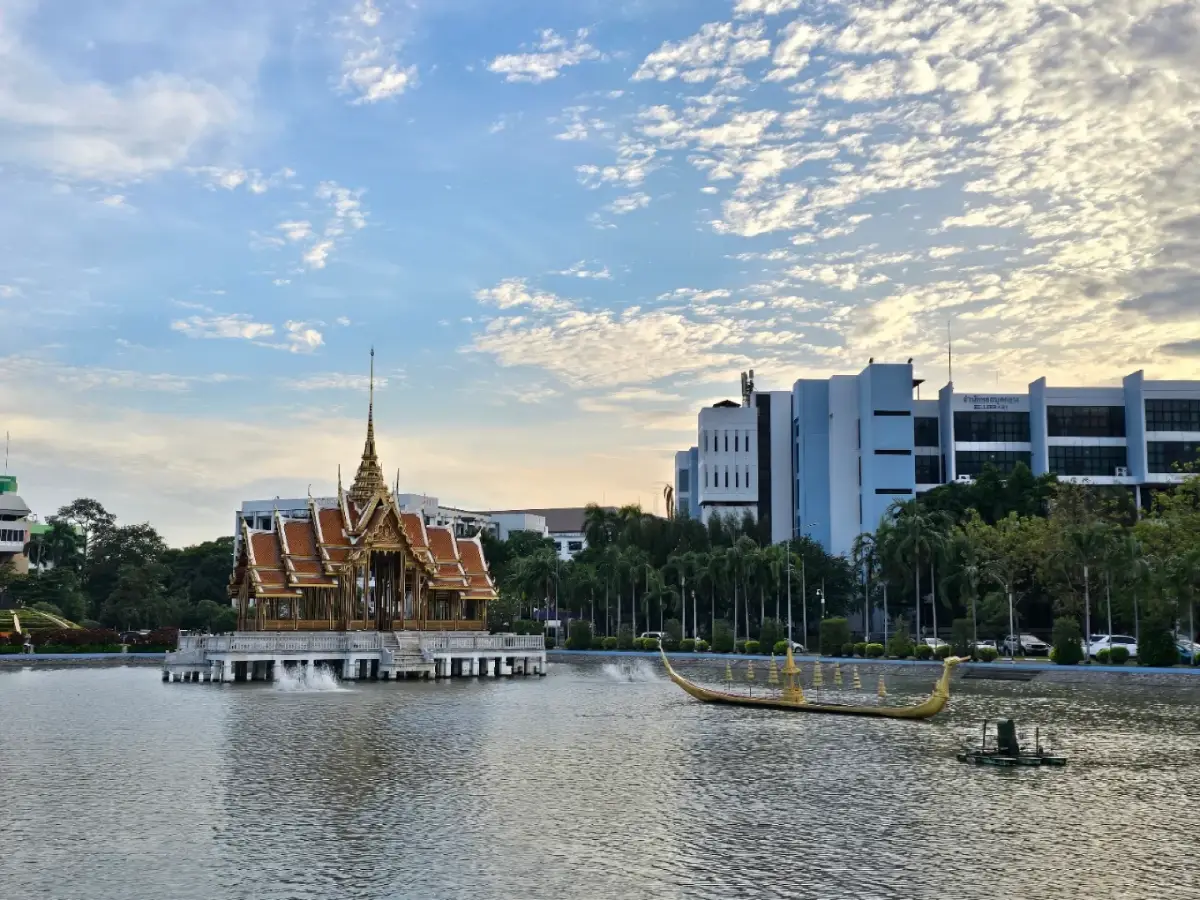
The central pond and surrounding landscaped areas are familiar features of the Hua Mak campus. Traditional Thai architectural elements and open-water spaces provide a visual contrast with the modern academic buildings nearby. These areas have appeared in photographs of university life across different periods and contribute to the campus's recognizable physical identity.
Buildings associated with the Faculty of Humanities, Faculty of Education, Faculty of Science, and the Sukhothai Building used by the Faculty of Mass Communication accommodate academic teaching and administrative functions. Because Ramkhamhaeng University has numerous buildings and service points, visitors should confirm the exact building name and location before arriving for examinations, appointments, or university business.
The Ramkhamhaeng University Demonstration Schools are associated with the university's educational activities at Hua Mak. They provide basic education and support the academic mission of the Faculty of Education through opportunities connected with teacher development, educational research, and professional experience. The schools therefore serve both younger learners and the university's broader work in improving educational practice.
Academically, Ramkhamhaeng University is particularly well known for law, political science, business administration, humanities, education, economics, mass communication, and human resource development. Many students choose these fields to improve professional qualifications, acquire knowledge relevant to their existing employment, or prepare for future career opportunities in the public or private sectors.
The Faculty of Law is one of the university's original four faculties. Its educational activities cover major areas of legal knowledge, including civil law, criminal law, public law, business law, and the justice system. Legal education is valuable for people pursuing legal professions, public administration, and work requiring an understanding of rights, responsibilities, regulations, and legal institutions.
The Faculty of Political Science offers education in government, international relations, and public administration. These areas provide foundations for careers in public agencies, local government, international organizations, and policy-related work. Different study plans allow learners to develop knowledge appropriate to their interests in political systems, diplomacy, administration, and public affairs.
The Faculty of Business Administration offers fields related to management, accounting, finance, marketing, and organizational operations. Its programs help students understand planning, resource allocation, financial analysis, business strategy, organizational behavior, and the changing demands of modern commerce.
The Faculty of Humanities offers academic study in languages, literature, history, philosophy, and cultural disciplines. These fields develop communication, interpretation, and analytical thinking. The Faculty of Education focuses on teaching, educational psychology, administration, and learning technologies. Some education programs have requirements linked to professional standards or specialized admission arrangements and should not automatically be treated as unrestricted open-enrollment programs.
The Faculty of Science provides education in foundational and applied scientific subjects, including mathematics, statistics, computing, and other scientific disciplines. The Faculty of Economics addresses economic systems, production, consumption, markets, public policy, and financial decision-making. Together, these fields equip students to analyze practical problems in business, government, and society.
The Faculty of Mass Communication has developed academic work relating to communication and digital media. Its curriculum connects content production, media technologies, organizational communication, and audience behavior. The Faculty of Human Resource Development addresses adult learning, training, personnel management, and the development of human capabilities within organizations.
Ramkhamhaeng University also maintains specialized faculties and programs in engineering, fine arts, public health, optometry, and nursing. These fields may have admission conditions and academic arrangements that differ from those of the university's general open-enrollment system. Professional standards, laboratory work, practical training, and faculty-specific selection requirements are especially important considerations for applicants interested in these areas.
For the 2026 academic year, the university announced regular undergraduate admissions in Bangkok through nine faculties: Law, Business Administration, Humanities, Education, Science, Political Science, Economics, Mass Communication, and Human Resource Development. Regular regional undergraduate admissions covered selected programs administered through Law, Business Administration, Political Science, and Mass Communication.
Applications for selected undergraduate programs may be submitted online, by post, or in person during designated admissions periods. The Pre-Degree and credit-transfer systems provide additional educational options. Applicants should carefully review each program's requirements, teaching location, examination schedule, and admission conditions because not all faculties or professional programs operate under identical arrangements.
Graduate studies at Ramkhamhaeng University include master's and doctoral education in several disciplines, such as law, political science, business administration, educational administration, science, human resource development, and other specialized academic fields. Depending on the program, teaching may take place during working hours, in the evening, on weekends, or under arrangements intended for employed professionals.
Research and academic work at the university address law, public administration, economics, society, education, communication, technology, and human resource development. These fields contribute to scholarly understanding of public institutions, social change, organizational management, and contemporary educational needs. Seminars, conferences, and academic publications help connect university research with professional communities and wider public discussion.
Ramkhamhaeng University's public-service role is closely connected to lifelong learning. Its educational model allows people to return to higher education at different stages of life, whether to gain additional qualifications, study a new discipline, or improve knowledge relevant to their employment. This flexibility remains one of the university's most significant contributions to reducing barriers to higher education in Thailand.
The university has maintained a long relationship with the surrounding Hua Mak community. Shops selling textbooks and educational supplies, photocopying services, affordable restaurants, cafés, accommodation, and local markets have developed to meet student needs. Ramkhamhaeng Road is therefore not simply the location of a university; it is part of a broader educational neighborhood shaped by the daily movement of students, staff, and local residents.
Local markets near the university and the Sports Authority of Thailand offer an additional dimension of neighborhood life. The Ramkhamhaeng Night Market and the SAT Market provide food, drinks, clothing, and everyday goods. These markets are popular among people living, studying, and working in the area and help visitors understand the atmosphere of this busy eastern Bangkok district.
For educational tourism, the main campus is especially relevant to visitors interested in the history of higher education in Thailand. The King Ramkhamhaeng Monument, university historical narratives, and the experience of a large public open university illustrate how higher education developed in response to social needs during the twentieth century.
Nearby attractions and leisure facilities include Rajamangala National Stadium, Hua Mak Indoor Stadium, Wat Thepleela, local markets, and shopping centers along Ramkhamhaeng Road. Together, they demonstrate the district's connections with education, sport, religion, commerce, and community life. Access to stadium interiors and event spaces depends on individual event schedules and operator regulations.
First-time visitors should confirm whether their appointment, examination, or class takes place at Ramkhamhaeng 1 in Hua Mak or Ramkhamhaeng 2 in Bang Na. The campuses occupy different parts of Bangkok, and the university has numerous buildings and examination venues. Checking the official building name, room number, and schedule before traveling is essential.
Getting There to the Hua Mak campus is possible by public buses traveling along Ramkhamhaeng Road. Routes historically serving the area include buses numbered 40, 58, 71, 92, 113, 126, 137, and 168. Travelers should check current route designations and services before departure because Bangkok's bus network has undergone route and operational changes. From the bus stops near the university, visitors can continue on foot to the appropriate campus entrance.
Travelers using the Airport Rail Link can get off at Ramkhamhaeng Station and continue to the university by public bus, taxi, or other local transportation. The Airport Rail Link station is not located directly at the university entrance, so additional travel time is necessary. Other urban rail services can be combined with transport connections toward Ramkhamhaeng Road where appropriate.
The Saen Saep Canal boat service provides another option for travelers approaching from districts connected to the canal. Passengers may use an operating pier in the Ramkhamhaeng area and continue to the campus on foot or by local transportation. Boat routes, stopping points, and timetables should be checked before traveling because service arrangements may change.
Visitors arriving by private car can navigate to Ramkhamhaeng University, Hua Mak, on Ramkhamhaeng Road in Bang Kapi district. The campus can be approached through the road network connected with Rama IX Road and nearby districts. Traffic may be heavy during rush hours, university examinations, and major concerts or sporting events at Rajamangala National Stadium. Drivers should follow university parking rules and confirm the appropriate entrance for their destination.
Academic groups requesting tours or access to particular buildings should contact the responsible university departments in advance. Classrooms, examination halls, libraries, administrative offices, and specialized teaching facilities have their own operating arrangements. General access to campus grounds does not automatically authorize entry into every academic building or facility.
Throughout its development, Ramkhamhaeng University has demonstrated that higher education can be organized to serve a broader section of society. Its open academic marketplace, Pre-Degree system, credit-transfer arrangements, regional branches, and technology-supported services reflect an institutional mission aimed at making learning more accessible beyond conventional full-time education.
As Ramkhamhaeng University approaches its 55th foundation anniversary on November 26, 2026, it remains important to Thailand's educational and social development. The university is more than a large campus in Hua Mak: it represents a lasting effort to expand educational opportunity, support lifelong learning, and connect people of different ages, professions, and backgrounds through higher education.
| University Name | Ramkhamhaeng University (RU) |
| Thai Name | มหาวิทยาลัยรามคำแหง |
| University Type | Public University With an Open Academic Marketplace Model |
| Main Campus Location | Hua Mak, Bang Kapi, Bangkok, Thailand |
| Address | 282 Ramkhamhaeng Road, Hua Mak, Bang Kapi, Bangkok 10240, Thailand |
| Year Established | 1971 |
| Founding Legislation | Ramkhamhaeng University Act B.E. 2514, Published in the Royal Gazette on March 2, 1971 |
| Annual Foundation Anniversary | November 26 |
| 55th Anniversary | November 26, 2026 |
| Key Founding Contributors | Government Officials, Legislators, and Educators, Including Professor Dr. Sak Phasukniran |
| First Rector | Professor Dr. Sak Phasukniran |
| Acting Rector | Assistant Professor Wutthisak Lapcharoensap (2026) |
| Name Origin | Named After King Ramkhamhaeng the Great of the Sukhothai Kingdom |
| University Symbol | King Ramkhamhaeng the Great |
| University Colors | Blue and Gold |
| University Tree | Suphannika (Fai Kham) |
| University Philosophy | Knowledge With Morality |
| Educational Strengths | Open Enrollment in Eligible Programs, Independent Study, Pre-Degree, Credit Transfer, and Regional Education |
| Original Faculties | 1. Faculty of Law 2. Faculty of Business Administration 3. Faculty of Humanities 4. Faculty of Education |
| Regular Bangkok Undergraduate Admissions, 2026 | 1. Faculty of Law 2. Faculty of Business Administration 3. Faculty of Humanities 4. Faculty of Education 5. Faculty of Science 6. Faculty of Political Science 7. Faculty of Economics 8. Faculty of Mass Communication 9. Faculty of Human Resource Development |
| Special-Program Faculties Publicized in 2026 | Faculty of Engineering, Faculty of Fine and Applied Arts, Faculty of Public Health, Faculty of Optometry, and Faculty of Nursing |
| Educational Locations | Hua Mak Campus (Ram 1), Bang Na Campus (Ram 2), and Regional and Overseas Academic Service Branches |
| Important Campus Landmarks | 1. King Ramkhamhaeng the Great Monument 2. King Ramkhamhaeng the Great Auditorium 3. Central Library 4. Sukhothai Building 5. Faculty of Education Buildings 6. Faculty of Humanities Buildings 7. Central Campus Pond and Landscaped Grounds 8. Ramkhamhaeng University Demonstration Schools |
| Major Events | Foundation Anniversary on November 26, King Ramkhamhaeng the Great Day on January 17, Student Orientation, Conferences, and Cultural Activities |
| Academic Fields | Law, Political Science, Business Administration, Humanities, Education, Science, Economics, Mass Communication, and Human Resource Development |
| Administrative Office Days | Monday – Friday, Except Public and University Holidays |
| Administrative Office Hours | 08:30 – 16:30 |
| Visitor Access | Access to Campus Buildings, Libraries, Examination Areas, and Event Facilities Is Subject to University Regulations |
| Facilities | Central Library, Textbook Services, Food Courts, Auditoriums, Student-Service Areas, and Parking Subject to University Regulations |
| Transportation | Public Buses on Ramkhamhaeng Road, Airport Rail Link to Ramkhamhaeng Station With Onward Transport, Saen Saep Canal Boats, Taxi, and Private Car |
| Nearby Attractions | 1. Rajamangala National Stadium 2. Hua Mak Indoor Stadium 3. Wat Thepleela 4. Ramkhamhaeng Night Market / SAT Market 5. The Mall Ramkhamhaeng 6. The Nine Center Rama 9 |
| Nearby Restaurants | 1. Shabubomb Ramkhamhaeng, Tel. +66 95 823 6815 2. Kang Pa Ramkhamhaeng 24, Tel. +66 80 802 7002 3. YAWA Modern Japanese Cuisine, Tel. +66 88 109 8000 4. Nuea Phung Tai Ramkhamhaeng, Tel. +66 95 978 6680 5. Samran Rom Ramkhamhaeng, Tel. +66 96 196 6369 |
| Nearby Accommodation | 1. Regent Ramkhamhaeng 22, Tel. +66 2 318 4440 2. JL Bangkok, Tel. +66 85 075 2556 3. The Quarter Ramkhamhaeng by UHG, Tel. +66 2 090 3999 4. Witz Bangkok Ramkhamhaeng 5. Madison Bangkok Hotel 6. S Ram Leisure Hotel, Tel. +66 2 374 0093 |
| University Telephone | +66 2 310 8000 |
| Faculty of Mass Communication Telephone | +66 2 310 8980 |
| Official Website | https://www.ru.ac.th/ |
| Admissions and Registration Website | https://iregis2.ru.ac.th/ |
| Current Status | Operating as a Public University Offering Open-Access and Specialized Academic Programs Across Multiple Educational Locations |
Academic Programs and Fields of Study at Ramkhamhaeng University, Academic Year 2026
| Faculty / Study Category | Programs and Fields of Study |
| Faculty of Law | Regular Bachelor's Degree, Bangkok and Regional Programs 1. Bachelor of Laws Graduate Studies 1. Master of Laws |
| Faculty of Business Administration | Regular Bachelor's Degree, Bangkok 1. Bachelor of Business Administration in Management 2. Bachelor of Business Administration in Marketing 3. Bachelor of Business Administration in Finance and Banking 4. Bachelor of Accountancy Regional Program 1. Bachelor of Business Administration in Management Graduate Studies 1. Master of Business Administration (MBA) |
| Faculty of Humanities | Regular Bachelor's Degree, Bangkok 1. Bachelor of Arts in Thai 2. Bachelor of Arts in English 3. Bachelor of Arts in History 4. Bachelor of Arts in Philosophy 5. Bachelor of Arts in Chinese 6. Bachelor of Arts in Japanese |
| Faculty of Education | Regular Bachelor's Degree, Bangkok 1. Bachelor of Arts in Digital Technology and Learning Innovation 2. Education and Learning Development Programs Offered by the Faculty Graduate Studies 1. Master of Education in Educational Administration |
| Faculty of Science | Regular Bachelor's Degree, Bangkok 1. Bachelor of Science in Mathematics 2. Bachelor of Science in Statistics 3. Bachelor of Science in Computer Science 4. Bachelor of Science in Physics 5. Bachelor of Science in Chemistry 6. Bachelor of Science in Biology |
| Faculty of Political Science | Regular Bachelor's Degree, Bangkok 1. Bachelor of Political Science, With Study Plans in Government, International Relations, and Public Administration Regional Program 1. Bachelor of Political Science, Public Administration Major Graduate Studies 1. Master of Political Science 2. Doctor of Philosophy in Public Administration |
| Faculty of Economics | Regular Bachelor's Degree, Bangkok 1. Bachelor of Economics Graduate Studies 1. Master of Economics |
| Faculty of Mass Communication | Regular Bachelor's Degree, Bangkok and Regional Programs 1. Bachelor of Arts in Communication and Digital Media |
| Faculty of Human Resource Development | Regular Bachelor's Degree, Bangkok 1. Undergraduate Program in Human Resource Development |
| Faculty of Engineering | Special and Graduate Programs 1. Engineering Degree Programs Subject to Faculty Admission Announcements 2. Master of Engineering in Engineering and Technology Management |
| Faculty of Fine and Applied Arts | Special Programs 1. Fine and Applied Arts Programs Subject to Faculty Admission Announcements |
| Faculty of Public Health | Special and Graduate Programs 1. Public Health Programs Subject to Faculty Admission Announcements 2. Master of Public Health |
| Faculty of Optometry | Professional Degree 1. Doctor of Optometry |
| Faculty of Nursing | Professional Bachelor's Degree 1. Bachelor of Nursing Science |
| Faculty of Hospitality Business | Specialized Academic Unit Offering Hospitality Business Education Under Faculty-Specific Curriculum and Admission Arrangements |
| Graduate School | Central Unit Supporting Master's and Doctoral Education in Cooperation With the University Faculties and Academic Projects |
| Pre-Degree System | Advance Study of Selected Undergraduate Courses for Credit Accumulation Under University Regulations |
Frequently Asked Questions (FAQ)
Q: Where is Ramkhamhaeng University located?
A: Ramkhamhaeng University's main campus is on Ramkhamhaeng Road in Hua Mak, Bang Kapi, Bangkok 10240, Thailand. It is commonly called Ramkhamhaeng 1 or Ram 1.
Q: When was Ramkhamhaeng University founded, and when is its anniversary?
A: The university was established under the Ramkhamhaeng University Act of 1971. Its annual foundation anniversary is celebrated on November 26, and its 55th anniversary falls on November 26, 2026.
Q: Who founded Ramkhamhaeng University?
A: The university was established through the efforts of government officials, legislators, and educators. Professor Dr. Sak Phasukniran played an important part in its academic preparation and became its first rector.
Q: What are Ramkhamhaeng University's opening days and hours?
A: University administrative offices generally operate Monday through Friday from 08:30 to 16:30, except on public and university holidays. Teaching, examinations, libraries, and individual student services may follow different schedules.
Q: Is Ramkhamhaeng University an open university?
A: Ramkhamhaeng University is a public university using an open academic marketplace model. Eligible applicants can enter many open programs without competing for a limited number of places, while certain professional and special programs have separate admission requirements.
Q: What is the Ramkhamhaeng Pre-Degree system?
A: Pre-Degree enables eligible learners to study selected undergraduate courses before entering a full degree program. Credits may later be transferred toward a bachelor's degree when the student meets the relevant admission and academic requirements.
Q: What is the difference between Ramkhamhaeng 1 and Ramkhamhaeng 2?
A: Ramkhamhaeng 1 is located in Hua Mak, Bang Kapi, while Ramkhamhaeng 2 is located in the Bang Na–Trat Road area of Prawet district. Teaching and examination venues differ, so students should always verify their assigned campus.
Q: How can I get to Ramkhamhaeng University in Hua Mak?
A: Visitors can take public buses serving Ramkhamhaeng Road, use the Airport Rail Link to Ramkhamhaeng Station and continue by local transport, travel by Saen Saep Canal boat, or arrive by taxi or private car.
 Category: ●University
 Group: ●Public university
Last Update : 1 WeekAgo
 Last Update : 1 WeekAgo
 Click to Access the Navigation Map GPS
Ramkhamhaeng University Map
Recommend

 Art, Culture and Heritage
 Historical Sites and Monuments(3)
 Landmarks and Memorials(23)
 Royal Palace(13)
 Art, Craft Centres, Tradition(35)
 Museums(59)
 Historic Homes and Cities(3)
 Art Gallery(16)
 Educational Places
 Museum for Study(6)
 Library(4)
Public university(8)
 Autonomous Universities(8)
 Rajamangala University of Technology(6)
 Rajabhat University(6)
 Private University(22)
 Places of Worship
 Temple(72)
 Church(2)
 Mosque(67)
 Other Sacred Sites(8)
 Research and Development
 Royal Project(1)
 Suburban Living
 Village, Community(5)
 Local Market(9)
 Floating Market(2)
 Nature and Wildlife
 River, Canal(3)
 Bays and Beaches(1)
 Other natural attractions(1)
 Entertainment and Agricultural
 Zoos and Aquariums(5)
 Animal camps and shows(5)
 Stadium(9)
 Farms, Parks and Ecotourism(20)
 Amusement Park(1)
 Waterpark(4)
 Theater(7)
 Cinema(1)
 Shopping
 Shopping and Night Market(20)
 Department Store(7)
 Spas and Wellness
 Spas and Wellness(1)
 Restaurant
 Michelin Star(5)
 Accommodation
 Hotel(3)
 Call Customer Service in Tourism
 Call Customer Service in Tourism(1)
 Travel Articles, Recipes
 Travel Review, Food Review(43)
 Royal Thai Desserts and Recipes(56)


