
lovethailand home >Central Travel Attractions >Bangkok Travel Attractions >Bangkok Noi >Arun Amarin > Wat Suwan Khiri
TL;DR: Wat Suwan Khiri is located at Rung Pracha Road, Arun Amarin Subdistrict, Bangkok Noi District, Bangkok, Near Khlong Chak Phra Junction And Khlong Bangkok Noi, open Daily, hours 08.00 – 17.00.
Wat Suwan Khiri
Open Days: Daily
Opening Hours: 08.00 – 17.00
Wat Suwan Khiri, also known by its old local name Wat Khi Lek, is an ancient canal-side Buddhist temple in Bangkok Noi, Bangkok. Located on Rung Pracha Road near the Khlong Chak Phra junction and Khlong Bangkok Noi, the temple is an important religious and cultural site on the Thon Buri side of the city. Its value comes from several layers of history: its origin in a grove of khi lek trees, its foundation traditionally dated to around B.E. 2228 in the late reign of King Narai the Great, its major restoration in the early Rattanakosin period by Somdet Krom Phra Ratchawang Bowon Maha Surasinghanat, and its continuing role as a community temple and meditation center. Visitors can pay respect to the large laterite principal Buddha image, see the ordination hall, observe the canal-side setting, and connect the temple with other historic sites in Bangkok Noi.
Wat Suwan Khiri is located at 796 Rung Pracha Road, Arun Amarin Subdistrict, Bangkok Noi District, Bangkok 10700. Older sources also connect the area with Bang Khun Non and the Khlong Chak Phra junction. The temple stands on lowland beside Khlong Bangkok Noi and is surrounded by water channels, with Khlong Bangkok Noi on the western side. This setting gives Wat Suwan Khiri the clear identity of an old canal-side temple. Although the surrounding area has become a dense urban neighborhood with roads, houses, schools, and public facilities, the temple still preserves its connection with the waterways that shaped Bangkok Noi’s early settlement and community life.
The history of Wat Suwan Khiri is traditionally traced to around B.E. 2228, in the late reign of King Narai the Great. The temple was originally called Wat Khi Lek. Local tradition says that a wandering forest monk set up his umbrella tent in an area where many khi lek trees grew, and villagers later helped establish a temple there. The old name therefore records both the natural landscape and the faith of the early local community. Over time, the temple declined and was later restored in a major rebuilding around B.E. 2338 by Somdet Krom Phra Ratchawang Bowon Maha Surasinghanat. After this restoration, the temple received the new name Wat Suwan Khiri.
The name Suwan Khiri gives the temple a more formal and auspicious identity. Suwan means gold or prosperity, while khiri means mountain. Together, the name suggests a sacred and stable place of merit. Even so, the old name Wat Khi Lek remains important because it preserves the memory of the original landscape and the tree grove associated with the temple’s foundation. The 2 names work together: Wat Khi Lek reflects local geography and community memory, while Wat Suwan Khiri reflects restoration, patronage, and the temple’s later formal identity in the Rattanakosin period.
Wat Suwan Khiri received its consecrated boundary around B.E. 2228, with the ordination boundary measuring 26 meters wide and 40 meters long. This is important because the consecrated boundary defines the sacred area for key monastic ceremonies, especially ordination and formal Sangha acts. The existence of this boundary from the early history of the temple shows that Wat Suwan Khiri was not merely a temporary monastic shelter. It became an established Buddhist temple with religious status and a long-standing role in the community.
Another important historical event took place on 22 October B.E. 2472, when King Prajadhipok, Rama VII, personally presented a royal Kathin robe at Wat Suwan Khiri. This event adds historical significance to the temple because it shows that the temple’s importance extended beyond the local canal-side community. The royal Kathin record connects the temple with Rattanakosin royal patronage and gives Wat Suwan Khiri a broader historical presence within Bangkok’s Buddhist landscape.
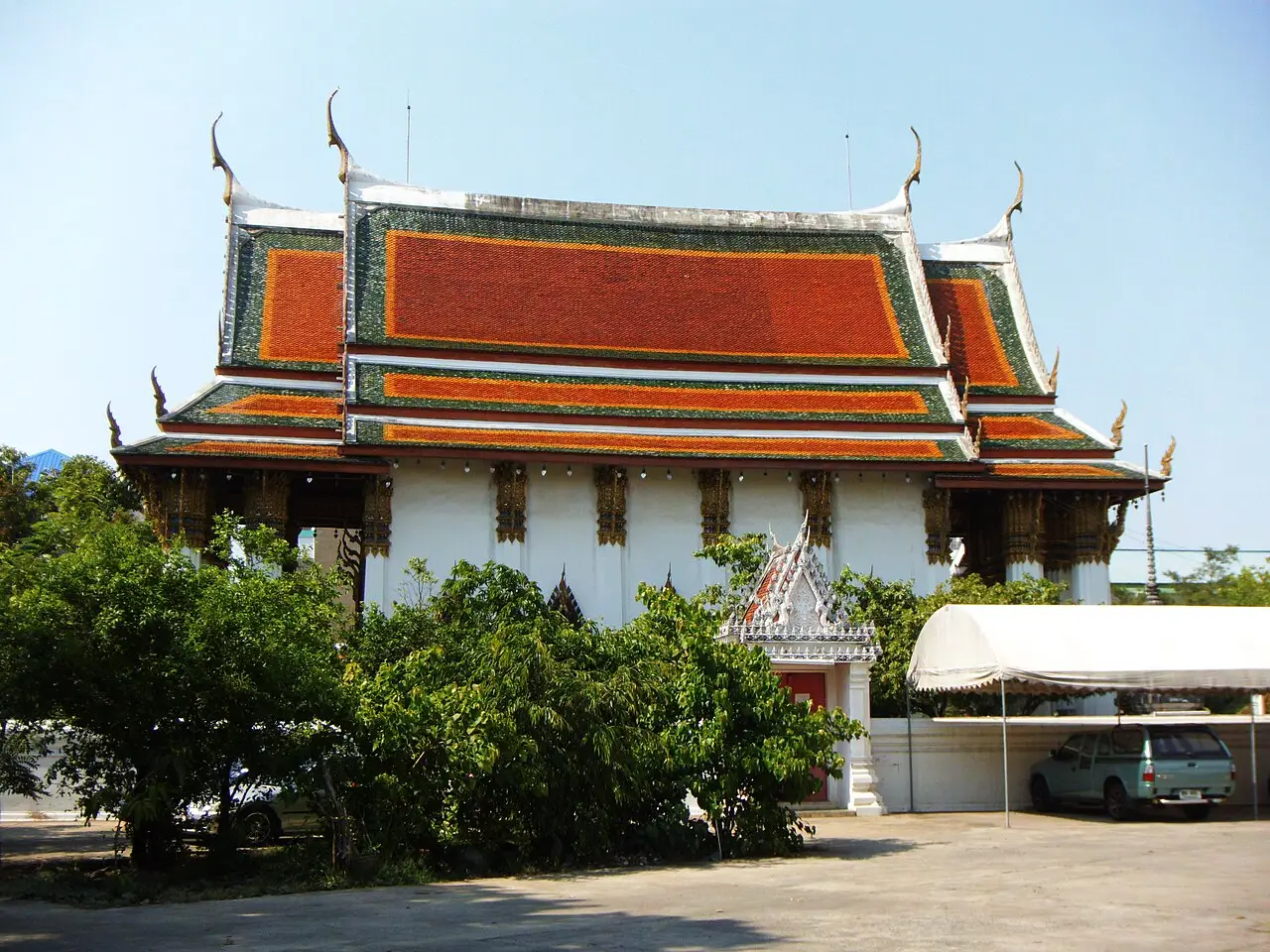
The ordination hall is one of the most important structures inside Wat Suwan Khiri. It measures 9 meters wide and 29 meters long and was completed in B.E. 2464. The building is a Thai-style brick-and-mortar structure with chofa finials, bai raka ornaments, a carved teak gable, and a 3-tiered roof. These elements reflect Thai temple craftsmanship of the Rattanakosin period, combining ceremonial function with architectural detail. Visitors should approach the ordination hall respectfully because it is the central sacred space for important Buddhist rites.
Inside the ordination hall is the principal Buddha image made of laterite. The image has a lap width of 2.50 meters and a height of 3 meters. It is in the Subduing Mara posture and is notable for the unusual detail that the left hand has 6 fingers. This principal image is the most important sacred object of Wat Suwan Khiri and the main focus of worship for monks, residents, and visitors. The image is flanked by the 2 chief disciples, Phra Moggallana and Phra Sariputta, completing the traditional sacred composition of the ordination hall.
The Subduing Mara posture represents the moment before the Buddha’s enlightenment, when he overcame Mara through spiritual perfection and mental steadiness. As the principal image of Wat Suwan Khiri, it gives the ordination hall a strong devotional and symbolic center. Visitors should also notice the laterite material, which gives the image a distinctive character compared with the bronze or plaster Buddha images commonly seen in many urban temples. The physical presence of the image helps make the temple memorable even though the temple compound itself is not large.
Wat Suwan Khiri also preserves a replica Buddha footprint, Phra Phutthachai, and a Tripitaka hall. The replica footprint is connected with the practice of venerating the Buddha’s trace and remembering the path of Dhamma. Phra Phutthachai gives worshippers another devotional focus, while the Tripitaka hall represents the preservation of Buddhist teaching. Together with the principal Buddha image and the monastic community, these elements give the temple a complete religious character built around the Buddha, the Dhamma, and the Sangha.
The temple holds an annual worship festival in the middle of the third lunar month. This kind of temple festival is important in community Buddhism because it allows local residents and devotees to gather for merit-making, worship, offerings, and shared religious activities. The annual festival is not only a religious occasion. It also keeps the relationship between the temple and the surrounding community active across generations.
Important structures inside the temple include the ordination hall, monks’ residences, sermon hall, chanting hall, viharn, pier pavilion, and Tripitaka hall. The monks’ residences include traditional half-wooden Thai-style buildings. The pier pavilion is especially meaningful because Wat Suwan Khiri is a canal-side temple. In earlier periods, waterways were the main routes for local movement, trade, and temple access. The pier pavilion therefore connects the temple directly with Khlong Bangkok Noi and with the older water-based life of the community.
The landscape of Wat Suwan Khiri is shaped by water. The temple stands on lowland beside the canal, with water channels around the compound and Khlong Bangkok Noi on the western side. The area is also linked with the meeting point of waterways near Khlong Chak Phra. A Buddha image in the Calming the Ocean posture is associated with the front area of the temple, reflecting local beliefs about protection in a water-linked landscape. This gives the temple significance not only as an old Buddhist site but also as a place shaped by geography, local belief, and canal culture.
The temple’s boundaries also reflect its canal-side identity. To the north is a water channel. To the south are a water channel and Serm Sattha School. To the east is a boundary water channel, and to the west is Khlong Bangkok Noi. This makes Wat Suwan Khiri different from temples that face only a major road. Even though road travel is now the main way to reach the area, the temple’s position still tells the story of Bangkok Noi when canals were the main arteries of community life.
Today, Wat Suwan Khiri is a public Buddhist temple under the Mahanikaya order and appears in official temple listings for Arun Amarin, Bangkok Noi, Bangkok. It also functions as a provincial meditation center recognized by the Sangha administration. The current abbot is Phra Ratcha Suwan Wethi. The temple has resident monks and continues to support religious activities, meditation, Buddhist holy days, Kathin ceremonies, and community-related events. Recent public activity records in Bangkok Noi also show that the temple remains an active shared space for the community, school, and local agencies.
Wat Suwan Khiri is more than a place for worship. It is a religious site, community space, learning area, and local landmark for residents around Khlong Bangkok Noi. People come for merit-making, Buddhist activities, Dhamma practice, and community events. Temples of this type are important because they show how old urban temples in Thon Buri still function in everyday life. Wat Suwan Khiri is not only a historic temple to look at; it is a living temple still connected with people, schools, waterways, and neighborhood movement.
The atmosphere of the temple combines calmness with community life. Wat Suwan Khiri sits deeper within a local neighborhood rather than directly on a major tourist route. Visitors on ordinary days can experience a quieter temple compound, pay respect inside the ordination hall, walk around the canal-side areas, and observe how the temple remains connected with its surrounding community. The temple’s value is not based on monumental scale. It lies in the continuity of its history, its sacred objects, and its canal-side setting.
Historically, Wat Suwan Khiri helps explain Bangkok Noi beyond the well-known riverside destinations. The district is often associated with Wang Lang, Siriraj, Wat Rakhang, and the Royal Barges National Museum, but smaller canal-side temples also preserve deep historical layers. Wat Suwan Khiri connects the late Ayutthaya period, early Rattanakosin restoration, royal Kathin history under King Rama VII, and present-day community use. It is therefore a valuable stop for travelers who want to understand the Thon Buri side of Bangkok in greater depth.
Getting There is possible by using Rung Pracha Road as the main access route. Travelers can connect from Borommaratchachonnani Road, the Bang Khun Non area, or the Khlong Chak Phra area, then navigate to the coordinates 13.78020, 100.46800. Drivers should allow extra time for local roads and parking because the temple is in a canal-side community with schools and residential areas nearby. By public transport, take the MRT Blue Line to Bang Yi Khan or Bang Khun Non Station, then continue by taxi, motorcycle taxi, or local transport to Rung Pracha Road.
Wat Suwan Khiri is well suited to a cultural route with Wat Noi Nai, Wat Bang Bamru, Wat Nai Rong, ChangChui Creative Park, and the Royal Barges National Museum. These places help visitors understand Bangkok Noi through old temples, canal communities, creative spaces, museums, and riverside history. With more time, the route can extend to Siriraj Bimuksthan Museum, Wang Lang Market, and Wat Rakhang Kositaram. This makes a visit to Wat Suwan Khiri part of a broader reading of Bangkok Noi rather than a single isolated stop.
The best time to visit is in the morning or the cooler part of the afternoon. These periods are more comfortable for walking around the ordination hall, viharn, pier pavilion, and canal-side areas. Visitors should dress modestly, keep shoulders covered, wear appropriate trousers or skirts, and behave respectfully around monks, worshippers, Buddha images, and sacred buildings. Those who want to join activities, arrange group merit-making, or contact the meditation center should call the temple in advance.
Wat Suwan Khiri is suitable for travelers interested in old Thon Buri temples, Khlong Bangkok Noi, Thai ordination hall architecture, early Rattanakosin restoration history, and community-based cultural travel. Its strength is not grandeur. Its strength lies in the convergence of several stories: the old grove of khi lek trees, the restoration by Somdet Krom Phra Ratchawang Bowon Maha Surasinghanat, the laterite principal Buddha image, the replica Buddha footprint, Phra Phutthachai, the Tripitaka hall, the annual third-lunar-month worship festival, and the temple’s long relationship with Khlong Bangkok Noi.
For travelers who want to see Bangkok beyond famous landmarks, Wat Suwan Khiri is an important stop. It reveals a quieter side of Bangkok Noi where temples, canals, schools, local homes, and religious practice remain connected. The temple allows visitors to read the city through names, sacred objects, waterways, and community memory. Anyone who wants to understand the Thon Buri side of Bangkok in a deeper and more patient way should include Wat Suwan Khiri in a Bangkok Noi itinerary.
| Name | Wat Suwan Khiri |
| Former / Local Names | Wat Khi Lek, Wat Dong Lek |
| Location | Rung Pracha Road, Arun Amarin Subdistrict, Bangkok Noi District, Bangkok, Near Khlong Chak Phra Junction And Khlong Bangkok Noi |
| Address | 796 Rung Pracha Road, Arun Amarin Subdistrict, Bangkok Noi District, Bangkok 10700, Thailand |
| Coordinates | 13.78020, 100.46800 |
| Temple Type | Public Buddhist Temple Under The Mahanikaya Order |
| Area | 13 Rai, 1 Ngan, 12 Square Wa |
| Boundaries | North: Water Channel; South: Water Channel And Serm Sattha School; East: Boundary Water Channel; West: Khlong Bangkok Noi |
| Highlights | Ancient canal-side temple dating to around B.E. 2228, formerly called Wat Khi Lek, restored around B.E. 2338, with a large laterite principal Buddha image, replica Buddha footprint, Phra Phutthachai, Tripitaka hall, and annual worship festival in the middle of the third lunar month |
| History | Founded around B.E. 2228 in the late reign of King Narai the Great; restored around B.E. 2338 by Somdet Krom Phra Ratchawang Bowon Maha Surasinghanat and renamed Wat Suwan Khiri |
| Name Origin | The old name Wat Khi Lek came from the original grove of khi lek trees; the present name Wat Suwan Khiri was adopted after the early Rattanakosin restoration |
| Ordination Hall | 9 Meters Wide And 29 Meters Long, Completed In B.E. 2464, Thai-Style Brick-And-Mortar Structure With Chofa, Bai Raka, Carved Teak Gable, And 3-Tiered Roof |
| Main Areas / Zones | Ordination Hall, Monks’ Residences, Sermon Hall, Chanting Hall, Viharn, Pier Pavilion, Tripitaka Hall, Buddhist Precinct, And Khlong Bangkok Noi Canal-Side Area |
| Sacred Objects | Large Laterite Principal Buddha Image, 2.50 Meters Wide And 3 Meters High, In The Subduing Mara Posture With 6 Fingers On The Left Hand, Together With Phra Moggallana, Phra Sariputta, A Replica Buddha Footprint, Phra Phutthachai, And A Calming The Ocean Buddha Image Near The Front Area |
| Traditions / Activities | Annual Worship Festival In The Middle Of The Third Lunar Month, Buddhist Holy Day Merit-Making, Major Buddhist Calendar Ceremonies, Kathin Ceremony, And Meditation Activities |
| Abbot / Caretaker | Phra Ratcha Suwan Wethi |
| Travel Information | Enter Via Rung Pracha Road, Connecting From Borommaratchachonnani Road, Bang Khun Non, Or Khlong Chak Phra; Public Transport Users Can Continue From MRT Bang Yi Khan Or Bang Khun Non Station |
| Current Status | Open As A Public Buddhist Temple, Meditation Center, And Community Religious Site Beside Khlong Bangkok Noi |
| Open Days | Daily |
| Opening Hours | 08.00 – 17.00 |
| Main Contact Number | 02-884-5475, 02-884-8608 |
| Nearby Tourist Attractions | 1. Wat Noi Nai, 1.1 km 2. Wat Bang Bamru, 1.3 km 3. Wat Nai Rong, 1.5 km 4. ChangChui Creative Park, 2.1 km 5. Royal Barges National Museum, 3.6 km, Tel. 02-424-0004 6. Siriraj Bimuksthan Museum, 4.0 km 7. Wang Lang Market, 4.2 km |
| Nearby Restaurants | 1. Krua Phrueksa, 1.4 km, Tel. 095-812-5495 2. Art Fish Ball Noodles, 1.4 km, Tel. 083-678-9121 3. Kopi Siam Pinklao, 1.6 km, Tel. 093-478-1634, 097-252-5126 4. Eat With Me Pinklao, 1.7 km, Tel. 095-471-1864, 089-895-1961 5. Hom La Moon, 1.7 km, Tel. 092-269-1255 6. Ono Sushi The Sense Pinklao, 1.8 km, Tel. 081-631-1429 7. Purr-ri Matcha Pinklao, 1.8 km, Tel. 089-895-1961, 092-519-8229 |
| Nearby Accommodations | 1. Bangkok Noi Residence, 1.8 km, Tel. 099-350-8886 2. Riski Residence Bangkok-Noi, 2.6 km, Tel. 090-985-2425 3. CHANN Bangkok-Noi, 4.2 km, Tel. 082-632-3994 4. Kaya Heritage Hotel, 4.8 km, Tel. 02-412-4414 5. Baankorrakang, 4.8 km, Tel. 081-689-4646 6. MOWA Bangkok, 4.9 km, Tel. 02-412-9318 7. Baan Wanglang Riverside, 5.0 km, Tel. 02-412-7234 8. Theatre Residence, 5.1 km, Tel. 02-866-2066 |
Frequently Asked Questions (FAQ)
Q: Where is Wat Suwan Khiri located?
A: Wat Suwan Khiri is located at 796 Rung Pracha Road, Arun Amarin Subdistrict, Bangkok Noi District, Bangkok 10700, near the Khlong Chak Phra junction and Khlong Bangkok Noi.
Q: What was the former name of Wat Suwan Khiri?
A: The former local name was Wat Khi Lek, because the original area was known for many khi lek trees and local tradition connects the temple’s foundation with a wandering monk who stayed in that grove.
Q: When was Wat Suwan Khiri built?
A: Wat Suwan Khiri is traditionally dated to around B.E. 2228 in the late reign of King Narai the Great. It was later restored around B.E. 2338 by Somdet Krom Phra Ratchawang Bowon Maha Surasinghanat.
Q: What is the most important sacred object at Wat Suwan Khiri?
A: The most important sacred object is the large laterite principal Buddha image in the ordination hall. It is 2.50 meters wide and 3 meters high, in the Subduing Mara posture, with 6 fingers on the left hand.
Q: When is the annual worship festival at Wat Suwan Khiri?
A: Wat Suwan Khiri holds its annual worship festival in the middle of the third lunar month, when devotees gather for merit-making, worship, and temple activities.
Q: Who is the current abbot of Wat Suwan Khiri?
A: The current abbot of Wat Suwan Khiri is Phra Ratcha Suwan Wethi.
Q: How can travelers get to Wat Suwan Khiri?
A: Travelers can enter via Rung Pracha Road from Borommaratchachonnani Road, Bang Khun Non, or Khlong Chak Phra. By MRT, use Bang Yi Khan or Bang Khun Non Station and continue by taxi, motorcycle taxi, or local transport.
Q: What nearby attractions can be combined with Wat Suwan Khiri?
A: Nearby attractions include Wat Noi Nai, Wat Bang Bamru, Wat Nai Rong, ChangChui Creative Park, the Royal Barges National Museum, Siriraj Bimuksthan Museum, and Wang Lang Market.
 Category: ●Places of Worship
 Group: ●Temple
Last Update : 1 WeekAgo
 Last Update : 1 WeekAgo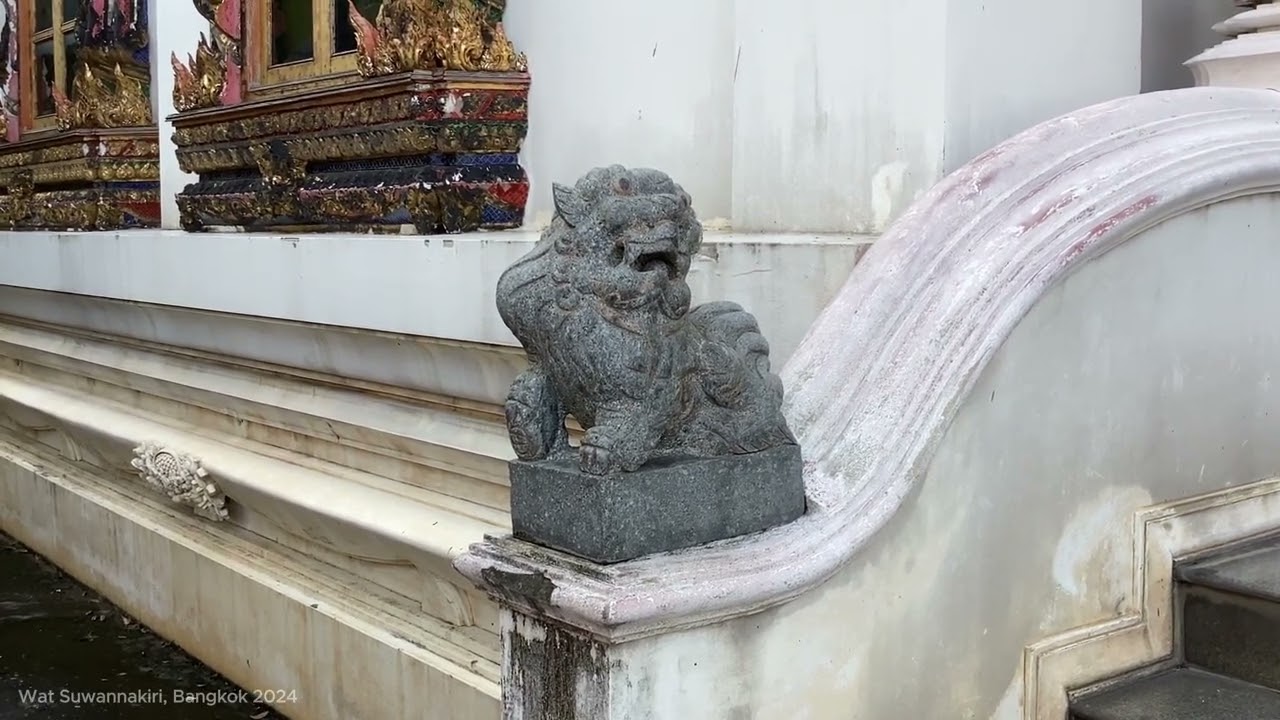
 Click to Access the Navigation Map GPS
Wat Suwan Khiri Map
Recommend

 Phra Nakhon(24)Dusit(17)Khlong San(7)Khlong Toei(3)Jatujak(2)Don Muang(5)Taling Chan(26)Thon Buri(23)Bangkok Noi(31)Bangkok Yai(13)Bang Kapi(5)Bang Kun Tien(15)Bang Khen(3)Bang Kholam(10)Bang Sue(9)Bang Plad(23)Bang Rak(6)Chom Thong(16)Bung Kum(5)Pra Wet(6)Patum Wan(6)Pom Prap Sattru Phai(11)Paya Thai(1)Pra Kanong(4)Pa Sri Charoen(23)Min Buri(7)Yan Na Wa(8)Ratchathewi(4)Rat Burana(6)Lat Krabang(13)Nong Chok(16)Lat Phrao(4)Sathorn(4)Sam Phan Tha Wong(12)Nong Khaem(7)Huai Khwang(3)Suan Luang(7)Din Daeng(2)Lak Si(1)Sai Mai(8)Khan Na Yao(2)Wang Thong Lang(1)Klong Sam Wa(10)Watthana(2)Bang Na(4)Thawi Watthana(3)Bang Khae(5)Thung Khru(4)Bang Bon(3)


