
lovethailand home >Central Travel Attractions >Phranakhon Si Ayutthaya Travel Attractions >Phranakhon Si Ayutthaya >Han Tra > Wat Samanakottharam
TL;DR: Wat Samanakottharam is located at 65/2 Phai Ling Subdistrict, Phra Nakhon Si Ayutthaya District, Phra Nakhon Si Ayutthaya 13000, Thailand, open Daily, hours 08:00 – 17:00.
Wat Samanakottharam
Open Days: Daily
Opening Hours: 08:00 – 17:00
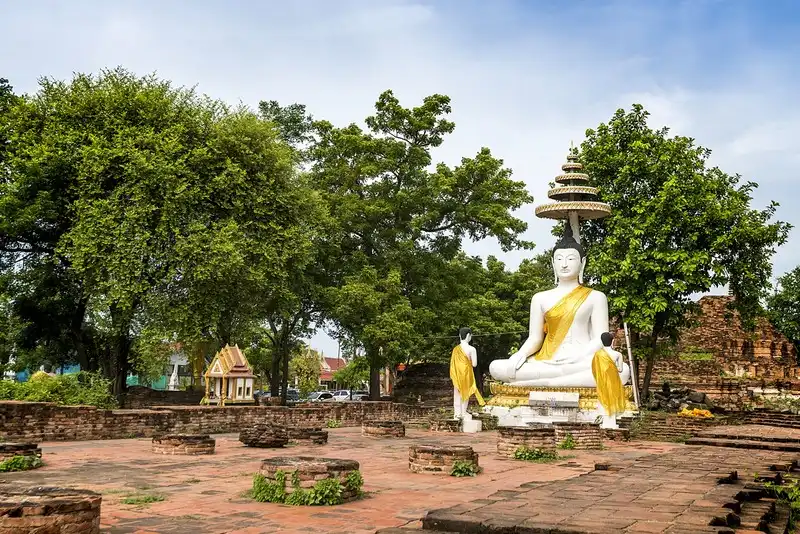
Wat Samanakottharam (Wat Phraya Khlang) is a local temple in Phai Ling Subdistrict, Phra Nakhon Si Ayutthaya District, known for the way a “living temple” and historic ruins sit together in one place without feeling forced. If you have visited Ayutthaya and felt that the famous temples on the island can be so crowded that it’s hard to slow down and truly read the details, this is the kind of site that gives you a calmer rhythm to walk, look, and notice the “real structure” of old Ayutthaya without racing the crowd. Quiet does not mean empty of stories. In fact, the more carefully you look, the more you can sense layers of time stacked within the same grounds—from early foundations to later-period restorations where the names of high-ranking officials are repeatedly tied to this temple in a serious way.
According to official tourism information, Wat Samanakottharam is believed to have been established in the early Ayutthaya period and later underwent a major restoration in the late Ayutthaya period associated with Chao Phraya Kosa (Lek) and Chao Phraya Kosa (Pan). This connection suggests the temple was not only a community place of merit-making, but also part of a wider network of power and prominent figures at a time when Ayutthaya had to navigate intense international trade and diplomacy. Late Ayutthaya was not only about warfare or royal ceremonies; it was also an era when the court had to “read the intentions of the outside world” and balance politics with precision. Temples discussed in this context are rarely minor places that simply happened to be seen; they tend to be spaces that carried social weight, religious importance, and ceremonial roles among people of status in the city.
Another intriguing layer is the name “Wat Phraya Khlang,” which is often used to refer to this temple in some records and oral retellings. If you enjoy reading Ayutthaya with nuance, multiple names are not a problem—they are clues. They invite you to trace how different groups in different periods perceived the temple, and who it was associated with in the city’s structure. The key is not to treat this place as a quick stop. If you walk with intention, you will notice that the temple’s components feel “meaningfully arranged,” and that several features preserve traces of construction built over earlier foundations—a hallmark of Ayutthaya sites that continued to grow as the city’s resources and collective faith evolved over time.
Starting your walk at the ordination hall helps you grasp the overall picture quickly. The ubosot is an Ayutthaya-period structure built with brick and plaster, notable for having side entrances on all four sides. This is not just a detail to memorize; it encourages you to think about how a sacred space was designed to accommodate movement and access from multiple directions. Inside, the roof is a wooden gable-frame structure, and the principal Buddha image is enshrined within; it is noted to be about 3.5 meters wide. If you stand there for a moment, you may begin to feel how the scale creates an intimate atmosphere like a community temple, while still carrying the calm gravity of Ayutthaya work that emphasizes architectural mass and the stillness of the Buddha image as the spiritual center.
To the east stands a large viharn, another key element that reinforces the idea that this was not a small, purely local site. A sizable viharn lets you imagine days of ceremonies, festivals, and community events that required space for many people. As you move from the ubosot area toward the main historic zone, you will reach the feature most people mention when they talk about this temple: the large prang with an unusually striking silhouette compared with typical Ayutthaya prang forms.
The main prang of Wat Samanakottharam is believed to have been modeled after Chiang Mai’s Chedi Chet Yot (Seven-Spired Chedi) and was built atop an earlier stupa. Key characteristics include an eastern projecting porch (mukh) and two stairways leading up to the circumambulatory terrace. From an architectural perspective, the most meaningful moment is not only the top of the prang, but the deliberate design that allows visitors to climb to a higher level, look back across the grounds, and perform circumambulation. The ritual meaning is here: circumambulation is not merely walking in a circle, but a “rhythm of devotion” where the body’s movement is choreographed in relation to architecture, turning belief into lived experience.
It is also suggested that this prang dates to the middle Ayutthaya period, which further strengthens the temple’s value as a site that preserves work from multiple eras in one place. Building new structures over earlier foundations is one of the clearest ways to “read time” in Ayutthaya, because living cities naturally change, repair, and elevate sacred spaces as communities grow and as important patrons invest in them. Continuing your walk, you will find a large bell-shaped chedi situated between the prang and the ubosot. It is believed to date back to the temple’s earliest phase, based on its form and the decorative motifs on its base. Details like these create an “archaeological layer” that is not separated into different sites, but stacked within your sightline in one location.
If you want an experience that reveals the monument’s depth more clearly, visit in the morning or late afternoon. The sunlight emphasizes shadows and surface textures, making the massing of the prang and the terrace proportions easier to perceive. Walking slowly while observing the stairways, the projecting porch, and the base lines that connect structures helps you understand that this temple was designed to be “walked and used,” not simply displayed to be viewed from a distance.
Because Wat Samanakottharam remains an active temple with resident monks and regular merit-making, visitors should behave as they would at any living religious site: dress modestly, keep noise low, and be mindful when taking photos in areas where people are worshipping or where religious activities are underway. Tranquility is one of the temple’s core charms, and preserving that calm is part of responsible travel that helps keep the place welcoming for future visitors as well.
Getting There The temple is located at 65/2 Phai Ling Subdistrict, Phra Nakhon Si Ayutthaya District. Driving is the most convenient option; you can navigate directly to Phai Ling. If you arrive by train, get off at Ayutthaya Railway Station and continue by taxi, local transport, or a ride-hailing app. The distance from Ayutthaya’s main tourist areas is not far, making it a practical stop for a half-day or one-day itinerary, with easy connections to other temples and attractions in the same trip.
In short, Wat Samanakottharam is a destination for anyone who wants to “read Ayutthaya more deeply” through real structures: an Ayutthaya-period ubosot, a large viharn, an eye-catching prang with a distinctive form, and a large bell-shaped chedi that feels like a marker of the temple’s early beginnings. This place does not tell the past only through descriptions; it tells it through architecture and earlier foundations that remain visible to the eye. Give it a little time, and you leave with calm, knowledge, and the feeling that the old capital is not far away at all—it lives in the details we choose to slow down and see.
| Place Name | Wat Samanakottharam (Wat Phraya Khlang) |
| Place Summary | An active temple in Phai Ling, Ayutthaya, with important historic monuments to explore, including an Ayutthaya-period ubosot, a viharn, a large prang, and a bell-shaped chedi, with multiple construction layers visible on earlier foundations. |
| Key Highlights | Ayutthaya-period ubosot (four side entrances) – large eastern viharn – distinctive main prang (believed inspired by Chedi Chet Yot) – large bell-shaped chedi and visible construction layers over earlier foundations. |
| Period | Believed established in the early Ayutthaya period, with major restoration in the late Ayutthaya period (linked to Chao Phraya Kosa (Lek) and Chao Phraya Kosa (Pan)). |
| Key Evidence | Ayutthaya architectural forms in the ubosot and chedi – prang built over an earlier structure – large bell-shaped chedi between the prang and ubosot – traces of construction built over older foundations (reflecting multiple restoration phases). |
| Name Origin | Known as “Wat Samanakottharam,” and also referred to as “Wat Phraya Khlang” in some retellings and tourism sources. |
| Abbot / Current Custodian | Phra Khru Athon Bunwisut (Ngam Thanawaro) |
| Address | 65/2 Phai Ling Subdistrict, Phra Nakhon Si Ayutthaya District, Phra Nakhon Si Ayutthaya 13000, Thailand |
| Travel | Drive or ride a motorbike and navigate directly to Phai Ling (address 65/2) – take a train to Ayutthaya Station and continue by taxi, local transport, or ride-hailing apps. |
| Facilities | Merit-making and worship areas within the temple (other facilities may vary by time and temple management). |
| Fees | Free entry (donations welcome). |
| Current Status | Active temple with resident monks and open to visitors. |
| Contact Number | 035-242-096 |
| Nearby Tourist Attractions With Distance | 1) Wat Kudi Dao – Approx. 1 km 2) Ayothaya Floating Market – Approx. 2 km 3) Wat Yai Chai Mongkhon – Approx. 3 km 4) Wat Phanan Choeng Worawihan – Approx. 5 km 5) Wat Mahathat (Ayutthaya Island Area) – Approx. 6 km |
| Popular Restaurants Nearby With Distance And Phone Number | 1) Baan U-Thong Riverside – Approx. 7 km – 081-341-4595 2) Baan Mai Rim Nam Ayutthaya – Approx. 7 km – 035-242-248 3) Abideen-Phanom Sang Arun Roti Sai Mai – Approx. 7 km – 089-005-9948 4) Krua Manao – Approx. 10 km – 081-141-5118 5) Suan Rim Nam (Krungsri River Hotel) – Approx. 10 km – 035-244-333 |
| Popular Accommodations Nearby With Distance And Phone Number | 1) Baan Thai House Ayutthaya – Approx. 2 km – 080-437-4555 2) Classic Kameo Hotel Ayutthaya – Approx. 4 km – 035-212-535 3) Centara Ayutthaya – Approx. 10 km – 035-243-555 4) iuDia on the River – Approx. 7 km – 035-323-208 5) sala ayutthaya – Approx. 8 km – 035-242-588 |
Frequently Asked Questions (FAQ)
Q: Where is Wat Samanakottharam located?
A: The temple is located at 65/2 Phai Ling Subdistrict, Phra Nakhon Si Ayutthaya District, Phra Nakhon Si Ayutthaya 13000. It is outside the main island area and can be reached easily from Ayutthaya Railway Station by taxi or local transport.
Q: Is Wat Samanakottharam open every day, and when is the best time to visit?
A: It is generally open daily. Morning or late afternoon is recommended because the light helps reveal the prang’s form and the textures of the historic structures, and the walk is more comfortable and peaceful.
Q: Is there an entrance fee to visit Wat Samanakottharam?
A: Entry is generally free, and visitors may donate according to personal faith.
Q: What are the highlights you should not miss at Wat Samanakottharam?
A: Don’t miss the Ayutthaya-period ubosot with four side entrances, the large eastern viharn, the distinctive main prang, and the large bell-shaped chedi between the prang and the ubosot that helps you “read” multiple historical layers in one place.
Q: How is the temple connected to Chao Phraya Kosa (Lek) and Chao Phraya Kosa (Pan)?
A: Sources note that the temple is believed to have early Ayutthaya origins and later underwent a significant restoration in the late Ayutthaya period associated with Chao Phraya Kosa (Lek) and Chao Phraya Kosa (Pan), placing the site within the broader context of late Ayutthaya politics and international contact.
Q: What should visitors wear and how should they behave at the temple?
A: Dress modestly, keep noise low, and be mindful when taking photos to avoid disturbing worshippers or ongoing religious activities.
 Category: ●Places of Worship
 Group: ●Temple
Last Update : 6 MonthAgo
 Last Update : 6 MonthAgo
 Click to Access the Navigation Map GPS
Wat Samanakottharam Map
Recommend

 Art, Culture and Heritage
 Historical Sites and Monuments(7)
 Landmarks and Memorials(6)
 Royal Palace(4)
 Art, Craft Centres, Tradition(6)
 Museums(9)
 Educational Places
 Museum for Study(1)
 Educational Gardens, Farm(2)
 Training Center(1)
Temple(133)
Training Center(1)
Temple(133)
 Church(2)
 Mosque(2)
 Other Sacred Sites(15)
 Research and Development
 Royal Project(4)
 Suburban Living
 Village, Community(10)
 Local Market(7)
 Floating Market(3)
 Nature and Wildlife
 Dam, Reservoir, Lake(1)
 River, Canal(3)
 Islands(2)
 Other natural attractions(1)
 Entertainment and Agricultural
 Animal camps and shows(2)
 Farms, Parks and Ecotourism(4)
 Travel Articles, Recipes
 Travel Review, Food Review(2)


