
lovethailand home >Central Travel Attractions >Phranakhon Si Ayutthaya Travel Attractions >Se Na >Bang Nom Kho > Wat Bang Nom Kho
TL;DR: Wat Bang Nom Kho is located at Bang Nom Kho Subdistrict, Sena District, Phra Nakhon Si Ayutthaya Province, Thailand, open Open daily, hours 08:00 – 17:00.
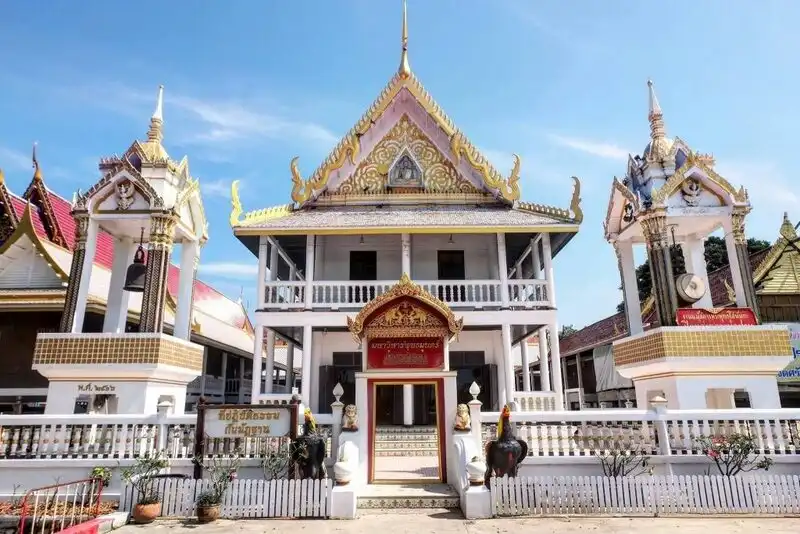
Wat Bang Nom Kho
Open Days: Open daily
Opening Hours: 08:00 – 17:00
Wat Bang Nom Kho is located in Bang Nom Kho Subdistrict, Sena District, Phra Nakhon Si Ayutthaya Province. It is an old temple whose history is traced back to the late Ayutthaya period, and it has continuously served as a religious and spiritual center for the local community up to the present day. The temple is not only a sacred place for Buddhist rites, but also a space that reflects local identity, community livelihood, and significant episodes in Thai history—especially the turbulent years near the end of the Ayutthaya Kingdom, a period marked by profound change and loss.
The temple stands in a fertile rural community surrounded by agricultural landscapes and the everyday rhythms of the Chao Phraya river basin. Wat Bang Nom Kho covers an area of approximately 24 rai 4 ngan 21 square wah, which is relatively spacious for a community temple. The arrangement of buildings and open areas inside the temple reflects gradual development over time, while still preserving a simple, lived-in character that clearly represents a village temple rather than a monument built for spectacle.
Historically, Wat Bang Nom Kho was known as “Wat Nom Kho.” The name came from the way of life in the area: Bang Nom Kho was a community where people raised cattle and buffalo more heavily than nearby places. Because the local environment supported both farming and livestock, cattle and buffalo were major household assets and essential labor for rice cultivation. The temple’s original name therefore mirrored the community’s identity and its practical rural livelihood.
During the late Ayutthaya period, Wat Bang Nom Kho and the surrounding community faced a decisive historical upheaval. Burmese forces set up a military camp at Si Kuk Subdistrict, not far from the temple area. At that time, they took the opportunity to round up cattle and buffalo from Bang Nom Kho villagers, using them as supplies to feed the army. The livestock that had been central to local survival was taken away, leaving the community with hardship, loss, and instability.
This occurred in the same era when Ayutthaya ultimately fell to the Burmese. The fall did not only affect the royal capital and the country’s political structure, but it also directly impacted smaller rural communities such as Bang Nom Kho. As the heart of community life, the temple was inevitably affected as well—both in its day-to-day functioning and in the broader environment of the area. Even so, Wat Bang Nom Kho remains a historical witness, reflecting the struggles and transformations experienced during that critical time.
After Ayutthaya’s fall and as conditions gradually stabilized, local residents worked together to restore and rebuild the temple. Alongside temple restoration came the revival of traditional community life, including livestock raising, which continued to play a major role in the area. Rebuilding the temple was not only a matter of repairing structures; it represented a renewal of morale, identity, and collective hope. The temple returned to its role as a shared center of faith and a spiritual refuge for the community.
Following this restoration, people began to call the temple “Wat Bang Nom Kho,” reflecting both its location and the enduring identity of a community long associated with cattle and buffalo raising. In this sense, the temple’s name is more than a label—it is a symbol of local memory, historical continuity, and a way of life passed down across generations.
The most important focal point of devotion at Wat Bang Nom Kho is Luang Pho To (the Great Buddha Image), enshrined within the temple grounds. This large Buddha statue is deeply revered by local residents and devotees from other areas. Many visitors come specifically to pay respects and pray to Luang Pho To for peace of mind, stability in life, and ongoing wellbeing. In this way, Luang Pho To serves as a spiritual anchor that connects people across communities through shared faith.
In addition to Luang Pho To, Wat Bang Nom Kho has the key structures required for Buddhist practice and community religious life, including an ordination hall, a shrine hall, a sermon hall, monks’ quarters, and areas for community activities. The temple’s layout emphasizes practical use in everyday life rather than decorative grandeur, aligning with the lived reality of a community temple that supports continuous religious activities and local gatherings.
From a cultural and traditional perspective, Wat Bang Nom Kho continues to play an active role in Buddhist merit-making and Thai religious life on major holy days, such as Makha Bucha Day, Visakha Bucha Day, Asalha Bucha Day, and the Buddhist Lent period. The temple also hosts pha pa and kathina offerings depending on the year. These occasions bring residents together for shared merit-making and strengthen community unity, reinforcing the temple as a continuing center of social and spiritual life.
For visitors, Wat Bang Nom Kho is well suited to a calm temple visit—paying respects, making merit, and learning about local history in a peaceful, non-crowded setting. Walking around the grounds, worshipping Luang Pho To, and reflecting on the community’s historical narrative allow visitors to experience Ayutthaya in a different dimension from the well-known archaeological attractions. It is an experience where devotion and local heritage naturally blend together.
Getting There Wat Bang Nom Kho is located in Bang Nom Kho Subdistrict, Sena District, Phra Nakhon Si Ayutthaya Province. The most convenient way to visit is by private car. Using a navigation system to search for “Wat Bang Nom Kho, Sena” will help you reach the destination accurately. The final stretch includes local roads, so careful driving is recommended. For public transport travelers, it is advisable to reach Sena District first, then continue to the temple by local taxi or local transport as available.
| Place Name | Wat Bang Nom Kho |
| Address | Bang Nom Kho Subdistrict, Sena District, Phra Nakhon Si Ayutthaya Province, Thailand |
| Overview | A late-Ayutthaya-era community temple closely tied to local livelihood and historical memory, and home to Luang Pho To, a large revered Buddha image. |
| Key Highlights | Luang Pho To (large Buddha image), late Ayutthaya history, community-temple atmosphere, peaceful setting |
| Abbot / Temple Head (Latest) | Phra Khru Wihanakitjanukan (Pan Sonanto) |
| Nearby Attractions | 1) Sena Market – 8 km 2) Wat Pa Kho – 12 km 3) Wat Chaiyo Worawihan – 25 km 4) Bang Pa-In Royal Palace – 30 km 5) Ayutthaya Historical Park – 35 km |
| Nearby Restaurants | 1) Restaurants near Sena Market – 8 km 2) Local Restaurants in Sena Area – 10 km 3) Krua Ban Mai (Sena) – 12 km – 098-564-7297 4) Suan Ahan Lung Nuai – 20 km – 098-969-9244 5) Ayutthaya Boat Noodles – 22 km – 086-803-1566 |
| Nearby Accommodations | 1) Sena Place Hotel – 10 km 2) Ayutthaya Retreat – 28 km 3) Sweet Inn Resort – 30 km – 084-672-9428 4) Ice Inn Resort – 32 km – 083-015-2708 5) Wang Noi Resort – 35 km – 096-931-9181 |
Frequently Asked Questions (FAQ)
Q: Which period was Wat Bang Nom Kho built in?
A: Wat Bang Nom Kho dates back to the late Ayutthaya period.
Q: What is the origin of the name “Wat Bang Nom Kho”?
A: The temple was originally called Wat Nom Kho because the community raised many cattle and buffalo. Later, it became known as Wat Bang Nom Kho, reflecting its location and community identity.
Q: Why is Luang Pho To important at Wat Bang Nom Kho?
A: Luang Pho To is the temple’s main object of devotion. People come to pay respects and pray for peace, stability, and blessings.
Q: How is Wat Bang Nom Kho connected to the fall of Ayutthaya?
A: During the late Ayutthaya era, Burmese forces camped near the area and seized cattle and buffalo from local villagers, affecting the community and the temple’s surroundings.
Q: What should visitors wear when visiting Wat Bang Nom Kho?
A: Visitors should dress modestly—tops with sleeves and long trousers or a long skirt—and behave respectfully within the temple grounds.
 Category: ●Places of Worship
 Group: ●Temple
Last Update : 10 MonthAgo
 Last Update : 10 MonthAgo

 Click to Access the Navigation Map GPS
Wat Bang Nom Kho Map
Recommend

 Art, Culture and Heritage
 Historical Sites and Monuments(7)
 Landmarks and Memorials(6)
 Royal Palace(4)
 Art, Craft Centres, Tradition(6)
 Museums(10)
 Educational Places
 Museum for Study(1)
 Educational Gardens, Farm(2)
 Training Center(1)
 University
 Autonomous Universities(2)
 Rajamangala University of Technology(2)
 Rajabhat University(1)
Temple(134)
 Church(2)
 Mosque(2)
 Other Sacred Sites(15)
 Research and Development
 Royal Project(4)
 Suburban Living
 Village, Community(10)
 Local Market(7)
 Floating Market(3)
 Nature and Wildlife
 Dam, Reservoir, Lake(1)
 River, Canal(3)
 Islands(2)
 Other natural attractions(1)
 Entertainment and Agricultural
 Animal camps and shows(3)
 Farms, Parks and Ecotourism(4)
 Waterpark(1)
 Shopping
 Department Store(3)
 Travel Articles, Recipes
 Travel Review, Food Review(3)


