
lovethailand home >North Travel Attractions >Tak Travel Attractions >Mae Sot >Mae Sot > Wat Chumphon Khiri
TL;DR: Wat Chumphon Khiri is located at Mae Sot Subdistrict, Mae Sot District, Tak Province, open Daily, hours 08.00 - 16.30.
Wat Chumphon Khiri
Open Days: Daily
Opening Hours: 08.00 - 16.30
Wat Chumphon Khiri is one of the oldest and most culturally significant temples in Mae Sot District, Tak Province. Located within Mae Sot Municipality, close to the town’s urban community and main local roads, the temple has a history of more than 200 years. It was formerly known as “Wat Klang” because it stood in the central area of the local community and served as an important Buddhist center for residents. The current name, “Wat Chumphon Khiri,” carries a meaningful symbolic sense. “Chumphon” suggests the gathering of people, unity, and community strength, while “Khiri” means mountain, reflecting Mae Sot’s landscape surrounded by high mountain ranges. Wat Chumphon Khiri therefore represents both the collective faith of the community and the cultural landscape of this historic border town.
Wat Chumphon Khiri was established as a temple around 1771, during the late Thonburi period or the early Rattanakosin era according to the historical context of old Mae Sot. The temple received its consecrated boundary on 12 March 1965 and held its boundary-marking ceremony on 2 March 1969, allowing it to conduct formal monastic ceremonies properly. It is a local Buddhist temple under the Mahanikaya order and has maintained a close relationship with Mae Sot’s community for generations. In earlier times, Mae Sot was an important border settlement on trade and travel routes between Thailand and Myawaddy in Myanmar, and Wat Chumphon Khiri served as one of the main religious centers for the local people.
The importance of Wat Chumphon Khiri lies not only in its age but also in its continuing role as a spiritual anchor for the people of Mae Sot. In the past, the temple was a place for Buddhist ceremonies, community gatherings, youth learning, and traditional merit-making activities. Because of its location within Mae Sot town, the temple has long connected daily life with Buddhist practice. Local residents could come to worship, make merit, listen to sermons, join ceremonies, and participate in community events with ease. This practical connection between temple and town is one of the reasons Wat Chumphon Khiri remains meaningful today.
Inside the ordination hall, Wat Chumphon Khiri enshrines a principal Buddha image in the Mara Vichai posture. This posture represents the moment when the Buddha overcame Mara and all defilements before attaining enlightenment. The image has a calm and dignified appearance, making it the main spiritual focus of the temple. Local worshippers often come to pay respect and ask for blessings for good fortune, mental strength, protection from hardship, and encouragement in life. Paying respect to the principal Buddha image inside this old temple offers visitors a direct experience of faith, history, and inner calm.
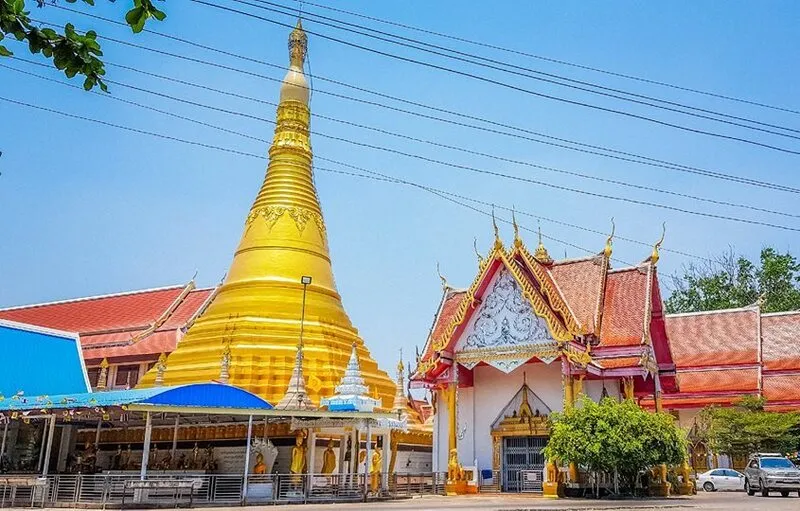
Another important highlight of Wat Chumphon Khiri is its golden chedi, which was modeled after the Shwedagon Pagoda in Myanmar. This chedi reflects the cultural connection between Mae Sot and Myanmar clearly. Mae Sot has long been a border town shaped by trade, travel, migration, and cultural exchange. The golden chedi is therefore not only a beautiful architectural feature but also a symbol of shared Buddhist faith and artistic influence across the Moei River border. Visitors can admire the chedi’s golden form and sense how Thai and Burmese Buddhist cultures meet naturally in Mae Sot.
In addition to the principal Buddha image and golden chedi, Wat Chumphon Khiri preserves an important historical object: an ancient drum more than 200 years old, kept inside the viharn. This drum is a valuable reminder of community life before modern communication technology. In the past, villagers used the drum to send important signals, such as announcing emergencies, calling people to gather, marking the beginning of religious ceremonies, or summoning the community in times of need. The sound of the drum functioned almost like a public communication system, linking the temple with the surrounding village.
The ancient drum of Wat Chumphon Khiri is more than an old object. It tells the story of how closely the temple and community were connected. In earlier times, the temple was the center of village life, and the sound of the drum could reach people in the surrounding area. It announced ceremonies, urgent news, and community duties. The fact that the drum is still preserved today allows visitors to see a tangible trace of old Mae Sot, when people relied on the temple as a center for worship, communication, coordination, and collective life.
Wat Chumphon Khiri was also important as a place of learning in the old community. Before modern school systems became widespread, many temples in Thailand served as places where children learned reading, writing, Buddhist teachings, and moral conduct. Wat Chumphon Khiri played a similar role in Mae Sot. It was not only a place for rituals but also a place where the younger generation received guidance, knowledge, and ethical values. This educational role made the temple an important foundation of community development.
Today, the connection between the temple and education continues through Wat Chumphon Khiri Municipal School, located near the temple. The school’s name reflects the temple’s long-standing place in the identity of the local community. This relationship between temple and school shows that the temple’s role in learning has not disappeared, even though formal education now takes a different form. Wat Chumphon Khiri remains part of Mae Sot’s shared memory in religious, historical, and educational dimensions.
On important Buddhist days, Wat Chumphon Khiri continues to function as an active religious site. Local residents come to make merit, listen to Dhamma talks, join candlelight processions, offer alms and necessities to monks, and take part in temple activities. These occasions include Makha Bucha, Visakha Bucha, Asalha Bucha, Buddhist Lent, the end of Buddhist Lent, Kathin ceremonies, and other community merit-making events. These activities keep the temple alive as a living Buddhist center rather than turning it into only a historic attraction.
Wat Chumphon Khiri is also significant because it is a temple in a border town. Mae Sot has long been home to Thai residents, Myanmar communities, Karen people, Tai Yai people, people of Chinese descent, traders, travelers, and many other groups. Located within this diverse environment, the temple serves as a Buddhist space that welcomes people from different backgrounds. Whether local residents, travelers, or visitors passing through the town, many people can come here to worship and find a moment of peace. The temple therefore reflects the way religion and culture help connect people in Mae Sot’s borderland society.
Getting There is very convenient because Wat Chumphon Khiri is located within Mae Sot Municipality, near Prasatwithi Road, Intharakiri Road, and the town’s main community area. From central Mae Sot, visitors can reach the temple by private car, local hired vehicle, or local songthaew. From the Mae Sot-Myawaddy border checkpoint, Rim Moei Market, or the Thai-Myanmar Friendship Bridge, the temple can also be reached within a short drive. This makes it suitable as a cultural and spiritual stop before or after visiting border attractions.
Visitors traveling from Mueang Tak to Mae Sot can follow the Tak-Mae Sot route into Mae Sot town and continue into the municipal area. Because the temple is located in an urban community, visitors should allow time for local traffic and parking, especially during market hours or temple events. Morning and late afternoon are pleasant times to visit, as the weather is usually more comfortable for worship and walking around the temple grounds.
A meaningful visit to Wat Chumphon Khiri should begin with paying respect to the principal Buddha image inside the ordination hall. After that, visitors can walk to the golden chedi inspired by the Shwedagon Pagoda and then view the ancient drum preserved inside the viharn. If time allows, it is worth walking slowly around the temple grounds to observe the quiet atmosphere of this old urban temple. Wat Chumphon Khiri is not a large tourist complex, but its value lies in its age, its relationship with the community, and the historical objects it continues to preserve.
Visitors interested in local history will find that Wat Chumphon Khiri helps tell the story of Mae Sot clearly. The temple began during a period when Mae Sot was still an old border community and later witnessed the area’s transformation into an important trade town and border gateway. The temple is like a quiet witness to these changes. By seeing the principal Buddha image, golden chedi, ancient drum, and the temple’s urban setting, visitors can understand that Mae Sot is not only a town of markets and border trade but also a place with deep Buddhist and cultural roots stretching back more than 2 centuries.
For photographers, Wat Chumphon Khiri offers several interesting subjects, including the golden chedi with Burmese artistic influence, the ordination hall, the atmosphere of an old temple in town, and the historical drum in the viharn. Photography should be done respectfully. Visitors should not disturb worshippers or ceremonies, and they should not touch the ancient drum or sacred objects without permission. These items have both religious and historical value and should be treated with care.
Wat Chumphon Khiri is suitable for many types of visitors: Buddhist worshippers, cultural travelers, history enthusiasts, people interested in border-town heritage, and travelers who want a meaningful stop within Mae Sot town. The temple can be visited together with Wat Manee Phraison, Wat Thai Wattanaram, Mae Sot Market, Rim Moei Market, the Thai-Myanmar Friendship Bridge, Mae Sot Airport area, and other nearby attractions. Its central location makes it suitable for both half-day and full-day cultural routes in Mae Sot.
The atmosphere of Wat Chumphon Khiri is simple and calm, like an old temple embedded in the life of the town. Visitors should not rush through the site, because much of the temple’s value lies in its accumulated stories: the former name Wat Klang, its establishment around 1771, the principal Buddha image, the golden chedi, the ancient drum, and its lasting relationship with the people of Mae Sot. Taking time to observe these details helps reveal why this temple is more than a short stop for worship or photography.
In summary, Wat Chumphon Khiri is an old temple of Mae Sot with a history of more than 200 years. Formerly known as Wat Klang, it was established around 1771 and continues to serve as a spiritual center for the local community. The temple houses a principal Buddha image in the Mara Vichai posture, a golden chedi modeled after the Shwedagon Pagoda, and an ancient drum over 200 years old that once served as an important communication tool for villagers. For visitors to Mae Sot, Wat Chumphon Khiri is a worthwhile stop for worship, historical learning, and understanding the living Buddhist heritage of this border town.
| Name | Wat Chumphon Khiri |
| Former Name | Wat Klang |
| Location | Mae Sot Subdistrict, Mae Sot District, Tak Province |
| Address / Landmark | Prasatwithi Road, Mae Sot Municipality, near Mae Sot urban community and Wat Chumphon Khiri Municipal School |
| Highlights | Old temple over 200 years old, featuring a principal Buddha image in Mara Vichai posture, a golden chedi modeled after the Shwedagon Pagoda, and an ancient drum over 200 years old |
| History | Established as a temple around 1771 under the former name Wat Klang; received its consecrated boundary on 12 March 1965 and held its boundary-marking ceremony on 2 March 1969 |
| Name Origin | “Chumphon” suggests the gathering of people and community unity, while “Khiri” means mountain, reflecting Mae Sot’s mountain-surrounded landscape |
| Distinctive Features | Local Buddhist temple under the Mahanikaya order, located in Mae Sot town and long serving as a religious center for the community |
| Important Sacred Objects / Structures | Principal Buddha image in Mara Vichai posture, golden chedi modeled after the Shwedagon Pagoda, ancient drum over 200 years old, ordination hall, and viharn |
| Important Historical Object | Ancient drum over 200 years old, formerly used to signal announcements, emergencies, gatherings, and important community ceremonies |
| Travel Information | Travel into Mae Sot town and Mae Sot Municipality. The temple is near Prasatwithi Road and can be reached by private car, local hired vehicle, or local songthaew. |
| Current Status | Active temple and important religious-cultural site of Mae Sot, open daily for worshippers and visitors |
| Open Days | Daily |
| Opening Hours | 08.00 - 16.30 |
| Local Administrative Contact | Mae Sot Municipality, Tel. 055-531-033, 055-508-986 |
| Facilities | Temple courtyard, ordination hall, viharn, principal Buddha worship area, ancient drum viewing area, and parking space according to the urban temple setting |
| Main Areas / Zones | Ordination hall, principal Buddha image in Mara Vichai posture, golden chedi, ancient drum viharn, temple courtyard, and community religious activity area |
| Nearby Tourist Attractions | 1. Mae Sot Market, about 1 km 2. Wat Manee Phraison, about 1 km 3. Mae Sot Airport, about 3 km 4. Wat Thai Wattanaram, about 6 km 5. Rim Moei Market, about 8 km 6. Thai-Myanmar Friendship Bridge, about 9 km |
| Nearby Restaurants | 1. Borderline Tea Garden, about 1 km, Tel. 055-546-584 2. Krua Canadian Restaurant, about 1 km, Tel. 055-534-659 3. No Two B.B.Q, about 1 km, Tel. 096-018-9019 4. Gethava Restaurant, about 2 km, Tel. 086-207-7620 5. One Way Phochana, about 2 km, Tel. 093-198-7167 6. Kafae Mo Din Khanom Chin Khayum, about 3 km, Tel. 055-533-880 |
| Nearby Accommodations | 1. HOP INN Mae Sot, about 2 km, Tel. 02-080-2222 2. Fortune D Hotel Maesot, about 2 km, Tel. 055-036-899 3. Centara Life Hotel Mae Sot, about 2 km, Tel. 055-532-601-8 4. HOP INN Mae Sot Building B, about 2 km, Tel. 063-205-7365 5. Monte Maesot Hotel, about 4 km, Tel. 065-415-8979, 055-030-808 6. B2 Mae Sot Boutique & Budget Hotel, about 4 km |
Frequently Asked Questions (FAQ)
Q: Where is Wat Chumphon Khiri located?
A: Wat Chumphon Khiri is located within Mae Sot Municipality, Mae Sot Subdistrict, Mae Sot District, Tak Province, near Prasatwithi Road and the urban community of Mae Sot.
Q: What was the former name of Wat Chumphon Khiri?
A: Wat Chumphon Khiri was formerly known as Wat Klang because it stood in the central area of the community and served as a Buddhist center for local residents.
Q: When was Wat Chumphon Khiri established?
A: Wat Chumphon Khiri was established as a temple around 1771 and has a history of more than 200 years.
Q: What are the main highlights of Wat Chumphon Khiri?
A: The main highlights include the principal Buddha image in Mara Vichai posture, the golden chedi modeled after the Shwedagon Pagoda, and an ancient drum over 200 years old.
Q: Why is the ancient drum at Wat Chumphon Khiri important?
A: The ancient drum was once used to signal announcements, emergencies, gatherings, and important community ceremonies, showing the temple’s former role as a communication center for villagers.
Q: What are the opening hours of Wat Chumphon Khiri?
A: Wat Chumphon Khiri is generally open daily from 08.00 to 16.30.
Q: What nearby attractions can be visited with Wat Chumphon Khiri?
A: Nearby attractions include Mae Sot Market, Wat Manee Phraison, Wat Thai Wattanaram, Rim Moei Market, the Thai-Myanmar Friendship Bridge, and Mae Sot Airport area.
Q: What type of travelers should visit Wat Chumphon Khiri?
A: The temple is suitable for Buddhist worshippers, cultural travelers, history enthusiasts, and visitors interested in old temples, ancient objects, and the cultural history of Mae Sot.
 Category: ●Places of Worship
 Group: ●Temple
Last Update : 4 MonthAgo
 Last Update : 4 MonthAgo
 Click to Access the Navigation Map GPS
Wat Chumphon Khiri Map
Recommend

 Art, Culture and Heritage
 Historical Sites and Monuments(2)
 Landmarks and Memorials(3)
 Art, Craft Centres, Tradition(6)
 Historic Homes and Cities(2)
 Educational Places
 Educational Gardens, Farm(2)
Temple(22)
Educational Gardens, Farm(2)
Temple(22)
 Other Sacred Sites(9)
 Suburban Living
 Village, Community(5)
 Local Market(3)
 Nature and Wildlife
 National Parks and Marine Reserves(9)
 Mountain (Doi)(9)
 Dam, Reservoir, Lake(14)
 Waterfalls(23)
 Hot Springs(2)
 Caves(6)
 River, Canal(1)
 Bays and Beaches(1)
 Islands(1)
 Other natural attractions(1)
 Entertainment and Agricultural
 Farms, Parks and Ecotourism(5)
 Outdoor and Adventure Activities(4)


