
lovethailand home >Central Travel Attractions >Phetchaburi Travel Attractions > 20 Best Places to Visit in Phetchaburi Central Tha..
TL;DR: 20 Best Places to Visit in Phetchaburi Central Thailand.
20 Best Places to Visit in Phetchaburi Central Thailand
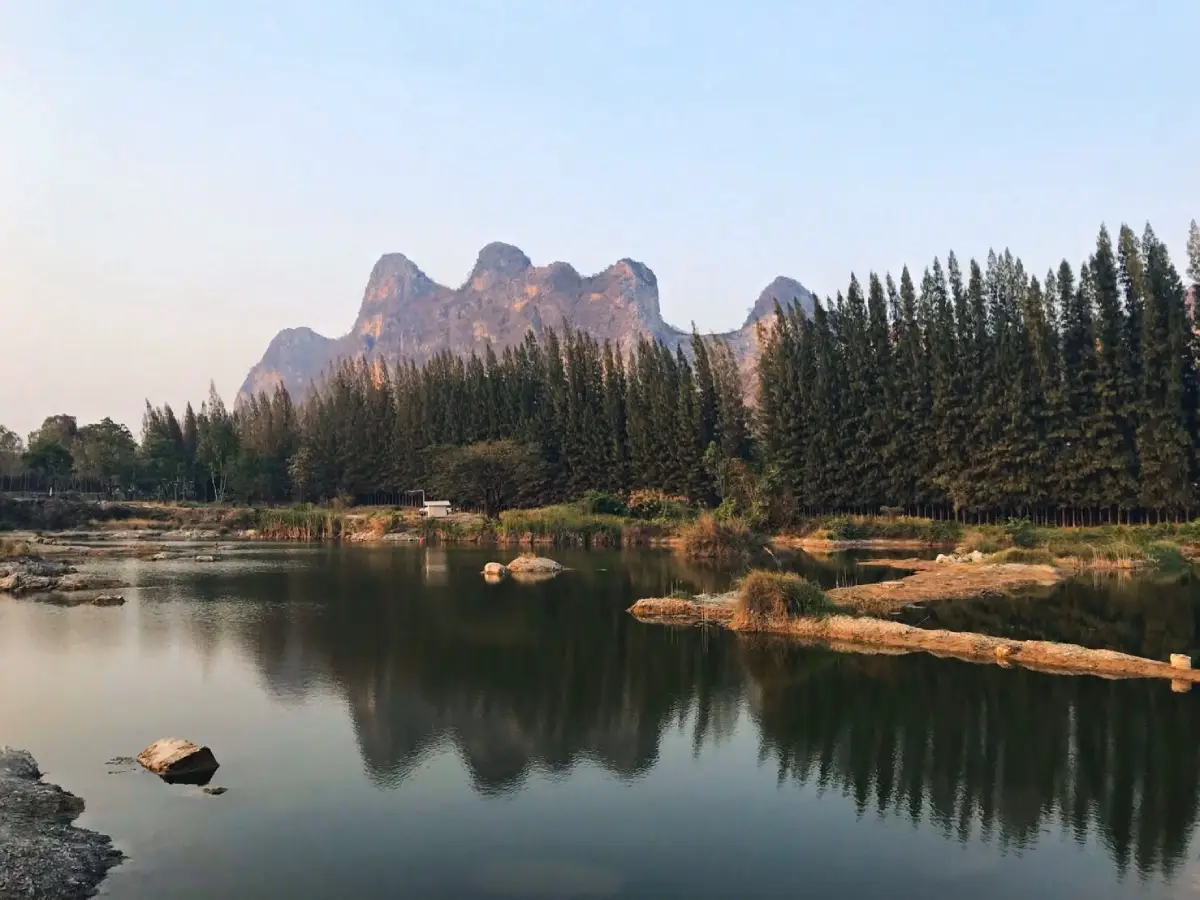
20 Best Places to Visit in Phetchaburi, Central Thailand — Phetchaburi is one of the most fascinating provinces in the lower Central Region of Thailand, combining a historic old town, royal palaces, ancient temples, caves, mountains, the western forest complex, beaches and traditional communities within a single destination. Located within easy reach of Bangkok and serving as a gateway to southern Thailand, the province is suitable for everything from a short 1–2 day trip to a more detailed 3–5 day journey covering Phetchaburi city, Cha-am, Kaeng Krachan, Ban Laem and the Gulf of Thailand coastline.
For first-time visitors, the essential places to know are Phra Nakhon Khiri Historical Park, Tham Khao Luang Cave, Hat Cha-am Beach, Kaeng Krachan National Park, Phanoen Thung, Mrigadayavan Palace, Hat Chao Samran Beach, Hat Puek Tian Beach, Wat Mahathat Worawihan and Phra Ram Ratchaniwet, also known as Ban Puen Palace. Together, these 10 attractions reveal the many sides of Phetchaburi, from royal history and traditional local craftsmanship to the western forests, the sea and the atmosphere of a classic Thai resort town.
Phetchaburi's geography is remarkably diverse. To the west lie the Tenasserim Mountains and an extensive forest system connected with natural areas along the Thailand–Myanmar border, with Kaeng Krachan National Park forming the ecological heart of the region. The central part of the province consists mainly of lowlands and agricultural areas, while the eastern side extends to the Gulf of Thailand, with important coastal destinations stretching from Ban Laem and Hat Chao Samran to Puek Tian and Cha-am.
This geographical diversity gives travelers an unusually wide range of experiences. One day can be spent exploring a royal palace on a hill and historic temples in the old town, while the next can focus on birdwatching, hiking, sea-of-mist viewpoints or relaxing beside the sea. Phetchaburi therefore suits families, couples, history enthusiasts, nature travelers, photographers and visitors who plan their trips around local food.
History of Phetchaburi extends across many periods of Thai history, with archaeological evidence showing long-established settlements in the region. The city played an important role from the Dvaravati, Sukhothai and Ayutthaya periods before becoming particularly prominent during the Rattanakosin era, when several Thai monarchs chose Phetchaburi as a place for royal residences and seasonal retreats.
Phetchaburi is therefore widely associated with the idea of the “City of Three Palaces.” These are Phra Nakhon Khiri, built during the reign of King Rama IV; Phra Ram Ratchaniwet, or Ban Puen Palace, begun during the reign of King Rama V; and Mrigadayavan Palace, built during the reign of King Rama VI. Each palace has a distinct architectural style and historical setting, making a royal-palace itinerary one of the most rewarding ways to explore the province's history.
Phetchaburi's art and cultural heritage are equally important. The province has long been renowned for highly skilled craftsmen, particularly in stucco work, wood carving, mural painting and traditional Thai decorative arts. Many temples in the city still preserve the work of Phetchaburi artisans, including Wat Mahathat Worawihan, Wat Yai Suwannaram Worawihan and other historic temples where visitors can see the precision and distinctive character of local craftsmanship.
Phetchaburi also maintains traditions and festivals closely connected with history and religious faith. One of the best known is the Phra Nakhon Khiri–Mueang Phet Festival, centered around Phra Nakhon Khiri and featuring cultural performances, local food, traditional craftsmanship and other expressions of provincial identity. Buddhist festivals and community merit-making traditions also continue to play an important role in local life.
Phetchaburi cuisine is another essential part of the travel experience. One of the province's most distinctive ingredients is toddy palm sugar, which has long been closely connected with the agricultural landscape and traditional way of life. The province's most famous sweet is khanom mo kaeng, a rich Thai custard, while thong yip, thong yot, met khanun and many other Thai desserts are also closely associated with the characteristic fragrance and sweetness of palm sugar.
Savory food is equally distinctive. Local dishes include kaeng hua tan, a curry made using young toddy palm, along with traditional dishes based on locally grown ingredients. Along the coast at Ban Laem, Hat Chao Samran, Puek Tian and Cha-am, fresh seafood is a major attraction. A journey through Phetchaburi can therefore be designed as a food route just as easily as a historical or nature itinerary.
For practical trip planning, Phetchaburi can be divided into four main travel zones. Phetchaburi City is best for palaces, temples and the old town; Kaeng Krachan is the main zone for forests, reservoirs, birdwatching and sea-of-mist scenery; the Ban Laem–Hat Chao Samran–Puek Tian coastline is ideal for beaches and seafood; and the Cha-am–Mrigadayavan area combines a seaside resort atmosphere with a historic royal residence. Traveling by zone reduces unnecessary backtracking and makes a 3–5 day itinerary much easier to organize.
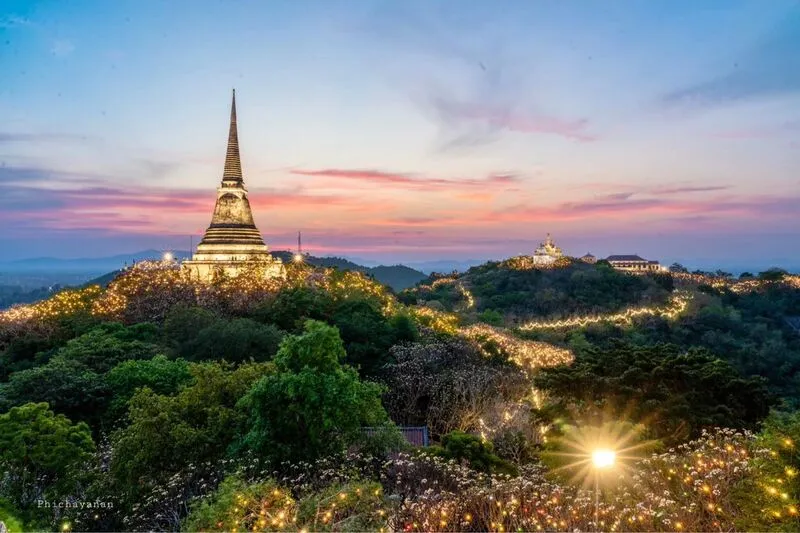
1. Phra Nakhon Khiri Historical Park is one of Phetchaburi's most important landmarks. The complex stands on a hill approximately 95 meters high in the center of the city and extends across three summits. King Mongkut, Rama IV, commissioned a royal residence here for seasonal stays and named the complex “Phra Nakhon Khiri,” although local residents commonly refer to it simply as “Khao Wang,” meaning Palace Hill.
Highlights: Phra Nakhon Khiri is remarkable because it brings together a royal palace, temples, a chedi, government buildings and elevated viewpoints along the same ridge. Visitors can see royal halls and architecture influenced by both Western and Chinese styles while enjoying broad views across Phetchaburi city. Few places in the province combine history, architecture and landscape so clearly in a single site.
Phra Nakhon Khiri was completed in 1860 under the supervision of Chao Phraya Sri Suriwong, also known as Chuang Bunnag. The complex is organized around three hilltops. The eastern summit is associated mainly with religious buildings, the central summit contains Phra That Chom Phet, while the western summit holds the principal palace buildings and royal residences.
One particularly interesting site is Wat Phra Kaeo, which served as the royal temple of Phra Nakhon Khiri. On the eastern slope lies Wat Maha Samanaram, whose ordination hall contains murals by Khrua In Khong, one of the most important Thai painters of the early Rattanakosin period. This makes the site especially rewarding for travelers interested in art history as well as royal architecture.
The central summit is dominated by Phra That Chom Phet, an important visual landmark from which visitors can look across the palace buildings on the neighboring summits and over the city below. On the western summit are several major structures, including Phra Thinang Phet Phum Phairot, Phra Thinang Pramot Mahaisawan, Phra Thinang Wetchayan Wichian Prasat and Ho Chatchawan Wiang Chai.
Visitors should allow at least half a day for Phra Nakhon Khiri. Those who want to see the museum and explore all three summits should allow even more time. A funicular railway is available for travelers who do not want to walk up the hill, although considerable walking is still required between buildings and hilltops once inside the historical park. Comfortable shoes and drinking water are strongly recommended.
Getting There: Phra Nakhon Khiri is located on Khiri Ratthaya Road in Khlong Krachaeng Subdistrict, Mueang Phetchaburi District. The hill is close to the city center and is easily visible from Phet Kasem Road. From Bangkok, follow Highway No. 4 into Phetchaburi city and then follow signs for Phra Nakhon Khiri. Visitors can either walk up the hill or use the funicular railway.
Map (GPS): https://www.google.com/maps/dir/?api=1&destination=13.109975,99.938170&travelmode=driving
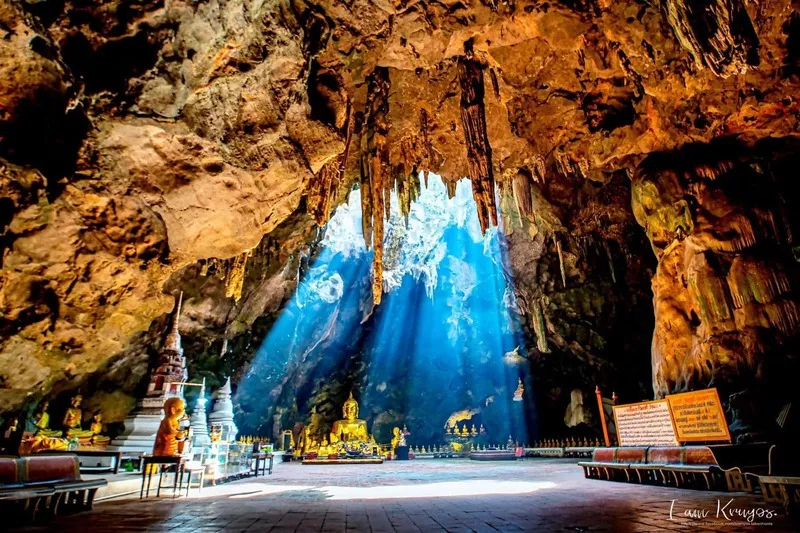
2. Tham Khao Luang Cave is one of Phetchaburi's best-known natural caves and religious sites. Located in Thong Chai Subdistrict, Mueang Phetchaburi District, it is only a short distance from the city and Phra Nakhon Khiri. Inside are stalactites, stalagmites, numerous Buddha images and openings in the cave ceiling that allow natural sunlight to illuminate the cavern below.
Highlights: The most iconic sight at Tham Khao Luang occurs when shafts of sunlight enter through openings in the ceiling and fall into the cave. Under suitable weather conditions and at the right angle of the sun, the beam of light contrasts dramatically with the dark cavern and the Buddha images below, creating an atmosphere that feels both natural and deeply spiritual.
The cave has connections with the Thai royal court during the Rattanakosin period and contains a large number of Buddha images. A visit is therefore not simply about geology or photography; it is also an encounter with an active sacred space respected by local worshippers.
The route down into the cave involves stairs and changes in elevation. Shoes with good grip are recommended, especially when surfaces are damp. Elderly visitors or travelers with mobility limitations should assess their physical condition before descending into the deeper sections.
Monkeys live around the hill and surrounding area. Food and personal belongings should be kept securely stored, and visitors should avoid carrying visible food bags or feeding monkeys directly by hand. Families traveling with children should keep them close from the parking area to the cave entrance.
Tham Khao Luang can be combined easily with Phra Nakhon Khiri, Wat Mahathat Worawihan and Phra Ram Ratchaniwet because all are within Mueang Phetchaburi District. Starting early makes it possible to explore several major historical and cultural attractions in the same day without rushing.
Getting There: From Phetchaburi city, follow the road toward Thong Chai Subdistrict and signs for Tham Khao Luang. The cave is not far from Khao Wang and is most easily reached by private car. Before descending, check current opening conditions. Typical visiting hours are approximately 08:00–16:00 on weekdays and 08:00–17:00 on weekends.
Map (GPS): https://www.google.com/maps/dir/?api=1&destination=13.137548,99.933250&travelmode=driving

3. Hat Cha Am Beach is one of the best-known beaches on the upper Gulf of Thailand and one of the country's classic seaside resort destinations. Its main strengths are a long beachfront, easy access from Bangkok, and a wide selection of hotels, seafood restaurants, shops and tourism services, making it suitable for families, couples and travelers looking for an uncomplicated beach getaway.
Highlights: The beach is relatively broad and extends for a considerable distance, making it suitable for walking along the shore. During many periods of the year the water is fairly shallow and wave conditions are relatively gentle, which has helped make Cha-am popular with families. Visitors can sit on beach chairs beneath umbrellas, eat seafood by the sea, swim, walk along the beach or use water-sport services in designated areas.
Cha-am's character comes from its combination of resort-town convenience and a traditional seaside community. Although the area contains many hotels and tourism businesses, visitors can still see local restaurants, beach vendors and communities whose livelihoods depend on both tourism and fishing.
The area is well suited to a 1–2 night stay because Cha-am can be used as a base for visiting Mrigadayavan Palace, nearby natural attractions or even driving into Phetchaburi city to explore Khao Wang and historic temples without changing hotels every day.
Early morning is a good time for walking along the shore and observing the local community, while the evening brings cooler temperatures and a livelier dining scene. Weekends and public holidays can become very busy, so travelers who prefer a quieter atmosphere should consider visiting on weekdays.
Anyone planning to swim should pay attention to actual wave conditions and local safety guidance. For commercial activities such as jet skiing or banana boats, confirm prices and conditions with the operator before using the service.
Getting There: From Bangkok, follow Highway No. 4, or Phet Kasem Road, south toward Cha-am District. The distance from Phetchaburi city to Cha-am is approximately 41 kilometers. At the main junction for the beach, continue around 2 kilometers to the shoreline. Cha-am can be reached by private car, bus or train.
Map (GPS): https://www.google.com/maps/dir/?api=1&destination=12.794277,99.984233&travelmode=driving

4. Kaeng Krachan National Park is a vast forested area in western Phetchaburi and one of Thailand's most important natural destinations. The park contains mountains, evergreen forest, mixed forest, streams and highly diverse ecosystems, making it a major destination for birdwatchers, wildlife photographers and travelers seeking a more serious nature experience.
Highlights: Kaeng Krachan is famous for its rich forest, wildlife and exceptionally diverse birdlife, as well as the route leading to Phanoen Thung, one of Thailand's best-known sea-of-mist viewpoints. The area around Kaeng Krachan Reservoir is also popular for relaxing, camping and enjoying mountain and water scenery.
The area's importance extends far beyond tourism. The forests of Kaeng Krachan form part of the Kaeng Krachan Forest Complex, which has been inscribed as a UNESCO World Heritage natural site, recognizing the region's outstanding ecological value and biodiversity at an international level.
Birdwatchers should begin early in the morning because the park is considered one of Thailand's leading birding destinations, with both resident and migratory species occurring seasonally. Wildlife should always be observed from a safe distance; visitors should remain quiet and never feed wild animals.
A trip to Kaeng Krachan requires more planning than an ordinary sightseeing stop because some areas have restrictions on entry times, vehicle numbers, road conditions and seasonal closures designed to protect and restore natural habitats. Travelers heading to Phanoen Thung or deeper forest areas should always check the latest park announcements in advance.
Visitors looking for a relaxed experience can stay around the reservoir and park headquarters, while serious nature travelers should allow at least 2 days for forest exploration, birdwatching and a trip to Phanoen Thung without rushing.
Getting There: From Phetchaburi city, drive toward Kaeng Krachan District. A private vehicle is the most convenient option. Once inside the national park, follow all designated routes and official entry times. Before continuing to higher elevations or nature trails, check road conditions and access restrictions with park staff.
Map (GPS): https://www.google.com/maps/dir/?api=1&destination=12.891131,99.628143&travelmode=driving

5. Phanoen Thung is a high-elevation viewpoint inside Kaeng Krachan National Park and one of Thailand's most famous places for viewing a sea of mist. A major advantage of the area is that mist can sometimes be seen during several periods of the year rather than only during the cool season.
Highlights: The viewpoint overlooks a complex series of mountain ridges within the Kaeng Krachan forest. On suitable mornings, moist air settles into the valleys and forms a broad layer of mist, while mountaintops rise above it in multiple layers, creating one of the park's most recognizable landscapes.
The route to Phanoen Thung passes through exceptionally rich forest and is therefore popular with birdwatchers and wildlife enthusiasts. Animals or signs of wildlife may occasionally be seen along the route, but they should always be observed from a safe distance and vehicles should not stop in ways that obstruct traffic.
Reaching Phanoen Thung is very different from driving to a conventional roadside viewpoint. Some sections use park roads where uphill and downhill traffic is managed according to scheduled times and directional restrictions. The area may also close during certain seasons, so travelers must confirm access conditions with the national park before every visit.
Travelers hoping to see the morning sea of mist should stay in the Kaeng Krachan area the night before rather than driving from Phetchaburi city in the middle of the night. A light jacket, suitable walking shoes, drinking water and seasonal rain protection are useful.
Phanoen Thung is best planned as part of a dedicated Kaeng Krachan nature trip rather than as a quick stop between unrelated attractions. Travel time and park access regulations require more careful planning than ordinary sightseeing.
Getting There: Visitors must first enter Kaeng Krachan National Park and then follow the park route toward Phanoen Thung. The vehicle should be suitable for current road conditions, and all uphill and downhill time restrictions must be followed strictly. Check the latest park announcements before the day of travel.
Map (GPS): https://www.google.com/maps/dir/?api=1&destination=12.824264,99.365502&travelmode=driving
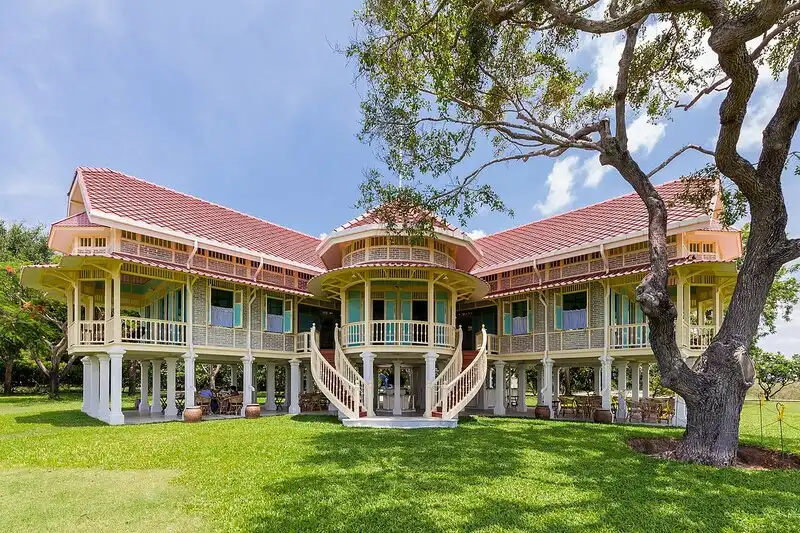
6. Mrigadayavan Palace is a seaside royal residence in the Cha-am area built during the reign of King Vajiravudh, Rama VI. It is one of Thailand's most distinctive royal residences in terms of architecture. The palace consists of elevated wooden buildings connected by long covered walkways and was designed to take advantage of natural sea breezes.
Highlights: The architecture is defined by light-colored timber buildings, hipped roofs, rhythmic rows of columns and elevated corridors linking the different royal residences. Seen across the open lawns and surrounding trees, the structure has a light and airy character particularly suited to the tropical coastal climate.
The palace was built as a royal retreat for King Rama VI and is often promoted in tourism as the “Palace of Love and Hope.” Its atmosphere is calm and very different from a monumental palace in a city, instead resembling an elegant royal seaside residence integrated with its natural surroundings.
Visitors should allow at least 1–2 hours to explore the buildings and gardens. Dress should be respectful, and all conservation regulations must be followed, particularly restrictions involving photography and access to certain parts of the historic wooden structures.
The palace is especially suitable for travelers interested in history, architecture and photography and combines easily with Hat Cha-am Beach. Visitors staying in Cha-am can explore the palace in the morning or late morning before returning to the beach for the afternoon.
Because the palace consists largely of historic wooden structures, restoration work and public access to individual sections may change according to conservation needs. Travelers should check current opening days and access conditions before departure.
Getting There: Mrigadayavan Palace is located in Cha-am District between Cha-am and Hua Hin. Follow Phet Kasem Road and turn into the palace area according to the signs. It is only a short drive from Cha-am Beach, and private cars or taxis are the most convenient options.
Map (GPS): https://www.google.com/maps/dir/?api=1&destination=12.697773,99.962946&travelmode=driving

7. Hat Chao Samran Beach is one of Phetchaburi's historic beaches, located in Mueang Phetchaburi District and considerably closer to the city than Cha-am. Its appeal lies in its relatively simple coastal atmosphere and local seaside community, making it suitable for travelers who want to relax beside the Gulf of Thailand without staying in a large resort town.
Highlights: Hat Chao Samran has a shoreline suitable for walking, enjoying the sea breeze and watching the sunrise. Early mornings are especially peaceful and provide a better opportunity to observe local fishing life than at larger resort beaches.
The beach's name is associated with historical accounts of royal visits and seaside recreation, giving the destination a cultural and historical dimension in addition to its role as a place for relaxation.
Several accommodation options and seafood restaurants are located around the beach, making it suitable for an overnight stay. Food-focused travelers can also use Hat Chao Samran as a base for visiting Ban Laem and Laem Phak Bia, areas known for fishing communities and seafood restaurants.
The beach suits families, couples and visitors who prefer a quieter setting than Cha-am. Anyone planning to swim should still check actual sea and wave conditions because the character of the Gulf coast can change with season and weather.
Hat Chao Samran can be combined with Hat Puek Tian Beach and the Laem Phak Bia area in the same day, or used as an overnight stop before exploring Phetchaburi city the following morning.
Getting There: From Phetchaburi city, follow the road east toward the Hat Chao Samran coastline. A private car is the most convenient option. The drive from the city is relatively short, and the coastal route can be continued onward to Hat Puek Tian or Laem Phak Bia.
Map (GPS): https://www.google.com/maps/dir/?api=1&destination=13.005946,100.065663&travelmode=driving

8. Hat Puek Tian Beach is a beach in Puek Tian Subdistrict, Tha Yang District, best known for sculptures of characters from Thai literature standing beside and in the sea. The most recognizable is the giant sea ogress from the epic poem Phra Aphai Mani, giving the beach a visual identity unlike any other coastal destination in Phetchaburi.
Highlights: The literary sculptures are the beach's best-known feature. Their appearance changes with the tide as seawater rises and falls around them, producing different photographic compositions throughout the day and creating a strong connection between Thai literature and the coastal landscape.
Phra Aphai Mani by Sunthorn Phu is one of Thailand's most important literary works, and incorporating its characters into the landscape gives Hat Puek Tian a character that differs from beaches focused primarily on swimming or resort activities.
The beach itself is generally quiet, with seafood restaurants and accommodation scattered around the coastal area. It works particularly well as a stop between Hat Chao Samran and Cha-am or as a slower seaside destination in its own right.
Beach conditions and water levels vary with season and tide. Visitors should be cautious when approaching sculptures during high tide or rough waves and should use safer designated areas if they wish to swim rather than entering the water close to offshore structures.
Hat Puek Tian can be combined easily with Hat Chao Samran Beach, while Laem Phak Bia or Cha-am can be added depending on the direction of travel. Seafood lovers can turn the entire route into a full-day coastal food and sightseeing trip.
Getting There: From Phetchaburi city, follow the road toward the coast and continue to Puek Tian Subdistrict, or travel along the coastal route from Hat Chao Samran. A private car is the most practical option for connecting several beaches in the same day.
Map (GPS): https://www.google.com/maps/dir/?api=1&destination=12.947263,100.034003&travelmode=driving
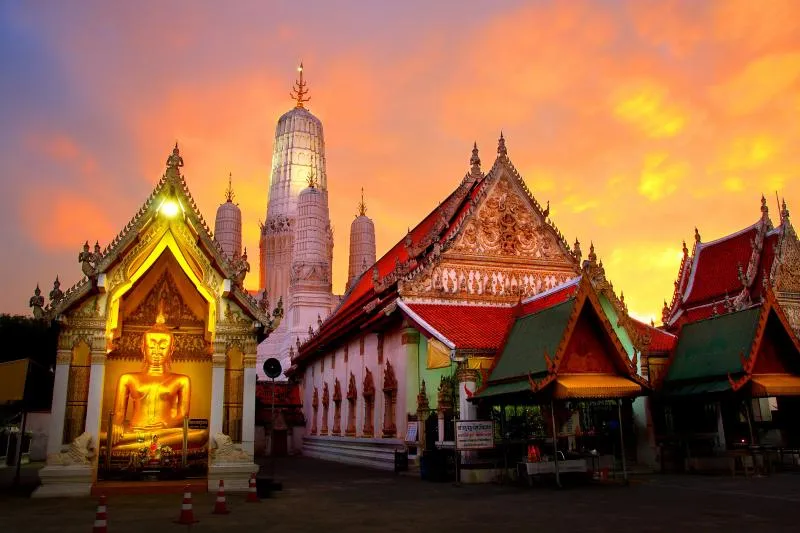
9. Wat Mahathat Worawihan is an important royal temple in the heart of Phetchaburi city and one of the best places to understand the reputation of the province's traditional craftsmen. The temple has a long history and is particularly distinguished by its prang towers, stucco work and architectural details representing the skills of local artisans across several periods.
Highlights: The group of prang towers forms the temple's most recognizable architectural feature and can be seen from several parts of the city. Around the temple, elaborate stucco decorations and other artistic elements deserve close attention because much of the site's character lies in fine details rather than only in the overall silhouette.
Phetchaburi has long been famous for stucco craftsmanship, and Wat Mahathat is one of the key places for understanding the development and quality of this tradition. Travelers interested in Thai art can use the temple as a starting point before continuing to other historic temples in the old city.
Beyond its artistic importance, Wat Mahathat remains an active center of Buddhist worship. Local residents continue to visit the temple to pay respects and participate in religious activities. Visitors should therefore dress modestly and remain quiet around the ordination hall and ceremonial areas.
The temple's central location makes it easy to combine with the old-town market area, local khanom mo kaeng shops, Phra Nakhon Khiri and Phra Ram Ratchaniwet. It is particularly suitable for a half-day route focused on history, religion and traditional Phetchaburi art.
Photographers should spend time observing the stucco details and architectural elements around the prang towers rather than taking only wide-angle photographs. The temple's real appeal lies in craftsmanship accumulated across many individual surfaces and structures.
Getting There: Wat Mahathat Worawihan is located in central Phetchaburi and can be reached quickly from Phra Nakhon Khiri or the old-market area. Cars, motorcycles and local taxis can access the temple conveniently.
Map (GPS): https://www.google.com/maps/dir/?api=1&destination=13.105563,99.947061&travelmode=driving
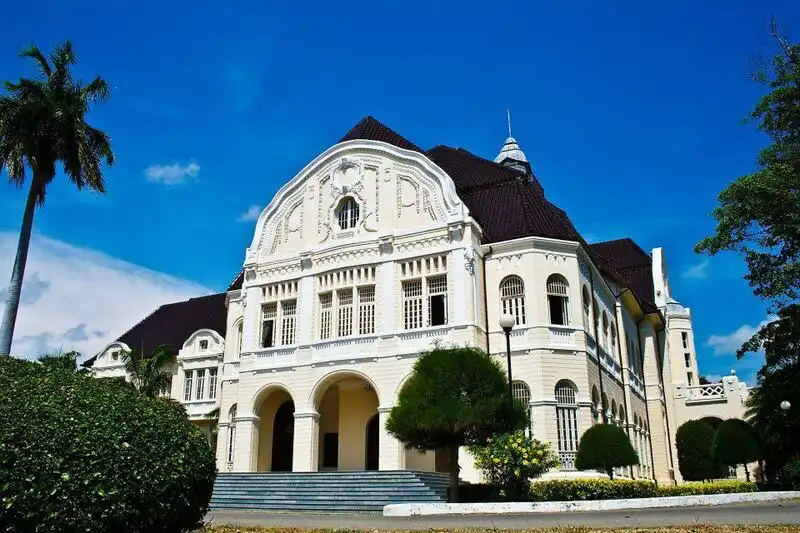
10. Phra Ram Ratchaniwet (Ban Puen Palace) is an important royal residence in Phetchaburi city and one of the three palaces closely associated with the province. Construction began during the reign of King Chulalongkorn, Rama V, and the building is particularly notable for its European architectural style, which differs clearly from both Phra Nakhon Khiri and Mrigadayavan Palace.
Highlights: The palace is distinguished by symmetrical European-influenced architecture, light-colored façades, carefully arranged windows and openings, and interior decorative details reflecting the tastes of the Thai royal court during a period of increasing European influence.
Construction began toward the end of the reign of King Rama V and continued into the reign of King Rama VI. The palace therefore provides an important architectural record of the transition into the early 20th century and the changing character of royal architecture in Siam.
The atmosphere differs significantly from Khao Wang because Ban Puen Palace stands on level ground rather than on a hill. Visitors do not need to make a steep climb and can appreciate the architecture at close range, making the site particularly suitable for elderly travelers, families and history enthusiasts who prefer an easily accessible attraction.
Visitors should check current regulations concerning photography inside the building and which sections are open, as the historic property remains under active management and certain areas may be restricted for operational or conservation reasons.
Phra Ram Ratchaniwet can be combined easily with Phra Nakhon Khiri, Wat Mahathat Worawihan and Tham Khao Luang Cave as part of a Phetchaburi city route. With a full day, travelers can see several of the city's most important historical attractions without leaving the district.
Getting There: The palace is located within Phetchaburi city and is easily accessible by car. From Phet Kasem Road, follow signs into the city for Phra Ram Ratchaniwet or Ban Puen Palace. It is only a short drive from Phra Nakhon Khiri and is well suited to the same day's itinerary.
Map (GPS): https://www.google.com/maps/dir/?api=1&destination=13.092975,99.948491&travelmode=driving
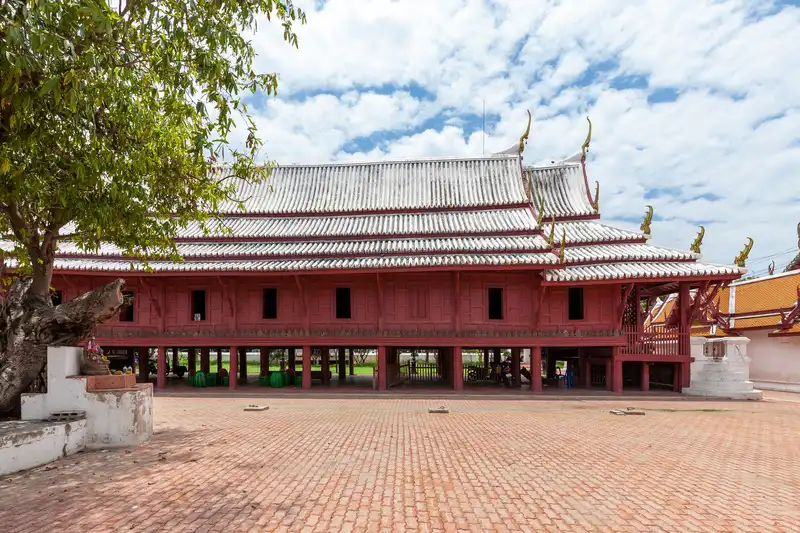
11. Wat Yai Suwannaram Worawihan is an ancient royal temple in Tha Rap Subdistrict, Mueang Phetchaburi District, and one of the best places for travelers who want to understand the meaning of the traditional “Phetchaburi School” of craftsmanship. The temple's history reaches back to the Ayutthaya period and includes a major restoration during the reign of King Suea under Phra Suwan Muni, who was later elevated to the position of Supreme Patriarch and became known as Somdet Phra Sangkharat Taengmo.
Highlights: The ordination hall and its mural paintings are among the temple's most important treasures. The murals are considered outstanding examples of late Ayutthaya art and include scenes from the life of the Buddha, assemblies of deities, giants, nagas, garudas and celestial beings. Facial features and decorative details differ noticeably from later Bangkok-period mural styles, giving the paintings a distinctive historical character.
The ordination hall is a brick-and-stucco building characteristic of late Ayutthaya architecture, with a multi-tiered gable roof decorated with chofa, bai raka and hang hong elements. The pediments feature both garuda motifs and traditional Thai flame patterns, while the stucco details reveal the high level of craftsmanship for which Phetchaburi has long been known.
Another major feature is the large wooden sermon hall, supported by octagonal columns and decorated with numerous painted details. Nearby is the scripture library standing in water, designed according to traditional knowledge to help protect Buddhist manuscripts from termites and moisture. Together, these structures make the temple feel almost like a living museum of traditional Thai architecture that remains in active religious use.
The temple is suitable for history enthusiasts, art lovers, students and general travelers who want to experience a deeper side of Phetchaburi beyond its royal palaces. Photographers should pay particular attention to doors, columns, stucco decorations, mural details and wooden structures rather than focusing only on wide views of the temple.
Wat Yai Suwannaram can be combined easily with Wat Mahathat Worawihan, Phra Nakhon Khiri and Phetchaburi's old-town area in a half-day or full-day route. The short distances between these places make it ideal for a “historic temples–Phetchaburi craftsmanship–royal palace” itinerary.
Getting There: From Phet Kasem Road, enter Phetchaburi city and continue toward Tha Rap Subdistrict. The temple is within the urban area and can be reached conveniently by car or motorcycle. It is generally open daily from around 08:00–17:00. Visitors should dress respectfully and remain quiet within the religious grounds.
Map (GPS): https://www.google.com/maps/dir/?api=1&destination=13.109020,99.952572&travelmode=driving
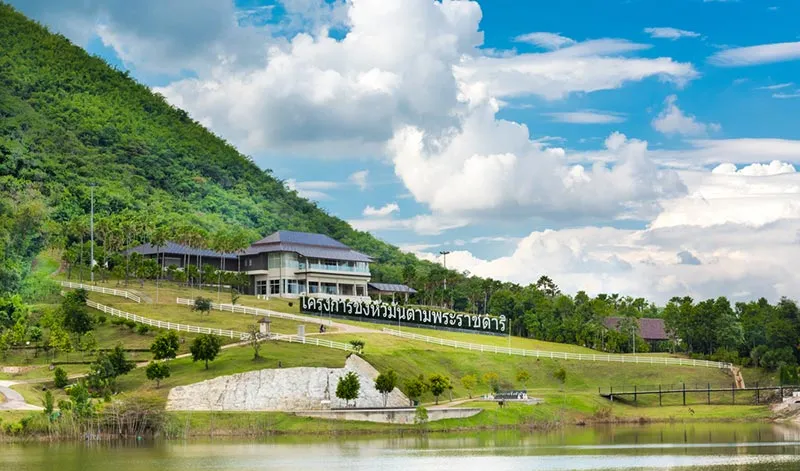
12. Chang Hua Man Royal Project is located at Ban Nong Kho Kai in Khao Krapuk Subdistrict, Tha Yang District. It is an educational center focusing on agriculture and integrated resource management developed under the royal initiative of King Bhumibol Adulyadej, Rama IX. Its main significance lies in transforming a challenging piece of land into a working model for agriculture, water management, renewable energy and practical resource use.
Highlights: The project includes demonstration plots for economic crops and local plants, livestock areas, water-management systems and renewable-energy facilities. The wind turbines have become one of the most recognizable visual symbols of the site. Visitors therefore come not only to photograph the landscape but also to see how different types of resources can be connected within a single management system.
The name “Chang Hua Man” is associated with the story of a sweet potato that was placed on a weighing scale and continued to sprout. The story became a symbolic starting point for an idea showing that, when land and resources are managed thoughtfully, even something small can develop into a broader source of knowledge and benefit.
The project has been developed as an outdoor classroom suitable for families, students, farmers and travelers interested in sustainable development. Visitors can clearly see the relationships between soil, water, crops, energy and agricultural production within one integrated area.
Because much of the project is open-air and requires a fair amount of walking, visitors should bring a hat, umbrella, drinking water and comfortable shoes. Morning is generally a better time to explore than midday, when temperatures can become high. The early hours are also more suitable for photographing wind turbines against the agricultural landscape.
The project can be combined with attractions in Tha Yang, Cha-am or a continued journey toward Kaeng Krachan. This makes it suitable for a day that combines educational travel with nature without needing to return to Phetchaburi city first.
Getting There: The project is located at Moo 5, Ban Nong Kho Kai, Khao Krapuk Subdistrict, Tha Yang District. A private car is the most convenient option. It is generally open daily from around 08:00–16:00. Groups should check current visiting requirements and arrangements before traveling.
Map (GPS): https://www.google.com/maps/dir/?api=1&destination=12.747119,99.706015&travelmode=driving
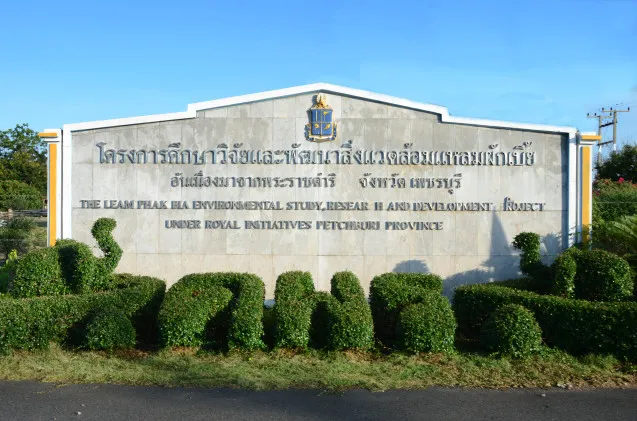
13. Laem Phak Bia Environmental Research and Development Project is located in Laem Phak Bia Subdistrict, Ban Laem District. It is a royal initiative project that has played an important role in researching practical methods for managing wastewater and solid waste through natural processes and has become one of Thailand's most important environmental learning centers.
Highlights: The central principle is “nature helping nature.” The project uses treatment ponds, constructed wetlands, plants, soil, microorganisms and natural ecological processes to reduce pollution before water is safely returned to the environment. Visitors can therefore see how wastewater management does not always need to depend entirely on complex, energy-intensive technology.
Laem Phak Bia is particularly suitable for environmental research because it is a flat coastal area containing a wide variety of ecosystems, from treatment ponds and wetlands to mangrove forests and the Gulf coast. This makes it possible to observe the results of treatment processes from the starting point through to the natural receiving environment.
For general travelers, the project is also interesting as an ecological learning area and birdwatching destination. The Laem Phak Bia coast supports many waterbirds and shorebirds, making it possible to combine environmental education with a birdwatching trip along the nearby coastline.
The project is suitable for students, families, educational institutions, organizations and travelers interested in environmental management. Groups should coordinate in advance to make the most of guided learning opportunities and access to different parts of the project.
The project can be combined with Laem Phak Bia, Hat Chao Samran Beach and fishing communities around Ban Laem in the same day. This creates a varied route combining environmental learning, coastal ecosystems, seafood and local community life.
Getting There: From Phetchaburi city, travel toward Ban Laem District and continue to Laem Phak Bia Subdistrict. A private car is the most convenient option. Weekday opening hours are generally around 08:30–16:30, while weekend visiting hours are shorter. Check the latest schedule before departure.
Map (GPS): https://www.google.com/maps/dir/?api=1&destination=13.047264,100.084410&travelmode=driving

14. Khao Nang Phanthurat Forest Park is a natural attraction in Cha-am District known for its distinctive limestone mountain formation. Seen from a distance, the ridge resembles a woman lying on her back, leading to the local nickname “Khao Nang Non.” The landscape is also connected with the Thai literary story of Sang Thong and the giantess Nang Phanthurat.
Highlights: Nature trails and limestone scenery form the heart of the experience. Visitors can see cliffs, ridgelines and various points associated with the story of Nang Phanthurat, giving the walk an additional layer of literature and local legend beyond its natural landscape.
The area has been conserved and rehabilitated to protect the limestone mountain and surrounding ecosystem. It therefore offers a useful example of how a natural landscape can be developed as an educational and tourism resource while reducing further impact on the original terrain.
Travelers who enjoy short hikes and mountain photography can see a completely different side of Cha-am from its beach resort image. Some elevated points offer broader views of the surrounding landscape, and morning is particularly suitable because temperatures are cooler.
Some trail sections are steep and rocky. Visitors should wear suitable walking shoes, carry drinking water and a hat, and avoid hiking during heavy rain because limestone and soil surfaces can become slippery.
The forest park can be combined with Hat Cha-am Beach, Mrigadayavan Palace or attractions around Khao Krapuk, making it a good choice for travelers who want both sea and mountain scenery within the same Cha-am itinerary.
Getting There: The forest park is located in Cha-am District, Khao Yai Subdistrict. From Phet Kasem Road, follow local signs toward the park. A private car is the most convenient option. It is generally open around 08:00–17:00, although current park notices should be checked before traveling.
Map (GPS): https://www.google.com/maps/dir/?api=1&destination=12.845614,99.953808&travelmode=driving

15. Kaeng Krachan Dam is an earth-fill dam across the Phetchaburi River in Kaeng Krachan District. Completed in 1966, it plays an important role in water storage, irrigation and regional water management. At the same time, the large reservoir has become one of the most scenic landscapes in the Kaeng Krachan area.
Highlights: The reservoir covers approximately 46.5 square kilometers and has a storage capacity of around 710 million cubic meters. Numerous small islands are scattered across the water, and when water levels are suitable, ridgelines appear above the reservoir like a group of islands, creating a landscape very different from that of a conventional dam.
Popular activities include boat trips across the reservoir, photography, sunset viewing, fishing in permitted areas and simply relaxing along the waterfront. Early morning and late afternoon are particularly attractive for photography because softer light can create clear reflections of the surrounding mountains on the water.
For families or travelers who do not want a demanding hike, Kaeng Krachan Dam is much easier to access than Phanoen Thung or Thothip Waterfall. Visitors can enjoy the atmosphere of Kaeng Krachan without traveling deep into forested routes.
The area around the reservoir has resorts, homestays, restaurants and a variety of tourism activities, making it suitable for a 1–2 night stay. It can also serve as a base for visiting Kaeng Krachan National Park, Phanoen Thung or the Ban Phu Khem community.
Anyone taking a boat trip or participating in water activities should use operators with proper safety equipment, wear a life jacket and avoid swimming in areas that are not specifically designated for recreation.
Getting There: From Phetchaburi, travel through Tha Yang District and continue along Highway 3499 toward Kaeng Krachan. A private car is the most convenient option. The dam area is generally open around 06:00–18:00.
Map (GPS): https://www.google.com/maps/dir/?api=1&destination=12.920035,99.629908&travelmode=driving

16. Thothip Waterfall is a natural waterfall deep within the forests of Kaeng Krachan National Park. It is best suited to travelers who want a genuine forest experience rather than a waterfall that can be reached within a few minutes of parking, because the journey requires walking and offers a nature experience from the moment the trail begins.
Highlights: The waterfall has 9 tiers flowing down the forested slope. Its appeal lies not only in the waterfall itself but also in the approximately 4.5-kilometer hiking route, where visitors experience humidity, birds, insects and the distinctive atmosphere of the Kaeng Krachan forest.
The period from late rainy season into early cool season is particularly attractive because the forest remains green and the waterfall still carries a good amount of water, while trail conditions may be easier than during periods of heavy rainfall. Natural conditions can change quickly, however, so park announcements should always be checked before departure.
Hikers should have a reasonable level of fitness and prepare shoes with good grip, drinking water, snacks, rain protection and leech protection during humid periods. Visitors should remain on the designated trail and should not separate from their group.
Along the trail, visitors may hear birds and gibbons and may occasionally notice signs of wildlife. Animals should always be observed from a distance without loud noise because the route passes through an ecologically important forest environment.
Thothip Waterfall is best included in a dedicated Kaeng Krachan itinerary rather than combined with attractions in several different zones on the same day. Both travel time and hiking time must be considered, and nature-focused travelers should stay in the Kaeng Krachan area for at least one night.
Getting There: Visitors must enter Kaeng Krachan National Park and continue to the trailhead for the waterfall. Access depends on season, road conditions and park announcements. The national park area generally operates around 06:00–18:00, but these hours should never be interpreted as a guarantee that the waterfall route itself is open. Always confirm access status before traveling.
Map (GPS): https://www.google.com/maps/dir/?api=1&destination=12.848755,99.307984&travelmode=driving
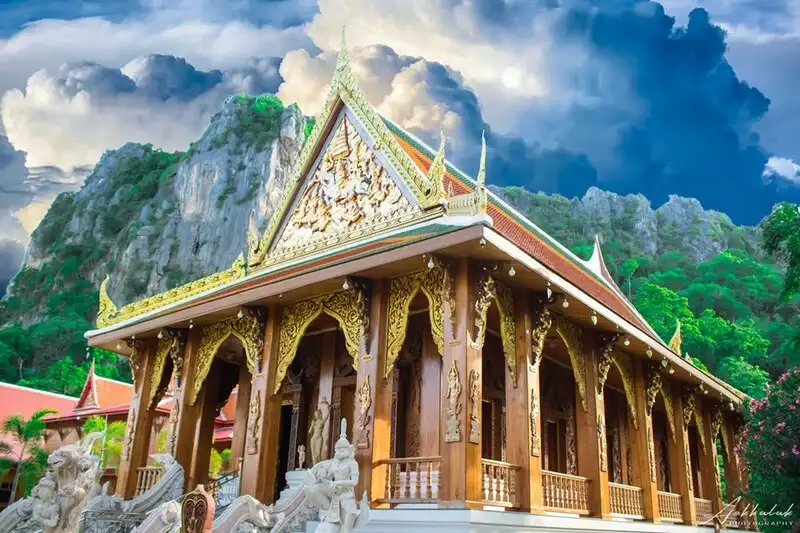
17. Wat Khao Yoi is an important cave temple in Khao Yoi District located close to Phet Kasem Road. It makes a convenient stop for travelers driving from Bangkok toward Phetchaburi city. The site combines limestone mountain scenery, natural caves and Buddhist worship within the same landscape.
Highlights: Inside the cave are natural chambers and Buddha images positioned among limestone walls. Moving from the bright exterior into the cooler interior changes the atmosphere immediately, creating a peaceful setting that feels almost like a naturally formed Buddhist sanctuary.
Khao Yoi is part of a limestone landscape containing numerous caves, and many caves in Phetchaburi have long been used as places of worship or meditation. Wat Khao Yoi therefore helps visitors understand the close relationship between local geography and religious belief.
The temple is suitable for travelers of many ages, although some areas have stairs, uneven surfaces and damp cave floors. Comfortable footwear is recommended, with extra caution during the rainy season.
Travelers coming from Bangkok can use Wat Khao Yoi as the first stop of the trip before continuing into Phetchaburi city for Phra Nakhon Khiri, Wat Mahathat or Tham Khao Luang. This adds variety to the journey without requiring a major detour.
Khao Yoi District also contains communities and religious sites reflecting the area's cultural diversity, making it worthwhile for travelers interested in community history as well as limestone scenery.
Getting There: The temple is located in Khao Yoi Subdistrict, Khao Yoi District, close to Phet Kasem Road. From Bangkok, drive south and take the local turnoff toward the temple. It is generally open daily from around 08:00–17:00.
Map (GPS): https://www.google.com/maps/dir/?api=1&destination=13.236525,99.828105&travelmode=driving
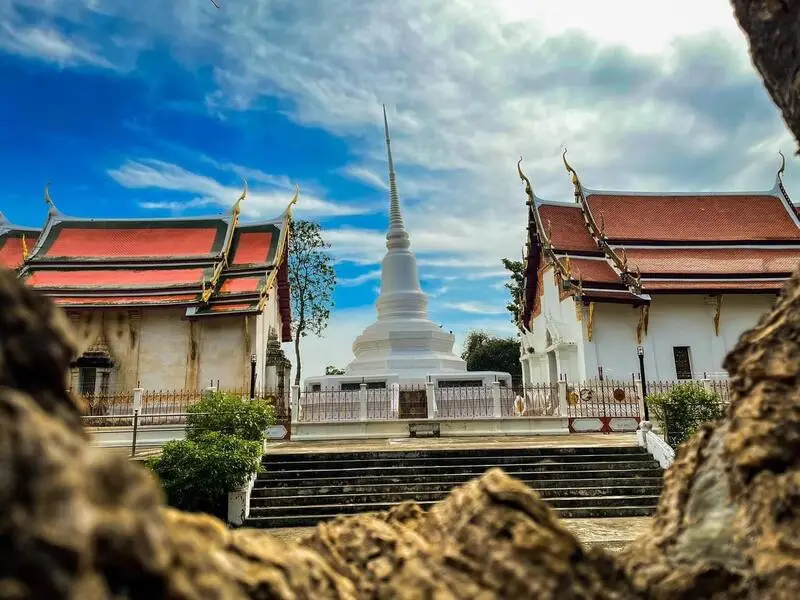
18. Wat Khao Bandai It is an old temple in Rai Som Subdistrict, Mueang Phetchaburi District. Its distinctive character comes from its location on a small hill containing several caves, giving the temple both a lower ground-level religious area and higher cave zones used for worship and meditation.
Highlights: The hill caves are what distinguish Wat Khao Bandai It from ordinary temples on flat ground. Inside are Buddha images and several sacred spaces. The atmosphere is quiet and secluded, making the site especially suitable for travelers who want to experience Buddhist worship in a mountain and cave setting.
The area's history is connected with an old monastic retreat and the tradition of monks practicing meditation in mountain settings, a pattern found in several parts of Phetchaburi. The temple therefore has both religious significance and value as an example of how caves were used as peaceful places for Buddhist practice.
The terrain requires some climbing and walking over rocky surfaces. Elderly visitors should choose only areas suitable for their physical condition, while those planning to explore the caves should wear shoes with good grip.
The site is suitable for travelers interested in old temples, local history and natural caves. Depending on how many areas visitors want to explore, a visit may take from around 1 hour to half a day.
The temple is close to Phetchaburi city and can easily be combined with Phra Nakhon Khiri, Tham Khao Luang, Wat Yai Suwannaram and Wat Mahathat, making it a useful addition to a city route focused on temples and historical sites.
Getting There: From Phetchaburi city, travel toward Rai Som Subdistrict and follow signs for Wat Khao Bandai It. A private car is convenient. The temple is generally open daily from around 08:00–17:00.
Map (GPS): https://www.google.com/maps/dir/?api=1&destination=13.101384,99.927193&travelmode=driving
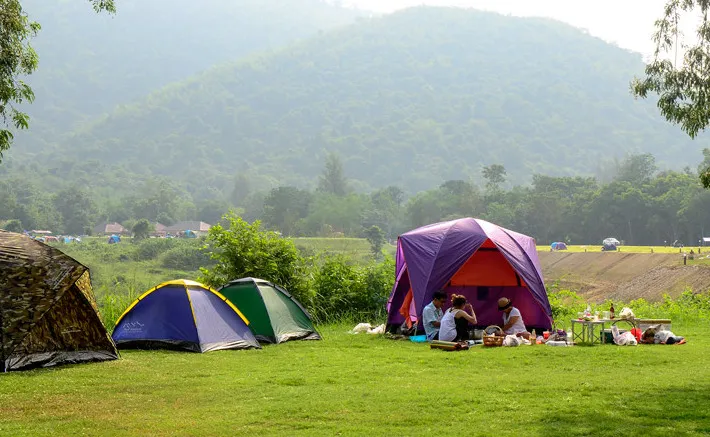
19. Ban Phu Khem Eco-Tourism Project (Homestay) is a community on the edge of Kaeng Krachan Reservoir that has developed tourism around local life and natural-resource conservation. It is especially suitable for travelers who want to experience Kaeng Krachan from the perspective of a community rather than visiting only viewpoints or the national park.
Highlights: The main attractions are the quiet reservoir-side atmosphere, local community life and activities connected with conservation of water and fish resources. Tourism here does not depend on large structures or commercial entertainment but instead focuses on direct experience with local people and the surrounding landscape.
The community's tourism model grew from the need to adapt after relying heavily on fish resources. As fish populations became less predictable, residents developed community conservation rules and began using tourism as another source of income alongside efforts to protect the local environment.
Visitors can learn about life by the water, community activities and the relationship between local residents and the reservoir. Staying in a homestay allows more time to experience the evening and early morning atmosphere than a brief daytime stop.
The project is suitable for families, student groups, community-tourism travelers and visitors who enjoy slower forms of travel. Anyone interested in specific activities should contact the community in advance because programs and accommodation depend on prior arrangements.
The community can be combined with Kaeng Krachan Dam and Kaeng Krachan National Park. Staying at Ban Phu Khem can provide a base for exploring the area while adding a community dimension to a trip otherwise focused on forests and the reservoir.
Getting There: Ban Phu Khem is located in Kaeng Krachan Subdistrict, Kaeng Krachan District. A private car is the most practical option. Accommodation and activities should be booked or arranged with the community in advance rather than assuming that programs will be available immediately on arrival.
Map (GPS): https://www.google.com/maps/dir/?api=1&destination=12.921241,99.569826&travelmode=driving
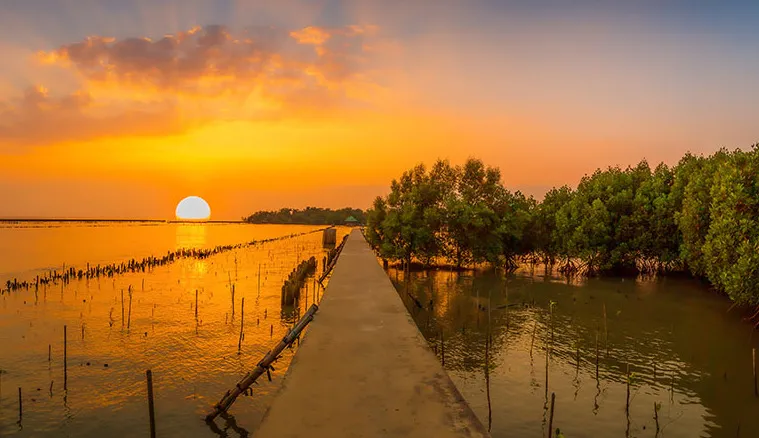
20. Laem Phak Bia is a coastal area in Ban Laem District that shows a side of Phetchaburi very different from the resort atmosphere of Cha-am. Rather than focusing on entertainment or conventional beach tourism, Laem Phak Bia is known for mangrove forests, wetlands, beaches, estuarine areas and coastal ecosystems important to marine life and shorebirds.
Highlights: The tip of the cape opens onto broad views of the Gulf of Thailand. Visitors can walk along the coast, observe mangrove areas and see how the shoreline changes with the tides. The atmosphere is quiet and highly natural, making it particularly attractive for photographers, birdwatchers and travelers interested in coastal communities.
Laem Phak Bia is one of Thailand's important birdwatching areas, especially for waterbirds and shorebirds feeding on mudflats, ponds and wetland habitats. Birdwatchers should bring binoculars and plan their visit according to tidal conditions to improve the chances of seeing a wider range of species.
The area is also closely connected with the Laem Phak Bia Environmental Research and Development Project, allowing visitors to see the relationship between wastewater management, mangrove forest, wetlands and the sea within an actual coastal landscape rather than only through indoor displays.
The attraction's main appeal is its simplicity. Travelers expecting a large selection of beach shops and commercial activities like those found at Cha-am will find a very different atmosphere. For nature lovers, birdwatchers and anyone looking for a quiet coastal setting, however, Laem Phak Bia is one of Phetchaburi's most distinctive destinations.
It can be combined with the environmental project, Hat Chao Samran Beach and seafood restaurants around Ban Laem in the same day. Evening is a good time for coastal scenery, while serious birdwatchers should plan according to the species they hope to see and the state of the tide.
Getting There: From Phetchaburi city, drive toward Ban Laem District and Laem Phak Bia Subdistrict along the coastal route. A private car is the most convenient option. The general coastal area can be visited throughout the day, although access to individual zones or activities may depend on operating hours and tidal conditions.
Map (GPS): https://www.google.com/maps/dir/?api=1&destination=13.026064,100.077934&travelmode=driving
| Topic | Details |
| Province | Phetchaburi is a province in Thailand's lower Central Region with a remarkable variety of attractions, including a historic old town, royal palaces, ancient temples, caves, mountains, western forests, reservoirs, wetlands and the Gulf of Thailand coastline. It is suitable for trips ranging from a single day to 4–5 days. |
| Top 10 Highlights | 1. Phra Nakhon Khiri Historical Park 2. Tham Khao Luang Cave 3. Hat Cha Am Beach 4. Kaeng Krachan National Park 5. Phanoen Thung 6. Mrigadayavan Palace 7. Hat Chao Samran Beach 8. Hat Puek Tian Beach 9. Wat Mahathat Worawihan 10. Phra Ram Ratchaniwet (Ban Puen Palace) |
| Phetchaburi City Area | 1. Phra Nakhon Khiri Historical Park 2. Tham Khao Luang Cave 3. Wat Mahathat Worawihan 4. Phra Ram Ratchaniwet (Ban Puen Palace) 5. Wat Yai Suwannaram Worawihan 6. Wat Khao Bandai It This area is ideal for a full-day itinerary focused on history, traditional art and architecture. |
| Cha-am–Tha Yang Area | 1. Hat Cha Am Beach 2. Mrigadayavan Palace 3. Khao Nang Phanthurat Forest Park 4. Chang Hua Man Royal Project Ideal for families, couples and travelers who want to combine the sea, nature and educational attractions in a single day. |
| Kaeng Krachan Area | 1. Kaeng Krachan National Park 2. Phanoen Thung 3. Kaeng Krachan Dam 4. Thothip Waterfall 5. Ban Phu Khem Eco-Tourism Project Best suited to nature lovers, birdwatchers, hikers, photographers and travelers planning an overnight stay of 1–2 nights. |
| Ban Laem–Hat Chao Samran Coast | 1. Hat Chao Samran Beach 2. Hat Puek Tian Beach 3. Laem Phak Bia Environmental Research and Development Project 4. Laem Phak Bia This area is suitable for beaches, seafood, birdwatching, coastal ecosystems and a slower style of travel. |
| Khao Yoi Area | 1. Wat Khao Yoi A convenient stop between Bangkok and Phetchaburi city, especially for travelers interested in cave temples and limestone landscapes. |
| Important Royal Palaces | 1. Phra Nakhon Khiri — Reign of King Rama IV 2. Phra Ram Ratchaniwet — Construction began during the reign of King Rama V 3. Mrigadayavan Palace — Reign of King Rama VI Together, these three royal residences have helped establish Phetchaburi's identity as the “City of Three Palaces.” |
| Temples and Traditional Art | 1. Wat Mahathat Worawihan 2. Wat Yai Suwannaram Worawihan 3. Wat Khao Bandai It 4. Wat Khao Yoi These attractions are particularly suitable for travelers interested in stucco work, mural painting, traditional Thai architecture and cave temples. |
| Nature and Forests | Kaeng Krachan National Park, Phanoen Thung, Thothip Waterfall, Kaeng Krachan Dam and Khao Nang Phanthurat Forest Park cover a broad range of natural landscapes, including forest, World Heritage areas, limestone mountains, waterfalls and reservoirs. |
| Sea and Coast | Hat Cha Am Beach is ideal for resort-style travel and families, Hat Chao Samran offers a more local seaside-community atmosphere, Hat Puek Tian is known for literary sculptures, while Laem Phak Bia is especially important for coastal nature and birdwatching. |
| Royal Initiative Projects | 1. Chang Hua Man Royal Project — Agriculture, water management and renewable energy 2. Laem Phak Bia Environmental Research and Development Project — Wastewater and waste management through natural processes |
| Family-Friendly Learning Attractions | Phra Nakhon Khiri, Chang Hua Man Royal Project, Laem Phak Bia Environmental Research and Development Project, Khao Nang Phanthurat Forest Park, Kaeng Krachan Dam and the historic temples of Phetchaburi city are suitable for learning about history, nature, agriculture and the environment. |
| Best for History Lovers | Phra Nakhon Khiri, Phra Ram Ratchaniwet, Mrigadayavan Palace, Wat Mahathat Worawihan and Wat Yai Suwannaram form the core of a historical itinerary covering Phetchaburi from Ayutthaya-period art through the Rattanakosin royal era. |
| Best for Nature Lovers | Kaeng Krachan National Park, Phanoen Thung, Thothip Waterfall, Kaeng Krachan Dam, Laem Phak Bia and Khao Nang Phanthurat Forest Park are excellent for birdwatching, hiking, sea-of-mist views and nature photography. |
| Best for Beach Lovers | Hat Cha Am Beach, Hat Chao Samran Beach, Hat Puek Tian Beach and Laem Phak Bia offer different coastal experiences, from swimming and beach walks to seafood and coastal ecosystem exploration. |
| Best for Photography | Phra Nakhon Khiri, Phanoen Thung, Mrigadayavan Palace, Kaeng Krachan Dam, Tham Khao Luang Cave, Laem Phak Bia and Khao Nang Phanthurat Forest Park offer a wide variety of subjects, including architecture, sea of mist, shafts of light inside caves, mountains and coastal scenery. |
| Food and Souvenirs | Khanom mo kaeng, toddy palm sugar, thong yip, thong yot, met khanun, kaeng hua tan, traditional Phetchaburi dishes and fresh seafood from Ban Laem, Hat Chao Samran, Puek Tian and Cha-am are among the province's best-known foods and souvenirs. |
| Important Traditions and Culture | The Phra Nakhon Khiri–Mueang Phet Festival, Buddhist merit-making traditions, Phetchaburi craftsmanship, stucco art, mural painting and the traditional use of toddy palm sugar are all important parts of the province's cultural identity. |
| 1-Day Itinerary: Phetchaburi City | Morning: Phra Nakhon Khiri – Wat Mahathat Worawihan Afternoon: Wat Yai Suwannaram – Phra Ram Ratchaniwet Evening: Try khanom mo kaeng and local Phetchaburi food in the city. |
| 1-Day Itinerary: Cha-am | Morning: Khao Nang Phanthurat Forest Park Late Morning–Afternoon: Mrigadayavan Palace Evening: Hat Cha Am Beach and seafood by the sea. |
| 1-Day Itinerary: Coast | Morning: Laem Phak Bia Environmental Research and Development Project Late Morning: Laem Phak Bia Afternoon: Hat Chao Samran – Hat Puek Tian Evening: Seafood dinner along the coast. |
| 2-Day Itinerary | Day 1: Phra Nakhon Khiri – Tham Khao Luang – Wat Mahathat – Phra Ram Ratchaniwet Day 2: Mrigadayavan Palace – Hat Cha Am Beach – Khao Nang Phanthurat Forest Park |
| 3-Day Itinerary | Day 1: Phetchaburi Old Town and the Three Palaces Day 2: Kaeng Krachan – Kaeng Krachan Dam – Ban Phu Khem Day 3: Laem Phak Bia – Hat Chao Samran – Hat Puek Tian or Cha-am |
| 4–5 Day Itinerary | Add Phanoen Thung, Thothip Waterfall, Chang Hua Man Royal Project, Wat Khao Yoi and Wat Khao Bandai It. Divide the trip by zone to reduce unnecessary backtracking. |
| Best Time to Visit | Phetchaburi can be visited throughout the year. November to February generally offers more comfortable weather for the old town, Cha-am and outdoor activities. For Kaeng Krachan, Phanoen Thung and waterfalls, always check seasonal opening conditions and national park announcements before traveling. |
| Getting There from Bangkok | Use Rama II Road and continue onto Highway No. 4, or Phet Kasem Road, toward Phetchaburi. A private car is the most convenient option for visiting several zones. Train and bus services are also available to Phetchaburi city and Cha-am. |
| Getting Around the Province | A private or rental car is the most practical option because attractions are spread from Khao Yoi and Phetchaburi city to Kaeng Krachan, Ban Laem and Cha-am. For national park areas and nature routes, use vehicles suitable for current road conditions and follow all local access regulations. |
| Safety Notes | Check national park opening and closure announcements before traveling to Phanoen Thung or Thothip Waterfall. Watch for slippery surfaces in caves and mountainous areas, do not feed monkeys around Tham Khao Luang, and check actual wave conditions before swimming at beaches. |
| Responsible Travel | Do not leave rubbish in forests, caves or coastal areas. Never feed wildlife or remove rocks, plants or living organisms from natural sites. Support local food and community products and remain respectful and quiet when visiting temples, royal palaces and historic sites. |
Frequently Asked Questions (FAQ)
Q: Where should I start on my first trip to Phetchaburi?
A: If you have only one day, start with Phra Nakhon Khiri, Wat Mahathat Worawihan, Wat Yai Suwannaram and Phra Ram Ratchaniwet. All are located within the Phetchaburi city area and provide the clearest introduction to the province's history, traditional craftsmanship and royal heritage.
Q: How many days should I spend in Phetchaburi?
A: Two days are suitable for Phetchaburi city and Cha-am. To include Kaeng Krachan, the Ban Laem coastline and royal initiative projects, allow 3–4 days. For a more complete trip covering several zones without rushing, 4–5 days is ideal.
Q: What are the best family-friendly attractions in Phetchaburi?
A: Phra Nakhon Khiri, Chang Hua Man Royal Project, Mrigadayavan Palace, Hat Cha Am Beach, Kaeng Krachan Dam, Laem Phak Bia Environmental Research and Development Project and Khao Nang Phanthurat Forest Park are all suitable for families because they combine learning, history, nature and recreation.
Q: Where is the best sea-of-mist viewpoint in Phetchaburi?
A: Phanoen Thung in Kaeng Krachan National Park is the province's best-known sea-of-mist viewpoint. Mist can appear during several periods of the year, but visitors must check current entry times, road conditions and park announcements before traveling.
Q: Which beaches in Phetchaburi are worth visiting?
A: Hat Cha Am Beach is best for families and resort-style travel, Hat Chao Samran is suited to travelers looking for a local seaside-community atmosphere, Hat Puek Tian is known for literary sculptures, while Laem Phak Bia is ideal for nature lovers and birdwatchers.
Q: What is the difference between Phra Nakhon Khiri and Ban Puen Palace?
A: Phra Nakhon Khiri stands on a hill, was built during the reign of King Rama IV and combines royal residences, temples and viewpoints. Phra Ram Ratchaniwet, or Ban Puen Palace, stands on level ground and is known for European architecture dating from the late reign of King Rama V into the reign of King Rama VI.
Q: What are Phetchaburi's three royal palaces?
A: They are Phra Nakhon Khiri, Phra Ram Ratchaniwet and Mrigadayavan Palace, associated respectively with the reigns of King Rama IV, King Rama V and King Rama VI.
Q: What are the best nature attractions in Phetchaburi?
A: Kaeng Krachan National Park, Phanoen Thung, Thothip Waterfall, Kaeng Krachan Dam, Khao Nang Phanthurat Forest Park and Laem Phak Bia are among the main choices, covering forests, mountains, waterfalls, reservoirs, limestone landscapes and coastal wetlands.
Q: Is Thothip Waterfall suitable for everyone?
A: Not necessarily. The route requires an approximately 4.5-kilometer forest walk and can become slippery depending on the season. Visitors should have reasonable physical fitness and confirm the trail's current status with the national park before entering.
Q: How many nights should I stay in Kaeng Krachan?
A: One night is enough for Kaeng Krachan Dam and nearby attractions. If you also want to visit Phanoen Thung, go birdwatching or hike to Thothip Waterfall, allowing 2 nights will make the trip considerably less rushed.
Q: What food should I try in Phetchaburi?
A: Khanom mo kaeng is the province's most famous souvenir. Other local specialties include Thai sweets made with toddy palm sugar, kaeng hua tan, traditional local dishes and fresh seafood from Ban Laem, Hat Chao Samran, Puek Tian and Cha-am.
Q: Where are the best birdwatching areas in Phetchaburi?
A: Kaeng Krachan is one of the province's major areas for forest birds, while Laem Phak Bia and the Ban Laem coastline are excellent for waterbirds and shorebirds. This makes it possible to combine forest and coastal birdwatching within the same province.
Q: Can I travel around Phetchaburi without a private car?
A: Yes, especially in Phetchaburi city and Cha-am, which can be reached by train, bus and local transport. However, a private or rental car is much more convenient for Kaeng Krachan, Ban Laem, Chang Hua Man and attractions spread across different districts.
Q: When is the best time to visit Phetchaburi?
A: November to February is generally comfortable for Phetchaburi city, Cha-am and outdoor sightseeing. For forest areas, waterfalls and Phanoen Thung, check national park opening schedules and weather conditions for the specific year before planning the trip.
 Category: ●Travel Articles, Recipes
 Group: ●Travel Review, Food Review
Last Update : 3 WeekAgo
 Last Update : 3 WeekAgo
Recommend

 Art, Culture and Heritage
 Historical Sites and Monuments(1)
 Landmarks and Memorials(1)
 Royal Palace(2)
 Art, Craft Centres, Tradition(8)
 Museums(1)
 Educational Places
 Educational Gardens, Farm(4)
 Places of Worship
 Temple(72)
 Other Sacred Sites(7)
 Research and Development
 Royal Project(6)
 Suburban Living
 Village, Community(10)
 Floating Market(1)
 Nature and Wildlife
 National Parks and Marine Reserves(4)
 Mountain (Doi)(3)
 Dam, Reservoir, Lake(3)
 Waterfalls(5)
 Hot Springs(1)
 Caves(13)
 River, Canal(1)
 Bays and Beaches(11)
 Islands(1)
 Other natural attractions(10)
 Entertainment and Agricultural
 Farms, Parks and Ecotourism(3)
 Waterpark(1)
 Theater(1)
 Outdoor and Adventure Activities(1)
Travel Review, Food Review(3)


