
lovethailand home >North Travel Attractions >Chiang Mai Travel Attractions >Muang Chiang Mai >Suthep > Chiang Mai University
TL;DR: Chiang Mai University is located at Suthep Subdistrict, Mueang Chiang Mai District, Chiang Mai Province, open Monday–Friday (Administrative Office Contact), hours 08:30–16:30 (Individual Visitor Facilities Have Separate Hours).

Chiang Mai University
Open Days: Monday–Friday (Administrative Office Contact)
Opening Hours: 08:30–16:30 (Individual Visitor Facilities Have Separate Hours)
Chiang Mai University (CMU), at 239 Huay Kaew Road in Suthep Subdistrict, Mueang Chiang Mai District, was the first university established by the Thai government outside Bangkok. Classes began on June 18, 1964, and the university was officially inaugurated on January 24, 1965, the date it now observes as its founding anniversary. In 2026, it marked the 61st anniversary of that inauguration. Situated at the foot of Doi Suthep, the university is known for its research and academic programs, its commitment to Lanna culture, and memorable places including Ang Kaew Reservoir, Sala Dham, and the university history museum. CMU is therefore both an important center of higher education in northern Thailand and an appealing destination for cultural and educational visits.
One of Chiang Mai University's defining qualities is its relationship with the surrounding landscape. Its main campus, approached from Huay Kaew Road, lies beneath the slopes of Doi Suthep and has substantial green areas, shaded paths, teaching buildings, and spaces used for student activities. Views across Ang Kaew Reservoir toward the mountain have become closely associated with the university. Although CMU has expanded into advanced technology and contemporary research, proximity to nature remains a major aspect of campus identity.
Before CMU was established, Thai higher education was concentrated primarily in Bangkok. Many students in the northern provinces had to leave their home regions to pursue university studies. Calls for a university in Chiang Mai became increasingly visible around 1950 and reflected a desire to broaden educational opportunities, prepare professionals for regional development, and provide northern Thailand with a major academic center of its own. The university's origins should therefore be understood within a wider process of decentralizing higher education rather than simply as a local construction project.
On March 29, 1960, the Thai cabinet approved the establishment of Chiang Mai University, with teaching scheduled to begin in academic year 1964. Mom Luang Pin Malakul, then Minister of Education, played a leading role in its preparation. His work included establishing policy, examining possible sites, planning the campus, developing academic structures, and preparing the personnel and facilities needed for teaching. He is honored as one of the principal founders and architects of CMU. Establishing a university required not only classrooms, but also an educational purpose, academic administration, and systems that could be sustained for generations.
The Chiang Mai University Act was enacted on January 15, 1964, published in the Royal Gazette on January 21, and came into force on January 22, 1964. That date marks the institution's legal establishment. Its first day of teaching followed on June 18, 1964. The distinction among the legal foundation, the start of instruction, and the royal inauguration is essential when explaining CMU's history, because each refers to a different stage in its development.
At the outset, CMU opened with three faculties: Humanities, Social Sciences, and Science. These initial fields reflected an ambition to build a broad-based university rather than an institution devoted to a single profession. The first academic programs supported the development of teachers, researchers, public-service professionals, and other personnel needed for the region's social and economic progress. From these beginnings, the university developed a growing academic community with links to communities across northern Thailand.
On January 24, 1965, King Bhumibol Adulyadej and Queen Sirikit formally inaugurated Chiang Mai University. The event became a central milestone in institutional history. CMU subsequently adopted January 24 as its anniversary, when the university honors its origins and the individuals who contributed to its establishment. In 2026, its 61st-anniversary ceremonies followed this institutional tradition. January 24, 1965, should not be confused with the university's first teaching day in 1964.
Phraya Si Wisarawaja, CMU's first rector, was another important figure in its founding years. Leading a new university required the creation of working arrangements among academic staff, administrators, students, and the surrounding community. The opening years were therefore a period of building both educational standards and the institutional culture that would shape CMU's future. The story of early leadership adds a human dimension to the chronology of the university's establishment.
Over time, CMU added faculties and professional disciplines in response to social needs. Education, agriculture, engineering, medicine, nursing, pharmacy, dentistry, allied health, business, economics, law, and other fields became part of its academic development. This expansion strengthened its roles in professional training, scientific inquiry, and the provision of knowledge relevant to health, food production, regional economies, environmental resources, and the communities of northern Thailand.
In 2008, Chiang Mai University became an autonomous public university under the Chiang Mai University Act of 2008. The change created a new institutional framework for managing personnel, finances, academic affairs, and long-term development. Its fundamental missions, however, continued to include higher education, research, academic services, and the preservation of arts and culture. The legal transition represents another important stage in understanding how the university has adapted to changing expectations of higher education.
In 2026, Chiang Mai University continues its academic and research activities under the leadership of Rector Professor Dr. Pongruk Sribanditmongkol. Its development is guided by the Thirteenth Education Development Plan for 2023–2027, with preparations underway for the subsequent planning period. Current priorities connect teaching and research with digital transformation, sustainable development, university management, and the creation of social value. These initiatives build on CMU's historical mission while responding to challenges that did not exist in its founding era.
The official university emblem shows an elephant carrying a torch. The elephant symbolizes northern Thailand and continued progress, while the torch represents the light of knowledge and scholarship. An eight-pointed radiance recalls the academic ambitions of the university's original planning, and the teak flower represents northern Thailand's valued forest resources and abundance. The motto, “Attānaṃ damayanti paṇḍitā,” is commonly translated as “The wise train themselves.” Taken together, these elements express the links among regional identity, learning, self-discipline, and responsibility.
CMU's official color is a distinctive purple associated with the crown flower, and this color has become familiar on university materials and in student activities. The flame-of-the-forest, known in Thai as Thong Kwao, is the university’s official tree and flower. Its vivid orange blossoms are closely associated with CMU’s landscape and student memories, and its colors also inspire elements of the university’s secondary visual identity. Students and alumni are affectionately known as “Luk Chang,” or young elephants, a reference to the university emblem that conveys solidarity and a shared sense of belonging across generations.
Perhaps the university's most recognizable student tradition is the walk up Doi Suthep, often called the “Freshmen Trek.” New students join senior students and members of the university community in a journey associated with paying respect at Wat Phra That Doi Suthep and learning about Lanna culture. The event has significance beyond endurance: it helps newcomers form friendships and understand the sacred mountain overlooking the campus. For 2026, the university announced November 21 as the scheduled date, with participants advised to consult its current official event notices.
Another cherished tradition is the university's freshman railway welcome. In 2026, the event took place on June 6–7, when a special train carried incoming students from Bangkok's Hua Lamphong station to Chiang Mai. University staff, alumni, and senior students then welcomed the new arrivals, with further activities at Sala Dham on campus. The railway tradition captures the sense of anticipation and community surrounding the beginning of university life, especially for students traveling to Chiang Mai from other parts of Thailand.
The annual founding-anniversary ceremony, observed on January 24, is an opportunity to recognize the university's achievements and remember those who contributed to its development. In 2026, ceremonies marking the 61st anniversary were held at Sala Dham and included religious observances, institutional honors, recognition of distinguished alumni and staff, and a tribute to Mom Luang Pin Malakul. These events ensure that the history of CMU remains part of the lived experience of its academic community rather than simply a set of historical dates.
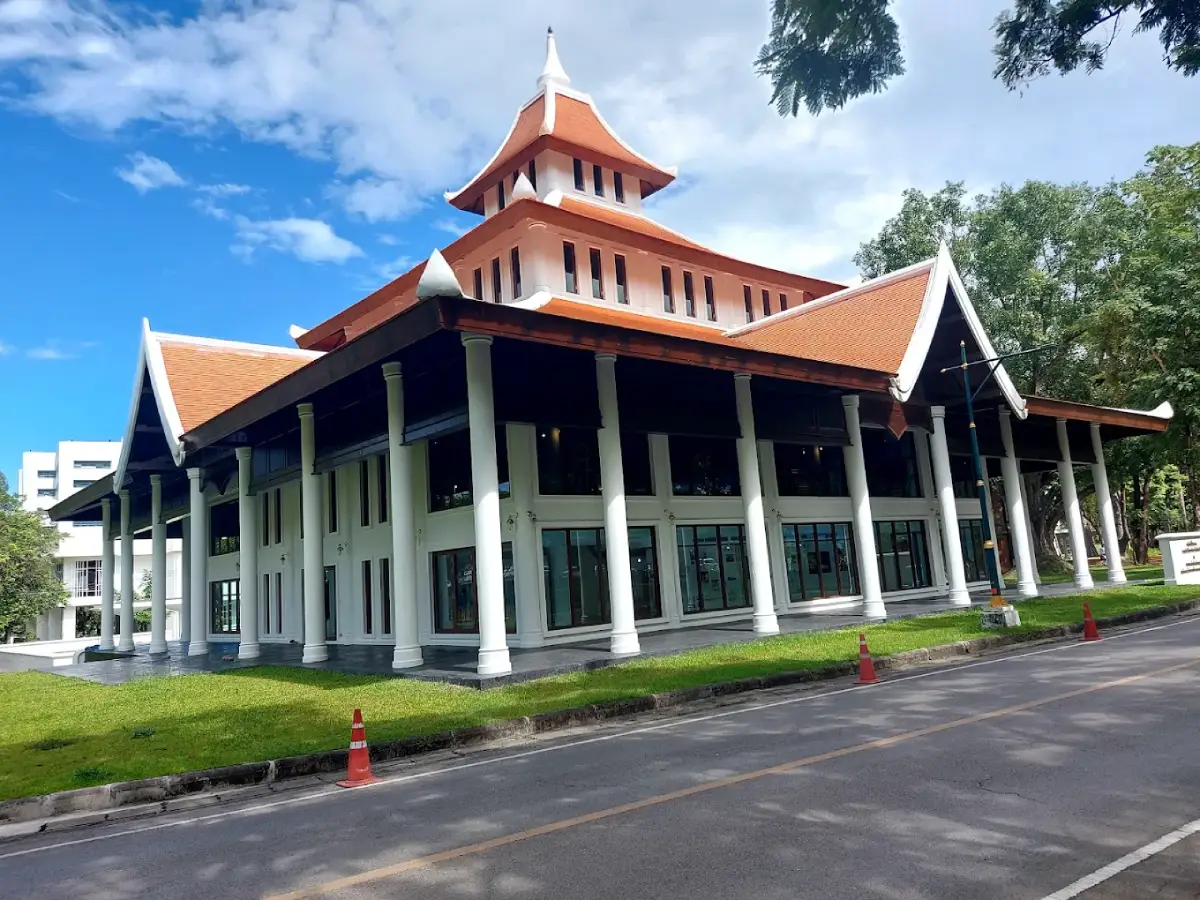
Sala Dham is among the university's most important ceremonial buildings. Its architecture draws from Thai traditions, with a striking roof and elegant exterior details. The building is used for religious and commemorative events and is closely associated with important moments in the university calendar. For visitors, its architecture provides an opportunity to appreciate the connection between a modern academic institution and the cultural and spiritual traditions of northern Thailand.
Ang Kaew Reservoir is one of the best-known places on the CMU campus. Located within the main university grounds, the reservoir has paths and green areas used for walking, relaxation, and exercise in accordance with university rules. The open water creates a striking foreground for views of Doi Suthep. Different times of day offer different perspectives, and the area has long been a favorite place for students and visitors. Ang Kaew is more than a photographic landmark; it also illustrates how water and landscaped spaces contribute to campus life.
The Ang Kaew area is associated with Sala Ang Kaew and nearby student gathering spaces. Other campus locations include Lan Sak, Lan Sangkhit, the cultural courtyard, and the palm garden. These spaces accommodate university events ranging from artistic performances and student activities to ceremonial gatherings. Because some areas are reserved for organized functions, visitors should respect access arrangements and ongoing activities rather than assuming that every open-looking space is available at all times.
Pin Mala Art Hall, home to the Chiang Mai University History Development Hall, is especially valuable for visitors interested in the institution's past. The building was developed as part of an effort to support Lanna arts and culture, and its name honors Mom Luang Pin Malakul. The historical exhibitions explore the campaign to establish CMU, the growth of faculties and departments, the contributions of notable individuals, and the university's development through photographs and historical materials. A visit offers context that cannot be gained from founding dates alone.
The second floor of the history hall accommodates a Dharma exhibition honoring Somdet Phra Sangharajachao Krom Luang Vajiranyanasamvara. Displays concern Buddhist teachings, religious work, and the role of spirituality in Thai society. The museum's published visiting hours are Monday to Friday from 8:30 a.m. to 4:30 p.m. and weekends from 10:00 a.m. to 6:00 p.m., excluding public holidays. The university advertises free access to its indoor exhibitions; visitors planning specific programs should check museum information beforehand.
The Lanna Traditional House Museum is another important cultural destination associated with Chiang Mai University. Its collection preserves traditional northern Thai timber buildings and rice barns, making it possible to study vernacular architecture and the relationship between homes, families, agricultural life, and local beliefs. Traditional buildings reveal how design responds to climate, available materials, and customs. The museum is particularly relevant to visitors interested in architecture, conservation, rural history, and the cultural landscape of northern Thailand.
The Doi Suthep Nature Center, operated by the Faculty of Science, connects campus learning with the natural environment of the mountain. Its exhibitions and educational programs cover ecology, flora and fauna, geology, and environmental conservation. Activities for young people, families, and educational groups help explain the importance of the mountain's ecological systems to Chiang Mai. Those interested in nature-based learning can consult the center about exhibition access, guided educational activities, and advance arrangements.
Academically, Chiang Mai University has 21 faculties, together with colleges and specialized institutes. Its disciplines range from humanities, social sciences, science, engineering, agriculture, and economics to medicine, allied health, veterinary medicine, architecture, media, and digital technology. The breadth of academic expertise creates opportunities for interdisciplinary research, such as linking agricultural production with food engineering, data science with public health, or cultural heritage with design and technology.
The Faculty of Medicine and associated health-science faculties play an important role in educating healthcare professionals and providing services to northern Thailand. Maharaj Nakorn Chiang Mai Hospital is a major clinical and teaching institution, while the Suan Dok academic area is distinct from the main campus. Collaboration among medical, nursing, pharmacy, dentistry, allied health, and related specialties supports clinical education, public-health research, and the development of healthcare services for a broad regional population.
The Faculty of Agriculture and other life-science departments contribute to the study of crops, livestock, soil, water, and natural resources. Parts of the university's agricultural teaching and research take place at Mae Hia and other field locations. Issues such as highland farming, food security, resource management, and the value of agricultural products are particularly relevant to northern Thailand, where agricultural communities, mountain ecosystems, and expanding cities intersect.
The faculties of Science and Engineering and the College of Arts, Media and Technology address scientific methods, digital technology, software, artificial intelligence, infrastructure, and creative production. The 2026 undergraduate listings include chemistry, biology, physics, mathematics, computer science, data science, robotics and artificial-intelligence engineering, semiconductor engineering, digital games, and animation. These fields demonstrate how the university is adapting its academic offerings to changing industries and workforce needs.
The humanities, social sciences, fine arts, and related departments contribute to the study of language, history, geography, anthropology, art, design, and social change. Research involving ethnic communities, highland environments, urban transformation, and the preservation of local knowledge provides perspectives on the complex cultural landscape of northern Thailand. Such scholarship is essential to understanding how Chiang Mai and the wider region respond to tourism, digital economies, environmental pressures, and changing ways of life.
Sustainability at CMU includes efforts concerning energy, waste, water, greenhouse-gas emissions, and sustainable transportation. The university has developed a carbon-landscape project to measure emissions and carbon absorption across different university areas, including Suan Sak, Suan Dok, Mae Hia, Hariphunchai, and Samut Sakhon. The information supports evidence-based environmental management and illustrates how the physical operations of a university can be connected with wider ecological goals.
A visible example of sustainability in everyday university life is CMU's electric shuttle system, popularly called the “Purple Bus.” In 2026, the university promoted clean-energy electric vehicles serving key destinations within the main campus and on routes connecting Suan Dok and Mae Hia. Student and staff services are subject to university eligibility rules, and visitors should confirm whether they can use a particular route rather than assuming that all services are open to the public. Current routes and operating schedules are published through the university's transport services.
In addition to the main campus near Doi Suthep, Chiang Mai University has academic and operational areas at Suan Dok, Mae Hia, the Hariphunchai educational center in Lamphun Province, and other sites serving specialist activities. Understanding these different locations is important for prospective students, visitors, and participants in training programs, because clinics, faculties, laboratories, and research facilities are not all located within the same campus boundary.
For a general educational visit, Ang Kaew and its surroundings offer an introduction to the university's landscape, while Sala Dham illustrates the ceremonial aspects of campus life. The history museum offers the strongest orientation to CMU's origins and evolution. Visitors interested in Lanna architecture or ecology can also consider the Lanna Traditional House Museum and Doi Suthep Nature Center. Choosing a theme for the visit produces a more meaningful experience than treating the university solely as a scenic photo stop.
It is important to remember that CMU is an operating university, not an unrestricted public park. Teaching buildings, laboratories, medical facilities, student residences, and research locations may have controlled access. Visitors should avoid interrupting academic activities, respect personal privacy, and obtain permission before entering restricted facilities or arranging group tours. The history museum and the relevant faculty or center are appropriate starting points for specialized inquiries.
Nearby attractions offer opportunities to extend a university visit into a broader exploration of Chiang Mai. Wat Suan Dok is known for its Lanna royal memorial stupas, while Wat Umong offers wooded grounds and ancient temple tunnels. Chiang Mai Zoo is situated near Huay Kaew Road, and Wat Phra That Doi Suthep is one of the region's principal Buddhist landmarks. Visitors interested in traditional architecture can also explore CMU's own Lanna house museum. These sites offer different experiences and should be planned according to travel time and individual interests.
The Huay Kaew, Nimmanhaemin, and area behind the university provide an extensive choice of local restaurants, cafés, and accommodation. Options include northern Thai food, everyday student eateries, independent cafés, and hotels catering to families, academic visitors, and tourists. Because the campus has several entrances and spreads across multiple areas, the most convenient accommodation will depend on the specific department or building a visitor needs to reach.
Getting There: The main CMU address is 239 Huay Kaew Road, Suthep Subdistrict, Mueang Chiang Mai District, Chiang Mai 50200. From central Chiang Mai, follow Huay Kaew Road toward Doi Suthep. Travelers arriving at Chiang Mai International Airport or Chiang Mai Railway Station can use available hired transport or local transportation services. Those driving should confirm the appropriate university entrance and designated parking areas, particularly during major ceremonies, graduation periods, and events that may affect traffic.
For visits to Pin Mala Art Hall or specialized educational centers, check the relevant department's published timetable before traveling. Administrative office hours, museum hours, and access to university grounds should not be treated as interchangeable. A morning or late-afternoon stroll may be comfortable in the green areas, while sufficient time should be reserved for historical exhibitions. Respecting opening times and departmental rules makes the visit more useful for both guests and the university community.
Across more than six decades, Chiang Mai University has grown from Thailand's first government-established regional university into an institution active across academic and research disciplines. What makes it especially distinctive is the coexistence of advanced scholarship and Lanna cultural heritage. The elephant-and-torch emblem, purple university color, Doi Suthep freshman tradition, Sala Dham, history museum, and Ang Kaew all represent aspects of a history that continues to be experienced in daily campus life.
Chiang Mai University is therefore more than an institution located at the foot of Doi Suthep. It is a place where learning, memory, community relationships, and the cultural heritage of northern Thailand meet. Visitors interested in Thai educational history, Lanna culture, architecture, nature, or higher education will find several different perspectives within this one university. Its continuing ideal of self-discipline and using knowledge for the benefit of society connects the purpose of the original university with its responsibilities today.
| Name | Chiang Mai University (CMU) |
| Type | Autonomous Public University; Thailand’s First Government-Established Regional University |
| Location | Suthep Subdistrict, Mueang Chiang Mai District, Chiang Mai Province |
| Address | 239 Huay Kaew Road, Suthep, Mueang Chiang Mai, Chiang Mai 50200, Thailand |
| Legal Establishment | January 22, 1964 |
| First Teaching Day | June 18, 1964 |
| University Anniversary | January 24, 1965 (Official Royal Inauguration) |
| Institutional Age | 61 Years in 2026, Counting from the Official Inauguration |
| Historical Figures | Mom Luang Pin Malakul, Founding Planner; Phraya Si Wisarawaja, First Rector |
| Rector in 2026 | Professor Dr. Pongruk Sribanditmongkol |
| University Identity | Elephant-and-Torch Emblem; Purple University Color; Motto: The Wise Train Themselves |
| Academic Units | 21 Faculties Plus Specialized Colleges and Institutes |
| Academic and Operational Areas | Suan Sak Main Campus; Suan Dok; Mae Hia; Hariphunchai in Lamphun and Other Specialized Sites |
| Key Campus Places | Ang Kaew Reservoir; Sala Dham; Sala Ang Kaew; Pin Mala Art Hall and History Museum; Dharma Exhibition; Lan Sak; Palm Garden |
| Related Learning Centers | Lanna Traditional House Museum; Doi Suthep Nature Center |
| Traditions | January 24 Anniversary; Freshman Railway Welcome; Doi Suthep Freshmen Trek |
| Administrative Office Hours | Monday–Friday, 08:30–16:30 (Not a Universal Campus Visiting Schedule) |
| History Museum Visiting Hours | Monday–Friday, 08:30–16:30; Saturday–Sunday, 10:00–18:00; Closed on Public Holidays; Free Exhibition Admission |
| Getting There | Follow Huay Kaew Road from Central Chiang Mai toward Doi Suthep; Confirm the Entrance and Building Destination |
| Facilities | University Libraries, Food Services, Student Health Center, Activity Areas, Designated Parking and University Transit Subject to Regulations |
| Nearby Attractions | 1. Wat Suan Dok 2. Wat Umong 3. Chiang Mai Zoo 4. Lanna Traditional House Museum, CMU 5. Wat Phra That Doi Suthep |
| Nearby Restaurants | 1. Han Teung Chiangmai, Tel. +66 93 970 6885 2. Suki Changphuak (Behind CMU), Tel. +66 62 003 5251 3. KRAM Cafe & Eatery, Tel. +66 62 325 9882 4. Grandpa Home Kitchen, Tel. +66 91 075 5532 5. Happy Hut, Tel. +66 99 223 5268 |
| Nearby Accommodations | 1. TUCK Me iN, Tel. +66 63 780 4777 2. ibis Styles Chiang Mai, Tel. +66 53 908 888 3. Eastin Tan Hotel Chiang Mai, Tel. +66 52 001 999 4. The Empire Nimman Chiang Mai, Tel. +66 53 289 288 5. Hyde Park Chiangmai, Tel. +66 53 275 959 |
| Main Contact Number | +66 53 941 300 |
| University History Museum | +66 53 944 529 |
| Official Website | https://www.cmu.ac.th |
| Current Status | Active Public University in 2026 |
Chiang Mai University Academic Programs and Fields of Study, Academic Year 2026 The bachelor’s list follows the official university registration fee schedule applicable to students entering in academic year 2026. Duplicate fields across regular, special and international tracks are consolidated where appropriate. Inclusion in this official schedule does not mean that every field recruited students in every TCAS application round.
| 1. Faculty of Humanities | Bachelor’s Degree 1. English 2. French 3. Home and Community 4. Psychology 5. Information Studies 6. Tourism and Hospitality 7. Liberal Arts (Thai, Philosophy, History, Chinese, Japanese Language and Culture, Korean Language and Culture, Indian Language and Culture) 8. Myanmar Language and Culture 9. Innovative Culinary Arts and Entrepreneurship 10. Thai as a Foreign Language (International) 11. Humanities and Sustainability (International) |
| 2. Faculty of Education | Bachelor’s Degree 1. Primary Education 2. Thai Language Education 3. English Education 4. Social Studies Education 5. Biology Education 6. Physics Education 7. Chemistry Education 8. Art Education 9. Mathematics Education 10. Physical Education 11. Early Childhood and Special Education 12. Industrial and Career Education |
| 3. Faculty of Fine Arts | Bachelor’s Degree 1. Painting 2. Sculpture 3. Design 4. Media Arts and Media Design 5. Interdisciplinary Arts 6. Printmaking 7. Creative Photography 8. Performing Arts 9. Thai Art and Creative Culture |
| 4. Faculty of Social Sciences | Bachelor’s Degree 1. Geography 2. Sociology and Anthropology 3. ASEAN Studies 4. Social Sciences and Sustainable Development (International) |
| 5. Faculty of Science | Bachelor’s Degree 1. Chemistry 2. Industrial Chemistry 3. Biochemistry and Biochemical Innovation 4. Biology 5. Microbiology 6. Zoology 7. Physics 8. Materials Science 9. Geology 10. Gemology 11. Mathematics 12. Statistics 13. Computer Science 14. Data Science 15. Environmental Science (International) |
| 6. Faculty of Engineering | Bachelor’s Degree 1. Civil Engineering 2. Electrical Engineering 3. Environmental Engineering 4. Industrial Engineering 5. Mechanical Engineering 6. Computer Engineering 7. Robotics and Artificial Intelligence Engineering 8. Integrated Engineering 9. Mining and Petroleum Engineering 10. Semiconductor Engineering (Bilingual) 11. Mechanical Engineering and Engineering Project Management (International) 12. Electrical Engineering and Smart Grid Technology (International) 13. Civil Engineering (International) 14. Industrial Engineering and Logistics Management (International) 15. Integrated and Multidisciplinary Engineering (International) 16. Information Systems and Cybersecurity (International) |
| 7. Faculty of Medicine | Bachelor’s Degree 1. Doctor of Medicine 2. Medical Science |
| 8. Faculty of Agriculture | Bachelor’s Degree 1. Agriculture (Agronomy, Horticulture, Entomology, Plant Pathology, Soil Science, Agricultural Extension) 2. Animal Science (Animal Science Major) 3. Animal Science (Fisheries Science Major) 4. Agricultural Economics and Agribusiness 5. Highland Agriculture and Forest Resources 6. Smart Agriculture and Food Entrepreneurship (Multidisciplinary) |
| 9. Faculty of Dentistry | Bachelor’s Degree 1. Doctor of Dental Surgery 2. Medical Science |
| 10. Faculty of Pharmacy | Bachelor’s Degree 1. Pharmacy 2. Medical Science |
| 11. Faculty of Associated Medical Sciences | Bachelor’s Degree 1. Medical Technology 2. Occupational Therapy 3. Radiological Technology 4. Physical Therapy 5. Communication Sciences and Disorders |
| 12. Faculty of Nursing | Bachelor’s Degree 1. Nursing Science (Thai and International Programs) |
| 13. Faculty of Agro-Industry | Bachelor’s Degree 1. Food Science and Technology (Thai and International) 2. Agro-Industrial Biotechnology 3. Food Process Engineering 4. Product Development Technology 5. Packaging Technology 6. Seafood Product Technology and Innovation 7. Agro-Industry Innovation and Entrepreneurship |
| 14. Faculty of Veterinary Medicine | Bachelor’s Degree 1. Doctor of Veterinary Medicine 2. Veterinary Science 3. Veterinary Nursing |
| 15. Chiang Mai University Business School | Bachelor’s Degree 1. Business Administration (Regular and Special Programs) 2. Accountancy (Regular, Special and International Programs) 3. Service Business Management (Trilingual) |
| 16. Faculty of Economics | Bachelor’s Degree 1. Economics (Thai and International Programs) |
| 17. Faculty of Architecture | Bachelor’s Degree 1. Architecture (Five-Year Program) 2. Architecture (Four-Year Program) 3. Landscape Architecture 4. Industrial Design 5. Integrated Innovative Architectural Design (International) |
| 18. Faculty of Mass Communication | Bachelor’s Degree 1. Mass Communication 2. Digital Film (Bilingual) |
| 19. Faculty of Political Science and Public Administration | Bachelor’s Degree 1. Public Administration 2. International Relations 3. Politics and Government 4. Sustainability Studies (International) |
| 20. Faculty of Law | Bachelor’s Degree 1. Law (Regular and Special Programs) |
| 21. College of Arts, Media and Technology | Bachelor’s Degree 1. Modern Management and Information Technology (Thai and International) 2. Digital Game 3. Digital Industry Integration 4. Animation and Visual Effects 5. Software Engineering (International) |
| 22. International College of Digital Innovation | Bachelor’s Degree 1. Digital Innovation (International) |
Graduate Programs Individually Verified from 2026 Announcements
| Faculty of Science | Master’s: Mathematics; Doctoral: Mathematics |
| Faculty of Public Health | Master’s: Public Health; Doctoral: Public Health |
| Multidisciplinary and Interdisciplinary School | Master’s: Integrated Science (Pet Business Management Track) |
Frequently Asked Questions (FAQ)
Q: Where is Chiang Mai University located?
A: The main campus is at 239 Huay Kaew Road, Suthep Subdistrict, Mueang Chiang Mai District, Chiang Mai 50200, at the foot of Doi Suthep.
Q: When was Chiang Mai University established?
A: The university was legally established on January 22, 1964, and began its first classes on June 18, 1964.
Q: Why is January 24 the official university anniversary?
A: January 24, 1965, was the date of the royal inauguration. CMU observes this date as its annual founding anniversary.
Q: Who played important roles in founding Chiang Mai University?
A: Mom Luang Pin Malakul was a key figure in planning the university, while Phraya Si Wisarawaja served as its first rector.
Q: What faculties does Chiang Mai University have?
A: CMU has 21 faculties covering disciplines including humanities, sciences, social sciences, engineering, education, agriculture, medicine, health sciences, fine arts and more, alongside specialized colleges and institutes.
Q: What academic programs did Chiang Mai University offer in 2026?
A: The article includes the undergraduate fields listed in the university’s official 2026 entry fee schedule. Graduate admissions and program status should be checked individually using the current registration system.
Q: Can members of the public visit Chiang Mai University?
A: The public may visit areas designated for visitors, including the university history museum during its published hours. Teaching, laboratory and research facilities may require authorization.
Q: How can I get to Chiang Mai University?
A: Take Huay Kaew Road from central Chiang Mai toward Doi Suthep. Confirm the specific entrance and building required before traveling.
 Category: ●University
 Group: ●Autonomous Universities
Last Update : 1 WeekAgo
 Last Update : 1 WeekAgo
 Click to Access the Navigation Map GPS
Chiang Mai University Map
Recommend

 Art, Culture and Heritage
 Historical Sites and Monuments(8)
 Landmarks and Memorials(5)
 Royal Palace(2)
 Art, Craft Centres, Tradition(43)
 Museums(24)
 Educational Places
 Museum for Study(2)
 Educational Gardens, Farm(5)
 Training Center(1)
 Public university(3)
Autonomous Universities(3)
 Rajamangala University of Technology(1)
 Rajabhat University(1)
 Private University(5)
 Places of Worship
 Temple(79)
 Mosque(2)
 Other Sacred Sites(17)
 Research and Development
 Royal Project(45)
 Suburban Living
 Village, Community(41)
 Local Market(14)
 Nature and Wildlife
 National Parks and Marine Reserves(18)
 Mountain (Doi)(21)
 Dam, Reservoir, Lake(26)
 Waterfalls(43)
 Hot Springs(12)
 Caves(11)
 River, Canal(6)
 Other natural attractions(14)
 Entertainment and Agricultural
 Zoos and Aquariums(3)
 Animal camps and shows(3)
 Stadium(1)
 Farms, Parks and Ecotourism(19)
 Waterpark(2)
 Theater(1)
 Outdoor and Adventure Activities(10)
 Shopping
 Shopping and Night Market(6)
 Restaurant
 Michelin Star(1)
 Michelin Guide(23)
 Call Customer Service in Tourism
 Call Customer Service in Tourism(1)
 Travel Articles, Recipes
 Travel Review, Food Review(26)
 Food Menu, North Recipes(30)
 Thai Desserts, North Recipes(17)


