
lovethailand home >North Travel Attractions >Chiang Mai Travel Attractions >Muang Chiang Mai >Phra Sing > Nong Buak Haad Public Park
TL;DR: Nong Buak Haad Public Park is located at Southwestern corner of Chiang Mai's Old City, near Ku Hueang Corner, open Daily, hours 05:00–21:00.

Nong Buak Haad Public Park
Open Days: Daily
Opening Hours: 05:00–21:00
Admission Fee: Free Entry
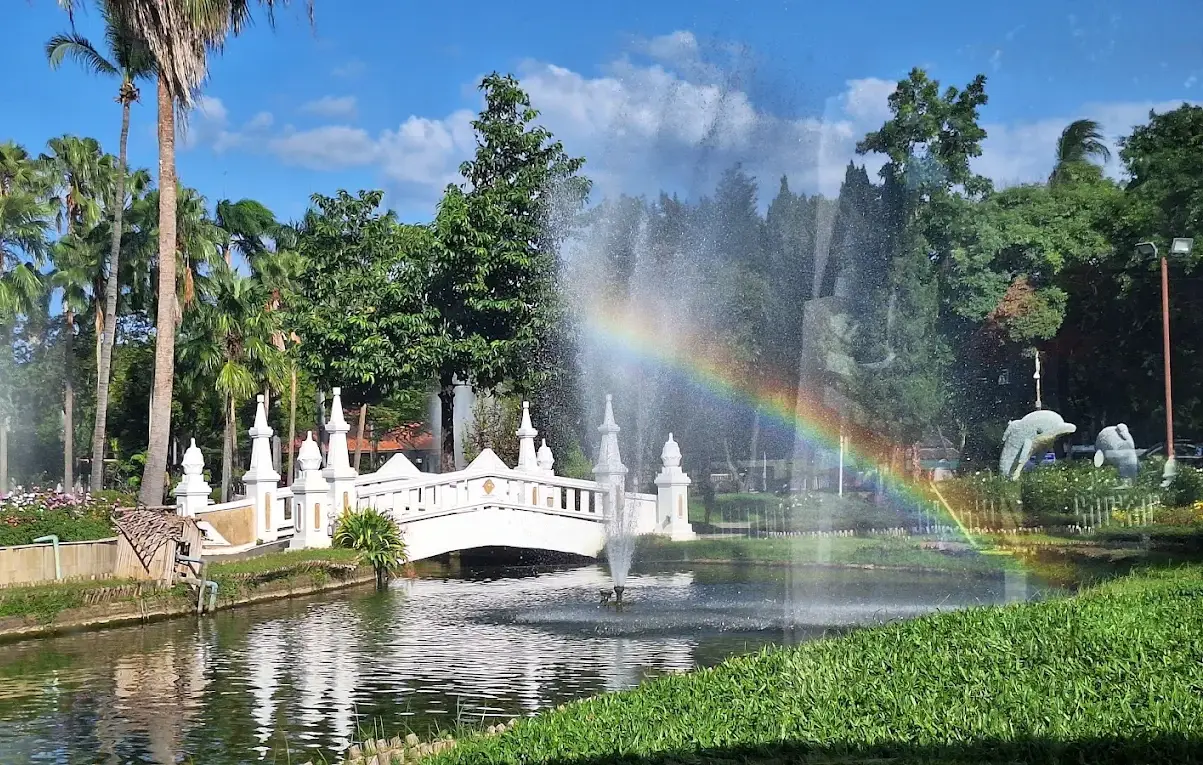
Nong Buak Haad Public Park, Chiang Mai: A Beautiful Green Retreat in the Old City, Perfect for Relaxation, Exercise, and Seasonal Flower Displays. Nong Buak Haad Public Park, commonly known as Suan Buak Haad or Buak Haad Public Park, is one of Chiang Mai's established urban green spaces. Located on Arak Road in Phra Sing Subdistrict, Mueang Chiang Mai District, near the southwestern corner of the historic Old City and the Ku Hueang Corner of the city walls, the park covers approximately 12 rai, 3 ngan, and 29 square wah. Managed by Chiang Mai Municipality, it opens daily from 5:00 AM to 9:00 PM with free admission. Visitors can enjoy ornamental ponds, fountains, a picturesque white bridge, shaded pavilions, landscaped gardens, walking paths, outdoor exercise equipment, lawns, and a children's playground. The park is also closely associated with the annual Chiang Mai Flower Festival, making it an excellent destination for travelers interested in nature, recreation, photography, and local life in northern Thailand.
Nong Buak Haad Public Park has long played an important role in the everyday lives of Chiang Mai residents. Situated within the historic Old City, an area surrounded by ancient walls, moats, temples, and traditional communities, the park provides a welcome contrast to the busy streets outside. Although it occupies a central urban location, its trees, lawns, and ornamental ponds create an inviting atmosphere where visitors can slow down, relax, and enjoy nature without traveling far from the city's main attractions. For travelers exploring Chiang Mai on foot, the park is especially appealing because it combines accessibility with a pleasant, informal setting.
For local residents, Nong Buak Haad is much more than a tourist attraction. It is a shared public space used by people of different ages and backgrounds throughout the day. Older residents visit for gentle exercise and morning walks, working adults come to jog or unwind after work, families bring children to the playground, and students and travelers find quiet places to read, rest, or enjoy the surroundings. These everyday activities give the park an authentic community atmosphere. Rather than being designed exclusively for sightseeing, it remains an active part of Chiang Mai's urban lifestyle, where recreation, social interaction, and access to nature naturally come together.
The park occupies a convenient position near Ku Hueang Corner, one of the historic corners of Chiang Mai's old defensive walls. It is connected to the surrounding city through important roads, including Arak Road, Bumrung Buri Road, and Sam Lan Road, while Suan Prung Gate and several traditional neighborhoods are nearby. This location makes Nong Buak Haad particularly useful as a resting point during an Old City walking tour. Visitors can spend time in the park before continuing to nearby Buddhist temples, traditional markets, historic streets, or local restaurants. The compact layout of the Old City makes it possible to combine these experiences without needing a separate day for the park.
The history of Nong Buak Haad Public Park is closely connected to Chiang Mai's urban development and the transformation of former wetland areas into public recreational spaces. Before becoming a landscaped park, the site was government-owned land characterized by an old pond and naturally occurring aquatic vegetation. Much of the area had remained underused. Chiang Mai Municipality subsequently developed the land into a public park, gradually improving the landscape by filling selected sections, establishing lawns and walking paths, planting trees, and creating recreational areas for public use.
This transformation represents an important example of urban land being adapted for community benefit. Instead of allowing the entire site to become a built-up commercial area, the municipality established a green space accessible to residents and visitors. The park's historical connection with water remains visible in its ornamental ponds, which continue to shape the character of the landscape. The combination of water, greenery, and open recreational areas is therefore not merely decorative; it also reflects the site's evolution from a natural wetland into one of Chiang Mai's familiar public gathering places.
A government study of public parks published in 2005 recorded Nong Buak Haad as occupying approximately 12 rai, 3 ngan, and 29 square wah, equivalent to slightly more than two hectares. Chiang Mai Municipality was identified as the authority responsible for its management and maintenance. Although the park is considerably smaller than major metropolitan parks elsewhere in Thailand, its landscape design accommodates several different types of activity within a relatively compact space. Open lawns, ponds, garden beds, pedestrian routes, and recreational facilities are arranged to support both leisurely visits and regular community use.
During the park's earlier development, considerable attention was given to planting shade trees, establishing lawns, and creating paths suitable for morning and evening exercise. Historical records describe a variety of ornamental plants and tropical trees, including Queen's crape myrtle, bullet wood, coconut palms, Indian mast trees, and several species of palms. These plantings reflected an approach to tropical park design that balanced shade, decorative foliage, and visual variety. Together with the ponds and open grass areas, they helped establish the green, relaxed atmosphere for which the park became known.
As Chiang Mai continued to grow, Nong Buak Haad underwent additional landscape improvements to accommodate changing recreational needs. Walking routes, lighting, drainage, and other public facilities became part of the park's ongoing development. Its importance gradually extended beyond visual beauty to include public health, recreational access, urban greenery, and community interaction. The park illustrates how a relatively small area can provide significant social value when it remains accessible and serves a variety of everyday purposes.
The park's history is also closely connected with the Chiang Mai Flower Festival, which began with its first edition held from February 6 to 12, 1977. The festival subsequently developed into a major annual celebration associated with northern Thailand's ornamental plant industry and Chiang Mai's reputation as a city of flowers. Nong Buak Haad became one of the festival's principal locations for landscaped floral displays and horticultural exhibitions. This long association has made the park especially recognizable during February, when seasonal flower installations transform its familiar grounds into a colorful visitor attraction.
The name Nong Buak Haad reflects the site's historical association with a pond or wetland. Several versions of the name appear in everyday usage and travel information, including Nong Buak Haad Public Park, Suan Buak Haad, Buak Haad Public Park, and Suan Buak Hat. All refer to the same public park near the southwestern corner of Chiang Mai's Old City. Local residents commonly use the shorter name Suan Buak Haad, while government publications and tourism directories also use the longer form. Travelers searching for the park on maps can use either name to locate the site.
The landscape of Nong Buak Haad Public Park is defined by its harmonious combination of water, greenery, lawns, ornamental gardens, and pedestrian routes. The ponds form prominent visual features, while trees and landscaped areas provide depth and shade throughout the grounds. This design encourages visitors to explore the park from different viewpoints rather than simply walking along a single central path. The resulting atmosphere is noticeably different from an urban square dominated by buildings and paved surfaces.
The ornamental ponds are among the park's most recognizable features. Their surfaces reflect the surrounding trees, bridges, and pavilions, creating a calm setting for visitors who enjoy sitting near the water. Fountains add movement and interest to the landscape when operating, while the changing reflections of daylight create different views throughout the day. Early morning and late afternoon are particularly attractive for photography because the sunlight is gentler and the surrounding greenery becomes more prominent in the reflected scenery.
Another distinctive landmark is the park's picturesque white bridge. Spanning part of the water, the bridge connects sections of the landscaped grounds and provides an attractive vantage point over the pond. Its white structure contrasts with the green lawns, tropical foliage, and colorful flowers surrounding it. During flower festival periods, floral installations often enhance the visual appeal of this area, making the bridge an especially popular photography location. Even during ordinary months, it remains one of the park's most recognizable architectural elements.
Shaded pavilions and sitting areas are equally important to the park's character. The pavilions offer places where visitors can take a break from the sun, while benches placed along the paths allow people to rest between walks. These facilities are particularly useful for older visitors, families with young children, and travelers who have spent several hours sightseeing in Chiang Mai's Old City. Whether enjoying the pond, reading a book, or having a quiet conversation, visitors can appreciate the park without following a fixed itinerary or participating in organized activities.
Open lawns provide flexible recreational space and contribute to the park's pleasant appearance. Visitors can sit or relax on permitted grassy areas, while the surrounding trees create a mixture of sunny and shaded locations. The contrast between the green lawns and Chiang Mai's nearby streets and buildings is one reason the park feels like a small retreat from the city. Its combination of open space and mature vegetation is particularly valuable in a historic urban district where buildings, temples, and roads occupy much of the surrounding land.
The ornamental gardens and plant collections contribute significantly to Nong Buak Haad's identity. Flower beds, shrubs, and trees are arranged to provide color and texture throughout the grounds. Tall trees create a green canopy, smaller ornamental plants help define different landscape areas, and flowering species add seasonal interest. The park's planting design makes it attractive to visitors who enjoy nature photography, garden landscapes, and observing how tropical plants are incorporated into urban public spaces.
Chiang Mai's seasonal climate also influences the appearance of the park. The cooler months, generally extending from late in the year into the beginning of the next, provide favorable conditions for many ornamental flowers associated with northern Thailand. This is especially relevant during the Chiang Mai Flower Festival, when additional seasonal plants and elaborate temporary displays are introduced. However, the festival's special flower gardens are not permanent year-round installations. Outside the event period, visitors experience the park in its regular form, with its established trees, lawns, ponds, and everyday recreational facilities.
From an urban environmental perspective, the park contributes to the quality of life in the surrounding neighborhoods. Trees provide shade and reduce direct exposure to sunlight along paths and resting areas. Grass and planted surfaces break up the continuous expanses of paving common in city centers, while the ponds add landscape variety. Beyond these physical features, the park creates opportunities for visitors to observe plants, water, birds, and other elements of the local urban ecosystem. Its value lies in making contact with nature part of everyday city life rather than an activity that requires traveling outside Chiang Mai.
Walking and jogging are among the most popular activities at Nong Buak Haad Public Park. The pedestrian paths connect different sections of the grounds and can be used for casual strolling, brisk walking, or light jogging. The internal routes allow visitors to complete repeated circuits without relying on the surrounding streets. This makes the park convenient for residents who want a regular exercise location and travelers who prefer to maintain their fitness routines while staying in Chiang Mai.
Morning is an especially pleasant time for outdoor exercise. The air is generally cooler before the stronger midday heat develops, and the landscaped surroundings provide an enjoyable setting for walking, jogging, and gentle stretching. Visitors staying in nearby Old City hotels can begin the day with a walk through the park before breakfast or sightseeing. For many people, this simple routine offers a more relaxed introduction to Chiang Mai than immediately joining the busiest tourist routes.
Late afternoon and early evening bring another aspect of the park's community life. Residents arrive to exercise after work or school, families gather in the open spaces, and visitors enjoy walking as the temperature becomes more comfortable. Informal wellness gatherings and occasional group activities, including yoga and other forms of outdoor exercise, also take place in the park. The availability and schedule of individual sessions depend on the organizers, and visitors who wish to participate can check locally for current arrangements.
Outdoor fitness equipment provides an additional option for people who want to exercise without visiting an indoor gym. These facilities support basic body movement and strength exercises, while the surrounding paths remain available for walking and jogging. Visitors should select activities suited to their physical condition and inspect equipment before use. By offering several forms of outdoor recreation in one location, the park accommodates a broad range of interests and fitness levels.
The children's playground at Nong Buak Haad Public Park is an important attraction for families. The playground contains colorful equipment designed for activities such as climbing, sliding, and active play. This gives children an opportunity to spend time outdoors while parents or guardians enjoy the surrounding park environment. For families staying in Chiang Mai's Old City, the playground offers a convenient alternative to indoor entertainment and provides a pleasant break between temple visits or other sightseeing activities.
Parents should supervise younger children closely, particularly around the ponds, shared walking routes, and climbing equipment. Children should use playground structures appropriate for their ages and abilities, and adults should remain attentive when children are near water. Planning a family visit during the morning or later afternoon also helps avoid the strongest sunshine. With suitable supervision, the park can provide a rewarding outdoor experience for families seeking a relaxed activity in the center of Chiang Mai.
One of the park's greatest advantages is that visitors do not need a substantial budget to enjoy it. Entry is free, and many of its principal attractions involve simply walking, sitting, observing the scenery, or spending time together. Travelers can bring a book, enjoy the shade, take photographs, or rest on permitted lawn areas without purchasing an admission ticket. This makes Nong Buak Haad particularly useful for budget-conscious travelers and visitors looking for a quieter activity between Chiang Mai's more demanding sightseeing experiences.
Nong Buak Haad Public Park and the Chiang Mai Flower Festival share a long and important history. The annual festival showcases the beauty of ornamental plants while celebrating the expertise of growers, gardeners, designers, and agricultural communities in northern Thailand. Government agencies, local businesses, horticultural producers, and community organizations contribute to the event. Nong Buak Haad serves as an important site for the landscaped floral exhibitions that attract both Thai and international visitors.
Since its beginnings in 1977, the Chiang Mai Flower Festival has become one of the province's signature seasonal events. Typically associated with February, it presents a wide variety of flowering plants, horticultural exhibitions, cultural performances, and locally produced goods. The festival is also known for its decorated floral floats, which demonstrate both creative craftsmanship and the region's strong connection to ornamental plant cultivation. These activities connect tourism with agriculture and help visitors understand the importance of flower production to Chiang Mai's local economy and cultural identity.
In 2026, Chiang Mai hosted the 49th Chiang Mai Flower Festival from February 13 to 15 under the Thai theme "Buppha Rachinee Kong Kroek Fa, Lam Loe Kha Nakhon Phing", celebrating royal floral heritage and the beauty of Chiang Mai. Nong Buak Haad Public Park was one of the principal locations for the flower displays. The event featured approximately 170,000 flowering plants representing 52 varieties, combined with decorative installations inspired by nature, northern Thai culture, and environmental conservation.
The 2026 floral displays featured three major thematic areas. One focused on royal initiatives involving natural resources, forests, water, and community livelihoods. Another was designed for children and families, using colorful flowers and imaginative sculptures to create an engaging environment. The third presented premium ornamental flowers and attractive photography locations. Lighting and decorative installations added further visual interest during the evening. These displays were part of the temporary annual festival and should not be confused with the park's permanent recreational areas.
A particularly appealing feature of the festival is the opportunity to see flowering plants arranged in creative combinations that are not normally available throughout the year. Previous editions have featured tulips, lilies, hydrangeas, orchids, spray roses, and many other ornamental flowers. Each year's exhibitions follow different themes and layouts, giving returning visitors a new experience. Beyond their photographic appeal, the displays highlight the skill required to cultivate, transport, arrange, and maintain large collections of flowers in a public landscape.
The festival also supports Chiang Mai's horticultural communities. Some of the plants used in seasonal displays are cultivated by growers in northern Thailand's highland areas, where cooler conditions are suitable for producing ornamental flowers. Bringing these plants into a major public exhibition helps connect agricultural production with tourism and introduces visitors to the region's horticultural expertise. The economic benefits extend beyond the display grounds to plant producers, local vendors, restaurants, transport providers, and other businesses participating in the festival period.
Decorated floral floats form another important part of the wider Chiang Mai Flower Festival. These elaborate vehicles are covered with colorful flowers and often incorporate designs associated with northern Thai culture. Cultural performances, competitions, exhibitions, and community product stalls contribute to the festive atmosphere. While different events may be held at several locations around the city, Nong Buak Haad remains closely identified with the beautifully arranged flower gardens that visitors can explore on foot.
The park's relationship with Lanna culture and community life can also be seen in its everyday role as a gathering place. Residents use the grounds for recreation, informal exercise, family outings, and occasional community activities. During major festivals, visitors from many regions and countries gather to experience Chiang Mai's floral traditions. On ordinary days, the same space returns to its quieter function as a neighborhood park. This ability to accommodate both major public celebrations and ordinary daily routines is one of Nong Buak Haad's defining characteristics.
Historically, the park has also been used for educational activities related to plants, landscaping, and public recreation. School groups have visited to study plant species, while community exercise sessions and horticultural learning activities have formed part of its public use. This broader educational function demonstrates how a park can serve as an informal learning environment, where knowledge of nature and healthy living becomes accessible beyond classrooms and formal institutions.
The park's location within Chiang Mai's historic urban landscape further strengthens its cultural value. The surrounding area contains old streets, Buddhist temples, traditional communities, and surviving elements of the ancient city defenses. Although the city has developed significantly over the centuries, the Old City's moat and historic street network remain prominent features of its identity. Nong Buak Haad adds a recreational dimension to this landscape, providing a place where history, community activity, and contemporary urban life can exist alongside one another.
The atmosphere of Nong Buak Haad in the morning is particularly attractive to visitors who appreciate natural light and quiet surroundings. Sunlight filters through the trees and reflects on the ponds, while the white bridge and nearby pavilions create appealing photographic compositions. Morning walkers and joggers contribute to the park's lively but relaxed character. This time of day is well suited to older visitors, travelers interested in gentle exercise, and anyone who wants to experience Chiang Mai's local daily rhythm before visiting the city's major attractions.
During late morning and the middle of the day, the character of the park changes as temperatures rise. In Chiang Mai's warmer months, some open areas can become hot under direct sunlight. Visitors arriving at these times can seek shade beneath the larger trees or use covered resting areas. Bringing drinking water, a hat, and appropriate sun protection makes a visit more comfortable, particularly for families with children or travelers who intend to spend an extended period outdoors.
Late afternoon is another excellent time to explore Nong Buak Haad. The softer sunlight enhances the greenery, the ponds become attractive photography subjects, and the temperature generally becomes more comfortable for walking. Visitors can stroll along the paths, sit near the water, or enjoy the surroundings before continuing to nearby restaurants and historic neighborhoods. On Saturdays, a late-afternoon park visit can be combined with an evening trip to Wua Lai Walking Street, where visitors can explore local handicrafts, silverwork, traditional food, and souvenirs.
The best time to visit Nong Buak Haad Public Park depends on the experience travelers are seeking. Early morning and late afternoon are particularly suitable for walking, jogging, and relaxing outdoors. Those interested in elaborate floral exhibitions should plan their trip around the annual Chiang Mai Flower Festival, normally held in February. During the rainy season, the grounds have a lush appearance, although visitors should take account of changing weather conditions and avoid exposed areas or large trees during thunderstorms.
For photography enthusiasts, the park offers several different subjects within a compact area. Its white bridge, ornamental ponds, fountains, trees, lawns, and seasonal flower beds can be used for landscape and portrait compositions. The combination of water and greenery creates attractive reflections, while the surrounding paths allow photographers to explore different angles. During busy festivals, visitors should remain on designated routes and avoid entering planted flower beds or obstructing other people who are enjoying the grounds.
Who should visit Nong Buak Haad Public Park? Its wide range of activities makes it suitable for many kinds of visitors. Nature lovers can enjoy the gardens and ponds, fitness enthusiasts can walk or jog, families can use the children's playground, and older travelers can take gentle walks or rest in shaded areas. Visitors interested in Chiang Mai's history and culture can combine the park with important nearby attractions such as Wat Phra Singh Woramahawihan, Wat Chedi Luang Worawihan, Wat Sri Suphan, and the traditional neighborhoods surrounding the Old City.
Solo travelers may find the park especially useful as a peaceful place to pause between activities. Because admission is free, there is no need to purchase a ticket or commit to a scheduled attraction. A short walk, a few photographs, or a quiet break beside the pond can provide a welcome change of pace. Couples and groups of friends can also enjoy the setting as a casual meeting place, particularly during the cooler hours when outdoor sightseeing is more comfortable.
Facilities at Nong Buak Haad Public Park include pedestrian paths, benches, shaded pavilions, lawns, a children's playground, outdoor exercise equipment, and public restrooms. Different areas accommodate different types of activity, from active recreation to quiet relaxation. Travelers arriving by private car can look for permitted parking spaces in the surrounding streets and nearby parking areas. Parking availability varies, particularly during weekends and large festivals, so visitors should allow additional time or consider using local transport when the area is busy.
Visitors who use wheelchairs or have limited mobility can select the smoother paths and suitable entrances when exploring the park. However, the grounds include curved routes, changes in paving, and areas close to water, so the most comfortable route depends on individual accessibility needs. Travelers accompanying older relatives or people using mobility aids may prefer quieter visiting hours, when there is more room to move at a relaxed pace and take breaks at benches or pavilions.
Keeping the park clean helps preserve its welcoming environment for everyone. Visitors should dispose of litter in appropriate bins, avoid picking flowers, remain outside planted garden beds, and treat playground and fitness equipment carefully. Anyone bringing food or drinks should remove their waste afterward. Feeding animals should follow any notices issued by the park authorities, helping protect water quality, cleanliness, and the local environment. These simple practices support the long-term maintenance of one of Chiang Mai's valued public spaces.
How to get to Nong Buak Haad Public Park is straightforward because the park lies within Chiang Mai's Old City, on Arak Road in Phra Sing Subdistrict. Visitors driving a private or rental car can navigate to Nong Buak Haad Public Park or Suan Buak Haad and approach the southwestern section of the Old City near Ku Hueang Corner. Drivers should follow local traffic signs, as roads around Chiang Mai's moat operate with designated traffic directions and some nearby streets have limited parking.
Local transport provides another convenient option. Travelers can use Chiang Mai's red songthaew shared taxis, tuk-tuks, or app-based ride-hailing services and request Nong Buak Haad Public Park on Arak Road near Ku Hueang Corner. The park is a familiar local landmark, making it an easy destination to identify. Using a local vehicle is particularly practical for visitors traveling with children, carrying luggage, or arriving during periods when parking is difficult.
Visitors staying in the Old City can often reach the park on foot or by bicycle. Accommodation around Sam Lan Road, Ratchamankha Road, and Wat Phra Singh is particularly convenient for pedestrians. Walking provides an opportunity to observe Chiang Mai's historic street layout, traditional architecture, neighborhood shops, and temple surroundings along the way. Care is still required when crossing roads, particularly near the moat, where traffic can be busy at certain times of the day.
Travelers arriving at Chiang Mai International Airport can take a taxi or app-based vehicle directly to the park or to nearby accommodation. Because Nong Buak Haad lies toward the southwestern side of the Old City, it can be incorporated into a journey to hotels around Phra Sing or the Chiang Mai Gate area. Travel time depends on traffic conditions, the chosen route, and the time of day.
Combining Nong Buak Haad with Chiang Mai's historic attractions is an excellent way to experience both nature and Lanna heritage in a single day. One convenient itinerary begins with a morning stroll through the park, followed by a visit to Wat Phra Singh Woramahawihan, one of Chiang Mai's most important Buddhist temples. Visitors can admire its traditional Lanna architecture, revered Buddha images, and historic religious buildings before continuing to Wat Chedi Luang Worawihan, known for its monumental ancient chedi and important place in Chiang Mai's history.
A second itinerary is particularly suitable for travelers interested in local craftsmanship. After visiting Nong Buak Haad, continue south toward Wat Sri Suphan on Wua Lai Road. This temple is celebrated for its intricately decorated silver-colored ordination hall and its close relationship with the area's traditional metalworking community. Visitors can appreciate the connections between Buddhist architecture, religious art, and local craftsmanship. On Saturday evenings, the nearby Wua Lai Walking Street provides opportunities to browse silverware, handmade goods, local snacks, and other northern Thai products.
The area around Chiang Mai Gate offers another convenient extension to a park visit. Local food markets and restaurants can be found throughout the surrounding neighborhoods, making it easy to plan an early evening meal after spending time outdoors. Travelers staying in the Old City can adjust their route according to the time available, combining the park with one or two temples, a traditional market, or a local restaurant without undertaking long journeys across the city.
Restaurants near Nong Buak Haad Public Park range from casual Thai eateries to establishments specializing in northern Thai cuisine. Kuay Teow Rua Buak Haad on Bumrung Buri Road is convenient for a simple noodle meal. Restaurants around Sam Lan Road include 9 Siblings Restaurant and Drop In Restaurant, while SP Chicken is known for its grilled chicken. Huen Phen is another popular choice for travelers seeking traditional northern Thai food in the Old City. These restaurants offer different dining styles and provide convenient opportunities to explore Chiang Mai's food culture.
Sampling local cuisine is an excellent complement to visiting the park. Chiang Mai is well known for northern Thai dishes such as khao soi, a coconut curry noodle soup; khanom jeen nam ngiao, rice noodles served with a northern-style tomato-based broth; sai ua, northern Thai sausage; nam prik num, a roasted green chili dip; and gaeng hang lay, a rich northern-style pork curry. Nearby restaurants range from straightforward eateries serving individual dishes to more traditional dining establishments suitable for groups. Combining a walk through the park with a meal in the surrounding neighborhood offers visitors a relaxed introduction to the region's culinary heritage.
Accommodation near Nong Buak Haad Public Park includes small Old City hotels, boutique properties, and larger establishments offering a range of facilities. The Sam Lan Road area is convenient for visitors who want to reach the park on foot, with properties such as The Wing Lanna Hotel and The Inside House located nearby. Other options include 99 The Gallery Hotel and Rachamankha Hotel toward the Wat Phra Singh area, while Chiang Mai Gate Hotel provides convenient access to the southern side of the Old City and nearby food markets.
Staying near Nong Buak Haad is particularly attractive to travelers who enjoy exploring cities on foot. A morning can begin with a walk through the park before visiting historic temples, cafés, markets, and nearby neighborhoods. In the evening, guests can return to the park for a relaxed stroll or continue to local restaurants and cultural attractions. Choosing accommodation within the Old City also allows travelers to experience Chiang Mai's quieter morning and evening atmosphere, beyond the busier hours of organized sightseeing.
Management and maintenance of Nong Buak Haad Public Park are the responsibility of Chiang Mai Municipality. Municipal responsibilities include maintaining public green spaces, caring for trees and planted areas, managing cleanliness, improving the landscape, and providing facilities for residents and visitors. Regular maintenance of pathways, lawns, gardens, and equipment is essential to keeping the grounds suitable for recreation. The municipality also plays an important role in preparing the park for public events and annual floral exhibitions.
From an urban planning perspective, Nong Buak Haad helps preserve accessible green space within Chiang Mai's historic center. The continued maintenance of the park supports recreation, community interaction, and the environmental quality of the surrounding neighborhoods. Seasonal flower exhibitions also provide opportunities to celebrate horticulture and connect tourists with the knowledge and products of northern Thailand's agricultural communities. These functions give the park lasting importance beyond its immediate appeal as a pleasant place for sightseeing.
Nong Buak Haad also provides a meaningful connection between Chiang Mai's past and present. What began as an old pond on government-owned land became a landscaped public park that continues to serve the local community. Its ponds and trees provide everyday relaxation, while its association with the Chiang Mai Flower Festival connects the site to one of northern Thailand's established cultural and horticultural celebrations. This combination of environmental, historical, and social significance gives the park a distinctive identity within the Old City.
For first-time visitors, Nong Buak Haad offers an opportunity to experience Chiang Mai beyond its famous temples and major tourist attractions. Spending time here reveals how residents use the city's public spaces, how greenery fits into the historic urban environment, and how a familiar neighborhood park can become the setting for a major annual festival. Whether visiting during the flower festival or on an ordinary day, travelers can experience a more relaxed side of Chiang Mai and appreciate the everyday rhythms of the Old City.
Nong Buak Haad Public Park, Chiang Mai is an important green retreat where nature, recreation, local history, and community life come together. Its ornamental ponds, white bridge, shaded pavilions, lawns, mature trees, and seasonal floral displays give the park a recognizable character. Its convenient Old City location makes it suitable for families, solo travelers, couples, photography enthusiasts, and anyone interested in seeing a different side of northern Thailand. Whether the purpose is walking, exercising, relaxing, taking photographs, or exploring Chiang Mai's cultural heritage, Nong Buak Haad provides a memorable and accessible experience in the heart of the city.
| Name | Nong Buak Haad Public Park |
| Alternative Names | Suan Buak Haad, Buak Haad Public Park, Suan Buak Hat |
| Category | Public Park, Urban Green Space, Recreation and Exercise Area |
| Location | Southwestern corner of Chiang Mai's Old City, near Ku Hueang Corner |
| Address | 65/2 Arak Road, Phra Sing Subdistrict, Mueang Chiang Mai District, Chiang Mai 50200, Thailand |
| Coordinates | 18.782111, 98.979484 |
| Area | Approximately 12 rai, 3 ngan, and 29 square wah, as recorded in a 2005 public park study |
| History | Originally government-owned land containing an old pond, later developed and landscaped into a public park by Chiang Mai Municipality |
| Significance | An established recreational green space, community gathering place, informal nature-learning environment, and important venue for the annual Chiang Mai Flower Festival |
| Highlights | Ornamental ponds, fountains, a white bridge, shaded pavilions, flower gardens, mature trees, and the historic Old City atmosphere |
| Main Areas / Zones | 1. Ponds and Fountain Area 2. White Bridge 3. Pavilions and Seating Areas 4. Ornamental Gardens 5. Lawns and Green Spaces 6. Walking and Exercise Paths 7. Outdoor Fitness Area 8. Children's Playground 9. Open Community Activity Areas |
| Important Structures | Bridge, pavilions, internal walkways, playground structures, and ornamental fountains |
| Activities | Walking, Jogging, Outdoor Exercise, Photography, Relaxation, Family Activities, and Seasonal Flower Viewing |
| Management | Chiang Mai Municipality, through its departments responsible for public parks and urban green spaces |
| Current Status | Operating as a public park for residents and visitors |
| Open Days | Daily |
| Opening Hours | 05:00–21:00 |
| Admission Fee | Free Entry |
| Facilities | Walking Paths, Benches, Pavilions, Lawns, Children's Playground, Outdoor Exercise Equipment, Public Restrooms, and Rest Areas |
| Best Time to Visit | Early Morning and Late Afternoon for Walking and Relaxation; February for Special Flower Festival Displays |
| Annual Festival | Chiang Mai Flower Festival, held annually with major seasonal floral exhibitions at the park |
| Chiang Mai Flower Festival 2026 | 49th Edition, February 13–15, 2026, featuring approximately 170,000 flowering plants from 52 varieties under a theme celebrating royal floral heritage and Chiang Mai |
| Getting There | Private Car, Red Songthaew, Tuk-Tuk, Ride-Hailing Services, Bicycle, or Walking from Chiang Mai's Old City. Navigate to Arak Road near Ku Hueang Corner. |
| Parking | Parking may be available in nearby designated areas and permitted roadside spaces, subject to local traffic regulations. |
| Management Contact | Chiang Mai Municipality, Tel. +66 53 259 000 |
| Official Municipality Website | www.cmcity.go.th |
| Nearby Tourist Attractions | 1. Kanchanaphisek Park, Approximately 0.3 km 2. Wat Sri Suphan, Approximately 0.9 km, Tel. +66 61 403 2815 3. Wat Phra Singh Woramahawihan, Approximately 1.0 km 4. Chiang Mai Gate, Approximately 1.1 km 5. Wat Chedi Luang Worawihan, Approximately 1.3 km 6. Wua Lai Saturday Walking Street, Approximately 0.9 km |
| Nearby Restaurants | 1. Kuay Teow Rua Buak Haad, Approximately 0.3 km, Tel. +66 98 795 5296 2. 9 Siblings Restaurant, Approximately 0.6 km, Tel. +66 81 166 8688 3. Drop In Restaurant, Approximately 0.7 km, Tel. +66 62 287 5777 4. SP Chicken, Approximately 1.1 km, Tel. +66 80 500 5035 5. Huen Phen Restaurant, Approximately 1.1 km, Tel. +66 86 911 2882 |
| Nearby Accommodations | 1. The Wing Lanna Hotel, Approximately 0.3 km, Tel. +66 53 275 858, +66 98 562 3558 2. 99 The Gallery Hotel Chiang Mai, Approximately 0.8 km, Tel. +66 97 920 4252 3. The Inside House, Approximately 0.9 km, Tel. +66 53 904 699 4. Rachamankha Hotel, Approximately 1.2 km, Tel. +66 53 904 111 5. Chiang Mai Gate Hotel, Approximately 1.4 km, Tel. +66 53 203 895 6. BED Phrasingh Hotel, Approximately 1.0 km, Tel. +66 94 636 6171 |
Frequently Asked Questions (FAQ)
Q: Where is Nong Buak Haad Public Park located?
A: Nong Buak Haad Public Park is located on Arak Road, Phra Sing Subdistrict, Mueang Chiang Mai District, Chiang Mai, Thailand. It lies near Ku Hueang Corner at the southwestern side of the historic Old City and is accessible by car, red songthaew, tuk-tuk, bicycle, or on foot from nearby neighborhoods.
Q: What are the opening hours of Nong Buak Haad Public Park?
A: The park is open daily from 5:00 AM to 9:00 PM. Early morning and late afternoon are particularly suitable for walking, jogging, photography, and outdoor relaxation.
Q: Is there an admission fee for Nong Buak Haad Public Park?
A: No. Admission to Nong Buak Haad Public Park is free for both Thai residents and international visitors. Certain optional services or independently organized activities may have separate charges.
Q: What can visitors see and do at Nong Buak Haad Public Park?
A: Visitors can enjoy ornamental ponds, fountains, a white bridge, shaded pavilions, lawns, gardens, walking paths, outdoor fitness equipment, and a children's playground. Popular activities include walking, jogging, relaxing, and photographing the landscaped surroundings.
Q: Is Nong Buak Haad Public Park suitable for families with children?
A: Yes. The park offers a children's playground, open lawns, walking paths, and shaded resting areas. Parents should supervise children carefully, especially near the ponds and playground equipment.
Q: When is the Chiang Mai Flower Festival held at Nong Buak Haad?
A: The Chiang Mai Flower Festival is generally held in February, with Nong Buak Haad serving as a major venue for landscaped flower exhibitions. The 49th festival took place from February 13 to 15, 2026. Exact dates and programs vary each year according to official announcements.
Q: What is the history of Nong Buak Haad Public Park?
A: The park was developed from government-owned land that originally contained a natural pond and wetland vegetation. Chiang Mai Municipality gradually transformed the site into a landscaped public park with lawns, pedestrian paths, ponds, and recreational facilities. It later became closely associated with the Chiang Mai Flower Festival, first held in 1977.
Q: What attractions can be visited near Nong Buak Haad Public Park?
A: Nearby attractions include Wat Phra Singh Woramahawihan, Wat Chedi Luang Worawihan, Wat Sri Suphan, Chiang Mai Gate, Kanchanaphisek Park, and Wua Lai Saturday Walking Street. These destinations can be combined into a half-day or full-day itinerary around Chiang Mai's Old City.
 Category: ●Entertainment and Agricultural
 Group: ●Farms, Parks and Ecotourism
Last Update : 1 WeekAgo
 Last Update : 1 WeekAgo
 Click to Access the Navigation Map GPS
Nong Buak Haad Public Park Map
Recommend

 Art, Culture and Heritage
 Historical Sites and Monuments(8)
 Landmarks and Memorials(5)
 Royal Palace(2)
 Art, Craft Centres, Tradition(44)
 Museums(26)
 Educational Places
 Museum for Study(2)
 Educational Gardens, Farm(5)
 Training Center(1)
 University
 Public university(3)
 Autonomous Universities(3)
 Rajamangala University of Technology(1)
 Rajabhat University(1)
 Private University(5)
 Places of Worship
 Temple(79)
 Mosque(2)
 Other Sacred Sites(18)
 Research and Development
 Royal Project(45)
 Suburban Living
 Village, Community(43)
 Local Market(15)
 Nature and Wildlife
 National Parks and Marine Reserves(18)
 Mountain (Doi)(22)
 Dam, Reservoir, Lake(26)
 Waterfalls(45)
 Hot Springs(12)
 Caves(11)
 River, Canal(6)
 Other natural attractions(14)
 Zoos and Aquariums(3)
 Animal camps and shows(4)
 Stadium(1)
Farms, Parks and Ecotourism(19)
 Waterpark(2)
 Theater(1)
 Outdoor and Adventure Activities(10)
 Shopping
 Shopping and Night Market(6)
 Department Store(5)
 Restaurant
 Michelin Star(1)
 Michelin Guide(23)
 Call Customer Service in Tourism
 Call Customer Service in Tourism(1)
 Travel Articles, Recipes
 Travel Review, Food Review(27)
 Food Menu, North Recipes(30)
 Thai Desserts, North Recipes(17)


