
lovethailand home >North Travel Attractions >Chiang Mai Travel Attractions >Hang Dong >Ban Waen > Wat Khong Khao (Ban Waen)
TL;DR: Wat Khong Khao (Ban Waen) is located at Ban Khong Khao, Moo 2, Ban Waen Subdistrict, Hang Dong District, Chiang Mai Province, open Daily, hours 08.00 – 17.00.

Wat Khong Khao (Ban Waen)
Open Days: Daily
Opening Hours: 08.00 – 17.00
Wat Khong Khao (Ban Waen) is located at No. 71, Moo 2, Ban Khong Khao, Ban Waen Subdistrict, Hang Dong District, Chiang Mai Province. It is a local Buddhist temple under the Mahanikaya order and one of the old religious landmarks of Hang Dong. The temple was officially established in 1456 and received its Wisungkham Sima in 1982. It is known for its long history, Lanna Buddhist architecture, golden viharn, marble-paved Lanna-style ordination hall, gilded chedi, Sala Phra Ratchaphrommayan, and its strong connection with Luang Pho Ruesi Ling Dam of Wat Tha Sung.
Wat Khong Khao stands in Ban Khong Khao, Moo 2 of Ban Waen Subdistrict. The area is close to Chiang Mai city and connects easily with the canal road, the Chiang Mai outer ring road, and the Chiang Mai–Hang Dong–San Pa Tong route. Ban Waen is a convenient travel area with local communities, craft routes, restaurants, accommodation, and nearby attractions such as Kad Farang Village, Baan Tawai handicraft village, Grand Canyon Chiang Mai, and Royal Park Rajapruek.
The origin of the temple’s name is one of its most distinctive stories. In northern Thai usage, “khong” can mean an arch or tunnel, while “khao” means white. The name Wat Khong Khao therefore refers to a white arch or white tunnel. In the old ordination hall, behind the main Buddha image, there was once an opening large enough for a person to pass through into a small cave. The entrance resembled a white tunnel, and local people came to call the temple Wat Khong Khao.
Local legend also connects the temple with the period of Queen Chamadevi, the first ruler of Hariphunchai. According to local accounts, when Queen Chamadevi came to build Phra That Doi Kham, she also supported the construction of a viharn at Wat Khong Khao as an act of Buddhist devotion. This story is preserved as local tradition and reflects the community’s belief that the temple is an ancient sacred site with deep historical memory.
The temple has been cared for by many generations of monks. Names preserved in the temple history include Khruba Nantha Thera, Khruba Phrom, Khruba Potha, Khruba Kham Sobhano, Phra Athikan Inta, Phra Khru Piyaratthanaphon or Luang Pho Boonrat Kantacharo, and Phra Khru Palat Chu Wachiramethi. This continuity shows that Wat Khong Khao has remained a living religious institution rather than only a historical monument.
A major period of restoration began under Phra Khru Piyaratthanaphon. After becoming abbot, he saw that the old viharn, which was central to the religious life of the community, had deteriorated badly with age. He discussed the matter with the local faith community and supporters, and they agreed to rebuild it. Construction began in 1966, and the new viharn was celebrated in 1971 according to northern Thai Buddhist custom.
Another important turning point came in 1982, when Luang Pho Phra Ratchaphrommayan, widely known as Luang Pho Ruesi Ling Dam of Wat Tha Sung in Uthai Thani, brought his followers to hold a Kathin ceremony at Wat Khong Khao. His disciples and supporters helped develop the temple by purchasing additional land, building laterite boundary walls, restoring the chedi, and supporting the construction of monastic buildings. This greatly transformed Wat Khong Khao from a small local temple into a more complete and well-developed religious site.
Wat Khong Khao received its Wisungkham Sima on 25 December 1982, with a consecrated boundary measuring 20 meters by 40 meters. Later, a Lanna-style ordination hall with marble flooring and surrounding pavilions was built. In 1997, during the year celebrating Chiang Mai’s 700th anniversary, the temple held important boundary-related ceremonies, linking its modern development with a major milestone in Chiang Mai history.
Important places to see inside the temple include the Lanna-style ordination hall, surrounding pavilions, the gilded chedi built over the older chedi, the Lanna viharn enshrining Phra Phuttha Maha Chakkraphat, the two-storey Thai-style sermon hall, the image of Luang Pho Phra Ratchaphrommayan, the shrine of Khruba Nantha Thera, the stupa containing the relics of Phra Khru Piyaratthanaphon, monks’ residences, the dining hall, Sala Phra Ratchaphrommayan, and the shaded Bodhi courtyard.
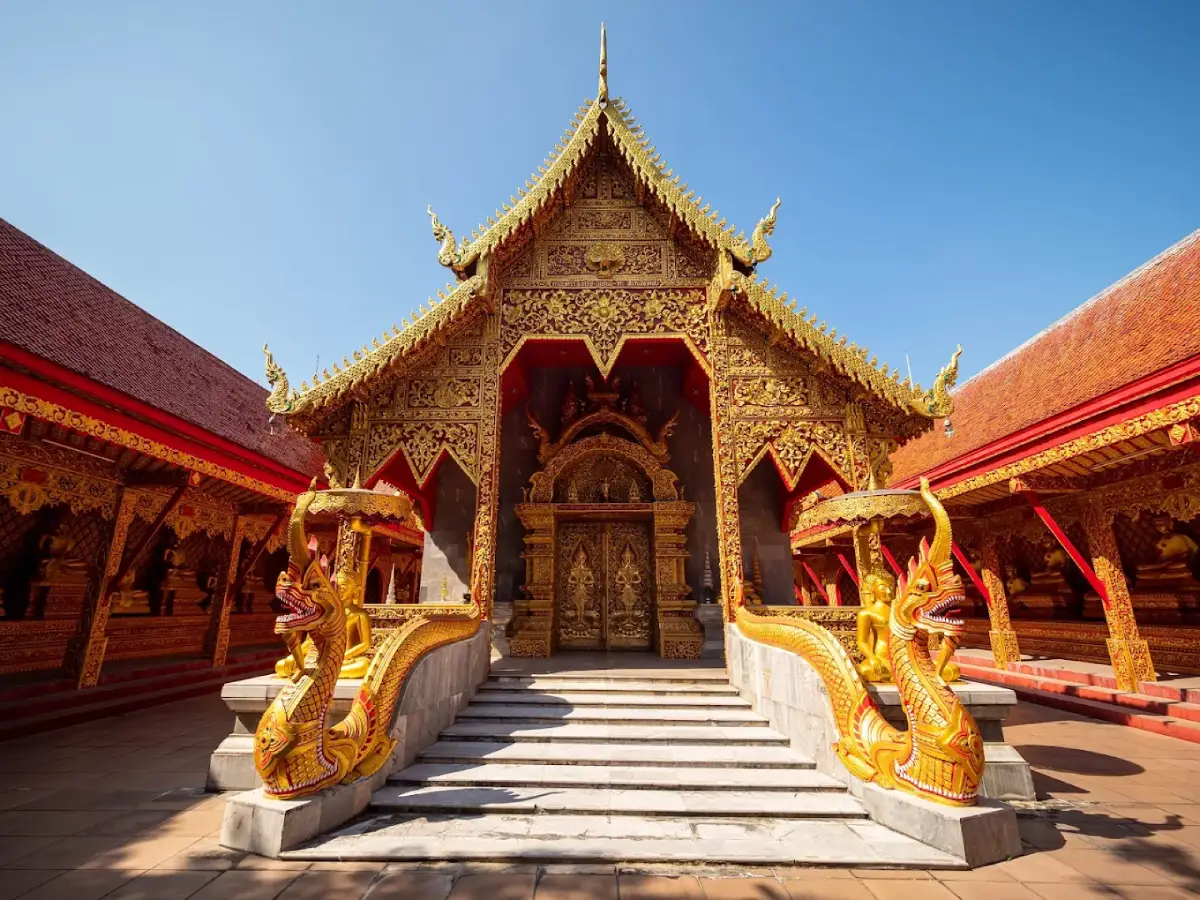
The viharn is one of the temple’s architectural highlights. Its exterior is decorated with gold tones, stucco, colored glass, and elaborate Lanna-inspired motifs. The roof has three layered gables, while the entrance is guarded by a golden five-headed naga and makara-naga motifs. Inside, the main Buddha image is a richly adorned Buddha in the Mara-vijaya posture. Behind the main image are paintings of the twelve zodiac relic pagodas, while images of Luang Pho Pan of Wat Bang Nom Kho and Luang Pho Ruesi Ling Dam stand to the left and right.
The temple’s connection with Luang Pho Ruesi Ling Dam gives it special meaning for many devotees. His role in supporting Kathin ceremonies and temple restoration created a lasting spiritual connection between Wat Khong Khao and the Wat Tha Sung tradition. The temple also has a statue of Luang Pho Phra Ratchaphrommayan and Sala Phra Ratchaphrommayan, preserving gratitude for his contribution.
Another story associated with the temple is that Luang Pho Ruesi Ling Dam once spoke of King Ramarat of Sukhothai, who was believed to have practiced meditation at Wat Khong Khao in the final period of his life after renouncing worldly affairs. This story strengthens the temple’s image as a place of quiet practice, solitude, and spiritual cultivation.
The Bodhi courtyard is another peaceful area within Wat Khong Khao. The brick-paved ground, trees, and quiet atmosphere make it suitable for slow walking, sitting calmly, or reading Dhamma books provided for visitors. This gives the temple a contemplative character that goes beyond architectural beauty.
Wat Khong Khao continues to serve Ban Khong Khao and Ban Waen as a community temple. It is used for Buddhist holy days, Buddhist Lent, the end of Buddhist Lent, Lanna Songkran, Kathin, robe-offering ceremonies, and local merit-making activities. The temple remains a place where villagers gather for worship, ceremonies, and community religious life.
For travelers, Wat Khong Khao is suitable for those interested in old temples, Lanna Buddhist art, golden viharn architecture, chedis, quiet temple grounds, and the devotional legacy of Luang Pho Ruesi Ling Dam. Its location near Chiang Mai city makes it a convenient half-day stop, especially when combined with nearby attractions in Hang Dong.
A good travel route can begin with worship at Wat Khong Khao, followed by Kad Farang Village for food and rest, Baan Tawai for woodcarving and handicrafts, Wat Ton Kwen for traditional Lanna architecture, and then Grand Canyon Chiang Mai or Royal Park Rajapruek. This route combines temple worship, local crafts, shopping, food, and family-friendly attractions.
Getting There is convenient by private car or rental car. From Chiang Mai city, take the canal road or the outer ring road toward Hang Dong, then continue into Ban Waen Subdistrict and Ban Khong Khao. Public transport users should travel first to Hang Dong or Kad Farang, then continue by local vehicle or hired transport to the temple.
Visitors should dress modestly, speak quietly, and respect sacred areas, especially the ordination hall, viharn, chedi, images of revered teachers, and Dhamma practice spaces. Photography should be done respectfully and without disturbing monks, worshippers, or those practicing meditation.
Wat Khong Khao is a meaningful destination for travelers who want to see a deeper side of Chiang Mai beyond the most famous city temples. It brings together ancient local memory, Lanna art, a white-tunnel name origin, a golden viharn, a sacred chedi, a peaceful Bodhi courtyard, and the faith legacy connected with Luang Pho Ruesi Ling Dam.
| Name | Wat Khong Khao (Ban Waen) |
| Location | Ban Khong Khao, Moo 2, Ban Waen Subdistrict, Hang Dong District, Chiang Mai Province |
| Address | No. 71, Moo 2, Ban Khong Khao, Ban Waen Subdistrict, Hang Dong District, Chiang Mai 50230, Thailand |
| Coordinates | 18.70842, 98.92051 |
| Type | Local Buddhist temple under the Mahanikaya order |
| Temple Area | 20 rai, with local municipal information noting later expansion and development to 14,463 square wa |
| History | Officially established as a temple in 1456 and granted Wisungkham Sima on 25 December 1982, with a consecrated boundary of 20 by 40 meters |
| Name Origin | The name means a white arch or white tunnel, referring to the old white tunnel-like entrance behind the main Buddha image in the former ordination hall |
| Highlights | Golden Lanna viharn, marble-paved Lanna ordination hall, gilded chedi, Sala Phra Ratchaphrommayan, Bodhi courtyard, and the restoration legacy connected with Luang Pho Ruesi Ling Dam |
| Main Areas / Structures | Lanna ordination hall, Phra Ratchaphrommayan viharn, gilded chedi, two-storey sermon hall, monks’ residences, dining hall, pavilions around the ordination hall, laterite boundary wall, Bodhi courtyard, and Khruba Nantha Thera shrine |
| Sacred Points | Adorned Mara-vijaya Buddha image, Phra Phuttha Maha Chakkraphat, gilded chedi, image of Luang Pho Phra Ratchaphrommayan, image of Luang Pho Pan, and the stupa of Phra Khru Piyaratthanaphon |
| Abbot / Caretaker | Phra Khru Palat Chu Wachiramethi |
| Important Historical Abbots | Khruba Nantha Thera, Khruba Phrom, Khruba Potha, Khruba Kham Sobhano, Phra Athikan Inta, and Phra Khru Piyaratthanaphon or Luang Pho Boonrat Kantacharo |
| Community Role | Spiritual center of Ban Khong Khao and Ban Waen, supporting merit-making, Dhamma listening, meditation, Kathin, robe-offering ceremonies, and community Buddhist activities |
| Traditions / Merit-Making | Buddhist holy days, Buddhist Lent, the end of Buddhist Lent, Lanna Songkran, Kathin, robe-offering ceremonies, and local Lanna community merit-making |
| Travel Information | From Chiang Mai city, take the canal road or outer ring road toward Hang Dong, then continue into Ban Waen and Ban Khong Khao. Private car or rental car is recommended. |
| Current Status | An active community temple and religious, cultural, and Lanna Buddhist art attraction in Hang Dong District |
| Open Days | Daily |
| Opening Hours | 08.00 – 17.00 |
| Main Contact Number | 053-441-374 |
| Local Authority | Ban Waen Subdistrict Municipality |
| Nearby Tourist Attractions | 1. Kad Farang Village, about 3 km 2. Baan Tawai Handicraft Village, about 5 km 3. Wat Intharawat or Wat Ton Kwen, about 6 km 4. Grand Canyon Chiang Mai, about 9 km 5. Royal Park Rajapruek, about 10 km |
| Nearby Restaurants | 1. Baan Wong Thong Luea, about 3 km, Tel. 081-783-3433 2. Mum Aroi Ban Waen, about 3 km, Tel. 095-685-1820, 095-838-8522 3. Suki Sawatdee Hang Dong, about 4 km, Tel. 088-884-5599 4. Krua Mae Ann Ban Waen Hang Dong, about 4 km, Tel. 080-131-1738 5. Koi Hug Cafe, about 5 km, Tel. 097-359-7648 |
| Nearby Accommodations | 1. Laan Mai Fai Chang Resort, about 2 km, Tel. 082-994-7888 2. At Leaf Villa, about 3 km, Tel. 083-763-3222 3. Beaver Club Homestay, about 3 km, Tel. 097-961-1449 4. North Hill City Resort, about 5 km, Tel. 053-333-111 5. Soft Kad Farang Hang Dong, about 4 km |
Frequently Asked Questions (FAQ)
Q: Where is Wat Khong Khao located?
A: Wat Khong Khao is located at No. 71, Moo 2, Ban Khong Khao, Ban Waen Subdistrict, Hang Dong District, Chiang Mai 50230, Thailand.
Q: When was Wat Khong Khao established?
A: Wat Khong Khao was officially established as a temple in 1456 and received Wisungkham Sima in 1982.
Q: What does the name Wat Khong Khao mean?
A: The name refers to a white arch or white tunnel, linked with the old tunnel-like opening behind the main Buddha image in the former ordination hall.
Q: What are the main highlights of Wat Khong Khao?
A: Highlights include the golden Lanna viharn, marble-paved ordination hall, gilded chedi, Sala Phra Ratchaphrommayan, Bodhi courtyard, and the temple’s connection with Luang Pho Ruesi Ling Dam.
Q: How is Wat Khong Khao connected with Luang Pho Ruesi Ling Dam?
A: Luang Pho Ruesi Ling Dam of Wat Tha Sung brought disciples and devotees to support Kathin ceremonies and temple restoration, helping develop Wat Khong Khao significantly.
Q: What type of traveler is Wat Khong Khao suitable for?
A: It is suitable for travelers interested in old temples, Lanna Buddhist art, golden viharn architecture, chedis, Dhamma practice, and quiet temple visits near Chiang Mai city.
Q: What nearby attractions can be visited with Wat Khong Khao?
A: Nearby places include Kad Farang Village, Baan Tawai Handicraft Village, Wat Ton Kwen, Grand Canyon Chiang Mai, and Royal Park Rajapruek.
 Category: ●Places of Worship
 Group: ●Temple
Last Update : 2 MonthAgo
 Last Update : 2 MonthAgo
 Click to Access the Navigation Map GPS
Wat Khong Khao (Ban Waen) Map
Recommend

 Muang Chiang Mai(121)Chom Thong(47)Mae Chaem(25)Chiang Dao(33)Doi Saket(68)Mae Taeng(85)Mae Rim(69)Samoeng(29)Fang(71)Mae Ai(59)Phrao(70)San Pa Tong(103)San Kamphaeng(66)San Sai(73)Hang Dong(73)Hot(32)Doi Tao(22)Omkoi(11)Saraphi(74)Wiang Haeng(15)Chai Prakan(28)Mae Wang(32)Mae On(22)Doi Lo(33)Galyani Vadhana(1)


