
lovethailand home >North Travel Attractions >Chiang Mai Travel Attractions >Hang Dong >Nam Phrae > Wat Wiang Dong
TL;DR: Wat Wiang Dong is located at Ban Wiang Dong, Nam Phrae Subdistrict, Hang Dong District, Chiang Mai Province, open Daily, hours 08.00 – 17.00.

Wat Wiang Dong
Open Days: Daily
Opening Hours: 08.00 – 17.00
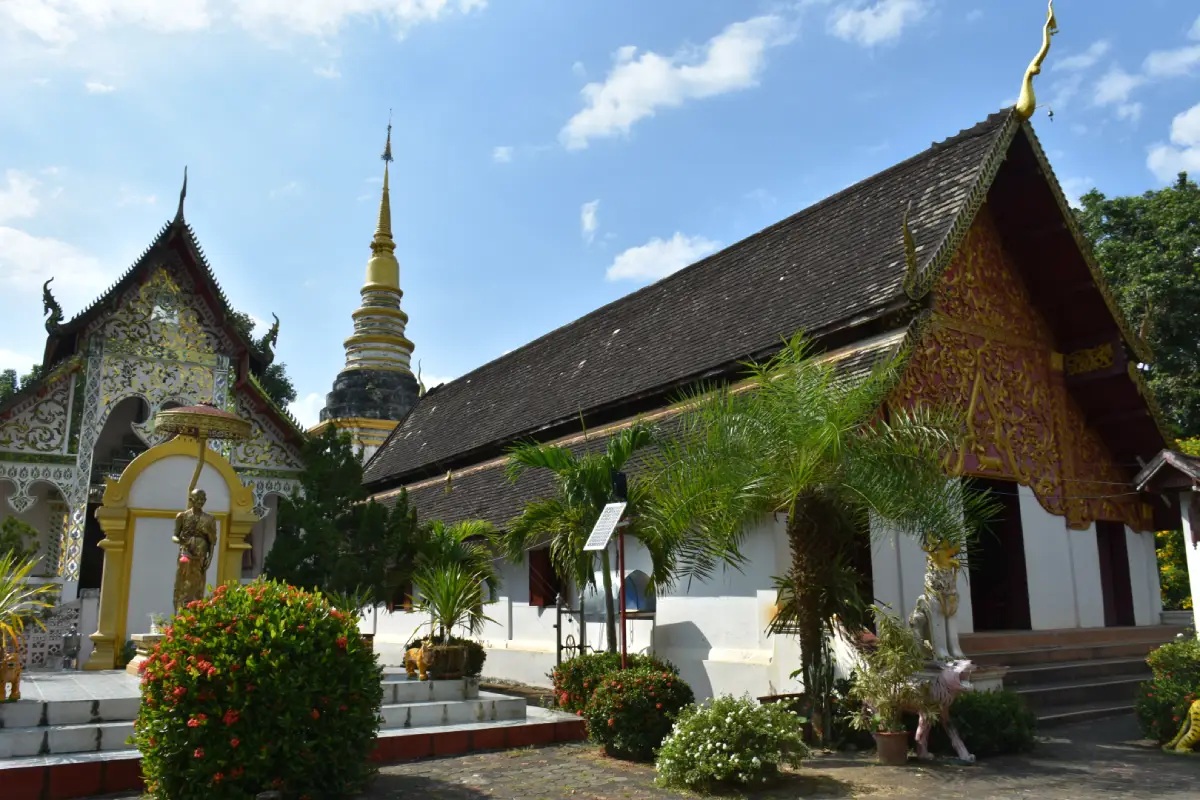
Wat Wiang Dong, also known locally as Wat Phra That Wiang Dong, is an old community temple in Ban Wiang Dong, Nam Phrae Subdistrict, Hang Dong District, Chiang Mai Province. The temple is closely linked with Pho Khun Muen Dong Nakhon, an important Lanna military figure associated with the reign of King Tilokaraj. More than a place of worship, Wat Wiang Dong is a historical and spiritual landmark that preserves the memory of an old fortified settlement, a former military camp, a sacred chedi containing Buddha relics, and an annual local ceremony dedicated to Pho Khun Muen Dong Nakhon and the temple relic.
Wat Wiang Dong is located at No. 81, Moo 11, Ban Wiang Dong, Nam Phrae Subdistrict, Hang Dong District, Chiang Mai 50230. It is a local Buddhist temple under the Mahanikaya order. The temple stands within Ban Wiang Dong, one of the important villages in Nam Phrae. The name “Wiang Dong” reflects the area’s historical identity. In Lanna usage, “wiang” often refers to a fortified settlement or enclosed habitation area, while “Dong” is associated with Muen Dong Nakhon, the historical figure remembered by the local community.
The temple is different from many ordinary village temples because its story is tied to the Lanna period under King Tilokaraj, the ninth ruler of the Mangrai dynasty. Local history records that Pho Khun Muen Dong Nakhon selected a wide area west of Chiang Mai as a place for his later years, bringing followers and soldiers to settle there. The area was enclosed with a moat and defensive earthworks, and it became known as Wiang Dong, the military camp and residence of Pho Khun Muen Dong Nakhon. A temple was then established inside this settlement.
According to local records, Wat Wiang Dong was founded in 1469 during the reign of King Tilokaraj. When Muen Dong Nakhon came to assist the administration of Nopburi Sri Nakhon Ping Chiang Mai, he built a residence and ordered soldiers to construct homes within the settlement. The temple was later built inside Wiang Dong. Bricks were made, kilns were set up, and skilled craftsmen were assigned to build the ordination hall, viharn, sermon hall, and chedi. This origin shows that Wat Wiang Dong was not only a village temple but part of a planned historical settlement.
In later periods, Wat Wiang Dong became deserted as people moved away because of war and social disruption. The original religious structures deteriorated, and the ordination hall and viharn collapsed, leaving the chedi as the most important surviving structure. The survival of the chedi preserved the spiritual core of the old temple, even during the time when the site had lost its active religious role.
A major revival took place in 1933, when Khruba Srivichai restored the viharn and chedi. This restoration was important because Khruba Srivichai was one of the most revered monks in northern Thailand, known for restoring temples, roads, and religious monuments across Lanna. His involvement helped bring Wat Wiang Dong back to life as an active religious site and restored its role as a center of faith for the Ban Wiang Dong community.
Important structures within Wat Wiang Dong include the ordination hall, main viharn, monks’ quarters, pavilions, sermon hall, Buddha image, and chedi. The chedi is especially significant because it enshrines Buddha relics. It is the main sacred focus of the temple and a key reason why villagers and visitors come to pay respect. For travelers interested in Lanna history, local Buddhism, and community-based cultural tourism, the temple offers a meaningful stop in Hang Dong.
The ordination hall serves important monastic and Buddhist ceremonial functions. The viharn is the main space for worship and merit-making. The sermon hall and pavilions support community activities, religious gatherings, local meetings, and annual ceremonies. The monks’ quarters support the daily life of the resident Sangha. Together, these structures allow Wat Wiang Dong to function as both a living temple and a cultural landmark.
Another major feature is the monument of Pho Khun Muen Dong Nakhon, located within the temple grounds. He is remembered locally as a skilled Lanna warrior and military leader connected with the period of King Tilokaraj. The monument allows the community to honor his role and helps younger generations understand the historical identity of Ban Wiang Dong. It is one of the most meaningful points to visit inside the temple.
The most important annual traditions of Wat Wiang Dong are the ceremony honoring Pho Khun Muen Dong Nakhon and the bathing ceremony of the temple relic. These events are more than religious activities. They are community rituals that preserve local memory, connect villagers with their history, and reaffirm the identity of Ban Wiang Dong. During the annual ceremony, residents gather to pay respect to Pho Khun Muen Dong Nakhon, bathe the sacred relic, and continue a tradition that has been passed down for generations.
Wat Wiang Dong plays several roles in the local community. It is a spiritual center, a place for Buddhist ceremonies, a local history site, and a gathering place for villagers. Buddhist events such as Kathin, robe-offering ceremonies, Buddhist holy days, Buddhist Lent, the end of Buddhist Lent, Songkran, and local annual merit-making activities help keep the relationship between the temple and the village alive.
The temple also helps visitors understand Nam Phrae Subdistrict more deeply. Nam Phrae lies west of Hang Dong and includes plains, foothills, forests, agricultural land, and traditional communities. Ban Wiang Dong is Moo 11 of the subdistrict and has a strong historical identity connected with the old fortified settlement and Pho Khun Muen Dong Nakhon. Visiting the temple therefore provides insight into the relationship between landscape, settlement, Buddhism, and Lanna history.
For a connected travel route, Wat Wiang Dong can be combined with Wat Phra That Doi Tham, Ob Khan National Park, Ban Wiang Dong Community Forest, the Nam Phrae Lanna Cultural Learning Center, and Grand Canyon Chiang Mai. A good route is to begin at Wat Wiang Dong to learn about Pho Khun Muen Dong Nakhon, continue to Wat Phra That Doi Tham for another site linked to the same historical tradition, then visit Ob Khan or the local community forest for nature and landscape.
The atmosphere of Wat Wiang Dong is quiet and local. It is not a crowded mainstream attraction, but its value lies in its old chedi, its connection with a Lanna military figure, its living temple culture, and its community ceremonies. Visitors should take time to walk respectfully around the temple, observe the religious structures, pay respect at the chedi, and understand the historical layers behind the site.
The key places to see and pay respect to include the chedi containing Buddha relics, the Buddha image, the viharn, the ordination hall, and the monument of Pho Khun Muen Dong Nakhon. Travelers who visit during the annual ceremony will see the temple’s role as a living community center more clearly, especially through the relic bathing ceremony and the gathering of local residents.
Getting There is most convenient by private car or rental car. From Chiang Mai city, travel toward Hang Dong District via the Chiang Mai–Hang Dong route or the canal road, then continue into Nam Phrae Subdistrict and Ban Wiang Dong. The route is suitable for travelers who want to explore several cultural and natural attractions in the same day. Public transport users should travel to Hang Dong first, then continue by local transport into Nam Phrae.
Visitors should dress modestly, speak quietly, and avoid disturbing monks or community ceremonies. Wat Wiang Dong is an active community temple, not only a historical attraction. Respectful behavior helps preserve the calm atmosphere and supports meaningful cultural tourism in the local area.
Wat Wiang Dong is suitable for travelers interested in old temples, Lanna history, Pho Khun Muen Dong Nakhon, and community-based travel in Hang Dong. For those who want to see a quieter side of Chiang Mai beyond the old city and popular cafés, this temple offers a grounded perspective on local history, faith, landscape, and village life.
| Name | Wat Wiang Dong / Wat Phra That Wiang Dong |
| Location | Ban Wiang Dong, Nam Phrae Subdistrict, Hang Dong District, Chiang Mai Province |
| Address | No. 81, Moo 11, Ban Wiang Dong, Nam Phrae Subdistrict, Hang Dong District, Chiang Mai 50230, Thailand |
| Coordinates | PW85+GJH, Nam Phrae, Hang Dong District, Chiang Mai |
| Type | Local Buddhist temple under the Mahanikaya order |
| Temple Area | 11 rai, 1 ngan, 76 square wa |
| History | Established in 1469 during the reign of King Tilokaraj, the ninth ruler of the Mangrai dynasty |
| Key Historical Figure | Pho Khun Muen Dong Nakhon / Chao Muen Dong Nakhon |
| Name Origin | Wiang Dong refers to the old fortified residence and military camp associated with Pho Khun Muen Dong Nakhon |
| Highlights | Chedi enshrining Buddha relics, monument of Pho Khun Muen Dong Nakhon, old fortified settlement history, and annual relic bathing ceremony |
| Main Structures | Ordination hall, viharn, monks’ quarters, pavilion, sermon hall, and chedi |
| Sacred Objects | Buddha image and chedi enshrining Buddha relics |
| Temple Boundary | North: private land; South: private land; East: Mae Tha Chang River; West: private land |
| Abbot / Caretaker | Phra Khru Phimon Silasunthon Silatecho |
| Important Annual Traditions | Ceremony honoring Pho Khun Muen Dong Nakhon and annual bathing ceremony of the temple relic |
| Travel Information | From Chiang Mai city, travel toward Hang Dong, then continue into Nam Phrae and Ban Wiang Dong. Private car or rental car is recommended. |
| Current Status | An old cultural temple of Nam Phrae with the monument of Pho Khun Muen Dong Nakhon as a key local worship site |
| Open Days | Daily |
| Opening Hours | 08.00 – 17.00 |
| Local Authority | Nam Phrae Phattana Municipality, Tel. 052-080792 |
| Nearby Tourist Attractions | 1. Pho Khun Muen Dong Nakhon Monument, about 0 km 2. Wat Phra That Doi Tham, about 6 km 3. Ban Wiang Dong Community Forest, about 7 km 4. Ob Khan National Park, about 12 km 5. Grand Canyon Chiang Mai, about 13 km |
| Nearby Restaurants | 1. Nopporn Traditional Grilled Pork, Tea, Coffee and Smoothies, about 1 km, Tel. 088-467-4279 2. Bunga Café And Resort Nam Phrae Hang Dong, about 7 km, Tel. 098-789-9423 3. The Hope Nam Phrae, about 8 km, Tel. 065-406-4514 4. Im Aroi Nam Phrae, about 9 km, Tel. 062-882-3556, 091-818-3890 5. Pad Toh Grill and Mala Nam Phrae, about 9 km, Tel. 084-373-2794 |
| Nearby Accommodations | 1. Hideaway, about 4 km, Tel. 081-952-5687 2. Rimthar Phu Willa / Rim Tarn Phu View Chiang Mai, about 10 km, Tel. 092-892-2378 3. Bamboo Garden Resort and Restaurant, about 11 km, Tel. 062-037-3620 4. Rice Barn and Rooms, about 12 km, Tel. 081-960-3997 5. ZJ Stay Over The Moon Wellness Resort and Cafe, about 13 km |
Frequently Asked Questions (FAQ)
Q: Where is Wat Wiang Dong located?
A: Wat Wiang Dong is located at No. 81, Moo 11, Ban Wiang Dong, Nam Phrae Subdistrict, Hang Dong District, Chiang Mai 50230, Thailand.
Q: When was Wat Wiang Dong established?
A: Wat Wiang Dong was established in 1469 during the reign of King Tilokaraj of the Lanna kingdom.
Q: How is Wat Wiang Dong connected with Pho Khun Muen Dong Nakhon?
A: The Wiang Dong area was the residence and military camp of Pho Khun Muen Dong Nakhon before the temple was built inside the settlement. A monument dedicated to him now stands within the temple.
Q: What are the main things to see at Wat Wiang Dong?
A: Key features include the chedi enshrining Buddha relics, the viharn, the ordination hall, the Buddha image, and the monument of Pho Khun Muen Dong Nakhon.
Q: What important annual traditions are held at Wat Wiang Dong?
A: The temple is associated with the annual ceremony honoring Pho Khun Muen Dong Nakhon and the bathing ceremony of the temple relic.
Q: What type of traveler is Wat Wiang Dong suitable for?
A: It is suitable for travelers interested in old temples, Lanna history, Pho Khun Muen Dong Nakhon, and quiet cultural travel in Hang Dong.
Q: What nearby attractions can be visited with Wat Wiang Dong?
A: Nearby attractions include Wat Phra That Doi Tham, Ban Wiang Dong Community Forest, Ob Khan National Park, and Grand Canyon Chiang Mai.
 Category: ●Places of Worship
 Group: ●Temple
Last Update : 1 MonthAgo
 Last Update : 1 MonthAgo
 Click to Access the Navigation Map GPS
Wat Wiang Dong Map
Recommend

 Muang Chiang Mai(121)Chom Thong(47)Mae Chaem(25)Chiang Dao(33)Doi Saket(68)Mae Taeng(85)Mae Rim(69)Samoeng(29)Fang(71)Mae Ai(59)Phrao(70)San Pa Tong(103)San Kamphaeng(66)San Sai(73)Hang Dong(73)Hot(32)Doi Tao(22)Omkoi(11)Saraphi(74)Wiang Haeng(15)Chai Prakan(28)Mae Wang(32)Mae On(22)Doi Lo(33)Galyani Vadhana(1)


