
lovethailand home >North Travel Attractions >Chiang Mai Travel Attractions >Saraphi >Saraphi > Wat Saraphi
TL;DR: Wat Saraphi is located at Ban Saraphi, Moo 2, Chiang Mai–Lamphun Road, Saraphi Subdistrict, Saraphi District, Chiang Mai Province, open Daily, hours 08.00 – 17.00.

Wat Saraphi
Open Days: Daily
Opening Hours: 08.00 – 17.00
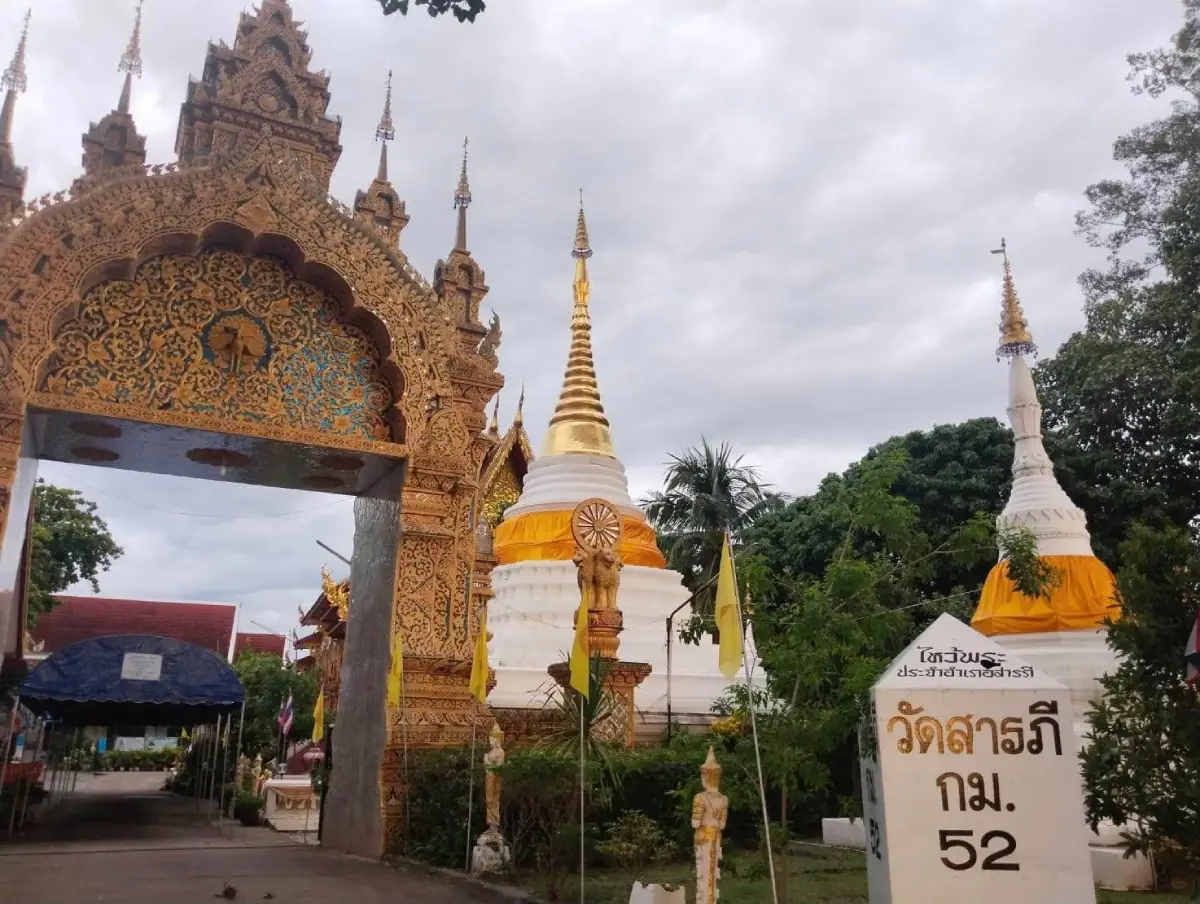
Wat Saraphi is a local Buddhist temple under the Mahanikaya monastic order, located at No. 52, Ban Saraphi, Chiang Mai–Lamphun Road, Moo 2, Saraphi Subdistrict, Saraphi District, Chiang Mai Province. It is an old community temple with a history dating back to 1817. The temple was formerly known as Wat Duang Dee before being renamed Wat Saraphi after the fragrant saraphi flower, a flower traditionally associated in northern Thailand with paying respect to elders during the Lanna New Year. The temple land covers 2 rai, 1 ngan, and 92 square wah. It received its Wisungkhamsima on 23 October 1973, with the boundary measuring 40 meters wide and 80 meters long. The current abbot is Phra Khru Sathorn Kit Koson Chawanpanyo.
Wat Saraphi should be understood as a central community temple of Ban Saraphi rather than simply a temple beside the Chiang Mai–Lamphun Road. The temple name, village name, subdistrict name, and local identity are all connected with the word Saraphi. The saraphi flower is fragrant and culturally meaningful in Lanna tradition, especially in elder-respect rituals during the northern Thai New Year. The temple name therefore reflects not only geography but also respect, auspiciousness, and the cultural roots of the community.
The temple’s former name, Wat Duang Dee, carries an auspicious meaning. Later, as the community identity became closely associated with the saraphi flower, the temple became known as Wat Saraphi. This new name turned the temple into a direct symbol of the village and subdistrict. It preserves the memory of a local flower, northern Thai respect customs, and the spiritual identity of the community.
The Chiang Mai–Lamphun Road, also known as the old yang tree-lined road, is an important cultural route linking old settlements, temples, agricultural communities, and historic urban areas in the Ping River basin. Wat Saraphi stands along this route and therefore functions both as the spiritual center of Ban Saraphi and as a landmark within one of the most recognizable cultural corridors of Saraphi District.
The temple was founded in 1817, making it one of the older temples in Saraphi Subdistrict. During that period, a village temple was central to local life. It served as a place for merit-making, Dhamma listening, ceremonies, basic learning, and community gathering. Wat Saraphi therefore represents more than religious architecture; it is evidence of long community continuity and Buddhist devotion in Ban Saraphi.
The granting of Wisungkhamsima on 23 October 1973 was an important milestone in the temple’s religious history. A Wisungkhamsima is the formal boundary used for important Sangha rites, especially ordination and ecclesiastical ceremonies. Wat Saraphi’s boundary measures 40 meters wide and 80 meters long, confirming the temple’s formal role in Buddhist monastic practice.
The temple land covers 2 rai, 1 ngan, and 92 square wah under land title No. 12495. Its boundaries connect with privately occupied land, public land, and the national highway. This setting reflects the character of a community temple embedded in everyday village life and major local transportation routes. Wat Saraphi is therefore accessible and closely connected with the movement of people along the historic road.
The main temple structures include a Lanna Thai-style ordination hall, sermon hall, and monks’ residence. Important sacred objects include 2 pagodas and ancient Buddha images. These elements make the temple meaningful both as a community Buddhist center and as a place where visitors can observe local religious art and devotion.
The Lanna Thai-style ordination hall is one of the most important highlights of Wat Saraphi. Inside the hall are mural paintings, including a depiction of the Bodhi tree at the moment of the Buddha’s enlightenment behind the principal Buddha image. Other wall paintings present the Five Precepts, the Five Ennobling Virtues, and northern Thai traditions. These murals are not merely decoration; they teach moral values and transmit local culture through visual storytelling.
The principal Buddha image inside the ordination hall is the main focus of worship. Visitors should pay respect calmly and understand the image as a devotional center rather than only an object to observe. The atmosphere inside the ordination hall shows how Buddhist teachings, Lanna art, and community faith come together in one sacred space.
The 2 pagodas are important sacred features of the temple. In Lanna Buddhist culture, pagodas symbolize the stability of the religion and serve as points of reverence for local devotees. A white pagoda visible near the front of the temple also helps visitors recognize Wat Saraphi from the Chiang Mai–Lamphun Road.
The sermon hall plays an important social and religious role. It is used for Dhamma listening, merit-making, temple meetings, and village activities. In a Lanna community temple, the sermon hall is not merely a multipurpose building; it is a shared space where villagers gather, cooperate, and preserve the custom of making merit together.
The monks’ residence supports the continuity of temple life. Current temple information identifies 9 resident monks. With monks residing at the temple, Wat Saraphi can maintain daily chanting, monastic routines, alms-related activities, religious guidance, and ceremonies for the community.
Phra Khru Sathorn Kit Koson Chawanpanyo is the current abbot of Wat Saraphi. After the previous abbot passed away, the Saraphi monastic administration appointed Phra Maha Mongkhon, who served as the ecclesiastical head of Saraphi–Nong Faek Subdistrict and abbot of Wat Chang Khoeng, as acting abbot. Later, Phra Khru Sathorn Kit Koson Chawanpanyo became the abbot of Wat Saraphi. This succession connects the temple with both local community life and the wider monastic administration of Saraphi District.
Wat Saraphi has also served as a venue for important Buddhist and community activities in Saraphi District. Its role extends beyond the village because it can host district-level religious events and gatherings of devotees from several subdistricts. This makes the temple one of the meaningful religious and cultural centers of Saraphi.
The saraphi flower gives the temple name special cultural meaning. In Lanna New Year customs, fragrant flowers, turmeric-scented water, and offerings are used to pay respect to elders. The temple name therefore connects Buddhism, nature, gratitude, elder respect, and family relationships within the northern Thai cultural world.
Religious activities associated with Wat Saraphi include Buddhist holy days, Buddhist Lent, the end of Buddhist Lent, Kathin, robe-offering ceremonies, Songkran, elder-respect customs, Yi Peng, and local merit-making in Ban Saraphi. These events bring villagers together and help preserve the rhythm of Lanna Buddhist life.
The main appeal of Wat Saraphi for visitors is its direct connection with the identity of Saraphi itself. The temple was formerly Wat Duang Dee, later renamed after the saraphi flower, and contains a Lanna Thai-style ordination hall with murals, 2 pagodas, ancient Buddha images, a sermon hall, and monks’ residence. It is suitable for visitors interested in old community temples, Lanna murals, and the cultural route along the Chiang Mai–Lamphun Road.
The temple atmosphere is calm and local. Visitors should allow around 30 to 60 minutes to observe the ordination hall, mural paintings, principal Buddha image, pagodas, sermon hall, monks’ residence, and surrounding temple area. Morning or late afternoon is generally the most comfortable time to walk around the temple grounds.
Visitors should dress modestly, speak softly, remove shoes before entering sacred buildings, avoid touching Buddha images, pagodas, or mural paintings unnecessarily, and avoid disturbing monks or villagers during ceremonies. If community events are taking place, visitors should allow space for local participants and behave respectfully within the temple grounds.
Getting There is possible by taking the Chiang Mai–Lamphun Road from Chiang Mai city toward Saraphi District. After entering Saraphi Subdistrict, the temple is on the left-hand side, with a white pagoda visible near the front. Private car, rental car, or local hired transport is the most convenient option. Wat Saraphi can be combined easily with nearby temples along the old road.
A practical cultural route can begin at Wat Saraphi and continue to Wat Chang Khoeng, Wat Pak Kong, Wat Ko Pracham Hong, Wat Hong Kok, Wat Mongkhon Wanaram, Wat Ton Phueng, and Wat Kong Sai. Travelers who want to extend the route can continue to temples in Nong Phueng and the wider Wiang Kum Kam area. This route helps visitors understand Saraphi through old temples, the yang tree-lined road, traditional village communities, the saraphi flower, and Lanna Buddhist art.
Overall, Wat Saraphi is valuable for its history, religious identity, Lanna art, and deep connection with local culture. Built in 1817, formerly named Wat Duang Dee, renamed after the saraphi flower used in northern Thai elder-respect customs, and granted Wisungkhamsima in 1973, the temple continues to function as an active Buddhist center for Ban Saraphi and the wider Saraphi District community.
| Name | Wat Saraphi |
| Former Name | Wat Duang Dee |
| Location | Ban Saraphi, Moo 2, Chiang Mai–Lamphun Road, Saraphi Subdistrict, Saraphi District, Chiang Mai Province |
| Address | No. 52, Ban Saraphi, Chiang Mai–Lamphun Road, Moo 2, Saraphi Subdistrict, Saraphi District, Chiang Mai Province 50140, Thailand |
| Temple Type | Local Buddhist temple under the Mahanikaya monastic order |
| Temple Land | 2 rai, 1 ngan, and 92 square wah |
| Land Title | Land title No. 12495 |
| Temple Boundaries | North: about 64 meters, privately occupied land South: about 60 meters, public land East: about 62 meters, public land West: about 75 meters, national highway |
| Highlights | Old temple of Ban Saraphi, formerly Wat Duang Dee, renamed after the saraphi flower used in northern Thai elder-respect customs, with a Lanna Thai-style ordination hall, mural paintings, 2 pagodas, and ancient Buddha images |
| History | Built in 1817; formerly named Wat Duang Dee before being renamed Wat Saraphi after the fragrant saraphi flower associated with Lanna respect customs |
| Wisungkhamsima | Granted on 23 October 1973; the boundary measures 40 meters wide and 80 meters long |
| Main Areas / Zones | Lanna Thai-style ordination hall, sermon hall, monks’ residence, and community merit-making areas |
| Artistic Highlight | Mural paintings in the ordination hall showing the Bodhi tree at the moment of enlightenment behind the principal Buddha image, with walls depicting the Five Precepts, the Five Ennobling Virtues, and northern Thai traditions |
| Sacred Objects | 2 pagodas and ancient Buddha images |
| Abbot | Phra Khru Sathorn Kit Koson Chawanpanyo |
| Resident Monks | 9 monks |
| Open Days | Daily |
| Opening Hours | 08.00 – 17.00 |
| Important Religious Activities | Buddhist holy days, Buddhist Lent, end of Buddhist Lent, Kathin, robe-offering ceremonies, Songkran, elder-respect activities, Yi Peng, and local merit-making in Ban Saraphi |
| Travel Information | Take the Chiang Mai–Lamphun Road from Chiang Mai city toward Saraphi District. After entering Saraphi Subdistrict, the temple is on the left-hand side, with a white pagoda visible near the front. Private car, rental car, or local hired transport is the most convenient option |
| Current Status | Active community temple in Saraphi Subdistrict and a venue for Buddhist worship, village merit-making, and Saraphi District monastic activities |
| Nearby Tourist Attractions | 1. Wat Chang Khoeng, Saraphi, about 1 km 2. Wat Pak Kong, Saraphi, about 3 km 3. Wat Ko Pracham Hong, Saraphi, about 4 km 4. Wat Hong Kok, Saraphi, about 4 km 5. Wat Mongkhon Wanaram, Saraphi, about 5 km 6. Wat Kong Sai, Nong Phueng, about 7 km |
| Nearby Restaurants | 1. Nai Ya Kitchen Yang Noeng Saraphi, about 4 km, Tel. 095-830-4248 2. Pee Rung Restaurant Khuamung Moo 5, about 6 km, Tel. 061-065-7961 3. Zaab Isan Khuamung, about 7 km, Tel. 098-172-0983 4. Restime Pizza Khuamung, about 7 km, Tel. 081-472-0954 5. The Khuamung, about 8 km, Tel. 083-313-3733, 062-495-0496 |
| Nearby Accommodations | 1. 9Roomz, about 6 km, Tel. 095-446-0758, 053-963-829 2. Baan Saraphi, about 7 km, Tel. 053-321-942 3. Ruean Thip Resort, about 8 km, Tel. 098-556-6291 4. Baan Nam Ping Riverside Village, about 10 km, Tel. 053-439040 5. Baan Hom Samunphrai, about 11 km, Tel. 053-817-362, 081-885-1429 |
Frequently Asked Questions (FAQ)
Q: Where is Wat Saraphi located?
A: Wat Saraphi is located at No. 52, Ban Saraphi, Chiang Mai–Lamphun Road, Moo 2, Saraphi Subdistrict, Saraphi District, Chiang Mai Province 50140. It is a local Buddhist temple under the Mahanikaya monastic order.
Q: What was the former name of Wat Saraphi?
A: Wat Saraphi was formerly known as Wat Duang Dee. It was later renamed Wat Saraphi after the saraphi flower, a flower associated with northern Thai elder-respect customs.
Q: When was Wat Saraphi built?
A: Wat Saraphi was built in 1817 and received its Wisungkhamsima on 23 October 1973.
Q: What can visitors see at Wat Saraphi?
A: Visitors can see the Lanna Thai-style ordination hall, mural paintings, sermon hall, monks’ residence, 2 pagodas, ancient Buddha images, and the calm atmosphere of a community temple on the Chiang Mai–Lamphun Road.
Q: What do the murals inside Wat Saraphi depict?
A: The murals include the Bodhi tree at the moment of enlightenment behind the principal Buddha image, and wall paintings about the Five Precepts, the Five Ennobling Virtues, and northern Thai traditions.
Q: Who is the abbot of Wat Saraphi?
A: The abbot of Wat Saraphi is Phra Khru Sathorn Kit Koson Chawanpanyo.
Q: What are the opening hours of Wat Saraphi?
A: Wat Saraphi is open daily from 08.00 to 17.00.
Q: What nearby places can be visited with Wat Saraphi?
A: Nearby places include Wat Chang Khoeng, Wat Pak Kong, Wat Ko Pracham Hong, Wat Hong Kok, Wat Mongkhon Wanaram, Wat Kong Sai, and the wider Wiang Kum Kam cultural route.
 Category: ●Places of Worship
 Group: ●Temple
Last Update : 2 MonthAgo
 Last Update : 2 MonthAgo

 Click to Access the Navigation Map GPS
Wat Saraphi Map
Recommend

 Muang Chiang Mai(121)Chom Thong(47)Mae Chaem(25)Chiang Dao(33)Doi Saket(68)Mae Taeng(85)Mae Rim(69)Samoeng(29)Fang(71)Mae Ai(59)Phrao(70)San Pa Tong(103)San Kamphaeng(66)San Sai(73)Hang Dong(73)Hot(32)Doi Tao(22)Omkoi(11)Saraphi(74)Wiang Haeng(15)Chai Prakan(28)Mae Wang(32)Mae On(22)Doi Lo(33)Galyani Vadhana(1)


