
lovethailand home >North Travel Attractions >Chiang Mai Travel Attractions >Saraphi >Saraphi > Wat Mongkhon Wanaram
TL;DR: Wat Mongkhon Wanaram is located at Ban Pa Daet, Moo 1, Chiang Mai–Lamphun Road, Saraphi Subdistrict, Saraphi District, Chiang Mai Province, open Daily, hours 08.00 – 17.00.

Wat Mongkhon Wanaram
Open Days: Daily
Opening Hours: 08.00 – 17.00
Wat Mongkhon Wanaram, widely known by local people as Wat Pa Daet, is a local Buddhist temple under the Mahanikaya monastic order. It is located at No. 76, Ban Pa Daet, Chiang Mai–Lamphun Road, Moo 1, Saraphi Subdistrict, Saraphi District, Chiang Mai Province. The temple stands along the historic Chiang Mai–Lamphun cultural route and has been closely connected with the Ban Pa Daet community for generations. It was founded around 1858 when Phra Decha and local villagers rebuilt a temple on the site of an abandoned monastery. The temple was first known as Wat Pa Aram Ban Rai, later became Wat Pa Daet, and was officially renamed Wat Mongkhon Wanaram on 23 November 1983. It received its Wisungkhamsima on 16 March 1976, with the boundary measuring 40 meters wide and 80 meters long. The current abbot is Phra Athikan Thirasak Panyawachiro.
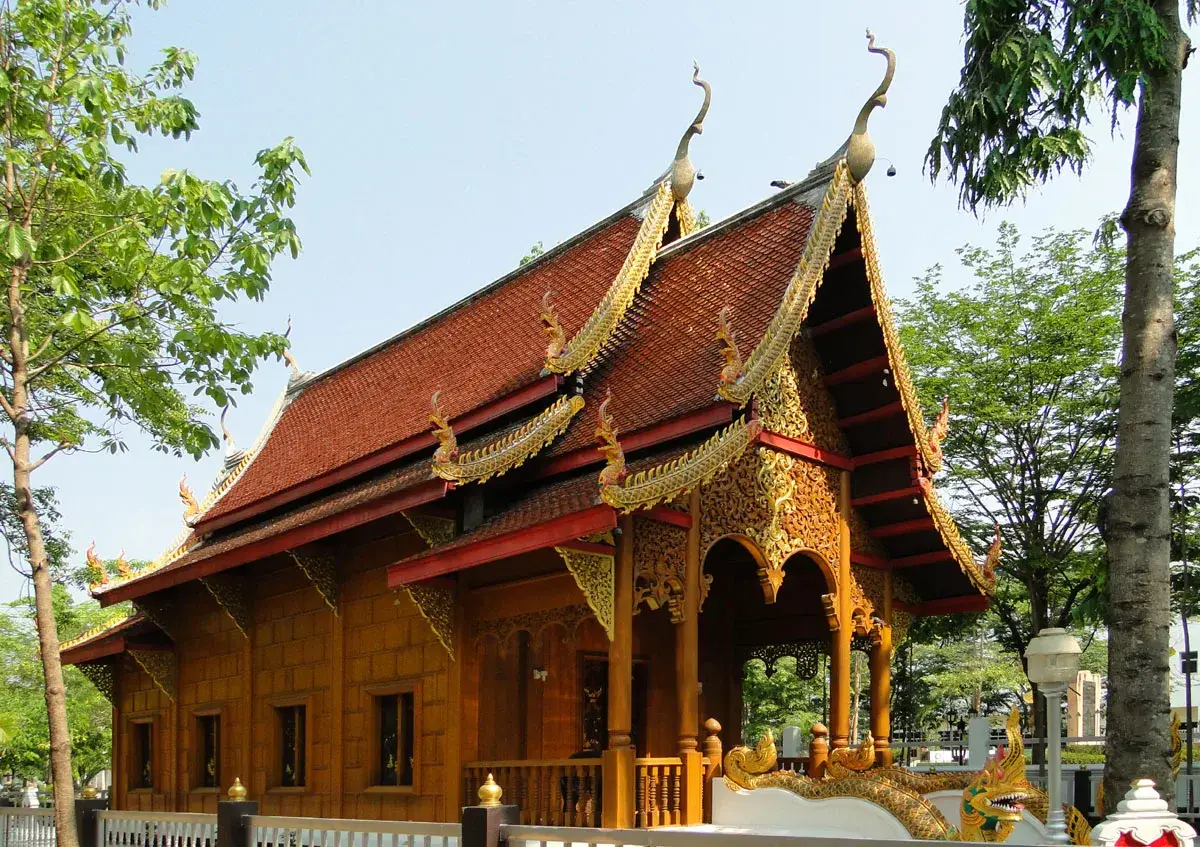
Wat Mongkhon Wanaram should be understood as an old community temple of Saraphi rather than only a roadside place of worship. Its history has several layers: an earlier abandoned temple site, revival by monks and villagers, several name changes, formal recognition through Wisungkhamsima, and continued use as a Buddhist center for Ban Pa Daet. Important features include the Lanna-style ordination hall, viharn, pagoda, statue of Khruba Siwichai, a replica of Phra Phuttha Chinnarat, and the local devotional memory connected with Khruba Som of Wat Pa Daet.
The temple’s first known name, Wat Pa Aram Ban Rai, reflects an older setting connected with village fields and a former sacred site. Later, the temple became known as Wat Pa Daet because the area was open and had few trees, allowing strong sunlight across the temple grounds. The present name, Wat Mongkhon Wanaram, gives the temple a more auspicious and peaceful meaning, while the older name Wat Pa Daet remains deeply familiar to local devotees.
Ban Pa Daet in Saraphi Subdistrict lies along the Chiang Mai–Lamphun Road, one of the important historic routes linking Chiang Mai and Lamphun. This road connects temples, villages, agricultural communities, and old settlement areas. Wat Mongkhon Wanaram belongs to this cultural corridor and reflects the character of Saraphi as a district shaped by temple communities, old roads, and Lanna Buddhist traditions.
The founding of the temple around 1858 is significant because it marked the revival of an abandoned sacred site. Phra Decha and local villagers rebuilt the temple so that the community would again have a place for merit-making, Dhamma listening, ceremonies, and Buddhist gatherings. In this sense, the temple represents both religious revival and the social organization of Ban Pa Daet.
The official renaming in 1983 was another important stage in the temple’s history. The name Wat Mongkhon Wanaram shifted the temple’s formal identity from a name based on the open, sunny landscape to one expressing auspiciousness and the peace of a Buddhist monastery. The coexistence of the official name and the local name Wat Pa Daet gives the temple a distinctive two-layer identity: one used in formal records and one preserved in community memory.
The granting of Wisungkhamsima on 16 March 1976 confirmed the temple’s formal role within the Buddhist monastic system. A Wisungkhamsima is the boundary used for important Sangha rites, especially ordination and ecclesiastical ceremonies. Wat Mongkhon Wanaram’s boundary measures 40 meters wide and 80 meters long, allowing the temple to function fully as a center of Buddhist monastic activity.
The temple land covers 5 rai and 1 ngan. Its boundaries connect with privately held land, public roads, and garden areas, reflecting the character of a village temple embedded in everyday community life. The temple is not separated from the surrounding settlement; it is part of the social and physical landscape of Ban Pa Daet.
The Lanna-style ordination hall is one of the temple’s key religious structures. Visitors should approach it respectfully because it is connected with the temple’s Wisungkhamsima and formal Sangha activities. Its northern Thai architectural character helps express the temple’s identity within the Lanna Buddhist tradition.
The viharn is an important devotional space for worship, Dhamma listening, and community merit-making. Visitors should remove shoes where required, speak softly, and pay respect calmly. In a Lanna community temple, the viharn is not merely an architectural feature but a living sacred space used by villagers throughout the Buddhist calendar.
The pagoda is another important sacred feature. In Lanna Buddhism, a pagoda represents the stability of the religion and serves as a focus of reverence for local devotees. Visitors should walk respectfully around the area and avoid touching, climbing, or leaning on sacred structures.
The statue of Khruba Siwichai connects the temple with one of the most revered monks in northern Thai Buddhist history. Khruba Siwichai is remembered for religious dedication, public works, and strong devotional leadership. Paying respect to his statue allows visitors to connect with a wider layer of Lanna Buddhist faith.
The replica of Phra Phuttha Chinnarat is another important sacred object in the temple. Phra Phuttha Chinnarat is one of Thailand’s most revered Buddha images, and its replica gives visitors a familiar devotional focus within the local context of Ban Pa Daet and Saraphi.
Wat Mongkhon Wanaram is also associated with Khruba Som of Wat Pa Daet, a monk remembered with deep respect by local devotees. His memory adds another devotional layer to the temple and helps explain why the older name Wat Pa Daet continues to carry strong religious meaning among people who know the temple’s history.
A fire that damaged the viharn in the past became an important reminder of the need to preserve and restore sacred buildings. The temple and its devotees continued to support the restoration and maintenance of the temple so that Buddhist activities could continue. This reflects the resilience of a community temple, where local faith helps sustain the temple through difficult periods.
Phra Athikan Thirasak Panyawachiro serves as the current abbot of Wat Mongkhon Wanaram. His role includes receiving and guiding religious activities such as candle offerings during Buddhist Lent, caring for the temple, and maintaining the connection between monks, villagers, and outside institutions that take part in Buddhist ceremonies.
Wat Mongkhon Wanaram functions as a spiritual center for Ban Pa Daet and Saraphi Subdistrict. It supports Buddhist holy days, Buddhist Lent, candle-offering ceremonies, the end of Buddhist Lent, Kathin, robe-offering ceremonies, Songkran, elder-respect customs, Yi Peng, and other village merit-making activities. These events bring villagers together and preserve the local rhythm of Lanna Buddhist life.
The Buddhist Lent candle-offering tradition is especially meaningful because it connects the temple with local communities and educational institutions. During this period, devotees offer candles as an act of Buddhist merit and respect. Such activities help transmit ethical values, community unity, and devotion to Buddhism across generations.
The main appeal of Wat Mongkhon Wanaram for visitors is its layered history and living community role. The temple has moved through several names, from Wat Pa Aram Ban Rai to Wat Pa Daet and finally Wat Mongkhon Wanaram. It contains a Lanna-style ordination hall, viharn, pagoda, statue of Khruba Siwichai, a replica of Phra Phuttha Chinnarat, and devotional memory connected with Khruba Som of Wat Pa Daet.
The temple is suitable for visitors who want a calm place to make merit, pay respect, and learn about old community temples in Saraphi. It is best visited slowly, with around 30 to 60 minutes allowed for worship and observation of the ordination hall, viharn, pagoda, Khruba Siwichai statue, Buddha image, and temple grounds. Morning or late afternoon is generally the most comfortable time to visit.
Visitors should dress modestly, speak softly, remove shoes before entering sacred buildings, avoid touching Buddha images, monk statues, or sacred objects unnecessarily, and avoid climbing or leaning on temple structures. If ceremonies, candle offerings, or community activities are taking place, visitors should allow space for local participants and behave respectfully.
Getting There is possible by taking the Chiang Mai–Lamphun Road from Chiang Mai city toward Saraphi District. The temple is located in Ban Pa Daet, Moo 1, Saraphi Subdistrict. Private car, rental car, or local hired transport is the most convenient option. Wat Mongkhon Wanaram can be combined easily with other temples along the old Chiang Mai–Lamphun route.
A practical cultural route can begin at Wat Mongkhon Wanaram and continue to Wat Pak Kong, Wat Chang Khoeng, Wat Saraphi, Wat Ko Pracham Hong, Wat Hong Kok, Wat Ton Phueng, and Wat Kong Sai. Travelers who want to extend the route can continue to temples in Nong Phueng and the wider Wiang Kum Kam area. This route helps visitors understand Saraphi through old temples, the Chiang Mai–Lamphun road, Lanna Buddhist art, and living community faith.
Overall, Wat Mongkhon Wanaram is valuable for its history, religious identity, Lanna architecture, and community role. Founded around 1858 by Phra Decha and local villagers on an abandoned temple site, formerly known as Wat Pa Aram Ban Rai and Wat Pa Daet, officially renamed in 1983, and granted Wisungkhamsima in 1976, the temple continues to serve as a meaningful Buddhist center for Ban Pa Daet and Saraphi District.
| Name | Wat Mongkhon Wanaram |
| Former / Local Names | Wat Pa Aram Ban Rai, Wat Pa Daet |
| Location | Ban Pa Daet, Moo 1, Chiang Mai–Lamphun Road, Saraphi Subdistrict, Saraphi District, Chiang Mai Province |
| Address | No. 76, Ban Pa Daet, Chiang Mai–Lamphun Road, Moo 1, Saraphi Subdistrict, Saraphi District, Chiang Mai Province 50140, Thailand |
| Temple Type | Local Buddhist temple under the Mahanikaya monastic order |
| Temple Land | 5 rai and 1 ngan |
| Temple Boundaries | North: about 66 wa, private land South: about 91 wa, public road East: about 26 wa, garden land West: about 29 wa, public road |
| Highlights | Old temple of Ban Pa Daet, formerly Wat Pa Aram Ban Rai and Wat Pa Daet, with a Lanna-style ordination hall, viharn, pagoda, Khruba Siwichai statue, Phra Phuttha Chinnarat replica, and devotional memory connected with Khruba Som of Wat Pa Daet |
| History | Around 1858, Phra Decha and local villagers built the temple on an abandoned temple site. It was first named Wat Pa Aram Ban Rai, later became Wat Pa Daet, and was officially renamed Wat Mongkhon Wanaram on 23 November 1983 |
| Wisungkhamsima | Granted on 16 March 1976; the boundary measures 40 meters wide and 80 meters long |
| Main Areas / Zones | Lanna-style ordination hall, viharn, pagoda, Khruba Siwichai statue, and community merit-making areas |
| Sacred Object | Phra Phuttha Chinnarat replica |
| Abbot | Phra Athikan Thirasak Panyawachiro |
| Important Monastic Memory | Khruba Som of Wat Pa Daet and Phra Athikan Boonyuen Thaworathammo, former abbot |
| Open Days | Daily |
| Opening Hours | 08.00 – 17.00 |
| Important Religious Activities | Buddhist holy days, Buddhist Lent, candle offerings, end of Buddhist Lent, Kathin, robe-offering ceremonies, Songkran, elder-respect activities, Yi Peng, and local merit-making in Ban Pa Daet |
| Travel Information | Take the Chiang Mai–Lamphun Road from Chiang Mai city toward Saraphi District. The temple is located in Ban Pa Daet, Moo 1. Private car, rental car, or local hired transport is the most convenient option |
| Current Status | Active community temple in Saraphi Subdistrict and a place for Buddhist worship and village merit-making |
| Nearby Tourist Attractions | 1. Wat Pak Kong, Saraphi, about 2 km 2. Wat Chang Khoeng, Saraphi, about 3 km 3. Wat Saraphi, Saraphi, about 4 km 4. Wat Ko Pracham Hong, Saraphi, about 5 km 5. Wat Hong Kok, Saraphi, about 6 km 6. Wat Kong Sai, Nong Phueng, about 7 km |
| Nearby Restaurants | 1. Nai Ya Kitchen Yang Noeng Saraphi, about 5 km, Tel. 095-830-4248 2. Pee Rung Restaurant Khuamung Moo 5, about 6 km, Tel. 061-065-7961 3. Zaab Isan Khuamung, about 7 km, Tel. 098-172-0983 4. Restime Pizza Khuamung, about 7 km, Tel. 081-472-0954 5. The Khuamung, about 8 km, Tel. 083-313-3733, 062-495-0496 |
| Nearby Accommodations | 1. 9Roomz, about 6 km, Tel. 095-446-0758, 053-963-829 2. Baan Saraphi, about 7 km, Tel. 053-321-942 3. Ruean Thip Resort, about 8 km, Tel. 098-556-6291 4. Baan Nam Ping Riverside Village, about 10 km, Tel. 053-439040 5. Baan Hom Samunphrai, about 11 km, Tel. 053-817-362, 081-885-1429 |
Frequently Asked Questions (FAQ)
Q: Where is Wat Mongkhon Wanaram located?
A: Wat Mongkhon Wanaram is located at No. 76, Ban Pa Daet, Chiang Mai–Lamphun Road, Moo 1, Saraphi Subdistrict, Saraphi District, Chiang Mai Province 50140. It is a local Buddhist temple under the Mahanikaya monastic order.
Q: What was the former name of Wat Mongkhon Wanaram?
A: The temple was formerly known as Wat Pa Aram Ban Rai and later Wat Pa Daet before being officially renamed Wat Mongkhon Wanaram on 23 November 1983.
Q: When was Wat Mongkhon Wanaram founded?
A: Wat Mongkhon Wanaram was founded around 1858 when Phra Decha and local villagers built a temple on an abandoned temple site.
Q: When did Wat Mongkhon Wanaram receive its Wisungkhamsima?
A: Wat Mongkhon Wanaram received its Wisungkhamsima on 16 March 1976. The boundary measures 40 meters wide and 80 meters long.
Q: What can visitors see at Wat Mongkhon Wanaram?
A: Visitors can see the Lanna-style ordination hall, viharn, pagoda, Khruba Siwichai statue, Phra Phuttha Chinnarat replica, and the calm atmosphere of a community temple in Ban Pa Daet.
Q: Who is the abbot of Wat Mongkhon Wanaram?
A: The abbot of Wat Mongkhon Wanaram is Phra Athikan Thirasak Panyawachiro.
Q: What are the opening hours of Wat Mongkhon Wanaram?
A: Wat Mongkhon Wanaram is open daily from 08.00 to 17.00.
Q: What nearby places can be visited with Wat Mongkhon Wanaram?
A: Nearby places include Wat Pak Kong, Wat Chang Khoeng, Wat Saraphi, Wat Ko Pracham Hong, Wat Hong Kok, Wat Kong Sai, and the wider Wiang Kum Kam cultural route.
 Category: ●Places of Worship
 Group: ●Temple
Last Update : 3 DayAgo
 Last Update : 3 DayAgo
 Click to Access the Navigation Map GPS
Wat Mongkhon Wanaram Map
Recommend

 Muang Chiang Mai(121)Chom Thong(47)Mae Chaem(25)Chiang Dao(33)Doi Saket(68)Mae Taeng(85)Mae Rim(69)Samoeng(29)Fang(71)Mae Ai(59)Phrao(70)San Pa Tong(103)San Kamphaeng(66)San Sai(73)Hang Dong(73)Hot(32)Doi Tao(22)Omkoi(11)Saraphi(74)Wiang Haeng(15)Chai Prakan(28)Mae Wang(32)Mae On(22)Doi Lo(34)Galyani Vadhana(1)


