
lovethailand home >North Travel Attractions >Chiang Mai Travel Attractions >Saraphi >San Sai > Wat Buppharam
TL;DR: Wat Buppharam is located at Ban Long Pu Mon, San Sai Subdistrict, Saraphi District, Chiang Mai Province, open Daily, hours 08.00 – 17.00.

Wat Buppharam
Open Days: Daily
Opening Hours: 08.00 – 17.00
Wat Buppharam (San Sai) is a local Buddhist temple under the Mahanikaya monastic order, located at No. 70, Ban Long Pu Mon, San Sai Subdistrict, Saraphi District, Chiang Mai Province 50141. The temple was officially established in 1927 and received its Wisungkhamsima in 1991. It covers 5 rai, 2 ngan, and 8 square wah, and has long served as an important community temple for Ban Long Pu Mon and the surrounding San Sai area.
Wat Buppharam should be understood primarily as a living community temple rather than a large commercial tourist attraction. Its value lies in the relationship between the temple, Ban Long Pu Mon, San Sai Subdistrict, and the wider Saraphi community. The temple is used for merit-making, Dhamma listening, Buddhist ceremonies, and annual community activities such as Buddhist holy days, Buddhist Lent, the end of Buddhist Lent, Kathin, robe-offering ceremonies, and local merit-making events.
San Sai Subdistrict in Saraphi District is a community landscape where villages, Buddhist temples, irrigation channels, agricultural areas, and local roads remain closely connected. Wat Buppharam belongs to this cultural setting. It links village life, Buddhist faith, local history, and community memory in one place. For travelers who want to see Chiang Mai beyond major tourist temples, this temple offers a quieter and more local perspective.
The name Buppharam carries an auspicious meaning. The word buppha means flower, while aram means monastery or temple. The name can therefore be understood as a monastery of flowers, suggesting beauty, calmness, and sacredness. Locally, the temple is also known as Wat Long Pu Mon, a name that connects it directly with the surrounding village and strengthens its local identity.
The temple’s formal establishment in 1927 confirms its long role as a community religious site. Its Wisungkhamsima, granted in 1991, is also important because this formal monastic boundary is used for important Sangha rites, especially ordination and ecclesiastical ceremonies. This confirms that Wat Buppharam is a functioning Buddhist temple with a complete religious role, not merely a village shrine or local gathering place.
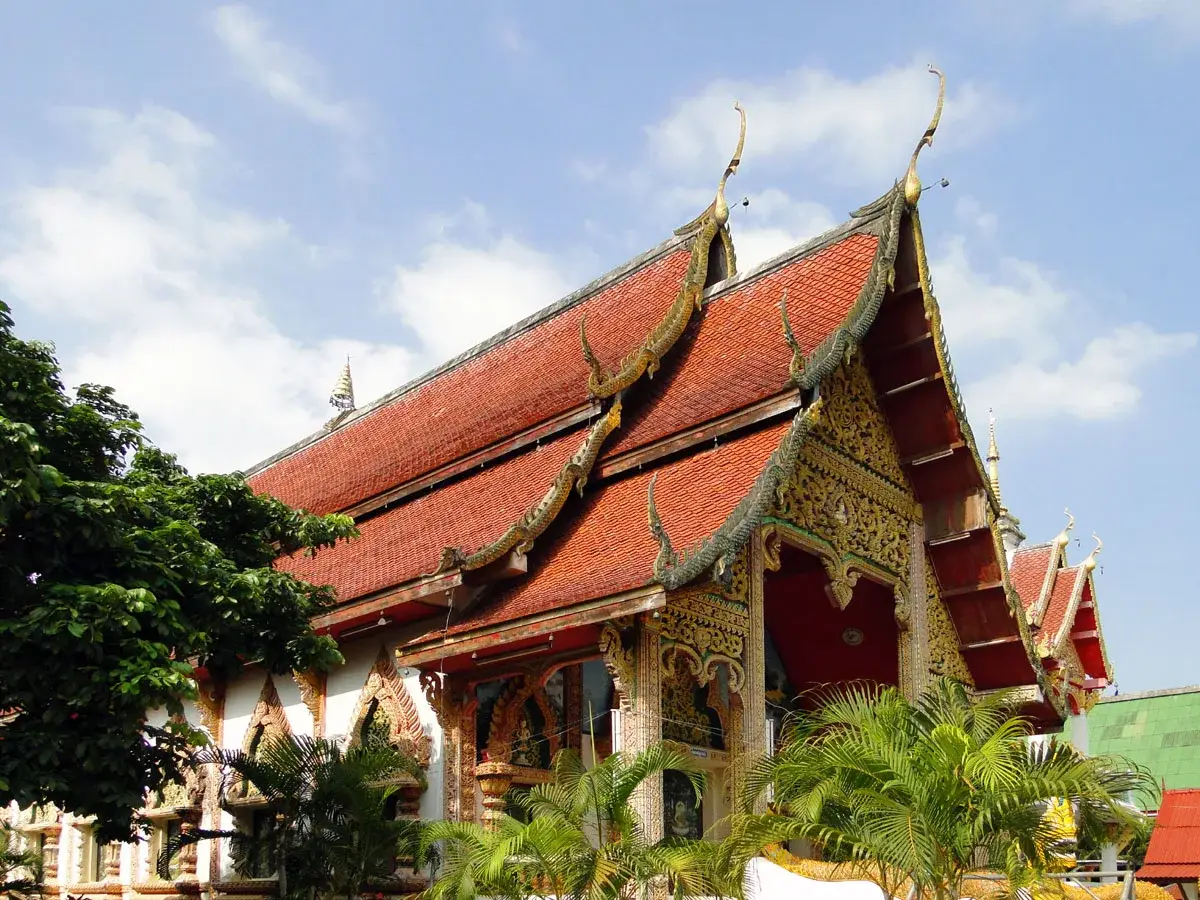
The main structures inside the temple include an ordination hall, monks’ residences, viharn, kitchen building, bell tower, pagoda, and sermon hall. The ordination hall is used for formal monastic rites. The viharn serves as a devotional space for worship and Buddhist activities. The monks’ residences support the resident monastic community. The sermon hall is used for Dhamma listening and community gatherings. The kitchen building reflects the communal character of Lanna merit-making, where villagers often prepare food and offerings together during temple events.
The bell tower reflects the rhythm of temple life in a Lanna community. The sound of a temple bell is connected with Buddhist activities, monastic routines, and community gatherings. The pagoda is another important sacred point within the temple compound. Visitors should walk around it respectfully, avoid touching or climbing sacred structures, and treat the area as a religious space rather than only a photo location.
The viharn is a good place to begin a visit. Visitors should remove shoes where required, speak softly, and pay respect calmly. A community temple such as Wat Buppharam has a quiet and natural atmosphere. Spending time inside the viharn helps visitors understand how a local temple functions as a spiritual refuge for the village.
The sermon hall and kitchen building show the temple’s community role. Merit-making in Lanna villages often involves collective work, including preparing food, arranging offerings, cleaning the temple compound, and attending Dhamma activities together. These spaces are therefore more than supporting buildings. They represent the relationship between the temple and the people who continue to care for it.
Important monks associated with the temple include Phra Khru Sathit Phatthara Tham Phutthathammo, who appears in temple records and Sangha-related information. Local community activity records also mention Phra Athikan Pakorn Rattanamethi in connection with Wat Buppharam and the San Sai Sangha community. These names reflect the temple’s continuing role within the local monastic network of San Sai Subdistrict.
Wat Buppharam remains active in current Buddhist community life. In 2026, the Visakha Bucha candlelight procession and merit-making activities were held at Wat Buppharam, Long Pu Mon, with participation from the San Sai Mahawong Subdistrict Municipality, the local cultural council, village leaders, and Buddhist devotees. This confirms the temple’s continuing role as a religious and cultural center in the community.
Major religious and cultural activities associated with the temple follow the Buddhist and Lanna annual calendar. These include Buddhist holy days, Visakha Bucha, Buddhist Lent, the end of Buddhist Lent, Kathin, robe-offering ceremonies, Songkran, traditional elder-respect activities, Yi Peng, and local village merit-making. These events keep the temple connected with community life across the year.
The main appeal of Wat Buppharam for travelers is its calm community atmosphere. Visitors can observe the ordination hall, viharn, sermon hall, bell tower, pagoda, and the surrounding village setting. The temple is suitable for travelers interested in local Lanna temples, quiet cultural routes, and the everyday religious life of Saraphi communities.
Visitors should behave respectfully because Wat Buppharam remains a living temple. Dress modestly, speak softly, remove shoes before entering required sacred buildings, avoid touching Buddha images and sacred objects unnecessarily, do not climb on temple structures, and keep an appropriate distance if monks or villagers are conducting ceremonies.
Getting There is possible from Chiang Mai city by traveling toward Saraphi District and continuing into San Sai Subdistrict and Ban Long Pu Mon. Private car, rental car, or local hired transport is the most convenient option. The temple can be combined with other nearby temples in San Sai, such as Wat Ton Phueng, Wat Pak Khlong, Wat Pa Sa, Wat Nong Baen, Wat San Sai Maha Wong, and Wat Si Don Chai.
A practical cultural route can begin at Wat Buppharam and continue to Wat Ton Phueng, Wat Pak Khlong, Wat Pa Sa, Wat Nong Baen, Wat San Sai Maha Wong, and Wat Si Don Chai. Travelers who want to extend the trip can continue toward Wat Hua Dong in Khuamung Subdistrict or other Saraphi temples in Yang Noeng. This route helps visitors understand Saraphi through community temples, villages, canals, agricultural landscapes, and local Buddhist traditions.
Overall, Wat Buppharam (San Sai) is valuable for its community history and its continuing Buddhist role. It has a clear founding year, a formal Wisungkhamsima, a defined temple area, important temple structures, and an active role in local religious events. It is a meaningful stop for travelers who want to explore the quieter cultural side of Chiang Mai and the community temples of Saraphi District.
| Name | Wat Buppharam (San Sai) |
| Local Name | Wat Buppharam, Wat Long Pu Mon |
| Location | Ban Long Pu Mon, San Sai Subdistrict, Saraphi District, Chiang Mai Province |
| Address | No. 70, Ban Long Pu Mon, San Sai Subdistrict, Saraphi District, Chiang Mai Province 50141, Thailand |
| Temple Type | Local Buddhist temple under the Mahanikaya monastic order |
| Temple Land | 5 rai, 2 ngan, and 8 square wah |
| Highlights | Old community temple of Ban Long Pu Mon with an ordination hall, viharn, sermon hall, bell tower, pagoda, and an active role in San Sai Buddhist community activities |
| History | Established in 1927 and granted Wisungkhamsima in 1991 |
| Name Meaning | Buppharam means a flower monastery, suggesting beauty, calmness, and sacredness |
| Main Areas / Zones | Ordination hall, monks’ residences, viharn, kitchen building, bell tower, pagoda, and sermon hall |
| Important Monks | Phra Khru Sathit Phatthara Tham Phutthathammo and Phra Athikan Pakorn Rattanamethi appear in records connected with Wat Buppharam and the San Sai Sangha community |
| Open Days | Daily |
| Opening Hours | 08.00 – 17.00 |
| Phone Number | 053-966-211 |
| Important Religious Activities | Visakha Bucha, candlelight procession, Buddhist holy days, Buddhist Lent, end of Buddhist Lent, Kathin, robe-offering ceremonies, Songkran, elder-respect activities, Yi Peng, and local merit-making |
| Travel Information | From Chiang Mai city, travel toward Saraphi District, then continue into San Sai Subdistrict and Ban Long Pu Mon. Private car, rental car, or local hired transport is the most convenient option |
| Current Status | Active community temple in San Sai Subdistrict and a venue for Buddhist religious activities |
| Nearby Tourist Attractions | 1. Wat Ton Phueng, San Sai, about 2 km 2. Wat Pak Khlong, San Sai, about 3 km 3. Wat Pa Sa, San Sai, about 4 km 4. Wat Nong Baen, San Sai, about 5 km 5. Wat San Sai Maha Wong, about 5 km 6. Wat Si Don Chai, San Sai, about 6 km |
| Nearby Restaurants | 1. Zaab Isan Khuamung, about 4 km, Tel. 098-172-0983 2. Restime Pizza Khuamung, about 4 km, Tel. 081-472-0954 3. The Khuamung, about 5 km, Tel. 083-313-3733, 062-495-0496 4. Pad Thai-Hoy Tod By Phung To Khuamung, about 5 km, Tel. 096-632-7226 5. Nai Ya Kitchen Yang Noeng Saraphi, about 8 km, Tel. 095-830-4248 |
| Nearby Accommodations | 1. 9Roomz, about 10 km, Tel. 095-446-0758 2. Ruean Thip Resort, about 11 km, Tel. 098-556-6291 3. Baan Nam Ping Riverside Village, about 12 km, Tel. 053-439040 4. Relax Garden House, about 13 km, Tel. 090-326-6108 5. Longan Tree, about 13 km |
Frequently Asked Questions (FAQ)
Q: Where is Wat Buppharam (San Sai) located?
A: Wat Buppharam is located at No. 70, Ban Long Pu Mon, San Sai Subdistrict, Saraphi District, Chiang Mai Province 50141.
Q: When was Wat Buppharam established?
A: Wat Buppharam was established in 1927 and received its Wisungkhamsima in 1991.
Q: What can visitors see at Wat Buppharam?
A: Visitors can see the ordination hall, monks’ residences, viharn, kitchen building, bell tower, pagoda, sermon hall, and the calm atmosphere of a Lanna community temple.
Q: What is Wat Buppharam also known as locally?
A: The temple is also known locally as Wat Long Pu Mon because it is located in Ban Long Pu Mon, San Sai Subdistrict.
Q: What are the opening hours of Wat Buppharam?
A: Wat Buppharam is open daily from 08.00 to 17.00.
Q: What kind of travelers will enjoy Wat Buppharam?
A: Wat Buppharam is best for travelers interested in quiet community temples, Lanna village culture, local Buddhist traditions, and cultural routes through Saraphi District.
Q: What nearby places can be visited with Wat Buppharam?
A: Nearby places include Wat Ton Phueng, Wat Pak Khlong, Wat Pa Sa, Wat Nong Baen, Wat San Sai Maha Wong, Wat Si Don Chai, and other community temples in Saraphi District.
 Category: ●Places of Worship
 Group: ●Temple
Last Update : 2 MonthAgo
 Last Update : 2 MonthAgo
 Click to Access the Navigation Map GPS

 Muang Chiang Mai(121)Chom Thong(47)Mae Chaem(25)Chiang Dao(33)Doi Saket(68)Mae Taeng(85)Mae Rim(69)Samoeng(29)Fang(71)Mae Ai(59)Phrao(70)San Pa Tong(103)San Kamphaeng(66)San Sai(73)Hang Dong(73)Hot(32)Doi Tao(22)Omkoi(11)Saraphi(74)Wiang Haeng(15)Chai Prakan(28)Mae Wang(32)Mae On(22)Doi Lo(33)Galyani Vadhana(1)


