
lovethailand home >North Travel Attractions >Chiang Mai Travel Attractions >Saraphi >Pa Bong > Wat Sri Kham Chomphu
TL;DR: Wat Sri Kham Chomphu is located at Ban Sri Kham Chomphu, Village No. 3, Pa Bong Subdistrict, Saraphi District, Chiang Mai Province, open Daily, hours 08.00 – 17.00.

Wat Sri Kham Chomphu
Open Days: Daily
Opening Hours: 08.00 – 17.00
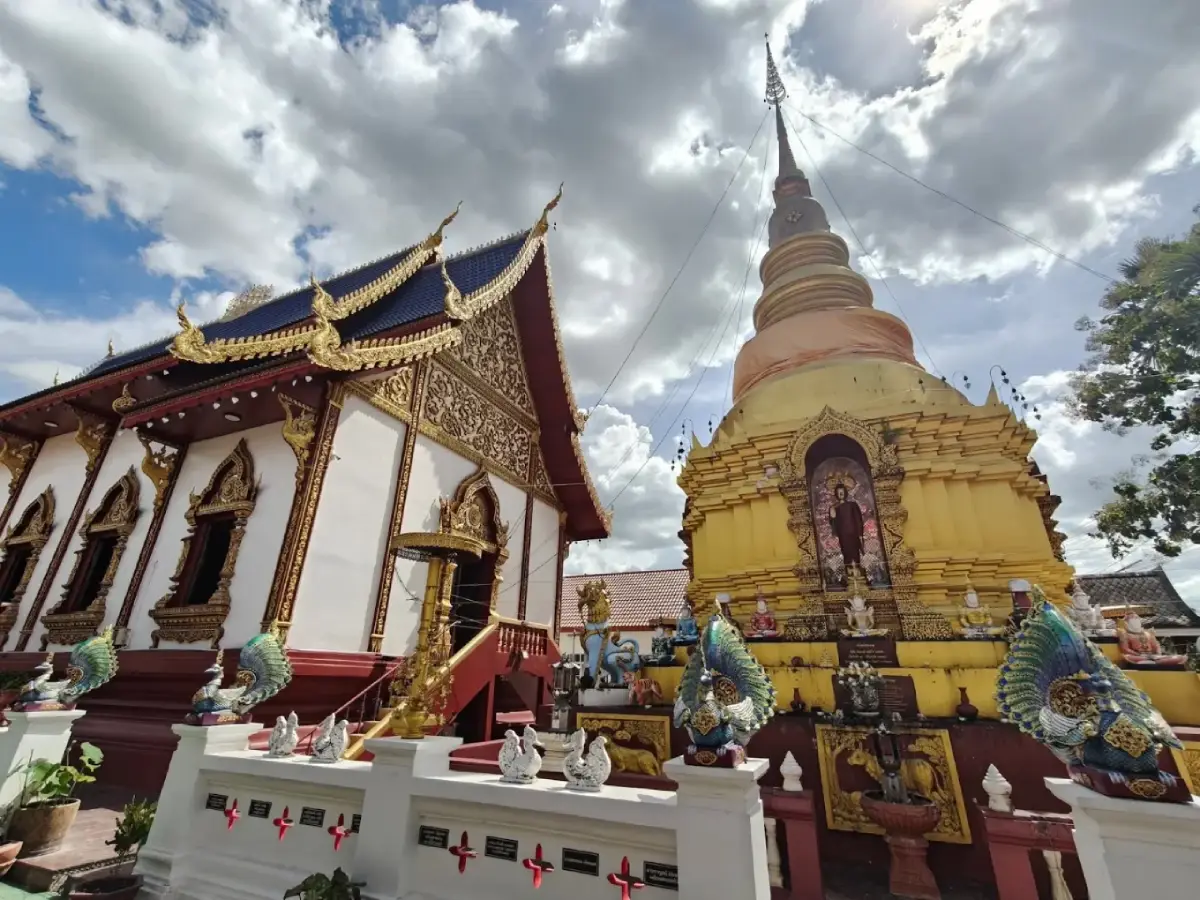
Wat Sri Kham Chomphu is located at No. 97, Village No. 3, Ban Sri Kham Chomphu, Pa Bong Subdistrict, Saraphi District, Chiang Mai Province 50140. It is a local Buddhist temple under the Mahanikaya sect, covering 2 rai and 2 ngan. The temple was officially established in B.E. 2412 and received its royal consecrated boundary in B.E. 2420. It is one of the old community temples of Pa Bong and serves as a spiritual center for Ban Sri Kham Chomphu, supporting merit-making, Buddhist ceremonies, sermons, Kathin, robe-offering events, school-related activities, and annual community traditions.
The name Wat Sri Kham Chomphu carries a strong sense of auspiciousness and local identity. The word “Sri” suggests beauty and prosperity, while “Kham” in a northern Thai cultural context is often associated with gold or precious value. Together with the village name Sri Kham Chomphu, the temple name reflects a place of faith, beauty, and community belonging. Like many northern Thai temples, its name is closely tied to the surrounding village rather than standing apart from local life.
The establishment year of B.E. 2412 places Wat Sri Kham Chomphu among the historic temples of Pa Bong and Saraphi. Temples founded during this period usually developed from the needs of the community: a place for monks to reside, a place for laypeople to make merit, and a shared space for Buddhist learning and village ceremonies. Wat Sri Kham Chomphu therefore represents both religious history and the long development of Ban Sri Kham Chomphu as a settled Buddhist community.
The temple received its royal consecrated boundary in B.E. 2420. In Thai Buddhism, a consecrated boundary is important because it designates the formal area for Sangha rites such as ordination and other monastic ceremonies. This confirms that Wat Sri Kham Chomphu is not only a village merit-making place but also a fully established Buddhist temple within the Mahanikaya tradition.
Pa Bong Subdistrict is an important community area of Saraphi District, Chiang Mai. It covers about 5.528 square kilometers, or approximately 3,455 rai, and consists of 6 villages: Ban Chai Sathan, Ban Rong Don Chai, Ban Sri Kham Chomphu, Ban Pa Bong Luang, Ban Thepharam, and Ban Suphan. Wat Sri Kham Chomphu stands in Village No. 3 and belongs to a living village landscape of homes, local roads, school life, temples, markets, and community activities.
The name Pa Bong is connected with local bamboo. In the past, bamboo grew abundantly in the area, and villagers used it to make baskets, containers, and household objects. This bamboo-based craft tradition became part of Pa Bong identity. Wat Sri Kham Chomphu belongs to this wider cultural environment of local craftsmanship, agriculture, village cooperation, and Lanna Buddhist practice.
Ban Sri Kham Chomphu is a village where temple and school life are closely connected. Chumchon Wat Sri Kham Chomphu School grew from the community context around the temple and remains an important educational institution in the area. This reflects the traditional role of temples in Thai society, especially in Lanna communities, where temples served not only as religious places but also as centers of learning, manners, culture, and moral education.
Wat Sri Kham Chomphu therefore has a role that extends beyond ordinary worship. Local residents use the temple for merit-making, food offerings, sermons, family merit ceremonies, memorial rites, Kathin, robe-offering events, and annual village activities. At the same time, the temple remains connected with school and community events, bringing together monks, elders, families, teachers, students, and lay supporters.
The current abbot of Wat Sri Kham Chomphu is Phra Khru Khemachittaphon, also known as Phra Khru Samuh Kiattisak Khemachitto. Recent ecclesiastical news identifies him as having received the royal ecclesiastical title Phra Khru Khemachittaphon, second-class abbot of a local temple. In a village temple, the abbot’s role includes maintaining Buddhist practice, caring for temple spaces, coordinating merit-making activities, guiding lay supporters, and sustaining the relationship between the temple, school, and community.
The temple is also remembered through the legacy of Phra Khru Sitthiwarayan, also known as Khru Ba Ai Surinṭo, a former abbot of Wat Sri Kham Chomphu, former subdistrict ecclesiastical chief, and adviser to the Pa Bong subdistrict clergy. He was deeply respected by local residents and played an important role in developing the temple. His memory gives Wat Sri Kham Chomphu a strong personal and spiritual dimension beyond its formal history.
A gratitude ceremony and communal robe-offering event once held in memory of Phra Khru Sitthiwarayan shows how the temple functions as a place of collective remembrance. Such events are not only fundraising or ceremonial activities. They are also ways for disciples, villagers, students, and supporters to honor the contribution of a respected teacher and to renew their relationship with the temple.
Publicly available details about individual buildings inside Wat Sri Kham Chomphu are not as extensive as those of large tourist temples. However, the temple is clearly active: it is listed as a Mahanikaya temple, has a current abbot, a public contact number, a connected community school, and an ongoing role in local religious life. Visitors should understand it as a living village temple rather than as a staged tourist attraction.
The main value of Wat Sri Kham Chomphu lies in its quiet Lanna community atmosphere. Visitors can pay respect, make merit, observe the temple grounds, and experience the relationship between the temple, village, and school. Its significance comes from its foundation date, its consecrated boundary, its role in Ban Sri Kham Chomphu, the memory of Khru Ba Ai, and its continued function as a Buddhist center of Pa Bong.
For the local community, the temple is both a spiritual and social center. Elders visit for sermons and quiet worship. Families bring children to make merit. Students learn temple manners and community traditions. Villagers support Kathin, robe-offering events, and annual activities. Through these activities, the temple teaches generosity, respect, cooperation, and Buddhist values in a practical community setting.
Important religious activities associated with Wat Sri Kham Chomphu include Kathin, robe-offering events, Buddhist Lent, the end of Lent, Buddhist holy days, memorial merit-making, sermons, gratitude ceremonies for respected teachers, and annual village ceremonies. During major events, the temple becomes a shared community space where residents prepare food, arrange offerings, welcome guests, and support monks.
Pa Bong Subdistrict has several temples that can be visited on the same route, including Wat Chai Sathan, Wat Rong Don Chai, Wat Pa Bong Luang, Wat Thepharam, and Wat Suphan. Wat Sri Kham Chomphu fits naturally into this route as a community temple that highlights the relationship between faith, education, village identity, and Lanna Buddhist life.
Wat Sri Kham Chomphu is suitable for travelers interested in old Saraphi temples, quiet Lanna village temples, local Pa Bong history, temple-school relationships, and cultural routes near Chiang Mai. It is best visited slowly and respectfully. On ordinary days, the temple offers a calm atmosphere. During merit-making events, visitors can see the living faith of the local community more clearly.
A good cultural route can combine Wat Sri Kham Chomphu with Wat Chai Sathan, Wat Pa Bong Luang, Wat Thepharam, Wat Suphan, and Wat Rong Don Chai. Travelers who want to extend the route can continue toward Tha Wang Tan Subdistrict and visit the Wiang Kum Kam Information Center, Wat Chedi Liam, Wat Chang Kham, Wat That Khao, and the Chiang Mai–Lamphun rubber tree road. This creates a balanced itinerary of local village temples, Lanna community culture, and nearby ancient-city heritage.
Getting There is easiest by private car, rental car, motorbike, taxi, or ride-hailing service from Chiang Mai city. Travel toward Saraphi District, enter Pa Bong Subdistrict, and continue to Ban Sri Kham Chomphu, Village No. 3. Local roads connect the temple with Ban Chai Sathan, Ban Pa Bong Luang, Ban Thepharam, Ban Rong Don Chai, and Ban Suphan. Visitors planning to see several temples should arrange a half-day route through Pa Bong, Saraphi, and Tha Wang Tan.
Visitors without their own vehicle should arrange a return trip or hire transport for several hours. Temples and local attractions in Pa Bong are spread across village roads. Although distances are not large, traveling by vehicle saves time and is more practical during the hotter parts of the day. Morning and late afternoon are the most comfortable times to visit.
Visitors should follow standard Thai temple etiquette: dress modestly, speak softly, remove shoes where required, do not enter private monastic areas, avoid disturbing ceremonies, do not touch sacred objects unnecessarily, and ask permission before photographing people closely. Wat Sri Kham Chomphu is an active community temple, so respectful behavior is essential.
In summary, Wat Sri Kham Chomphu is a historic Mahanikaya community temple in Ban Sri Kham Chomphu, Village No. 3, Pa Bong Subdistrict, Saraphi District, Chiang Mai. Established in B.E. 2412 and granted its royal consecrated boundary in B.E. 2420, the temple covers 2 rai and 2 ngan and remains a spiritual center for the village. With Phra Khru Khemachittaphon, also known as Phra Khru Samuh Kiattisak Khemachitto, as abbot, and with the remembered legacy of Phra Khru Sitthiwarayan or Khru Ba Ai Surinṭo, the temple is a meaningful destination for travelers who want to understand old Saraphi temples, Pa Bong village culture, temple-school relationships, and the quieter cultural side of Chiang Mai near the Wiang Kum Kam route.
| Name | Wat Sri Kham Chomphu |
| Location | Ban Sri Kham Chomphu, Village No. 3, Pa Bong Subdistrict, Saraphi District, Chiang Mai Province |
| Address | No. 97, Village No. 3, Ban Sri Kham Chomphu, Pa Bong Subdistrict, Saraphi District, Chiang Mai 50140, Thailand |
| Temple Type | Local Buddhist temple under the Mahanikaya sect |
| Temple Code | 350191205 |
| Area | 2 rai and 2 ngan |
| Highlights | Historic community temple of Ban Sri Kham Chomphu, established in B.E. 2412, connected with Chumchon Wat Sri Kham Chomphu School and the legacy of Phra Khru Sitthiwarayan, also known as Khru Ba Ai Surinṭo |
| History | Officially established as a temple in B.E. 2412 and granted its royal consecrated boundary in B.E. 2420 |
| Key Figures | Phra Khru Khemachittaphon, also known as Phra Khru Samuh Kiattisak Khemachitto, current abbot of Wat Sri Kham Chomphu Phra Khru Sitthiwarayan, also known as Khru Ba Ai Surinṭo, former abbot, former subdistrict ecclesiastical chief, and adviser to the Pa Bong subdistrict clergy |
| Community Context | Located in Ban Sri Kham Chomphu, Village No. 3, one of the 6 villages of Pa Bong Subdistrict, a Saraphi community associated with bamboo culture, local craft traditions, village life, schools, temples, and Lanna Buddhist practice |
| Important Zones And Activity Areas | Worship Area And Buddhist Activity Space Temple Grounds For Merit-Making And Community Events Community Gathering Area For Buddhist Holy Days, Kathin, Robe-Offering Events, And Gratitude Ceremonies For Respected Teachers Community Temple Area Connected With The School And The Pa Bong Temple Route |
| Important Ceremonies | Kathin, robe-offering events, Buddhist Lent, the end of Lent, Buddhist holy days, memorial merit-making, sermons, gratitude ceremonies for respected teachers, and annual community ceremonies of Ban Sri Kham Chomphu |
| Travel Information | Accessible from Chiang Mai city toward Saraphi District, then Pa Bong Subdistrict and Ban Sri Kham Chomphu; best reached by private car, rental car, motorbike, taxi, or ride-hailing service |
| Current Status | Open as an active community temple used for Buddhist ceremonies, merit-making, school-related activities, and local village events |
| Open Days | Daily |
| Opening Hours | 08.00 – 17.00 |
| Abbot / Caretaker | Phra Khru Khemachittaphon, also known as Phra Khru Samuh Kiattisak Khemachitto |
| Main Contact Number | 053-322-912 |
| Nearby Tourist Attractions | 1. Wat Chai Sathan, about 1.5 km 2. Wat Pa Bong Luang, about 2 km 3. Wat Thepharam, about 3 km 4. Wat Suphan, about 3 km 5. Wat Rong Don Chai, about 4 km 6. Wiang Kum Kam Information Center, about 8 km 7. Wat Chedi Liam, about 8 km 8. Chiang Mai–Lamphun Rubber Tree Road, about 9 km |
| Nearby Restaurants | 1. Krua Pa Wan Saraphi, about 1 km, Tel. 088-670-3877 2. Ma-Cool Cafe, about 1.5 km, Tel. 080-946-6942, 080-821-5119 3. Krua Baan Baan, about 2 km, Tel. 091-749-6072 4. Pa Taem Made-To-Order Food Pa Bong, about 2 km, Tel. 082-195-1554 5. Sarim Sam Sahai Pa Bong, about 2.5 km, Tel. 096-679-6074 6. TeeMood, about 3 km, Tel. 061-271-7995 |
| Nearby Accommodations | 1. Bansuan Thanormpat Resort, about 2 km, Tel. 089-997-9511 2. La Campagne Villa Chiangmai, about 4 km 3. Kham Mon Lanna Resort Chiang Mai, about 6 km 4. The Sali-Kham Traditional Lanna Home, about 6 km 5. Baan Suay Huean Ngam Resort, about 7 km |
Frequently Asked Questions (FAQ)
Q: Where is Wat Sri Kham Chomphu located?
A: Wat Sri Kham Chomphu is located at No. 97, Village No. 3, Ban Sri Kham Chomphu, Pa Bong Subdistrict, Saraphi District, Chiang Mai Province 50140.
Q: What are the opening days and hours of Wat Sri Kham Chomphu?
A: The temple is open daily from 08.00 to 17.00.
Q: Why is Wat Sri Kham Chomphu historically important?
A: Wat Sri Kham Chomphu was officially established in B.E. 2412 and received its royal consecrated boundary in B.E. 2420, making it one of the old community temples of Pa Bong.
Q: Who is the abbot of Wat Sri Kham Chomphu?
A: The abbot is Phra Khru Khemachittaphon, also known as Phra Khru Samuh Kiattisak Khemachitto.
Q: How is Wat Sri Kham Chomphu connected with the local school?
A: The temple is closely connected with Chumchon Wat Sri Kham Chomphu School, reflecting the traditional role of temples as centers of religion, learning, and community life.
Q: Who was Phra Khru Sitthiwarayan?
A: Phra Khru Sitthiwarayan, also known as Khru Ba Ai Surinṭo, was a former abbot of Wat Sri Kham Chomphu, former subdistrict ecclesiastical chief, and an important figure in the temple’s development.
Q: What kind of travelers is Wat Sri Kham Chomphu suitable for?
A: The temple is suitable for travelers interested in old Saraphi temples, quiet Lanna village temples, Pa Bong community history, temple-school relationships, and cultural routes near Chiang Mai.
Q: What nearby places can be visited with Wat Sri Kham Chomphu?
A: Nearby places include Wat Chai Sathan, Wat Pa Bong Luang, Wat Thepharam, Wat Suphan, Wat Rong Don Chai, the Wiang Kum Kam Information Center, Wat Chedi Liam, and the Chiang Mai–Lamphun rubber tree road.
 Category: ●Places of Worship
 Group: ●Temple
Last Update : 2 MonthAgo
 Last Update : 2 MonthAgo
 Click to Access the Navigation Map GPS
Wat Sri Kham Chomphu Map
Recommend

 Muang Chiang Mai(121)Chom Thong(47)Mae Chaem(25)Chiang Dao(33)Doi Saket(68)Mae Taeng(85)Mae Rim(69)Samoeng(29)Fang(71)Mae Ai(59)Phrao(70)San Pa Tong(103)San Kamphaeng(66)San Sai(73)Hang Dong(73)Hot(32)Doi Tao(22)Omkoi(11)Saraphi(74)Wiang Haeng(15)Chai Prakan(28)Mae Wang(32)Mae On(22)Doi Lo(33)Galyani Vadhana(1)


