
lovethailand home >North Travel Attractions >Chiang Mai Travel Attractions >Saraphi >Tha Wang Tan > Wat Ban Klang
TL;DR: Wat Ban Klang is located at Ban Klang, Village No. 3, Tha Wang Tan Subdistrict, Saraphi District, Chiang Mai Province, open Daily, hours 08.00 – 17.00.

Wat Ban Klang
Open Days: Daily
Opening Hours: 08.00 – 17.00
Wat Ban Klang is located at No. 146, Village No. 3, Ban Klang, Tha Wang Tan Subdistrict, Saraphi District, Chiang Mai Province 50140. It is a local Buddhist temple under the Mahanikaya sect, covering 2 rai, 2 ngan, and 23 square wah under land title deed No. 27616. The temple is an important community temple of Ban Klang and one of the clearest examples of how a former abandoned temple site in Tha Wang Tan was restored by local faith and community cooperation. Today, Wat Ban Klang serves as a place for merit-making, Buddhist ceremonies, sermons, community gatherings, and the preservation of local Lanna Buddhist life.
The importance of Wat Ban Klang lies in its revival. Before becoming the active temple seen today, the site was known as an old abandoned temple associated by the local community with the Wiang Kum Kam period. Residents of Ban Klang, Village No. 3, found it difficult to travel to distant temples for merit-making. As a result, the community joined together to restore this abandoned temple site and bring it back into religious use. The temple therefore represents not only Buddhist devotion but also the determination of a village to rebuild its own spiritual center.
Tha Wang Tan Subdistrict is an important area of Saraphi District, covering about 13.63 square kilometers, or approximately 8,614 rai. It consists of 13 villages: Ban Chedi Liam, Ban Pa Poe, Ban Klang, Ban Pong, Ban Pa Ngio, Ban Pa Sao, Ban Buak Hua Chang, Ban Buak Khrok Nuea, Ban Buak Khrok Tai, Ban San Pa Kwao, Ban Chang Kham, Ban Hang Khwae, and Ban Pa Kluai. Ban Klang is Village No. 3 and one of the major community areas of the subdistrict. Wat Ban Klang stands within this living village landscape of homes, roads, irrigation channels, and community activities.
The setting of Tha Wang Tan gives Wat Ban Klang wider cultural significance. The subdistrict is closely connected with Wiang Kum Kam, the ancient city associated with early Lanna history. Major nearby heritage sites such as Wat Chedi Liam, Wat Chang Kham, Wat That Khao, and other Wiang Kum Kam monuments represent the archaeological side of Tha Wang Tan. Wat Ban Klang, by contrast, represents the living village side of the same area: a community temple restored for everyday Buddhist life.
Wat Ban Klang was rebuilt and reestablished in B.E. 2516. During the first phase of revival, local residents invited Luang Pho Boonchu Aruno to reside at the temple and care for it. After Luang Pho Boonchu returned to his original temple, Phra Somsak Sirivanno continued the work of looking after Wat Ban Klang. This marked the transition from an abandoned temple site into an active religious place with monks, lay supporters, ceremonies, and a living role in the village.
On December 9, B.E. 2542, the Department of Religious Affairs formally recognized the former abandoned Wat Ban Klang as a proper temple under the Sangha Act. On October 1, B.E. 2543, Phra Somsak Sirivanno was appointed abbot. Later, on the occasion of the royal birthday ceremony on December 5, B.E. 2549, Phra Athikan Somsak Sirivanno was royally granted the ecclesiastical title Phra Khru Kowit Wihankan, second-class abbot of a local temple. These milestones show the temple’s development from a restored local site into an officially recognized Buddhist institution.
The temple boundaries reflect the character of a Lanna village temple. The northern boundary, 3 sen and 18 square wah in length, adjoins a public road. The southern boundary, 2 sen and 19 wa in length, adjoins a public irrigation channel. The eastern boundary, 2 sen and 6 wa in length, adjoins a public road. The western boundary, 3 sen and 10 wa in length, adjoins a public irrigation channel. These boundaries show that the temple is closely integrated with roads, water systems, and village life.
The presence of irrigation channels around the temple is important for understanding its community context. In Saraphi and Tha Wang Tan, settlement patterns are closely tied to water, agriculture, and local movement routes. Wat Ban Klang is therefore part of a wider Lanna landscape where temples, homes, roads, and irrigation systems function together. Visitors should observe not only the temple buildings but also the surrounding village environment.
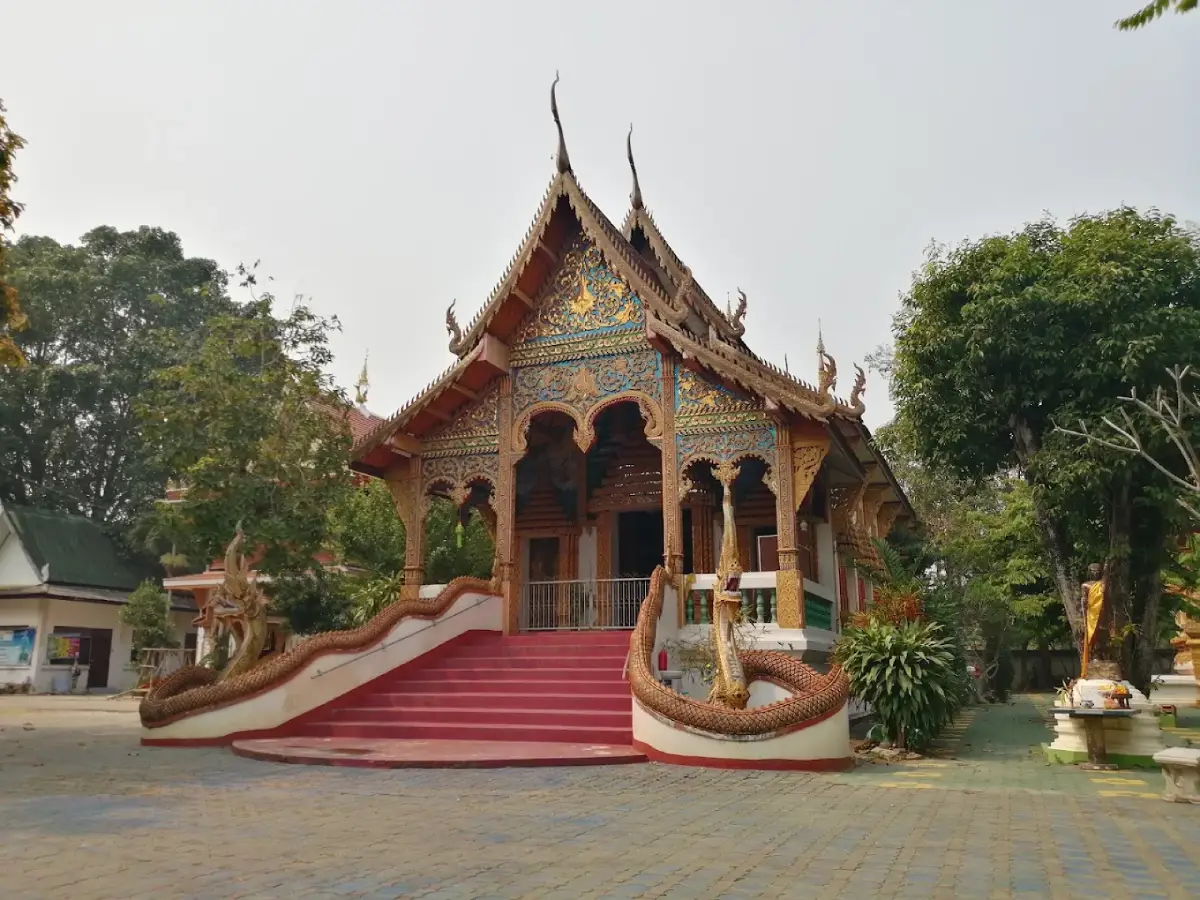
The important structures of Wat Ban Klang include a Lanna Thai-style viharn, a 2-story Thai-style monks’ residence, a bell tower, a 2-story Lanna Thai-style multipurpose hall, boundary walls, entrance arch, sermon hall, kitchen, and reading pavilion. These elements allow the temple to support worship, monastic life, community merit-making, sermons, food preparation during ceremonies, and local learning activities.
The Lanna Thai-style viharn is the best place to begin a visit because it is the main worship space of the temple. It reflects the regional artistic identity of Chiang Mai and Saraphi while serving the practical needs of Ban Klang residents. The viharn is used for worship, sermons, Buddhist holy days, and community ceremonies. Visitors should enter respectfully, dress modestly, and treat the space as an active religious area rather than only a sightseeing spot.
The 2-story monks’ residence supports monastic life, while the bell tower reflects the role of sound in Thai temple culture. Bells have traditionally helped mark time, call monks and laypeople to activities, and connect temple rhythms with village life. The multipurpose hall is especially important for a community temple because it supports merit-making, meetings, ceremonies, and shared activities organized by local residents.
The boundary wall and entrance arch define the sacred space of the temple. The sermon hall supports Buddhist learning and religious events. The kitchen becomes especially important during large merit-making ceremonies when villagers gather to prepare food and offerings. The reading pavilion adds another educational dimension, showing how the temple continues the older role of Buddhist temples as centers of learning and community values.
The temple’s important sacred objects include Buddha images and a Lanna Thai-style chedi. The Buddha images serve as the focus of worship, while the chedi acts as a sacred monument and memory marker of the temple. Together, these elements give Wat Ban Klang the essential devotional character of a Lanna community temple and make it meaningful for both local residents and visitors interested in Buddhist culture.
The main highlight of Wat Ban Klang is the combination of restored history, local community faith, and Lanna-style religious architecture. The temple shows how a former abandoned sacred site can return to active use through collective village effort. Its value lies not in size or spectacle but in continuity: a community needed a temple, restored one, invited monks to reside there, and gradually built a fully functioning Buddhist center.
Phra Khru Kowit Wihankan, also known as Phra Somsak Sirivanno, is a key figure in the modern history of the temple. After the initial revival phase, he continued caring for Wat Ban Klang and was later appointed abbot. The role of an abbot in a village temple extends beyond ritual leadership. It includes maintaining temple property, guiding religious activities, coordinating with residents, and preserving the relationship between the monastery and the community.
Important religious activities at Wat Ban Klang include Buddhist holy days, Buddhist Lent, the end of Lent, Kathin, robe-offering events, memorial merit-making, sermons, and annual community ceremonies. On ordinary days, the temple offers a calm setting for worship. During major events, it becomes a shared space where villagers prepare food, arrange offerings, welcome guests, support monks, and maintain the temple grounds together.
Tha Wang Tan Subdistrict also preserves important traditions such as Songkran, Yi Peng or Loy Krathong, Atthami Bucha, water-pouring ceremonies for elders, support-pole processions, sand-carrying rituals at temples, and cultural activities related to Wiang Kum Kam. Wat Ban Klang belongs to this wider cultural calendar. Although it is not the main archaeological monument of Wiang Kum Kam, it supports the living Buddhist and community life of the same subdistrict.
For Ban Klang, the temple remains a spiritual and social center. It supports individual merit-making, family ceremonies, annual village events, community learning, and local gathering. In the past, residents struggled to travel to distant temples for merit-making. The restoration of Wat Ban Klang answered that need directly, giving the village a nearby sacred space and allowing Buddhist practice to continue more conveniently within the community.
Wat Ban Klang is suitable for travelers interested in Lanna community temples, restored temple sites, local history of Tha Wang Tan, and temple routes near Wiang Kum Kam. Visitors who already know Wat Chedi Liam or Wat Chang Kham will see another side of the same area here: not the large archaeological monument, but the living village temple shaped by local faith and community cooperation.
Key places to see at Wat Ban Klang include the Lanna Thai-style viharn, Buddha images, Lanna-style chedi, bell tower, multipurpose hall, sermon hall, entrance arch, and temple grounds. Visitors should take time to observe the temple slowly. Its value is found in the overall relationship between architecture, community function, and local history rather than in a single monument.
A good cultural route can combine Wat Ban Klang with Wat Pa Ngio, Wat Buak Khrok Nuea, Wat Buak Khrok Tai, the Wiang Kum Kam Information Center, Wat Chedi Liam, Wat Chang Kham, and Wat That Khao. A half-day route can begin at Wat Ban Klang and continue to nearby village temples before entering the Wiang Kum Kam area. A full-day route can add Wat Chedi Liam, Wat Chang Kham, Wat That Khao, Wat E-Kang, and the Chiang Mai–Lamphun rubber tree road.
Getting There is easiest by private car, rental car, motorbike, taxi, or ride-hailing service from Chiang Mai city. Travel south toward Saraphi District, enter Tha Wang Tan Subdistrict, and continue to Ban Klang, Village No. 3. Local roads connect with Mahidol Road, Sai Ko Klang Road, the middle ring road, and the Wiang Kum Kam route. Visitors planning to see several temples should arrange transport for several hours.
Visitors without their own vehicle should arrange a return trip or hire transport for a half-day itinerary. The temples and historical sites in Tha Wang Tan are spread across village areas. Although many sites are not far apart, traveling by vehicle saves time and is more practical during the hotter parts of the day. Those who want to combine village temples with Wiang Kum Kam should allow at least half a day.
The best time to visit is in the morning or late afternoon when the weather is more comfortable and the temple atmosphere is peaceful. Visitors interested in local community life may come during Buddhist holy days or annual merit-making activities, while those seeking a quiet visit should choose a weekday outside major ceremonies.
Visitors should follow standard Thai temple etiquette: dress modestly, speak softly, remove shoes where required, do not enter private monastic areas, do not disturb ceremonies, avoid touching sacred objects unnecessarily, and ask permission before photographing people closely. Wat Ban Klang is an active community temple, so respectful behavior is essential.
In summary, Wat Ban Klang is a restored community temple in Ban Klang, Tha Wang Tan Subdistrict, Saraphi District, Chiang Mai. Rebuilt in B.E. 2516 from a former abandoned temple site, it was officially recognized as a temple under the Sangha Act on December 9, B.E. 2542. Its important features include a Lanna Thai-style viharn, monks’ residence, bell tower, multipurpose hall, sermon hall, kitchen, reading pavilion, Buddha images, and a Lanna-style chedi. It is a meaningful destination for travelers who want to understand local Lanna Buddhism, restored village temples, and the quieter cultural side of Tha Wang Tan near Wiang Kum Kam.
| Name | Wat Ban Klang |
| Location | Ban Klang, Village No. 3, Tha Wang Tan Subdistrict, Saraphi District, Chiang Mai Province |
| Address | No. 146, Village No. 3, Tha Wang Tan Subdistrict, Saraphi District, Chiang Mai 50140, Thailand |
| Coordinates | 18.737063, 99.001619 |
| Temple Type | Local Buddhist temple under the Mahanikaya sect |
| Temple Code | 350191005 |
| Area | 2 rai, 2 ngan, 23 square wah |
| Land Title Deed | No. 27616 |
| Boundaries | North: 3 sen and 18 square wah, adjoining a public road South: 2 sen and 19 wa, adjoining a public irrigation channel East: 2 sen and 6 wa, adjoining a public road West: 3 sen and 10 wa, adjoining a public irrigation channel |
| Highlights | Restored community temple of Ban Klang with a Lanna Thai-style viharn, Buddha images, Lanna-style chedi, bell tower, multipurpose hall, and a strong role as the spiritual center of Village No. 3 |
| History | Rebuilt in B.E. 2516 from a former abandoned temple site associated by local memory with the Wiang Kum Kam period; officially recognized as a temple under the Sangha Act on December 9, B.E. 2542 |
| Key Figures | Luang Pho Boonchu Aruno, invited to reside and care for the temple during the revival period Phra Khru Kowit Wihankan, also known as Phra Somsak Sirivanno, later appointed abbot |
| Community Context | Located in Ban Klang, Village No. 3, one of the 13 villages of Tha Wang Tan Subdistrict, a community area connected with homes, roads, irrigation channels, and the nearby Wiang Kum Kam cultural route |
| Important Zones And Structures | Lanna Thai-Style Viharn 2-Story Thai-Style Monks’ Residence Bell Tower 2-Story Lanna Thai-Style Multipurpose Hall Boundary Wall And Entrance Arch Sermon Hall Kitchen Reading Pavilion Temple Grounds And Community Religious Activity Area |
| Sacred Objects | Buddha images and Lanna Thai-style chedi |
| Important Ceremonies | Kathin, robe-offering events, Buddhist Lent, the end of Lent, Buddhist holy days, memorial merit-making, sermons, and annual community ceremonies of Ban Klang |
| Travel Information | Accessible from Chiang Mai city toward Saraphi District, then Tha Wang Tan Subdistrict and Ban Klang; best reached by private car, rental car, motorbike, taxi, or ride-hailing service |
| Current Status | Open as an active community temple used for Buddhist ceremonies, merit-making, and local village activities |
| Open Days | Daily |
| Opening Hours | 08.00 – 17.00 |
| Abbot / Caretaker | Phra Khru Kowit Wihankan, also known as Phra Somsak Sirivanno |
| Nearby Tourist Attractions | 1. Wat Pa Ngio, about 2 km 2. Wat Buak Khrok Tai, about 3 km 3. Wat Buak Khrok Nuea, about 3 km 4. Wiang Kum Kam Information Center, about 4 km 5. Wat Chedi Liam, about 4 km 6. Wat Chang Kham, about 5 km 7. Wat That Khao, about 5 km 8. Chiang Mai–Lamphun Rubber Tree Road, about 7 km |
| Nearby Restaurants | 1. Silky Cafe Ban Klang Tha Wang Tan, about 1 km, Tel. 091-856-6624, 099-541-5190, 064-267-0523 2. Fresh Coffee Tha Wang Tan, about 1 km, Tel. 083-515-8180 3. Krua Sa Pa Tha Wang Tan, about 2 km, Tel. 080-229-8450 4. Pao Pao Khao Man Kai Tha Wang Tan Ban Pa Ngio, about 3 km, Tel. 098-854-8724 5. Aunt Ra Duck Noodles Tha Wang Tan Saraphi, about 4 km, Tel. 083-197-0230 6. Baan Koy Khong Kin Lam Saraphi, about 5 km, Tel. 098-991-3856 |
| Nearby Accommodations | 1. Baan Hom Samunphrai, about 3 km 2. Golden Teak Home Resort, about 4 km 3. De Wiangkumkam, about 4 km, Tel. 094-471-0117 4. Wiang Kum Kam Resort, about 5 km, Tel. 097-949-4227 5. Maraya Hotel & Resort, about 6 km, Tel. 053-812-121 6. Chiang Mai Garden Bungalows, about 7 km, Tel. 083-272-6681 |
Frequently Asked Questions (FAQ)
Q: Where is Wat Ban Klang located?
A: Wat Ban Klang is located at No. 146, Village No. 3, Ban Klang, Tha Wang Tan Subdistrict, Saraphi District, Chiang Mai Province 50140.
Q: What are the opening days and hours of Wat Ban Klang?
A: The temple is open daily from 08.00 to 17.00.
Q: Why is Wat Ban Klang historically important?
A: Wat Ban Klang was rebuilt in B.E. 2516 from a former abandoned temple site and was officially recognized as a temple under the Sangha Act on December 9, B.E. 2542.
Q: Who were important figures in the revival of Wat Ban Klang?
A: Luang Pho Boonchu Aruno was invited to reside and care for the temple during the revival period. Phra Somsak Sirivanno later continued caring for the temple and was appointed abbot, later receiving the title Phra Khru Kowit Wihankan.
Q: What important structures are found at Wat Ban Klang?
A: Important structures include a Lanna Thai-style viharn, a 2-story Thai-style monks’ residence, bell tower, 2-story Lanna Thai-style multipurpose hall, boundary wall, entrance arch, sermon hall, kitchen, and reading pavilion.
Q: What sacred objects are important at Wat Ban Klang?
A: Important sacred objects include Buddha images and a Lanna Thai-style chedi, which serve as the devotional focus of the temple.
Q: What kind of travelers is Wat Ban Klang suitable for?
A: The temple is suitable for travelers interested in Lanna community temples, restored abandoned temple sites, local Tha Wang Tan history, and temple routes near Wiang Kum Kam.
Q: What nearby places can be visited with Wat Ban Klang?
A: Nearby places include Wat Pa Ngio, Wat Buak Khrok Nuea, Wat Buak Khrok Tai, the Wiang Kum Kam Information Center, Wat Chedi Liam, Wat Chang Kham, Wat That Khao, and the Chiang Mai–Lamphun rubber tree road.
 Category: ●Places of Worship
 Group: ●Temple
Last Update : 2 MonthAgo
 Last Update : 2 MonthAgo
 Click to Access the Navigation Map GPS

 Muang Chiang Mai(121)Chom Thong(47)Mae Chaem(25)Chiang Dao(33)Doi Saket(68)Mae Taeng(85)Mae Rim(69)Samoeng(29)Fang(71)Mae Ai(59)Phrao(70)San Pa Tong(103)San Kamphaeng(66)San Sai(73)Hang Dong(73)Hot(32)Doi Tao(22)Omkoi(11)Saraphi(74)Wiang Haeng(15)Chai Prakan(28)Mae Wang(32)Mae On(22)Doi Lo(33)Galyani Vadhana(1)


